

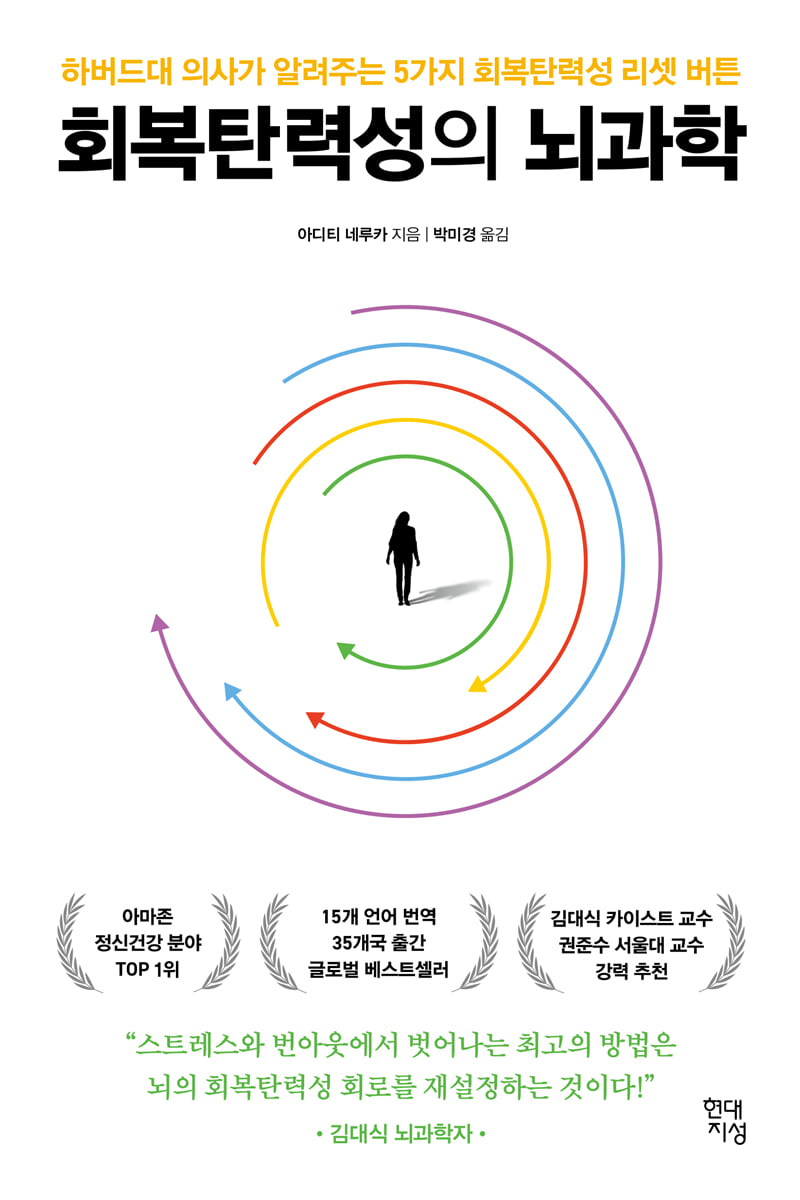
The Neuroscience of Resilience
 |
Description
Book Introduction
With 5 scientifically proven reset buttons
Train your brain's latent resilience muscles.
“The best way to escape from stress and burnout is
“It’s about resetting the brain’s resilience circuits!”
Kim Dae-sik | Neuroscientist, KAIST Professor
★ #1 in the Amazon Mental Health category, a bestseller published in 35 countries
★ Strongly recommended by Professor Kim Dae-sik of KAIST and Professor Kwon Jun-soo of Seoul National University
★ Adam Grant and Malcolm Gladwell's 'Next Big Idea Club': A Must-Read
We live in a 'stress pandemic'.
In modern society, stress is rampant like an epidemic.
We live fiercely at work, school, and home, but our lives are not improving and the future is uncertain.
I try to push myself and live harder, but I don't have the time to take care of my depleted body and mind.
Even today, we are still unable to escape the shackles of anxiety, burnout, depression, and sleep disorders.
Before becoming a mental health specialist at Harvard University, Dr. Neruka was also a patient suffering from extreme stress.
I went to the hospital, but the doctor only told me to “rest a little more.”
This led her to study the effects of stress on the brain and body, and after discovering ways to reduce stress and increase resilience, she became a doctor who helps people going through difficult times like her.
This book does not simply view stress as the root of all evil that must be eliminated.
Rather, they argue that healthy stress is a natural biological phenomenon and a potential energy source that can enhance resilience.
Based on this, and drawing on the latest scientific research and clinical experience, including neuroscience, we propose five reset buttons and 15 practical techniques to improve your relationship with stress, restore your body's balance, and strengthen your brain's resilience circuits.
The author has personally witnessed thousands of patients transformed by this technique.
What more convincing proof could there be? I hope you'll join me in this success story.
Train your brain's latent resilience muscles.
“The best way to escape from stress and burnout is
“It’s about resetting the brain’s resilience circuits!”
Kim Dae-sik | Neuroscientist, KAIST Professor
★ #1 in the Amazon Mental Health category, a bestseller published in 35 countries
★ Strongly recommended by Professor Kim Dae-sik of KAIST and Professor Kwon Jun-soo of Seoul National University
★ Adam Grant and Malcolm Gladwell's 'Next Big Idea Club': A Must-Read
We live in a 'stress pandemic'.
In modern society, stress is rampant like an epidemic.
We live fiercely at work, school, and home, but our lives are not improving and the future is uncertain.
I try to push myself and live harder, but I don't have the time to take care of my depleted body and mind.
Even today, we are still unable to escape the shackles of anxiety, burnout, depression, and sleep disorders.
Before becoming a mental health specialist at Harvard University, Dr. Neruka was also a patient suffering from extreme stress.
I went to the hospital, but the doctor only told me to “rest a little more.”
This led her to study the effects of stress on the brain and body, and after discovering ways to reduce stress and increase resilience, she became a doctor who helps people going through difficult times like her.
This book does not simply view stress as the root of all evil that must be eliminated.
Rather, they argue that healthy stress is a natural biological phenomenon and a potential energy source that can enhance resilience.
Based on this, and drawing on the latest scientific research and clinical experience, including neuroscience, we propose five reset buttons and 15 practical techniques to improve your relationship with stress, restore your body's balance, and strengthen your brain's resilience circuits.
The author has personally witnessed thousands of patients transformed by this technique.
What more convincing proof could there be? I hope you'll join me in this success story.
- You can preview some of the book's contents.
Preview
index
Recommendation
Introduction
Chapter 1: How to Reduce Stress and Increase Resilience?
Chapter 2 How does the brain perceive stress?
Chapter 3: The First Resilience Reset Button:
Be clear about what's most important
Chapter 4: The Second Resilience Reset Button:
Find peace in a noisy world
Chapter 5: The Third Resilience Reset Button:
Synchronize your brain and body
Chapter 6: The Fourth Resilience Reset Button:
Give your brain a rest
Chapter 7: The Fifth Resilience Reset Button:
Bring your best self to the forefront
Chapter 8 Fast Track
Acknowledgements
main
Introduction
Chapter 1: How to Reduce Stress and Increase Resilience?
Chapter 2 How does the brain perceive stress?
Chapter 3: The First Resilience Reset Button:
Be clear about what's most important
Chapter 4: The Second Resilience Reset Button:
Find peace in a noisy world
Chapter 5: The Third Resilience Reset Button:
Synchronize your brain and body
Chapter 6: The Fourth Resilience Reset Button:
Give your brain a rest
Chapter 7: The Fifth Resilience Reset Button:
Bring your best self to the forefront
Chapter 8 Fast Track
Acknowledgements
main
Detailed image

Into the book
Resilience can be defined as “the ability to cope with shock and continue to function in much the same way as before.”
This is a healthy biological phenomenon.
However, it is sometimes confused with toxic resilience.
This is a distorted view of this definition, and often leads to unhealthy behaviors such as pushing boundaries, blindly increasing productivity, and rushing into anything with the mindset that it's up to you.
It's the Energizer Bunny mentality of constantly banging on the drum, which can eventually get you into trouble.
Modern society is built on this toxic resilience.
When I was a child, I was rewarded for being alert and focused in school.
As an adult, you have to do that anytime, anywhere.
Whether it's caring for children at home, caring for parents, earning money at work, or participating in community activities.
--- p.44
Before the discovery of neuroplasticity, the scientific community initially believed that the brain remained the same throughout life.
Yes, I thought it was completely dependent on luck.
But new brain imaging techniques like functional magnetic resonance imaging (fMRI) and electroencephalography (EEG) are showing that brain structures, cells, and connections can increase or decrease based on your actions.
Neuroplasticity gives you the ability to rewire your brain.
As you gradually train your brain to reduce stress and increase resilience, keep in mind what I call the "Resilience Rule of 2."
Your brain is a muscle, just like your biceps.
You wouldn't try to lift a 50-kilogram barbell without training properly.
Your brain also needs to be rewired through gradual training.
Strengthening neurons also requires practice.
--- p.75
The most powerful aspect of the relationship between stress and resilience is that if the brain can learn to experience less stress, it can also learn to build more resilience.
Resilience is an innate quality, but it can be strengthened with time, patience, and practice.
Just like when you first learn to swim, you might feel a bit anxious and awkward at first, but surprisingly, healthy stress is necessary to develop resilience.
Healthy stress pushes you to the edge of the pool like a swimming instructor, while resilience flails your arms and legs to keep your head above water.
If you persevere and endure for a while, even when healthy stress challenges you, you will move forward with both arms swinging strongly.
--- p.88~89
When you're stressed, your adrenal glands (located just above your kidneys) receive signals from your pituitary gland to produce cortisol.
Cortisol is released into the bloodstream, quickly activating the brain's fight-or-flight response.
And it has been active throughout half of human history.
Early humans were able to run away from various dangers, such as a charging tiger, thanks to cortisol.
Cortisol signals your heart to pump blood more quickly to the large muscles of your body (like your leg muscles) and mobilize stored glucose to help activate those large muscles.
It is a survival hormone that helps you run away quickly or fight off the danger you face.
For our early ancestors, once the danger was over, extreme stress subsided and cortisol levels returned to normal.
A unique problem in modern society is that much of the stress is chronic rather than acute.
So it doesn't disappear and continues to accumulate.
Cortisol, like the amygdala, has not evolved with the times.
You can't tell if you're stressed about finances or if you're being chased by a tiger.
Chronic stress causes cortisol to keep secreting, constantly buzzing.
--- p.168
Brain connections may influence stress.
Because the gut and brain are closely connected through two-way information channels.
Because the gut is so sensitive to emotional states, scientists sometimes call it the "second brain."
The gut is home to the second largest number of nerve cells, or neurons, after the brain.
The brain sends 'downward' signals to the gut, and the gut sends 'upward' signals to the brain, a process called 'cross talk.'
The gut-brain crosstalk acts as a telephone switchboard, connecting the brain and gut, and influences a range of physical and mental health conditions, from diabetes to Parkinson's disease, anxiety and depression.
As it turns out, cross-brain communication can also influence stress responses.
--- p.242
Monotasking through time blocks is an effective strategy for overcoming stress and burnout because it supports the brain's need for compartmentalization.
No event has highlighted the need for brain compartmentalization more than the COVID-19 pandemic.
…when we can set clear physical boundaries for different roles, we have a better chance of functioning properly in each role.
In different fields, you demonstrate different skills and characteristics.
But if you have to perform at your best in each role while being crowded with other people in a cramped space, you won't be able to perform any role properly.
Just as your brain is optimized for monotasking rather than multitasking, you too can perform at your best, leading to greater achievement and productivity, when you're not forced to perform multiple roles simultaneously.
--- p.282~283
The language of gratitude powerfully blocks stress pathways in the brain.
Gratitude has been shown to reduce stress, improve mood, and increase resilience and life satisfaction.
In one study, gratitude was found to be effective in preventing depression and physical symptoms during a stressful event.
In another study, gratitude reduced stress levels within a month.
Gratitude can also help rewire brain circuits to respond to negative experiences.
Because such experiences slide off like Teflon coating instead of sticking to you like Velcro tape.
This process is known as cognitive reframing, which means that the area you focus on grows.
--- p.305~306
My role in treating patients is to help them discover their innate resilience, optimism, and happiness.
Whether the patient sitting before me is suffering from complications of terminal cancer, chronic pain, or facing life's struggles and adversities, learning to live a full life in one day is one of the principles I most universally recommend.
Living a lifetime in a day doesn't simply mean taking the approach of making the most of every 24 hours.
Rather, it means slowing down as an antidote to hustle culture.
For example, it is about integrating the six elements that make up a long and meaningful life trajectory—childhood, work, vacation, community, solitude, and retirement—into “one day.”
By practicing how to live a lifetime in one day, you can gradually redefine your sense of time, your most precious and enduring asset, in a new and warm way.
If you lived your entire life in one day, you would be gifted with a sense of fulfillment at the end of each day.
This is a healthy biological phenomenon.
However, it is sometimes confused with toxic resilience.
This is a distorted view of this definition, and often leads to unhealthy behaviors such as pushing boundaries, blindly increasing productivity, and rushing into anything with the mindset that it's up to you.
It's the Energizer Bunny mentality of constantly banging on the drum, which can eventually get you into trouble.
Modern society is built on this toxic resilience.
When I was a child, I was rewarded for being alert and focused in school.
As an adult, you have to do that anytime, anywhere.
Whether it's caring for children at home, caring for parents, earning money at work, or participating in community activities.
--- p.44
Before the discovery of neuroplasticity, the scientific community initially believed that the brain remained the same throughout life.
Yes, I thought it was completely dependent on luck.
But new brain imaging techniques like functional magnetic resonance imaging (fMRI) and electroencephalography (EEG) are showing that brain structures, cells, and connections can increase or decrease based on your actions.
Neuroplasticity gives you the ability to rewire your brain.
As you gradually train your brain to reduce stress and increase resilience, keep in mind what I call the "Resilience Rule of 2."
Your brain is a muscle, just like your biceps.
You wouldn't try to lift a 50-kilogram barbell without training properly.
Your brain also needs to be rewired through gradual training.
Strengthening neurons also requires practice.
--- p.75
The most powerful aspect of the relationship between stress and resilience is that if the brain can learn to experience less stress, it can also learn to build more resilience.
Resilience is an innate quality, but it can be strengthened with time, patience, and practice.
Just like when you first learn to swim, you might feel a bit anxious and awkward at first, but surprisingly, healthy stress is necessary to develop resilience.
Healthy stress pushes you to the edge of the pool like a swimming instructor, while resilience flails your arms and legs to keep your head above water.
If you persevere and endure for a while, even when healthy stress challenges you, you will move forward with both arms swinging strongly.
--- p.88~89
When you're stressed, your adrenal glands (located just above your kidneys) receive signals from your pituitary gland to produce cortisol.
Cortisol is released into the bloodstream, quickly activating the brain's fight-or-flight response.
And it has been active throughout half of human history.
Early humans were able to run away from various dangers, such as a charging tiger, thanks to cortisol.
Cortisol signals your heart to pump blood more quickly to the large muscles of your body (like your leg muscles) and mobilize stored glucose to help activate those large muscles.
It is a survival hormone that helps you run away quickly or fight off the danger you face.
For our early ancestors, once the danger was over, extreme stress subsided and cortisol levels returned to normal.
A unique problem in modern society is that much of the stress is chronic rather than acute.
So it doesn't disappear and continues to accumulate.
Cortisol, like the amygdala, has not evolved with the times.
You can't tell if you're stressed about finances or if you're being chased by a tiger.
Chronic stress causes cortisol to keep secreting, constantly buzzing.
--- p.168
Brain connections may influence stress.
Because the gut and brain are closely connected through two-way information channels.
Because the gut is so sensitive to emotional states, scientists sometimes call it the "second brain."
The gut is home to the second largest number of nerve cells, or neurons, after the brain.
The brain sends 'downward' signals to the gut, and the gut sends 'upward' signals to the brain, a process called 'cross talk.'
The gut-brain crosstalk acts as a telephone switchboard, connecting the brain and gut, and influences a range of physical and mental health conditions, from diabetes to Parkinson's disease, anxiety and depression.
As it turns out, cross-brain communication can also influence stress responses.
--- p.242
Monotasking through time blocks is an effective strategy for overcoming stress and burnout because it supports the brain's need for compartmentalization.
No event has highlighted the need for brain compartmentalization more than the COVID-19 pandemic.
…when we can set clear physical boundaries for different roles, we have a better chance of functioning properly in each role.
In different fields, you demonstrate different skills and characteristics.
But if you have to perform at your best in each role while being crowded with other people in a cramped space, you won't be able to perform any role properly.
Just as your brain is optimized for monotasking rather than multitasking, you too can perform at your best, leading to greater achievement and productivity, when you're not forced to perform multiple roles simultaneously.
--- p.282~283
The language of gratitude powerfully blocks stress pathways in the brain.
Gratitude has been shown to reduce stress, improve mood, and increase resilience and life satisfaction.
In one study, gratitude was found to be effective in preventing depression and physical symptoms during a stressful event.
In another study, gratitude reduced stress levels within a month.
Gratitude can also help rewire brain circuits to respond to negative experiences.
Because such experiences slide off like Teflon coating instead of sticking to you like Velcro tape.
This process is known as cognitive reframing, which means that the area you focus on grows.
--- p.305~306
My role in treating patients is to help them discover their innate resilience, optimism, and happiness.
Whether the patient sitting before me is suffering from complications of terminal cancer, chronic pain, or facing life's struggles and adversities, learning to live a full life in one day is one of the principles I most universally recommend.
Living a lifetime in a day doesn't simply mean taking the approach of making the most of every 24 hours.
Rather, it means slowing down as an antidote to hustle culture.
For example, it is about integrating the six elements that make up a long and meaningful life trajectory—childhood, work, vacation, community, solitude, and retirement—into “one day.”
By practicing how to live a lifetime in one day, you can gradually redefine your sense of time, your most precious and enduring asset, in a new and warm way.
If you lived your entire life in one day, you would be gifted with a sense of fulfillment at the end of each day.
--- p.319
Publisher's Review
Stress Pandemic
red light that never goes out
Although the COVID-19 pandemic has long since passed, the "stress pandemic" remains with us.
In modern society, stress is rampant like an epidemic.
According to a 2025 survey of 1,500 Korean adults conducted by the Seoul National University Graduate School of Public Health, more than half (54.9%) responded that they had experienced severe stress in the past year.
The red light for mental health is not going off.
We live fiercely at work, at school, and at home, but life is not getting better, and the future remains uncertain.
I try to push myself and live harder, but I don't have the time to take care of my depleted body and mind.
Not only individual daily lives, but also unstable social environments such as economic crises, crime crises, disaster crises, and climate crises are causes of stress pandemics.
Even today, we are still trapped in the cycle of anxiety, burnout, depression, and sleep disorders.
“Please rest more comfortably.”
The only cure for stress?
Dr. Neruka, author of "The Neuroscience of Resilience," was also a patient suffering from extreme stress before becoming a mental health specialist at Harvard University.
While working as a resident at a hospital, I felt a sensation in my chest, as if a wild horse was running wild.
The heart palpitations did not improve at all, and the cause was stress from excessive work.
I went to the hospital, but the doctor only told me to “rest a little more.”
In fact, it is said that 60 to 80 percent of patients who visit hospitals show stress-related factors, but only 3 percent of doctors provide advice on stress management.
Dr. Neruka tried to relax and rest as prescribed by the doctor, but it had no effect.
Then, by chance, I discovered yoga, breathing techniques, and mind-body connection, and as I started practicing them, my heart palpitations began to improve.
This remarkable experience led her to begin studying the effects of stress on the brain and body.
After discovering ways to reduce stress and increase resilience, she became a doctor, helping people going through difficult times in their lives like she did.
'Two Principles of Resilience'
Strengthening the brain's resilience muscles
This book does not simply view stress as the root of all evil that must be eliminated.
Rather, they argue that healthy stress is a natural biological phenomenon and a potential energy source that can enhance resilience.
Based on this, and based on the latest scientific research and clinical experience, including neuroscience, we propose five reset buttons that will improve your relationship with stress, restore your body's balance, and strengthen the brain's resilience circuits.
1: Clarify what matters most, 2: Find calm in a noisy world, 3: Synchronize your brain and body, 4: Give your brain a rest, 5: Bring your best self to the forefront.
These 15 practical techniques to put these five resilience reset buttons into practice are simple and easy for anyone to follow.
Stress begins in the hippocampus, the brain's center of learning and memory.
Stress is also a learned response, meaning it can be learned and restructured for the better.
The brain also has neuroplasticity, which makes it like a growing muscle.
Based on this neuroscientific evidence, we can gradually train our brains to reduce stress and increase resilience.
However, because the brain can perceive even positive changes as stress if they are excessive, it is advised to make only two changes in your life at a time.
These are the 'two principles of resilience'.
This simple change strategy can be put into practice today.
The author has personally witnessed thousands of patients transform using five reset buttons and 15 techniques.
What more convincing proof could there be? I hope you'll join me in this success story.
red light that never goes out
Although the COVID-19 pandemic has long since passed, the "stress pandemic" remains with us.
In modern society, stress is rampant like an epidemic.
According to a 2025 survey of 1,500 Korean adults conducted by the Seoul National University Graduate School of Public Health, more than half (54.9%) responded that they had experienced severe stress in the past year.
The red light for mental health is not going off.
We live fiercely at work, at school, and at home, but life is not getting better, and the future remains uncertain.
I try to push myself and live harder, but I don't have the time to take care of my depleted body and mind.
Not only individual daily lives, but also unstable social environments such as economic crises, crime crises, disaster crises, and climate crises are causes of stress pandemics.
Even today, we are still trapped in the cycle of anxiety, burnout, depression, and sleep disorders.
“Please rest more comfortably.”
The only cure for stress?
Dr. Neruka, author of "The Neuroscience of Resilience," was also a patient suffering from extreme stress before becoming a mental health specialist at Harvard University.
While working as a resident at a hospital, I felt a sensation in my chest, as if a wild horse was running wild.
The heart palpitations did not improve at all, and the cause was stress from excessive work.
I went to the hospital, but the doctor only told me to “rest a little more.”
In fact, it is said that 60 to 80 percent of patients who visit hospitals show stress-related factors, but only 3 percent of doctors provide advice on stress management.
Dr. Neruka tried to relax and rest as prescribed by the doctor, but it had no effect.
Then, by chance, I discovered yoga, breathing techniques, and mind-body connection, and as I started practicing them, my heart palpitations began to improve.
This remarkable experience led her to begin studying the effects of stress on the brain and body.
After discovering ways to reduce stress and increase resilience, she became a doctor, helping people going through difficult times in their lives like she did.
'Two Principles of Resilience'
Strengthening the brain's resilience muscles
This book does not simply view stress as the root of all evil that must be eliminated.
Rather, they argue that healthy stress is a natural biological phenomenon and a potential energy source that can enhance resilience.
Based on this, and based on the latest scientific research and clinical experience, including neuroscience, we propose five reset buttons that will improve your relationship with stress, restore your body's balance, and strengthen the brain's resilience circuits.
1: Clarify what matters most, 2: Find calm in a noisy world, 3: Synchronize your brain and body, 4: Give your brain a rest, 5: Bring your best self to the forefront.
These 15 practical techniques to put these five resilience reset buttons into practice are simple and easy for anyone to follow.
Stress begins in the hippocampus, the brain's center of learning and memory.
Stress is also a learned response, meaning it can be learned and restructured for the better.
The brain also has neuroplasticity, which makes it like a growing muscle.
Based on this neuroscientific evidence, we can gradually train our brains to reduce stress and increase resilience.
However, because the brain can perceive even positive changes as stress if they are excessive, it is advised to make only two changes in your life at a time.
These are the 'two principles of resilience'.
This simple change strategy can be put into practice today.
The author has personally witnessed thousands of patients transform using five reset buttons and 15 techniques.
What more convincing proof could there be? I hope you'll join me in this success story.
GOODS SPECIFICS
- Date of issue: May 22, 2025
- Page count, weight, size: 376 pages | 488g | 140*210*24mm
- ISBN13: 9791139723281
- ISBN10: 1139723286
You may also like
카테고리
korean


korean

![GQ KOREA Mark (Monthly): December [2025]](http://librairie.coreenne.fr/cdn/shop/files/8ef265dbbfbf186523ed75ba7319009d.jpg?v=1765340328&width=3840)


