

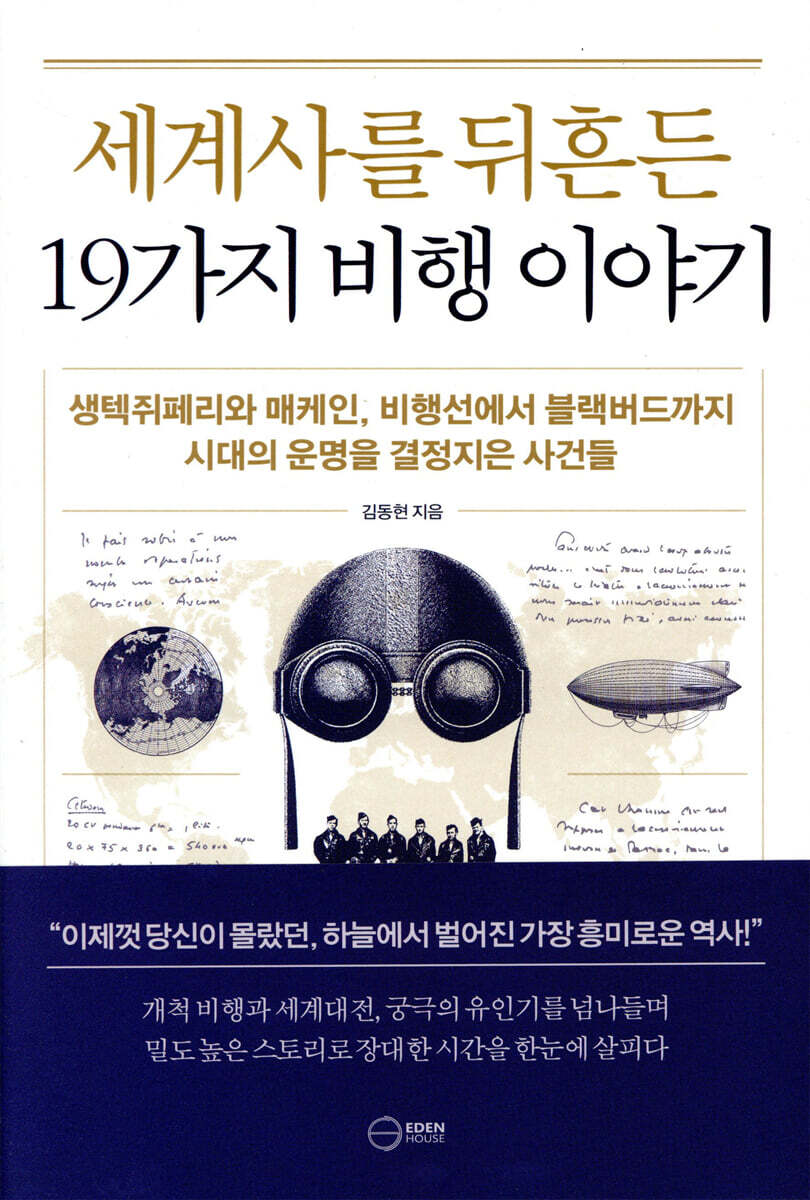
19 Flight Stories That Shook the World
 |
Description
Book Introduction
- A word from MD
-
Airplanes have always been a part of modern and contemporary history.As humans began to fly, desires turned into greed and caused wars.
Soon, the history of flight became world history.
The history of the sky, which transcends time and space, and the stories of the people who once lived within it, will serve as a ticket to a new dimension of history, broadening the reader's horizons.
August 2, 2022. Humanities PD Ahn Hyun-jae
"The most vivid flight story, written by a current captain, is back!"
Discover the wondrous history of aviation unfolding at a turning point in history.
A single book, "19 Flight Stories That Shook the World"
"An aerial war launched by the soaring arrogance and greed of human beings,
And it contains the stories of the people who lived in that era"
"Airplanes have always been at the heart of interesting modern and contemporary history!"
This book, "19 Flight Stories That Shook the World," dynamically covers almost every story of flight in world history, from the era of propeller planes and airships that crossed the Atlantic, to the world wars created by human greed, and even the modern wars between Iran and the United States, compressing a wide range of history into a story of flight. It does not stop at describing history.
It vividly shows the other side of the lives of thirty-three people, from Latecoere, who pioneered airmail routes, to Saint-Exupéry, who loved flying, to Park Gyeong-won, a Korean woman who became a Japanese pilot, to Horikoshi Jiro, who created the Zero, a kamikaze plane, and even to politician John McCain.
Through their meticulously detailed stories, we not only learn about the consequences of individual choices that have changed over time, but also confront the question of whether every technological advancement involves hidden sacrifices.
This book, woven with clear sentences to the very end, poses yet another question about the complexly intertwined history of heaven, providing an opportunity to view the world from a three-dimensional perspective.
A single book that captures the world history of flight, a story no one has ever told before! "19 Flight Stories That Shook the World" will shake your worldview, challenging you to consider how history as we know it is nothing more than a homogenized and fragmented narrative.
Discover the wondrous history of aviation unfolding at a turning point in history.
A single book, "19 Flight Stories That Shook the World"
"An aerial war launched by the soaring arrogance and greed of human beings,
And it contains the stories of the people who lived in that era"
"Airplanes have always been at the heart of interesting modern and contemporary history!"
This book, "19 Flight Stories That Shook the World," dynamically covers almost every story of flight in world history, from the era of propeller planes and airships that crossed the Atlantic, to the world wars created by human greed, and even the modern wars between Iran and the United States, compressing a wide range of history into a story of flight. It does not stop at describing history.
It vividly shows the other side of the lives of thirty-three people, from Latecoere, who pioneered airmail routes, to Saint-Exupéry, who loved flying, to Park Gyeong-won, a Korean woman who became a Japanese pilot, to Horikoshi Jiro, who created the Zero, a kamikaze plane, and even to politician John McCain.
Through their meticulously detailed stories, we not only learn about the consequences of individual choices that have changed over time, but also confront the question of whether every technological advancement involves hidden sacrifices.
This book, woven with clear sentences to the very end, poses yet another question about the complexly intertwined history of heaven, providing an opportunity to view the world from a three-dimensional perspective.
A single book that captures the world history of flight, a story no one has ever told before! "19 Flight Stories That Shook the World" will shake your worldview, challenging you to consider how history as we know it is nothing more than a homogenized and fragmented narrative.
- You can preview some of the book's contents.
Preview
index
Prologue: Thirty-Three Lives That Wrote the 20th Century
Part 1: Pioneers of the Sky
Chapter 1: Led Zeppelin, Crossing the Atlantic
- The Atlantic Ocean, the Sea of Greed
- The first intercontinental passenger ship, Graf Zeppelin
- The end of the airship era
Chapter 2: From France to Chile: The Beginning of an Epic Journey
- Latecoere, the pioneer of airmail
- A reconnaissance aircraft that found an ultra-long-range gun
- Didier Dora, the cool-headed enthusiast
Chapter 3: The Little Prince Jumps into the Mediterranean
- A bohemian who admired pioneer pilots
- The source of inspiration, the Western Sahara Desert
- The writer sitting in the cockpit
- Pilot who flew to asteroid B-612
Chapter 4: The Pilot Who Flew to the End of the World
- Pioneer pilot Jean Mermoz
- Those who are true to their existence have nothing to fear.
- Croix du Sud, which disappeared as the Southern Cross
Chapter 5: Silent Air Battles Over the Atlantic
- Three pilots who crossed the Atlantic Ocean westward
- America for speed, Europe for range
- Dream of the setting sun of the British Empire
- The Boeing 707 that dominated the Atlantic
Discord with the second era
Chapter 6: The Colonial Pilot's Last Flight
- An airplane flying in the sky of Gyeongseong
- A colonial youth who became a pilot
- An unfulfilled dream, the Korean Liberation Army Flight School
Chapter 7: What if I were the flower of the empire, if only I could fly?
- I won't live like a cylinder.
- The compact pilot that captivated Koizumi
- There is no life free from the times.
Chapter 8: The Nakajima fighter that shot down a civilian aircraft
- The Quelinho crashed into the river
- American Captain Ignores Japan's Madness
Chapter 9 The Wind Never Stops
- The boy who couldn't become a pilot
- The Zero Sen, born for the dream of the empire
- The illusion of a kamikaze attack
Chapter 10: The Master of Crossing the Pacific
- Irresistible Force Little Boy
- “When the time had fully come, he sent his Son.”
- The Japanese Empire Awakens from a Dream
Part 3: On the Border Between Civilization and Barbarism
Chapter 11: Knight of the Sky, Pilot
- Airplanes transformed into weapons
- Their own rules, airmanship
- Dinner at the Grotley Hotel
Chapter 12: Nazi Air Force Escorts American Forces
- 'Yeold Pub' in Purple Heart Corner
- Do not shoot the escaping pilot.
- Honor of the Luftwaffe Pilots
Chapter 13: Hero of the Battlefield or Victim of Politics?
- The liberation wars of French Indochina and Vietnam
- Check-in at Hanoi Hilton
McCain refused to be released, Trump refused to be drafted.
Part 4: The 1 Percent Dream, the American Dream
Chapter 14: The Pilot Who Became a CIA Agent
- U-2 glider with jet engine
- Operation Grand Slam, which kicked away détente
To be or not to be, that is the question.
- The price of refusing a 'noble suicide'
Chapter 15: The MiG-25 Flying into the Capitalist World
- The ultimate airplane, the A-12 Blackbird
- A Soviet plane that dodges missiles
- You who have worked hard, go away.
Chapter 16: Pilots Who Carried Power and Money
- 'Death Flight' towards the Atlantic
- Civilian airline captain who transported CIA weapons
- $100 million in transportation costs, American Delivery pilot
- Louisiana court's proxy death sentence
Part 5: Capitalism Rules the Sky
Chapter 17: The Forbidden Sky
- Paul Bunyan, Cut Down the Poplar Tree
- UFO that invaded the skies above the Blue House
- Israeli fighter jet that shot down passenger plane
Chapter 18: The Origin of Tragedy
- Wall Street's Best Business
- The Middle East, the largest market for the U.S. defense industry
- Instinct for survival, fear
- The never-ending tragedy in Ukraine
- Airspace passage fee for the spring that never dries up
Chapter 19: The Sky Has No Boundaries
- Behead Qasem Soleimani
- Passenger plane sacrificed in bloody revenge
- Flight as a purpose
Epilogue_Souls On Board
Part 1: Pioneers of the Sky
Chapter 1: Led Zeppelin, Crossing the Atlantic
- The Atlantic Ocean, the Sea of Greed
- The first intercontinental passenger ship, Graf Zeppelin
- The end of the airship era
Chapter 2: From France to Chile: The Beginning of an Epic Journey
- Latecoere, the pioneer of airmail
- A reconnaissance aircraft that found an ultra-long-range gun
- Didier Dora, the cool-headed enthusiast
Chapter 3: The Little Prince Jumps into the Mediterranean
- A bohemian who admired pioneer pilots
- The source of inspiration, the Western Sahara Desert
- The writer sitting in the cockpit
- Pilot who flew to asteroid B-612
Chapter 4: The Pilot Who Flew to the End of the World
- Pioneer pilot Jean Mermoz
- Those who are true to their existence have nothing to fear.
- Croix du Sud, which disappeared as the Southern Cross
Chapter 5: Silent Air Battles Over the Atlantic
- Three pilots who crossed the Atlantic Ocean westward
- America for speed, Europe for range
- Dream of the setting sun of the British Empire
- The Boeing 707 that dominated the Atlantic
Discord with the second era
Chapter 6: The Colonial Pilot's Last Flight
- An airplane flying in the sky of Gyeongseong
- A colonial youth who became a pilot
- An unfulfilled dream, the Korean Liberation Army Flight School
Chapter 7: What if I were the flower of the empire, if only I could fly?
- I won't live like a cylinder.
- The compact pilot that captivated Koizumi
- There is no life free from the times.
Chapter 8: The Nakajima fighter that shot down a civilian aircraft
- The Quelinho crashed into the river
- American Captain Ignores Japan's Madness
Chapter 9 The Wind Never Stops
- The boy who couldn't become a pilot
- The Zero Sen, born for the dream of the empire
- The illusion of a kamikaze attack
Chapter 10: The Master of Crossing the Pacific
- Irresistible Force Little Boy
- “When the time had fully come, he sent his Son.”
- The Japanese Empire Awakens from a Dream
Part 3: On the Border Between Civilization and Barbarism
Chapter 11: Knight of the Sky, Pilot
- Airplanes transformed into weapons
- Their own rules, airmanship
- Dinner at the Grotley Hotel
Chapter 12: Nazi Air Force Escorts American Forces
- 'Yeold Pub' in Purple Heart Corner
- Do not shoot the escaping pilot.
- Honor of the Luftwaffe Pilots
Chapter 13: Hero of the Battlefield or Victim of Politics?
- The liberation wars of French Indochina and Vietnam
- Check-in at Hanoi Hilton
McCain refused to be released, Trump refused to be drafted.
Part 4: The 1 Percent Dream, the American Dream
Chapter 14: The Pilot Who Became a CIA Agent
- U-2 glider with jet engine
- Operation Grand Slam, which kicked away détente
To be or not to be, that is the question.
- The price of refusing a 'noble suicide'
Chapter 15: The MiG-25 Flying into the Capitalist World
- The ultimate airplane, the A-12 Blackbird
- A Soviet plane that dodges missiles
- You who have worked hard, go away.
Chapter 16: Pilots Who Carried Power and Money
- 'Death Flight' towards the Atlantic
- Civilian airline captain who transported CIA weapons
- $100 million in transportation costs, American Delivery pilot
- Louisiana court's proxy death sentence
Part 5: Capitalism Rules the Sky
Chapter 17: The Forbidden Sky
- Paul Bunyan, Cut Down the Poplar Tree
- UFO that invaded the skies above the Blue House
- Israeli fighter jet that shot down passenger plane
Chapter 18: The Origin of Tragedy
- Wall Street's Best Business
- The Middle East, the largest market for the U.S. defense industry
- Instinct for survival, fear
- The never-ending tragedy in Ukraine
- Airspace passage fee for the spring that never dries up
Chapter 19: The Sky Has No Boundaries
- Behead Qasem Soleimani
- Passenger plane sacrificed in bloody revenge
- Flight as a purpose
Epilogue_Souls On Board
Detailed image

Into the book
Most of the historical common sense we have about familiar events that represent modern and contemporary history is snapshots taken by Westerners, the victors of the 20th century.
In fact, the inner workings of history are so complexly intertwined with specific events that they cannot be judged by common sense.
If we do not acknowledge the diversity and subjectivity of interpretation of those who have lived on the site of history, we will not be able to take even one step into its depths.
In this book, rather than listing historical events or providing a one-sided interpretation, I sought to take a close look at the people who lived through that era.
As my field is aviation and navigation systems, the content presented in this book also focuses on the history of the skies throughout the 20th century.
From the Zeppelin, the first airship in human history, to the Potez 25, the protagonist of Southern Mail and Night Flight, to the pilots who became kamikaze pilots in Zero fighters, the "hero" of the Vietnam War, John McCain, and even the CIA pilots who transported drugs for South American cartels, I wanted to look back with readers on the other side of this world that has become so familiar to them.
--- p.6~7
The American colonies of the 19th century were a vast laboratory for sophisticated science and technology targeting humans.
European scholars experimented on Native Americans with new technologies affecting almost every aspect of human health, from simple pesticides and fertilizers to vaccines and contraceptives.
The high level of scientific and technological prowess accumulated through extensive human experimentation that could never have been approved in Europe became the source of power that made the 20th century the European era.
Ships from America to Europe always carried tens of thousands of research items, specimens, and letters sent home by Europeans.
Just over a decade after the invention of the airplane, the French government was receiving mail from its African colonies in just one day, instead of the usual two weeks it took by train.
If only it were possible to cross the Atlantic by airplane, mail to the American colonies, which used to take two months, could arrive in two days.
Airmail was a revolutionary means of transportation for quickly exchanging not only government documents but also time-sensitive documents such as checks and contracts.
--- p.39~40
Before the outbreak of World War I, very few Europeans had actually flown on an airplane.
At that time, flying was freedom itself and romantic.
The young pilots of Latécoère, brimming with passion for flying, stayed up every night at their Toulouse hotel telling stories of their thrilling flights between the vast desert and jagged mountain peaks.
Not only the guests but also the hotel staff were so absorbed in the pilots' heroics that they forgot to charge for dinner.
Saint-Exupéry wanted to join Latecoere Airlines.
He wrote a letter to Latecoere, describing the circumstances of the crash at the Louvre as an incident born of his passion for flying, and expressed his interest in joining the company.
Intrigued by his letter, Latecoere instructed Dora to meet Saint-Exupéry.
Dora felt a strange attraction to Saint-Exupéry's quiet voice and serious demeanor.
Although his imagination seemed overly rich, it was not a major flaw that could justify refusing the request of his boss, Latecoere.
Dora, who sent Saint-Exupéry to the garage, carefully observed his working attitude.
--- p.53~54
Even Junkers, who seemed poised to dominate the skies of the world at any moment, could not escape the times.
The Nazis, who came to power in 1933, asked Junkers to develop military aircraft.
Junkers refused to allow his planes to be used as instruments of war.
The Nazis placed Junkers under house arrest and announced that he had resigned from the company to devote himself to research.
Two years later, Goebbels visited Junkers again at his home on his 76th birthday and persuaded him to join him in building a new homeland.
Junkers again refused the Nazi demands.
After Goebbels' visit, Junkers died at home.
The exact cause of death is unknown.
The Nazis kept Junkers' resistance against them a secret and gave him a state funeral.
--- p.94~95
On November 24th, the day Mary arrived in Tokyo, Japan decided to send a female pilot to welcome Mary in the skies over Tokyo.
It was to show that Japan's aviation skills were no less advanced than those of the West.
The female pilot of the Welcome Flight was Park Kyung-won, Japan's only second-class female pilot.
Park Kyung-won guided Mary into Japanese airspace and landed alongside her at Haneda Airport.
At the welcoming ceremony, the tall Park Kyung-won confidently took a commemorative photo with a British woman, completely capturing the hearts of the Japanese, who had an inferiority complex toward Europeans.
The newspaper article reporting Mary's welcome ceremony the next day omitted the adjective "from the peninsula," which always followed Park Kyung-won.
Park Kyung-won was already Japan's greatest new woman.
--- p.135
In the early days of the kamikaze attacks, the US military believed that planes with malfunctioning engines had accidentally rammed ships.
However, the United States soon learned that the Japanese military was carrying out suicide bombings and became disgusted with the Japanese imperial leadership.
In the United States, there were even claims that Japan should be eliminated altogether rather than demanded to surrender.
The success rate of kamikaze attacks was extremely low.
Carrying a heavy bomb and diving at top speed to accurately hit the engine room of a battleship is a maneuver as difficult as dropping a flagpole from the roof of a 20-story apartment building and hitting a baseball on the ground.
It was impossible from the beginning for novice pilots who had barely learned the technique of flying an airplane to accurately crash into the engine room of an enemy ship under extreme fear and stress.
--- p.163
Little Boy, based on enriched uranium, was a physically unstable bomb.
Because there was an incident where a B-29 training with the same weight failed to take off, the United States was very anxious that the plane might crash during takeoff and cause an atomic bomb to explode at the Tinian base.
Colonel William Parsons, commander of the 509th Fighter Wing, decided to disassemble Little Boy, load it onto the Enola Gay, and then fly to the Japanese mainland to climb into the bomb bay and assemble Little Boy himself.
The telegram that the judge was going to work was a code word that Colonel Parsons had begun assembling the atomic bomb.
Enola Gay's destination was Hiroshima, Japan.
While the US military bombed major cities on the Japanese mainland, it left Hiroshima, which served as a military supply depot for the Japanese army, completely untouched.
There were even rumors that President Truman's mother was being held captive in Hiroshima, but in reality, Hiroshima was left intact to test the power of Little Boy.
--- p.173
It was Partridge who found out Showpiece's contact information through the Luftwaffe Veterans Association in Germany.
On the day Partridge visited Munich, Showpiece went to the airport with his wife to greet Partridge.
They lived like brothers for the rest of their lives, commuting between their homes in Munich and London, until Partridge's death in 1990.
A person's character and value are not represented by his or her occupation.
Showpiece and Partridge did not confuse the duties of a soldier with his personality as a natural man.
It was a Royal Flying Corps captain and a Luftwaffe lieutenant who fired at each other from the sky, but it was natural people Partridge and Showpiece who met and held each other's hands in the frozen snow.
--- p.206
Politician McCain has been a lifelong opponent of fellow Republican Donald Trump.
When Trump ran for the Republican presidential nomination, McCain was his most outspoken critic.
In fact, the personalities of the two people are very similar.
McCain and Trump faced expulsion from the Naval Academy and New York Military Academy, respectively, due to their rough and arrogant behavior, but both graduated safely thanks to the protection of their backgrounds.
However, the two people's values and behaviors towards life were completely different.
During the five and a half years that McCain was held captive in Vietnam, Trump avoided deployment to Vietnam by avoiding the draft four times, attending Fordham University and Wharton School.
While Trump was buying a run-down Manhattan hotel and undertaking a renovation project, McCain was on the brink of death in the Hoa Lo prison camp.
Although the Viet Minh arranged for meetings with French politicians, McCain refused any meetings, fearing that he would be used as a political propaganda tool.
Trump, the 2016 Republican presidential nominee, disagreed with calling McCain a war hero, saying, "He's called a war hero because he was a prisoner of war.
“I like people who don’t take prisoners,” he taunted.
--- p.232
The United States and Israel again waited for the MiG-25 to appear in the Sinai Peninsula.
As soon as the MiG-25 was detected on radar, Israel immediately launched an interceptor missile.
However, the MiG-25's explosive acceleration allowed it to dodge the missile in the blink of an eye.
The United States believed that the Soviet Union had finally developed a fighter plane capable of penetrating American air defenses.
It was a time when false alarms were sounding at the White House and the Kremlin several times a month, warning that the other side had launched a nuclear missile.
What if a MiG-25 were to penetrate US air defenses and drop nuclear missiles on Washington? The US believed the MiG-25 could even intercept a Blackbird.
The Pentagon was put on high alert when a White House Security Council meeting concluded that there was no air defense system capable of stopping the MiG-25.
On September 6, 1976, an earth-shattering explosion rang out over Hakodate, Hokkaido.
A moment later, a huge jet plane, the likes of which no one had ever seen before, appeared from the clouds.
The tail was clearly marked with a red star symbolizing the Soviet Union.
It was a MiG-25.
The pilot who flew the fighter was 29-year-old Soviet Air Force Lieutenant Viktor Ivanovich Belenko.
The Soviet secret fighter plane that the United States so feared flew into the West on its own two feet.
--- p.258~259
North Korea was greatly embarrassed when it confirmed that the B-52 had entered the airspace over the Korean Peninsula.
The B52 was a high-altitude strategic bomber developed by the United States for nuclear air strikes to immediately paralyze the Soviet Union in the event of an emergency.
The deployment of the B-52 meant that the retaliatory operation planned by the United States was not a simple show of force, but was considering all-out war.
North Korea urgently requested assistance from the Soviet Union, but Brezhnev refused Kim Il-sung's visit to Moscow.
Even Mao Zedong, who was appalled by North Korea's act of murdering an American officer with an axe, did not even issue a formal message of support for North Korea.
When China and the Soviet Union made it clear that they would not intervene in the US retaliatory operation, North Korea issued a quasi-war alert to its entire military and prepared for any eventuality.
The United States sent an ultimatum through China, warning that “if North Korea responds even slightly to Operation Paul Bunyan, it will face an irreversible situation.”
--- p.297~298
The news that the US Navy had shot down a passenger plane shocked the world.
As international criticism mounted, the United States backed down, saying the Vincennes' crew had made a mistake by misreading data from the Aegis radar while extremely tense.
The crew, trained to launch a preemptive strike against enemy air raids, selectively received only information about the plane's descent.
But soon even this was revealed to be a false excuse.
Radar data from the Vincennes showed that Iran Air Flight 655 was not descending, but rather ascending, and even had the transponder identification code IRA655 recorded.
The US explanation that the Vincennes' crew misinterpreted all this obvious information and fired the missiles was too narrow.
--- p.323
In a country at war, the annual airspace passage fee, which runs into the hundreds of billions of won, is a temptation that is hard to resist.
Airlines also do not abandon direct routes unless a direct threat is confirmed.
Even on the day Malaysia Airlines Flight 017 was hit by a missile and shot down, 37 so-called advanced airlines from around the world were flying the Donetsk route.
Civilian aircraft are shot down by missiles not because of technical problems, but because of fear.
The crews who fired missiles at the passenger plane all fired their missiles as soon as the aircraft was detected on radar, fearing an imminent retaliatory attack.
There is nothing more futile than trying to force logic and reason on people who are facing the fear of death.
In fact, the inner workings of history are so complexly intertwined with specific events that they cannot be judged by common sense.
If we do not acknowledge the diversity and subjectivity of interpretation of those who have lived on the site of history, we will not be able to take even one step into its depths.
In this book, rather than listing historical events or providing a one-sided interpretation, I sought to take a close look at the people who lived through that era.
As my field is aviation and navigation systems, the content presented in this book also focuses on the history of the skies throughout the 20th century.
From the Zeppelin, the first airship in human history, to the Potez 25, the protagonist of Southern Mail and Night Flight, to the pilots who became kamikaze pilots in Zero fighters, the "hero" of the Vietnam War, John McCain, and even the CIA pilots who transported drugs for South American cartels, I wanted to look back with readers on the other side of this world that has become so familiar to them.
--- p.6~7
The American colonies of the 19th century were a vast laboratory for sophisticated science and technology targeting humans.
European scholars experimented on Native Americans with new technologies affecting almost every aspect of human health, from simple pesticides and fertilizers to vaccines and contraceptives.
The high level of scientific and technological prowess accumulated through extensive human experimentation that could never have been approved in Europe became the source of power that made the 20th century the European era.
Ships from America to Europe always carried tens of thousands of research items, specimens, and letters sent home by Europeans.
Just over a decade after the invention of the airplane, the French government was receiving mail from its African colonies in just one day, instead of the usual two weeks it took by train.
If only it were possible to cross the Atlantic by airplane, mail to the American colonies, which used to take two months, could arrive in two days.
Airmail was a revolutionary means of transportation for quickly exchanging not only government documents but also time-sensitive documents such as checks and contracts.
--- p.39~40
Before the outbreak of World War I, very few Europeans had actually flown on an airplane.
At that time, flying was freedom itself and romantic.
The young pilots of Latécoère, brimming with passion for flying, stayed up every night at their Toulouse hotel telling stories of their thrilling flights between the vast desert and jagged mountain peaks.
Not only the guests but also the hotel staff were so absorbed in the pilots' heroics that they forgot to charge for dinner.
Saint-Exupéry wanted to join Latecoere Airlines.
He wrote a letter to Latecoere, describing the circumstances of the crash at the Louvre as an incident born of his passion for flying, and expressed his interest in joining the company.
Intrigued by his letter, Latecoere instructed Dora to meet Saint-Exupéry.
Dora felt a strange attraction to Saint-Exupéry's quiet voice and serious demeanor.
Although his imagination seemed overly rich, it was not a major flaw that could justify refusing the request of his boss, Latecoere.
Dora, who sent Saint-Exupéry to the garage, carefully observed his working attitude.
--- p.53~54
Even Junkers, who seemed poised to dominate the skies of the world at any moment, could not escape the times.
The Nazis, who came to power in 1933, asked Junkers to develop military aircraft.
Junkers refused to allow his planes to be used as instruments of war.
The Nazis placed Junkers under house arrest and announced that he had resigned from the company to devote himself to research.
Two years later, Goebbels visited Junkers again at his home on his 76th birthday and persuaded him to join him in building a new homeland.
Junkers again refused the Nazi demands.
After Goebbels' visit, Junkers died at home.
The exact cause of death is unknown.
The Nazis kept Junkers' resistance against them a secret and gave him a state funeral.
--- p.94~95
On November 24th, the day Mary arrived in Tokyo, Japan decided to send a female pilot to welcome Mary in the skies over Tokyo.
It was to show that Japan's aviation skills were no less advanced than those of the West.
The female pilot of the Welcome Flight was Park Kyung-won, Japan's only second-class female pilot.
Park Kyung-won guided Mary into Japanese airspace and landed alongside her at Haneda Airport.
At the welcoming ceremony, the tall Park Kyung-won confidently took a commemorative photo with a British woman, completely capturing the hearts of the Japanese, who had an inferiority complex toward Europeans.
The newspaper article reporting Mary's welcome ceremony the next day omitted the adjective "from the peninsula," which always followed Park Kyung-won.
Park Kyung-won was already Japan's greatest new woman.
--- p.135
In the early days of the kamikaze attacks, the US military believed that planes with malfunctioning engines had accidentally rammed ships.
However, the United States soon learned that the Japanese military was carrying out suicide bombings and became disgusted with the Japanese imperial leadership.
In the United States, there were even claims that Japan should be eliminated altogether rather than demanded to surrender.
The success rate of kamikaze attacks was extremely low.
Carrying a heavy bomb and diving at top speed to accurately hit the engine room of a battleship is a maneuver as difficult as dropping a flagpole from the roof of a 20-story apartment building and hitting a baseball on the ground.
It was impossible from the beginning for novice pilots who had barely learned the technique of flying an airplane to accurately crash into the engine room of an enemy ship under extreme fear and stress.
--- p.163
Little Boy, based on enriched uranium, was a physically unstable bomb.
Because there was an incident where a B-29 training with the same weight failed to take off, the United States was very anxious that the plane might crash during takeoff and cause an atomic bomb to explode at the Tinian base.
Colonel William Parsons, commander of the 509th Fighter Wing, decided to disassemble Little Boy, load it onto the Enola Gay, and then fly to the Japanese mainland to climb into the bomb bay and assemble Little Boy himself.
The telegram that the judge was going to work was a code word that Colonel Parsons had begun assembling the atomic bomb.
Enola Gay's destination was Hiroshima, Japan.
While the US military bombed major cities on the Japanese mainland, it left Hiroshima, which served as a military supply depot for the Japanese army, completely untouched.
There were even rumors that President Truman's mother was being held captive in Hiroshima, but in reality, Hiroshima was left intact to test the power of Little Boy.
--- p.173
It was Partridge who found out Showpiece's contact information through the Luftwaffe Veterans Association in Germany.
On the day Partridge visited Munich, Showpiece went to the airport with his wife to greet Partridge.
They lived like brothers for the rest of their lives, commuting between their homes in Munich and London, until Partridge's death in 1990.
A person's character and value are not represented by his or her occupation.
Showpiece and Partridge did not confuse the duties of a soldier with his personality as a natural man.
It was a Royal Flying Corps captain and a Luftwaffe lieutenant who fired at each other from the sky, but it was natural people Partridge and Showpiece who met and held each other's hands in the frozen snow.
--- p.206
Politician McCain has been a lifelong opponent of fellow Republican Donald Trump.
When Trump ran for the Republican presidential nomination, McCain was his most outspoken critic.
In fact, the personalities of the two people are very similar.
McCain and Trump faced expulsion from the Naval Academy and New York Military Academy, respectively, due to their rough and arrogant behavior, but both graduated safely thanks to the protection of their backgrounds.
However, the two people's values and behaviors towards life were completely different.
During the five and a half years that McCain was held captive in Vietnam, Trump avoided deployment to Vietnam by avoiding the draft four times, attending Fordham University and Wharton School.
While Trump was buying a run-down Manhattan hotel and undertaking a renovation project, McCain was on the brink of death in the Hoa Lo prison camp.
Although the Viet Minh arranged for meetings with French politicians, McCain refused any meetings, fearing that he would be used as a political propaganda tool.
Trump, the 2016 Republican presidential nominee, disagreed with calling McCain a war hero, saying, "He's called a war hero because he was a prisoner of war.
“I like people who don’t take prisoners,” he taunted.
--- p.232
The United States and Israel again waited for the MiG-25 to appear in the Sinai Peninsula.
As soon as the MiG-25 was detected on radar, Israel immediately launched an interceptor missile.
However, the MiG-25's explosive acceleration allowed it to dodge the missile in the blink of an eye.
The United States believed that the Soviet Union had finally developed a fighter plane capable of penetrating American air defenses.
It was a time when false alarms were sounding at the White House and the Kremlin several times a month, warning that the other side had launched a nuclear missile.
What if a MiG-25 were to penetrate US air defenses and drop nuclear missiles on Washington? The US believed the MiG-25 could even intercept a Blackbird.
The Pentagon was put on high alert when a White House Security Council meeting concluded that there was no air defense system capable of stopping the MiG-25.
On September 6, 1976, an earth-shattering explosion rang out over Hakodate, Hokkaido.
A moment later, a huge jet plane, the likes of which no one had ever seen before, appeared from the clouds.
The tail was clearly marked with a red star symbolizing the Soviet Union.
It was a MiG-25.
The pilot who flew the fighter was 29-year-old Soviet Air Force Lieutenant Viktor Ivanovich Belenko.
The Soviet secret fighter plane that the United States so feared flew into the West on its own two feet.
--- p.258~259
North Korea was greatly embarrassed when it confirmed that the B-52 had entered the airspace over the Korean Peninsula.
The B52 was a high-altitude strategic bomber developed by the United States for nuclear air strikes to immediately paralyze the Soviet Union in the event of an emergency.
The deployment of the B-52 meant that the retaliatory operation planned by the United States was not a simple show of force, but was considering all-out war.
North Korea urgently requested assistance from the Soviet Union, but Brezhnev refused Kim Il-sung's visit to Moscow.
Even Mao Zedong, who was appalled by North Korea's act of murdering an American officer with an axe, did not even issue a formal message of support for North Korea.
When China and the Soviet Union made it clear that they would not intervene in the US retaliatory operation, North Korea issued a quasi-war alert to its entire military and prepared for any eventuality.
The United States sent an ultimatum through China, warning that “if North Korea responds even slightly to Operation Paul Bunyan, it will face an irreversible situation.”
--- p.297~298
The news that the US Navy had shot down a passenger plane shocked the world.
As international criticism mounted, the United States backed down, saying the Vincennes' crew had made a mistake by misreading data from the Aegis radar while extremely tense.
The crew, trained to launch a preemptive strike against enemy air raids, selectively received only information about the plane's descent.
But soon even this was revealed to be a false excuse.
Radar data from the Vincennes showed that Iran Air Flight 655 was not descending, but rather ascending, and even had the transponder identification code IRA655 recorded.
The US explanation that the Vincennes' crew misinterpreted all this obvious information and fired the missiles was too narrow.
--- p.323
In a country at war, the annual airspace passage fee, which runs into the hundreds of billions of won, is a temptation that is hard to resist.
Airlines also do not abandon direct routes unless a direct threat is confirmed.
Even on the day Malaysia Airlines Flight 017 was hit by a missile and shot down, 37 so-called advanced airlines from around the world were flying the Donetsk route.
Civilian aircraft are shot down by missiles not because of technical problems, but because of fear.
The crews who fired missiles at the passenger plane all fired their missiles as soon as the aircraft was detected on radar, fearing an imminent retaliatory attack.
There is nothing more futile than trying to force logic and reason on people who are facing the fear of death.
--- p.343
Publisher's Review
“Beyond interesting knowledge
“A story of flight that unravels world history through war and incident.”
The power and greed that shook the world,
Stories beyond technology and capital
Captain Kim Dong-hyun's second book, "19 Flight Stories That Shook World History," which connects aviation and the humanities, surpasses the surprise of his first book by a wide margin.
In this book, which guides readers to the sites of world history, the author vividly brings to life on every page the history and sounds of the sites he explored around the world over 28 years.
As if to prove this fact, the book is filled not only with vast images but also with stories that transcend time and are like the essence of history.
You will be able to see the trajectory of history at a glance with an immersive experience beyond your imagination.
“In the 18th century, Britain won all four wars it fought with France for Atlantic hegemony.
After the British Navy under Admiral Nelson defeated the combined French and Spanish fleets in 1805, Britain was never again challenged.
Britain, which controlled the Atlantic Ocean, monopolized the slave trade.
The source of capital that created today's Britain was the money they earned by selling slaves.
“The British who became wealthy lived dignified lives by engaging in cultural and artistic pursuits and finance instead of manual labor.”_Page 20
A new history begins with the scene where mankind first boarded a ship and crossed the Atlantic Ocean.
The voyages of greed that marked the beginning of colonial development and slavery soon led to the skies, and the airplane, the first invention to realize the human desire to fly, became established as a tool of war and a source of pioneering.
It was a rush into bloody history.
The author has selected 19 scenes related to flight from the bloody history and included almost the entire world history of flight that transcends power, greed, technology, and capital.
This book, which condenses a vast history into a single volume, clearly differentiates itself from existing history books by connecting topics not previously covered in other books.
But the difference is not limited to the subject of flight.
By looking at history from a distance, rather than focusing on the perfect victories or defeats we habitually observe, we will clearly encounter the other side of the dynamic history.
“Intellectual flight by pilot Kim Dong-hyun, a writer!
“Reading a new world history you’ve never seen before”
The history of aviation that has been active throughout the ages,
There have always been people at the center of it all.
There are always people in stories that capture our attention.
History is the same.
Against the backdrop of the times, humans are always forced to make choices.
After the opening of the skies, the technological advancement of airplanes soon led to a terrible war, in the midst of which many pilots were lost.
In fact, the instrument of power in the pilot's life was not the airplane, but the human being itself.
Those in power who observed all of history wrote history while erasing the lives of the survivors and the dead.
The author therefore devoted his efforts to reconstructing the lives of the thirty-three people featured in this book and presenting their stories from the most objective perspective possible.
“In this book, rather than listing historical events or providing a one-sided interpretation, I wanted to take a close look at the people who lived through that era.
As my field is aviation and navigation systems, the content presented in this book also focuses on the history of the skies throughout the 20th century.
From the Zeppelin, the first airship in human history, to the Potez 25, the protagonist of Southern Mail and Night Flight, to the pilots who became kamikaze pilots in Zero fighters, the 'hero' of the Vietnam War, John McCain, and the CIA pilots who transported drugs for South American cartels, I wanted to look back with readers on the other side of this world that has become so familiar to them.”_Page 7
Easily accessible media easily leads us to fall into a uniform worldview.
This book draws on a variety of characters to break away from that simplistic perspective.
Not to consume their stories.
It allows us to think for ourselves about the answers to countless questions, such as how we should view individual choices in the context of that era, what kind of history we are living through now, and whether the clues to solving the current history can actually be found in the past.
“A story of flight that unravels world history through war and incident.”
The power and greed that shook the world,
Stories beyond technology and capital
Captain Kim Dong-hyun's second book, "19 Flight Stories That Shook World History," which connects aviation and the humanities, surpasses the surprise of his first book by a wide margin.
In this book, which guides readers to the sites of world history, the author vividly brings to life on every page the history and sounds of the sites he explored around the world over 28 years.
As if to prove this fact, the book is filled not only with vast images but also with stories that transcend time and are like the essence of history.
You will be able to see the trajectory of history at a glance with an immersive experience beyond your imagination.
“In the 18th century, Britain won all four wars it fought with France for Atlantic hegemony.
After the British Navy under Admiral Nelson defeated the combined French and Spanish fleets in 1805, Britain was never again challenged.
Britain, which controlled the Atlantic Ocean, monopolized the slave trade.
The source of capital that created today's Britain was the money they earned by selling slaves.
“The British who became wealthy lived dignified lives by engaging in cultural and artistic pursuits and finance instead of manual labor.”_Page 20
A new history begins with the scene where mankind first boarded a ship and crossed the Atlantic Ocean.
The voyages of greed that marked the beginning of colonial development and slavery soon led to the skies, and the airplane, the first invention to realize the human desire to fly, became established as a tool of war and a source of pioneering.
It was a rush into bloody history.
The author has selected 19 scenes related to flight from the bloody history and included almost the entire world history of flight that transcends power, greed, technology, and capital.
This book, which condenses a vast history into a single volume, clearly differentiates itself from existing history books by connecting topics not previously covered in other books.
But the difference is not limited to the subject of flight.
By looking at history from a distance, rather than focusing on the perfect victories or defeats we habitually observe, we will clearly encounter the other side of the dynamic history.
“Intellectual flight by pilot Kim Dong-hyun, a writer!
“Reading a new world history you’ve never seen before”
The history of aviation that has been active throughout the ages,
There have always been people at the center of it all.
There are always people in stories that capture our attention.
History is the same.
Against the backdrop of the times, humans are always forced to make choices.
After the opening of the skies, the technological advancement of airplanes soon led to a terrible war, in the midst of which many pilots were lost.
In fact, the instrument of power in the pilot's life was not the airplane, but the human being itself.
Those in power who observed all of history wrote history while erasing the lives of the survivors and the dead.
The author therefore devoted his efforts to reconstructing the lives of the thirty-three people featured in this book and presenting their stories from the most objective perspective possible.
“In this book, rather than listing historical events or providing a one-sided interpretation, I wanted to take a close look at the people who lived through that era.
As my field is aviation and navigation systems, the content presented in this book also focuses on the history of the skies throughout the 20th century.
From the Zeppelin, the first airship in human history, to the Potez 25, the protagonist of Southern Mail and Night Flight, to the pilots who became kamikaze pilots in Zero fighters, the 'hero' of the Vietnam War, John McCain, and the CIA pilots who transported drugs for South American cartels, I wanted to look back with readers on the other side of this world that has become so familiar to them.”_Page 7
Easily accessible media easily leads us to fall into a uniform worldview.
This book draws on a variety of characters to break away from that simplistic perspective.
Not to consume their stories.
It allows us to think for ourselves about the answers to countless questions, such as how we should view individual choices in the context of that era, what kind of history we are living through now, and whether the clues to solving the current history can actually be found in the past.
GOODS SPECIFICS
- Publication date: July 22, 2022
- Page count, weight, size: 348 pages | 610g | 152*225*22mm
- ISBN13: 9791197603679
- ISBN10: 1197603670
You may also like
카테고리
korean


korean

![ELLE 엘르 스페셜 에디션 A형 : 12월 [2025]](http://librairie.coreenne.fr/cdn/shop/files/b8e27a3de6c9538896439686c6b0e8fb.jpg?v=1766436872&width=3840)


