

The Quantum Age
 |
Description
Book Introduction
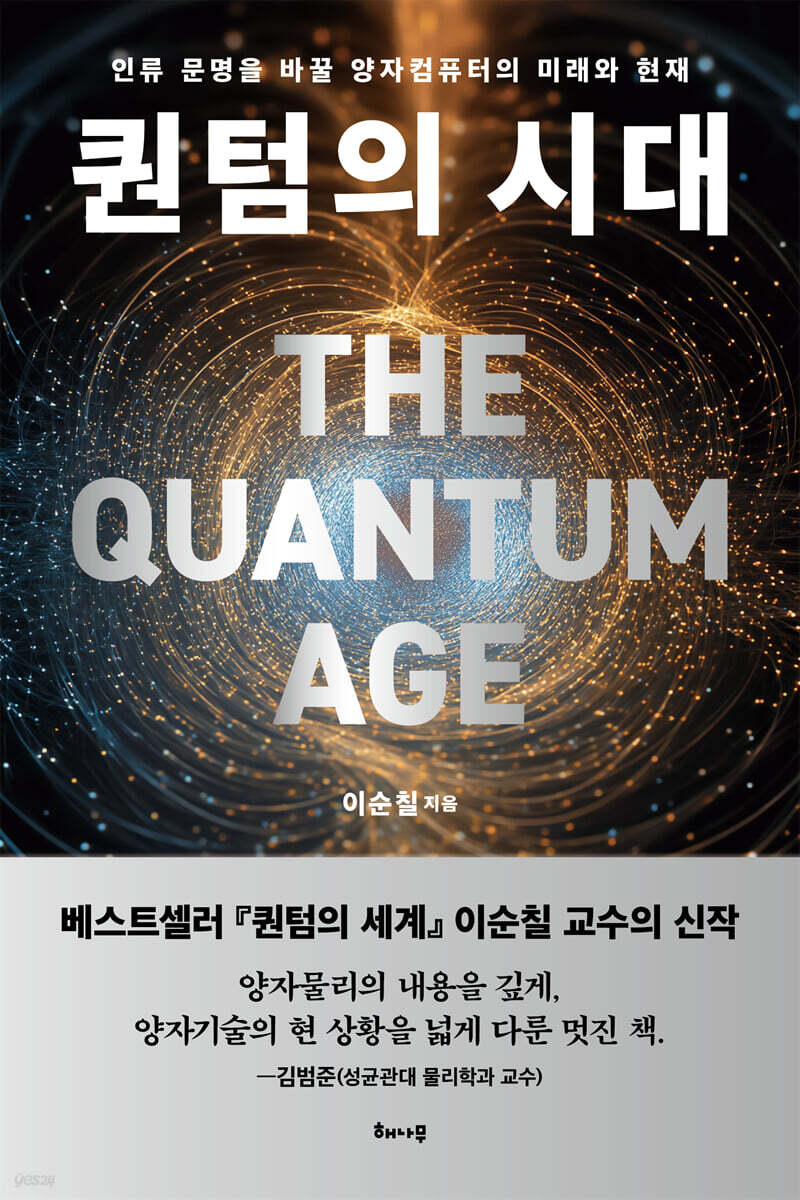
Professor Lee Soon-chil, whose book 『The World of Quantum』 has established itself as a solid introduction to quantum mechanics and quantum computers, has returned with a new book, 『The Age of Quantum』.
After publishing his first book, Professor Lee Soon-chil was repeatedly asked, "So, which type of quantum computer will ultimately win?"
This book, in response to this, presents a realistic and easily understandable account of the future transformations brought about by quantum technology, the strengths and weaknesses of the various quantum computer technologies fiercely competing to lead this transformation, and the requirements for practical application, all with profound insight.
The advent of quantum physics fundamentally changed the way humanity perceives the world and the paradigm of scholarship.
The author views this as the first quantum leap in civilization, a quantum leap forward, and foresees that quantum computers, which apply quantum physics, will bring about a transformation across the economy and industry, thus achieving the second quantum leap in civilization.
The author, a first-generation quantum information researcher in Korea and until recently the director of the Quantum Technology Center at the National Research Foundation of Korea, has always been at the center of quantum computer development. With his unique insight, he penetrates the past and future of quantum physics, thereby assessing the current state of quantum technology and suggesting our own responses.
As we approach the threshold of transformation, this book will help you develop an eye for reading the flow of quantum technology.
After publishing his first book, Professor Lee Soon-chil was repeatedly asked, "So, which type of quantum computer will ultimately win?"
This book, in response to this, presents a realistic and easily understandable account of the future transformations brought about by quantum technology, the strengths and weaknesses of the various quantum computer technologies fiercely competing to lead this transformation, and the requirements for practical application, all with profound insight.
The advent of quantum physics fundamentally changed the way humanity perceives the world and the paradigm of scholarship.
The author views this as the first quantum leap in civilization, a quantum leap forward, and foresees that quantum computers, which apply quantum physics, will bring about a transformation across the economy and industry, thus achieving the second quantum leap in civilization.
The author, a first-generation quantum information researcher in Korea and until recently the director of the Quantum Technology Center at the National Research Foundation of Korea, has always been at the center of quantum computer development. With his unique insight, he penetrates the past and future of quantum physics, thereby assessing the current state of quantum technology and suggesting our own responses.
As we approach the threshold of transformation, this book will help you develop an eye for reading the flow of quantum technology.
- You can preview some of the book's contents.
Preview
index
Opening remarks
Part 1: Civilization's First Quantum Jump - The Past
Chapter 1: The Shock of Modern Physics
The Brilliant Achievements of Classical Physics | The Emergence of Modern Physics | Theory and Experiment | The Quantum Leap of Civilization
Chapter 2: Paradigm Shift
Superposition and Measurement | Existence and Perception | Future Determinism | Entanglement and Locality
Part 2: Civilization's Second Quantum Jump - The Future
Chapter 3 Representative Fields of Quantum Technology
The Dawn of Quantum Technology | Quantum Sensors | Quantum Communications | Quantum Computers
Chapter 4: Applications of Quantum Computers
Cryptography | Bitcoin | Molecular Simulation | Optimization Problems | Differential Equations | Quantum AI | Finance | The Future of Quantum Computers
Part 3: The Current State of Quantum Technology
Chapter 5: Investment Landscape for Quantum Technology
Investment Status | Development Status
Chapter 6: Current Status of Quantum Computer Development
Quantum gain | Error correction | NISQ computer
Chapter 7: The Quantum Computer Race
Superconducting quantum computer | Ion-trap quantum computer | Neutral atom quantum computer | Optical quantum computer | Quantum dot quantum computer | Point defect quantum computer | Topological quantum computer | The ultimate winner
Chapter 8 Our Response
Corporate | National | Quantum Ethics and Individuals
Conclusion
supplement
main
Source of images and photos
Search
Part 1: Civilization's First Quantum Jump - The Past
Chapter 1: The Shock of Modern Physics
The Brilliant Achievements of Classical Physics | The Emergence of Modern Physics | Theory and Experiment | The Quantum Leap of Civilization
Chapter 2: Paradigm Shift
Superposition and Measurement | Existence and Perception | Future Determinism | Entanglement and Locality
Part 2: Civilization's Second Quantum Jump - The Future
Chapter 3 Representative Fields of Quantum Technology
The Dawn of Quantum Technology | Quantum Sensors | Quantum Communications | Quantum Computers
Chapter 4: Applications of Quantum Computers
Cryptography | Bitcoin | Molecular Simulation | Optimization Problems | Differential Equations | Quantum AI | Finance | The Future of Quantum Computers
Part 3: The Current State of Quantum Technology
Chapter 5: Investment Landscape for Quantum Technology
Investment Status | Development Status
Chapter 6: Current Status of Quantum Computer Development
Quantum gain | Error correction | NISQ computer
Chapter 7: The Quantum Computer Race
Superconducting quantum computer | Ion-trap quantum computer | Neutral atom quantum computer | Optical quantum computer | Quantum dot quantum computer | Point defect quantum computer | Topological quantum computer | The ultimate winner
Chapter 8 Our Response
Corporate | National | Quantum Ethics and Individuals
Conclusion
supplement
main
Source of images and photos
Search
Detailed image
Into the book
Quantum physics was a completely new set of physical laws.
This law opened up a new world of physics research by allowing us to peer into the atomic world.
It has become possible to understand empirical laws that were previously established only through macroscopic observation from the basic principles.
I thought there was nothing to do, but then a new world opened up, so most physicists at the time, even if they weren't majoring in quantum physics, would have been very interested in quantum physics, and they would have been watching the situation with excitement as new facts were discovered every day.
--- p.23
The proof of Bell's inequality played a key role in the birth of quantum technology.
Once nonlocality is confirmed, the instantaneous influence that entanglement creates between two objects creates quantum technologies such as teleportation of quantum states, quantum computers that are faster than supercomputers, and quantum communication that is fundamentally impossible to eavesdrop on.
Among these, the technology that most directly demonstrates the non-locality of entanglement is teleportation.
Quantum teleportation technology allows information about objects to be teleported.
The hydrogen, carbon, nitrogen, and oxygen that make me up exist in other stars, so if I send information about the particles that make me up to a distant star and assemble the elements according to that information, I can create an object identical to me on that star.
As you can guess, entanglement is used here to instantaneously transmit information between particles.
--- p.61
Insurance company AXA is said to be researching quantum-resistant encryption that quantum computers cannot crack on its data.
A quantum computer powerful enough to crack codes won't be available until 2035 at the earliest, so why worry so much already? A company's confidential data is difficult to hack into, and even if it were, it's encrypted and unreadable.
But while companies are letting their guard down, confidential data can be stolen and read only after 10 years when quantum computers capable of breaking encryption are developed.
From the company's perspective, it doesn't matter if the corporate secrets they have now are disclosed in 10 years, but if not, it means they need to start researching quantum-resistant encryption that quantum computers can't break.
--- p.98~99
When quantum computers come out, the story changes.
The parallel processing of quantum computers could enable high-resolution wargames to be performed in real time, enabling a quantum leap in war capabilities.
Quantum computers that are good at war games will command robot fighters, unmanned fighter jets, drones, and unmanned tanks to fight the enemy.
The wars that we humans wage, risking our lives, have become games played by quantum computers and robots.
Of course, this is a story about a war between advanced countries with advanced quantum technology, and countries without quantum technology cannot even compete.
Thanks to quantum computers, when computational power becomes so great that we can accurately input our own and our opponent's strengths before going to war and know whether we can win or not, there may be no need to go to war.
--- p.141
Quantum computer hardware must be developed, no matter how far behind it may be.
However, while hardware development is being pursued by advanced countries, there is one area in which our country can lead: software.
As quantum policy is revised, it is one of the two items that is increasingly emphasized along with industrialization, and is closely related to industrialization.
Since there is no usable hardware yet, the development of algorithms and software has been ineffective and has not made much progress.
Software development has the advantage of being able to be labeled "leading," a word that civil servants like, but there are high expectations that the software market will eventually surpass the hardware market.
--- p.153
One of the questions people have about quantum technology is how different the quantum computer technology in our country is compared to that in advanced countries.
For example, in terms of hardware, our country has a roadmap to start developing a 1,000-qubit superconducting quantum computer in 2025 and complete it by 2033.
However, IBM has already announced a 1000-qubit quantum computer in 2023, so we can say that there is a gap of about 10 years.
And IBM announced that it will develop a quantum computer with 100,000 qubits by 2033.
--- p.163
Among the elements needed for a practical quantum computer, the ones that I focus on are coherence time and connectivity.
These two factors are related to error correction and scalability.
Of the six quantum computer systems mentioned above, three operate by creating qubits on a substrate, while the remaining three have qubits isolated from the external environment.
The three that belong to the former are superconducting, quantum dot, and point-defect quantum computers, and the three that belong to the latter are ion traps, neutral atoms, and optical quantum computers.
The advantage of fabricating qubits on a substrate is that we can design CPUs as we wish and apply our country's advanced semiconductor device production technology.
The biggest drawback is that it is vulnerable to interaction with the surroundings, has a short coherence time, and poor connectivity.
--- p.224~225
First, the McKinsey report cited the pharmaceutical, chemical, financial, and automotive industries as industries that will be affected by quantum computers.
This report estimates that quantum computers will create between 1500 and 3000 trillion won in value in this field.
These industries were selected because optimization and molecular simulation are considered to be the areas where currently imperfect quantum computers can make a significant contribution.
But ultimately, as mentioned above, all industries will inevitably be affected.
If you don't understand how quantum computers will transform your company, you'll suddenly find yourself behind your competitors, and it'll be difficult to do anything about it.
This law opened up a new world of physics research by allowing us to peer into the atomic world.
It has become possible to understand empirical laws that were previously established only through macroscopic observation from the basic principles.
I thought there was nothing to do, but then a new world opened up, so most physicists at the time, even if they weren't majoring in quantum physics, would have been very interested in quantum physics, and they would have been watching the situation with excitement as new facts were discovered every day.
--- p.23
The proof of Bell's inequality played a key role in the birth of quantum technology.
Once nonlocality is confirmed, the instantaneous influence that entanglement creates between two objects creates quantum technologies such as teleportation of quantum states, quantum computers that are faster than supercomputers, and quantum communication that is fundamentally impossible to eavesdrop on.
Among these, the technology that most directly demonstrates the non-locality of entanglement is teleportation.
Quantum teleportation technology allows information about objects to be teleported.
The hydrogen, carbon, nitrogen, and oxygen that make me up exist in other stars, so if I send information about the particles that make me up to a distant star and assemble the elements according to that information, I can create an object identical to me on that star.
As you can guess, entanglement is used here to instantaneously transmit information between particles.
--- p.61
Insurance company AXA is said to be researching quantum-resistant encryption that quantum computers cannot crack on its data.
A quantum computer powerful enough to crack codes won't be available until 2035 at the earliest, so why worry so much already? A company's confidential data is difficult to hack into, and even if it were, it's encrypted and unreadable.
But while companies are letting their guard down, confidential data can be stolen and read only after 10 years when quantum computers capable of breaking encryption are developed.
From the company's perspective, it doesn't matter if the corporate secrets they have now are disclosed in 10 years, but if not, it means they need to start researching quantum-resistant encryption that quantum computers can't break.
--- p.98~99
When quantum computers come out, the story changes.
The parallel processing of quantum computers could enable high-resolution wargames to be performed in real time, enabling a quantum leap in war capabilities.
Quantum computers that are good at war games will command robot fighters, unmanned fighter jets, drones, and unmanned tanks to fight the enemy.
The wars that we humans wage, risking our lives, have become games played by quantum computers and robots.
Of course, this is a story about a war between advanced countries with advanced quantum technology, and countries without quantum technology cannot even compete.
Thanks to quantum computers, when computational power becomes so great that we can accurately input our own and our opponent's strengths before going to war and know whether we can win or not, there may be no need to go to war.
--- p.141
Quantum computer hardware must be developed, no matter how far behind it may be.
However, while hardware development is being pursued by advanced countries, there is one area in which our country can lead: software.
As quantum policy is revised, it is one of the two items that is increasingly emphasized along with industrialization, and is closely related to industrialization.
Since there is no usable hardware yet, the development of algorithms and software has been ineffective and has not made much progress.
Software development has the advantage of being able to be labeled "leading," a word that civil servants like, but there are high expectations that the software market will eventually surpass the hardware market.
--- p.153
One of the questions people have about quantum technology is how different the quantum computer technology in our country is compared to that in advanced countries.
For example, in terms of hardware, our country has a roadmap to start developing a 1,000-qubit superconducting quantum computer in 2025 and complete it by 2033.
However, IBM has already announced a 1000-qubit quantum computer in 2023, so we can say that there is a gap of about 10 years.
And IBM announced that it will develop a quantum computer with 100,000 qubits by 2033.
--- p.163
Among the elements needed for a practical quantum computer, the ones that I focus on are coherence time and connectivity.
These two factors are related to error correction and scalability.
Of the six quantum computer systems mentioned above, three operate by creating qubits on a substrate, while the remaining three have qubits isolated from the external environment.
The three that belong to the former are superconducting, quantum dot, and point-defect quantum computers, and the three that belong to the latter are ion traps, neutral atoms, and optical quantum computers.
The advantage of fabricating qubits on a substrate is that we can design CPUs as we wish and apply our country's advanced semiconductor device production technology.
The biggest drawback is that it is vulnerable to interaction with the surroundings, has a short coherence time, and poor connectivity.
--- p.224~225
First, the McKinsey report cited the pharmaceutical, chemical, financial, and automotive industries as industries that will be affected by quantum computers.
This report estimates that quantum computers will create between 1500 and 3000 trillion won in value in this field.
These industries were selected because optimization and molecular simulation are considered to be the areas where currently imperfect quantum computers can make a significant contribution.
But ultimately, as mentioned above, all industries will inevitably be affected.
If you don't understand how quantum computers will transform your company, you'll suddenly find yourself behind your competitors, and it'll be difficult to do anything about it.
--- p.238
Publisher's Review
★ A new book by Professor Lee Soon-chil, author of the best-selling 『Quantum World』★
ㆍKorea's leading authority on quantum computer science ㆍ
ㆍDirector of the Quantum Technology Center, National Research Foundation of Korea, 2022-2024
A wonderful book that covers the subject of quantum physics in depth and the current state of quantum technology broadly.
- Kim Beom-jun (Professor of Physics, Sungkyunkwan University)
A reliable guide and invaluable companion that provides profound insights.
- Jaeho Jeong (Director of the Quantum Research Center at Yonsei University and Professor of Surgery, College of Medicine)
It strongly conveys the message that this is a story directly connected to our future.
- Sangyoon Eom (CEO of IDQ)
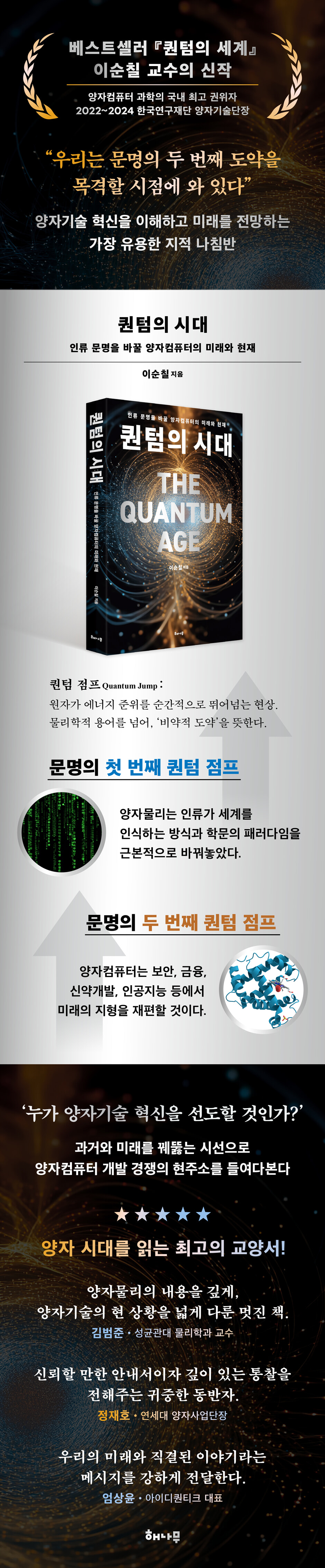
Now, our civilization stands on the threshold of its second leap forward.
Understanding quantum technology innovation and looking to the future
The most useful intellectual compass
ㆍQuantum Jump:
A phenomenon in which an atom instantly jumps between energy levels.
Beyond the physical term, it means a 'quantum leap'.
Professor Lee Soon-chil, whose book 『The World of Quantum』 has established itself as a solid introduction to quantum mechanics and quantum computers, has returned with a new book, 『The Age of Quantum』.
After publishing his first book, Professor Lee Soon-chil was repeatedly asked, "So, which type of quantum computer will ultimately win?"
This book, in response to this, presents a realistic and easily understandable account of the future transformations brought about by quantum technology, the strengths and weaknesses of the various quantum computer technologies fiercely competing to lead this transformation, and the requirements for practical application, all with profound insight.
The advent of quantum physics fundamentally changed the way humanity perceives the world and the paradigm of scholarship.
The author views this as the first quantum leap in civilization, a quantum leap forward, and foresees that quantum technology, which applies quantum physics, will bring about a transformation across the economy and industry, thus achieving a second quantum leap in civilization.
The author, a first-generation quantum information researcher in Korea and until recently the director of the Quantum Technology Center at the National Research Foundation of Korea, has always been at the center of quantum computer development. With his unique insight, he penetrates the past and future of quantum physics, thereby assessing the current state of quantum technology and suggesting our own responses.
As we approach the threshold of transformation, this book will help you develop an eye for reading the flow of quantum technology.
Why the World Is Focusing on Quantum Computers
A starting point for reading the flow of technology and preparing for the future.
As the pace of technological advancement accelerates to the point where we can feel the changes in our daily lives, interest in technology is also increasing.
One such technology is quantum computing.
Recently, NVIDIA's stock price plummeted after CEO Jensen Huang said that quantum computers would take 20 years to become practical, indicating that the public's expectations for quantum computers are high.
People already intuitively sense that quantum technology will have a ripple effect that will reshape the economic and social order.
However, the reality is that there are still not many people who properly understand its principles and practical effects.
The Quantum Age is a book written to fill that gap.
The author explains the core concepts of quantum physics in easy-to-understand language, and based on this, persuasively conveys why quantum technology is revolutionary and the areas in which quantum computers can be used.
Quantum computers, which apply the quantum physics principles of superposition and entanglement, will process various problems at an astonishing speed and scale that are incomparable to classical computers.
It's clear why global companies and governments are preparing for the quantum age.
This is because when quantum computers become practical, existing encryption systems can be easily broken, posing a major threat to national defense, industrial, and financial security.
At the same time, the goal is to secure this core technology that can maximize innovation and efficiency in various fields, such as new drug development, industrial process optimization, manufacturing, logistics, energy management, and quantum artificial intelligence.
The author predicts that just as quantum physics has fundamentally changed the way we view the world, quantum computers will take human civilization to a new level.
This book interprets this enormous change within the context of scientific principles and the flow of the times, transforming the seemingly difficult innovations of quantum technology into an "understandable future."
If you want to know the next world order that quantum computers will create, this book can be the starting point.
What are the requirements for the ultimate quantum computer winner?
The Challenges and Key Tasks of Quantum Computers: The Technology That Will Drive Our Future
News about quantum computers is pouring in every day.
Quantum computers are currently being researched and developed using various approaches.
Around 2000, nuclear magnetic resonance quantum computers were popular, around 2010, ion trap quantum computers were promising, and around 2020, superconducting quantum computers were popular.
By the end of 2023, a quantum computer using neutral atoms had emerged, demonstrating remarkable performance (Chapter 7).
The quantum computing technology that will have an overwhelming advantage has not yet been determined.
Research institutes and technology companies around the world are each exploring the possibilities in their own way and are immersed in research, and as such, quantum computers are rapidly developing amidst fierce competition.
The author, who developed Korea's first parallel processing quantum computer and gained recognition as a first-generation quantum information researcher, served as the Director of the Quantum Technology Center at the National Research Foundation of Korea from 2022 to 2024, overseeing domestic research.
These activities allowed us to gain detailed insight into everything from global quantum technology development trends to the research topics of individual quantum technology experts in our country.
The author, who has observed technological advancements over a long period of time at the center of quantum computer development, identifies the common goals that current quantum computer research is striving to achieve and summarizes the principles, strengths, and key challenges of each quantum computer.
Furthermore, we present our opinions on the requirements for the ultimate winner of quantum computers and the quantum computer market.
In particular, the author's deep insight shines in the part where he predicts that quantum computers may coexist in second place, just as hard disks and USB memory coexist for different purposes, citing computer storage devices as an example, and that if we do not take the initiative to develop our own quantum technology capabilities, we may become dependent on the quantum technology of advanced countries.
Asking which type of quantum computer will ultimately win, this book opens the way to a broad and deep understanding of the fiercely competitive world of quantum computing.
As quantum technology transcends the realm of science and emerges as a key enabler of industry and national competitiveness, this book serves as the definitive guide for readers seeking to understand the quantum era.
From the birth of quantum physics to the development of quantum computers and ethical issues.
The ultimate popular education book that pierces through the quantum era.
The emergence of quantum physics along with the theory of relativity was a huge event that shook not only physics but also the entire human cognitive system.
In the microscopic world, experimental results that contradict our intuition were observed, and a new theory emerged to explain them: quantum physics.
The order of the microscopic world revealed by quantum physics is something that cannot be understood with conventional wisdom or reason. The process of accepting this has influenced thought and culture, fundamentally changing the way humans perceive the world.
Quantum technology is a concept that utilizes concepts discovered in quantum physics.
As quantum physics deepens our understanding of the microscopic world, technology has advanced to the point where we can now manipulate individual atoms and electrons.
How will quantum technology transform our future? Where are we at along that path, and what are we focusing on?
This book is like a time machine in the quantum world.
The author invites readers into the quantum world by revealing the past state of physics and anecdotes from the lab, then quickly moves into the future and brings us back to the present.
This book consists of three parts: “Part 1: Civilization’s First Quantum Jump – The Past,” “Part 2: Civilization’s Second Quantum Jump – The Future,” and “Part 3: Quantum Technology Today.”
By adopting the structure of 'past-future-present' rather than 'past-present-future', it shows the direction and meaning of current quantum technology in a three-dimensional way.
Furthermore, it goes beyond the understanding of science and technology and introduces how the concepts of superposition, measurement, entanglement, and locality have influenced philosophical concepts such as existence, perception, and future determinism. It also opens up discussions on ethical issues that may arise due to quantum computer technology, persuasively demonstrating that everyone should be interested in quantum computers.
"The Quantum Age" is a book of insight that goes beyond technology to help us understand the times and civilization.
It vividly shows how quantum computing is changing the world, guiding readers into the heart of the future.
The author, who received a positive response from the public in his previous work for his unique metaphors and unadorned explanations, has also presented the story of quantum computers in an accessible style, incorporating interesting stories and anecdotes in this book.
In this journey that crosses science and technology, philosophy and society, quantum computers will open up new horizons of civilization and thought.
Discover the exciting 'Quantum Age' through this one book.
ㆍKorea's leading authority on quantum computer science ㆍ
ㆍDirector of the Quantum Technology Center, National Research Foundation of Korea, 2022-2024
A wonderful book that covers the subject of quantum physics in depth and the current state of quantum technology broadly.
- Kim Beom-jun (Professor of Physics, Sungkyunkwan University)
A reliable guide and invaluable companion that provides profound insights.
- Jaeho Jeong (Director of the Quantum Research Center at Yonsei University and Professor of Surgery, College of Medicine)
It strongly conveys the message that this is a story directly connected to our future.
- Sangyoon Eom (CEO of IDQ)
Now, our civilization stands on the threshold of its second leap forward.
Understanding quantum technology innovation and looking to the future
The most useful intellectual compass
ㆍQuantum Jump:
A phenomenon in which an atom instantly jumps between energy levels.
Beyond the physical term, it means a 'quantum leap'.
Professor Lee Soon-chil, whose book 『The World of Quantum』 has established itself as a solid introduction to quantum mechanics and quantum computers, has returned with a new book, 『The Age of Quantum』.
After publishing his first book, Professor Lee Soon-chil was repeatedly asked, "So, which type of quantum computer will ultimately win?"
This book, in response to this, presents a realistic and easily understandable account of the future transformations brought about by quantum technology, the strengths and weaknesses of the various quantum computer technologies fiercely competing to lead this transformation, and the requirements for practical application, all with profound insight.
The advent of quantum physics fundamentally changed the way humanity perceives the world and the paradigm of scholarship.
The author views this as the first quantum leap in civilization, a quantum leap forward, and foresees that quantum technology, which applies quantum physics, will bring about a transformation across the economy and industry, thus achieving a second quantum leap in civilization.
The author, a first-generation quantum information researcher in Korea and until recently the director of the Quantum Technology Center at the National Research Foundation of Korea, has always been at the center of quantum computer development. With his unique insight, he penetrates the past and future of quantum physics, thereby assessing the current state of quantum technology and suggesting our own responses.
As we approach the threshold of transformation, this book will help you develop an eye for reading the flow of quantum technology.
Why the World Is Focusing on Quantum Computers
A starting point for reading the flow of technology and preparing for the future.
As the pace of technological advancement accelerates to the point where we can feel the changes in our daily lives, interest in technology is also increasing.
One such technology is quantum computing.
Recently, NVIDIA's stock price plummeted after CEO Jensen Huang said that quantum computers would take 20 years to become practical, indicating that the public's expectations for quantum computers are high.
People already intuitively sense that quantum technology will have a ripple effect that will reshape the economic and social order.
However, the reality is that there are still not many people who properly understand its principles and practical effects.
The Quantum Age is a book written to fill that gap.
The author explains the core concepts of quantum physics in easy-to-understand language, and based on this, persuasively conveys why quantum technology is revolutionary and the areas in which quantum computers can be used.
Quantum computers, which apply the quantum physics principles of superposition and entanglement, will process various problems at an astonishing speed and scale that are incomparable to classical computers.
It's clear why global companies and governments are preparing for the quantum age.
This is because when quantum computers become practical, existing encryption systems can be easily broken, posing a major threat to national defense, industrial, and financial security.
At the same time, the goal is to secure this core technology that can maximize innovation and efficiency in various fields, such as new drug development, industrial process optimization, manufacturing, logistics, energy management, and quantum artificial intelligence.
The author predicts that just as quantum physics has fundamentally changed the way we view the world, quantum computers will take human civilization to a new level.
This book interprets this enormous change within the context of scientific principles and the flow of the times, transforming the seemingly difficult innovations of quantum technology into an "understandable future."
If you want to know the next world order that quantum computers will create, this book can be the starting point.
What are the requirements for the ultimate quantum computer winner?
The Challenges and Key Tasks of Quantum Computers: The Technology That Will Drive Our Future
News about quantum computers is pouring in every day.
Quantum computers are currently being researched and developed using various approaches.
Around 2000, nuclear magnetic resonance quantum computers were popular, around 2010, ion trap quantum computers were promising, and around 2020, superconducting quantum computers were popular.
By the end of 2023, a quantum computer using neutral atoms had emerged, demonstrating remarkable performance (Chapter 7).
The quantum computing technology that will have an overwhelming advantage has not yet been determined.
Research institutes and technology companies around the world are each exploring the possibilities in their own way and are immersed in research, and as such, quantum computers are rapidly developing amidst fierce competition.
The author, who developed Korea's first parallel processing quantum computer and gained recognition as a first-generation quantum information researcher, served as the Director of the Quantum Technology Center at the National Research Foundation of Korea from 2022 to 2024, overseeing domestic research.
These activities allowed us to gain detailed insight into everything from global quantum technology development trends to the research topics of individual quantum technology experts in our country.
The author, who has observed technological advancements over a long period of time at the center of quantum computer development, identifies the common goals that current quantum computer research is striving to achieve and summarizes the principles, strengths, and key challenges of each quantum computer.
Furthermore, we present our opinions on the requirements for the ultimate winner of quantum computers and the quantum computer market.
In particular, the author's deep insight shines in the part where he predicts that quantum computers may coexist in second place, just as hard disks and USB memory coexist for different purposes, citing computer storage devices as an example, and that if we do not take the initiative to develop our own quantum technology capabilities, we may become dependent on the quantum technology of advanced countries.
Asking which type of quantum computer will ultimately win, this book opens the way to a broad and deep understanding of the fiercely competitive world of quantum computing.
As quantum technology transcends the realm of science and emerges as a key enabler of industry and national competitiveness, this book serves as the definitive guide for readers seeking to understand the quantum era.
From the birth of quantum physics to the development of quantum computers and ethical issues.
The ultimate popular education book that pierces through the quantum era.
The emergence of quantum physics along with the theory of relativity was a huge event that shook not only physics but also the entire human cognitive system.
In the microscopic world, experimental results that contradict our intuition were observed, and a new theory emerged to explain them: quantum physics.
The order of the microscopic world revealed by quantum physics is something that cannot be understood with conventional wisdom or reason. The process of accepting this has influenced thought and culture, fundamentally changing the way humans perceive the world.
Quantum technology is a concept that utilizes concepts discovered in quantum physics.
As quantum physics deepens our understanding of the microscopic world, technology has advanced to the point where we can now manipulate individual atoms and electrons.
How will quantum technology transform our future? Where are we at along that path, and what are we focusing on?
This book is like a time machine in the quantum world.
The author invites readers into the quantum world by revealing the past state of physics and anecdotes from the lab, then quickly moves into the future and brings us back to the present.
This book consists of three parts: “Part 1: Civilization’s First Quantum Jump – The Past,” “Part 2: Civilization’s Second Quantum Jump – The Future,” and “Part 3: Quantum Technology Today.”
By adopting the structure of 'past-future-present' rather than 'past-present-future', it shows the direction and meaning of current quantum technology in a three-dimensional way.
Furthermore, it goes beyond the understanding of science and technology and introduces how the concepts of superposition, measurement, entanglement, and locality have influenced philosophical concepts such as existence, perception, and future determinism. It also opens up discussions on ethical issues that may arise due to quantum computer technology, persuasively demonstrating that everyone should be interested in quantum computers.
"The Quantum Age" is a book of insight that goes beyond technology to help us understand the times and civilization.
It vividly shows how quantum computing is changing the world, guiding readers into the heart of the future.
The author, who received a positive response from the public in his previous work for his unique metaphors and unadorned explanations, has also presented the story of quantum computers in an accessible style, incorporating interesting stories and anecdotes in this book.
In this journey that crosses science and technology, philosophy and society, quantum computers will open up new horizons of civilization and thought.
Discover the exciting 'Quantum Age' through this one book.
GOODS SPECIFICS
- Date of issue: October 30, 2025
- Page count, weight, size: 280 pages | 382g | 140*210*17mm
- ISBN13: 9791164053414
You may also like
카테고리
korean


korean

![GQ KOREA Mark (Monthly): December [2025]](http://librairie.coreenne.fr/cdn/shop/files/8ef265dbbfbf186523ed75ba7319009d.jpg?v=1765340328&width=3840)


