

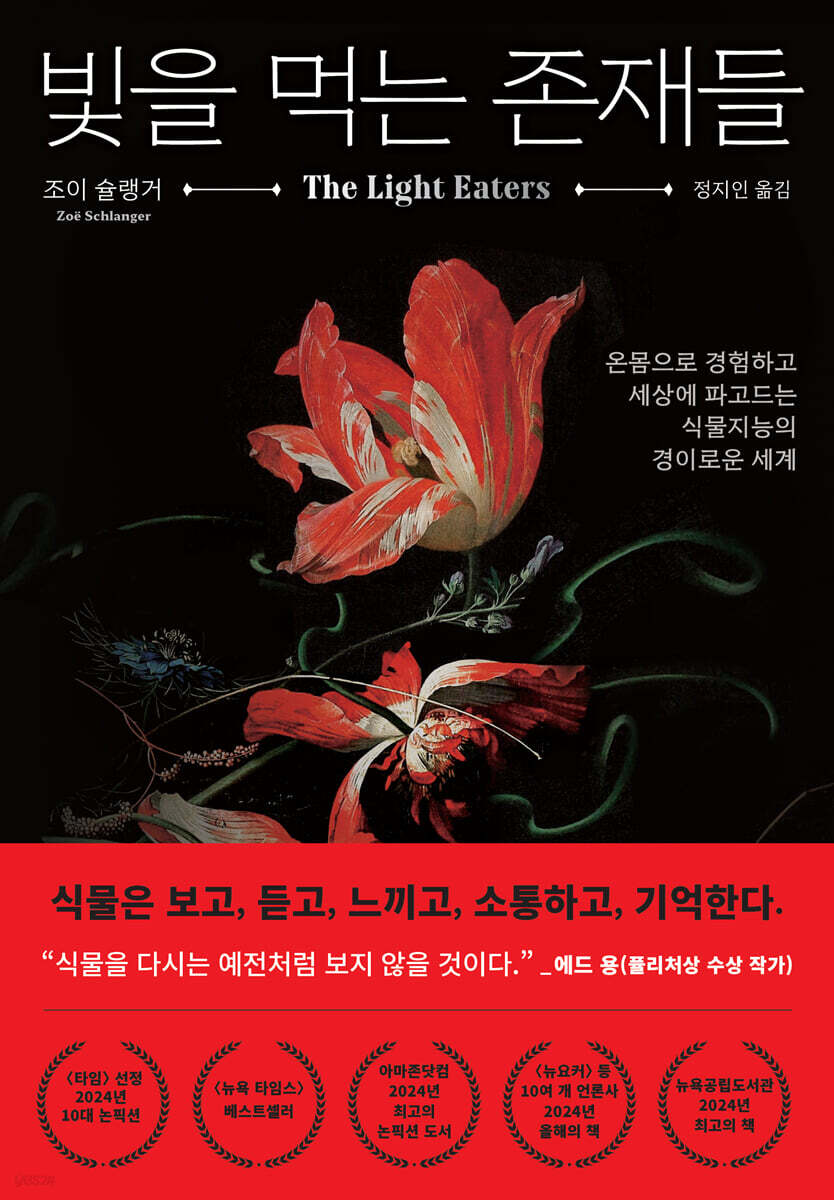
Light-eating beings
 |
Description
Book Introduction
- A word from MD
-
Plant intelligence is more surprising than artificial intelligenceScience writer Joy Schlanger's groundbreaking book will amaze you with the increasing speed and accuracy of machines in the AI era, but even more astonishing is the intelligence of plants.
Science is increasingly discovering that plants also perceive, think, and react.
You can even share experiences and communicate.
The more you know about the amazing life of plants, the more you realize it.
December 2, 2025. Min-gyu Son, PD of Natural Sciences
The newest horizon in understanding life,
The wonders of invisible plant intelligence
Amazon's Best Nonfiction Books of 2024, Time's Top 10 Nonfiction Books of 2024
A New York Times bestseller, The New Yorker, and over 10 other publications named it the Book of the Year for 2024.
Plants think.
See the object, hear the sound, sense the touch, choose the better one, and devise a strategy.
Embrace risks, share experiences, and pass on the memories of the land.
For a long time, plants were considered 'slow and passive' beings.
However, over the past 10 to 20 years, thanks to advanced imaging technology and advances in specific fields such as physiology, neurobiology, and molecular biology, the secrets of plants' unique sensory systems have begun to be explosively revealed.
This book, "The Light-Eating Creatures," brings together these latest research findings to present readers with a new paradigm called "Plant Intelligent."
Author Joy Schlanger, a rising star in the science journalism community, has captured the cutting-edge discoveries that are redefining the boundaries between life and intelligence.
This book explores the latest discoveries in the field of plant intelligence as well as its history, offering readers a new perspective that transcends conventional human-centric thinking.
The wonders of invisible plant intelligence
Amazon's Best Nonfiction Books of 2024, Time's Top 10 Nonfiction Books of 2024
A New York Times bestseller, The New Yorker, and over 10 other publications named it the Book of the Year for 2024.
Plants think.
See the object, hear the sound, sense the touch, choose the better one, and devise a strategy.
Embrace risks, share experiences, and pass on the memories of the land.
For a long time, plants were considered 'slow and passive' beings.
However, over the past 10 to 20 years, thanks to advanced imaging technology and advances in specific fields such as physiology, neurobiology, and molecular biology, the secrets of plants' unique sensory systems have begun to be explosively revealed.
This book, "The Light-Eating Creatures," brings together these latest research findings to present readers with a new paradigm called "Plant Intelligent."
Author Joy Schlanger, a rising star in the science journalism community, has captured the cutting-edge discoveries that are redefining the boundaries between life and intelligence.
This book explores the latest discoveries in the field of plant intelligence as well as its history, offering readers a new perspective that transcends conventional human-centric thinking.
- You can preview some of the book's contents.
Preview
index
prolog
Chapter 1: The Problem of Plant Consciousness
Chapter 2: How Science Changes Our Minds
Chapter 3: Plant Communication
Chapter 4: Living Beings Are Feeling Beings
Chapter 5: Put your ear to the ground
Chapter 6: The Body (of Plants) Remembers
Chapter 7: Talking to Animals
Chapter 8: The Scientist and the Chameleon Vine
Chapter 9: The Social Life of Plants
Chapter 10: Inheritance
Chapter 11: The Future of Plants
Acknowledgements
Translator's Note
main
Search
Chapter 1: The Problem of Plant Consciousness
Chapter 2: How Science Changes Our Minds
Chapter 3: Plant Communication
Chapter 4: Living Beings Are Feeling Beings
Chapter 5: Put your ear to the ground
Chapter 6: The Body (of Plants) Remembers
Chapter 7: Talking to Animals
Chapter 8: The Scientist and the Chameleon Vine
Chapter 9: The Social Life of Plants
Chapter 10: Inheritance
Chapter 11: The Future of Plants
Acknowledgements
Translator's Note
main
Search
Detailed image

Into the book
If you want to live while constantly growing and still be rooted in one place, you will face an enormous number of difficulties.
To solve that predicament, plants have devised some of the most creative survival strategies of any living thing, including us humans.
Many of these methods are so ingenious that they are considered nearly impossible for plants.
(…) But the incredible powers of plants clearly exist, regardless of our poor imagination.
--- p.20, "Prologue"
Plants continue to rise upwards, toward the sun, regardless of what we think of them.
At a time when the Earth is in such disarray, plants open up a window of possibility for us to think like green plants.
--- p.22, "Prologue"
Plants have complex, dynamic lives of their own—social lives, sexual lives, and all the subtle sensory savors we usually assume are the domain of animals.
Furthermore, plants sense things we cannot even imagine, and we live in a world of information that we cannot see.
Understanding plants will open new horizons of understanding for us humans.
The fact is that we not only share the Earth with these ingenious beings, both strange and familiar, but we also owe them our very lives.
--- p.23, "Prologue"
So far, we have only found intelligence in animals relatively evolutionarily close to humans, such as dolphins, dogs, and our much closer cousins, the primates.
But now we know that the incredible intelligence of all kinds of creatures can evolve completely independently of humans.
Similar tectonic shifts are occurring in the plant-related realm.
--- p.28, "The Problem of Plant Consciousness"
The atmosphere we enjoy today was created by them, the early terrestrial plants.
It is no exaggeration to say that plants created the world we live in.
As Italian philosopher Emanuele Coccia said, our universe was built by plants.
--- p.59, “How Does Science Change Our Minds?”
In the entire known world, the only things that can produce sugars from light and air, materials that life has never known before, are plant leaves.
The rest of us are secondary users who recycle the things plants make.
--- p.59, “How Does Science Change Our Minds?”
It has been discovered that some plant species can detect chemicals in the caterpillar's saliva to identify the species of caterpillar, and then synthesize the exact chemicals that attract predators that eat that species.
Then the parasitic wasps notice the signal and willingly come and take care of the larvae.
--- p.68, "How Science Changes Thinking"
Do plants communicate? And if they do, what does that change? Communication presupposes awareness of oneself and awareness of beings other than oneself—other selves.
Communication is the act of spinning the thread that connects entities.
(…) If it is true that a forest or an entire field is communicating, the character of the forest or field changes.
There is also a change in the concept of what a plant is.
What kind of plant has no means of communication? It's just a shell.
And without conversation, the forest is not a forest.
--- p.103, "Plant Communication"
The answer Rose discovered was incredible, shocking, and dangerous.
The answer is that the trees were communicating with each other.
Trees that the caterpillars have not yet reached have weaponized their leaves against the caterpillars' attack.
The caterpillars that ate the leaves became sick and died.
--- p.105, “Plant Communication”
Plant cells do this too.
To put it bluntly, cells 'talk' to each other.
In this way, each cell understands what it is, or in other words, who it is.
Barbara McClintock, a geneticist who won the Nobel Prize in Physiology or Medicine for discovering that genes in corn can move around, described this cellular recognition as “cellular self-recognition.”
--- p.107, "Plant Communication"
Sagebrush also used a 'private' means of communication, warning only its own family group about insect attacks when the overall insect threat was low.
In other words, it is using irregular channels.
This means that they use complex compounds that only work on themselves and those close to them.
However, when an entire area is under concentrated attack, Sagebrush switches to a 'public' channel and sends out a more universally understandable warning signal.
--- p.123, "Plant Communication"
This means that plants have their own dialects and are aware enough of their context to know when to use them.
Moreover, plants are clearly aware of who is who, that is, who is family and who is not family.
They are constantly aware of the changing state of their environment and their enemies.
--- p.124, "Plant Communication"
When researchers peered into the genomes of Arabidopsis thaliana, a weedy plant in the cabbage family and the lab rat of plant biology, they observed that teasing silently triggered dramatic responses in hormones and gene expression that practically impeded growth.
They stroked the Arabidopsis plants with a soft brush and then analyzed the genetic responses.
Within 30 minutes of being touched, 10 percent of the Arabidopsis genome was altered.
It was clear that the Arabidopsis had redirected its energy from the effort of growing taller to prioritize solving this obstacle.
When repeatedly touched, the Arabidopsis plants slowed their growth by about 30 percent, which was consistent with results Jaffe had seen several years earlier.
--- p.147, “Living beings are feeling beings.”
We know that our bodies are fundamentally powered by electricity.
However, it is largely unknown that our current understanding of how electricity controls human nerves and muscles began in plants.
Alan Lloyd Hodgkin, Andrew Fielding Huxley, and John Carew Eccles were awarded the Nobel Prize in the 1950s for their work on the electrical properties of human neurons.
Their study builds on previous research that measured electrical impulses inside the giant cells of the scutellaria baicalensis, a green algae commonly found in ponds.
The cells of the snail are 10 centimeters long and 1 millimeter in diameter, making them very large for a cell and visible to the naked eye.
So you can just stick the electrodes directly into the cells.
And those cells generate electrical signals in a way that is quite similar to human cells.
--- p.153, “Living beings are feeling beings.”
In 2019, researchers at Tel Aviv University discovered that playing recorded bee sounds to evening primroses—bright yellow, cup-shaped flowers that grow low to the ground—in just three minutes boosted the sweetness of their nectar.
This evening primrose ignored any sound that was out of the frequency of the bee's buzzing wings.
--- p.194~195, “With Your Ear to the Ground”
It seemed that each plant species had its own unique bursting frequency.
For example, a cactus sounds very different from a grape.
But what's most interesting, he explained, is that the sound changes dramatically depending on the condition of the plant.
There was a significant difference between the sounds of plants suffering from dehydration stress and those of healthy, well-watered plants.
For example, tomatoes squeaked an average of thirty-five times per hour when under drought stress, but squeaked less than once an hour when they received enough water.
When Hadani took on the role of a herbivore and cut leaves, the number of times it made a sound increased dramatically.
The plants that were not harassed were considerably quieter in comparison.
“Tomatoes and cigarettes are almost silent when they are in a good mood,” says Hadani.
--- p.198~199, "With Your Ear to the Ground"
Memory has long been inextricably intertwined with the way we think about our own consciousness.
What we call our 'sense of the past' is filled with the perception of ourselves as moving beings passing through time.
Memory is the foundation of the self-narrative we tell ourselves, and nothing is more central to conscious experience.
--- p.217, “The (plant’s) body remembers.”
“Plants don’t have brain-like structures.
That's clear.
But look at what plants do.
So, plants take in information from the outside world.
Process that information.
Let's make a decision.
And then carry out that decision.
Plants take everything into account and transform all that information into a response.
And to me, that's the basic definition of intelligence.
What I mean is, it's not something that just happens automatically.”
--- p.218, “The (plant’s) body remembers.”
After conducting experiments with suitable control groups, de Moraes discovered that when bees nibbled on the plants they were feeding on, the plants bloomed up to 30 days earlier than normal.
(…) Every species depends on other species in some way.
If the timing of this relationship is off, everyone suffers.
Survival depends on having a means of communication across boundaries between species.
--- p.244, "Talking to Animals"
When surrounded by other plants, the sea buckthorn aggressively spread its roots into the sandy soil, trying to monopolize the nearby nutrients.
However, when growing up next to family, they politely limited root growth to leave room for their siblings to live next to them.
(…) This was the first time that it was discovered that plants recognize their family, let alone that they distinguish between family and others and show consideration for them.
--- p.337, "The Social Life of Plants"
This means that parent plants can pass on survival skills that helped them survive in a harsh world to their offspring.
In some cases, this may involve creating entirely new body parts and armor.
For example, when the yellow-bellied hawk moth is exposed to predators, it produces offspring with thin, defensive spines on their leaves.
Having survived a massive onslaught of destructive caterpillars, the Western squirrel produces baby squirrels with exceptionally tough hairs on their leaves, and these babies are even loaded with defensive chemicals to better ward off threats.
These plant children will be much better prepared to navigate the same challenges their parents faced.
To solve that predicament, plants have devised some of the most creative survival strategies of any living thing, including us humans.
Many of these methods are so ingenious that they are considered nearly impossible for plants.
(…) But the incredible powers of plants clearly exist, regardless of our poor imagination.
--- p.20, "Prologue"
Plants continue to rise upwards, toward the sun, regardless of what we think of them.
At a time when the Earth is in such disarray, plants open up a window of possibility for us to think like green plants.
--- p.22, "Prologue"
Plants have complex, dynamic lives of their own—social lives, sexual lives, and all the subtle sensory savors we usually assume are the domain of animals.
Furthermore, plants sense things we cannot even imagine, and we live in a world of information that we cannot see.
Understanding plants will open new horizons of understanding for us humans.
The fact is that we not only share the Earth with these ingenious beings, both strange and familiar, but we also owe them our very lives.
--- p.23, "Prologue"
So far, we have only found intelligence in animals relatively evolutionarily close to humans, such as dolphins, dogs, and our much closer cousins, the primates.
But now we know that the incredible intelligence of all kinds of creatures can evolve completely independently of humans.
Similar tectonic shifts are occurring in the plant-related realm.
--- p.28, "The Problem of Plant Consciousness"
The atmosphere we enjoy today was created by them, the early terrestrial plants.
It is no exaggeration to say that plants created the world we live in.
As Italian philosopher Emanuele Coccia said, our universe was built by plants.
--- p.59, “How Does Science Change Our Minds?”
In the entire known world, the only things that can produce sugars from light and air, materials that life has never known before, are plant leaves.
The rest of us are secondary users who recycle the things plants make.
--- p.59, “How Does Science Change Our Minds?”
It has been discovered that some plant species can detect chemicals in the caterpillar's saliva to identify the species of caterpillar, and then synthesize the exact chemicals that attract predators that eat that species.
Then the parasitic wasps notice the signal and willingly come and take care of the larvae.
--- p.68, "How Science Changes Thinking"
Do plants communicate? And if they do, what does that change? Communication presupposes awareness of oneself and awareness of beings other than oneself—other selves.
Communication is the act of spinning the thread that connects entities.
(…) If it is true that a forest or an entire field is communicating, the character of the forest or field changes.
There is also a change in the concept of what a plant is.
What kind of plant has no means of communication? It's just a shell.
And without conversation, the forest is not a forest.
--- p.103, "Plant Communication"
The answer Rose discovered was incredible, shocking, and dangerous.
The answer is that the trees were communicating with each other.
Trees that the caterpillars have not yet reached have weaponized their leaves against the caterpillars' attack.
The caterpillars that ate the leaves became sick and died.
--- p.105, “Plant Communication”
Plant cells do this too.
To put it bluntly, cells 'talk' to each other.
In this way, each cell understands what it is, or in other words, who it is.
Barbara McClintock, a geneticist who won the Nobel Prize in Physiology or Medicine for discovering that genes in corn can move around, described this cellular recognition as “cellular self-recognition.”
--- p.107, "Plant Communication"
Sagebrush also used a 'private' means of communication, warning only its own family group about insect attacks when the overall insect threat was low.
In other words, it is using irregular channels.
This means that they use complex compounds that only work on themselves and those close to them.
However, when an entire area is under concentrated attack, Sagebrush switches to a 'public' channel and sends out a more universally understandable warning signal.
--- p.123, "Plant Communication"
This means that plants have their own dialects and are aware enough of their context to know when to use them.
Moreover, plants are clearly aware of who is who, that is, who is family and who is not family.
They are constantly aware of the changing state of their environment and their enemies.
--- p.124, "Plant Communication"
When researchers peered into the genomes of Arabidopsis thaliana, a weedy plant in the cabbage family and the lab rat of plant biology, they observed that teasing silently triggered dramatic responses in hormones and gene expression that practically impeded growth.
They stroked the Arabidopsis plants with a soft brush and then analyzed the genetic responses.
Within 30 minutes of being touched, 10 percent of the Arabidopsis genome was altered.
It was clear that the Arabidopsis had redirected its energy from the effort of growing taller to prioritize solving this obstacle.
When repeatedly touched, the Arabidopsis plants slowed their growth by about 30 percent, which was consistent with results Jaffe had seen several years earlier.
--- p.147, “Living beings are feeling beings.”
We know that our bodies are fundamentally powered by electricity.
However, it is largely unknown that our current understanding of how electricity controls human nerves and muscles began in plants.
Alan Lloyd Hodgkin, Andrew Fielding Huxley, and John Carew Eccles were awarded the Nobel Prize in the 1950s for their work on the electrical properties of human neurons.
Their study builds on previous research that measured electrical impulses inside the giant cells of the scutellaria baicalensis, a green algae commonly found in ponds.
The cells of the snail are 10 centimeters long and 1 millimeter in diameter, making them very large for a cell and visible to the naked eye.
So you can just stick the electrodes directly into the cells.
And those cells generate electrical signals in a way that is quite similar to human cells.
--- p.153, “Living beings are feeling beings.”
In 2019, researchers at Tel Aviv University discovered that playing recorded bee sounds to evening primroses—bright yellow, cup-shaped flowers that grow low to the ground—in just three minutes boosted the sweetness of their nectar.
This evening primrose ignored any sound that was out of the frequency of the bee's buzzing wings.
--- p.194~195, “With Your Ear to the Ground”
It seemed that each plant species had its own unique bursting frequency.
For example, a cactus sounds very different from a grape.
But what's most interesting, he explained, is that the sound changes dramatically depending on the condition of the plant.
There was a significant difference between the sounds of plants suffering from dehydration stress and those of healthy, well-watered plants.
For example, tomatoes squeaked an average of thirty-five times per hour when under drought stress, but squeaked less than once an hour when they received enough water.
When Hadani took on the role of a herbivore and cut leaves, the number of times it made a sound increased dramatically.
The plants that were not harassed were considerably quieter in comparison.
“Tomatoes and cigarettes are almost silent when they are in a good mood,” says Hadani.
--- p.198~199, "With Your Ear to the Ground"
Memory has long been inextricably intertwined with the way we think about our own consciousness.
What we call our 'sense of the past' is filled with the perception of ourselves as moving beings passing through time.
Memory is the foundation of the self-narrative we tell ourselves, and nothing is more central to conscious experience.
--- p.217, “The (plant’s) body remembers.”
“Plants don’t have brain-like structures.
That's clear.
But look at what plants do.
So, plants take in information from the outside world.
Process that information.
Let's make a decision.
And then carry out that decision.
Plants take everything into account and transform all that information into a response.
And to me, that's the basic definition of intelligence.
What I mean is, it's not something that just happens automatically.”
--- p.218, “The (plant’s) body remembers.”
After conducting experiments with suitable control groups, de Moraes discovered that when bees nibbled on the plants they were feeding on, the plants bloomed up to 30 days earlier than normal.
(…) Every species depends on other species in some way.
If the timing of this relationship is off, everyone suffers.
Survival depends on having a means of communication across boundaries between species.
--- p.244, "Talking to Animals"
When surrounded by other plants, the sea buckthorn aggressively spread its roots into the sandy soil, trying to monopolize the nearby nutrients.
However, when growing up next to family, they politely limited root growth to leave room for their siblings to live next to them.
(…) This was the first time that it was discovered that plants recognize their family, let alone that they distinguish between family and others and show consideration for them.
--- p.337, "The Social Life of Plants"
This means that parent plants can pass on survival skills that helped them survive in a harsh world to their offspring.
In some cases, this may involve creating entirely new body parts and armor.
For example, when the yellow-bellied hawk moth is exposed to predators, it produces offspring with thin, defensive spines on their leaves.
Having survived a massive onslaught of destructive caterpillars, the Western squirrel produces baby squirrels with exceptionally tough hairs on their leaves, and these babies are even loaded with defensive chemicals to better ward off threats.
These plant children will be much better prepared to navigate the same challenges their parents faced.
--- p.359, "Inheritance"
Publisher's Review
★The only science book selected by Time Magazine as one of the top 10 nonfiction books of 2024.
★New York Times bestseller, The New Yorker, and over 10 other media outlets' 2024 Book of the Year
★Amazon's Best Nonfiction of 2024, New York Public Library's Best Book of 2024
★Recommended by Ed Yong for "Such a Wonderful World" and Robin Wall Kimmerer and Rebecca Solnit for "Braiding the Spices."
★Published in 20 countries worldwide, including France, Germany, and the UK
★《Fish Does Not Exist》 translated by Jeong Ji-in
“How we decide to think of plants
“It will change everything for us.”
The most dynamic topic in modern science,
A global bestseller that encapsulates the wonders of plant intelligence.
Each arm of an octopus functions like a human brain, and dolphins not only have language, but even regional dialects.
Intelligence is not exclusive to humans.
What about plants? What if they, too, communicate with one another in ways that are difficult to imagine with our five senses? What if plants, which we've perceived as mere "green blobs" on the stage of Earth, also observe their surroundings, hear urgent warnings from individuals, sense threats, alert others to them, remember the lessons of life rooted in their respective places, and pass those memories on to future generations? If you realized that the withering flowerpot next to you might be sending out an SOS, hoping to reach its nearest kin, your world would be transformed forever.
Plants don't have brains.
But I think and act with my whole body.
From the mycorrhizal network of roots to the tips of leaves that absorb and breathe light that has crossed 150 million kilometers of space.
Sometimes a colony, sometimes an entire forest.
Plants think.
See the object, hear the sound, sense the touch, choose the better one, and devise a strategy.
Embrace risks, share experiences, and pass on the memories of the land.
For a long time, plants were considered 'slow and passive' beings.
However, over the past 10 to 20 years, the secrets of plant sensory systems have begun to be revealed explosively, based on advanced imaging technology and advances in specific fields such as physiology, neurobiology, and molecular biology.
This book brings together these latest research findings and presents readers with a paradigm called 'Plant Intelligence.'
Author Joy Schlanger is a science journalist who travels the world from labs to forests, tracking how plants perceive and respond to the world.
Plants that were pushed off the 'ladder of nature'
Rethinking the Definition of Intelligence at the Forefront of Science
Until the early 20th century, plants were considered to be incapable of senses or judgment.
Since Aristotle's view of nature, which described plants as beings without intelligence or senses at the bottom of the 'ladder of nature (scala naturae)', has dominated the West, plants have been treated as the 'background' or 'material' for animals, including humans, to live.
After Charles Darwin published “The Origin of Species,” he became absorbed in botany and in 1880, in his later years, he proposed the “root-brain” hypothesis, which stipulated that the tips of young roots of plants “function like the brains of lower animals,” but he was fiercely criticized by contemporary botanists.
But in the late 20th century, existing perceptions began to rapidly shake.
Since the 1970s, a series of studies have been published showing that plants 'detect' moisture with their roots, 'calculate' the angle and intensity of light with their leaves, 'remember' and 'distinguish' the frequency of stimuli, and 'interpret' chemical signals from neighboring plants.
The surprising results of plant behavior research soon sparked a heated debate over whether plants are intelligent.
The academic community is divided into several camps: some dismiss it as a physiological response, others call for recognition of plant intelligence and even consciousness, and others argue that the definition of intelligence itself needs to be rewritten.
The author, a promising journalist who has won the National Association of Science Writers (NASW) Award for Science Reporting and has contributed to major media outlets such as The New York Times and Time, jumped into the debate firsthand.
The author, who had been covering environmental pollution and the climate crisis and felt a thirst for “creation and generation,” entered the field of botany during the “renaissance of plant behavior research.”
The author resigns, saying, “It’s not often that we get a chance to glimpse inside a field of study during a period of genuine upheaval.” He then follows scientists around the world conducting experiments across the globe, exploring everything from the cliffs of Kauai, Hawaii, to the jungles of Chile.
As a science journalist leading a new generation, his debut work, "The Light Eaters," which conveyed the cutting-edge discoveries of this era that are redrawing the boundaries between life and intelligence to readers around the world, was selected as one of Time's "Top 10 Nonfiction Books of 2024."
It is published in 20 countries around the world, and the Korean version was translated by Ji-in Jeong, a science book expert who is a foodie herself and was selected as the 2022 Translator of the Year for "Fish Does Not Exist" and has placed numerous science books in the "Translation of the Year" category, perfecting a clear and accurate reading experience.
Research in botany, neuroscience, and ecology reveals that
The world of plants that see, hear, feel, communicate, and remember
There are some general principles that botanists of all camps have in common.
It's about not anthropomorphizing plants.
The evolution of plants is different from that of animals, and the sensory system of plants is far beyond the five senses of humans, so hasty imagination and incorrect metaphors can actually hinder the exploration of plant intelligence.
A good example is the mimicry abilities of the vine Boquila trifoliolata, discovered in 2014 by Peruvian ecologist Ernesto Gianoli.
Boquila can change its form by mimicking the shape, color, texture, and even vein patterns of the leaves of surrounding plants without contact.
Early researchers assumed that boquila would utilize chemical information in the air, but later experiments with fake plants made of plastic led to the prevailing assumption that it would acquire information "visually" without the eyes that humans might imagine (Chapter 8, "Scientists and the Chameleon Vine").
Other examples of plant intelligence are also gradually overcoming human biases.
Plants are not quiet.
Plants communicate with each other by releasing chemicals into the air.
Sagebrush plants communicate through multiple 'channels' when the threat from predators is low, secreting complex compounds that are understood only by nearby plants, and when the threat is high, secreting simple compounds that can be understood by all plant species in the area (Chapter 3, 'Plant Communication').
Plants feel.
That is, it feels and reacts to the contact made.
Voltage-gated ion channels and neurotransmitters, similar to those in the human nervous system, send electrical signals from the site of stimulation to the entire body and activate the immune system (Chapter 4, 'Living Beings Are Feeling Beings').
Plants hear sound.
Evening primroses increase the sweetness of their honey within three minutes of hearing the sound of a bee flying, and pea sprouts grow roots even in a closed pipe when they hear the sound of running water (Chapter 5, 'Putting Your Ear to the Ground').
Plants remember.
Nasa poissoniana remembers how often pollinators visit and releases pollen when they return (Chapter 6, 'The Body Remembers').
Sometimes they deceive and manipulate other species.
The water bumblebee easily attracts more bees by releasing a volatile substance that fools the bees (Chapter 7, 'Talking to Animals').
Recognize kinship.
When family members of the Western Impatiens and sunflower are next to each other, they adjust the angle of their leaves and stems to avoid shading each other, and when seeds of other species are nearby, plantains synchronize their germination times and growth rates with those of their relatives (Chapter 9, 'The Social Life of Plants').
Passing down survival skills to descendants.
Western sedges that survive predator attacks produce offspring with tough fur and defensive chemicals, and sedges grown in the shade produce offspring with traits that make their leaves larger and bloom earlier (Chapter 10, 'Inheritance').
When we go beyond human-centered thinking
A new and expanding understanding of humanity
This book, which compiles the latest discoveries and history of plant intelligence, offers readers a new perspective that transcends conventional human-centered thinking.
Science is not fixed.
It is constantly changing, breaking down established views and moving forward.
Human civilization has broadened its horizons of understanding through those who have continued to explore, even amidst conflict, debate, criticism, and rejection, shaking up the existing order.
《The Light-Eating Creatures》 announces that it is time to further expand our understanding through plant intelligence.
As a result of our continued indiscriminate development, regarding plants and other living things solely as "human resources," not only we ourselves but also the entire Earth's ecosystem is facing an irreversible crisis.
Since the advent of artificial intelligence, we have entered an era where human intelligence can no longer be confined to the 'brain'.
In these times, surprising examples of plant intelligence expand the concept of 'intelligence' to encompass all living things.
The process broadens the scope to ecological, philosophical, and ethical thinking, allowing us to perceive the world in a new way.
After the drama of the green creatures, we will never see the world the same again.
■ Translator's Note
If you think about it, it's a huge deal.
We owe every breath we take, every moment we eat, our very existence, our very life, to plants.
Indeed, science expands our imperfect and dull senses, allowing us to see the world in broader, deeper, and more detailed ways.
Now that we have finally opened our eyes, removed the eye boogers that have been obscuring our vision, and begun to see more clearly, the new direction of change we will take will help us understand more accurately our place in this vast world of life, and make sound judgments about how we should live in that world and what kind of relationships we should have with other living beings.
_Jeong Ji-in (from the 'Translator's Note')
Praise for this book
The author reminds us of universal truths we take for granted.
The truth is that plants are amazing.
Blending scientific research with his own personal story, the author lucidly explains why plants are so essential to our ecosystems and raises pressing questions about the relationship between humans and nature.
The result is a surprising and gentle science book that forces us to rethink the way we think about the green creatures that live inside and outside our homes.
_<time>
A very special book in the way it breaks free from the constraints of the science book genre.
This book doesn't force scientists or their discoveries into the narrative engine.
Instead, the field of botany itself, undergoing radical change, functions as a character, fully illustrating the excitement, the exhilaration, the discomfort, and the uncertainty that the change brings.
The power of this book comes from its reminder that concepts, too, in a constantly evolving field, have their own life cycles, beginning with utter embarrassment and humiliation, then gradually becoming accepted as possibilities, and eventually becoming textbook orthodoxy.
_〈The New Yorker〉
The author's descriptions, composed in exquisite and sophisticated sentences, provide a rare and welcome glimpse into the humanity and dedication of botanists.
Plant lovers will be deeply intrigued by the inspiring stories the author discovers where his curiosity leads him.
_〈Nature〉
Equal parts science journalism, travelogue, and introspection, this book explores the remarkable powers of plants and shows how understanding their complex and dynamic nature can transform how we see ourselves.
_〈Science〉
I am often surprised by the actions of beings that are superficially considered inferior creatures.
The author's writing is full of precision and love, and there are so many moments that make you think, "This is impossible, this is ridiculous."
After fertilizing your brain with this book, you'll never look at your favorite or least favorite plants the same way again.
_〈Wall Street Journal〉
A brilliant book that reminds us that this wonderful appreciation for plants and the more subtle creatures we so often take for granted is crucial to rekindling our love for the Earth and our desire to care for it.
_〈Los Angeles Times〉
While reading this book, the human mind will be startled and stopped at least once on every page.
_〈Boston Globe〉
The author, an environmental science journalist, brilliantly explains that plants, too, may be intelligent beings.
A wonder in itself, this book guides readers into the magical world of plants.
_〈Library Journal〉
The author's gaze goes beyond leaves and branches, looking into how our green neighbors perceive the world, offering a plant's perspective on life.
The beings that eat light emit bright light.
_Smithsonian Magazine
A wonderful book.
This book will change the way you view the essence of not only plants, but all life.
Scientific American
It's not often that I find a book that, once I've finished it, makes me want to grab people and tell them what it's about, and this is one of them.
_〈Daily Mail〉
A remarkable book that equally balances three things: captivating the reader, challenging assumptions, and providing enlightenment.
It's hard to imagine a more thorough introduction to the questions the author poses, nor is it hard to imagine any author more fully committed to the subject.
_〈Kirkus Review〉
A wondrous exploration of the amazing power of plants.
Mind-bending discoveries unfold on every page, and the author combines a healthy intellectual curiosity with a delicate lyricism.
The greatest achievement science writing has ever achieved.
_〈Publisher's Weekly〉
★New York Times bestseller, The New Yorker, and over 10 other media outlets' 2024 Book of the Year
★Amazon's Best Nonfiction of 2024, New York Public Library's Best Book of 2024
★Recommended by Ed Yong for "Such a Wonderful World" and Robin Wall Kimmerer and Rebecca Solnit for "Braiding the Spices."
★Published in 20 countries worldwide, including France, Germany, and the UK
★《Fish Does Not Exist》 translated by Jeong Ji-in
“How we decide to think of plants
“It will change everything for us.”
The most dynamic topic in modern science,
A global bestseller that encapsulates the wonders of plant intelligence.
Each arm of an octopus functions like a human brain, and dolphins not only have language, but even regional dialects.
Intelligence is not exclusive to humans.
What about plants? What if they, too, communicate with one another in ways that are difficult to imagine with our five senses? What if plants, which we've perceived as mere "green blobs" on the stage of Earth, also observe their surroundings, hear urgent warnings from individuals, sense threats, alert others to them, remember the lessons of life rooted in their respective places, and pass those memories on to future generations? If you realized that the withering flowerpot next to you might be sending out an SOS, hoping to reach its nearest kin, your world would be transformed forever.
Plants don't have brains.
But I think and act with my whole body.
From the mycorrhizal network of roots to the tips of leaves that absorb and breathe light that has crossed 150 million kilometers of space.
Sometimes a colony, sometimes an entire forest.
Plants think.
See the object, hear the sound, sense the touch, choose the better one, and devise a strategy.
Embrace risks, share experiences, and pass on the memories of the land.
For a long time, plants were considered 'slow and passive' beings.
However, over the past 10 to 20 years, the secrets of plant sensory systems have begun to be revealed explosively, based on advanced imaging technology and advances in specific fields such as physiology, neurobiology, and molecular biology.
This book brings together these latest research findings and presents readers with a paradigm called 'Plant Intelligence.'
Author Joy Schlanger is a science journalist who travels the world from labs to forests, tracking how plants perceive and respond to the world.
Plants that were pushed off the 'ladder of nature'
Rethinking the Definition of Intelligence at the Forefront of Science
Until the early 20th century, plants were considered to be incapable of senses or judgment.
Since Aristotle's view of nature, which described plants as beings without intelligence or senses at the bottom of the 'ladder of nature (scala naturae)', has dominated the West, plants have been treated as the 'background' or 'material' for animals, including humans, to live.
After Charles Darwin published “The Origin of Species,” he became absorbed in botany and in 1880, in his later years, he proposed the “root-brain” hypothesis, which stipulated that the tips of young roots of plants “function like the brains of lower animals,” but he was fiercely criticized by contemporary botanists.
But in the late 20th century, existing perceptions began to rapidly shake.
Since the 1970s, a series of studies have been published showing that plants 'detect' moisture with their roots, 'calculate' the angle and intensity of light with their leaves, 'remember' and 'distinguish' the frequency of stimuli, and 'interpret' chemical signals from neighboring plants.
The surprising results of plant behavior research soon sparked a heated debate over whether plants are intelligent.
The academic community is divided into several camps: some dismiss it as a physiological response, others call for recognition of plant intelligence and even consciousness, and others argue that the definition of intelligence itself needs to be rewritten.
The author, a promising journalist who has won the National Association of Science Writers (NASW) Award for Science Reporting and has contributed to major media outlets such as The New York Times and Time, jumped into the debate firsthand.
The author, who had been covering environmental pollution and the climate crisis and felt a thirst for “creation and generation,” entered the field of botany during the “renaissance of plant behavior research.”
The author resigns, saying, “It’s not often that we get a chance to glimpse inside a field of study during a period of genuine upheaval.” He then follows scientists around the world conducting experiments across the globe, exploring everything from the cliffs of Kauai, Hawaii, to the jungles of Chile.
As a science journalist leading a new generation, his debut work, "The Light Eaters," which conveyed the cutting-edge discoveries of this era that are redrawing the boundaries between life and intelligence to readers around the world, was selected as one of Time's "Top 10 Nonfiction Books of 2024."
It is published in 20 countries around the world, and the Korean version was translated by Ji-in Jeong, a science book expert who is a foodie herself and was selected as the 2022 Translator of the Year for "Fish Does Not Exist" and has placed numerous science books in the "Translation of the Year" category, perfecting a clear and accurate reading experience.
Research in botany, neuroscience, and ecology reveals that
The world of plants that see, hear, feel, communicate, and remember
There are some general principles that botanists of all camps have in common.
It's about not anthropomorphizing plants.
The evolution of plants is different from that of animals, and the sensory system of plants is far beyond the five senses of humans, so hasty imagination and incorrect metaphors can actually hinder the exploration of plant intelligence.
A good example is the mimicry abilities of the vine Boquila trifoliolata, discovered in 2014 by Peruvian ecologist Ernesto Gianoli.
Boquila can change its form by mimicking the shape, color, texture, and even vein patterns of the leaves of surrounding plants without contact.
Early researchers assumed that boquila would utilize chemical information in the air, but later experiments with fake plants made of plastic led to the prevailing assumption that it would acquire information "visually" without the eyes that humans might imagine (Chapter 8, "Scientists and the Chameleon Vine").
Other examples of plant intelligence are also gradually overcoming human biases.
Plants are not quiet.
Plants communicate with each other by releasing chemicals into the air.
Sagebrush plants communicate through multiple 'channels' when the threat from predators is low, secreting complex compounds that are understood only by nearby plants, and when the threat is high, secreting simple compounds that can be understood by all plant species in the area (Chapter 3, 'Plant Communication').
Plants feel.
That is, it feels and reacts to the contact made.
Voltage-gated ion channels and neurotransmitters, similar to those in the human nervous system, send electrical signals from the site of stimulation to the entire body and activate the immune system (Chapter 4, 'Living Beings Are Feeling Beings').
Plants hear sound.
Evening primroses increase the sweetness of their honey within three minutes of hearing the sound of a bee flying, and pea sprouts grow roots even in a closed pipe when they hear the sound of running water (Chapter 5, 'Putting Your Ear to the Ground').
Plants remember.
Nasa poissoniana remembers how often pollinators visit and releases pollen when they return (Chapter 6, 'The Body Remembers').
Sometimes they deceive and manipulate other species.
The water bumblebee easily attracts more bees by releasing a volatile substance that fools the bees (Chapter 7, 'Talking to Animals').
Recognize kinship.
When family members of the Western Impatiens and sunflower are next to each other, they adjust the angle of their leaves and stems to avoid shading each other, and when seeds of other species are nearby, plantains synchronize their germination times and growth rates with those of their relatives (Chapter 9, 'The Social Life of Plants').
Passing down survival skills to descendants.
Western sedges that survive predator attacks produce offspring with tough fur and defensive chemicals, and sedges grown in the shade produce offspring with traits that make their leaves larger and bloom earlier (Chapter 10, 'Inheritance').
When we go beyond human-centered thinking
A new and expanding understanding of humanity
This book, which compiles the latest discoveries and history of plant intelligence, offers readers a new perspective that transcends conventional human-centered thinking.
Science is not fixed.
It is constantly changing, breaking down established views and moving forward.
Human civilization has broadened its horizons of understanding through those who have continued to explore, even amidst conflict, debate, criticism, and rejection, shaking up the existing order.
《The Light-Eating Creatures》 announces that it is time to further expand our understanding through plant intelligence.
As a result of our continued indiscriminate development, regarding plants and other living things solely as "human resources," not only we ourselves but also the entire Earth's ecosystem is facing an irreversible crisis.
Since the advent of artificial intelligence, we have entered an era where human intelligence can no longer be confined to the 'brain'.
In these times, surprising examples of plant intelligence expand the concept of 'intelligence' to encompass all living things.
The process broadens the scope to ecological, philosophical, and ethical thinking, allowing us to perceive the world in a new way.
After the drama of the green creatures, we will never see the world the same again.
■ Translator's Note
If you think about it, it's a huge deal.
We owe every breath we take, every moment we eat, our very existence, our very life, to plants.
Indeed, science expands our imperfect and dull senses, allowing us to see the world in broader, deeper, and more detailed ways.
Now that we have finally opened our eyes, removed the eye boogers that have been obscuring our vision, and begun to see more clearly, the new direction of change we will take will help us understand more accurately our place in this vast world of life, and make sound judgments about how we should live in that world and what kind of relationships we should have with other living beings.
_Jeong Ji-in (from the 'Translator's Note')
Praise for this book
The author reminds us of universal truths we take for granted.
The truth is that plants are amazing.
Blending scientific research with his own personal story, the author lucidly explains why plants are so essential to our ecosystems and raises pressing questions about the relationship between humans and nature.
The result is a surprising and gentle science book that forces us to rethink the way we think about the green creatures that live inside and outside our homes.
_<time>
A very special book in the way it breaks free from the constraints of the science book genre.
This book doesn't force scientists or their discoveries into the narrative engine.
Instead, the field of botany itself, undergoing radical change, functions as a character, fully illustrating the excitement, the exhilaration, the discomfort, and the uncertainty that the change brings.
The power of this book comes from its reminder that concepts, too, in a constantly evolving field, have their own life cycles, beginning with utter embarrassment and humiliation, then gradually becoming accepted as possibilities, and eventually becoming textbook orthodoxy.
_〈The New Yorker〉
The author's descriptions, composed in exquisite and sophisticated sentences, provide a rare and welcome glimpse into the humanity and dedication of botanists.
Plant lovers will be deeply intrigued by the inspiring stories the author discovers where his curiosity leads him.
_〈Nature〉
Equal parts science journalism, travelogue, and introspection, this book explores the remarkable powers of plants and shows how understanding their complex and dynamic nature can transform how we see ourselves.
_〈Science〉
I am often surprised by the actions of beings that are superficially considered inferior creatures.
The author's writing is full of precision and love, and there are so many moments that make you think, "This is impossible, this is ridiculous."
After fertilizing your brain with this book, you'll never look at your favorite or least favorite plants the same way again.
_〈Wall Street Journal〉
A brilliant book that reminds us that this wonderful appreciation for plants and the more subtle creatures we so often take for granted is crucial to rekindling our love for the Earth and our desire to care for it.
_〈Los Angeles Times〉
While reading this book, the human mind will be startled and stopped at least once on every page.
_〈Boston Globe〉
The author, an environmental science journalist, brilliantly explains that plants, too, may be intelligent beings.
A wonder in itself, this book guides readers into the magical world of plants.
_〈Library Journal〉
The author's gaze goes beyond leaves and branches, looking into how our green neighbors perceive the world, offering a plant's perspective on life.
The beings that eat light emit bright light.
_Smithsonian Magazine
A wonderful book.
This book will change the way you view the essence of not only plants, but all life.
Scientific American
It's not often that I find a book that, once I've finished it, makes me want to grab people and tell them what it's about, and this is one of them.
_〈Daily Mail〉
A remarkable book that equally balances three things: captivating the reader, challenging assumptions, and providing enlightenment.
It's hard to imagine a more thorough introduction to the questions the author poses, nor is it hard to imagine any author more fully committed to the subject.
_〈Kirkus Review〉
A wondrous exploration of the amazing power of plants.
Mind-bending discoveries unfold on every page, and the author combines a healthy intellectual curiosity with a delicate lyricism.
The greatest achievement science writing has ever achieved.
_〈Publisher's Weekly〉
GOODS SPECIFICS
- Date of issue: October 30, 2025
- Page count, weight, size: 464 pages | 636g | 146*210*26mm
- ISBN13: 9791194880233
- ISBN10: 1194880231
You may also like
카테고리
korean


korean

![GQ KOREA Mark (Monthly): December [2025]](http://librairie.coreenne.fr/cdn/shop/files/8ef265dbbfbf186523ed75ba7319009d.jpg?v=1765340328&width=3840)


