

leap of thought
 |
Description
Book Introduction
- A word from MD
-
What are you thinkingWe often say that we think about things on a daily basis.
What does "thinking" mean? This book explores various aspects of thinking for intellectual growth and discusses ultra-efficient thinking methods that can elevate it to a higher level.
It presents specific and practical methods to filter out unnecessary knowledge and organize your thoughts systematically.
February 7, 2025. Self-Development PD Oh Da-eun
“If you don’t think on your own, you lose everything.”
Shigehiko Toyama, a master of thought
A timeless teaching 40 years ahead of its time
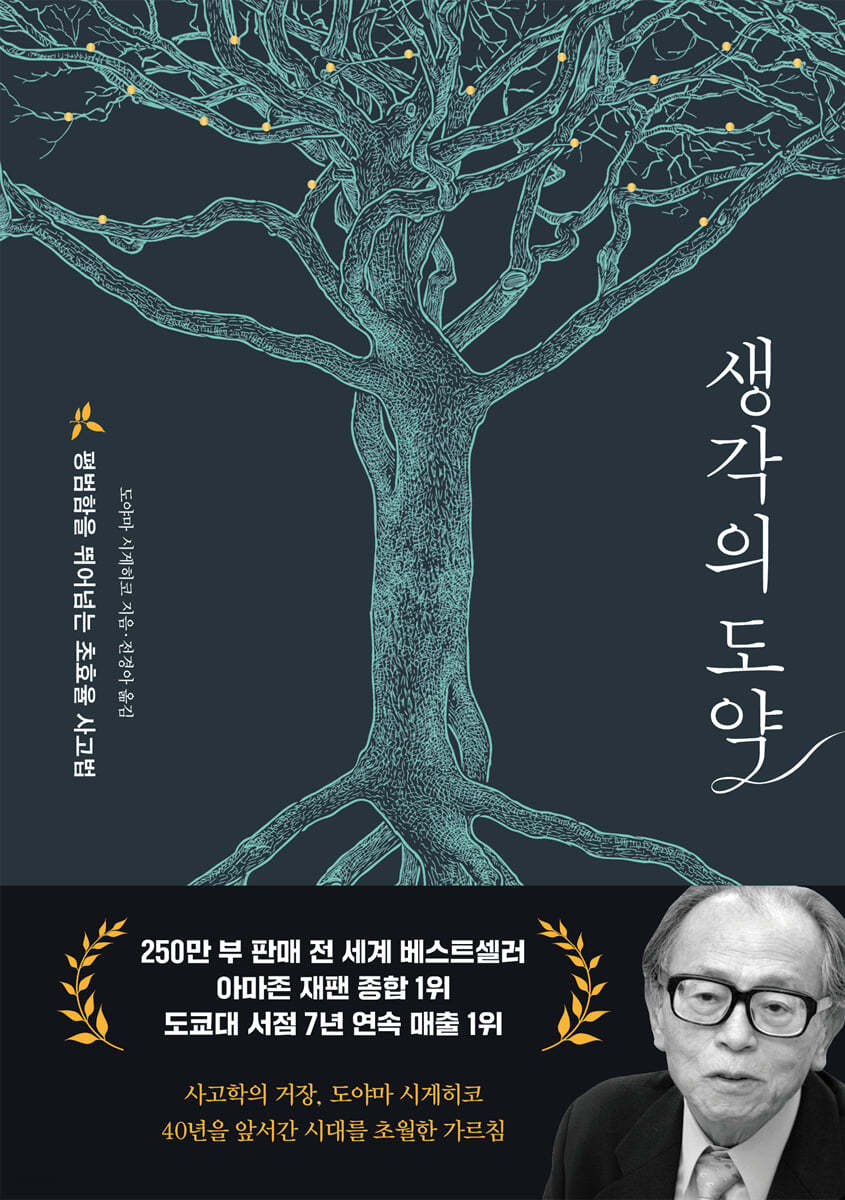
**** A worldwide bestseller with 2.5 million copies sold
**** Amazon Japan #1 for 22 consecutive weeks
**** Tokyo University Bookstore ranks first in sales for 7 consecutive years
A book by Professor Shigehiko Toyama, who was highly praised by the Japanese public and called a “giant of knowledge,” has been published in Korea.
This book has firmly established itself as a "must-read for the University of Tokyo" and has been a legendary steady seller that has been "tenaciously" sold for 40 years, changing the mindset of 2.5 million readers not only in Japan but around the world.
There is an interesting anecdote about how this book suddenly became a bestseller.
A bookstore employee happened to find this book and, in the hopes that more people would read it, wrote a POP that said, “If only I had read it when I was younger...”
It quickly went viral, selling 250,000 copies that year and jumping to number one on Amazon the following year.
Among the numerous teachings, the one the author particularly emphasizes is the 'power to think for oneself.'
The world is no longer satisfied with honor students who simply submit 'perfect answers'.
Going one step further, we want creative talents who can come up with 'original ideas'.
This book is full of ingenious ways to break out of your comfort zone and unleash the creativity within you.
You will experience amazing things that will broaden your horizons, and you will also encounter great discoveries in your everyday life.
Shigehiko Toyama, a master of thought
A timeless teaching 40 years ahead of its time
**** A worldwide bestseller with 2.5 million copies sold
**** Amazon Japan #1 for 22 consecutive weeks
**** Tokyo University Bookstore ranks first in sales for 7 consecutive years
A book by Professor Shigehiko Toyama, who was highly praised by the Japanese public and called a “giant of knowledge,” has been published in Korea.
This book has firmly established itself as a "must-read for the University of Tokyo" and has been a legendary steady seller that has been "tenaciously" sold for 40 years, changing the mindset of 2.5 million readers not only in Japan but around the world.
There is an interesting anecdote about how this book suddenly became a bestseller.
A bookstore employee happened to find this book and, in the hopes that more people would read it, wrote a POP that said, “If only I had read it when I was younger...”
It quickly went viral, selling 250,000 copies that year and jumping to number one on Amazon the following year.
Among the numerous teachings, the one the author particularly emphasizes is the 'power to think for oneself.'
The world is no longer satisfied with honor students who simply submit 'perfect answers'.
Going one step further, we want creative talents who can come up with 'original ideas'.
This book is full of ingenious ways to break out of your comfort zone and unleash the creativity within you.
You will experience amazing things that will broaden your horizons, and you will also encounter great discoveries in your everyday life.
- You can preview some of the book's contents.
Preview
index
Introduction
What are you thinking?
Ⅰ.
True Talent - People Who Can't Soar on Their Own
Voluntary Will - Creativity Taken Away by Kind Education
Morning Brain - The Miraculous Time When Everything Gets Simple
Ⅱ.
Fermentation - Wait until it comes to you on its own feet
Sleep - If you can't overcome it even with effort
Cocktails - Comprehensive and Inventive
Editorship - What order should you group them in?
Catalyst - The most unique thing is the one without personality.
Analogy - How to Solve the Unknown Problem
Serendipity - A discovery disguised as a coincidence
Ⅲ.
Metafication of Information - Transforming Flat Information into Three-Dimensional Thinking
Scraping - An efficient way to gather information
Cards and Notes - Writing Techniques That Increase Value
The Subconscious Reading Method: Using Mental Notes
Second Note - Awakening Ideas and Making Them Breathe Again
Metanote - Transplanting thoughts can lead to terrifying growth.
Ⅳ.
Summary - Abilities Required for Creative People
Forgetting - A Cool Way to Forget
The Test of Time - The Power of Classics That Have Standed the Test of Time
The Courage to Let Go - A Value That Becomes More Important the More Knowledge You Have
Write first - the more you write, the more organized your thoughts become.
Topics and Titles - When you organize your thoughts properly, only nouns remain.
Praise - Thoughts are energized when praised.
V.
Speech - When to speak freely, when to be sparing
Chat - Who will you talk to?
Inbreeding - Similar things don't affect each other
Samsang and Samda - When and Where Does Ingenuity Come From?
Wisdom - knowledge acquired naturally
Proverb - How to Complete a Thought System Without Reading a Book
Ⅵ.
Reality - Root your thoughts in the real world.
The Base and the Unknown - and a New World
Divergence and Convergence - From Perfect Answers to Creative Answers
The Rise of the Computer - Mechanical Man Is Pushed Out by Natural Selection
Special Appendix 1
Definition of 'think'
Special Appendix 2
University of Tokyo Lecture: New Ways to Use the Brain
What are you thinking?
Ⅰ.
True Talent - People Who Can't Soar on Their Own
Voluntary Will - Creativity Taken Away by Kind Education
Morning Brain - The Miraculous Time When Everything Gets Simple
Ⅱ.
Fermentation - Wait until it comes to you on its own feet
Sleep - If you can't overcome it even with effort
Cocktails - Comprehensive and Inventive
Editorship - What order should you group them in?
Catalyst - The most unique thing is the one without personality.
Analogy - How to Solve the Unknown Problem
Serendipity - A discovery disguised as a coincidence
Ⅲ.
Metafication of Information - Transforming Flat Information into Three-Dimensional Thinking
Scraping - An efficient way to gather information
Cards and Notes - Writing Techniques That Increase Value
The Subconscious Reading Method: Using Mental Notes
Second Note - Awakening Ideas and Making Them Breathe Again
Metanote - Transplanting thoughts can lead to terrifying growth.
Ⅳ.
Summary - Abilities Required for Creative People
Forgetting - A Cool Way to Forget
The Test of Time - The Power of Classics That Have Standed the Test of Time
The Courage to Let Go - A Value That Becomes More Important the More Knowledge You Have
Write first - the more you write, the more organized your thoughts become.
Topics and Titles - When you organize your thoughts properly, only nouns remain.
Praise - Thoughts are energized when praised.
V.
Speech - When to speak freely, when to be sparing
Chat - Who will you talk to?
Inbreeding - Similar things don't affect each other
Samsang and Samda - When and Where Does Ingenuity Come From?
Wisdom - knowledge acquired naturally
Proverb - How to Complete a Thought System Without Reading a Book
Ⅵ.
Reality - Root your thoughts in the real world.
The Base and the Unknown - and a New World
Divergence and Convergence - From Perfect Answers to Creative Answers
The Rise of the Computer - Mechanical Man Is Pushed Out by Natural Selection
Special Appendix 1
Definition of 'think'
Special Appendix 2
University of Tokyo Lecture: New Ways to Use the Brain
Detailed image

Into the book
It is said that plants are symmetrical because their visible parts above ground and their roots hidden underground are almost identical in shape.
Flowers bloom because there is a large structure in the ground.
Knowledge is also a flower that blooms on the tree of humanity.
If you just pick flowers and put them in a vase because they are beautiful, they will soon wither.
You can tell just by looking at this that the flower you picked is not yours.
--- p.20
Ironically, the harder schools try to teach and the more knowledge they provide, the more passive learners become.
It is a failure in true education.
--- p.25
As you read, you will come across parts that you admire, parts that you feel uncomfortable with, and parts that you don't understand.
Write all of this down.
If there is a part that resonates with you over and over again, then that part is important.
If you keep seeing mysterious and incomprehensible parts, you also need to be careful.
This is exactly the material.
--- p.38
There is a mysterious power in things that have been held in the heart for a long time.
A sleeping subject becomes incredibly active when it opens its eyes.
--- p.47
This is the editorship of conception.
This is how funny expressions that have the power to intoxicate people come about.
--- p.59
That's not what true organization is.
It is a qualitative change that elevates primary thinking to a higher level.
No matter how much knowledge you have and how often you think and conceive, it will not be elevated to secondary thinking.
You have to let that thought go and wait for the chemical change to occur.
Such a harmonized thought becomes a 'meta-thought' different from before.
--- p.87
No matter how hard you try to forget, there are some things that remain forever.
Because it is connected to the person's deep-seated interests and concerns.
--- p.106
In this notebook, ideas take a break.
If you stop breathing while you are sleeping, you will be thrown away without mercy.
If you don't gain weight while sleeping, it means you didn't have a connection.
An idea that is still interesting when you look at it again is alive and well.
Don't just leave it there, let it rest a little longer somewhere else.
--- p.111
If you pass through the gate of your own mind, you are likely to pass through the gate of someone else's mind.
--- p.112
We are so focused on accumulating knowledge that we don't really think about what to do with the knowledge that enters our heads.
That's how knowledgeable people come into being.
--- p.142
Some knowledge must be discarded.
To discard it naturally is forgetting, and to discard it consciously is organizing.
--- p.145
For humans to become truly human, they must be able to do things that machines cannot or cannot reach.
In that sense, creativity is the greatest thing.
Flowers bloom because there is a large structure in the ground.
Knowledge is also a flower that blooms on the tree of humanity.
If you just pick flowers and put them in a vase because they are beautiful, they will soon wither.
You can tell just by looking at this that the flower you picked is not yours.
--- p.20
Ironically, the harder schools try to teach and the more knowledge they provide, the more passive learners become.
It is a failure in true education.
--- p.25
As you read, you will come across parts that you admire, parts that you feel uncomfortable with, and parts that you don't understand.
Write all of this down.
If there is a part that resonates with you over and over again, then that part is important.
If you keep seeing mysterious and incomprehensible parts, you also need to be careful.
This is exactly the material.
--- p.38
There is a mysterious power in things that have been held in the heart for a long time.
A sleeping subject becomes incredibly active when it opens its eyes.
--- p.47
This is the editorship of conception.
This is how funny expressions that have the power to intoxicate people come about.
--- p.59
That's not what true organization is.
It is a qualitative change that elevates primary thinking to a higher level.
No matter how much knowledge you have and how often you think and conceive, it will not be elevated to secondary thinking.
You have to let that thought go and wait for the chemical change to occur.
Such a harmonized thought becomes a 'meta-thought' different from before.
--- p.87
No matter how hard you try to forget, there are some things that remain forever.
Because it is connected to the person's deep-seated interests and concerns.
--- p.106
In this notebook, ideas take a break.
If you stop breathing while you are sleeping, you will be thrown away without mercy.
If you don't gain weight while sleeping, it means you didn't have a connection.
An idea that is still interesting when you look at it again is alive and well.
Don't just leave it there, let it rest a little longer somewhere else.
--- p.111
If you pass through the gate of your own mind, you are likely to pass through the gate of someone else's mind.
--- p.112
We are so focused on accumulating knowledge that we don't really think about what to do with the knowledge that enters our heads.
That's how knowledgeable people come into being.
--- p.142
Some knowledge must be discarded.
To discard it naturally is forgetting, and to discard it consciously is organizing.
--- p.145
For humans to become truly human, they must be able to do things that machines cannot or cannot reach.
In that sense, creativity is the greatest thing.
--- p.228
Publisher's Review
The legacy of a master of modern Japanese thought
The most perfect thought-organizing technique
While there has been a recent surge of interest in improving vocabulary and literacy, the key to true intellectual growth lies in developing higher-level thinking.
The author points out that modern people "don't even realize that they can't think for themselves," and that we need to take a closer look at what thinking is.
We acquire a vast amount of knowledge while attending school, but we are not taught how to think.
Especially in modern society, where new information is constantly pouring in, the ability to filter out unnecessary knowledge and organize thoughts is important.
Professor Toyama explains that the secret to creativity lies in properly maturing selected information.
“Even while dreaming, thoughts grow.”
"Super-Efficient Thinking" Followed by Students at Prestigious Universities
The author introduced the method of writing “metanotes” as one way to elevate thoughts to a higher level.
This is a very simple method that only requires three notebooks. Just copy the information you acquire in your daily life three times from notebook 1 to notebook 2 to notebook 3.
Even if it seems like it's just a copy and paste, it's absolutely not.
Amazingly, during this process, thoughts mature on their own.
Even while we dream, our thoughts grow bigger and bigger.
Unnecessary information disappears, and surprising ideas that you never thought of before pop up.
Note number 3 is called the “metanote.”
Just surviving this far is meaningful in itself.
Because it is a valuable asset that embodies one's personal values and interests.
It is really important knowledge that has passed through the gate of one's own mind, so it is very likely to pass through the gate of another's mind.
The author said that he created 53 notebooks over 20 years and that they were everything to him.
Besides note-taking, there are many ways to improve your thinking skills.
The author introduces key principles such as “If you can’t overcome it with effort, forget it,” “The most unique thought is to be without individuality,” and “Make one day into two.” These principles break free from existing stereotypes and provide fresh inspiration that you won’t find anywhere else.
As you read, you'll discover clues to how to organize complex thoughts, where to find the material for ideas, and the process by which great discoveries are made.
The most perfect thought-organizing technique
While there has been a recent surge of interest in improving vocabulary and literacy, the key to true intellectual growth lies in developing higher-level thinking.
The author points out that modern people "don't even realize that they can't think for themselves," and that we need to take a closer look at what thinking is.
We acquire a vast amount of knowledge while attending school, but we are not taught how to think.
Especially in modern society, where new information is constantly pouring in, the ability to filter out unnecessary knowledge and organize thoughts is important.
Professor Toyama explains that the secret to creativity lies in properly maturing selected information.
“Even while dreaming, thoughts grow.”
"Super-Efficient Thinking" Followed by Students at Prestigious Universities
The author introduced the method of writing “metanotes” as one way to elevate thoughts to a higher level.
This is a very simple method that only requires three notebooks. Just copy the information you acquire in your daily life three times from notebook 1 to notebook 2 to notebook 3.
Even if it seems like it's just a copy and paste, it's absolutely not.
Amazingly, during this process, thoughts mature on their own.
Even while we dream, our thoughts grow bigger and bigger.
Unnecessary information disappears, and surprising ideas that you never thought of before pop up.
Note number 3 is called the “metanote.”
Just surviving this far is meaningful in itself.
Because it is a valuable asset that embodies one's personal values and interests.
It is really important knowledge that has passed through the gate of one's own mind, so it is very likely to pass through the gate of another's mind.
The author said that he created 53 notebooks over 20 years and that they were everything to him.
Besides note-taking, there are many ways to improve your thinking skills.
The author introduces key principles such as “If you can’t overcome it with effort, forget it,” “The most unique thought is to be without individuality,” and “Make one day into two.” These principles break free from existing stereotypes and provide fresh inspiration that you won’t find anywhere else.
As you read, you'll discover clues to how to organize complex thoughts, where to find the material for ideas, and the process by which great discoveries are made.
GOODS SPECIFICS
- Date of issue: January 29, 2025
- Page count, weight, size: 256 pages | 426g | 148*210*16mm
- ISBN13: 9791169851206
You may also like
카테고리
korean


korean

![GQ KOREA Mark (Monthly): December [2025]](http://librairie.coreenne.fr/cdn/shop/files/8ef265dbbfbf186523ed75ba7319009d.jpg?v=1765340328&width=3840)


