

Time to read classics
 |
Description
Book Introduction
- A word from MD
-
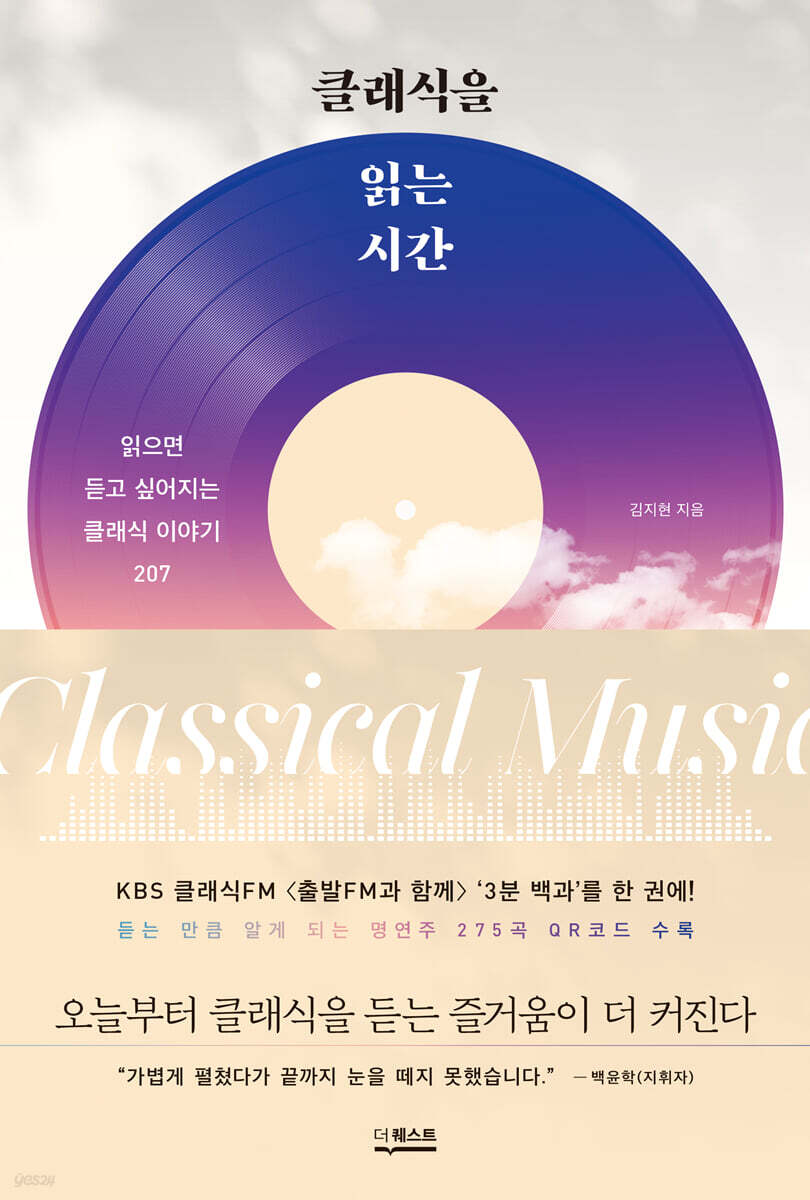
A classic story you'll want to hear as you readThe '3-Minute Encyclopedia' corner of KBS Classic FM's 'Start FM with Departure', which starts the day with classical music, is included in one volume.
As the saying goes, “You hear as much as you know,” the world of classical music is easily and richly explained.
The 275 songs in the book can be listened to immediately after reading, giving you the experience of music flowing out every time you turn the page.
October 1, 2025. Art PD Ahn Hyun-jae
▶ KBS Classic FM's "Departure with FM" '3-Minute Encyclopedia' in one volume!
▶ 275 songs with QR codes that you can learn the more you listen to.
"From today, the pleasure of listening to classical music will increase."
A classical walk for those who want to listen to their favorite music for longer.
"Dancing Conductor" Baek Yoon-hak and musicologist Professor Jeong Gyeong-yeong
〈With Departure FM〉 Strongly recommended by announcer Lee Jae-hoo!
Do you like classical music? There are many ways to access and enjoy it.
You can find classical music performance content on video platforms, and you can also use music-specific apps.
There are many people who go out of their way to see performances by their favorite performers.
Another truly 'classic' way is to naturally encounter classical music in your daily life.
It's 'radio'.
Many people start their day with Classic FM radio.
Sometimes lively, sometimes calm, you can enjoy the unexpected pleasure of finding a song that suits your taste among a wide selection of songs, and you can also ask questions about classical music and enjoy a fun quiz corner as a bonus.
At first, people who accidentally encounter classical music for the first time become curious, develop favorite music and composers, and become enthusiasts.
In the process, I've compiled my growing knowledge of classical music into a single book. This content has been featured on the "3-Minute Encyclopedia" segment of "Let's Go with FM," broadcast daily from 7:00 AM to 9:00 AM on KBS Classic FM (93.1MHz) for over two years.
Do you still find classical music boring and formal, making it difficult to approach? Now, classical music is shedding its traditional image and being reinterpreted as "hip" music that can be enjoyed without pressure.
Classical playlists are gaining popularity on YouTube, and fandoms for performers are growing on social media and at concert halls.
There has also been an increase in the number of people learning to play musical instruments as a hobby.
Those who have taken a step into the world of classical music are captivated by the dopamine-filled charm of classical music, no less than any other hobby or pastime.
▶ 275 songs with QR codes that you can learn the more you listen to.
"From today, the pleasure of listening to classical music will increase."
A classical walk for those who want to listen to their favorite music for longer.
"Dancing Conductor" Baek Yoon-hak and musicologist Professor Jeong Gyeong-yeong
〈With Departure FM〉 Strongly recommended by announcer Lee Jae-hoo!
Do you like classical music? There are many ways to access and enjoy it.
You can find classical music performance content on video platforms, and you can also use music-specific apps.
There are many people who go out of their way to see performances by their favorite performers.
Another truly 'classic' way is to naturally encounter classical music in your daily life.
It's 'radio'.
Many people start their day with Classic FM radio.
Sometimes lively, sometimes calm, you can enjoy the unexpected pleasure of finding a song that suits your taste among a wide selection of songs, and you can also ask questions about classical music and enjoy a fun quiz corner as a bonus.
At first, people who accidentally encounter classical music for the first time become curious, develop favorite music and composers, and become enthusiasts.
In the process, I've compiled my growing knowledge of classical music into a single book. This content has been featured on the "3-Minute Encyclopedia" segment of "Let's Go with FM," broadcast daily from 7:00 AM to 9:00 AM on KBS Classic FM (93.1MHz) for over two years.
Do you still find classical music boring and formal, making it difficult to approach? Now, classical music is shedding its traditional image and being reinterpreted as "hip" music that can be enjoyed without pressure.
Classical playlists are gaining popularity on YouTube, and fandoms for performers are growing on social media and at concert halls.
There has also been an increase in the number of people learning to play musical instruments as a hobby.
Those who have taken a step into the world of classical music are captivated by the dopamine-filled charm of classical music, no less than any other hobby or pastime.
- You can preview some of the book's contents.
Preview
index
1st movement.
The Basics of Music
1.
The names and compositions of the keys are difficult
Can someone tell me what song this is? / What are the letters in each song title? / Why is key important? / How does key affect music?
2.
The World of Opus Numbers
The story of the opus number 'Opus' / What does the opus number 1 mean? / Different composers use different opus numbers? / Numbers that excite Mozart fans / Is Debussy's opus number 1 the 10th?
3.
The history of musical scores
Did people in the Middle Ages and Renaissance see sheet music like this? / Bach's inventions aren't just one type of sheet music? / Who manages the sheet music for an orchestra of over 100 people? / How did people in the 19th century enjoy famous pieces at home?
4.
Performance techniques and expressions
Pizzicato, plucking the strings with your fingers / mid-note, playing multiple notes with a single stroke / staccato, playing short notes / glissando, sliding between notes / tremolo, a vibration expressed by the instrument
5.
Getting a feel for speed
The many shades of "slow" / Why are tempo words mostly Italian? / What exactly is "moderato"? / What is the metronome tempo for "allegro"? / "Fast" also has many feelings.
6.
Other directives and indicators
Neither too much nor too little, the aesthetics of 'non troppo' / 'Ritardando' as if 'pushing' with music / 'Cantabile' as if singing / A group of directives starting with 'con'
7.
The form of vocal music
Solo and duet / choir and a cappella
8.
instrumental music form
Solo and Duo / The delicate and intimate world of chamber music / [Everything about chamber music arrangements] / All instruments come together to form a grand ensemble, an orchestra / String ensemble and wind ensemble
9.
The Conductor's World
Do we really need a conductor? / From canes to toothpicks, the story of the baton / The conductor's view of the 'score' / Do conductors also have competitions? / What instrumentalists are most often conductors?
10.
Concert scene
How did 'Encore' begin? / Encore songs that reflect the times, places, and situations / [Encore This and That] / Page Turners, the Performers' Companions / The Origin of 'Box Office' / 'Intermission' Begins Now
2nd movement.
Music of instruments
1.
Rich tone, the charm of woodwind instruments
The 'standard' for oboe and orchestra pitch
Oboe · The secret to sound lies in this well-cut 'thing'?
Oboe · 'Circular Breathing': Inhaling and Exhaling at the Same Time
Are oboes and English horns also members of the oboe family?
Oboe · Is 'Oboe of Love' the name of an instrument?
Flute · Gold flute, silver flute, black flute?
Flute · Why is a metal flute a woodwind instrument?
Flute: An instrument favored by Frederick the Great in the 18th century
Flute · The world drawn by the sound of the flute
Piccolo: What is the highest-pitched instrument in the orchestra?
Clarinet · A composer who cannot be left out in the history of the clarinet
[How to distinguish between oboe and clarinet]
Clarinet · Clarinet sound remaining in movie scenes
Clarinet · The Clarinet 'Family' Story
Bassoon · Bassoon or Bassoon
Bassoon: An instrument that has been around since the Baroque era
Bassoon · What you see isn't everything
A must-play song for bassoonists
Recorder - An instrument very familiar to Koreans
[Baroque recorder, German recorder]
Saxophone · The saxophone isn't a brass instrument?
2.
Overwhelming presence, the power of brass instruments
A song that is the 'Alpha and Omega' for trumpeters and trumpeters.
Trumpet · A follow-up to Haydn's "Trumpet Concerto"
Trumpet: The instrument that competed with the legendary castrato Farinelli
Trumpet: An instrument encountered at key moments in one's past life
[Trumper Frequently Asked Questions]
Trombones: The trombone family, which appeared a full 500 years ago
Trombones · Why Trombones Stand at the Front Row of Military Bands
Trombone: A brass instrument that harmonizes with the human voice
Trombone · When was the trombone introduced into the orchestra?
Horn: The most difficult instrument to play in the world
[Horn and French Horn]
Horn · Why do you play with one hand inside the bell?
Horn, the 'licorice of the pharmacy'
Horn · A father and son who loved the horn
[Man playing the horn with his toes]
Tuba: The youngest instrument in the orchestra
Wagner tuba · It's not a tuba, it's a horn
Suzaphone · Is it a person, an instrument, or a snail?
3.
The melody of a stringed instrument created by the vibration of the strings
Why is the violinist in charge of the violin and orchestra?
Violin · Cremona, the home of the violin
[The Story of a Violin Master]
The Violin – Is it truly the devil's instrument?
[The Secret to a Good Violin Sound]
Violin · Why was Paganini so popular?
Violin · What is the most difficult violin piece in the world?
Viola · A secretly traditional viola joke
Viola · Viola without standard instrument dimensions
The second of the three brothers in the viola and string ensemble, the same instrument
Viola · Viola Concerto
Viola · 'National Violist' Richard Yongjae O'Neill
Cello · The Cellist of Sarajevo and the Instrument of Comfort
Cello · The Old Testament of the Cello: Bach's "Unaccompanied Cello Suites"
Cello · The New Testament of the Cello: Beethoven's Cello Sonata
What the advent of cello endpins changed
Cello · Haydn's Cello Concerto, brilliantly revived
Cello: The only instrument capable of single-instrument ensemble
Double bass · Double bass, contrabass, contrabass…?
Double Bass · Monodrama "Contrabass"
Double bass · Bottesini, called the 'Paganini of the double bass'
Double Bass · What is the most frequently asked question double bass players get?
Harp, the oldest stringed instrument in music history
Harp · A supporting role more popular than the lead, Handel's "Harp Concerto"
Harp, an instrument popularized by Marie Antoinette
Harp · Debussy and Ravel's harp competition
Arpeggio, a technique derived from the harp
From lute and wandering musicians to village girls
Mandolin: A romantic instrument that accompanied serenades
Giuliani, who led the golden age of guitar in the 18th century
Others: Sans, Segovia, Rodrigo
4.
A moment to watch: the tapping of percussion instruments
A bass drum that brings the sound of thunder
Snare drum: a small drum that requires delicate technique
Castanets · Castanets, how far have you played them?
Tambourine · The exotic sound of tinkling
Triangle · Does the triangle play an active role in Liszt's piano concerto?
Timpani · Timpanist waiting for the final blow
Marimba, xylophone, glockenspiel, marimba
Cymbals · "Waiting" is also played
Bell · The sound that creates special moments
5.
The world of versatile keyboard instruments
Piano vs. Harpsichord: Pluck or Strike, That is the Difference
The Rise, Fall, and Resurgence of the Harpsichord vs. the Piano
Harpsichord vs. Piano · The fortepiano that Bach, Mozart, and Haydn first encountered
[Pianist Mozart vs. Pianist Beethoven]
Harpsichord vs. Piano · What instrument are Bach's "Goldberg Variations" for?
Piano · White and Black Keys
Piano · Grand piano or upright piano: which came first?
Piano · Three pedals: types and functions
[The Story of the Piano Brand Loved by Pianists]
Organ · The master of the organ whom Bach and Handel met on foot
Organ · Organ playing requires multiple people
Organ · Is there a magic button on the organ?
Organ · Organs found in churches, concert halls, movie theaters, and ballrooms
Organ · The composer's main occupation was organist.
Other keyboard instruments: the celesta, which produces "heavenly sounds"
Other keyboard instruments: player pianos, melodica, toy pianos
3rd movement.
Music of the Voice
1.
Completion of the four parts
The tenor voice, which first appeared in the history of music / The root and foundation of the four-part voice, the bass / The sound that shines from the highest place, the soprano / The power of the inner voice, the alto or contralto / The history of the evolution of the four-part choir
2.
Deep beauty, a song
If the lyrics of several verses are sung with the same melody, it is a 'strophic song' / If different melodies are added to each verse, it is a 'consecutive song' / Before Schubert's songs, there were Beethoven's songs / The birth of German art songs, Lied / Schumann's 'Year of Song' / Mahler's songs accompanied by an orchestra
3.
Opera, the pinnacle of comprehensive art
A Beginner's Guide to Opera: Components / Did Opera Originate from a Wedding Song? / Opera, Becoming Everyone's Art in Venice / When You Meet 'Da Capo' in Opera, It's Time for the Singer / The Active Roles of Popular Opera Librarians in the Mozart Era / [The World of Mozart's Opera] / The Diva of Opera, Not the 'Prima Donna', but the 'Prima Donna' / Opera Where the Mezzo-Soprano Leads! / Male Roles, but Performed by Mezzo-Sopranos / What Roles Do Alto (Contralto) Singers Play in Opera? / The Contrasting Charms of Bass Singers / The Role of the Tenor, a High-Ranking and Attractive Leading Role / What is a 'Verdi Baritone'? / The Legend of the Castrati / The Countertenor, a Male Voice Singing the Female Voice / [The World of Puccini's Opera]
4.
Baroque vocal music
Bach's 'Secular Cantata' performed in a coffee house / Bach's 'Church Cantata' containing all of Baroque music / 20th-century secular cantata "Carmina Burana" / Oratorio that moved the King of England to his feet / Church music, Passion, that deals solely with the story of Jesus' suffering
5.
Understanding the Mass
What are the "ordinary" and "proper" masses? / The five movements of the ordinary mass: Kyrie, Gloria, Credo, Sanctus, and Agnus Dei / Vivaldi's uplifting "Gloria" / The score in Beethoven's portrait was "Missa Solemnis" / Mozart's unfinished "Requiem" / Ramirez's "Missa Criola," a mass sung in the native language
4th movement.
The shape of music
1.
The evolution of the symphony
Is the opera house the birthplace of the symphony? / Why Haydn, the "Father of the Symphony," went to London / Mozart, the blossoming of the symphony / Beethoven, the master of "build-up" that perfected the symphony
[Berlioz's Symphonie Fantastique] / Absolute Music and Program Music: Conservatism and Progressivism in 19th-Century Symphonies / [Brahms' Symphonies, Liszt's Symphonic Poems] / Is the Ninth Symphony Cursed? / Prokofiev's Symphony of the 20th Century / [Concertos Like Graduation Albums: Bartók's Concerto for Orchestra]
2.
Cooperate or compete, concerto
Solo concerto, where a solo instrument and an orchestra meet / Solo group vs. ensemble concerto / Cadenza, the flower of the concerto that blooms at the end of a movement / A departure from the 19th-century concerto
3.
A collection that can contain anything
Aren't "Suites" "Sweet Music"? / Orchestral Suites for Events
4.
Understanding Sonatas
Sonata and Sonatine / Is the first movement of a 'Sonata' in 'Sonata form'?
5.
The Beauty of Repetition, Variations
Melody variations, Mozart's "Little Star Variations" / Variations on a bass theme, Pachelbel's "Canon" / Most popular theme, "Variations on a Theme of Paganini"
6.
Serenade of the Night
Lover, "Open the Window~Door" / Serenade and Friends
7.
Uses of Marches
Military March in Step / Majestic, Coronation March / Music of Mourning, Funeral March / Wedding March to Brighten the Day
8.
The power of incidental music
Music that fills and accompanies the stage
9.
piano exercises
Chopin's Etude, the first concert study piece / Liszt's Transcendental Technique Study, the 'ultimate' of virtuosity
10.
The world of dance music
Strauss's Waltz / Can You Dance to Chopin's Waltz? / Schellwee, Polka / Polish Dance in Triple Time, Polonaise / A More Lively Polish Dance, Mazurka / Gracefully, Pavane / Keep on Dance Even if Your Steps Are Twisted, Tango / Piazzolla's Tango for the Ears, Not the Feet / [The Bandoneon, an Indispensable Instrument in Tango]
11.
Various other genres
Nocturne, music of the night on the piano / Impromptu, but not improvisation / Song without words, something / You already know 'Bagatel' / Rhapsody, a free frame and strong emotions / Ballad, not just a love song / Scherzo, music that started as a joke and grew into something big / Romance with deep lyricism
The Basics of Music
1.
The names and compositions of the keys are difficult
Can someone tell me what song this is? / What are the letters in each song title? / Why is key important? / How does key affect music?
2.
The World of Opus Numbers
The story of the opus number 'Opus' / What does the opus number 1 mean? / Different composers use different opus numbers? / Numbers that excite Mozart fans / Is Debussy's opus number 1 the 10th?
3.
The history of musical scores
Did people in the Middle Ages and Renaissance see sheet music like this? / Bach's inventions aren't just one type of sheet music? / Who manages the sheet music for an orchestra of over 100 people? / How did people in the 19th century enjoy famous pieces at home?
4.
Performance techniques and expressions
Pizzicato, plucking the strings with your fingers / mid-note, playing multiple notes with a single stroke / staccato, playing short notes / glissando, sliding between notes / tremolo, a vibration expressed by the instrument
5.
Getting a feel for speed
The many shades of "slow" / Why are tempo words mostly Italian? / What exactly is "moderato"? / What is the metronome tempo for "allegro"? / "Fast" also has many feelings.
6.
Other directives and indicators
Neither too much nor too little, the aesthetics of 'non troppo' / 'Ritardando' as if 'pushing' with music / 'Cantabile' as if singing / A group of directives starting with 'con'
7.
The form of vocal music
Solo and duet / choir and a cappella
8.
instrumental music form
Solo and Duo / The delicate and intimate world of chamber music / [Everything about chamber music arrangements] / All instruments come together to form a grand ensemble, an orchestra / String ensemble and wind ensemble
9.
The Conductor's World
Do we really need a conductor? / From canes to toothpicks, the story of the baton / The conductor's view of the 'score' / Do conductors also have competitions? / What instrumentalists are most often conductors?
10.
Concert scene
How did 'Encore' begin? / Encore songs that reflect the times, places, and situations / [Encore This and That] / Page Turners, the Performers' Companions / The Origin of 'Box Office' / 'Intermission' Begins Now
2nd movement.
Music of instruments
1.
Rich tone, the charm of woodwind instruments
The 'standard' for oboe and orchestra pitch
Oboe · The secret to sound lies in this well-cut 'thing'?
Oboe · 'Circular Breathing': Inhaling and Exhaling at the Same Time
Are oboes and English horns also members of the oboe family?
Oboe · Is 'Oboe of Love' the name of an instrument?
Flute · Gold flute, silver flute, black flute?
Flute · Why is a metal flute a woodwind instrument?
Flute: An instrument favored by Frederick the Great in the 18th century
Flute · The world drawn by the sound of the flute
Piccolo: What is the highest-pitched instrument in the orchestra?
Clarinet · A composer who cannot be left out in the history of the clarinet
[How to distinguish between oboe and clarinet]
Clarinet · Clarinet sound remaining in movie scenes
Clarinet · The Clarinet 'Family' Story
Bassoon · Bassoon or Bassoon
Bassoon: An instrument that has been around since the Baroque era
Bassoon · What you see isn't everything
A must-play song for bassoonists
Recorder - An instrument very familiar to Koreans
[Baroque recorder, German recorder]
Saxophone · The saxophone isn't a brass instrument?
2.
Overwhelming presence, the power of brass instruments
A song that is the 'Alpha and Omega' for trumpeters and trumpeters.
Trumpet · A follow-up to Haydn's "Trumpet Concerto"
Trumpet: The instrument that competed with the legendary castrato Farinelli
Trumpet: An instrument encountered at key moments in one's past life
[Trumper Frequently Asked Questions]
Trombones: The trombone family, which appeared a full 500 years ago
Trombones · Why Trombones Stand at the Front Row of Military Bands
Trombone: A brass instrument that harmonizes with the human voice
Trombone · When was the trombone introduced into the orchestra?
Horn: The most difficult instrument to play in the world
[Horn and French Horn]
Horn · Why do you play with one hand inside the bell?
Horn, the 'licorice of the pharmacy'
Horn · A father and son who loved the horn
[Man playing the horn with his toes]
Tuba: The youngest instrument in the orchestra
Wagner tuba · It's not a tuba, it's a horn
Suzaphone · Is it a person, an instrument, or a snail?
3.
The melody of a stringed instrument created by the vibration of the strings
Why is the violinist in charge of the violin and orchestra?
Violin · Cremona, the home of the violin
[The Story of a Violin Master]
The Violin – Is it truly the devil's instrument?
[The Secret to a Good Violin Sound]
Violin · Why was Paganini so popular?
Violin · What is the most difficult violin piece in the world?
Viola · A secretly traditional viola joke
Viola · Viola without standard instrument dimensions
The second of the three brothers in the viola and string ensemble, the same instrument
Viola · Viola Concerto
Viola · 'National Violist' Richard Yongjae O'Neill
Cello · The Cellist of Sarajevo and the Instrument of Comfort
Cello · The Old Testament of the Cello: Bach's "Unaccompanied Cello Suites"
Cello · The New Testament of the Cello: Beethoven's Cello Sonata
What the advent of cello endpins changed
Cello · Haydn's Cello Concerto, brilliantly revived
Cello: The only instrument capable of single-instrument ensemble
Double bass · Double bass, contrabass, contrabass…?
Double Bass · Monodrama "Contrabass"
Double bass · Bottesini, called the 'Paganini of the double bass'
Double Bass · What is the most frequently asked question double bass players get?
Harp, the oldest stringed instrument in music history
Harp · A supporting role more popular than the lead, Handel's "Harp Concerto"
Harp, an instrument popularized by Marie Antoinette
Harp · Debussy and Ravel's harp competition
Arpeggio, a technique derived from the harp
From lute and wandering musicians to village girls
Mandolin: A romantic instrument that accompanied serenades
Giuliani, who led the golden age of guitar in the 18th century
Others: Sans, Segovia, Rodrigo
4.
A moment to watch: the tapping of percussion instruments
A bass drum that brings the sound of thunder
Snare drum: a small drum that requires delicate technique
Castanets · Castanets, how far have you played them?
Tambourine · The exotic sound of tinkling
Triangle · Does the triangle play an active role in Liszt's piano concerto?
Timpani · Timpanist waiting for the final blow
Marimba, xylophone, glockenspiel, marimba
Cymbals · "Waiting" is also played
Bell · The sound that creates special moments
5.
The world of versatile keyboard instruments
Piano vs. Harpsichord: Pluck or Strike, That is the Difference
The Rise, Fall, and Resurgence of the Harpsichord vs. the Piano
Harpsichord vs. Piano · The fortepiano that Bach, Mozart, and Haydn first encountered
[Pianist Mozart vs. Pianist Beethoven]
Harpsichord vs. Piano · What instrument are Bach's "Goldberg Variations" for?
Piano · White and Black Keys
Piano · Grand piano or upright piano: which came first?
Piano · Three pedals: types and functions
[The Story of the Piano Brand Loved by Pianists]
Organ · The master of the organ whom Bach and Handel met on foot
Organ · Organ playing requires multiple people
Organ · Is there a magic button on the organ?
Organ · Organs found in churches, concert halls, movie theaters, and ballrooms
Organ · The composer's main occupation was organist.
Other keyboard instruments: the celesta, which produces "heavenly sounds"
Other keyboard instruments: player pianos, melodica, toy pianos
3rd movement.
Music of the Voice
1.
Completion of the four parts
The tenor voice, which first appeared in the history of music / The root and foundation of the four-part voice, the bass / The sound that shines from the highest place, the soprano / The power of the inner voice, the alto or contralto / The history of the evolution of the four-part choir
2.
Deep beauty, a song
If the lyrics of several verses are sung with the same melody, it is a 'strophic song' / If different melodies are added to each verse, it is a 'consecutive song' / Before Schubert's songs, there were Beethoven's songs / The birth of German art songs, Lied / Schumann's 'Year of Song' / Mahler's songs accompanied by an orchestra
3.
Opera, the pinnacle of comprehensive art
A Beginner's Guide to Opera: Components / Did Opera Originate from a Wedding Song? / Opera, Becoming Everyone's Art in Venice / When You Meet 'Da Capo' in Opera, It's Time for the Singer / The Active Roles of Popular Opera Librarians in the Mozart Era / [The World of Mozart's Opera] / The Diva of Opera, Not the 'Prima Donna', but the 'Prima Donna' / Opera Where the Mezzo-Soprano Leads! / Male Roles, but Performed by Mezzo-Sopranos / What Roles Do Alto (Contralto) Singers Play in Opera? / The Contrasting Charms of Bass Singers / The Role of the Tenor, a High-Ranking and Attractive Leading Role / What is a 'Verdi Baritone'? / The Legend of the Castrati / The Countertenor, a Male Voice Singing the Female Voice / [The World of Puccini's Opera]
4.
Baroque vocal music
Bach's 'Secular Cantata' performed in a coffee house / Bach's 'Church Cantata' containing all of Baroque music / 20th-century secular cantata "Carmina Burana" / Oratorio that moved the King of England to his feet / Church music, Passion, that deals solely with the story of Jesus' suffering
5.
Understanding the Mass
What are the "ordinary" and "proper" masses? / The five movements of the ordinary mass: Kyrie, Gloria, Credo, Sanctus, and Agnus Dei / Vivaldi's uplifting "Gloria" / The score in Beethoven's portrait was "Missa Solemnis" / Mozart's unfinished "Requiem" / Ramirez's "Missa Criola," a mass sung in the native language
4th movement.
The shape of music
1.
The evolution of the symphony
Is the opera house the birthplace of the symphony? / Why Haydn, the "Father of the Symphony," went to London / Mozart, the blossoming of the symphony / Beethoven, the master of "build-up" that perfected the symphony
[Berlioz's Symphonie Fantastique] / Absolute Music and Program Music: Conservatism and Progressivism in 19th-Century Symphonies / [Brahms' Symphonies, Liszt's Symphonic Poems] / Is the Ninth Symphony Cursed? / Prokofiev's Symphony of the 20th Century / [Concertos Like Graduation Albums: Bartók's Concerto for Orchestra]
2.
Cooperate or compete, concerto
Solo concerto, where a solo instrument and an orchestra meet / Solo group vs. ensemble concerto / Cadenza, the flower of the concerto that blooms at the end of a movement / A departure from the 19th-century concerto
3.
A collection that can contain anything
Aren't "Suites" "Sweet Music"? / Orchestral Suites for Events
4.
Understanding Sonatas
Sonata and Sonatine / Is the first movement of a 'Sonata' in 'Sonata form'?
5.
The Beauty of Repetition, Variations
Melody variations, Mozart's "Little Star Variations" / Variations on a bass theme, Pachelbel's "Canon" / Most popular theme, "Variations on a Theme of Paganini"
6.
Serenade of the Night
Lover, "Open the Window~Door" / Serenade and Friends
7.
Uses of Marches
Military March in Step / Majestic, Coronation March / Music of Mourning, Funeral March / Wedding March to Brighten the Day
8.
The power of incidental music
Music that fills and accompanies the stage
9.
piano exercises
Chopin's Etude, the first concert study piece / Liszt's Transcendental Technique Study, the 'ultimate' of virtuosity
10.
The world of dance music
Strauss's Waltz / Can You Dance to Chopin's Waltz? / Schellwee, Polka / Polish Dance in Triple Time, Polonaise / A More Lively Polish Dance, Mazurka / Gracefully, Pavane / Keep on Dance Even if Your Steps Are Twisted, Tango / Piazzolla's Tango for the Ears, Not the Feet / [The Bandoneon, an Indispensable Instrument in Tango]
11.
Various other genres
Nocturne, music of the night on the piano / Impromptu, but not improvisation / Song without words, something / You already know 'Bagatel' / Rhapsody, a free frame and strong emotions / Ballad, not just a love song / Scherzo, music that started as a joke and grew into something big / Romance with deep lyricism
Detailed image

Into the book
I hope that those who pick up this book will become familiar with unfamiliar terms and discover classical music that exists close to our lives.
Above all, I hope that after reading the book, readers will be left with a few songs that they can proudly say are 'my favorites'. So, I have compiled numerous '3 minutes' into one book.
--- 「Introduction.
From "3 minutes of water droplets gather to form a sea of classics"
Composers also have their own preferred keys.
Beethoven mainly used E-flat major for majestic and stately music.
The same goes for the Piano Concerto No. 5, 'Emperor', and the Symphony No. 3, 'Heroic', which was intended to be dedicated to Napoleon under the title 'Bonaparte'.
The Piano Sonata No. 26, 'Farewell', dedicated to Archduke Rudolf, his lifelong friend and patron, was also written in E-flat major.
On the other hand, for a song with a heavy and solemn atmosphere, I chose the key of C minor.
Representative pieces include Beethoven's Piano Sonata No. 8 'Pathétique', the Coriolanus Overture, which tells the tragic story of the ancient Roman hero Coriolanus, and Symphony No. 5, also known as 'Fate'.
--- From "Why is composition important?"
In December of the year he turned twenty, Johannes Brahms set aside all his previous compositions and composed the Piano Sonata No. 1, Op.
Published with 1 attached.
That fall, Brahms met the Schumanns for the first time and played for them, receiving rave reviews that said it was “new music I had never heard before.”
Schumann was amazed by Brahms' talent after hearing this piece and introduced him to the New Music Journal and recommended him to a publisher.
Brahms dedicated this piece to the violinist Joseph Joachim, who introduced him to the Schumanns.
So, what is the most splendid piece in the history of music, Opus 1? Niccolo Paganini, the greatest violinist of the 19th century, published his "Caprice for Solo Violin" as Opus 1 in 1820.
It is one of the most difficult violin pieces, requiring dizzying technique and speed, as well as complex and special playing techniques, almost like etudes.
Paganini dedicated this piece not to a specific artist or noble patron, but to "the artists"—that is, to all violinists.
--- From "What is the meaning of the work number 1?"
George Gershwin's "Rhapsody in Blue" begins with a very striking introduction.
In February 1924, ahead of the New York premiere, Gershwin, who was to perform as the piano soloist, was rehearsing with Paul Whiteman's band.
Then clarinetist Ross Gorman tried a playful, humorous introduction, a long, drawn-out trill in the low notes that then glides upwards into the high notes.
Gershwin liked this part so much that he added it to the song, and thus the famous introduction to "Rhapsody in Blue" was born.
--- From "'Glissando, sliding between notes'"
Ironically, Lully dies because of the huge baton that was a symbol of authority at the time.
It is said that he accidentally hit his own foot with his cane while conducting, and refused the doctor's recommendation that the toe should be amputated due to the festering wound, but eventually died from complications.
Let's listen to the 'Turkish Ritual March' from Lully's ballet 'The Common Nobleman' performed by the Oslo Philharmonic Orchestra led by Klaus Makela.
In the video below, MacKellen conducts with a Lully-era baton, not a modern one, but one that he bangs on the floor, making it seem like we've gone back in time to Lully's era.
--- From "From Cane to Toothpick, the Story of the Baton"
The conductor or performer may announce the title of the encore directly to the audience, or may begin the performance without saying anything.
Don't worry if you don't know the title.
After the performance, 'Today's Encore' is posted in the lobby of the concert hall, and the song list is also announced on the concert hall's website.
Meanwhile, the Vienna Philharmonic's New Year's Concert includes a piece that has been played as an encore for 65 years.
Let's listen to the legend of the encore song.
--- From "How did 'Encore' begin?"
When you see an oboist actually playing, you wonder, 'When on earth do they take a breath?'
I'm worried that I might collapse from blowing that long melody without even taking a breath.
But that's okay.
Experienced oboists can practice "circular breathing," exhaling through their mouth and inhaling through their nose at the same time.
Curiously, the performer is clearly exhaling through his mouth, and you can see his cheeks puffing out and then shrinking.
--- From "Oboe · 'Circular Breathing' of Exhaling and Inhaling Simultaneously"
The best of Mozart's clarinet works is undoubtedly the Clarinet Concerto in A major.
It premiered two months before he passed away, but the original score has not yet been discovered, leaving many wondering why.
It is Mozart's last concerto and his only clarinet concerto.
For many, it will be remembered as a scene from the film "Out of Africa." It's one of the most frequently requested songs on various KBS Classic FM radio programs, and it's also a popular song that topped the "Temptation of Picky Eating" segment of "Let's Go FM," broadcast daily at 7 a.m., in the first half of 2024.
--- From "Clarinet · Composers who cannot be left out in the history of the clarinet"
Let me tell you a joke about horns.
Do you know which orchestral musicians go to heaven the most? It's the horn players.
Because every time an important solo comes up, I pray, 'Please don't make a mistake.'
Even those who listen to the performance feel like they are praying along with it.
The horn is such a difficult instrument to play that it has been listed in the Guinness Book of World Records as the 'most difficult instrument to play.'
Why is it so difficult? _The Horn - The World's Hardest Instrument to Play
Schubert was so impressed by Paganini's performance in Vienna that he described it as "a visit from an angel."
Mendelssohn's older sister, Fanny Mendelssohn, saw Paganini play in Berlin and recalled him as "a talent of the utmost excellence, a bizarre appearance and gestures, and an interesting and thrilling performance."
On the same day, critic Ludwig Rellstab wrote:
“Perhaps Mephistopheles, the devil in Goethe’s Faust, played the violin like that.”
--- From "Why was the violin Paganini so popular?"
The cello is perfect for music that comforts someone like this.
When the Berlin Wall fell in 1989, cellist Rostropovich brought many to tears with his performance of Bach's "Sarabande" from the Unaccompanied Cello Suite No. 2.
Cellist Lynn Harrel performed Max Bruch's Kol Nidrei at the first Holocaust Remembrance Concert held at the Vatican in 1994, and in the spring of 2019, she performed Bach's "Prelude" from the Unaccompanied Cello Suite No. 1 in front of the Military Demarcation Line in South Korea to commemorate the first anniversary of the "Panmunjom Declaration."
--- From "Cello · 'The Cellist of Sarajevo' and the Instrument of Comfort"
In 2019, Lucero Tena visited the Tongyeong International Music Festival in Korea with harpist Xavier de Maistre.
The pair performed a passionate duet for harp and castanets to a piece by Spanish composer Manuel de Falla, and a video of Lucero Tena's dazzling castanets performance drew this comment:
“I’ve lost another instrument I thought I could play….”
--- From "Castanets, Castanets, How Far Have You Played?"
Because it is used when such a dramatic effect is needed, it often causes situations that embarrass timpani players.
This happened at the KBS Symphony Orchestra's 787th regular concert in February 2024.
Shostakovich's Symphony No. 11 was performed, and the role of the timpani is so prominent that four timpani pieces were used.
But in the passionate second movement, one of the timpani pieces was torn.
Then, Lee Won-seok, the head percussionist, quickly took out the instrument that was out of use and played the remaining part with only three timpani.
It was possible because it is an instrument that is played by tuning the pitch while playing, but it is also amazing that the performer changed the song practiced for four timpani to play for three timpani.
It seems to show that we can overcome sudden hardships in life.
--- From "Timpani · Timpanist Waiting for the Final Blow"
“You are my soul, my heart, my joy and my pain, you are the world in which I live, my sky in which I float, you are the tomb where I lay my worries.
You are my rest, my peace, my heaven-sent one, and with your love I become a worthy person.
“My good soul, better than I am, you”
In that year, the most fulfilling and happy time of his life, Schumann composed nearly 150 songs.
It is said that he completed one song every two to three days, so 1840 is called Schumann's 'Year of Song'.
By combining literature and music, he expressed the frustrations and passions of love he experienced.
Also, realistically, I had to sell popular song scores to make a living.
--- From "Schumann's 'Year of Song'"
In today's performances, the roles of Emperor Nero in Monteverdi's opera, the Persian king Serse in Handel's opera, and the mythical figure Orfeo in Gluck's opera are all sung by female singers, mezzo-sopranos.
In the past, this was a role played by castrati.
In the early 19th century, when castrati were banned in France, mezzo-sopranos took over the male roles they had played.
Mezzo-soprano singers who take on such young male roles are called "trouser roles" because they appear "wearing trousers" that look like riding breeches.
In recent years, the role has also been taken on by countertenor singers.
--- From "It's a male role, but it's played by a mezzo-soprano"
Rachmaninoff conceived the Rhapsody on a Theme of Paganini as a piano concerto with an added orchestra, and the work became a popular concert hall repertoire.
The eighteenth variation in particular was something the composer himself cherished.
Later, musical composer Andrew Lloyd Webber and pianist Marc-André Hamelin created variations on the same melody.
Paganini's melody, born in 1820, has been reborn over the next 200 years, changing its melody, rhythm, harmony, musical style, arrangement, and the composer's personality.
Above all, I hope that after reading the book, readers will be left with a few songs that they can proudly say are 'my favorites'. So, I have compiled numerous '3 minutes' into one book.
--- 「Introduction.
From "3 minutes of water droplets gather to form a sea of classics"
Composers also have their own preferred keys.
Beethoven mainly used E-flat major for majestic and stately music.
The same goes for the Piano Concerto No. 5, 'Emperor', and the Symphony No. 3, 'Heroic', which was intended to be dedicated to Napoleon under the title 'Bonaparte'.
The Piano Sonata No. 26, 'Farewell', dedicated to Archduke Rudolf, his lifelong friend and patron, was also written in E-flat major.
On the other hand, for a song with a heavy and solemn atmosphere, I chose the key of C minor.
Representative pieces include Beethoven's Piano Sonata No. 8 'Pathétique', the Coriolanus Overture, which tells the tragic story of the ancient Roman hero Coriolanus, and Symphony No. 5, also known as 'Fate'.
--- From "Why is composition important?"
In December of the year he turned twenty, Johannes Brahms set aside all his previous compositions and composed the Piano Sonata No. 1, Op.
Published with 1 attached.
That fall, Brahms met the Schumanns for the first time and played for them, receiving rave reviews that said it was “new music I had never heard before.”
Schumann was amazed by Brahms' talent after hearing this piece and introduced him to the New Music Journal and recommended him to a publisher.
Brahms dedicated this piece to the violinist Joseph Joachim, who introduced him to the Schumanns.
So, what is the most splendid piece in the history of music, Opus 1? Niccolo Paganini, the greatest violinist of the 19th century, published his "Caprice for Solo Violin" as Opus 1 in 1820.
It is one of the most difficult violin pieces, requiring dizzying technique and speed, as well as complex and special playing techniques, almost like etudes.
Paganini dedicated this piece not to a specific artist or noble patron, but to "the artists"—that is, to all violinists.
--- From "What is the meaning of the work number 1?"
George Gershwin's "Rhapsody in Blue" begins with a very striking introduction.
In February 1924, ahead of the New York premiere, Gershwin, who was to perform as the piano soloist, was rehearsing with Paul Whiteman's band.
Then clarinetist Ross Gorman tried a playful, humorous introduction, a long, drawn-out trill in the low notes that then glides upwards into the high notes.
Gershwin liked this part so much that he added it to the song, and thus the famous introduction to "Rhapsody in Blue" was born.
--- From "'Glissando, sliding between notes'"
Ironically, Lully dies because of the huge baton that was a symbol of authority at the time.
It is said that he accidentally hit his own foot with his cane while conducting, and refused the doctor's recommendation that the toe should be amputated due to the festering wound, but eventually died from complications.
Let's listen to the 'Turkish Ritual March' from Lully's ballet 'The Common Nobleman' performed by the Oslo Philharmonic Orchestra led by Klaus Makela.
In the video below, MacKellen conducts with a Lully-era baton, not a modern one, but one that he bangs on the floor, making it seem like we've gone back in time to Lully's era.
--- From "From Cane to Toothpick, the Story of the Baton"
The conductor or performer may announce the title of the encore directly to the audience, or may begin the performance without saying anything.
Don't worry if you don't know the title.
After the performance, 'Today's Encore' is posted in the lobby of the concert hall, and the song list is also announced on the concert hall's website.
Meanwhile, the Vienna Philharmonic's New Year's Concert includes a piece that has been played as an encore for 65 years.
Let's listen to the legend of the encore song.
--- From "How did 'Encore' begin?"
When you see an oboist actually playing, you wonder, 'When on earth do they take a breath?'
I'm worried that I might collapse from blowing that long melody without even taking a breath.
But that's okay.
Experienced oboists can practice "circular breathing," exhaling through their mouth and inhaling through their nose at the same time.
Curiously, the performer is clearly exhaling through his mouth, and you can see his cheeks puffing out and then shrinking.
--- From "Oboe · 'Circular Breathing' of Exhaling and Inhaling Simultaneously"
The best of Mozart's clarinet works is undoubtedly the Clarinet Concerto in A major.
It premiered two months before he passed away, but the original score has not yet been discovered, leaving many wondering why.
It is Mozart's last concerto and his only clarinet concerto.
For many, it will be remembered as a scene from the film "Out of Africa." It's one of the most frequently requested songs on various KBS Classic FM radio programs, and it's also a popular song that topped the "Temptation of Picky Eating" segment of "Let's Go FM," broadcast daily at 7 a.m., in the first half of 2024.
--- From "Clarinet · Composers who cannot be left out in the history of the clarinet"
Let me tell you a joke about horns.
Do you know which orchestral musicians go to heaven the most? It's the horn players.
Because every time an important solo comes up, I pray, 'Please don't make a mistake.'
Even those who listen to the performance feel like they are praying along with it.
The horn is such a difficult instrument to play that it has been listed in the Guinness Book of World Records as the 'most difficult instrument to play.'
Why is it so difficult? _The Horn - The World's Hardest Instrument to Play
Schubert was so impressed by Paganini's performance in Vienna that he described it as "a visit from an angel."
Mendelssohn's older sister, Fanny Mendelssohn, saw Paganini play in Berlin and recalled him as "a talent of the utmost excellence, a bizarre appearance and gestures, and an interesting and thrilling performance."
On the same day, critic Ludwig Rellstab wrote:
“Perhaps Mephistopheles, the devil in Goethe’s Faust, played the violin like that.”
--- From "Why was the violin Paganini so popular?"
The cello is perfect for music that comforts someone like this.
When the Berlin Wall fell in 1989, cellist Rostropovich brought many to tears with his performance of Bach's "Sarabande" from the Unaccompanied Cello Suite No. 2.
Cellist Lynn Harrel performed Max Bruch's Kol Nidrei at the first Holocaust Remembrance Concert held at the Vatican in 1994, and in the spring of 2019, she performed Bach's "Prelude" from the Unaccompanied Cello Suite No. 1 in front of the Military Demarcation Line in South Korea to commemorate the first anniversary of the "Panmunjom Declaration."
--- From "Cello · 'The Cellist of Sarajevo' and the Instrument of Comfort"
In 2019, Lucero Tena visited the Tongyeong International Music Festival in Korea with harpist Xavier de Maistre.
The pair performed a passionate duet for harp and castanets to a piece by Spanish composer Manuel de Falla, and a video of Lucero Tena's dazzling castanets performance drew this comment:
“I’ve lost another instrument I thought I could play….”
--- From "Castanets, Castanets, How Far Have You Played?"
Because it is used when such a dramatic effect is needed, it often causes situations that embarrass timpani players.
This happened at the KBS Symphony Orchestra's 787th regular concert in February 2024.
Shostakovich's Symphony No. 11 was performed, and the role of the timpani is so prominent that four timpani pieces were used.
But in the passionate second movement, one of the timpani pieces was torn.
Then, Lee Won-seok, the head percussionist, quickly took out the instrument that was out of use and played the remaining part with only three timpani.
It was possible because it is an instrument that is played by tuning the pitch while playing, but it is also amazing that the performer changed the song practiced for four timpani to play for three timpani.
It seems to show that we can overcome sudden hardships in life.
--- From "Timpani · Timpanist Waiting for the Final Blow"
“You are my soul, my heart, my joy and my pain, you are the world in which I live, my sky in which I float, you are the tomb where I lay my worries.
You are my rest, my peace, my heaven-sent one, and with your love I become a worthy person.
“My good soul, better than I am, you”
In that year, the most fulfilling and happy time of his life, Schumann composed nearly 150 songs.
It is said that he completed one song every two to three days, so 1840 is called Schumann's 'Year of Song'.
By combining literature and music, he expressed the frustrations and passions of love he experienced.
Also, realistically, I had to sell popular song scores to make a living.
--- From "Schumann's 'Year of Song'"
In today's performances, the roles of Emperor Nero in Monteverdi's opera, the Persian king Serse in Handel's opera, and the mythical figure Orfeo in Gluck's opera are all sung by female singers, mezzo-sopranos.
In the past, this was a role played by castrati.
In the early 19th century, when castrati were banned in France, mezzo-sopranos took over the male roles they had played.
Mezzo-soprano singers who take on such young male roles are called "trouser roles" because they appear "wearing trousers" that look like riding breeches.
In recent years, the role has also been taken on by countertenor singers.
--- From "It's a male role, but it's played by a mezzo-soprano"
Rachmaninoff conceived the Rhapsody on a Theme of Paganini as a piano concerto with an added orchestra, and the work became a popular concert hall repertoire.
The eighteenth variation in particular was something the composer himself cherished.
Later, musical composer Andrew Lloyd Webber and pianist Marc-André Hamelin created variations on the same melody.
Paganini's melody, born in 1820, has been reborn over the next 200 years, changing its melody, rhythm, harmony, musical style, arrangement, and the composer's personality.
--- From "Most Popular Theme, Variations on a Theme of Paganini"
Publisher's Review
'Music from the radio woke me up in the morning.'
A guide for those who want to listen to their favorite classics for longer.
People who are beginning to take an interest in classical music are brimming with curiosity.
“Symphony, concerto, suite, chamber music… they all sound good when you listen to them, but what makes them different?” “Who gives each piece its opus number and how?” “Do we really have to give it a key?” “There are two cadenzas for the same piece, but who creates and performs them?” “When should we applaud?” “How will everyone know if the instrument that got a standing ovation at today’s concert was the oboe or the clarinet?” “After the concert, everyone’s talking on social media and bulletin boards, and I want to share this emotion, but I don’t know what to say or how to say it!”
《Time to Read Classical Music》 broadly provides 'basic knowledge of classical music' to those who are just beginning to discover and are interested in classical music.
From the basics of music to the world of instruments and songs, and stories of famous songs and masters, this book, which is like a "classical story to listen to every morning while taking a walk," is a collection of the contents of the popular corner "3-Minute Encyclopedia" of the program "With Departure FM," which will be broadcast every morning from 7 to 9 a.m. on the KBS Radio Classic FM channel (Seoul Metropolitan Area frequency 93.1 MHz) starting in the spring of 2023.
On a busy morning, take a moment to listen and gain a piece of classical music knowledge along with energy for the day. This book is a perfect fit.
From the fundamentals of music to the world of instruments, masterpieces, and masters.
Everything you want to know about classics
This book is a collection of short but insightful pieces of knowledge based on frequently asked questions from classical music broadcasting aficionados, including those who are experts in the field.
Starting with the conductor story covered in the first broadcast of the '3 Minute Encyclopedia' corner, we expanded the categories to include various topics such as orchestral instruments, solo instruments, performers, composers, music history, music theory including the names of notes, form and expression, performance techniques and instructions, and denotative words.
This book consists of four movements.
The first movement begins with the names of the notes that form the basis of music, the key, the opus number that is useful when looking up a piece, the indications and tempo that you encounter in the score, and stories about experiences at the concert hall.
The second movement explores the world of orchestral instruments—winds, strings, percussion—and the versatile keyboard.
The third movement explores the world of music created by the voice, such as choirs, songs, operas, and religious music, while the final fourth movement explores various genres and musical forms, from symphonies to dance pieces and various piano pieces.
As you become familiar with this book, you will become familiar with terms that were once unfamiliar, and you will realize that classical music, which used to feel a bit distant, is not so complicated or difficult, but rather music that exists close to us.
QR codes for famous songs and performances that you can listen to while reading
Classical music is something you learn as much as you listen.
There are areas that are often referred to as 'high-end' hobbies.
When you first encounter it, it seems really difficult and you don't know what to do.
But once you become interested and keep looking at it, you will eventually develop your own taste, and you will start to notice names you have heard somewhere before.
In any field, they say, "The more you know, the better you see," but isn't it actually true that "the more you hear, the more you know"?
Each tab has a QR code with music related to the topic.
You can read the commentary first and then listen to the music to feel, "This is how the composer's heart is expressed in the music," or "This instrument makes this sound." It is also useful to listen to the music first and then read the commentary on the pages you like later.
This book can be read in one sitting, from the first movement to the last, as if listening to an entire symphony.
Or, you can start by finding your favorite musical instrument, listening to interesting genres, or discovering terms you're curious about, just like someone who listens to their favorite movement first.
I hope you enjoy it as part of your daily life, like a poetry collection that you read little by little whenever you have time.
A guide for those who want to listen to their favorite classics for longer.
People who are beginning to take an interest in classical music are brimming with curiosity.
“Symphony, concerto, suite, chamber music… they all sound good when you listen to them, but what makes them different?” “Who gives each piece its opus number and how?” “Do we really have to give it a key?” “There are two cadenzas for the same piece, but who creates and performs them?” “When should we applaud?” “How will everyone know if the instrument that got a standing ovation at today’s concert was the oboe or the clarinet?” “After the concert, everyone’s talking on social media and bulletin boards, and I want to share this emotion, but I don’t know what to say or how to say it!”
《Time to Read Classical Music》 broadly provides 'basic knowledge of classical music' to those who are just beginning to discover and are interested in classical music.
From the basics of music to the world of instruments and songs, and stories of famous songs and masters, this book, which is like a "classical story to listen to every morning while taking a walk," is a collection of the contents of the popular corner "3-Minute Encyclopedia" of the program "With Departure FM," which will be broadcast every morning from 7 to 9 a.m. on the KBS Radio Classic FM channel (Seoul Metropolitan Area frequency 93.1 MHz) starting in the spring of 2023.
On a busy morning, take a moment to listen and gain a piece of classical music knowledge along with energy for the day. This book is a perfect fit.
From the fundamentals of music to the world of instruments, masterpieces, and masters.
Everything you want to know about classics
This book is a collection of short but insightful pieces of knowledge based on frequently asked questions from classical music broadcasting aficionados, including those who are experts in the field.
Starting with the conductor story covered in the first broadcast of the '3 Minute Encyclopedia' corner, we expanded the categories to include various topics such as orchestral instruments, solo instruments, performers, composers, music history, music theory including the names of notes, form and expression, performance techniques and instructions, and denotative words.
This book consists of four movements.
The first movement begins with the names of the notes that form the basis of music, the key, the opus number that is useful when looking up a piece, the indications and tempo that you encounter in the score, and stories about experiences at the concert hall.
The second movement explores the world of orchestral instruments—winds, strings, percussion—and the versatile keyboard.
The third movement explores the world of music created by the voice, such as choirs, songs, operas, and religious music, while the final fourth movement explores various genres and musical forms, from symphonies to dance pieces and various piano pieces.
As you become familiar with this book, you will become familiar with terms that were once unfamiliar, and you will realize that classical music, which used to feel a bit distant, is not so complicated or difficult, but rather music that exists close to us.
QR codes for famous songs and performances that you can listen to while reading
Classical music is something you learn as much as you listen.
There are areas that are often referred to as 'high-end' hobbies.
When you first encounter it, it seems really difficult and you don't know what to do.
But once you become interested and keep looking at it, you will eventually develop your own taste, and you will start to notice names you have heard somewhere before.
In any field, they say, "The more you know, the better you see," but isn't it actually true that "the more you hear, the more you know"?
Each tab has a QR code with music related to the topic.
You can read the commentary first and then listen to the music to feel, "This is how the composer's heart is expressed in the music," or "This instrument makes this sound." It is also useful to listen to the music first and then read the commentary on the pages you like later.
This book can be read in one sitting, from the first movement to the last, as if listening to an entire symphony.
Or, you can start by finding your favorite musical instrument, listening to interesting genres, or discovering terms you're curious about, just like someone who listens to their favorite movement first.
I hope you enjoy it as part of your daily life, like a poetry collection that you read little by little whenever you have time.
GOODS SPECIFICS
- Date of issue: October 1, 2025
- Page count, weight, size: 328 pages | 516g | 152*225*21mm
- ISBN13: 9791140715794
- ISBN10: 1140715798
You may also like
카테고리
korean


korean

![GQ KOREA Mark (Monthly): December [2025]](http://librairie.coreenne.fr/cdn/shop/files/8ef265dbbfbf186523ed75ba7319009d.jpg?v=1765340328&width=3840)


