

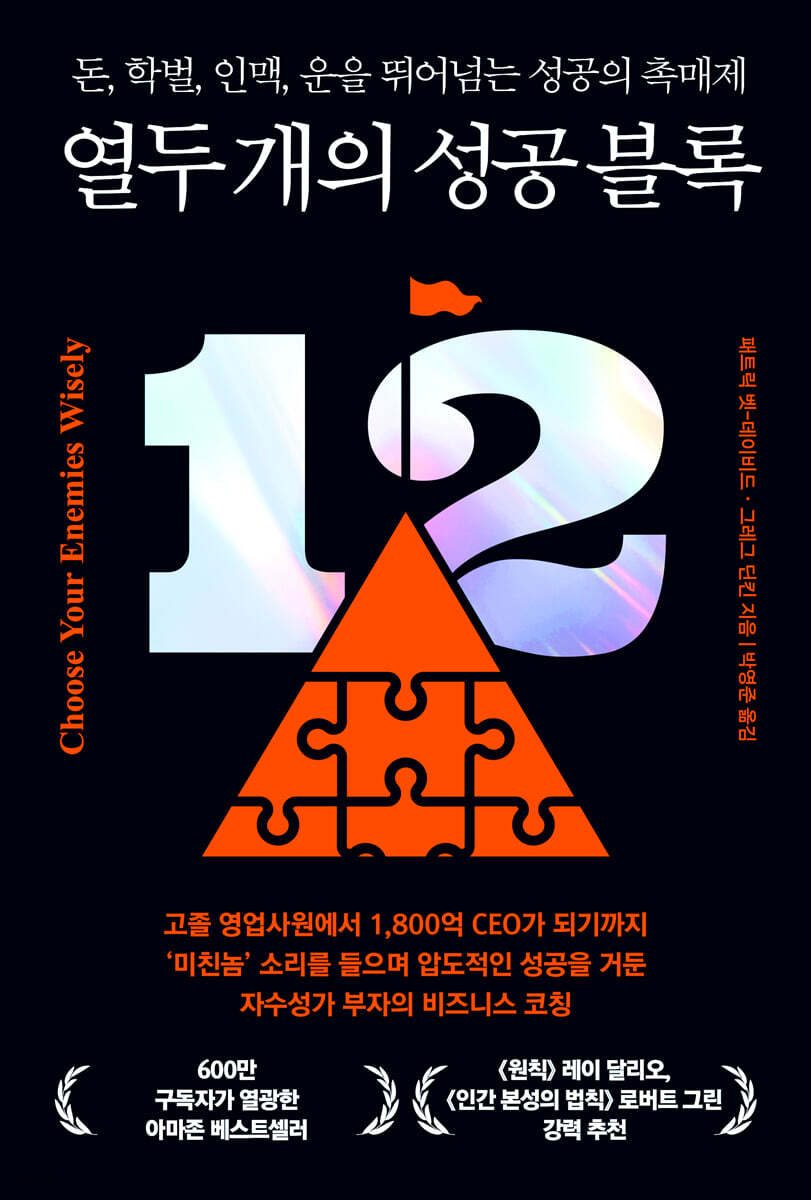
Twelve Blocks of Success
 |
Description
Book Introduction
A self-made billionaire who went from a high school graduate salesperson to a CEO with a net worth of 180 billion won reveals his secret to achieving overwhelming success beyond money, academic background, connections, and luck.
Patrick Bett-David, America's most famous serial entrepreneur, has developed a unique method for creating and executing business plans through coaching countless people for the past 15 years.
What's most unique about his coaching is that he ensures that your business plan is both passionate and realistic and logical.
Because when you combine a clear and compelling reason why you should work so hard with a logical method for how to achieve it, you can achieve unrivaled success that no one can beat.
This book will teach you how to achieve sustained, exponential success, whether you're someone who has a strong desire to succeed but doesn't know how to do it, or someone who's smart and logical but lacks passion and feels powerless.
Patrick Bett-David, America's most famous serial entrepreneur, has developed a unique method for creating and executing business plans through coaching countless people for the past 15 years.
What's most unique about his coaching is that he ensures that your business plan is both passionate and realistic and logical.
Because when you combine a clear and compelling reason why you should work so hard with a logical method for how to achieve it, you can achieve unrivaled success that no one can beat.
This book will teach you how to achieve sustained, exponential success, whether you're someone who has a strong desire to succeed but doesn't know how to do it, or someone who's smart and logical but lacks passion and feels powerless.
- You can preview some of the book's contents.
Preview
index
Entering What Happened on Christmas Day 2002
Part 1.
Do you have a reason why you must succeed?
Chapter 1.
The idea that you have to exclude emotions to be successful is wrong.
Chapter 2.
How to prepare for a game that will last
Chapter 3.
Towards a bold victory
Part 2.
Ignite hidden sparks with twelve success blocks.
Chapter 4.
Enemies and Competitors: The Force That Gets You Out of Bed Every Morning
Chapter 5.
Will and Skill: Wanting to succeed isn't enough.
Chapter 6.
Mission and Plan: Why I Went Through the Empty Even After Earning Millions
Chapter 7.
Dreams and Systems: How to Turn Vague Imagination into Reality
Chapter 8.
Culture and Organization: An organization where employees only take their paychecks cannot succeed.
Chapter 9.
Vision and Capital: Sell your vision and the investment money will naturally follow.
Part 3.
The path to unrivaled success that no one can replicate
Chapter 10.
How to Create Your Own Business Plan
Chapter 11.
Create a wave of change, lead everyone to success.
Coming out
Acknowledgements
Appendix A.
Review last year's performance
Appendix B.
1-page business plan form
Appendix C.
Example of writing a business plan
References
Part 1.
Do you have a reason why you must succeed?
Chapter 1.
The idea that you have to exclude emotions to be successful is wrong.
Chapter 2.
How to prepare for a game that will last
Chapter 3.
Towards a bold victory
Part 2.
Ignite hidden sparks with twelve success blocks.
Chapter 4.
Enemies and Competitors: The Force That Gets You Out of Bed Every Morning
Chapter 5.
Will and Skill: Wanting to succeed isn't enough.
Chapter 6.
Mission and Plan: Why I Went Through the Empty Even After Earning Millions
Chapter 7.
Dreams and Systems: How to Turn Vague Imagination into Reality
Chapter 8.
Culture and Organization: An organization where employees only take their paychecks cannot succeed.
Chapter 9.
Vision and Capital: Sell your vision and the investment money will naturally follow.
Part 3.
The path to unrivaled success that no one can replicate
Chapter 10.
How to Create Your Own Business Plan
Chapter 11.
Create a wave of change, lead everyone to success.
Coming out
Acknowledgements
Appendix A.
Review last year's performance
Appendix B.
1-page business plan form
Appendix C.
Example of writing a business plan
References
Detailed image

Into the book
If we spend our time only trying to figure out 'how' to win in life, we're missing the whole point.
The first thing you need to find is the 'why' you need to succeed.
Has someone upset you? Has someone taken advantage of you? Has a teacher or family member shamed you? Motivation varies from person to person, but the right enemy can fuel your life in ways your allies can't.
--- p.14, from “Introduction”
It might be a good idea to be clear about what kinds of emotions you should exclude and what kinds you should include in your business plan.
The emotions you need to eliminate are those that feel impulsive, irrational, exaggerated, and overly choleric.
On the other hand, the emotions that need to be expressed are passionate, obsessive, enthusiastic, persistent, powerful, and purposeful.
--- p.35, Chapter 1.
The idea that you have to exclude emotions to be successful is wrong.
Whether it's dating or business, the reason things don't work out is simple.
Because you haven't asked yourself important questions.
“What should I have done differently?” You either ignored the fact that you played a key role in creating the problem, or rationalized away that role altogether.
In other words, they did not reflect on their own behavioral patterns or tendencies, nor did they make an effort to identify their own weaknesses.
--- p.51, Chapter 2.
From "How to Prepare for a Long-Lasting Game"
Anyone who makes a business plan at the beginning of the year and never touches it after February isn't making a plan; they're just making a "wish list."
Performing orbital adjustments at least once every quarter is a core part of any business plan.
You should create a document that you regularly update and maintain, rather than planning to have it sit in a drawer gathering dust all year long.
--- pp.81-82, Chapter 3.
From “Towards a Bold Victory”
Expanding your perspective on your competitors doesn't mean stressing over every possible scenario that could go wrong. Instead, it means carefully observing and studying how your competitors might attack you and how they might disrupt your business model.
After understanding this, you must develop core competencies that differentiate you from your competitors and satisfy customer needs.
--- pp.119-120, 「Chapter 4.
From “Enemies and Competitors: The Force That Gets You Out of Bed Every Morning”
To fill the success block called "skill," whether in your personal life or business, you must first identify the actions necessary to overcome your weaknesses and write them down on paper.
As you improve, your business improves.
Building skills means putting your will into action.
In other words, it means putting in effort into self-improvement with an open mind.
--- p.159, Chapter 5.
From "Will and Skill: Wanting to Succeed Is Not Enough"
Now imagine Steve Jobs standing before Apple employees, wearing his trademark black turtleneck and jeans, and giving a passionate speech about how he would change the world.
(Omitted) A thunderous roar erupts from the audience! The staff is thrown into a frenzy of excitement.
They are ready to take over the world.
Why is that? Because they know their mission well.
It is the mission that inspires and encourages them.
Jobs doesn't stop there.
Now that we've told our audience the "why" they should do something, it's time to explain the "how."
The staff is ready to follow whatever plan comes out of his mouth.
--- pp.182-183, 「Chapter 6.
From "Mission and Plan: Why I Still Feel Emptied Even After Earning Millions"
Dreams ignite your passion and inspire you and your team to achieve them.
But without a system in place to help you accomplish specific tasks, you can't leverage those emotions to fuel your success.
Moreover, if you have to develop a new system every time you take action to achieve your dreams, you will ultimately fail due to extreme inefficiency.
Therefore, it is very important to build a system that can be replicated and used anytime, anywhere.
--- p.228, Chapter 7.
From "Dreams and Systems: How to Make Vague Imagination a Reality Before Your Eyes"
The contagiousness of culture arises from the consistent behavior of members of society and their perceptions of that behavior.
Repeated behaviors become established social norms.
For example, if members of an organization take risks and receive praise from their superiors, or even applause from their colleagues for pulling a funny prank on them, this gives other employees permission to do the same.
If an organization's culture rewards such behavior, it is bound to be reinforced.
--- p.258, Chapter 8.
Culture and Organization: An organization where employees only take their paychecks cannot succeed.
In almost every organization, there are roles that even selfish people can fill.
This fact leads us to make two common mistakes:
The first is to value the ability of employees more than their trustworthiness.
Employees with low trust have a very detrimental effect on an organization.
While it may be difficult to immediately remove someone from the company while they are performing well, if they are seriously damaging the organizational culture, they should not be allowed to continue to have a negative impact on other employees.
It's only after that employee leaves the company that you realize that "some people are better off without you."
--- pp..275-276, 「Chapter 8.
Culture and Organization: An organization where employees only take their paychecks cannot succeed.
Do you know what your company's core vision is? Do you stubbornly adhere to it? Have you established uncompromising, inviolable principles in everything you do? Even if I were given the opportunity to make millions, I would firmly say "no" if it didn't align with my vision.
--- p.300, Chapter 9.
From "Vision and Capital: If you sell your vision, investment funds will naturally follow"
Would anyone quit a job because the salary, growth, autonomy, teamwork, and fun were too much? Absolutely not.
They leave their jobs because they are fed up with working in a poor organizational culture, feeling like cogs in a machine, or because they are tired of working under managers who only go through the motions.
Remember.
It's not the jobs that employees are leaving, it's the leaders.
--- p.315, Chapter 9.
From "Vision and Capital: If you sell your vision, investment funds will naturally follow"
I have repeatedly emphasized that you must first develop a business plan that moves people's hearts.
People who are not motivated or emotionally energized find it difficult to carry out their plans to the end.
The waves of emotion flowing within you are a constant reminder of why you must work so hard.
The first thing you need to find is the 'why' you need to succeed.
Has someone upset you? Has someone taken advantage of you? Has a teacher or family member shamed you? Motivation varies from person to person, but the right enemy can fuel your life in ways your allies can't.
--- p.14, from “Introduction”
It might be a good idea to be clear about what kinds of emotions you should exclude and what kinds you should include in your business plan.
The emotions you need to eliminate are those that feel impulsive, irrational, exaggerated, and overly choleric.
On the other hand, the emotions that need to be expressed are passionate, obsessive, enthusiastic, persistent, powerful, and purposeful.
--- p.35, Chapter 1.
The idea that you have to exclude emotions to be successful is wrong.
Whether it's dating or business, the reason things don't work out is simple.
Because you haven't asked yourself important questions.
“What should I have done differently?” You either ignored the fact that you played a key role in creating the problem, or rationalized away that role altogether.
In other words, they did not reflect on their own behavioral patterns or tendencies, nor did they make an effort to identify their own weaknesses.
--- p.51, Chapter 2.
From "How to Prepare for a Long-Lasting Game"
Anyone who makes a business plan at the beginning of the year and never touches it after February isn't making a plan; they're just making a "wish list."
Performing orbital adjustments at least once every quarter is a core part of any business plan.
You should create a document that you regularly update and maintain, rather than planning to have it sit in a drawer gathering dust all year long.
--- pp.81-82, Chapter 3.
From “Towards a Bold Victory”
Expanding your perspective on your competitors doesn't mean stressing over every possible scenario that could go wrong. Instead, it means carefully observing and studying how your competitors might attack you and how they might disrupt your business model.
After understanding this, you must develop core competencies that differentiate you from your competitors and satisfy customer needs.
--- pp.119-120, 「Chapter 4.
From “Enemies and Competitors: The Force That Gets You Out of Bed Every Morning”
To fill the success block called "skill," whether in your personal life or business, you must first identify the actions necessary to overcome your weaknesses and write them down on paper.
As you improve, your business improves.
Building skills means putting your will into action.
In other words, it means putting in effort into self-improvement with an open mind.
--- p.159, Chapter 5.
From "Will and Skill: Wanting to Succeed Is Not Enough"
Now imagine Steve Jobs standing before Apple employees, wearing his trademark black turtleneck and jeans, and giving a passionate speech about how he would change the world.
(Omitted) A thunderous roar erupts from the audience! The staff is thrown into a frenzy of excitement.
They are ready to take over the world.
Why is that? Because they know their mission well.
It is the mission that inspires and encourages them.
Jobs doesn't stop there.
Now that we've told our audience the "why" they should do something, it's time to explain the "how."
The staff is ready to follow whatever plan comes out of his mouth.
--- pp.182-183, 「Chapter 6.
From "Mission and Plan: Why I Still Feel Emptied Even After Earning Millions"
Dreams ignite your passion and inspire you and your team to achieve them.
But without a system in place to help you accomplish specific tasks, you can't leverage those emotions to fuel your success.
Moreover, if you have to develop a new system every time you take action to achieve your dreams, you will ultimately fail due to extreme inefficiency.
Therefore, it is very important to build a system that can be replicated and used anytime, anywhere.
--- p.228, Chapter 7.
From "Dreams and Systems: How to Make Vague Imagination a Reality Before Your Eyes"
The contagiousness of culture arises from the consistent behavior of members of society and their perceptions of that behavior.
Repeated behaviors become established social norms.
For example, if members of an organization take risks and receive praise from their superiors, or even applause from their colleagues for pulling a funny prank on them, this gives other employees permission to do the same.
If an organization's culture rewards such behavior, it is bound to be reinforced.
--- p.258, Chapter 8.
Culture and Organization: An organization where employees only take their paychecks cannot succeed.
In almost every organization, there are roles that even selfish people can fill.
This fact leads us to make two common mistakes:
The first is to value the ability of employees more than their trustworthiness.
Employees with low trust have a very detrimental effect on an organization.
While it may be difficult to immediately remove someone from the company while they are performing well, if they are seriously damaging the organizational culture, they should not be allowed to continue to have a negative impact on other employees.
It's only after that employee leaves the company that you realize that "some people are better off without you."
--- pp..275-276, 「Chapter 8.
Culture and Organization: An organization where employees only take their paychecks cannot succeed.
Do you know what your company's core vision is? Do you stubbornly adhere to it? Have you established uncompromising, inviolable principles in everything you do? Even if I were given the opportunity to make millions, I would firmly say "no" if it didn't align with my vision.
--- p.300, Chapter 9.
From "Vision and Capital: If you sell your vision, investment funds will naturally follow"
Would anyone quit a job because the salary, growth, autonomy, teamwork, and fun were too much? Absolutely not.
They leave their jobs because they are fed up with working in a poor organizational culture, feeling like cogs in a machine, or because they are tired of working under managers who only go through the motions.
Remember.
It's not the jobs that employees are leaving, it's the leaders.
--- p.315, Chapter 9.
From "Vision and Capital: If you sell your vision, investment funds will naturally follow"
I have repeatedly emphasized that you must first develop a business plan that moves people's hearts.
People who are not motivated or emotionally energized find it difficult to carry out their plans to the end.
The waves of emotion flowing within you are a constant reminder of why you must work so hard.
--- p.379, from “Coming Out”
Publisher's Review
***Highly recommended: Ray Dalio's "Principles" and Robert Greene's "The Laws of Human Nature"***
***Amazon Bestseller with 6 Million Subscribers***
From a high school graduate salesperson to a CEO of 180 billion won
He achieved overwhelming success while being called a 'crazy guy'.
Business Coaching from a Self-Made Millionaire
◆ America's most famous serial entrepreneur,
The legend of a self-made man who became a CEO of 180 billion won without money, education, or connections, despite being an immigrant.
Patrick Bett-David's Business Coaching for Unparalleled Success
There is a man who entered the business world with no money, no education, and no connections, as an immigrant.
He never dreamed of going to college because his grades were poor in high school, so he enlisted in the army to earn money.
After being discharged from the military, I worked as a gym salesman during the day and wasted my youth by going to clubs at night without any particular dreams or goals.
Although he said he wanted to make a lot of money and become successful, in reality he was just an ordinary man, just trying to make ends meet, like many of us.
Yet, this man is now America's most famous serial entrepreneur and CEO with a net worth of $180 billion.
The insurance company he founded, PHP Agency, has grown into a large enterprise with over 150 branches in 49 states and approximately 47,000 employees, and is still growing rapidly.
Founded with the vision of sharing his business philosophy with others, Valuetainment, a media brand, has amassed 6 million YouTube subscribers and has been recognized as an influential media outlet, featuring presidential candidate Donald Trump ahead of the US presidential election.
What on earth happened to this man, Patrick Bett-David?
In this book, "Twelve Blocks of Success," he reveals the secrets and strategies for success that transformed him from an ordinary high school graduate salesperson to a tremendously successful CEO.
Patrick achieved success by heading straight for it, without any help from anyone around him, so he understands all too well the feelings of novice entrepreneurs and leaders who wish they had someone to offer them even a word of advice during these difficult times.
I started my business coaching practice with people around me out of a desire to help them, and over the past decade, it has been refined into a successful strategy that is both applicable and highly effective.
In fact, through his coaching, there have been many cases where people who started out as ordinary people in society, such as college students, security guards, and pizza shop owners, have become successful and earned hundreds of thousands of dollars.
Patrick has seen his coaching work for thousands of people across industries, and he wrote this book with the hope that readers will experience the same results.
◆ Where is the fuel that moves your heart?
A person who doesn't know why he has to work so hard will never succeed.
Most books tell you that you can be successful, but honestly, the road to success is not smooth.
You might find yourself helplessly losing an important project you've been working on for years to your boss or colleagues, or you might lose your biggest client just when your business is just getting off the ground.
There are many cases where things completely fall apart at the point where you think you can achieve great success if you just turn that corner safely.
Is that all?
No matter how diligent you are, it's rare to find someone who can withstand the constant onslaught of lethargy and burnout without wavering.
But when most people hit rock bottom and want to give up, when they try too hard and lose all motivation, and try to compromise with reality, thinking that this level of success is okay, some people grit their teeth and move forward.
Where does that passionate, energetic, persistent, and purposeful drive come from? Patrick Bett-David says it comes from "choosing your enemies wisely."
Wait, enemies? Yes.
When doing business, all kinds of hardships and challenges you encounter, people who hate you or betray you, people who belittle your challenges by saying, “You’ll never be able to do it,” and the risk of failure are all ‘enemies.’
The guilt, disappointment, anger, and shame these enemies inflict on you are transformed into a strong passion to “definitely succeed and achieve your grand goals.”
Only with this passion that blossoms from deep within your heart can you move forward toward your goal without tiring.
This book argues that combining emotional drive with the logical elements of business building can lead to unparalleled success that no one can match.
That is, you must integrate the emotions in your heart (the hot, intense feeling that you must succeed) with the logic in your head (realistic, logical plans and actions).
Patrick emphasizes that both emotions and logic must be balanced, because “emotions tell us ‘why’ something should be done, and logic tells us ‘how’ to do it.”
In this book, he creates twelve blocks (enemies/competitors) that harmonize both emotional and logical areas to create a truly heart-pounding, realistic success strategy, not a meaningless numbers game.
Introduces (will/skill, mission/plan, dream/system, culture/organization, vision/capital).
Building a business plan based on these building blocks of success will combine passion with logical, coherent planning, and will win the hearts and minds of not only yourself but also your team members, customers, and investors.
If you've unknowingly become complacent with the present, if you want to change your boring reality but don't know how, "The Twelve Blocks of Success" will ignite a burning passion in your heart.
◆ Next quarter, next year, next decade, and next generation
How to find your own powerful catalyst for sustained, exponential success.
What do Steve Jobs, Elon Musk, and Andy Grove (former Intel CEO) have in common? They were fiercely obsessed with and dedicated to their goals, ultimately achieving them, achieving overwhelming success that shook the world.
Some people call them 'crazy guys' for their fanatical obsession and reckless challenges.
However, their success is not something that was achieved by luck or something that runs for a few years and then disappears without a sound.
It is a sustained, exponential success that extends to the next quarter, the next year, the next decade, and the next generation.
In this book, author Patrick Bett-David calls them "the bold minority" and reveals how they use twelve emotional/logical blocks to create and execute business plans.
By following the step-by-step process for achieving success outlined in this book, you'll understand what it means to put your passion into action and achieve your goals, rather than creating a soulless, forced business plan to impress someone.
“If you’ve picked up this book and started reading it, it means you too can be part of that bold minority,” says Patrick, urging you to apply this business plan to your current situation and position, whether you’re a fresh graduate starting out in your career, a team leader, a CEO, or an executive.
Because anyone who wants to take charge of their own life needs to have grand and extraordinary goals and a concrete plan to achieve them.
The book immediately became an Amazon bestseller, receiving rave reviews such as, “There is not a single page in this book you can throw away,” and “This book gave me unprecedented inspiration when I thought I would never find passion or motivation again.”
This is a must-read for anyone who wants to build a powerful engine of success amidst a deepening recession and cutthroat competition.
***Amazon Bestseller with 6 Million Subscribers***
From a high school graduate salesperson to a CEO of 180 billion won
He achieved overwhelming success while being called a 'crazy guy'.
Business Coaching from a Self-Made Millionaire
◆ America's most famous serial entrepreneur,
The legend of a self-made man who became a CEO of 180 billion won without money, education, or connections, despite being an immigrant.
Patrick Bett-David's Business Coaching for Unparalleled Success
There is a man who entered the business world with no money, no education, and no connections, as an immigrant.
He never dreamed of going to college because his grades were poor in high school, so he enlisted in the army to earn money.
After being discharged from the military, I worked as a gym salesman during the day and wasted my youth by going to clubs at night without any particular dreams or goals.
Although he said he wanted to make a lot of money and become successful, in reality he was just an ordinary man, just trying to make ends meet, like many of us.
Yet, this man is now America's most famous serial entrepreneur and CEO with a net worth of $180 billion.
The insurance company he founded, PHP Agency, has grown into a large enterprise with over 150 branches in 49 states and approximately 47,000 employees, and is still growing rapidly.
Founded with the vision of sharing his business philosophy with others, Valuetainment, a media brand, has amassed 6 million YouTube subscribers and has been recognized as an influential media outlet, featuring presidential candidate Donald Trump ahead of the US presidential election.
What on earth happened to this man, Patrick Bett-David?
In this book, "Twelve Blocks of Success," he reveals the secrets and strategies for success that transformed him from an ordinary high school graduate salesperson to a tremendously successful CEO.
Patrick achieved success by heading straight for it, without any help from anyone around him, so he understands all too well the feelings of novice entrepreneurs and leaders who wish they had someone to offer them even a word of advice during these difficult times.
I started my business coaching practice with people around me out of a desire to help them, and over the past decade, it has been refined into a successful strategy that is both applicable and highly effective.
In fact, through his coaching, there have been many cases where people who started out as ordinary people in society, such as college students, security guards, and pizza shop owners, have become successful and earned hundreds of thousands of dollars.
Patrick has seen his coaching work for thousands of people across industries, and he wrote this book with the hope that readers will experience the same results.
◆ Where is the fuel that moves your heart?
A person who doesn't know why he has to work so hard will never succeed.
Most books tell you that you can be successful, but honestly, the road to success is not smooth.
You might find yourself helplessly losing an important project you've been working on for years to your boss or colleagues, or you might lose your biggest client just when your business is just getting off the ground.
There are many cases where things completely fall apart at the point where you think you can achieve great success if you just turn that corner safely.
Is that all?
No matter how diligent you are, it's rare to find someone who can withstand the constant onslaught of lethargy and burnout without wavering.
But when most people hit rock bottom and want to give up, when they try too hard and lose all motivation, and try to compromise with reality, thinking that this level of success is okay, some people grit their teeth and move forward.
Where does that passionate, energetic, persistent, and purposeful drive come from? Patrick Bett-David says it comes from "choosing your enemies wisely."
Wait, enemies? Yes.
When doing business, all kinds of hardships and challenges you encounter, people who hate you or betray you, people who belittle your challenges by saying, “You’ll never be able to do it,” and the risk of failure are all ‘enemies.’
The guilt, disappointment, anger, and shame these enemies inflict on you are transformed into a strong passion to “definitely succeed and achieve your grand goals.”
Only with this passion that blossoms from deep within your heart can you move forward toward your goal without tiring.
This book argues that combining emotional drive with the logical elements of business building can lead to unparalleled success that no one can match.
That is, you must integrate the emotions in your heart (the hot, intense feeling that you must succeed) with the logic in your head (realistic, logical plans and actions).
Patrick emphasizes that both emotions and logic must be balanced, because “emotions tell us ‘why’ something should be done, and logic tells us ‘how’ to do it.”
In this book, he creates twelve blocks (enemies/competitors) that harmonize both emotional and logical areas to create a truly heart-pounding, realistic success strategy, not a meaningless numbers game.
Introduces (will/skill, mission/plan, dream/system, culture/organization, vision/capital).
Building a business plan based on these building blocks of success will combine passion with logical, coherent planning, and will win the hearts and minds of not only yourself but also your team members, customers, and investors.
If you've unknowingly become complacent with the present, if you want to change your boring reality but don't know how, "The Twelve Blocks of Success" will ignite a burning passion in your heart.
◆ Next quarter, next year, next decade, and next generation
How to find your own powerful catalyst for sustained, exponential success.
What do Steve Jobs, Elon Musk, and Andy Grove (former Intel CEO) have in common? They were fiercely obsessed with and dedicated to their goals, ultimately achieving them, achieving overwhelming success that shook the world.
Some people call them 'crazy guys' for their fanatical obsession and reckless challenges.
However, their success is not something that was achieved by luck or something that runs for a few years and then disappears without a sound.
It is a sustained, exponential success that extends to the next quarter, the next year, the next decade, and the next generation.
In this book, author Patrick Bett-David calls them "the bold minority" and reveals how they use twelve emotional/logical blocks to create and execute business plans.
By following the step-by-step process for achieving success outlined in this book, you'll understand what it means to put your passion into action and achieve your goals, rather than creating a soulless, forced business plan to impress someone.
“If you’ve picked up this book and started reading it, it means you too can be part of that bold minority,” says Patrick, urging you to apply this business plan to your current situation and position, whether you’re a fresh graduate starting out in your career, a team leader, a CEO, or an executive.
Because anyone who wants to take charge of their own life needs to have grand and extraordinary goals and a concrete plan to achieve them.
The book immediately became an Amazon bestseller, receiving rave reviews such as, “There is not a single page in this book you can throw away,” and “This book gave me unprecedented inspiration when I thought I would never find passion or motivation again.”
This is a must-read for anyone who wants to build a powerful engine of success amidst a deepening recession and cutthroat competition.
GOODS SPECIFICS
- Date of issue: November 29, 2024
- Page count, weight, size: 408 pages | 632g | 145*215*27mm
- ISBN13: 9791193904237
- ISBN10: 1193904234
You may also like
카테고리
korean


korean

![ELLE 엘르 스페셜 에디션 A형 : 12월 [2025]](http://librairie.coreenne.fr/cdn/shop/files/b8e27a3de6c9538896439686c6b0e8fb.jpg?v=1766436872&width=3840)


