

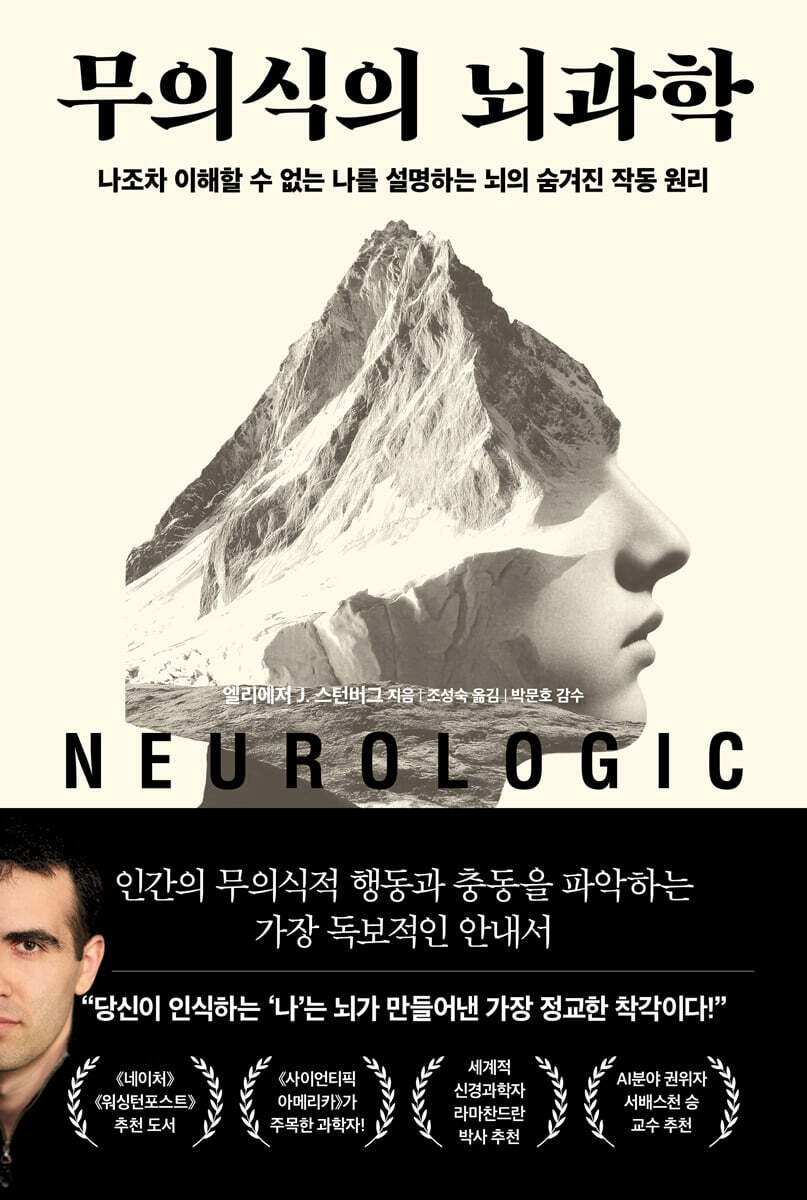
The Brain Science of the Unconscious
 |
Description
Book Introduction
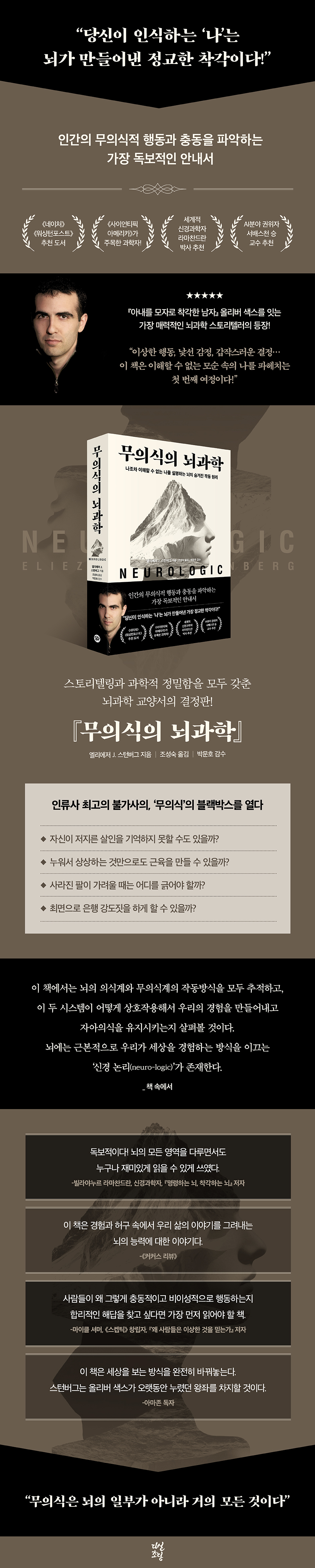
Understanding human unconscious behavior and impulses
The most exclusive guide!
“The ‘me’ you perceive is the most elaborate illusion created by the brain!”
[Nature] [Washington Post] Recommended Books
Scientists Spotlighted by [Scientific America]!
Recommended by world-renowned neuroscientist Dr. Ramachandran and AI authority Professor Sebastian Seung
The emergence of Oliver Sacks's most compelling neuroscience storyteller.
The core topic of 21st-century neuroscience is not ‘consciousness’ but ‘unconsciousness.’
We believe we think and choose for ourselves, but our perceptions, memories, emotions, and actions are deeply influenced by the brain's unconscious circuits.
"The Brain Science of the Unconscious" does not say that the unconscious is simply instinct, hidden impulse, or repressed desire.
Instead, it is described as a global cognitive system that perceives the world, constructs memories, and forms self-identity.
This book fascinatingly explores how the unconscious reconstructs reality through the strange and fascinating phenomena humans experience, from dreams and habits to hallucinations, multiple personalities, and even alien abductions.
This book, which world-renowned neuroscientist Ramachandran praised as “a new horizon in popular brain science,” examines everything from familiar everyday experiences to cases of mental illness, providing a completely new perspective on who we are and why we feel and act the way we do.
Eliezer J.
Sternberg, a neurologist and neuroscientist at Yale University New Haven Hospital, combines clinical experience with cutting-edge research to unravel the complex workings of the brain in compelling narratives.
Hailed as “the emergence of Oliver Sacks’s most compelling neuroscience storyteller,” this book combines scientific precision with the allure of a story in its own right.
This bold attempt to explore the world of the unconscious based on neuroscience and brain science has garnered attention and praise from the media, academia, and even contemporary science writers.
Tracing the hidden "unconscious circuits" of the brain through clinical cases that are sometimes bizarre and sometimes wondrous, this book is the most unique guide to understanding human unconscious behavior and impulses.
The most exclusive guide!
“The ‘me’ you perceive is the most elaborate illusion created by the brain!”
[Nature] [Washington Post] Recommended Books
Scientists Spotlighted by [Scientific America]!
Recommended by world-renowned neuroscientist Dr. Ramachandran and AI authority Professor Sebastian Seung
The emergence of Oliver Sacks's most compelling neuroscience storyteller.
The core topic of 21st-century neuroscience is not ‘consciousness’ but ‘unconsciousness.’
We believe we think and choose for ourselves, but our perceptions, memories, emotions, and actions are deeply influenced by the brain's unconscious circuits.
"The Brain Science of the Unconscious" does not say that the unconscious is simply instinct, hidden impulse, or repressed desire.
Instead, it is described as a global cognitive system that perceives the world, constructs memories, and forms self-identity.
This book fascinatingly explores how the unconscious reconstructs reality through the strange and fascinating phenomena humans experience, from dreams and habits to hallucinations, multiple personalities, and even alien abductions.
This book, which world-renowned neuroscientist Ramachandran praised as “a new horizon in popular brain science,” examines everything from familiar everyday experiences to cases of mental illness, providing a completely new perspective on who we are and why we feel and act the way we do.
Eliezer J.
Sternberg, a neurologist and neuroscientist at Yale University New Haven Hospital, combines clinical experience with cutting-edge research to unravel the complex workings of the brain in compelling narratives.
Hailed as “the emergence of Oliver Sacks’s most compelling neuroscience storyteller,” this book combines scientific precision with the allure of a story in its own right.
This bold attempt to explore the world of the unconscious based on neuroscience and brain science has garnered attention and praise from the media, academia, and even contemporary science writers.
Tracing the hidden "unconscious circuits" of the brain through clinical cases that are sometimes bizarre and sometimes wondrous, this book is the most unique guide to understanding human unconscious behavior and impulses.
- You can preview some of the book's contents.
Preview
index
The irony of the "incomprehensible self" hidden in the subconscious
brain map
1
The brain knows how to 'see' without looking: How the unconscious creates perception.
Mechanisms that fill the gaps in consciousness | The border between dreams and reality | People who enter a world of fantasy | What the blind see | The sagebrush recognizes stars | The corridor of sound | In dreams, everyone transcends themselves.
2
Another name for the unconscious, habit: an unconscious routine that operates without awareness.
Zombie Mode in Everyday Life | When Your Subconscious Takes the Driver's Seat... 082 | Mice in a Cross-Shaped Maze | The Division of Labor Between Consciousness and Unconsciousness | Spotting a Fake Smile | Why You Forget to Buy Milk | Why You Eat When You're Not Hungry | Executive Function Errors | Murders You Can't Remember | The Conditions of Multitasking
3
Can imagination alone improve athletic performance? : A brain simulation that links exercise and emotion.
The Mental Training Ground | Muscles Created by Thoughts | The Effects of Physical and Visual Training | The Mind Overcomes the Body's Limitations | Where to Scratch When Your Lost Arm Itches | How Mirror Neurons Affect Behavior | Why Yawning Is Contagious | The Necessary Conditions for Empathy | The Subconscious Remembers the Past
4
Can You Remember Things That Never Happened?: The Brain's Narrative of Memory, Emotion, and Self
The Brain Edits Memories | Emotionally Infused Memories | How the Brain Remembers Disasters | Memory Is Egocentric | How the Brain Protects Us from Pain | Lies for Belief | The Brain Tells Us a Fairy Tale
5
The unconscious is easily fooled: Why supernatural beliefs and hallucinations arise.
Why we believe in alien abductions | The gap between sleep and wakefulness | Nervous stimulation and the shadow of fear | Conversations with God | The illusion of death | Fake that looks real | Visions seen on the brink of death | Common hallucinations | When the brain tries to calm the nervous system | The perplexing scenarios adopted by the unconscious
6
Why People with Schizophrenia Hear Auditory Hallucinations: When the Lines Between Self and Other, Fantasy and Reality Blur
The Owner of the Voice | How to Interrupt Auditory Hallucinations | Hearing Other Voices in Your Head | What Humans and Electric Fish Have in Common | A Broken Language System | Auditory Hallucinations in the Deaf | The Self-Monitoring Fallacy | Why You Can't Tickle Yourself | The Story Your Subconscious Creates
7
Is Hypnotic Murder Possible?: Attention, Suggestion, and External Stimuli Targeting the Subconscious
What Hypnosis Can Do | Messages Your Conscious Mind Doesn't Recognize | The Hypnotized Brain | Hidden Commands | The Difference Between the Subconscious and Hypnosis | The Marks Advertising Leaves on Your Brain | The Subconscious's Excuses | The Brain's Warning Signals | The Subconscious's Purpose
8
What Makes Me "Me": Unconscious Strategies Surrounding the Division and Integration of the Self
Where in the Brain Is the Self? | The Split Brain and the One Self | Multiple Selves as Defense Mechanisms | The Trauma-Created Personality Mosaic | The Hypnotist Within | One "I", One "Eye" | Just the Beginning of a Journey
Acknowledgements
Americas
References
Image source
Search
brain map
1
The brain knows how to 'see' without looking: How the unconscious creates perception.
Mechanisms that fill the gaps in consciousness | The border between dreams and reality | People who enter a world of fantasy | What the blind see | The sagebrush recognizes stars | The corridor of sound | In dreams, everyone transcends themselves.
2
Another name for the unconscious, habit: an unconscious routine that operates without awareness.
Zombie Mode in Everyday Life | When Your Subconscious Takes the Driver's Seat... 082 | Mice in a Cross-Shaped Maze | The Division of Labor Between Consciousness and Unconsciousness | Spotting a Fake Smile | Why You Forget to Buy Milk | Why You Eat When You're Not Hungry | Executive Function Errors | Murders You Can't Remember | The Conditions of Multitasking
3
Can imagination alone improve athletic performance? : A brain simulation that links exercise and emotion.
The Mental Training Ground | Muscles Created by Thoughts | The Effects of Physical and Visual Training | The Mind Overcomes the Body's Limitations | Where to Scratch When Your Lost Arm Itches | How Mirror Neurons Affect Behavior | Why Yawning Is Contagious | The Necessary Conditions for Empathy | The Subconscious Remembers the Past
4
Can You Remember Things That Never Happened?: The Brain's Narrative of Memory, Emotion, and Self
The Brain Edits Memories | Emotionally Infused Memories | How the Brain Remembers Disasters | Memory Is Egocentric | How the Brain Protects Us from Pain | Lies for Belief | The Brain Tells Us a Fairy Tale
5
The unconscious is easily fooled: Why supernatural beliefs and hallucinations arise.
Why we believe in alien abductions | The gap between sleep and wakefulness | Nervous stimulation and the shadow of fear | Conversations with God | The illusion of death | Fake that looks real | Visions seen on the brink of death | Common hallucinations | When the brain tries to calm the nervous system | The perplexing scenarios adopted by the unconscious
6
Why People with Schizophrenia Hear Auditory Hallucinations: When the Lines Between Self and Other, Fantasy and Reality Blur
The Owner of the Voice | How to Interrupt Auditory Hallucinations | Hearing Other Voices in Your Head | What Humans and Electric Fish Have in Common | A Broken Language System | Auditory Hallucinations in the Deaf | The Self-Monitoring Fallacy | Why You Can't Tickle Yourself | The Story Your Subconscious Creates
7
Is Hypnotic Murder Possible?: Attention, Suggestion, and External Stimuli Targeting the Subconscious
What Hypnosis Can Do | Messages Your Conscious Mind Doesn't Recognize | The Hypnotized Brain | Hidden Commands | The Difference Between the Subconscious and Hypnosis | The Marks Advertising Leaves on Your Brain | The Subconscious's Excuses | The Brain's Warning Signals | The Subconscious's Purpose
8
What Makes Me "Me": Unconscious Strategies Surrounding the Division and Integration of the Self
Where in the Brain Is the Self? | The Split Brain and the One Self | Multiple Selves as Defense Mechanisms | The Trauma-Created Personality Mosaic | The Hypnotist Within | One "I", One "Eye" | Just the Beginning of a Journey
Acknowledgements
Americas
References
Image source
Search
Detailed image
Into the book
In this book, we will trace the workings of both the conscious and unconscious systems of the brain, examining how these two systems work together and, more importantly, how they interact to create our experiences and sustain our sense of self.
After reading this book, I hope you will understand that there are distinct patterns in how the brain's unconscious mechanisms guide behavior.
There is a fundamental 'neuro-logic' in the brain that guides how we experience the world.
You could think of this neural logic as software.
What we need to do is decipher the code of that logical system.
To do that, we need to observe the input and output, as well as find out what brain system creates that logical system.
Cracking the code of the software within us has profound implications for the study of neurology and psychiatry, the study of human relationships and interactions, and our understanding of humanity.
--- From the "Preface" on p.14~15
The brain does its best to create stories.
The brain's unconscious mind is incredibly adept at finding patterns, predicting the next pattern, and using contextual clues to fill in the gaps in an incomplete picture.
Perhaps these activities work collectively to stitch together the tattered signals received by the unconscious and weave them into a dreamscape.
In this way, a patchwork of thoughts, memories, fears, and desires takes over our minds, sometimes even giving rise to metaphorical stories.
Even so, our dreams are generally quite bizarre.
--- p.41~42 From “The brain knows how to ‘see’ even without seeing”
A driver who is deeply immersed in another thought will not remember the conscious experience of driving.
He doesn't remember stopping at a red light or turning left when he got the signal.
He drives on autopilot.
In a situation where an accident could easily occur, you are startled, quickly come to your senses, and step on the brakes hard.
He screeches to a halt just a few centimeters from the mail truck.
The driver calms down from his shock and then ponders how this happened.
This may not have happened just because of a moment of carelessness.
I feel like I was driving absentmindedly, not just for a moment, but on a much more serious level.
He thinks maybe he was completely distracted the whole time he was driving.
Driving in this daze is no different from driving without looking ahead.
--- p.82~83 From “Another Name for the Unconscious: Habit”
Memories play a huge role in determining who we are as people.
Our personal history creates our self-image and gathers stored knowledge.
The unconscious encodes our memories and also shapes our personality.
The unconscious, like a video camera, does not capture experiences as they are.
Instead, the unconscious focuses on our own role in the story, on what we consider important.
Then, at some point, a context emerges about how we are feeling, what our emotions are in that moment, what we are expecting and fearing, and what that moment 'means' to us.
And based on that context, the brain begins to write the first draft.
--- p.177 From “Can You Remember Something That Never Happened?”
Academics estimate that around 8 percent of the population suffers from sleep paralysis.
In the United States alone, more than 20 million people experience sleep paralysis at least once in their lifetime.
The severity of symptoms varies from person to person, but for most people, sleep paralysis lasts only a few seconds and does not last longer, leading to hallucinations.
Studies show that people with high anxiety levels are more likely to perceive a stranger's presence during sleep paralysis. 8 Stress that persists into sleep can make hallucinations, which are otherwise easily forgotten, even more frightening.
People with dysfunctional social imagery, a mild form of social phobia, are also more likely to hallucinate during sleep paralysis.
People with social image dysfunction believe that others are always watching and judging them.
When sleep paralysis strikes, these people experience more severe hallucinations, as if aliens are experimenting on them and poking things into their bodies.
--- p.214 From “The Unconscious is Easily Deceived”
Recently, my wife and I were on a trip to Mystic Seaport, Connecticut, and we discovered an ice cream shop tucked away at the end of a quiet street.
A picture of a strawberry-topped waffle cone hung in the window, and a wooden store sign swayed back and forth in the breeze.
Looking at the store, I felt strongly that it looked familiar.
The feeling was so strong that I confidently said that I had been to this store when I was traveling with my parents as a child.
But that weekend, my father told me that our family had never even been to Connecticut.
We've all experienced it at least once, but why does it feel that way? Why does a place we've never been to feel so familiar?
--- p.282~283 From “Why do schizophrenic patients hear auditory hallucinations”
The most common way to encounter hypnosis is to watch a hypnotist perform it on stage.
A stage hypnotist selects a volunteer from the audience and hypnotizes him into performing embarrassing, bizarre, and even comical acts.
In the hypnosis stage I saw, my friend Lee Seon volunteered.
Lee Seon, who was just as inflexible as usual, was successfully hypnotized.
At one point, the hypnotist told my friend that a falcon had just entered the performance space and was spreading its wings in an elegant pose.
Lee Sun followed the invisible bird with his eyes and made a look of wonder.
The hypnotist continued speaking.
“The eagle flew back and just landed on your head.” Lee Sun froze in fear.
His eyes flicked back and forth between the audience and his own forehead, straining to see the imaginary creature clutching his hair with its sharp claws.
The audience laughed, but Lee Sun didn't care.
The hypnotist went one step further.
“The eagle is flying up again and getting inside your shirt!” Lee Sun’s face turned red and he broke out in a cold sweat as he struggled to fight off the attacker.
Then his shirt was torn in half.
Finally, the hypnotist told him that the falcon had flown away.
After the hypnosis ended, Lee Sun swore that he could clearly see both the audience and the bird, and that he really believed in the fight with the falcon.
In any case, the hypnotic state made him recognize and fight creatures that were not even in the performance hall.
--- p.291 From "Is Hypnotic Murder Possible?"
In the history of science, there are often things that are treated as black boxes and declared mysteries.
This is because researchers have failed to establish an appropriate research framework.
To achieve breakthroughs, you need to ask the right questions.
The road to discovery begins with knowing what to look for.
The idea that the brain is divided into a conscious and an unconscious realm does not provide the answer to the mystery of consciousness.
This is just the beginning of the journey.
This idea serves as a springboard for approaching many of the challenging questions in neuroscience that remain elusive.
While some people are busy researching extensions of already known knowledge, others may be trying to open the black box.
He will think outside the box and not hesitate to ask questions that may seem odd at first.
(...) As brain research advances, the journey to uncover the black box must continue.
We need to fully leverage collective thinking to find the point where our thought and behavior patterns fit perfectly into neuroscience mechanisms.
The evidence is there.
Now it's up to us to fill the gap.
After reading this book, I hope you will understand that there are distinct patterns in how the brain's unconscious mechanisms guide behavior.
There is a fundamental 'neuro-logic' in the brain that guides how we experience the world.
You could think of this neural logic as software.
What we need to do is decipher the code of that logical system.
To do that, we need to observe the input and output, as well as find out what brain system creates that logical system.
Cracking the code of the software within us has profound implications for the study of neurology and psychiatry, the study of human relationships and interactions, and our understanding of humanity.
--- From the "Preface" on p.14~15
The brain does its best to create stories.
The brain's unconscious mind is incredibly adept at finding patterns, predicting the next pattern, and using contextual clues to fill in the gaps in an incomplete picture.
Perhaps these activities work collectively to stitch together the tattered signals received by the unconscious and weave them into a dreamscape.
In this way, a patchwork of thoughts, memories, fears, and desires takes over our minds, sometimes even giving rise to metaphorical stories.
Even so, our dreams are generally quite bizarre.
--- p.41~42 From “The brain knows how to ‘see’ even without seeing”
A driver who is deeply immersed in another thought will not remember the conscious experience of driving.
He doesn't remember stopping at a red light or turning left when he got the signal.
He drives on autopilot.
In a situation where an accident could easily occur, you are startled, quickly come to your senses, and step on the brakes hard.
He screeches to a halt just a few centimeters from the mail truck.
The driver calms down from his shock and then ponders how this happened.
This may not have happened just because of a moment of carelessness.
I feel like I was driving absentmindedly, not just for a moment, but on a much more serious level.
He thinks maybe he was completely distracted the whole time he was driving.
Driving in this daze is no different from driving without looking ahead.
--- p.82~83 From “Another Name for the Unconscious: Habit”
Memories play a huge role in determining who we are as people.
Our personal history creates our self-image and gathers stored knowledge.
The unconscious encodes our memories and also shapes our personality.
The unconscious, like a video camera, does not capture experiences as they are.
Instead, the unconscious focuses on our own role in the story, on what we consider important.
Then, at some point, a context emerges about how we are feeling, what our emotions are in that moment, what we are expecting and fearing, and what that moment 'means' to us.
And based on that context, the brain begins to write the first draft.
--- p.177 From “Can You Remember Something That Never Happened?”
Academics estimate that around 8 percent of the population suffers from sleep paralysis.
In the United States alone, more than 20 million people experience sleep paralysis at least once in their lifetime.
The severity of symptoms varies from person to person, but for most people, sleep paralysis lasts only a few seconds and does not last longer, leading to hallucinations.
Studies show that people with high anxiety levels are more likely to perceive a stranger's presence during sleep paralysis. 8 Stress that persists into sleep can make hallucinations, which are otherwise easily forgotten, even more frightening.
People with dysfunctional social imagery, a mild form of social phobia, are also more likely to hallucinate during sleep paralysis.
People with social image dysfunction believe that others are always watching and judging them.
When sleep paralysis strikes, these people experience more severe hallucinations, as if aliens are experimenting on them and poking things into their bodies.
--- p.214 From “The Unconscious is Easily Deceived”
Recently, my wife and I were on a trip to Mystic Seaport, Connecticut, and we discovered an ice cream shop tucked away at the end of a quiet street.
A picture of a strawberry-topped waffle cone hung in the window, and a wooden store sign swayed back and forth in the breeze.
Looking at the store, I felt strongly that it looked familiar.
The feeling was so strong that I confidently said that I had been to this store when I was traveling with my parents as a child.
But that weekend, my father told me that our family had never even been to Connecticut.
We've all experienced it at least once, but why does it feel that way? Why does a place we've never been to feel so familiar?
--- p.282~283 From “Why do schizophrenic patients hear auditory hallucinations”
The most common way to encounter hypnosis is to watch a hypnotist perform it on stage.
A stage hypnotist selects a volunteer from the audience and hypnotizes him into performing embarrassing, bizarre, and even comical acts.
In the hypnosis stage I saw, my friend Lee Seon volunteered.
Lee Seon, who was just as inflexible as usual, was successfully hypnotized.
At one point, the hypnotist told my friend that a falcon had just entered the performance space and was spreading its wings in an elegant pose.
Lee Sun followed the invisible bird with his eyes and made a look of wonder.
The hypnotist continued speaking.
“The eagle flew back and just landed on your head.” Lee Sun froze in fear.
His eyes flicked back and forth between the audience and his own forehead, straining to see the imaginary creature clutching his hair with its sharp claws.
The audience laughed, but Lee Sun didn't care.
The hypnotist went one step further.
“The eagle is flying up again and getting inside your shirt!” Lee Sun’s face turned red and he broke out in a cold sweat as he struggled to fight off the attacker.
Then his shirt was torn in half.
Finally, the hypnotist told him that the falcon had flown away.
After the hypnosis ended, Lee Sun swore that he could clearly see both the audience and the bird, and that he really believed in the fight with the falcon.
In any case, the hypnotic state made him recognize and fight creatures that were not even in the performance hall.
--- p.291 From "Is Hypnotic Murder Possible?"
In the history of science, there are often things that are treated as black boxes and declared mysteries.
This is because researchers have failed to establish an appropriate research framework.
To achieve breakthroughs, you need to ask the right questions.
The road to discovery begins with knowing what to look for.
The idea that the brain is divided into a conscious and an unconscious realm does not provide the answer to the mystery of consciousness.
This is just the beginning of the journey.
This idea serves as a springboard for approaching many of the challenging questions in neuroscience that remain elusive.
While some people are busy researching extensions of already known knowledge, others may be trying to open the black box.
He will think outside the box and not hesitate to ask questions that may seem odd at first.
(...) As brain research advances, the journey to uncover the black box must continue.
We need to fully leverage collective thinking to find the point where our thought and behavior patterns fit perfectly into neuroscience mechanisms.
The evidence is there.
Now it's up to us to fill the gap.
--- p.379~380 From “What Makes Me ‘Me’”
Publisher's Review
★★Recommended books by Nature and the Washington Post★★
★★Scientists Spotlighted by Scientific America!★★
Recommended by world-renowned neuroscientist Dr. Ramachandran and AI authority Professor Sebastian Seung
“The unconscious is not just a part of the brain; it is almost all of it.”
The first journey to unravel the incomprehensible contradictions within me!
Lies told without thinking, anxiety that comes without reason, a sense of unease felt in a place you've never seen before, and even moments when you tell completely different memories of the same event.
We are often bewildered by behaviors and emotions that we cannot even explain to ourselves.
"The Brain Science of the Unconscious" uncovers the secrets of those unfamiliar moments.
The author does not view the unconscious as simply a remnant of repressed desires or instincts.
Rather, it is described as the brain's overall operating system that perceives the world, constructs memories, and forms the self.
The reasons why blind people 'see' scenes in their dreams, the pathways through which vivid fantasies like alien abductions occur in the brain, the dissociated senses of multiple personalities, and bizarre cases like auditory and visual hallucinations are all vivid clues to the workings of the black box, the unconscious, within our brains.
This book reveals the true nature of the unconscious, crossing neuroscience, brain science, and philosophy, from familiar everyday experiences to surprising cases of neurological disorders.
The moment you open this book, you will rediscover the existence of 'me' on the invisible map of the unconscious.
The fascinating world of brain science, led by unfamiliar questions
The emergence of Oliver Sacks's most compelling neuroscience storyteller.
Could you possibly forget the murders you committed? Could you build muscle just by lying down and imagining them? So what about remembering events that never happened?
This book answers these surprising questions and shows that phenomena we casually dismiss as impossible are actually quite possible in the realm of the unconscious.
For example, Kenneth Parks of Canada fell asleep on the sofa one day.
And when he woke up, what he saw was his mother-in-law's face lying on the floor, covered in fear.
In his hand was a knife dripping with blood.
According to police investigation, he got up from the sofa, put on his shoes, put on his jacket, went outside and drove 23 kilometers.
He stopped three times at traffic lights, went to his in-laws' house, and got into an argument, strangling his father-in-law to death and stabbing his mother-in-law to death.
But he had no memory of all that.
No signs of mental illness or substance abuse were found.
The motive for the murder was also unclear.
What was going on in Kenneth Parks' brain that terrible night?
The world of the unconscious does not stop here.
The brain, which has erased the memory of the murder, intervenes in our reality in another way.
Tiger Woods and golf legend Jack Nicklaus are said to have improved their skills through visualization training alone.
In an experiment by psychologist Elizabeth Loftus, a whopping 29% of participants believed a false memory of "getting lost in a shopping mall as a child" to be true, and they even fabricated details about the event themselves.
A hypnotized soldier leaked confidential information in just one minute, yet was completely unaware of it.
Through incredible clinical cases and experimental results, this book shows how the unconscious designs our behavior, reorganizes our memories, and even writes the narrative we call our "self."
The self you believe to be 'me' is the most elaborate illusion created by the brain.
So what role does the unconscious play in designing ‘me’?
A New Way to Understand Humanity: A Map of the Unconscious
The unconscious fills in the gaps in our memories, protects our ego, and creates a continuous narrative of "me."
Sometimes I manipulate events or fabricate experiences that didn't exist, but there is absolutely no intention to deceive anyone.
This is just an unconscious instinct to protect oneself.
When parts of our story are lost, whether due to brain damage or a confusing experience, our brain fills in the gaps according to its own sequence.
It's about pulling from your own storehouse the fragments of memories and thoughts that most persuasively fit, and weaving them into a story that fits your personal beliefs, perspectives, hopes, and fears.
The bigger the hole in memory and the more confusing the experience, the more absurd the brain's story becomes, but even that is the brain's way of protecting 'me'.
『The Neuroscience of the Unconscious』 does not view the unconscious as a mere curiosity or a pathological phenomenon.
This book reinterprets, from the perspective of the unconscious, why we believe certain memories to be true, why we act impulsively, and why we accept auditory or visual hallucinations as reality.
The moment we understand how the unconscious works, we begin to see in a new light the contradiction of “a self that even I cannot understand.”
This changes the way we understand ourselves and others, and through it we encounter new possibilities as agents of choice and action.
Unlocking the Black Box of the Unconscious: The Greatest Mystery in Human History
The definitive neuroscience textbook, combining storytelling and scientific precision!
"The Brain Science of the Unconscious" is a book that combines engaging storytelling with scientific precision.
It was written so that anyone can easily read and become immersed in it without losing academic depth.
Through topics closely related to our lives, such as dreams, habits, memories, illusions, and multiple personalities, it serves as an excellent guide not only for general readers but also for those studying psychology, medicine, and cognitive science.
This book moves from philosophy to neuroscience, medicine, and their intersections, constantly asking questions.
How does the brain make decisions? Do mental illnesses affect our thinking? What are the interactions between us and our brains, and how does the brain shape us as individuals? These questions lead us on a journey through perception, habits, learning, memory, language, self, and identity, ultimately leading to the mystery of our very existence.
One question leads us to another.
To find the answers, you have to ask the right questions.
Because the road to discovery begins with knowing what to look for.
Helping you understand the unconscious underlying all our actions, this book guides you on the path to finding the most fascinating answer to the question, "Why do I feel and act this way?"
This book will be the beginning of a fascinating journey into the mystery of consciousness, the greatest mystery of mankind.
A fascinating journey filled with the author's passion and energy.
This book is about the brain's ability to create stories of our lives through experience and fiction.
-《Kirkus Reviews》
Sternberg's ambitious goal is to uncover why we behave strangely.
His assessment of the research on this topic is thorough and engaging.
-Publisher's Weekly
This book will completely change the way you see the world.
Sternberg will take the throne that Oliver Sacks has long held.
-Amazon Reader
★★Scientists Spotlighted by Scientific America!★★
Recommended by world-renowned neuroscientist Dr. Ramachandran and AI authority Professor Sebastian Seung
“The unconscious is not just a part of the brain; it is almost all of it.”
The first journey to unravel the incomprehensible contradictions within me!
Lies told without thinking, anxiety that comes without reason, a sense of unease felt in a place you've never seen before, and even moments when you tell completely different memories of the same event.
We are often bewildered by behaviors and emotions that we cannot even explain to ourselves.
"The Brain Science of the Unconscious" uncovers the secrets of those unfamiliar moments.
The author does not view the unconscious as simply a remnant of repressed desires or instincts.
Rather, it is described as the brain's overall operating system that perceives the world, constructs memories, and forms the self.
The reasons why blind people 'see' scenes in their dreams, the pathways through which vivid fantasies like alien abductions occur in the brain, the dissociated senses of multiple personalities, and bizarre cases like auditory and visual hallucinations are all vivid clues to the workings of the black box, the unconscious, within our brains.
This book reveals the true nature of the unconscious, crossing neuroscience, brain science, and philosophy, from familiar everyday experiences to surprising cases of neurological disorders.
The moment you open this book, you will rediscover the existence of 'me' on the invisible map of the unconscious.
The fascinating world of brain science, led by unfamiliar questions
The emergence of Oliver Sacks's most compelling neuroscience storyteller.
Could you possibly forget the murders you committed? Could you build muscle just by lying down and imagining them? So what about remembering events that never happened?
This book answers these surprising questions and shows that phenomena we casually dismiss as impossible are actually quite possible in the realm of the unconscious.
For example, Kenneth Parks of Canada fell asleep on the sofa one day.
And when he woke up, what he saw was his mother-in-law's face lying on the floor, covered in fear.
In his hand was a knife dripping with blood.
According to police investigation, he got up from the sofa, put on his shoes, put on his jacket, went outside and drove 23 kilometers.
He stopped three times at traffic lights, went to his in-laws' house, and got into an argument, strangling his father-in-law to death and stabbing his mother-in-law to death.
But he had no memory of all that.
No signs of mental illness or substance abuse were found.
The motive for the murder was also unclear.
What was going on in Kenneth Parks' brain that terrible night?
The world of the unconscious does not stop here.
The brain, which has erased the memory of the murder, intervenes in our reality in another way.
Tiger Woods and golf legend Jack Nicklaus are said to have improved their skills through visualization training alone.
In an experiment by psychologist Elizabeth Loftus, a whopping 29% of participants believed a false memory of "getting lost in a shopping mall as a child" to be true, and they even fabricated details about the event themselves.
A hypnotized soldier leaked confidential information in just one minute, yet was completely unaware of it.
Through incredible clinical cases and experimental results, this book shows how the unconscious designs our behavior, reorganizes our memories, and even writes the narrative we call our "self."
The self you believe to be 'me' is the most elaborate illusion created by the brain.
So what role does the unconscious play in designing ‘me’?
A New Way to Understand Humanity: A Map of the Unconscious
The unconscious fills in the gaps in our memories, protects our ego, and creates a continuous narrative of "me."
Sometimes I manipulate events or fabricate experiences that didn't exist, but there is absolutely no intention to deceive anyone.
This is just an unconscious instinct to protect oneself.
When parts of our story are lost, whether due to brain damage or a confusing experience, our brain fills in the gaps according to its own sequence.
It's about pulling from your own storehouse the fragments of memories and thoughts that most persuasively fit, and weaving them into a story that fits your personal beliefs, perspectives, hopes, and fears.
The bigger the hole in memory and the more confusing the experience, the more absurd the brain's story becomes, but even that is the brain's way of protecting 'me'.
『The Neuroscience of the Unconscious』 does not view the unconscious as a mere curiosity or a pathological phenomenon.
This book reinterprets, from the perspective of the unconscious, why we believe certain memories to be true, why we act impulsively, and why we accept auditory or visual hallucinations as reality.
The moment we understand how the unconscious works, we begin to see in a new light the contradiction of “a self that even I cannot understand.”
This changes the way we understand ourselves and others, and through it we encounter new possibilities as agents of choice and action.
Unlocking the Black Box of the Unconscious: The Greatest Mystery in Human History
The definitive neuroscience textbook, combining storytelling and scientific precision!
"The Brain Science of the Unconscious" is a book that combines engaging storytelling with scientific precision.
It was written so that anyone can easily read and become immersed in it without losing academic depth.
Through topics closely related to our lives, such as dreams, habits, memories, illusions, and multiple personalities, it serves as an excellent guide not only for general readers but also for those studying psychology, medicine, and cognitive science.
This book moves from philosophy to neuroscience, medicine, and their intersections, constantly asking questions.
How does the brain make decisions? Do mental illnesses affect our thinking? What are the interactions between us and our brains, and how does the brain shape us as individuals? These questions lead us on a journey through perception, habits, learning, memory, language, self, and identity, ultimately leading to the mystery of our very existence.
One question leads us to another.
To find the answers, you have to ask the right questions.
Because the road to discovery begins with knowing what to look for.
Helping you understand the unconscious underlying all our actions, this book guides you on the path to finding the most fascinating answer to the question, "Why do I feel and act this way?"
This book will be the beginning of a fascinating journey into the mystery of consciousness, the greatest mystery of mankind.
A fascinating journey filled with the author's passion and energy.
This book is about the brain's ability to create stories of our lives through experience and fiction.
-《Kirkus Reviews》
Sternberg's ambitious goal is to uncover why we behave strangely.
His assessment of the research on this topic is thorough and engaging.
-Publisher's Weekly
This book will completely change the way you see the world.
Sternberg will take the throne that Oliver Sacks has long held.
-Amazon Reader
GOODS SPECIFICS
- Date of issue: September 5, 2025
- Page count, weight, size: 432 pages | 737g | 148*228*30mm
- ISBN13: 9791130669311
- ISBN10: 1130669319
You may also like
카테고리
korean


korean

![GQ KOREA Mark (Monthly): December [2025]](http://librairie.coreenne.fr/cdn/shop/files/8ef265dbbfbf186523ed75ba7319009d.jpg?v=1765340328&width=3840)


