

Amazing Math Dictionary
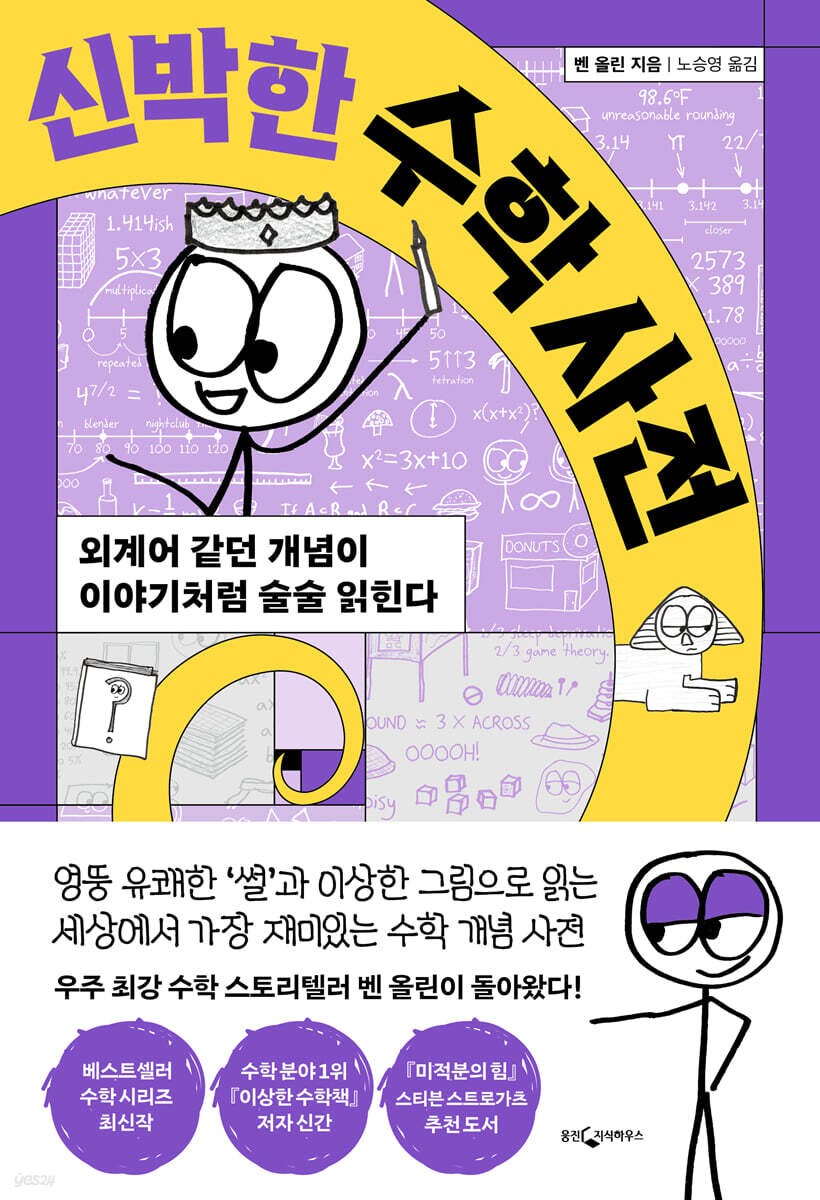 |
Description
Book Introduction
Math is as easy to read as Korean
A novel-like, novel-like, and innovative math book
The world's funniest math teacher, Ben Olin, is back!
This time, we'll be exploring math concepts with fun stories and unusual pictures.
What should you do if you want to become familiar with math? The answer is surprisingly simple.
It is about learning the concepts step by step and mastering the principles.
Here is a kind teacher who teaches math in the easiest and most enjoyable way in the world.
This is Ben Olin, author of the world-wide bestseller, The Weird Book of Math.
Ben Olin's writing, which adds his own unique humor to his own math "stories" and mixes in witty illustrations, instantly captivated not only math novice with weak fundamentals but also liberal arts students who find problem solving difficult.
Renowned as the universe's greatest mathematical storyteller, he's back, this time in an even more novel way.
The idea is to approach mathematical concepts that are dizzying just by looking at them as if learning a new language.
Just reading mathematics by viewing it as 'numbers are nouns', 'operations are verbs', and 'formulas are grammar' in the 'Amazing Math Dictionary' clearly shows that the concepts are seen differently.
Numbers become words and feel like tangible objects, and symbols become verbs and unfold before our eyes as concrete calculations.
Even equations and graphs that seem complicated are read as interesting events involving numbers and symbols.
The reason why many people struggle with math is simple.
Because all the language of mathematics is simply interpreted as instructions to solve problems.
This book teaches us how to imagine numbers and how to translate mathematics problems, which we have always understood as interrogative and imperative sentences, into declarative sentences.
Whether you're someone who's been afraid of math or an enthusiast looking for a fresh perspective, turning the pages of "Amazing Math Dictionary" will allow you to fluently understand the unfamiliar language of mathematics.
A novel-like, novel-like, and innovative math book
The world's funniest math teacher, Ben Olin, is back!
This time, we'll be exploring math concepts with fun stories and unusual pictures.
What should you do if you want to become familiar with math? The answer is surprisingly simple.
It is about learning the concepts step by step and mastering the principles.
Here is a kind teacher who teaches math in the easiest and most enjoyable way in the world.
This is Ben Olin, author of the world-wide bestseller, The Weird Book of Math.
Ben Olin's writing, which adds his own unique humor to his own math "stories" and mixes in witty illustrations, instantly captivated not only math novice with weak fundamentals but also liberal arts students who find problem solving difficult.
Renowned as the universe's greatest mathematical storyteller, he's back, this time in an even more novel way.
The idea is to approach mathematical concepts that are dizzying just by looking at them as if learning a new language.
Just reading mathematics by viewing it as 'numbers are nouns', 'operations are verbs', and 'formulas are grammar' in the 'Amazing Math Dictionary' clearly shows that the concepts are seen differently.
Numbers become words and feel like tangible objects, and symbols become verbs and unfold before our eyes as concrete calculations.
Even equations and graphs that seem complicated are read as interesting events involving numbers and symbols.
The reason why many people struggle with math is simple.
Because all the language of mathematics is simply interpreted as instructions to solve problems.
This book teaches us how to imagine numbers and how to translate mathematics problems, which we have always understood as interrogative and imperative sentences, into declarative sentences.
Whether you're someone who's been afraid of math or an enthusiast looking for a fresh perspective, turning the pages of "Amazing Math Dictionary" will allow you to fluently understand the unfamiliar language of mathematics.
- You can preview some of the book's contents.
Preview
index
preface
[Chapter 1 Noun: A thing called a number]
count
measurement
negative
fountain
decimal
Rounding
large digits
scientific notation
surd
infinity
[Chapter 2 Verbs: Arithmetic Acts]
Increase
addition
subtraction
multiplication
Division
Squares and cubes
square root
jisoo
log
lashing
calculate
[Chapter 3 Grammar: Algebra]
sign
variable
ceremony
Equation
Inequality
graph
official
leveling
sun
Category error
style
rule
[Chapter 4: Phrasebook: Mathematicians' Slang]
Growth and change
Errors and Estimates
Optimization
Sun and method
Shapes and curves
infinity
class
Logic and Proof
Truth and contradiction
Probability and possibility
Causality and Correlation
data
Games and Risks
attribute
Celebrities and Legends
Military words, quotations, small print
To study more deeply
Thank you for your ramblings
Search
[Chapter 1 Noun: A thing called a number]
count
measurement
negative
fountain
decimal
Rounding
large digits
scientific notation
surd
infinity
[Chapter 2 Verbs: Arithmetic Acts]
Increase
addition
subtraction
multiplication
Division
Squares and cubes
square root
jisoo
log
lashing
calculate
[Chapter 3 Grammar: Algebra]
sign
variable
ceremony
Equation
Inequality
graph
official
leveling
sun
Category error
style
rule
[Chapter 4: Phrasebook: Mathematicians' Slang]
Growth and change
Errors and Estimates
Optimization
Sun and method
Shapes and curves
infinity
class
Logic and Proof
Truth and contradiction
Probability and possibility
Causality and Correlation
data
Games and Risks
attribute
Celebrities and Legends
Military words, quotations, small print
To study more deeply
Thank you for your ramblings
Search
Detailed image

Into the book
A common complaint about mathematics is that it is not applicable to real-world situations.
Mathematics is too abstract, too vague, and too ivory-towered.
There is a time-honored adage:
“What use is this?” The textbook writers take this complaint seriously, turning the quadratic equation problem (“boring!”) into a ridiculous problem about a company whose profits are quadratic (“very practical and practical!”).
On the other hand, there are educators who reject the premise of ‘application to reality.’
No one asks when to 'use' music or literature, and he follows Albert Einstein's advice to accept mathematics as "the poetry of logical concepts."
Our answers to the question of how to apply mathematics to reality seem to me to be too tied to the word "reality."
When students ask for usefulness, what they want is not practicality, but a sense of purpose.
“When will I ever use this?” means “What am I doing here?” or “Why is this important?” or “What does all this mean?”
--- p.10
So what does it mean to say that mathematics is a language?
Mathematics starts with numbers.
Numbers and words have some notable differences, but both are systems for classifying the world.
Just like words, numbers can be used to transform complex experiences (like a walk by a lake) into something much simpler.
Words transform experiences into descriptions (“there are many expensive breeds of dogs”), and numbers transform experiences into quantities (“three kilometers”).
--- p.11
In high school, I had a friend who was notorious for asking questions that would send the class into a tizzy.
A friend of mine once said this:
“I’m also adding something to our class.
“That could be negative, but anyway, the book says that it’s addition.”
I've always liked that sentence.
Because it captures the essence of negative numbers.
The presence of wealth, the absence of many.
--- p.37
We have no way of avoiding the fountain.
If a high school student is struggling, it's probably because of a secret awkwardness about fractions.
It is an anxiety that follows them like a childhood memory.
If you're curious, ask the restaurant chain A&W.
In the 1980s, A&W heavily promoted its new "Third Pound" burger.
It costs the same as McDonald's Quarter Pounder, and according to surveys, it tastes just as good.
But it still failed.
People were indifferent.
“Why should I pay the same price as a quarter pound when there’s only a third of a pound of meat in it?”
Anyone who says, “The customer is always right” has never met a customer who insists that one-third is less than one-quarter.
But this customer is also right in his own way.
It correctly shows the difficulty of fractions and how difficult it is to compare numbers that have the mask of infinite synonyms.
--- pp.52~53
Sometimes I feel like math is like a tower.
It takes us from the mundane world of everyday experience (like a pile of cookies, a bucket, a 50-cent coin) to the lofty world of abstract ideas (like Lee Gun).
Going upstairs gives you a feeling of pleasure and strength.
But going down, you feel the same pleasure (and a different kind of power).
Down there, we can touch the foundations, peer into the intersections of mathematics and the world, and fill our half-liter buckets with new insights.
--- p.143
The problem is that the root is a very, very annoying number.
Have you ever tried calculating square roots by hand? It's freaking hard.
As soon as calculators became widely available, we removed square roots from the curriculum.
It was for the same reason that we don't send children to the coal mines.
Of course, not all roots are bad.
There are also things that are neat integers, such as the root of 4 and the root of 9.
However, the roots between the two are irrational and can only be expressed as infinite decimals.
What exactly is the square root of 7? A calculator will give you a rough estimate (about 2.646), but when you're pressed for time and paper, the only accurate way to describe the square root of 7 is "the number whose square equals 7."
--- pp.151~152
It takes a 120-member symphony orchestra 40 minutes to play Beethoven's Symphony No. 9.
How many minutes will it take if there are 60 members?
For the past few years, Claire's story has been circulating online, sparking suspicion and outrage wherever she goes (and not just because it takes her over an hour to properly play Beethoven's Ninth Symphony).
This problem is complete nonsense if you look at it as written.
Sending out one violinist doesn't change the tempo of the symphony.
“That’s not how it works,” someone quipped on Twitter (now X), read by millions.
“Nothing works that way,” someone else chimed in, comparing it to childbirth.
“It takes nine months for a woman to give birth to a baby.
"So how many months would it take for two women to have a baby?" You're itching to join in on their taunts.
--- p.173
Algebra is the study of relationships.
This isn't a love story, it's a story about 'what kind of relationship are there between two numbers?'
Fahrenheit temperature is related to Celsius temperature.
The diameter of a pizza is related to the number of people that can eat it.
The time it takes to walk one kilometer is related to the speed at which you walk.
When we want to express this relationship in a completely general and precise way, we use an equation.
Equations encode a tremendous amount of information, but can sometimes be difficult to decipher.
On the other hand, when you want to show a relationship by giving a few clear and specific examples, you use a table.
Tables are easier to understand than equations, but they are not perfect.
It's like a few thumbnail images that summarize and extract hours of video.
--- p.222
A lot of mathematics is actually about finding all kinds of culprits.
You learn how many years you should expect.
Learn to handle evidence carefully and cautiously.
Learn the right method for each situation.
You grow up to be the Sherlock Holmes of the water world.
The following example demonstrates how to rephrase evidence into a more useful form, using techniques learned in school (you don't need to go into detail).
(x - 5)(x + 2) = 0.
This evidence can be expressed as follows:
“When you multiply two numbers, you get zero.” This is an algebraic smoking gun.
No, it's no different from a public confession.
When does multiplication result in 0? It's only when one of the multiplicands is 0.
--- pp.245~246
If I rounded up what I taught you to the nearest tenth, it would be 0 percent of math.
But don't worry, my friend.
Because that was the original plan.
This book is not an encyclopedia of the world of mathematics, but rather a short introduction to exploring the language of mathematics.
We stood together on the beach and built a small boat.
The task of creating the chart is left to you.
But before you set sail, I have one parting gift for you.
It is a gift more precious than any key or compass.
It's a guide to understanding the jokes between mathematicians.
Mathematics is too abstract, too vague, and too ivory-towered.
There is a time-honored adage:
“What use is this?” The textbook writers take this complaint seriously, turning the quadratic equation problem (“boring!”) into a ridiculous problem about a company whose profits are quadratic (“very practical and practical!”).
On the other hand, there are educators who reject the premise of ‘application to reality.’
No one asks when to 'use' music or literature, and he follows Albert Einstein's advice to accept mathematics as "the poetry of logical concepts."
Our answers to the question of how to apply mathematics to reality seem to me to be too tied to the word "reality."
When students ask for usefulness, what they want is not practicality, but a sense of purpose.
“When will I ever use this?” means “What am I doing here?” or “Why is this important?” or “What does all this mean?”
--- p.10
So what does it mean to say that mathematics is a language?
Mathematics starts with numbers.
Numbers and words have some notable differences, but both are systems for classifying the world.
Just like words, numbers can be used to transform complex experiences (like a walk by a lake) into something much simpler.
Words transform experiences into descriptions (“there are many expensive breeds of dogs”), and numbers transform experiences into quantities (“three kilometers”).
--- p.11
In high school, I had a friend who was notorious for asking questions that would send the class into a tizzy.
A friend of mine once said this:
“I’m also adding something to our class.
“That could be negative, but anyway, the book says that it’s addition.”
I've always liked that sentence.
Because it captures the essence of negative numbers.
The presence of wealth, the absence of many.
--- p.37
We have no way of avoiding the fountain.
If a high school student is struggling, it's probably because of a secret awkwardness about fractions.
It is an anxiety that follows them like a childhood memory.
If you're curious, ask the restaurant chain A&W.
In the 1980s, A&W heavily promoted its new "Third Pound" burger.
It costs the same as McDonald's Quarter Pounder, and according to surveys, it tastes just as good.
But it still failed.
People were indifferent.
“Why should I pay the same price as a quarter pound when there’s only a third of a pound of meat in it?”
Anyone who says, “The customer is always right” has never met a customer who insists that one-third is less than one-quarter.
But this customer is also right in his own way.
It correctly shows the difficulty of fractions and how difficult it is to compare numbers that have the mask of infinite synonyms.
--- pp.52~53
Sometimes I feel like math is like a tower.
It takes us from the mundane world of everyday experience (like a pile of cookies, a bucket, a 50-cent coin) to the lofty world of abstract ideas (like Lee Gun).
Going upstairs gives you a feeling of pleasure and strength.
But going down, you feel the same pleasure (and a different kind of power).
Down there, we can touch the foundations, peer into the intersections of mathematics and the world, and fill our half-liter buckets with new insights.
--- p.143
The problem is that the root is a very, very annoying number.
Have you ever tried calculating square roots by hand? It's freaking hard.
As soon as calculators became widely available, we removed square roots from the curriculum.
It was for the same reason that we don't send children to the coal mines.
Of course, not all roots are bad.
There are also things that are neat integers, such as the root of 4 and the root of 9.
However, the roots between the two are irrational and can only be expressed as infinite decimals.
What exactly is the square root of 7? A calculator will give you a rough estimate (about 2.646), but when you're pressed for time and paper, the only accurate way to describe the square root of 7 is "the number whose square equals 7."
--- pp.151~152
It takes a 120-member symphony orchestra 40 minutes to play Beethoven's Symphony No. 9.
How many minutes will it take if there are 60 members?
For the past few years, Claire's story has been circulating online, sparking suspicion and outrage wherever she goes (and not just because it takes her over an hour to properly play Beethoven's Ninth Symphony).
This problem is complete nonsense if you look at it as written.
Sending out one violinist doesn't change the tempo of the symphony.
“That’s not how it works,” someone quipped on Twitter (now X), read by millions.
“Nothing works that way,” someone else chimed in, comparing it to childbirth.
“It takes nine months for a woman to give birth to a baby.
"So how many months would it take for two women to have a baby?" You're itching to join in on their taunts.
--- p.173
Algebra is the study of relationships.
This isn't a love story, it's a story about 'what kind of relationship are there between two numbers?'
Fahrenheit temperature is related to Celsius temperature.
The diameter of a pizza is related to the number of people that can eat it.
The time it takes to walk one kilometer is related to the speed at which you walk.
When we want to express this relationship in a completely general and precise way, we use an equation.
Equations encode a tremendous amount of information, but can sometimes be difficult to decipher.
On the other hand, when you want to show a relationship by giving a few clear and specific examples, you use a table.
Tables are easier to understand than equations, but they are not perfect.
It's like a few thumbnail images that summarize and extract hours of video.
--- p.222
A lot of mathematics is actually about finding all kinds of culprits.
You learn how many years you should expect.
Learn to handle evidence carefully and cautiously.
Learn the right method for each situation.
You grow up to be the Sherlock Holmes of the water world.
The following example demonstrates how to rephrase evidence into a more useful form, using techniques learned in school (you don't need to go into detail).
(x - 5)(x + 2) = 0.
This evidence can be expressed as follows:
“When you multiply two numbers, you get zero.” This is an algebraic smoking gun.
No, it's no different from a public confession.
When does multiplication result in 0? It's only when one of the multiplicands is 0.
--- pp.245~246
If I rounded up what I taught you to the nearest tenth, it would be 0 percent of math.
But don't worry, my friend.
Because that was the original plan.
This book is not an encyclopedia of the world of mathematics, but rather a short introduction to exploring the language of mathematics.
We stood together on the beach and built a small boat.
The task of creating the chart is left to you.
But before you set sail, I have one parting gift for you.
It is a gift more precious than any key or compass.
It's a guide to understanding the jokes between mathematicians.
--- p.271
Publisher's Review
★ Ben Olin's new book, "The Strange Math Book," a bestseller in the math field
★ Recommended by Stephen Strogatz, author of "The Power of Calculus"
★ An introductory book that even liberal arts students and those who have failed the exam can read without difficulty.
“Why does math confuse us so much?”
'Numbers = nouns', 'Operations = verbs', 'Formulas = grammar'
How to explore mathematics in easy-to-understand everyday language
▶ Can negative numbers be explained as ‘the existence of nothingness’?
▶ Subtraction is actually just another way of saying adding negative numbers?
▶ What does it mean if '+' in 2+3 is a preposition rather than an operator?
The reason we get frustrated with math isn't simply because we're bad at calculations.
Most of them don't understand the concept properly.
Questions such as “Why are negative numbers necessary when they are uncountable?”, “Is multiplication just repetition of addition?”, and “Why are equations composed of unknowns and equalities?” are often not covered in textbooks, but they ask about the essence of concepts.
We skip these questions and go straight to solving the problem.
Then mathematics soon becomes a collection of formulas to be memorized.
As a result, you end up in a situation where you can't explain what you've found even after solving the problem, or you don't even understand the meaning of the problem and can't even begin to solve it.
『Amazing Math Dictionary』 is the book that rescues us from that trap.
The author interprets negative numbers not simply as 'small numbers' but as 'a way to express nothingness'.
The '+' in 2+3 is changed to a preposition and explained as "2 with 3," and subtraction is also interpreted as "negative addition," so 5-3 is expressed as 5 + -3.
This shift in thinking allows us to break away from the stereotype that mathematics requires solving problems and memorizing formulas.
It is about transforming it into an imaginary world that can be expressed in various ways using numbers.
Ultimately, this book helps you accept mathematics as a living language and a tool for thinking, expanding your thinking to a whole new level.
“The problem can be solved just by reading the concepts and context!”
Break free from the mechanical solutions confined to numbers and symbols,
How to understand the logic of mathematics through concepts
▶ There are 125 sheep and 5 sheepdogs.
How old is the shepherd?
▶ It takes 40 minutes for 120 people to play a symphony.
How long will it take for 60 people?
▶ It takes nine months for a woman to give birth to a baby.
How many months will it take for two women?
When faced with problems like this, we habitually pick up our pencils first.
But let's think about it carefully.
Can you estimate the age of a shepherd by knowing how many sheep he has? Would a decrease in the number of orchestra members really affect the length of a performance? Could the time it takes two women to give birth change? It's pointless to try to answer the wrong question.
Ben Olin twists these odd problems with his signature humor and witty "storytelling," helping us discern between real problems and fake calculations.
In this way, he guides us in reading mathematics in a new way.
For example, 1 + 1 is usually read as a command to “add numbers,” but in this book it is treated simply as a noun phrase meaning “one and one.”
3 × 7 can also be converted to the answer 21, but that is just a calculation.
What is important is the structure and relationship that this multiplication shows.
You can also just read it as three groups of 7.
The nature of numbers is clearly revealed when they are not calculated.
Mathematics is not always a simple process of finding answers; it is a process in which numbers and symbols are intertwined like grammar to create new meaning.
Ben Olin points out this very point, forcing us to break free from the calculation habits we take for granted and read mathematics as a structure.
★ Recommended by Stephen Strogatz, author of "The Power of Calculus"
★ An introductory book that even liberal arts students and those who have failed the exam can read without difficulty.
“Why does math confuse us so much?”
'Numbers = nouns', 'Operations = verbs', 'Formulas = grammar'
How to explore mathematics in easy-to-understand everyday language
▶ Can negative numbers be explained as ‘the existence of nothingness’?
▶ Subtraction is actually just another way of saying adding negative numbers?
▶ What does it mean if '+' in 2+3 is a preposition rather than an operator?
The reason we get frustrated with math isn't simply because we're bad at calculations.
Most of them don't understand the concept properly.
Questions such as “Why are negative numbers necessary when they are uncountable?”, “Is multiplication just repetition of addition?”, and “Why are equations composed of unknowns and equalities?” are often not covered in textbooks, but they ask about the essence of concepts.
We skip these questions and go straight to solving the problem.
Then mathematics soon becomes a collection of formulas to be memorized.
As a result, you end up in a situation where you can't explain what you've found even after solving the problem, or you don't even understand the meaning of the problem and can't even begin to solve it.
『Amazing Math Dictionary』 is the book that rescues us from that trap.
The author interprets negative numbers not simply as 'small numbers' but as 'a way to express nothingness'.
The '+' in 2+3 is changed to a preposition and explained as "2 with 3," and subtraction is also interpreted as "negative addition," so 5-3 is expressed as 5 + -3.
This shift in thinking allows us to break away from the stereotype that mathematics requires solving problems and memorizing formulas.
It is about transforming it into an imaginary world that can be expressed in various ways using numbers.
Ultimately, this book helps you accept mathematics as a living language and a tool for thinking, expanding your thinking to a whole new level.
“The problem can be solved just by reading the concepts and context!”
Break free from the mechanical solutions confined to numbers and symbols,
How to understand the logic of mathematics through concepts
▶ There are 125 sheep and 5 sheepdogs.
How old is the shepherd?
▶ It takes 40 minutes for 120 people to play a symphony.
How long will it take for 60 people?
▶ It takes nine months for a woman to give birth to a baby.
How many months will it take for two women?
When faced with problems like this, we habitually pick up our pencils first.
But let's think about it carefully.
Can you estimate the age of a shepherd by knowing how many sheep he has? Would a decrease in the number of orchestra members really affect the length of a performance? Could the time it takes two women to give birth change? It's pointless to try to answer the wrong question.
Ben Olin twists these odd problems with his signature humor and witty "storytelling," helping us discern between real problems and fake calculations.
In this way, he guides us in reading mathematics in a new way.
For example, 1 + 1 is usually read as a command to “add numbers,” but in this book it is treated simply as a noun phrase meaning “one and one.”
3 × 7 can also be converted to the answer 21, but that is just a calculation.
What is important is the structure and relationship that this multiplication shows.
You can also just read it as three groups of 7.
The nature of numbers is clearly revealed when they are not calculated.
Mathematics is not always a simple process of finding answers; it is a process in which numbers and symbols are intertwined like grammar to create new meaning.
Ben Olin points out this very point, forcing us to break free from the calculation habits we take for granted and read mathematics as a structure.
GOODS SPECIFICS
- Date of issue: August 25, 2025
- Format: Hardcover book binding method guide
- Page count, weight, size: 360 pages | 818g | 160*233*26mm
- ISBN13: 9788901296692
- ISBN10: 8901296691
You may also like
카테고리
korean


korean

![GQ KOREA Mark (Monthly): December [2025]](http://librairie.coreenne.fr/cdn/shop/files/8ef265dbbfbf186523ed75ba7319009d.jpg?v=1765340328&width=3840)


