

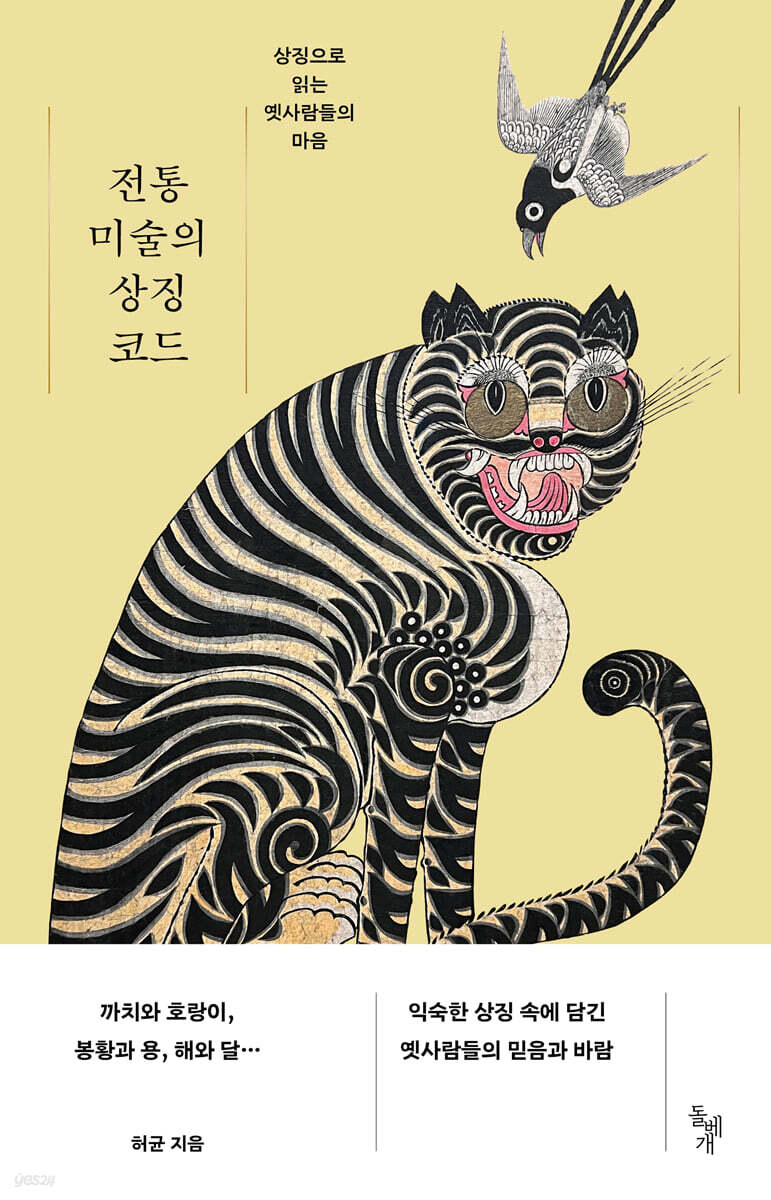
Symbolic codes of traditional art
 |
Description
Book Introduction
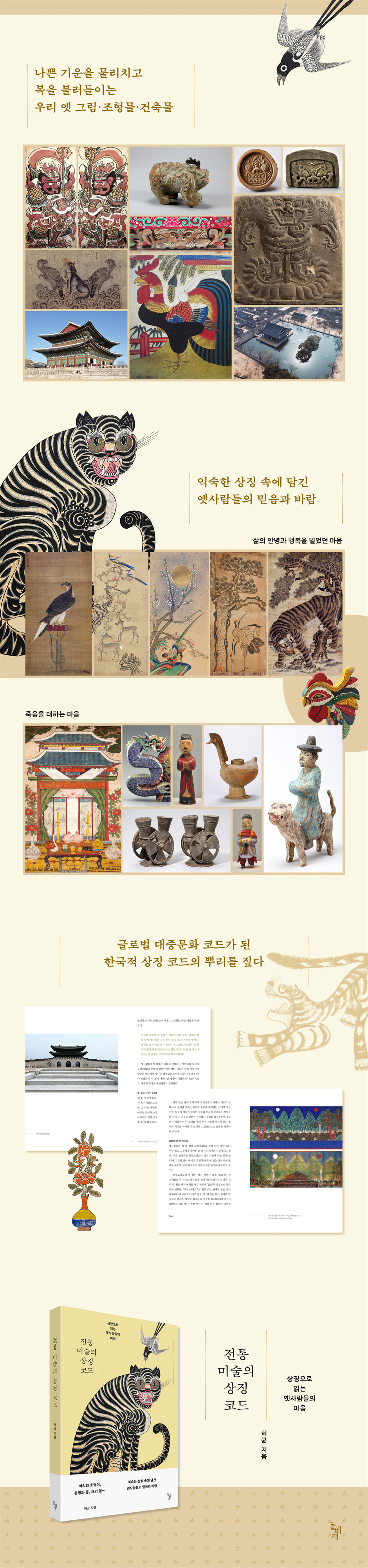
Our ancient paintings, sculptures, and buildings that ward off evil spirits and bring in good fortune.
Tracing the Roots of Korean Symbols That Have Become Global Pop Culture Codes
People in ancient times incorporated various symbols into paintings, sculptures, and buildings to ward off evil spirits and attract good fortune.
Ghosts were scary, but at the same time they were beings that protected life, and death was not the end, but the beginning of another journey.
This book unravels the traditional wisdom contained in auspicious and omens, life and death, space and the astronomical observatory, demonstrating the cultural power of symbols that still persist in our lives today.
Tracing the Roots of Korean Symbols That Have Become Global Pop Culture Codes
People in ancient times incorporated various symbols into paintings, sculptures, and buildings to ward off evil spirits and attract good fortune.
Ghosts were scary, but at the same time they were beings that protected life, and death was not the end, but the beginning of another journey.
This book unravels the traditional wisdom contained in auspicious and omens, life and death, space and the astronomical observatory, demonstrating the cultural power of symbols that still persist in our lives today.
- You can preview some of the book's contents.
Preview
index
In publishing the book
1. Wishing for the well-being and happiness of life: The art of auspicious and omnipotent
Samshin Seondo and Jaradol - Dreaming of the Heavenly World
Phoenix and Dragon - Hoping for Heaven's Praise and Auspicious Message
Ethical Text - Reasons to Be Blessed
Sehwa - Wishing you a safe and happy new year
The Art of Wall Painting - Defeating Ghosts and Fraud
2 Comforting and Seeing Off the Dead: Funerals and the Arts of the Underworld
Tomb Murals - Decorating the Afterlife
Funeral goods - items for the deceased
Funeral Decorations - Decorating the Departure
Neungyeok Sculptures - Honoring and Protecting the Former Kings
Gammoyeojaedo - Where Ancestral Spirits Reside
Buddhist Funeral Art - Representing Rebirth in Paradise and Impermanence and Anatta
3. Order in Direction and Direction: The Art of the Space Surrounding Life
The Humanities of Direction - Symbolic Systems of East, West, South, and North
Facing Direction and Left Facing Direction - The Order Contained in the Facing Direction
Left and right and inside and outside - the principles of setting space
Spaces that defy order
4. Embodying the Principles of the Universe: The Art of Astronomy and Constants
Cosmological Models - Inspiring Astronomy in the Humanities
The Sun and the Moon - Revealing the Yin and Yang of the Universe
Stars - govern human life and fortune
Constants - The principles of the universe contained in numbers
References
Search
1. Wishing for the well-being and happiness of life: The art of auspicious and omnipotent
Samshin Seondo and Jaradol - Dreaming of the Heavenly World
Phoenix and Dragon - Hoping for Heaven's Praise and Auspicious Message
Ethical Text - Reasons to Be Blessed
Sehwa - Wishing you a safe and happy new year
The Art of Wall Painting - Defeating Ghosts and Fraud
2 Comforting and Seeing Off the Dead: Funerals and the Arts of the Underworld
Tomb Murals - Decorating the Afterlife
Funeral goods - items for the deceased
Funeral Decorations - Decorating the Departure
Neungyeok Sculptures - Honoring and Protecting the Former Kings
Gammoyeojaedo - Where Ancestral Spirits Reside
Buddhist Funeral Art - Representing Rebirth in Paradise and Impermanence and Anatta
3. Order in Direction and Direction: The Art of the Space Surrounding Life
The Humanities of Direction - Symbolic Systems of East, West, South, and North
Facing Direction and Left Facing Direction - The Order Contained in the Facing Direction
Left and right and inside and outside - the principles of setting space
Spaces that defy order
4. Embodying the Principles of the Universe: The Art of Astronomy and Constants
Cosmological Models - Inspiring Astronomy in the Humanities
The Sun and the Moon - Revealing the Yin and Yang of the Universe
Stars - govern human life and fortune
Constants - The principles of the universe contained in numbers
References
Search
Detailed image
Into the book
People create myths and legends, and these myths and legends in turn dominate people's ideas and mental world.
Although it is a modern animal that originally inhabits the natural ecosystem, in the minds of ancient people, it was positioned as a divine animal that supported the Three Gods and the Three Immortals.
So, even though it is a sculpture made of stone, the space where the jar is placed is transformed into a magical world filled with auspicious energy.
--- p.18
Among the expressions we commonly use in our daily lives, there is the saying, 'to invite disaster.'
This saying implies that when you are angry, you are the cause of it.
The same goes for fortune.
The ancients believed that blessings were given from heaven when one did something to deserve them.
For Koreans, fortune and misfortune were ultimately given by heaven in response to the good and evil of each person.
--- p.32
Among the three paintings, the one that occupies the most important position is the painting on the gate and middle gate mentioned above.
The main gate is where a rope is tied to prevent entry by strangers and to ward off evil spirits and unclean things when a child is born.
It is also a place where they post spring greeting cards such as ‘Ipchundaegil’ (立春大吉) and ‘Geonyangdagyeong’ (建陽多慶).
The reason there are so many folk customs and traditions related to the main gate is because the main gate was considered a passageway through which not only people but also evil spirits and ghosts could pass, and there was a belief that good and bad fortune depended on this gate.
--- p.49
Among the murals featuring dogs as the main character, there is one that features a dog with three eyes.
It is called the 'Tang Sanmu Gu' (唐三目狗), and the fact that it has three eyes is a clever way to multiply the spiritual power of the wall dog that searches for evil spirits.
It is the same reason that the three-eyed mask worn during funerals or ceremonies to ward off ghosts has three eyes.
There are also some paintings with falcons, which is also a trick to increase the spiritual power of the wall painter.
--- p.63
The road a person takes to the afterlife is long and arduous.
If they lose their way, the dead may become vengeful spirits and wander the world, tormenting the living.
You can use a boat to cross rivers and seas, but when traveling a long and arduous land route, you need a device that will allow you to travel to the afterlife comfortably along the right path without getting lost along the way.
The cart is what plays that role.
'Bal-in' (發?) means removing the chocks of a cart wheel and departing for the afterlife.
If you clearly know the path to the afterlife, you won't have to take a side road or wander at a strange fork in the road, and you won't have to worry about running into thorns or giving up halfway while taking a shortcut.
This is precisely why cart-shaped pottery, which is considered to be a 'passenger's journey to the underworld, is buried in graves.
--- p.94~95
So what are ghosts? Are they good or evil? It's not easy to give a clear answer to this question.
Because ghosts are subtle in nature, they cannot be seen or experienced in reality.
However, its true identity is subtly revealed in the word 'ear' that we commonly use.
In expressions like ‘even ghosts don’t know’, ‘even ghosts can’t look down on them’, and ‘they hit like ghosts’, ghosts are omnipotent beings.
When you say 'the ghost helped you', the ghost becomes a guardian.
When we say, "The ghost is crying and leaving," the ghost is an emotional being, and when we say, "The ghost is coming out," the ghost is an evil being that lives in a dark and gloomy place.
Also, if someone behaves badly and you say, "He's acting like a ghost," then this ghost becomes a vicious and malicious being that causes harm.
In the phrase 'exorcising a ghost', a ghost is an object that must be exorcised.
But the job of exorcising that ghost is done by another ghost.
In this way, when it comes to ghosts, the dualism of good and evil naturally exists.
--- p.133
When a person dies and the body is placed in a coffin, the board placed underneath is called a Chilseong board.
It was given that name because there are seven holes in the shape of the Big Dipper on a single piece of board.
The Chilseongpan is a wooden board that combines the Big Dipper into a deity, and has the characteristics of a kind of shamanic tool.
The reason the Big Dipper is used as the body is because the six stars of the Southern Dipper govern yang and symbolize life, while the Big Dipper governs yin and symbolizes death.
Placing the body on the Chilseongpan has the symbolic meaning of returning the deceased to the place of yin, that is, the source of life.
(…) In the first place, the North Star and the Big Dipper had nothing to do with Buddhist doctrine.
However, the fact that the shrines that enshrine the North Star and the Big Dipper, including the Samseonggak, were located within the temple grounds is also connected to the practical problem of temple management.
In Joseon society, which started with the principle of suppressing Buddhism and promoting Confucianism as its founding ideology, most temples, except those related to the royal family, were bound to experience financial difficulties.
As a solution, the process of introducing ceremonies of blessings such as offerings and offerings of offerings to the temple led to the acceptance of the shamanistic belief in the holy water.
Although it is a modern animal that originally inhabits the natural ecosystem, in the minds of ancient people, it was positioned as a divine animal that supported the Three Gods and the Three Immortals.
So, even though it is a sculpture made of stone, the space where the jar is placed is transformed into a magical world filled with auspicious energy.
--- p.18
Among the expressions we commonly use in our daily lives, there is the saying, 'to invite disaster.'
This saying implies that when you are angry, you are the cause of it.
The same goes for fortune.
The ancients believed that blessings were given from heaven when one did something to deserve them.
For Koreans, fortune and misfortune were ultimately given by heaven in response to the good and evil of each person.
--- p.32
Among the three paintings, the one that occupies the most important position is the painting on the gate and middle gate mentioned above.
The main gate is where a rope is tied to prevent entry by strangers and to ward off evil spirits and unclean things when a child is born.
It is also a place where they post spring greeting cards such as ‘Ipchundaegil’ (立春大吉) and ‘Geonyangdagyeong’ (建陽多慶).
The reason there are so many folk customs and traditions related to the main gate is because the main gate was considered a passageway through which not only people but also evil spirits and ghosts could pass, and there was a belief that good and bad fortune depended on this gate.
--- p.49
Among the murals featuring dogs as the main character, there is one that features a dog with three eyes.
It is called the 'Tang Sanmu Gu' (唐三目狗), and the fact that it has three eyes is a clever way to multiply the spiritual power of the wall dog that searches for evil spirits.
It is the same reason that the three-eyed mask worn during funerals or ceremonies to ward off ghosts has three eyes.
There are also some paintings with falcons, which is also a trick to increase the spiritual power of the wall painter.
--- p.63
The road a person takes to the afterlife is long and arduous.
If they lose their way, the dead may become vengeful spirits and wander the world, tormenting the living.
You can use a boat to cross rivers and seas, but when traveling a long and arduous land route, you need a device that will allow you to travel to the afterlife comfortably along the right path without getting lost along the way.
The cart is what plays that role.
'Bal-in' (發?) means removing the chocks of a cart wheel and departing for the afterlife.
If you clearly know the path to the afterlife, you won't have to take a side road or wander at a strange fork in the road, and you won't have to worry about running into thorns or giving up halfway while taking a shortcut.
This is precisely why cart-shaped pottery, which is considered to be a 'passenger's journey to the underworld, is buried in graves.
--- p.94~95
So what are ghosts? Are they good or evil? It's not easy to give a clear answer to this question.
Because ghosts are subtle in nature, they cannot be seen or experienced in reality.
However, its true identity is subtly revealed in the word 'ear' that we commonly use.
In expressions like ‘even ghosts don’t know’, ‘even ghosts can’t look down on them’, and ‘they hit like ghosts’, ghosts are omnipotent beings.
When you say 'the ghost helped you', the ghost becomes a guardian.
When we say, "The ghost is crying and leaving," the ghost is an emotional being, and when we say, "The ghost is coming out," the ghost is an evil being that lives in a dark and gloomy place.
Also, if someone behaves badly and you say, "He's acting like a ghost," then this ghost becomes a vicious and malicious being that causes harm.
In the phrase 'exorcising a ghost', a ghost is an object that must be exorcised.
But the job of exorcising that ghost is done by another ghost.
In this way, when it comes to ghosts, the dualism of good and evil naturally exists.
--- p.133
When a person dies and the body is placed in a coffin, the board placed underneath is called a Chilseong board.
It was given that name because there are seven holes in the shape of the Big Dipper on a single piece of board.
The Chilseongpan is a wooden board that combines the Big Dipper into a deity, and has the characteristics of a kind of shamanic tool.
The reason the Big Dipper is used as the body is because the six stars of the Southern Dipper govern yang and symbolize life, while the Big Dipper governs yin and symbolizes death.
Placing the body on the Chilseongpan has the symbolic meaning of returning the deceased to the place of yin, that is, the source of life.
(…) In the first place, the North Star and the Big Dipper had nothing to do with Buddhist doctrine.
However, the fact that the shrines that enshrine the North Star and the Big Dipper, including the Samseonggak, were located within the temple grounds is also connected to the practical problem of temple management.
In Joseon society, which started with the principle of suppressing Buddhism and promoting Confucianism as its founding ideology, most temples, except those related to the royal family, were bound to experience financial difficulties.
As a solution, the process of introducing ceremonies of blessings such as offerings and offerings of offerings to the temple led to the acceptance of the shamanistic belief in the holy water.
--- p.255~257
Publisher's Review
The hearts of the ancient people who prayed for peace and happiness in life
People of old believed that invisible evil spirits and ghosts threatened life.
To prevent this and bring in good fortune, various symbolic devices were installed everywhere, from palaces and temples to the homes of common people.
The main gate was decorated with a painting of a tiger or a gate god, and the roof of the temple's main hall was decorated with tiles with scary-looking ghost faces to prevent evil spirits from entering.
In the private sector, they would hang a rope made of pine branches, red peppers, and charcoal at the village guardian shrine to prevent evil spirits from entering.
In the royal tomb, a stone beast stood to guard the rest of the deceased.
These symbols, which were mobilized in all spaces surrounding life, including paintings, sculptures, and buildings, were auspicious and evil-fighting devices intended to prevent disaster and bring in good fortune.
It was believed that fortune and misfortune ultimately stemmed from human actions, and that these actions led to the influence of heaven.
In other words, auspiciousness was not a simple superstition or decoration, but an order that connected the desirable life of humans with the will of heaven.
Ethical characters that express virtues such as filial piety, loyalty, and courtesy in writing are also representative examples of folding screens.
This idea is also clearly expressed in the Sehwa that was drawn and hung at the beginning of each year.
Rather than being a simple decorative painting, Sehwa was a device used in wall paintings to pray for a year free from disease and disaster.
Phrases like ‘Ipchundaegil’ (立春大吉) and ‘Geonyangdaegyeong’ (建陽多慶) and paintings of magpies and tigers contained wishes for happiness and safety.
Gilsang originated from the desire to protect life rather than from splendid artistic achievements.
People of old considered it desirable to live a life according to the laws of heaven, and sought peace and happiness in it.
From the signboards in palaces, to the decorations in temples, to the small talismans in homes, the wishes of people in the past for peace and happiness in life are all connected like a single code.
These traces continue to this day in New Year's greetings and small decorations placed in the home.
Ultimately, good fortune is a universal desire for well-being and happiness in life.
What kind of being was a ghost?
Korean symbolic codes that have become global pop culture codes
The success of K-Pop Demon Hunters (hereafter referred to as 'K-Pop Demon Hunters') clearly demonstrates how Korean shamanistic traditions can function as a global cultural code.
The 'honmun', which appears as an important setting in the work, is similar to the concepts of auspiciousness and banishment explained above.
So, what kind of being was a "demon"? Rumi, the protagonist of "Kedeheon," is both a being that catches ghosts and a ghost herself.
Are ghosts benevolent or evil? According to "Symbolic Codes of Traditional Art," "ghosts are so obscure that they cannot be seen," making it difficult to answer in a single word.
However, we can guess its complex nature through the various expressions that appear in our language life.
“In expressions like ‘even ghosts don’t know’, ‘even ghosts can’t look down on them’, and ‘they hit like ghosts’, ghosts are omnipotent beings.
When you say 'the ghost helped you', the ghost becomes a guardian.
When we say, "The ghost is crying and leaving," the ghost is an emotional being, and when we say, "The ghost is coming out," the ghost is an evil being that lives in a dark and gloomy place.
Also, if someone behaves badly and you say, "He's acting like a ghost," then this ghost becomes a vicious and malicious being that causes harm.
In the phrase 'exorcising a ghost', a ghost is an object that must be exorcised.
“But the work of exorcising that ghost is also done by another ghost.” (p. 133)
In this way, ghosts were ambivalent beings where good and evil coexisted.
So, while people were afraid of ghosts, they also accepted them as beings that were deeply involved in their lives.
Perhaps the reason why 'Kedeheon' appeals to people around the world today is because the work's Korean symbols are well connected to the fear and awe of the invisible, and the universal desire to find meaning and order in life through them.
'Balin' originally meant removing the chock of a cart wheel.
The ancient people's attitude toward death
In order for the cart to roll, the chock in front of the wheel must be removed.
'Balin' (發?) originally meant removing the chocks [?] of a cart wheel.
However, the fact that this act came to be used as a term for funeral procedures is related to the ancient people's view of life and death.
Our ancestors believed that the road to the afterlife after death was long and difficult.
So, to ensure that the deceased does not lose their way and can follow the right path, they buried a wheel-shaped pottery in the grave.
Park Ji-won (朴趾源, 1737-1805), a Silhak scholar of Joseon, used the expression “a chariot pointing south in the underworld” in his book “A Map of the Way to Learn.”
'Jinamgeo' means 'a cart pointing in the right direction'.
In ancient times, when the emperor was fighting Chiyou, the thick fog that Chiyou had created caused the soldiers to lose their direction and become confused. This legendary object is said to have been created by the emperor to guide his soldiers.
It is said that since the Jin Dynasty, this carriage has been used as a tool to straighten the path of the emperor's procession.
This idea was transferred to funeral rites, and 'Bal-in' became a word used to pray for a straight and peaceful path for the deceased as they depart for the afterlife after the funeral.
It gives us a glimpse into the traditional idea that death is a separation for the living, but the beginning of another journey for the deceased.
The desire to guide those who set out on a journey to the right path is contained within it the symbolic philosophy of the ancient people's views on life and death, connecting life and death.
The gate plaques of Changdeokgung and Changgyeonggung Palaces, moved by the Japanese, are still intact…
Things Missed During the Cultural Heritage Restoration Process
In traditional architecture, 'inside' and 'outside' were not simply inside and outside, but were important concepts that revealed the subject and order.
The king's residence or political space was designated as 'inner', and the surrounding area was naturally designated as 'outer'. In accordance with this order, the gate's signboard, the munak, was hung on the outside so that people entering from the outside could see it.
Looking at the “Donggwoldo” (東闕圖) produced in 1827 (the 27th year of King Sunjo’s reign), we can see that the gate of Changdeokgung Palace’s Sukjangmun was originally hung on the east side so that people entering Injeongjeon could see it.
However, the current signboard of the Sukjangmun Gate is hung on the west side.
How did the location of the gate change? “At the end of the Joseon Dynasty, when Emperor Sunjong lost his royal power and took refuge in Changdeokgung Palace, Huijeongdang became the inner palace.
Around 1908, the Japanese government opened a new road to allow the royal carriage to easily enter from Donhwamun Gate to Huijeongdang through Jinseonmun Gate and Sukjeongmun Gate under the pretext of promoting the convenience of Emperor Sunjong.
In this process, the Woldae in front of Donhwamun was demolished and Sukjangmun was made to function as the gate leading to Huijeongdang.
It is presumed that at this time, the Japanese moved the plaque to the west of the gate in accordance with the direction of entry into Heejeongdang.” (pp. 202-204) During the restoration project of Changdeokgung Palace, the Sukjangmun Gate was restored with the plaque hanging in the same condition as during the reign of King Sunjong.
The gate of Changgyeonggung Palace's Binyangmun Gate, which should have been hung on the east side, is currently hung on the west side.
According to the 『Gunggwolji』, the center of the direction of this area, that is, the place designated as ‘inner’, was Haminjeong.
The name 'Binyang' (賓陽) is derived from the phrase 'Inbinchulil' (寅賓出日) in the Book of Documents, which symbolizes the direction of 'east' where the sun rises and the energy of life begins, suggesting that Binyangmun is the east gate.
In light of the traditional internal and external order and symbolic system of defense, it is appropriate for the Binyangmun Gate to be hung in a location where people entering Haminjeong can see it, that is, on the Myeongjeongjeon side.
This is not simply a problem with a single signboard, but a distortion that goes against the internal and external order and the concept of direction that traditional architecture possesses.
The sun and the moon, the Big Dipper and the North Star…
The sky descending into paintings, sculptures, and rituals
To the ancients, the sun, moon, and stars were not simply celestial bodies.
This light of the sky, called Samgwang (Three Lights), was a symbol of the yin and yang of the universe, eternity, and the fate of mankind.
In particular, the North Star and the Big Dipper were considered stars that governed human lifespan and fortune, and the Seven Stars Board and Seven Stars Painting buried in tombs were devices to pray for the eternal rest of the deceased.
An interesting fact is that the Chilseong belief, which was originally unrelated to Buddhism, was introduced into temples during the Joseon Dynasty.
As temples suffering from financial difficulties under Joseon's policy of suppressing Buddhism and promoting Confucianism accepted shamanism as a practical solution, the North Star and the Big Dipper were transformed into Buddhist iconography.
In this way, the Buddha of the Light of the Earth and the Seven Buddhas became familiar objects of faith for the public to pray for longevity and good fortune.
The stars were also connected to politics.
In the Analects, Confucius compared the North Star to a ruler, saying, “If (the ruler) practices virtue, even if the North Star remains in its place, it will be like the stars protecting him.”
The concept of 'Gongbuk' (拱北) originated here and came to mean that if the king conducts good politics, his subjects and people will naturally follow him.
This is precisely why there are quite a few gate towers and pavilions with the name "Gongbuk" throughout Korea, such as the Gongbukru of Gochang-eupseong, the Gongbukru of Gongsanseong in Gongju, and the Gongbukmunru of Jinjuseong.
If the West read science from the stars, our ancestors read the order of life from the stars.
For people of old, looking at the stars meant understanding the order of the world and the path of humanity.
People of old believed that invisible evil spirits and ghosts threatened life.
To prevent this and bring in good fortune, various symbolic devices were installed everywhere, from palaces and temples to the homes of common people.
The main gate was decorated with a painting of a tiger or a gate god, and the roof of the temple's main hall was decorated with tiles with scary-looking ghost faces to prevent evil spirits from entering.
In the private sector, they would hang a rope made of pine branches, red peppers, and charcoal at the village guardian shrine to prevent evil spirits from entering.
In the royal tomb, a stone beast stood to guard the rest of the deceased.
These symbols, which were mobilized in all spaces surrounding life, including paintings, sculptures, and buildings, were auspicious and evil-fighting devices intended to prevent disaster and bring in good fortune.
It was believed that fortune and misfortune ultimately stemmed from human actions, and that these actions led to the influence of heaven.
In other words, auspiciousness was not a simple superstition or decoration, but an order that connected the desirable life of humans with the will of heaven.
Ethical characters that express virtues such as filial piety, loyalty, and courtesy in writing are also representative examples of folding screens.
This idea is also clearly expressed in the Sehwa that was drawn and hung at the beginning of each year.
Rather than being a simple decorative painting, Sehwa was a device used in wall paintings to pray for a year free from disease and disaster.
Phrases like ‘Ipchundaegil’ (立春大吉) and ‘Geonyangdaegyeong’ (建陽多慶) and paintings of magpies and tigers contained wishes for happiness and safety.
Gilsang originated from the desire to protect life rather than from splendid artistic achievements.
People of old considered it desirable to live a life according to the laws of heaven, and sought peace and happiness in it.
From the signboards in palaces, to the decorations in temples, to the small talismans in homes, the wishes of people in the past for peace and happiness in life are all connected like a single code.
These traces continue to this day in New Year's greetings and small decorations placed in the home.
Ultimately, good fortune is a universal desire for well-being and happiness in life.
What kind of being was a ghost?
Korean symbolic codes that have become global pop culture codes
The success of K-Pop Demon Hunters (hereafter referred to as 'K-Pop Demon Hunters') clearly demonstrates how Korean shamanistic traditions can function as a global cultural code.
The 'honmun', which appears as an important setting in the work, is similar to the concepts of auspiciousness and banishment explained above.
So, what kind of being was a "demon"? Rumi, the protagonist of "Kedeheon," is both a being that catches ghosts and a ghost herself.
Are ghosts benevolent or evil? According to "Symbolic Codes of Traditional Art," "ghosts are so obscure that they cannot be seen," making it difficult to answer in a single word.
However, we can guess its complex nature through the various expressions that appear in our language life.
“In expressions like ‘even ghosts don’t know’, ‘even ghosts can’t look down on them’, and ‘they hit like ghosts’, ghosts are omnipotent beings.
When you say 'the ghost helped you', the ghost becomes a guardian.
When we say, "The ghost is crying and leaving," the ghost is an emotional being, and when we say, "The ghost is coming out," the ghost is an evil being that lives in a dark and gloomy place.
Also, if someone behaves badly and you say, "He's acting like a ghost," then this ghost becomes a vicious and malicious being that causes harm.
In the phrase 'exorcising a ghost', a ghost is an object that must be exorcised.
“But the work of exorcising that ghost is also done by another ghost.” (p. 133)
In this way, ghosts were ambivalent beings where good and evil coexisted.
So, while people were afraid of ghosts, they also accepted them as beings that were deeply involved in their lives.
Perhaps the reason why 'Kedeheon' appeals to people around the world today is because the work's Korean symbols are well connected to the fear and awe of the invisible, and the universal desire to find meaning and order in life through them.
'Balin' originally meant removing the chock of a cart wheel.
The ancient people's attitude toward death
In order for the cart to roll, the chock in front of the wheel must be removed.
'Balin' (發?) originally meant removing the chocks [?] of a cart wheel.
However, the fact that this act came to be used as a term for funeral procedures is related to the ancient people's view of life and death.
Our ancestors believed that the road to the afterlife after death was long and difficult.
So, to ensure that the deceased does not lose their way and can follow the right path, they buried a wheel-shaped pottery in the grave.
Park Ji-won (朴趾源, 1737-1805), a Silhak scholar of Joseon, used the expression “a chariot pointing south in the underworld” in his book “A Map of the Way to Learn.”
'Jinamgeo' means 'a cart pointing in the right direction'.
In ancient times, when the emperor was fighting Chiyou, the thick fog that Chiyou had created caused the soldiers to lose their direction and become confused. This legendary object is said to have been created by the emperor to guide his soldiers.
It is said that since the Jin Dynasty, this carriage has been used as a tool to straighten the path of the emperor's procession.
This idea was transferred to funeral rites, and 'Bal-in' became a word used to pray for a straight and peaceful path for the deceased as they depart for the afterlife after the funeral.
It gives us a glimpse into the traditional idea that death is a separation for the living, but the beginning of another journey for the deceased.
The desire to guide those who set out on a journey to the right path is contained within it the symbolic philosophy of the ancient people's views on life and death, connecting life and death.
The gate plaques of Changdeokgung and Changgyeonggung Palaces, moved by the Japanese, are still intact…
Things Missed During the Cultural Heritage Restoration Process
In traditional architecture, 'inside' and 'outside' were not simply inside and outside, but were important concepts that revealed the subject and order.
The king's residence or political space was designated as 'inner', and the surrounding area was naturally designated as 'outer'. In accordance with this order, the gate's signboard, the munak, was hung on the outside so that people entering from the outside could see it.
Looking at the “Donggwoldo” (東闕圖) produced in 1827 (the 27th year of King Sunjo’s reign), we can see that the gate of Changdeokgung Palace’s Sukjangmun was originally hung on the east side so that people entering Injeongjeon could see it.
However, the current signboard of the Sukjangmun Gate is hung on the west side.
How did the location of the gate change? “At the end of the Joseon Dynasty, when Emperor Sunjong lost his royal power and took refuge in Changdeokgung Palace, Huijeongdang became the inner palace.
Around 1908, the Japanese government opened a new road to allow the royal carriage to easily enter from Donhwamun Gate to Huijeongdang through Jinseonmun Gate and Sukjeongmun Gate under the pretext of promoting the convenience of Emperor Sunjong.
In this process, the Woldae in front of Donhwamun was demolished and Sukjangmun was made to function as the gate leading to Huijeongdang.
It is presumed that at this time, the Japanese moved the plaque to the west of the gate in accordance with the direction of entry into Heejeongdang.” (pp. 202-204) During the restoration project of Changdeokgung Palace, the Sukjangmun Gate was restored with the plaque hanging in the same condition as during the reign of King Sunjong.
The gate of Changgyeonggung Palace's Binyangmun Gate, which should have been hung on the east side, is currently hung on the west side.
According to the 『Gunggwolji』, the center of the direction of this area, that is, the place designated as ‘inner’, was Haminjeong.
The name 'Binyang' (賓陽) is derived from the phrase 'Inbinchulil' (寅賓出日) in the Book of Documents, which symbolizes the direction of 'east' where the sun rises and the energy of life begins, suggesting that Binyangmun is the east gate.
In light of the traditional internal and external order and symbolic system of defense, it is appropriate for the Binyangmun Gate to be hung in a location where people entering Haminjeong can see it, that is, on the Myeongjeongjeon side.
This is not simply a problem with a single signboard, but a distortion that goes against the internal and external order and the concept of direction that traditional architecture possesses.
The sun and the moon, the Big Dipper and the North Star…
The sky descending into paintings, sculptures, and rituals
To the ancients, the sun, moon, and stars were not simply celestial bodies.
This light of the sky, called Samgwang (Three Lights), was a symbol of the yin and yang of the universe, eternity, and the fate of mankind.
In particular, the North Star and the Big Dipper were considered stars that governed human lifespan and fortune, and the Seven Stars Board and Seven Stars Painting buried in tombs were devices to pray for the eternal rest of the deceased.
An interesting fact is that the Chilseong belief, which was originally unrelated to Buddhism, was introduced into temples during the Joseon Dynasty.
As temples suffering from financial difficulties under Joseon's policy of suppressing Buddhism and promoting Confucianism accepted shamanism as a practical solution, the North Star and the Big Dipper were transformed into Buddhist iconography.
In this way, the Buddha of the Light of the Earth and the Seven Buddhas became familiar objects of faith for the public to pray for longevity and good fortune.
The stars were also connected to politics.
In the Analects, Confucius compared the North Star to a ruler, saying, “If (the ruler) practices virtue, even if the North Star remains in its place, it will be like the stars protecting him.”
The concept of 'Gongbuk' (拱北) originated here and came to mean that if the king conducts good politics, his subjects and people will naturally follow him.
This is precisely why there are quite a few gate towers and pavilions with the name "Gongbuk" throughout Korea, such as the Gongbukru of Gochang-eupseong, the Gongbukru of Gongsanseong in Gongju, and the Gongbukmunru of Jinjuseong.
If the West read science from the stars, our ancestors read the order of life from the stars.
For people of old, looking at the stars meant understanding the order of the world and the path of humanity.
GOODS SPECIFICS
- Date of issue: September 9, 2025
- Page count, weight, size: 296 pages | 464g | 135*210*19mm
- ISBN13: 9791194442509
- ISBN10: 1194442501
You may also like
카테고리
korean


korean

![GQ KOREA Mark (Monthly): December [2025]](http://librairie.coreenne.fr/cdn/shop/files/8ef265dbbfbf186523ed75ba7319009d.jpg?v=1765340328&width=3840)


