

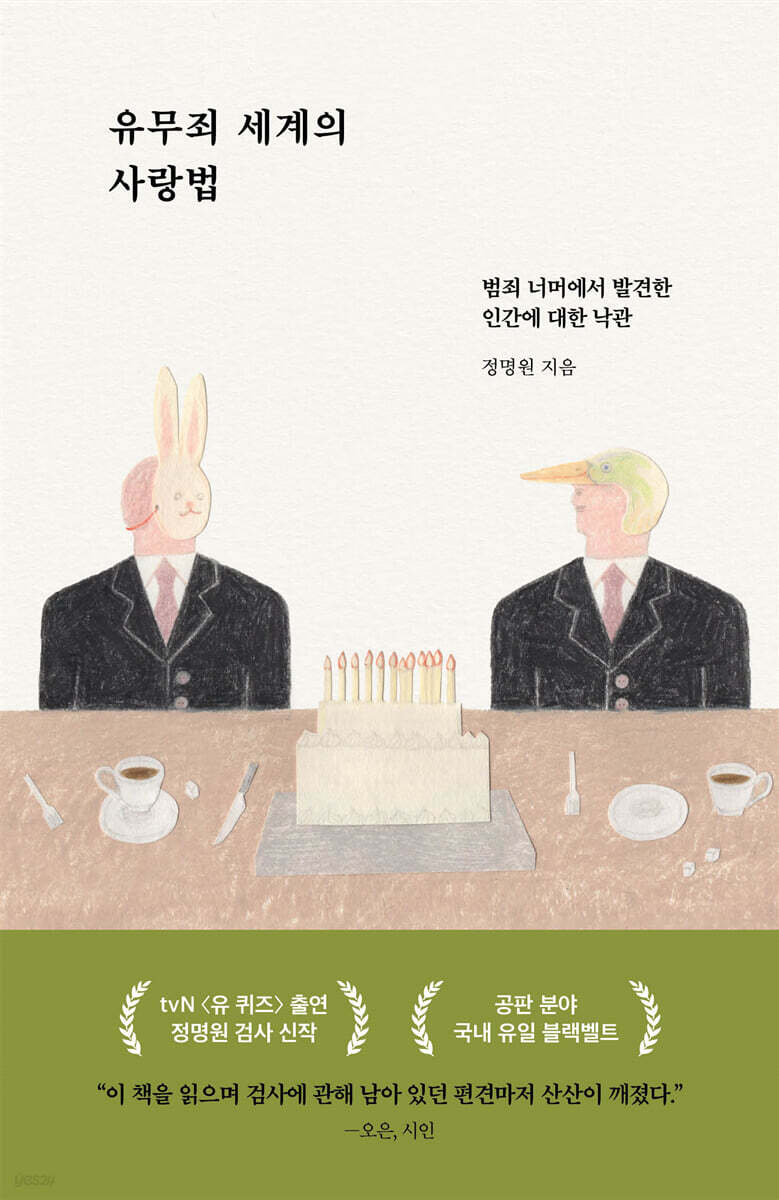
Love Laws of the Guilty and Innocent World
 |
Description
Book Introduction
- A word from MD
- Humans cannot be divided into guilty and innocent.『My Dear Petitioner』, a new work by prosecutor Jeong Myeong-won.
The author has met countless people both inside and outside the courtroom, but he never loses his optimism.
As the book says, crime often reveals itself in the faces of ordinary people who are struggling.
It is the duty of the prosecutor to believe in the human community that we are.
July 22, 2025. Humanities PD Son Min-gyu
★A hot topic appearing on tvN's "You Quiz"
★The sequel to "My Dear Petitioner," recommended by author Yoo Si-min to Yoon Seok-yeol
★Korea's only black belt prosecutor in the public trial field
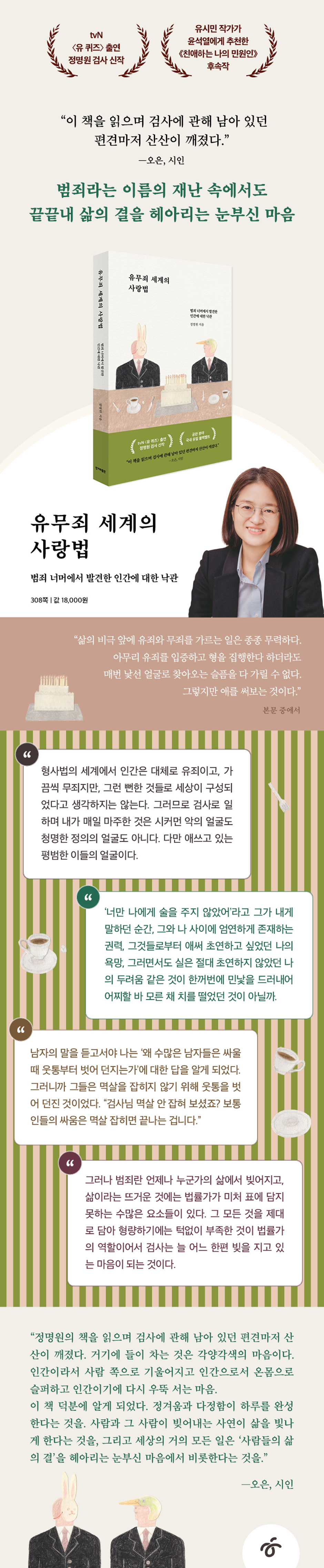
“In the face of life’s tragedy, distinguishing between guilt and innocence is often powerless.
Even if you prove guilty and execute the sentence,
I can't hide the sadness that comes every time with an unfamiliar face.
But I'm trying my best."
A 20-year veteran 'outsider' prosecutor
Optimism about humanity found beyond crime
Ahead of the 2021 presidential election in November, author Yoo Si-min appeared on a broadcast and was asked if there was one book he would recommend to candidate Yoon Seok-yeol.
Here, author Yoo responded to Prosecutor Jeong Myeong-won's "My Dear Petitioner."
The reason was, “I wish I knew how a prosecutor with a human heart works.”
Prosecutor Jeong Myeong-won, who in his previous work posed the question, "How much imagination is involved in suspecting and judging people?", has returned with a new work, "Love Laws in the World of Guilty and Innocent," which contains even deeper thoughts.
With 'prosecutorial reform' emerging as a hot topic of the times, this book is sufficient to raise multi-layered questions about humanity and the law.
In this book, he focuses on the fact that even in the world of criminal law, where the distinction is only between guilty and innocent, human life is not so simple, but rather a complex web of knots.
So this book is also a testament to my efforts to not lose the optimism about humanity that I found beyond the stereotypical indictment and beyond the crime.
The author does not know how to erase the scars of this world, a world of greed, irresponsibility, selfishness, resignation, and rationalization, but he does not despair and tries to move forward.
The author discovers the faces of ordinary people who are struggling in this case: a case where the attempted murder of the biological father was changed from attempted parricide to special intimidation of the mother due to the mother's wailing who had no choice but to report her child; the heartbreaking story of a tofu factory manager who worked hard for decades with his knuckles cut off but was eventually charged with embezzlement; and the victim's family who, despite the grief of losing their family in a traffic accident, offered a settlement that cost money out of concern for the perpetrator's family.
He says that he wrote this book about the things he learned while looking at that ordinary face for a long time, which was neither the face of evil nor the face of justice.
Poet Oh Eun added a word of recommendation for this book, saying, “If I have felt that prosecutors in this era are like swordsmen who wield swords, reading Jeong Myeong-won’s book shattered even my remaining prejudices about prosecutors.”
“In the world of criminal law, people are mostly guilty and sometimes innocent, but I don’t think the world is made up of such obvious things.
Human history is written by the power of those who struggle to maintain the gap between guilt and innocence.
So, what I face every day as a prosecutor is neither the dark face of evil nor the clear face of justice.
“It is just the face of ordinary people who are trying hard.” (Page 8)
★The sequel to "My Dear Petitioner," recommended by author Yoo Si-min to Yoon Seok-yeol
★Korea's only black belt prosecutor in the public trial field
“In the face of life’s tragedy, distinguishing between guilt and innocence is often powerless.
Even if you prove guilty and execute the sentence,
I can't hide the sadness that comes every time with an unfamiliar face.
But I'm trying my best."
A 20-year veteran 'outsider' prosecutor
Optimism about humanity found beyond crime
Ahead of the 2021 presidential election in November, author Yoo Si-min appeared on a broadcast and was asked if there was one book he would recommend to candidate Yoon Seok-yeol.
Here, author Yoo responded to Prosecutor Jeong Myeong-won's "My Dear Petitioner."
The reason was, “I wish I knew how a prosecutor with a human heart works.”
Prosecutor Jeong Myeong-won, who in his previous work posed the question, "How much imagination is involved in suspecting and judging people?", has returned with a new work, "Love Laws in the World of Guilty and Innocent," which contains even deeper thoughts.
With 'prosecutorial reform' emerging as a hot topic of the times, this book is sufficient to raise multi-layered questions about humanity and the law.
In this book, he focuses on the fact that even in the world of criminal law, where the distinction is only between guilty and innocent, human life is not so simple, but rather a complex web of knots.
So this book is also a testament to my efforts to not lose the optimism about humanity that I found beyond the stereotypical indictment and beyond the crime.
The author does not know how to erase the scars of this world, a world of greed, irresponsibility, selfishness, resignation, and rationalization, but he does not despair and tries to move forward.
The author discovers the faces of ordinary people who are struggling in this case: a case where the attempted murder of the biological father was changed from attempted parricide to special intimidation of the mother due to the mother's wailing who had no choice but to report her child; the heartbreaking story of a tofu factory manager who worked hard for decades with his knuckles cut off but was eventually charged with embezzlement; and the victim's family who, despite the grief of losing their family in a traffic accident, offered a settlement that cost money out of concern for the perpetrator's family.
He says that he wrote this book about the things he learned while looking at that ordinary face for a long time, which was neither the face of evil nor the face of justice.
Poet Oh Eun added a word of recommendation for this book, saying, “If I have felt that prosecutors in this era are like swordsmen who wield swords, reading Jeong Myeong-won’s book shattered even my remaining prejudices about prosecutors.”
“In the world of criminal law, people are mostly guilty and sometimes innocent, but I don’t think the world is made up of such obvious things.
Human history is written by the power of those who struggle to maintain the gap between guilt and innocence.
So, what I face every day as a prosecutor is neither the dark face of evil nor the clear face of justice.
“It is just the face of ordinary people who are trying hard.” (Page 8)
- You can preview some of the book's contents.
Preview
index
prolog
Scenes outside the incident area in Part 1
Indictment of aspiring writer and prosecutor
She's amazing
Actors in the courtroom
The world contained in the crime of attempted murder
The art of fighting
Uncle Mackerel's Basement Kingdom
Between fraud and passion
Tofu factory embezzlement case
What kind of chicken
After a large department store came into the area
The End of the World, Her Home
Something we finally believe in
No story begins where the investigation ends.
Part 2: The World of Guilt and Innocence: How to Love
A Day in the Life of Prosecutor J, Head of the Trial Division
The Evolution of My Office
The force that moves any test
Things we put in our glasses back then 1
Things We Had in Our Glasses Back Then 2
Cheers to the Jjokbaksan Mountain!
Prosecutor Mom 2
The moment the complainant's awl tip was pointed at me
Prosecutors' Office Life Gymnastics Club
My Dance: Present, Past, and Future
The effects of stiffness on humans
Today too, safely, the trial department is in full swing
Part 3 Rural Office Andante
Countryside Office Andante: Intro
Heart-fluttering fairies live here
Welcome to Dried Persimmon City
Ladies' flower viewing
Test B said he didn't like mushrooms
Towards a Happy End, Arrest Warrant
I bought boots
We cross the bridge and go to Starbucks.
Between absentmindedness and subtlety
Goodbye Sangju, olive green farewell
Epilogue
Recommendation
Scenes outside the incident area in Part 1
Indictment of aspiring writer and prosecutor
She's amazing
Actors in the courtroom
The world contained in the crime of attempted murder
The art of fighting
Uncle Mackerel's Basement Kingdom
Between fraud and passion
Tofu factory embezzlement case
What kind of chicken
After a large department store came into the area
The End of the World, Her Home
Something we finally believe in
No story begins where the investigation ends.
Part 2: The World of Guilt and Innocence: How to Love
A Day in the Life of Prosecutor J, Head of the Trial Division
The Evolution of My Office
The force that moves any test
Things we put in our glasses back then 1
Things We Had in Our Glasses Back Then 2
Cheers to the Jjokbaksan Mountain!
Prosecutor Mom 2
The moment the complainant's awl tip was pointed at me
Prosecutors' Office Life Gymnastics Club
My Dance: Present, Past, and Future
The effects of stiffness on humans
Today too, safely, the trial department is in full swing
Part 3 Rural Office Andante
Countryside Office Andante: Intro
Heart-fluttering fairies live here
Welcome to Dried Persimmon City
Ladies' flower viewing
Test B said he didn't like mushrooms
Towards a Happy End, Arrest Warrant
I bought boots
We cross the bridge and go to Starbucks.
Between absentmindedness and subtlety
Goodbye Sangju, olive green farewell
Epilogue
Recommendation
Detailed image
Into the book
In the world of criminal law, people are mostly guilty and sometimes innocent, but I don't think the world is made up of such obvious things.
Human history is written by the power of those who struggle to maintain the gap between guilt and innocence.
So, what I face every day as a prosecutor is neither the dark face of evil nor the clear face of justice.
These are just the faces of ordinary people who are trying hard.
I looked at that face for a long time and wrote down here little by little what I learned.
There are also expressions on the faces of my colleagues and I, as if it were an occupational disease, as we struggle to understand each other's worlds with our brows furrowed.
--- p.8
Among Goebbels' unconfirmed quotes, there is one that says, "One percent of truth is more effective than 100 percent lies."
In the same vein, she habitually mixed lies into areas that could be 100 percent true.
Thus, she constantly planned and executed lies in all aspects of her life, until she reached a point where she could not tell what was true and what was false, and until the very act of asking what was true and what was false became futile.
Her greatness as a con artist lay precisely in that point.
--- p.31
At that crossroads of judgment, what tilted my axis a little was the thought of their remaining lives as a family.
Perhaps a hope called family love that is reckless, illogical, and full of contradictions.
It is dangerous to mix such atypical and emotional elements into the process of determining whether an act constitutes a crime.
Nevertheless, it was a time when I would stare out the window for a long time, wondering whether it was possible or appropriate for a person to not look at people when dealing with other people's affairs.
--- p.52
It was a somewhat odd answer, but after hearing the man's words, I finally found the answer to a question I had been wondering for a long time: 'Why do so many men take off their shirts first when they fight?'
So they took off their shirts to avoid being grabbed by the collar.
Before, I thought they were just showing off their bodies or tattoos.
I found it a bit odd that there were quite a few men who didn't have tattoos and weren't in good shape but were just taking their shirts off.
I thought about it to the extent of 'Maybe it's because I have a fever and it's hot?', but I never thought of it as a tactically meaningful action.
--- p.55
But even if he is acting now, it seems clear that he has collapsed.
In the life of Pomsengpomssa, his form is already dead.
It's always dizzying to see how humans can be amazingly intelligent and brilliant, yet at the same time, they can be so incredibly fragile.
I wonder what has broken down inside him.
In the end, what had collapsed was what had supported him in the past, and it makes my mouth feel bitter when I think about whether it was okay to give those things names like dreams, hope, friendship, or trust.
--- p.74~75
Nevertheless, what can be clearly stated is that acquittal does not necessarily mean defeat for the prosecution.
The person we are fighting against is not just the defendant.
I can't say anything so simply about this fight.
The only answer a human court can give is guilty or not guilty, but we are often frustrated by the fact that there is a vast life that cannot be contained within that.
In that way, I feel helpless at the fact that the truth that I finally got to is nothing special.
Even at the end of my best efforts, I struggle to accept the fact that what I end up encountering is someone's sad face.
--- p.122
I learned that even if it is cramped, they do not install the inspection room on the first floor, and especially next to the civil affairs office.
Usually, the inspection room was a space behind a strict access control line, accessible only to registered people, but the civil affairs office was different.
It was common for people who were complaining to burst open the door next to my office and came in.
Fortunately, at the time, I was in my 20s, still young and immature, so when people suddenly asked me where the prosecutor was, I would peek out from behind the computer and say, “The prosecutor is not here right now,” and they would easily agree.
--- p.125
The moment he said to me, 'You're the only one who didn't give me alcohol,' the things that existed but I tried to ignore, the power that clearly existed between him and me, the cups of exaggerated loyalty that overflowed in that place as if trying to fill that gap, the desires contained there and my desire to try to be detached from them, the anxiety that my detachment might be discovered, my fear that I was never detached at all, all of these things all revealed their true colors at once, and I was left trembling, not knowing what to do.
--- p.149
As the bell rang at 6 o'clock, my heart started to pound furiously, and I rushed home from work, holding the baby in my arms. The baby also eagerly burrowed into my breast.
The moment when the pressure of a baby's tiny mouth agape and about to burst is finally released, that feeling of relief and relief... is something only those who have experienced it can truly understand. Male superiors who could not possibly know such things often arranged company dinners.
Whether it was friendship or something else, I often became mentally confused due to unresolved pressure.
I kept picturing a future where I lost my mind and ended up overturning the table or punching my manager.
--- p.177
In fact, I do not fully believe in human goodness.
I am not sure of the sublime friendship that exists regardless of one's own interests.
I am the loser who buries the fact that trust in this world is something that can be turned around and pointed at at any time, deep in my heart, and takes it out and touches it every once in a while so as not to forget it.
Nevertheless, if our weak words and writings, if a brief moment of listening to someone's desperate story, can prevent someone's sky from collapsing, then isn't it worthwhile to stand by someone's side as they stand helplessly under a collapsing sky?
--- p.187
So, how I grew, fell, and rose again in the face of the successes and failures I faced was solely my own business.
On one side of the courtroom stage, it was the perfect condition to complete my own dance that no one paid attention to.
One day, in a citizen participation trial courtroom with only a few onlookers, while I was performing my own fierce dance, a junior who came to observe the trial said:
“Wow, when I saw the senior giving his final statement, it looked like a shaman was riding a stick.
“I was so captivated that I almost jumped up and applauded.” My own dance was slowly coming to completion at the edge of the back row of the stage.
--- p.205
When I was a public prosecutor at a trial, I strangely felt pain in my legs after the trial.
"A trial isn't something you do with your legs, so why do my legs hurt?" I thought as I tapped my sore leg. I realized that when I stand in court, I have a habit of standing with my legs tense from the tips of my toes.
The courtroom was often like the end of the world or the dead end of a mine shaft, so weak humans, who were just trying to piece together the traces and prove the original truth, had no choice but to stand with strength in their legs.
--- p.223
But beyond the city of sad people who all look similar, there is a village where many heart-fluttering fairies live.
In this town, too, cases of fraud, drunk driving, theft, and violence occur, are recorded, and delivered to the prosecutor's desk. But there are those who watch with anticipation to see how the prosecutor's expression will change when he suddenly thrusts a flower at them and says, "Heart-fluttering!"
In places where people know where and what flowers bloom, visit them each season, and are eager to share their goodness, crimes become a little more lenient and wounds heal a little more quickly.
--- p.237
“Please do not call people during the persimmon harvest season at the end of October.
At that time, in Sangju, everyone with hands had to peel persimmons.
“Even the grandmothers who were lying in nursing homes all came out and peeled persimmons.” He spoke with a solemn yet proud expression, as if he was once again telling them about Sangju’s long-standing tradition. A rookie prosecutor from out of town innocently asked him.
“Does it have to be that time?” he says firmly, as if it can’t be helped.
“Yes, that’s it.
After that time passes, the feeling fades away.”
--- p.242
One day, right after the manager rejected the case, he would come in with a brisk pace, but then suddenly his pace would slow down, and the sound of his footsteps would stop for a moment in front of the manager's door, and then he would go back, with a clack clack clack clack.
The manager analyzed that he must have come forward with great vigor, intending to receive a rejection and then thought, 'Isn't that so?', and finally realized his mistake and turned back. He was really hit like a ghost.
As expected, the chief prosecutor's intuition was not something to be taken lightly.
And essentially, I've become quite accustomed to facing sad faces without ever being able to completely remove the pain.
Ultimately, my perspective on the world has been settled on the idea that nothing can completely eliminate the suffering of others, and that each person has their own share of pain to bear.
Not giving up on just seeing the sad faces next to him.
I agree with my somewhat calloused heart that this is the burden that a human being who dreams of living with his feet dipped in the waves of the world must bear.
Human history is written by the power of those who struggle to maintain the gap between guilt and innocence.
So, what I face every day as a prosecutor is neither the dark face of evil nor the clear face of justice.
These are just the faces of ordinary people who are trying hard.
I looked at that face for a long time and wrote down here little by little what I learned.
There are also expressions on the faces of my colleagues and I, as if it were an occupational disease, as we struggle to understand each other's worlds with our brows furrowed.
--- p.8
Among Goebbels' unconfirmed quotes, there is one that says, "One percent of truth is more effective than 100 percent lies."
In the same vein, she habitually mixed lies into areas that could be 100 percent true.
Thus, she constantly planned and executed lies in all aspects of her life, until she reached a point where she could not tell what was true and what was false, and until the very act of asking what was true and what was false became futile.
Her greatness as a con artist lay precisely in that point.
--- p.31
At that crossroads of judgment, what tilted my axis a little was the thought of their remaining lives as a family.
Perhaps a hope called family love that is reckless, illogical, and full of contradictions.
It is dangerous to mix such atypical and emotional elements into the process of determining whether an act constitutes a crime.
Nevertheless, it was a time when I would stare out the window for a long time, wondering whether it was possible or appropriate for a person to not look at people when dealing with other people's affairs.
--- p.52
It was a somewhat odd answer, but after hearing the man's words, I finally found the answer to a question I had been wondering for a long time: 'Why do so many men take off their shirts first when they fight?'
So they took off their shirts to avoid being grabbed by the collar.
Before, I thought they were just showing off their bodies or tattoos.
I found it a bit odd that there were quite a few men who didn't have tattoos and weren't in good shape but were just taking their shirts off.
I thought about it to the extent of 'Maybe it's because I have a fever and it's hot?', but I never thought of it as a tactically meaningful action.
--- p.55
But even if he is acting now, it seems clear that he has collapsed.
In the life of Pomsengpomssa, his form is already dead.
It's always dizzying to see how humans can be amazingly intelligent and brilliant, yet at the same time, they can be so incredibly fragile.
I wonder what has broken down inside him.
In the end, what had collapsed was what had supported him in the past, and it makes my mouth feel bitter when I think about whether it was okay to give those things names like dreams, hope, friendship, or trust.
--- p.74~75
Nevertheless, what can be clearly stated is that acquittal does not necessarily mean defeat for the prosecution.
The person we are fighting against is not just the defendant.
I can't say anything so simply about this fight.
The only answer a human court can give is guilty or not guilty, but we are often frustrated by the fact that there is a vast life that cannot be contained within that.
In that way, I feel helpless at the fact that the truth that I finally got to is nothing special.
Even at the end of my best efforts, I struggle to accept the fact that what I end up encountering is someone's sad face.
--- p.122
I learned that even if it is cramped, they do not install the inspection room on the first floor, and especially next to the civil affairs office.
Usually, the inspection room was a space behind a strict access control line, accessible only to registered people, but the civil affairs office was different.
It was common for people who were complaining to burst open the door next to my office and came in.
Fortunately, at the time, I was in my 20s, still young and immature, so when people suddenly asked me where the prosecutor was, I would peek out from behind the computer and say, “The prosecutor is not here right now,” and they would easily agree.
--- p.125
The moment he said to me, 'You're the only one who didn't give me alcohol,' the things that existed but I tried to ignore, the power that clearly existed between him and me, the cups of exaggerated loyalty that overflowed in that place as if trying to fill that gap, the desires contained there and my desire to try to be detached from them, the anxiety that my detachment might be discovered, my fear that I was never detached at all, all of these things all revealed their true colors at once, and I was left trembling, not knowing what to do.
--- p.149
As the bell rang at 6 o'clock, my heart started to pound furiously, and I rushed home from work, holding the baby in my arms. The baby also eagerly burrowed into my breast.
The moment when the pressure of a baby's tiny mouth agape and about to burst is finally released, that feeling of relief and relief... is something only those who have experienced it can truly understand. Male superiors who could not possibly know such things often arranged company dinners.
Whether it was friendship or something else, I often became mentally confused due to unresolved pressure.
I kept picturing a future where I lost my mind and ended up overturning the table or punching my manager.
--- p.177
In fact, I do not fully believe in human goodness.
I am not sure of the sublime friendship that exists regardless of one's own interests.
I am the loser who buries the fact that trust in this world is something that can be turned around and pointed at at any time, deep in my heart, and takes it out and touches it every once in a while so as not to forget it.
Nevertheless, if our weak words and writings, if a brief moment of listening to someone's desperate story, can prevent someone's sky from collapsing, then isn't it worthwhile to stand by someone's side as they stand helplessly under a collapsing sky?
--- p.187
So, how I grew, fell, and rose again in the face of the successes and failures I faced was solely my own business.
On one side of the courtroom stage, it was the perfect condition to complete my own dance that no one paid attention to.
One day, in a citizen participation trial courtroom with only a few onlookers, while I was performing my own fierce dance, a junior who came to observe the trial said:
“Wow, when I saw the senior giving his final statement, it looked like a shaman was riding a stick.
“I was so captivated that I almost jumped up and applauded.” My own dance was slowly coming to completion at the edge of the back row of the stage.
--- p.205
When I was a public prosecutor at a trial, I strangely felt pain in my legs after the trial.
"A trial isn't something you do with your legs, so why do my legs hurt?" I thought as I tapped my sore leg. I realized that when I stand in court, I have a habit of standing with my legs tense from the tips of my toes.
The courtroom was often like the end of the world or the dead end of a mine shaft, so weak humans, who were just trying to piece together the traces and prove the original truth, had no choice but to stand with strength in their legs.
--- p.223
But beyond the city of sad people who all look similar, there is a village where many heart-fluttering fairies live.
In this town, too, cases of fraud, drunk driving, theft, and violence occur, are recorded, and delivered to the prosecutor's desk. But there are those who watch with anticipation to see how the prosecutor's expression will change when he suddenly thrusts a flower at them and says, "Heart-fluttering!"
In places where people know where and what flowers bloom, visit them each season, and are eager to share their goodness, crimes become a little more lenient and wounds heal a little more quickly.
--- p.237
“Please do not call people during the persimmon harvest season at the end of October.
At that time, in Sangju, everyone with hands had to peel persimmons.
“Even the grandmothers who were lying in nursing homes all came out and peeled persimmons.” He spoke with a solemn yet proud expression, as if he was once again telling them about Sangju’s long-standing tradition. A rookie prosecutor from out of town innocently asked him.
“Does it have to be that time?” he says firmly, as if it can’t be helped.
“Yes, that’s it.
After that time passes, the feeling fades away.”
--- p.242
One day, right after the manager rejected the case, he would come in with a brisk pace, but then suddenly his pace would slow down, and the sound of his footsteps would stop for a moment in front of the manager's door, and then he would go back, with a clack clack clack clack.
The manager analyzed that he must have come forward with great vigor, intending to receive a rejection and then thought, 'Isn't that so?', and finally realized his mistake and turned back. He was really hit like a ghost.
As expected, the chief prosecutor's intuition was not something to be taken lightly.
And essentially, I've become quite accustomed to facing sad faces without ever being able to completely remove the pain.
Ultimately, my perspective on the world has been settled on the idea that nothing can completely eliminate the suffering of others, and that each person has their own share of pain to bear.
Not giving up on just seeing the sad faces next to him.
I agree with my somewhat calloused heart that this is the burden that a human being who dreams of living with his feet dipped in the waves of the world must bear.
--- p.291
Publisher's Review
“Tofu factory embezzlement case, actors in court,
The son of the accused in the attempted murder case and the ladies of the prosecution enjoy a flower festival.
“The indictment of the aspiring writer…”
From the proven world to the unproven world
The records behind the indictment, thoroughly dug up and revived
Part 1 of the book, which consists of three parts, looks into the 'scenes outside the case' based on actual public prosecution cases the author experienced.
A man who is called "Uncle" among runaway teenagers and coaxes and threatens them into committing crimes; a young businessman who lived a life of confidence and pomp only to have his life completely ruined by fraud in just a few months; the unfunny story of a defendant who was arrested for an illegal filming crime but made everyone in the courtroom gasp with his blindness, etc. These are interesting stories behind the cases that were not recorded in the indictment.
Part 2 is filled with interesting episodes that make you feel like you're watching a drama, including the author's experience of being assigned a room next to the civil affairs office while living in the room of a senior prosecutor, the author's memories of climbing the 'hill of the hill' while working as a professor at the Judicial Research and Training Institute and solidifying his position as an 'unconventional prosecutor' once again, and the internal conflict about the prosecution's internal culture that once led him to consider resigning after not pouring a drink for the number two person at a company dinner.
In Part 3, he tells the story of his time as the head of Sangju Branch, the olive-green city he showed off during his appearance on tvN's "You Quiz."
From late October to early November, during the persimmon harvest season, the prosecutor's office summons investigation is postponed in Sangju, the city of dried persimmons; the story of the 'heart-fluttering fairy' office manager who gives a vase of halmi flowers on the first day of work; the halmi flowers that have taken root in the bleak and murderous place called the prosecutor's office; the activities of the three prosecutors of the Sangju branch, B, T, and S; and episodes with Ms. Seong, who is responsible for a hearty meal for the prosecutor's office staff with seasonal ingredients every day in the cafeteria, and Ms. Kwon, who is in charge of environmental beautification, etc., you can encounter a rich 'story of the moss prosecutor'.
“But I am not leaving yet, I am here.
A lot of time has passed since the days when I would stick a poem on the corner of the desk in the prosecutor's office, where records were piled up so precariously that they seemed ready to collapse, and look at it from time to time.
For about 18 years, I went to work, faced incidents, and sometimes felt proud, sometimes regretful, and somehow lived as a prosecutor and an office worker.
I've learned a lot about the world of crime, but I've also learned that the world and life are made up of much more complex and nuanced things.
“I came to realize that there is a world that is equally unproven as the world that is proven.” (pp. 290-291)
“It is important not to lose optimism about the fragile human race.
“This is the duty that those who deal with the law must have.”
Even in the midst of a disaster called crime
A dazzling mind that finally grasps the knot of life
We live in a time of widespread distrust of the judiciary.
In particular, trust in the prosecution has long since fallen to rock bottom.
The author's concerns were deep as the publication approached.
“In this day and age… how would it be understood for someone who has been examined to publish a book? There were many days when I stopped and thought about it.
There were days when I thought I was just a carefree gardener planting flowers on the walls of a crumbling kingdom.
But soon he changes his mind.
“If we think about what this fortress was originally intended to protect, the answer becomes a little clearer.” (Page 8)
The author argues that there is now more reflection and urging than ever on how we cultivate the land of crime, and that the prosecution will change in some way, but whatever it is, what we seek to protect in that land will remain the same as it is now.
And then I try to find the answer myself.
“To protect the affection of those precious to us in the face of the disaster called crime, and in that way not to lose optimism about the fragile human race.”
In an age where it is difficult to see even an inch ahead, the traces of that effort for optimism come across heavily.
“The farmer’s daughter went out into the world and became a prosecutor.
It involves finding, analyzing, and categorizing things in people's lives that are labeled as crimes, and then selecting appropriate answers.
As with all things in life, to do this well, you must first understand the lives of the people who are the soil.
Now it is nothing more than a desolate crime scene, but we must hear the history of the land that may have once been the sea or the mountains, the story of the darkness, wind, and sunlight that descended upon it.
Otherwise, in this narrow world built solely on guilt and innocence, hope for humanity will fail time and time again.” (pp. 305-306)
The son of the accused in the attempted murder case and the ladies of the prosecution enjoy a flower festival.
“The indictment of the aspiring writer…”
From the proven world to the unproven world
The records behind the indictment, thoroughly dug up and revived
Part 1 of the book, which consists of three parts, looks into the 'scenes outside the case' based on actual public prosecution cases the author experienced.
A man who is called "Uncle" among runaway teenagers and coaxes and threatens them into committing crimes; a young businessman who lived a life of confidence and pomp only to have his life completely ruined by fraud in just a few months; the unfunny story of a defendant who was arrested for an illegal filming crime but made everyone in the courtroom gasp with his blindness, etc. These are interesting stories behind the cases that were not recorded in the indictment.
Part 2 is filled with interesting episodes that make you feel like you're watching a drama, including the author's experience of being assigned a room next to the civil affairs office while living in the room of a senior prosecutor, the author's memories of climbing the 'hill of the hill' while working as a professor at the Judicial Research and Training Institute and solidifying his position as an 'unconventional prosecutor' once again, and the internal conflict about the prosecution's internal culture that once led him to consider resigning after not pouring a drink for the number two person at a company dinner.
In Part 3, he tells the story of his time as the head of Sangju Branch, the olive-green city he showed off during his appearance on tvN's "You Quiz."
From late October to early November, during the persimmon harvest season, the prosecutor's office summons investigation is postponed in Sangju, the city of dried persimmons; the story of the 'heart-fluttering fairy' office manager who gives a vase of halmi flowers on the first day of work; the halmi flowers that have taken root in the bleak and murderous place called the prosecutor's office; the activities of the three prosecutors of the Sangju branch, B, T, and S; and episodes with Ms. Seong, who is responsible for a hearty meal for the prosecutor's office staff with seasonal ingredients every day in the cafeteria, and Ms. Kwon, who is in charge of environmental beautification, etc., you can encounter a rich 'story of the moss prosecutor'.
“But I am not leaving yet, I am here.
A lot of time has passed since the days when I would stick a poem on the corner of the desk in the prosecutor's office, where records were piled up so precariously that they seemed ready to collapse, and look at it from time to time.
For about 18 years, I went to work, faced incidents, and sometimes felt proud, sometimes regretful, and somehow lived as a prosecutor and an office worker.
I've learned a lot about the world of crime, but I've also learned that the world and life are made up of much more complex and nuanced things.
“I came to realize that there is a world that is equally unproven as the world that is proven.” (pp. 290-291)
“It is important not to lose optimism about the fragile human race.
“This is the duty that those who deal with the law must have.”
Even in the midst of a disaster called crime
A dazzling mind that finally grasps the knot of life
We live in a time of widespread distrust of the judiciary.
In particular, trust in the prosecution has long since fallen to rock bottom.
The author's concerns were deep as the publication approached.
“In this day and age… how would it be understood for someone who has been examined to publish a book? There were many days when I stopped and thought about it.
There were days when I thought I was just a carefree gardener planting flowers on the walls of a crumbling kingdom.
But soon he changes his mind.
“If we think about what this fortress was originally intended to protect, the answer becomes a little clearer.” (Page 8)
The author argues that there is now more reflection and urging than ever on how we cultivate the land of crime, and that the prosecution will change in some way, but whatever it is, what we seek to protect in that land will remain the same as it is now.
And then I try to find the answer myself.
“To protect the affection of those precious to us in the face of the disaster called crime, and in that way not to lose optimism about the fragile human race.”
In an age where it is difficult to see even an inch ahead, the traces of that effort for optimism come across heavily.
“The farmer’s daughter went out into the world and became a prosecutor.
It involves finding, analyzing, and categorizing things in people's lives that are labeled as crimes, and then selecting appropriate answers.
As with all things in life, to do this well, you must first understand the lives of the people who are the soil.
Now it is nothing more than a desolate crime scene, but we must hear the history of the land that may have once been the sea or the mountains, the story of the darkness, wind, and sunlight that descended upon it.
Otherwise, in this narrow world built solely on guilt and innocence, hope for humanity will fail time and time again.” (pp. 305-306)
GOODS SPECIFICS
- Date of issue: July 11, 2025
- Page count, weight, size: 308 pages | 370g | 130*200*20mm
- ISBN13: 9791172132835
You may also like
카테고리
korean


korean

![ELLE 엘르 스페셜 에디션 A형 : 12월 [2025]](http://librairie.coreenne.fr/cdn/shop/files/b8e27a3de6c9538896439686c6b0e8fb.jpg?v=1766436872&width=3840)


