

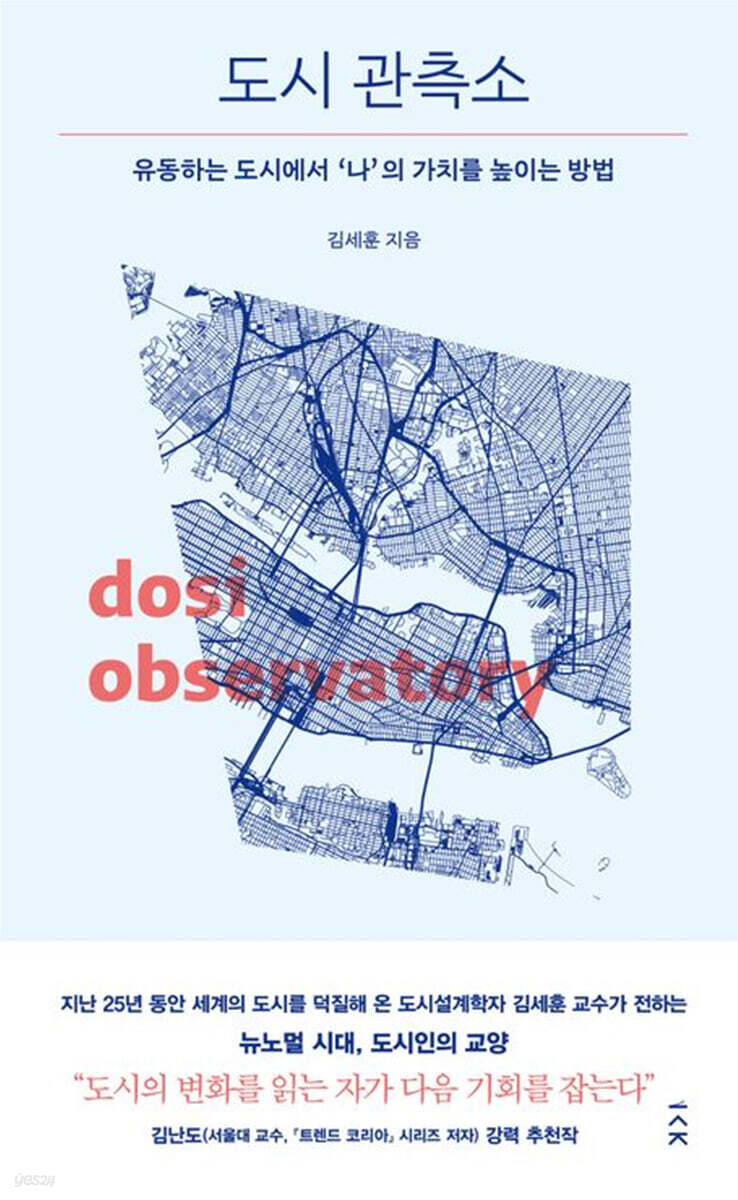
City Observatory
 |
Description
Book Introduction
- A word from MD
-
Urban Literacy for a Great LifeIn modern society, the city is a major factor that determines an individual's life.
The city you live in determines your quality of life.
Analyzing the prosperity and failure of cities through a variety of case studies, this book raises crucial questions, ranging from where individuals should work and live to what kind of nation we should build.
July 25, 2025. Humanities PD Son Min-gyu
Professor Kim Se-hoon, an urban design scholar who has been studying cities around the world for the past 25 years, shares his thoughts.
The New Normal Era: Urban Culture
"Those who read the city's changes seize the next opportunity."
Professor Kim Se-hoon of Seoul National University, an urban design scholar who has been exploring cities around the world for the past 25 years, shares tips on how to increase your value in a dynamic city.
In an era where the formula of urbanization equals growth no longer holds true, this book provides guidance on what kind of cities we should create and how we should design our personal lives and businesses.
Professor Kim Nan-do, author of the Trend Korea series, said, “The Urban Observatory captures the mechanisms of a changing city and persuasively tells us where we should place our bets on opportunities.
He highly recommended this book, saying, “This book will give you a blueprint for trends.”
The New Normal Era: Urban Culture
"Those who read the city's changes seize the next opportunity."
Professor Kim Se-hoon of Seoul National University, an urban design scholar who has been exploring cities around the world for the past 25 years, shares tips on how to increase your value in a dynamic city.
In an era where the formula of urbanization equals growth no longer holds true, this book provides guidance on what kind of cities we should create and how we should design our personal lives and businesses.
Professor Kim Nan-do, author of the Trend Korea series, said, “The Urban Observatory captures the mechanisms of a changing city and persuasively tells us where we should place our bets on opportunities.
He highly recommended this book, saying, “This book will give you a blueprint for trends.”
- You can preview some of the book's contents.
Preview
index
INTRODUCTION: An era where urban observation skills enhance one's value.
Part 1.
Opening a city observatory
01.
Urbanization | The Top Predator of the Spatial Ecosystem
02.
Scaling Laws | How Do Cities Create Wealth?
03.
The Age of Complex Crises | It Takes Less Than Five Minutes to Collapse
Part 2.
How to Survive in a Shrinking City
04.
Shrinking Growth | The Transformation of the Oxford-Cambridge Ark, Outside London
05.
Boston Style | The World's Most Innovative Square Mile
06.
Compact and Smart Downsizing | How Can We Overcome the Population Decline Crisis?
07.
Evolution through Connection | Why is the world's largest tech innovation exhibition held in the middle of the desert?
Part 3.
Moving Cities, Rewriting the Rules
08.
Fluidization | What Apple and Musinsa Have in Common, and the Secrets of the City
09.
Jobs | How Does the Heart of a City Work?
10.
Location | How did Tama New Town, on the outskirts of Tokyo, become a fusion city?
11.
The Logistics Revolution | A New Standard Created by a Revolution in Speed and Scale
12.
Transcraniality | The way novelty interacts with the world is changing.
Part 4.
The price of expensive cities
13.
Winner Takes All and Filter Out | The Curse of Superstar City
14.
The Light and Shadows of Superstar City | Escaping California
15.
The Neom Phenomenon | The World's Major Cities' Hegemony Competition and a New Paradigm
16.
Platform | Synergy between Online Platforms and Offline Cities
Part 5.
A city of immersion for me
17.
The Fourth Space | From New York's Flatiron District to Jeju's Tapdong
18.
Locality | A Real-Life Brand Called "Neighborhood"
19.
The Expanding World of Fandom | Cities Should Encourage Individual Cultural Immersion and Exploration
20.
Relationships and Space | The Power of This Place to Save Us from Isolation
EPILOGUE Broaden your horizons, deepen your experiences
Part 1.
Opening a city observatory
01.
Urbanization | The Top Predator of the Spatial Ecosystem
02.
Scaling Laws | How Do Cities Create Wealth?
03.
The Age of Complex Crises | It Takes Less Than Five Minutes to Collapse
Part 2.
How to Survive in a Shrinking City
04.
Shrinking Growth | The Transformation of the Oxford-Cambridge Ark, Outside London
05.
Boston Style | The World's Most Innovative Square Mile
06.
Compact and Smart Downsizing | How Can We Overcome the Population Decline Crisis?
07.
Evolution through Connection | Why is the world's largest tech innovation exhibition held in the middle of the desert?
Part 3.
Moving Cities, Rewriting the Rules
08.
Fluidization | What Apple and Musinsa Have in Common, and the Secrets of the City
09.
Jobs | How Does the Heart of a City Work?
10.
Location | How did Tama New Town, on the outskirts of Tokyo, become a fusion city?
11.
The Logistics Revolution | A New Standard Created by a Revolution in Speed and Scale
12.
Transcraniality | The way novelty interacts with the world is changing.
Part 4.
The price of expensive cities
13.
Winner Takes All and Filter Out | The Curse of Superstar City
14.
The Light and Shadows of Superstar City | Escaping California
15.
The Neom Phenomenon | The World's Major Cities' Hegemony Competition and a New Paradigm
16.
Platform | Synergy between Online Platforms and Offline Cities
Part 5.
A city of immersion for me
17.
The Fourth Space | From New York's Flatiron District to Jeju's Tapdong
18.
Locality | A Real-Life Brand Called "Neighborhood"
19.
The Expanding World of Fandom | Cities Should Encourage Individual Cultural Immersion and Exploration
20.
Relationships and Space | The Power of This Place to Save Us from Isolation
EPILOGUE Broaden your horizons, deepen your experiences
Detailed image

Into the book
The world we live in and the space that surrounds us will become more clearly distinguished as time passes, into a space of discovery and a space of surplus.
So, here's what I need to do to increase my value.
It is the ability to discern spaces with high performance and meaning, that is, ‘urban observation skills.’
Urban observation is the ability to read the value and context of a space, recognize its meaning, and internalize it in one's decision-making.
Through this, you should be able to understand the movement and spatial changes of the city and relate them to your own future.
It's on a whole different level from being one step ahead of trends.
Because trends are actually a product of the past.
Power and luck that have already passed, even if encountered, are likely to be noticed for a moment and then soon disappear.
Rather than focusing on temporary trends or incidents, we should focus on major trends that will continue for the next 10 years or more.
We must detect, judge, and act on signals of change.
--- From the "Prologue"
In 1980, futurist Alvin Toffler predicted the information revolution in his book The Third Wave.
He predicted that knowledge and information would become the most important resources for social development, and that the development of computers, mobile phones, and IT technology would allow people to work and communicate anytime, anywhere.
It was predicted that many people would leave the city and live in the countryside, building 'electronic cottages'.
It was a very interesting prediction, but the reality was a little different.
To cut to the chase, we didn't leave the city.
With the internet and smartphones in our hands and technology embedded in our bodies, we have become more deeply rooted in the city and its environs.
Cities are the base camps of human civilization.
The 'city on-and-off' lifestyle, where the main base of life is in the city and people leave the city when necessary and return to it, is more common.
--- From "How Do Cities Create Wealth?"
Ray Oldenburg, a renowned American urban sociologist, introduced a special space in his 1989 book, The Great Good Place.
This is a precious space that exists between home (our first space) and work (our second space), a place to escape the shackles of everyday life and find small joys with people around us.
Enjoy a pleasant chat at a local cafe and melt away the day's fatigue at your favorite bar.
Oldenburg emphasizes that third spaces play a crucial role in restoring humanity in disconnected societies and forming a healthy civil society.
Recently, a 'fourth space' with a different character has been attracting attention.
This is a special area where we focus on the self rather than on interacting with others.
Although the physical space itself is shared with others, its essential purpose is to revitalize one's own body and mind.
A place to escape the pressures of excessive social expectations and relationships, listen to your true inner desires, and build physical and mental strength.
So, here's what I need to do to increase my value.
It is the ability to discern spaces with high performance and meaning, that is, ‘urban observation skills.’
Urban observation is the ability to read the value and context of a space, recognize its meaning, and internalize it in one's decision-making.
Through this, you should be able to understand the movement and spatial changes of the city and relate them to your own future.
It's on a whole different level from being one step ahead of trends.
Because trends are actually a product of the past.
Power and luck that have already passed, even if encountered, are likely to be noticed for a moment and then soon disappear.
Rather than focusing on temporary trends or incidents, we should focus on major trends that will continue for the next 10 years or more.
We must detect, judge, and act on signals of change.
--- From the "Prologue"
In 1980, futurist Alvin Toffler predicted the information revolution in his book The Third Wave.
He predicted that knowledge and information would become the most important resources for social development, and that the development of computers, mobile phones, and IT technology would allow people to work and communicate anytime, anywhere.
It was predicted that many people would leave the city and live in the countryside, building 'electronic cottages'.
It was a very interesting prediction, but the reality was a little different.
To cut to the chase, we didn't leave the city.
With the internet and smartphones in our hands and technology embedded in our bodies, we have become more deeply rooted in the city and its environs.
Cities are the base camps of human civilization.
The 'city on-and-off' lifestyle, where the main base of life is in the city and people leave the city when necessary and return to it, is more common.
--- From "How Do Cities Create Wealth?"
Ray Oldenburg, a renowned American urban sociologist, introduced a special space in his 1989 book, The Great Good Place.
This is a precious space that exists between home (our first space) and work (our second space), a place to escape the shackles of everyday life and find small joys with people around us.
Enjoy a pleasant chat at a local cafe and melt away the day's fatigue at your favorite bar.
Oldenburg emphasizes that third spaces play a crucial role in restoring humanity in disconnected societies and forming a healthy civil society.
Recently, a 'fourth space' with a different character has been attracting attention.
This is a special area where we focus on the self rather than on interacting with others.
Although the physical space itself is shared with others, its essential purpose is to revitalize one's own body and mind.
A place to escape the pressures of excessive social expectations and relationships, listen to your true inner desires, and build physical and mental strength.
--- From "From New York's Flatiron District to Jeju's Tapdong"
Publisher's Review
Urban Literacy -
How the ability to read a city becomes the power to design life.
Observing a city means sensing where possibilities are accumulating and where new lifestyles are being experimented with.
Will I abandon myself in the ‘space of surplus’, or will I seize the ‘opportunity’ in the ‘space of discovery’ where possibilities accumulate and value is expressed?
Why do some cities survive and others collapse?
Will it be 'filtered out' like San Francisco, or will it be regenerated like Tama Newtown?
"Urban Observatory" is a rare book that simultaneously examines the city's crises and possibilities, its strategies and sensibilities.
This book will serve as an excellent resource and strategic guide for planners, producers, entrepreneurs, designers, marketers, policymakers, and anyone else who uses the city as a platform for their lives and growth.
The Laws of the Evolving City -
The way people come together and wealth is created is changing.
In an era where the formula that ‘urbanization’ equals ‘development’ no longer holds true, cities are moving in a different way than before.
Airbnb is revolutionizing the global experience by commercializing iconic offline spaces, while YouTube and Musinsa are expanding urban mobility by converging content, community, and distribution.
Cities at the top of the smiling curve, such as Seongsu-dong in Seoul, Brooklyn in New York, and Shoreditch in London, are re-establishing themselves as economic hubs through advanced brand-space strategies.
Urban functions are now reconfigured based on ‘access method’ rather than ‘location’.
The book unfolds like a panorama, from the first cities of mankind through the industrial age and into the future, and provides a three-dimensional view of the key elements that drive cities today.
Urban Ecosystems and Business -
The city is a concrete experience directly connected to my career path, consumption, relationships, and the rhythm of life.
The city is a concrete experience directly connected to my career path, consumption, relationships, and rhythm of life.
As the logistics structure changes, the dining table changes, and as a fourth space emerges, the patterns of individual immersion and recovery change.
The book unfolds a panoramic view of the city's transformation, from familiar places like Seoul's Seongsu and Pangyo, and Jeju's Tap-dong, to San Francisco, Tama Newtown, and New York, awakening a sense of reading the flow of the city.
It also three-dimensionally weaves together various elements surrounding the city, including architecture, economy, society, technology, and taste.
Through keywords such as logistics, real estate, platforms, fandom, and the fourth space, it vividly shows how cities are currently being restructured.
This book, which captures the sense of isolation and connection, density and mobility, immersion and recovery, guides trends in urban business.
How the ability to read a city becomes the power to design life.
Observing a city means sensing where possibilities are accumulating and where new lifestyles are being experimented with.
Will I abandon myself in the ‘space of surplus’, or will I seize the ‘opportunity’ in the ‘space of discovery’ where possibilities accumulate and value is expressed?
Why do some cities survive and others collapse?
Will it be 'filtered out' like San Francisco, or will it be regenerated like Tama Newtown?
"Urban Observatory" is a rare book that simultaneously examines the city's crises and possibilities, its strategies and sensibilities.
This book will serve as an excellent resource and strategic guide for planners, producers, entrepreneurs, designers, marketers, policymakers, and anyone else who uses the city as a platform for their lives and growth.
The Laws of the Evolving City -
The way people come together and wealth is created is changing.
In an era where the formula that ‘urbanization’ equals ‘development’ no longer holds true, cities are moving in a different way than before.
Airbnb is revolutionizing the global experience by commercializing iconic offline spaces, while YouTube and Musinsa are expanding urban mobility by converging content, community, and distribution.
Cities at the top of the smiling curve, such as Seongsu-dong in Seoul, Brooklyn in New York, and Shoreditch in London, are re-establishing themselves as economic hubs through advanced brand-space strategies.
Urban functions are now reconfigured based on ‘access method’ rather than ‘location’.
The book unfolds like a panorama, from the first cities of mankind through the industrial age and into the future, and provides a three-dimensional view of the key elements that drive cities today.
Urban Ecosystems and Business -
The city is a concrete experience directly connected to my career path, consumption, relationships, and the rhythm of life.
The city is a concrete experience directly connected to my career path, consumption, relationships, and rhythm of life.
As the logistics structure changes, the dining table changes, and as a fourth space emerges, the patterns of individual immersion and recovery change.
The book unfolds a panoramic view of the city's transformation, from familiar places like Seoul's Seongsu and Pangyo, and Jeju's Tap-dong, to San Francisco, Tama Newtown, and New York, awakening a sense of reading the flow of the city.
It also three-dimensionally weaves together various elements surrounding the city, including architecture, economy, society, technology, and taste.
Through keywords such as logistics, real estate, platforms, fandom, and the fourth space, it vividly shows how cities are currently being restructured.
This book, which captures the sense of isolation and connection, density and mobility, immersion and recovery, guides trends in urban business.
GOODS SPECIFICS
- Date of issue: July 11, 2025
- Page count, weight, size: 308 pages | 402g | 132*215*23mm
- ISBN13: 9791194140085
- ISBN10: 1194140084
You may also like
카테고리
korean


korean

![ELLE 엘르 스페셜 에디션 A형 : 12월 [2025]](http://librairie.coreenne.fr/cdn/shop/files/b8e27a3de6c9538896439686c6b0e8fb.jpg?v=1766436872&width=3840)


