

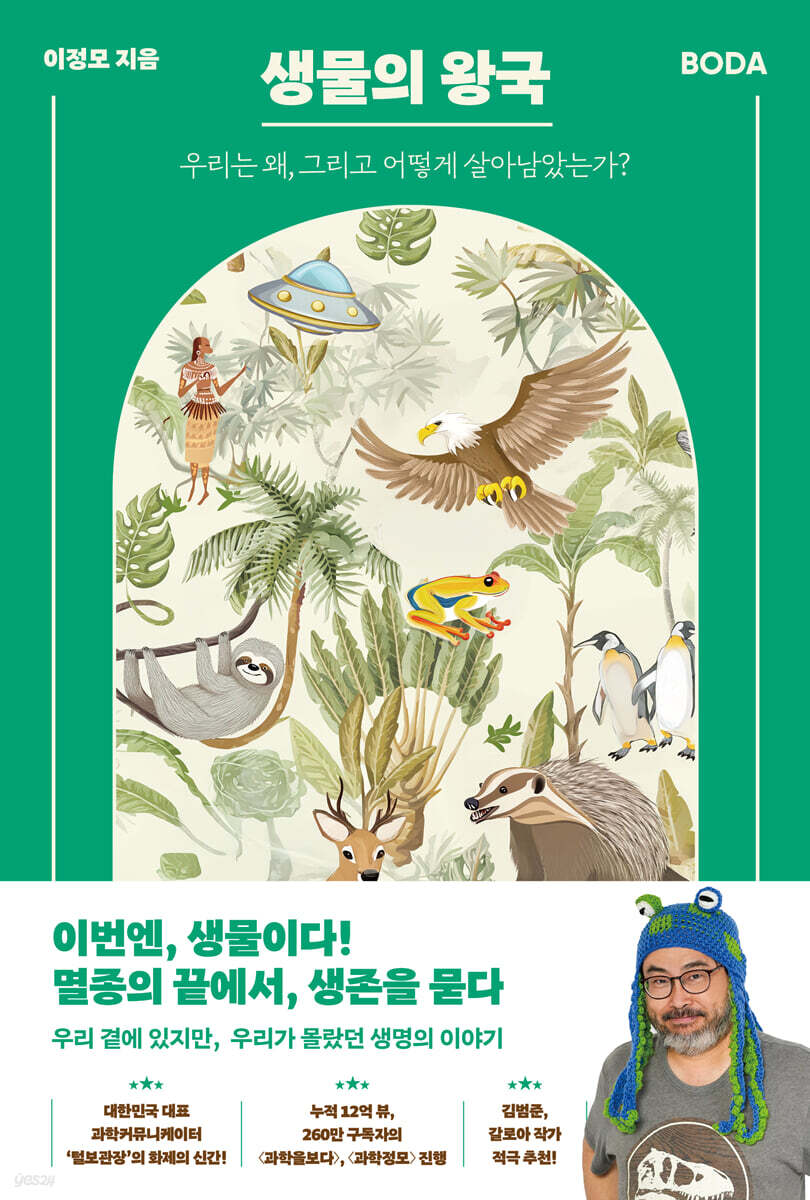
Kingdom of Creatures
 |
Description
Book Introduction
This time, it's a living thing!
At the Edge of Extinction, Asking About Survival
The story of life that is right next to us, but we didn't know about.
This book is a record of an intellectual exploration that follows the evolutionary journey of survival and makes us reflect on the grandeur and wonder of life.
"The Kingdom of Creatures" delves into the vast drama of survival that has unfolded over the past billions of years on this vast stage called Earth, where we stand, to ask, "What is life?"
From birds, the descendants of dinosaurs and rulers of the skies, to penguins that survived on the Antarctic ice with cooperation and patience, to honey badgers with a tenacious vitality that resists poison, to ground sloths that survived with a unique strategy of slowness, and finally to humans, the only living creatures that attempt to evolve through technology, transcending the laws of nature.
Through the survival stories of diverse creatures, this book reminds readers of the oldest and most steadfast law of the biological kingdom: evolution.
The book is divided into four parts, each following a grand narrative that explores life and evolution, ecosystems and civilization, and the universe.
Part 1 introduces the survival strategies of creatures that have survived in unique ways, such as eagles, snakes, eels, and deer, and shows how nature has maintained life through a variety of solutions.
Part 2 examines the organic nature and complexity of the Earth's ecosystem through stories of climate change, ecological upheaval, and the creatures that have adapted to it.
In particular, creatures that pose a new threat in unfamiliar environments, such as the 'shaman frog,' make readers question the meaning of biodiversity and ecosystem disruption.
In Part 3, the story shifts to a human-centric focus.
Humanity, which has harnessed fire, sought gold, understood lightning, and sought to unlock the secrets of the senses, is now faced with the question of whether it can become a being that transcends nature.
And in the final fourth part, the stage of the question expands beyond Earth to space.
The possibility of extraterrestrial life, the magnetic fields of Mars and Venus, and other issues are not simply the stuff of science fiction, but are concretized as scientific questions: Are we truly the only life forms in this universe?
"The Kingdom of Creatures" does not simply talk about life because we are alive, but asks deeper questions such as "why did we survive?" and "how did we survive?"
Furthermore, the question ultimately turns to humans.
Are humans truly the "rulers" of this kingdom, or are they merely dots in the vast network of life? This book goes beyond a simple science textbook.
It is a vast treasure trove of reflections that cross over philosophy, biology, anthropology, and space science, questioning the essence of life and the reason for human existence.
『The Kingdom of Creatures』 promises one thing to its readers.
The moment you close this book, your perspective on life will change.
And that gaze will expand to a greater and deeper understanding that no longer focuses solely on humans.
At the Edge of Extinction, Asking About Survival
The story of life that is right next to us, but we didn't know about.
This book is a record of an intellectual exploration that follows the evolutionary journey of survival and makes us reflect on the grandeur and wonder of life.
"The Kingdom of Creatures" delves into the vast drama of survival that has unfolded over the past billions of years on this vast stage called Earth, where we stand, to ask, "What is life?"
From birds, the descendants of dinosaurs and rulers of the skies, to penguins that survived on the Antarctic ice with cooperation and patience, to honey badgers with a tenacious vitality that resists poison, to ground sloths that survived with a unique strategy of slowness, and finally to humans, the only living creatures that attempt to evolve through technology, transcending the laws of nature.
Through the survival stories of diverse creatures, this book reminds readers of the oldest and most steadfast law of the biological kingdom: evolution.
The book is divided into four parts, each following a grand narrative that explores life and evolution, ecosystems and civilization, and the universe.
Part 1 introduces the survival strategies of creatures that have survived in unique ways, such as eagles, snakes, eels, and deer, and shows how nature has maintained life through a variety of solutions.
Part 2 examines the organic nature and complexity of the Earth's ecosystem through stories of climate change, ecological upheaval, and the creatures that have adapted to it.
In particular, creatures that pose a new threat in unfamiliar environments, such as the 'shaman frog,' make readers question the meaning of biodiversity and ecosystem disruption.
In Part 3, the story shifts to a human-centric focus.
Humanity, which has harnessed fire, sought gold, understood lightning, and sought to unlock the secrets of the senses, is now faced with the question of whether it can become a being that transcends nature.
And in the final fourth part, the stage of the question expands beyond Earth to space.
The possibility of extraterrestrial life, the magnetic fields of Mars and Venus, and other issues are not simply the stuff of science fiction, but are concretized as scientific questions: Are we truly the only life forms in this universe?
"The Kingdom of Creatures" does not simply talk about life because we are alive, but asks deeper questions such as "why did we survive?" and "how did we survive?"
Furthermore, the question ultimately turns to humans.
Are humans truly the "rulers" of this kingdom, or are they merely dots in the vast network of life? This book goes beyond a simple science textbook.
It is a vast treasure trove of reflections that cross over philosophy, biology, anthropology, and space science, questioning the essence of life and the reason for human existence.
『The Kingdom of Creatures』 promises one thing to its readers.
The moment you close this book, your perspective on life will change.
And that gaze will expand to a greater and deeper understanding that no longer focuses solely on humans.
- You can preview some of the book's contents.
Preview
index
Recommendation
Prologue: I thought YouTube only had Baby Shark...
The true joy of questioning science!
Part 1 | Evolution is Truly Unfair
01 | Laughing at Venom and Beasts, and Designing Pregnancy: The Honey Badger
02 | How to Eat the Dirtiest Food and Live the Cleanest Life: The Eagle
03 | Why Korea is the only exception to the global endangered species: Gorani
04 | A Life of Mystery: Eel, Where He Was Born and Where He Dies
05 | The greatest ruler survived in the smallest form: the bird
06 | When I Forgot the Law, I Could Fly Over the Sea: Penguin
Part 2 | There's a reason for everything that survived.
07 | How Ribs Became the Perfect Shield: Sea Turtles
08 | My cousin went to the sea, and I survived because I had no taste: sloth
09 | Life in the Amazon Begins from My Dust: The Desert
10 | My Beauty Becomes a Disaster to the World: The Shaman Frog
Part 3 | How the Fragileest Animal Became the Ruler of the Earth
11 | Fire nurtured the brain, and gold created trust: Fire and gold
12 | Are the blood vessels in our bodies and the lightning in the sky the same?: Lightning
13 | Seeing Red: This is What Made Us Masters: The Human Eye
Part 4 | The Possibility of Life Beyond Earth: We Are Not Alone
14 | The vast universe is teeming with life, so why are we alone?: Extraterrestrial civilizations
15 | A force that cannot be felt or seen protects everything: the magnetic field.
A Visit to the Kingdom of Creatures: Nature Asks, Lee Jeong-mo Answers
Source of the illustration
Prologue: I thought YouTube only had Baby Shark...
The true joy of questioning science!
Part 1 | Evolution is Truly Unfair
01 | Laughing at Venom and Beasts, and Designing Pregnancy: The Honey Badger
02 | How to Eat the Dirtiest Food and Live the Cleanest Life: The Eagle
03 | Why Korea is the only exception to the global endangered species: Gorani
04 | A Life of Mystery: Eel, Where He Was Born and Where He Dies
05 | The greatest ruler survived in the smallest form: the bird
06 | When I Forgot the Law, I Could Fly Over the Sea: Penguin
Part 2 | There's a reason for everything that survived.
07 | How Ribs Became the Perfect Shield: Sea Turtles
08 | My cousin went to the sea, and I survived because I had no taste: sloth
09 | Life in the Amazon Begins from My Dust: The Desert
10 | My Beauty Becomes a Disaster to the World: The Shaman Frog
Part 3 | How the Fragileest Animal Became the Ruler of the Earth
11 | Fire nurtured the brain, and gold created trust: Fire and gold
12 | Are the blood vessels in our bodies and the lightning in the sky the same?: Lightning
13 | Seeing Red: This is What Made Us Masters: The Human Eye
Part 4 | The Possibility of Life Beyond Earth: We Are Not Alone
14 | The vast universe is teeming with life, so why are we alone?: Extraterrestrial civilizations
15 | A force that cannot be felt or seen protects everything: the magnetic field.
A Visit to the Kingdom of Creatures: Nature Asks, Lee Jeong-mo Answers
Source of the illustration
Detailed image

Into the book
“Our mustelids each have their own survival strategy.
What we have in common is that we are by no means easy beings, despite our outward appearances.
The skunk lives his way and I live mine.
And we don't touch each other.
That's how we survive in this harsh world.
This is survival.
The weak are only prey to the strong.
I accepted this law.
That's why I survived.
“I am a strong being.”
--- From "Honey Badger"
“My life is waiting.
I believe in the cycle of heaven.
The hunt begins, life ends, and my place is made.
“I fill that space quietly, without making a fuss, but as a necessary presence.”
--- From "The Eagle"
“But canines are not completely useless in case a predator appears.
I basically use a strategy of running away when I encounter a predator.
Running away quickly from the forest is my biggest survival strategy.
But sometimes there are situations you can't escape.
At such moments, the fangs are used as a last resort.
Of course I knew it well.
That the fangs would not pose enough of a threat to predators.
“We know very well that a small number cannot defeat a large number.”
--- From "Gorani"
“I am flying in the sky now.
I fly on the wind with countless other birds.
My bones are light, my feathers cut through the wind, and my eyes pierce the world.
I am alive here now.
That dinosaurs, life from the Mesozoic Era, are still alive and breathing today.
I wish people would realize that.
We are not extinct.
We changed, we adapted, we survived.
That's the power of evolution.
The great things disappear, but the small and flexible life survives.
We are the proof.”
--- From "Bird"
“An even more serious problem is the plastic waste discarded by humans.
Many baby turtles become trapped in plastic trash or bottles on their way to the beach.
These friends, who could have headed to the sea without any problems in nature, get lost and die because of human waste.
This is also a problem that humans must solve.”
--- From "Sea Turtle"
“I just nod and chew on the leaves.
His back supported the ground, and moss grew on my back.
He stood on the world and I am hanging on to the world.
Although our ways of surviving were different, we had something in common.
“We were all silent creatures.”
--- From "The Sloth"
“I don’t stay in one place.
The desert is alive.
The desert changes.
Even though it may seem like we've stopped at first glance, our sands breathe and move forward at their own pace.
When we accumulate, we become land, when we become land, civilization arises, and when civilization arises, we disappear again.
I've repeated it countless times.
“I am not destruction, I am transformation.”
--- From "Desert"
“Ultimately, we have become beings who bring about change in the ecosystem in a certain sense.
For better or worse, our existence has changed the world.
“I and my fellow human beings, burdened with enormous responsibilities in this small body, will continue to live in harmony with the world, and in the process, we must not forget that humans and nature must take even greater care of each other to maintain the balance of the ecosystem.”
--- From "The Shaman's Frog"
“Biologically, modern humans are no different from Homo sapiens of 300,000 years ago.
But we know so much more, we create so much more, and we dominate the planet.
The beginning of all these differences is fire.
Fire allowed us to overcome climate change, turn night into day, and store and cook food.
“In the end, it made us ‘human.’”
--- From "Fire and Gold"
“As lightning passes through the body, it follows areas with high electrical conductivity, such as blood vessels, nerves, and muscles.
And when it reaches the exit, it explodes.
This is why lightning can cause more damage where it exits than where it first hits the body.
As if the exit of a bullet is much larger and deeper than the entrance when it penetrates the body.
Current flows and creates heat.
The heat rises from within and bursts out when it meets the insulator called air.
And the traces of this remain on our bodies as Lichtenberg patterns.
Nature loves repetition.
Small streams gather to become a river, and small branches gather to become a forest.
And sometimes, when electricity from the sky passes through a human body, that body also becomes a terrain, a forest.
When a branch-like mark is left on the body, it is a natural phenomenon.
The only difference is that it happened on human flesh.”
--- From "Lightning"
“Before eyes were formed, life had no purpose.
I just floated around in the water, swallowing whatever came into my mouth, dodging to avoid them, and if I ran into them, it was over.
It was a time when survival was everything, without will or goal.
But with the development of eyes, life was able to decide where to go.
Vision has become not just an organ for receiving information, but a sense that creates direction and will.
The human eye is the culmination of all this evolution.
Our ability to perceive light, perceive direction, focus, distinguish color, and read emotions stems from a long journey that began hundreds of millions of years ago, starting with a concave light-sensing spot.
--- From "The Human Eye"
“Evolution always goes from simple to complex.
Complex life forms do not arise from the beginning.
Even on Earth, early life existed in extremely simple forms.
It took simple bacteria and single-celled organisms billions of years to evolve into more complex forms.
During this process, the accidental event of sexual reproduction explosively accelerated that evolution.
Ultimately, the existence of the Earth and humanity is the result of countless coincidences and mutations.
A similar coincidence may have given rise to intelligent life on other planets elsewhere in the universe, but we have no idea whether they will look anything like us.
And we cannot predict when they will appear.
It may already be extinct, or it may just be transitioning from single-celled to complex life.
--- From "Alien Civilization"
"Ultimately, among the eight planets, Mercury, Venus, Earth, Mars, Jupiter, Saturn, and Heaven, Earth is the only one that has a surface and maintains a strong magnetic field.
Mercury is small and cool, Venus is too slow, and Mars has already cooled.
On the other hand, the Earth is still actively moving inside, with a reasonable size, heat, and rotation speed.
The outer core is still convecting, and its magnetic field constantly arises from its rotation.
And this magnetic field blocks the solar wind, protects life, and maintains the reliability of GPS and satellite communications.
We are creatures who must live on earth.
And of all the planets with land, only Earth is protected by a full magnetic field.
We need water to live, air to breathe, and light to get energy, but underneath it all lies the invisible hand of magnetic fields.
Because that hand has constantly been surrounding the Earth, we have been able to continue a quiet but stable evolution.
What we have in common is that we are by no means easy beings, despite our outward appearances.
The skunk lives his way and I live mine.
And we don't touch each other.
That's how we survive in this harsh world.
This is survival.
The weak are only prey to the strong.
I accepted this law.
That's why I survived.
“I am a strong being.”
--- From "Honey Badger"
“My life is waiting.
I believe in the cycle of heaven.
The hunt begins, life ends, and my place is made.
“I fill that space quietly, without making a fuss, but as a necessary presence.”
--- From "The Eagle"
“But canines are not completely useless in case a predator appears.
I basically use a strategy of running away when I encounter a predator.
Running away quickly from the forest is my biggest survival strategy.
But sometimes there are situations you can't escape.
At such moments, the fangs are used as a last resort.
Of course I knew it well.
That the fangs would not pose enough of a threat to predators.
“We know very well that a small number cannot defeat a large number.”
--- From "Gorani"
“I am flying in the sky now.
I fly on the wind with countless other birds.
My bones are light, my feathers cut through the wind, and my eyes pierce the world.
I am alive here now.
That dinosaurs, life from the Mesozoic Era, are still alive and breathing today.
I wish people would realize that.
We are not extinct.
We changed, we adapted, we survived.
That's the power of evolution.
The great things disappear, but the small and flexible life survives.
We are the proof.”
--- From "Bird"
“An even more serious problem is the plastic waste discarded by humans.
Many baby turtles become trapped in plastic trash or bottles on their way to the beach.
These friends, who could have headed to the sea without any problems in nature, get lost and die because of human waste.
This is also a problem that humans must solve.”
--- From "Sea Turtle"
“I just nod and chew on the leaves.
His back supported the ground, and moss grew on my back.
He stood on the world and I am hanging on to the world.
Although our ways of surviving were different, we had something in common.
“We were all silent creatures.”
--- From "The Sloth"
“I don’t stay in one place.
The desert is alive.
The desert changes.
Even though it may seem like we've stopped at first glance, our sands breathe and move forward at their own pace.
When we accumulate, we become land, when we become land, civilization arises, and when civilization arises, we disappear again.
I've repeated it countless times.
“I am not destruction, I am transformation.”
--- From "Desert"
“Ultimately, we have become beings who bring about change in the ecosystem in a certain sense.
For better or worse, our existence has changed the world.
“I and my fellow human beings, burdened with enormous responsibilities in this small body, will continue to live in harmony with the world, and in the process, we must not forget that humans and nature must take even greater care of each other to maintain the balance of the ecosystem.”
--- From "The Shaman's Frog"
“Biologically, modern humans are no different from Homo sapiens of 300,000 years ago.
But we know so much more, we create so much more, and we dominate the planet.
The beginning of all these differences is fire.
Fire allowed us to overcome climate change, turn night into day, and store and cook food.
“In the end, it made us ‘human.’”
--- From "Fire and Gold"
“As lightning passes through the body, it follows areas with high electrical conductivity, such as blood vessels, nerves, and muscles.
And when it reaches the exit, it explodes.
This is why lightning can cause more damage where it exits than where it first hits the body.
As if the exit of a bullet is much larger and deeper than the entrance when it penetrates the body.
Current flows and creates heat.
The heat rises from within and bursts out when it meets the insulator called air.
And the traces of this remain on our bodies as Lichtenberg patterns.
Nature loves repetition.
Small streams gather to become a river, and small branches gather to become a forest.
And sometimes, when electricity from the sky passes through a human body, that body also becomes a terrain, a forest.
When a branch-like mark is left on the body, it is a natural phenomenon.
The only difference is that it happened on human flesh.”
--- From "Lightning"
“Before eyes were formed, life had no purpose.
I just floated around in the water, swallowing whatever came into my mouth, dodging to avoid them, and if I ran into them, it was over.
It was a time when survival was everything, without will or goal.
But with the development of eyes, life was able to decide where to go.
Vision has become not just an organ for receiving information, but a sense that creates direction and will.
The human eye is the culmination of all this evolution.
Our ability to perceive light, perceive direction, focus, distinguish color, and read emotions stems from a long journey that began hundreds of millions of years ago, starting with a concave light-sensing spot.
--- From "The Human Eye"
“Evolution always goes from simple to complex.
Complex life forms do not arise from the beginning.
Even on Earth, early life existed in extremely simple forms.
It took simple bacteria and single-celled organisms billions of years to evolve into more complex forms.
During this process, the accidental event of sexual reproduction explosively accelerated that evolution.
Ultimately, the existence of the Earth and humanity is the result of countless coincidences and mutations.
A similar coincidence may have given rise to intelligent life on other planets elsewhere in the universe, but we have no idea whether they will look anything like us.
And we cannot predict when they will appear.
It may already be extinct, or it may just be transitioning from single-celled to complex life.
--- From "Alien Civilization"
"Ultimately, among the eight planets, Mercury, Venus, Earth, Mars, Jupiter, Saturn, and Heaven, Earth is the only one that has a surface and maintains a strong magnetic field.
Mercury is small and cool, Venus is too slow, and Mars has already cooled.
On the other hand, the Earth is still actively moving inside, with a reasonable size, heat, and rotation speed.
The outer core is still convecting, and its magnetic field constantly arises from its rotation.
And this magnetic field blocks the solar wind, protects life, and maintains the reliability of GPS and satellite communications.
We are creatures who must live on earth.
And of all the planets with land, only Earth is protected by a full magnetic field.
We need water to live, air to breathe, and light to get energy, but underneath it all lies the invisible hand of magnetic fields.
Because that hand has constantly been surrounding the Earth, we have been able to continue a quiet but stable evolution.
--- From "Magnetic Field"
Publisher's Review
◆ A hot new book from Korea's leading science communicator, 'Tteolbogwanjang'!
◆ Hosting "Science View" and "Science Gathering" with 1.2 billion cumulative views and 2.6 million subscribers
◆ Highly recommended by Kim Beom-jun and Galois!
“All life is a product of unpredictable chance and
“It is a product of endless efforts to survive.”
The survival drama of living things continues even at this moment!
『Kingdom of Creatures』 is not simply a book that lists the victories of the ‘survivors.’
Quite the opposite.
This book persistently asks, “What did you give up and what strategies did you adopt to survive?”
This book clearly shows that survival is not a process that goes to the strongest, but to those who make the wisest choices.
Evolution is not progress.
It is the result of constantly redesigning oneself to suit the environment and conditions.
The journey guided by 『Kingdom of Creatures』 is a drama of life engraved in the 4.6 billion years of Earth's history.
The world we knew was one huge kingdom.
Within it, countless living beings have made choices to survive in different ways.
This book retraces the history of that choice step by step.
For example, birds, the ultimate evolutionary form of dinosaurs, chose the sky, and snakes lost their legs and gained more flexible bodies.
Eagles have extreme eating habits, swallowing their entire bodies to conserve energy, and eels travel across oceans in ways still unknown to find their breeding grounds.
The honey badger is a tough warrior who is intimidated by no one and has evolved an immune system that is immune to poison, and the penguin, who has endured the extreme cold of Antarctica, has chosen to live in the sea instead of giving up flying.
Each of these beings is a being that has implemented the only law for survival: 'choice to adapt to change.'
But this book goes beyond simply listing interesting biological examples.
『The Kingdom of Creatures』 makes us take a sober look at the position of humans.
We feel like we are at the top of the kingdom.
However, just because we wield technology as a weapon does not mean that we are truly survivors.
A human who has acquired fire, gold, and lightning, redesigned his senses, and is trying to go beyond the sky and into space.
But do we understand the laws of nature and life in the process, or are we mistaken about them?
This book answers the arrogant human question, "Can we evolve through technology?" with a resolute silence.
This book quietly but firmly conveys the message that technology can aid survival, but cannot itself be the essence of life.
The final chapter of "Kingdom of Creatures" expands beyond Earth.
From the possibility of extraterrestrial life, to the disappearance of the magnetic fields of Mars and Venus, to the possibility of civilization on Earth, a tiny dot in this universe, this book freely crosses the boundaries between scientific fact and imagination, taking readers deep into the universe.
In this way, the kingdom of life extends beyond Earth into the wider cosmic order.
“Survival is not a fight.
It is the art of selection and adaptation.”
The true value of this book lies in changing our perspective on life.
It moves us beyond the human-centric perspective and makes us realize how we are just a dot in the vast network of life.
Life is not the result of war.
It is the result of countless sacrifices, exquisite strategies, and constant choices.
And that choice continues to this day.
Survival is not just a matter of survival; it is the most fundamental question of how to live.
That question is also a question about the direction of our lives.
And the clues to that question are hidden throughout this book.
◆ Hosting "Science View" and "Science Gathering" with 1.2 billion cumulative views and 2.6 million subscribers
◆ Highly recommended by Kim Beom-jun and Galois!
“All life is a product of unpredictable chance and
“It is a product of endless efforts to survive.”
The survival drama of living things continues even at this moment!
『Kingdom of Creatures』 is not simply a book that lists the victories of the ‘survivors.’
Quite the opposite.
This book persistently asks, “What did you give up and what strategies did you adopt to survive?”
This book clearly shows that survival is not a process that goes to the strongest, but to those who make the wisest choices.
Evolution is not progress.
It is the result of constantly redesigning oneself to suit the environment and conditions.
The journey guided by 『Kingdom of Creatures』 is a drama of life engraved in the 4.6 billion years of Earth's history.
The world we knew was one huge kingdom.
Within it, countless living beings have made choices to survive in different ways.
This book retraces the history of that choice step by step.
For example, birds, the ultimate evolutionary form of dinosaurs, chose the sky, and snakes lost their legs and gained more flexible bodies.
Eagles have extreme eating habits, swallowing their entire bodies to conserve energy, and eels travel across oceans in ways still unknown to find their breeding grounds.
The honey badger is a tough warrior who is intimidated by no one and has evolved an immune system that is immune to poison, and the penguin, who has endured the extreme cold of Antarctica, has chosen to live in the sea instead of giving up flying.
Each of these beings is a being that has implemented the only law for survival: 'choice to adapt to change.'
But this book goes beyond simply listing interesting biological examples.
『The Kingdom of Creatures』 makes us take a sober look at the position of humans.
We feel like we are at the top of the kingdom.
However, just because we wield technology as a weapon does not mean that we are truly survivors.
A human who has acquired fire, gold, and lightning, redesigned his senses, and is trying to go beyond the sky and into space.
But do we understand the laws of nature and life in the process, or are we mistaken about them?
This book answers the arrogant human question, "Can we evolve through technology?" with a resolute silence.
This book quietly but firmly conveys the message that technology can aid survival, but cannot itself be the essence of life.
The final chapter of "Kingdom of Creatures" expands beyond Earth.
From the possibility of extraterrestrial life, to the disappearance of the magnetic fields of Mars and Venus, to the possibility of civilization on Earth, a tiny dot in this universe, this book freely crosses the boundaries between scientific fact and imagination, taking readers deep into the universe.
In this way, the kingdom of life extends beyond Earth into the wider cosmic order.
“Survival is not a fight.
It is the art of selection and adaptation.”
The true value of this book lies in changing our perspective on life.
It moves us beyond the human-centric perspective and makes us realize how we are just a dot in the vast network of life.
Life is not the result of war.
It is the result of countless sacrifices, exquisite strategies, and constant choices.
And that choice continues to this day.
Survival is not just a matter of survival; it is the most fundamental question of how to live.
That question is also a question about the direction of our lives.
And the clues to that question are hidden throughout this book.
GOODS SPECIFICS
- Date of issue: July 4, 2025
- Page count, weight, size: 306 pages | 584g | 155*225*19mm
- ISBN13: 9791199327801
- ISBN10: 1199327808
You may also like
카테고리
korean


korean

![GQ KOREA Mark (Monthly): December [2025]](http://librairie.coreenne.fr/cdn/shop/files/8ef265dbbfbf186523ed75ba7319009d.jpg?v=1765340328&width=3840)


