

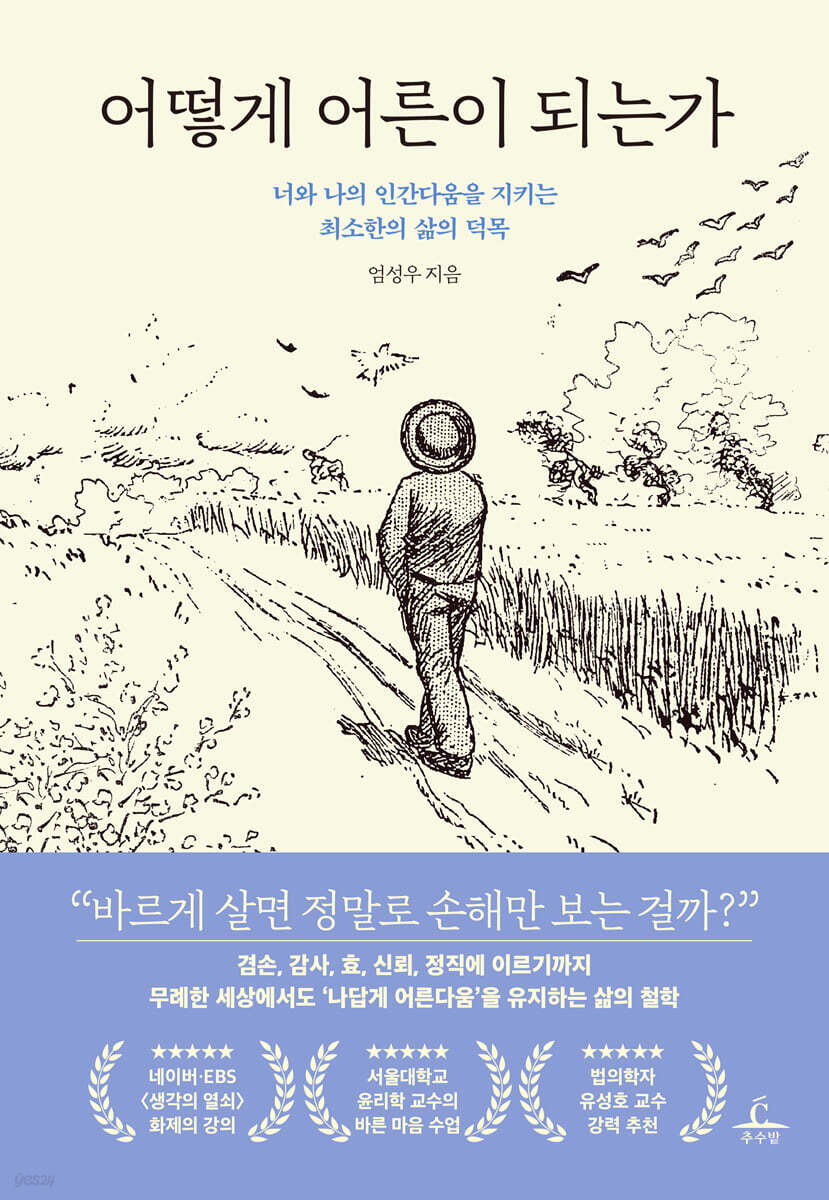
How to become an adult
 |
Description
Book Introduction
In a world where "living well means losing," why should we live uprightly "despite all that?" This book helps us reclaim the "thread of ethics" that sustains our lives, a thread that has been fading in the pursuit of greater profit.
Professor Eom Seong-woo of Seoul National University's Department of Ethics Education, known as the "Teacher of Moral Teachers," explores the five virtues of life—humility, gratitude, filial piety, trust, and honesty—as the "link of humanity" connecting you and me, through 50 questions ranging from "Why should we be humble?" to "Will artificial intelligence be honest?"
This book helps you think about, understand, and practice ethical virtues when faced with specific life situations. It guides you on the path to "adulthood" that embraces not only you and me, but even the harsh world.
Professor Eom Seong-woo of Seoul National University's Department of Ethics Education, known as the "Teacher of Moral Teachers," explores the five virtues of life—humility, gratitude, filial piety, trust, and honesty—as the "link of humanity" connecting you and me, through 50 questions ranging from "Why should we be humble?" to "Will artificial intelligence be honest?"
This book helps you think about, understand, and practice ethical virtues when faced with specific life situations. It guides you on the path to "adulthood" that embraces not only you and me, but even the harsh world.
- You can preview some of the book's contents.
Preview
index
Introduction: Living like an adult without losing your individuality
Chapter 1: Humility: A Heart That Can Bow Its Head with Confidence
What is humility? | Why should we be humble? | How does humility differ from courtesy or kindness? | Do humble people know themselves well? | How are humble people conscious of themselves? | What is the relationship between gratitude and humility? | How do humility and self-deprecation differ? | What is the relationship between humility and arrogance? | Can one be humble and still have high self-esteem and confidence? | Can only those who have outstanding things to boast about be humble?
+How can we cultivate the virtue of humility?
Chapter 2 Gratitude: A Heart That Recognizes Good Thoughts for Me
What is gratitude? | What does gratitude consist of? | Where does the value of gratitude lie? | What are the appropriate standards for gratitude? | Can gratitude be a duty? | What is a 'virtuous gratitude'? | Is there such a thing as 'bad gratitude'? | Is gratitude for existence possible? | What attitude can be compared to gratitude?
+How can we cultivate the virtue of gratitude?
Chapter 3: Filial Piety: A Childly Heart Repaying Parental Kindness
Why talk about filial piety now? | What is filial piety? | Where does the value of filial piety lie? | What is the ethical basis for filial piety? | What is filial piety as a relational virtue? | How should filial piety change in modern times? | How should filial piety change according to the stage of life? | Should we be filial to parents who are not parents? | Is filial piety only about obeying one's parents?
+How can we cultivate the virtue of filial piety?
Chapter 4: Trust: Willingness to Entrust Myself to You
What is trust? | What are similar concepts to trust? | Where does the value of trust lie? | Can we trust by our own will? | What does it mean to trust in oneself? | What kind of person is trustworthy? | What does it mean to trust wisely? | Why are a distrustful heart and a trusting heart bad?
+How can we cultivate trust and confidence?
Chapter 5 Honesty: The Heart That Protects the Right Not to Be Deceived
What is honesty? | Why should we be honest? | What is the difference between honesty and candor? | Is honesty something that doesn't lie? | Is deliberate deception always dishonest? | Do honest people lie? | Do honest people keep their promises? | Can they be dishonest to themselves? | Is artificial intelligence honest?
+How can we cultivate the virtue of honesty?
References
Chapter 1: Humility: A Heart That Can Bow Its Head with Confidence
What is humility? | Why should we be humble? | How does humility differ from courtesy or kindness? | Do humble people know themselves well? | How are humble people conscious of themselves? | What is the relationship between gratitude and humility? | How do humility and self-deprecation differ? | What is the relationship between humility and arrogance? | Can one be humble and still have high self-esteem and confidence? | Can only those who have outstanding things to boast about be humble?
+How can we cultivate the virtue of humility?
Chapter 2 Gratitude: A Heart That Recognizes Good Thoughts for Me
What is gratitude? | What does gratitude consist of? | Where does the value of gratitude lie? | What are the appropriate standards for gratitude? | Can gratitude be a duty? | What is a 'virtuous gratitude'? | Is there such a thing as 'bad gratitude'? | Is gratitude for existence possible? | What attitude can be compared to gratitude?
+How can we cultivate the virtue of gratitude?
Chapter 3: Filial Piety: A Childly Heart Repaying Parental Kindness
Why talk about filial piety now? | What is filial piety? | Where does the value of filial piety lie? | What is the ethical basis for filial piety? | What is filial piety as a relational virtue? | How should filial piety change in modern times? | How should filial piety change according to the stage of life? | Should we be filial to parents who are not parents? | Is filial piety only about obeying one's parents?
+How can we cultivate the virtue of filial piety?
Chapter 4: Trust: Willingness to Entrust Myself to You
What is trust? | What are similar concepts to trust? | Where does the value of trust lie? | Can we trust by our own will? | What does it mean to trust in oneself? | What kind of person is trustworthy? | What does it mean to trust wisely? | Why are a distrustful heart and a trusting heart bad?
+How can we cultivate trust and confidence?
Chapter 5 Honesty: The Heart That Protects the Right Not to Be Deceived
What is honesty? | Why should we be honest? | What is the difference between honesty and candor? | Is honesty something that doesn't lie? | Is deliberate deception always dishonest? | Do honest people lie? | Do honest people keep their promises? | Can they be dishonest to themselves? | Is artificial intelligence honest?
+How can we cultivate the virtue of honesty?
References
Detailed image

Into the book
In fact, one might question whether it is necessary to delve deeply into philosophical concepts of virtues that are familiar to us, such as humility or honesty.
Some people might ask, “Do people steal or lie because they don’t know that it’s wrong?”
We might think that our inability to live ethically is not because we don't know the good way and the bad way, but simply because we lack the will to practice a good life.
But knowing which way is the right way is not easy.
No matter how familiar a virtue is, if you don't know exactly what it is, it will be difficult to find a direction to cultivate and develop that virtue.
First, you need to know your destination so you can figure out how to get there.
And it is also very important to know 'why' such virtues are valuable.
If you don't understand the value of those virtues, you won't have the motivation to cultivate and develop them.
--- pp.6-7 From "Introduction"
Another thing to look for in relation to humility is being strict with yourself and generous with others.
We say that a person who is strict with himself, not easily satisfied, constantly striving, and striving upwards is humble.
But that's not necessarily the case.
Because treating yourself 'specially' in that way can also reveal an immature attitude.
Let's consider the case of the top student in the school.
For example, a student who is ranked first in the entire school is not satisfied with just one question on a test and becomes distressed, and whips himself by saying, "I have to do better."
At that time, Kim Geung-jeong, who usually gets 50 points, came to the suffering Ildeung and comforted him, saying, “It’s okay. Grades aren’t everything in life.”
But instead of being thankful, the suffering Ildeung says, “It’s okay for someone like you, but not me!”
While these people are not satisfied with themselves and strive to continually improve, they also tend to look down on others, see themselves as special, and hold themselves to even harsher standards. Couldn't this attitude actually be considered lacking humility? It's difficult to call this attitude of applying different standards to oneself and treating others differently humility.
--- pp.41-42 From "Chapter 1 Humility"
I propose the Three Principles as a practical guideline for living humbly yet confidently.
No matter what I do or where I go, my goal is to be ranked 3rd.
If you become obsessed with being number one, you will experience extreme stress in life, and even after achieving your goal, you will suffer from anxiety about not knowing when your position will be taken away.
The second place person looks at the back of the first place person's head with disgust, and it's easy to get hurt by jealousy, thinking, "If only he weren't here, I'd be first!"
But if you aim for 3rd place, you can work appropriately and hard, but the mental burden will be less.
They say bronze medalists are happier than silver medalists.
Someone might ask:
“Then why is it not ‘fourth classism’ or ‘fifth classism’ but ‘third classism’?” The spirit of third classism is contained in this very awareness of the problem.
In other words, the core of 'third-classism' is the realization that rank itself has no intrinsic value, and that if you live your life pursuing 'good things', there is no need to obsess over achieving 'better' than others.
--- pp.51
In virtuous gratitude, it is important to apply the 'principle of presumption of goodwill' even if the other person's intentions are not clearly known.
This is an attitude of assuming that the other person's intentions were good and not bad when their true intentions were not clearly revealed.
This principle is similar to the 'principle of presumption of innocence' used in court, which states that when it is not certain whether someone is guilty or not, we should first assume that they are not guilty.
The presumption of innocence is not because there is more evidence supporting the other party's innocence than the evidence pointing to guilt.
However, the principle of presumption of innocence exists because the wrong of treating an innocent person as a criminal is greater than the wrong of treating a guilty person as an innocent person.
Likewise, the principle of inferring goodwill is not just because people are more likely to be good or because there is more evidence to support it.
Just as it is just in law to presume a defendant is innocent when the evidence is insufficient, it may be virtuous to assume that a person's intentions are not malicious even when the mind is unknown.
--- pp.93-94 From "Chapter 2 Gratitude"
Unfortunately, as children grow older, parents become more and more frail and eventually become more and more dependent on their children.
There comes a time when we need to go beyond an equal relationship and take care of our parents as we were cared for when we were young.
We need to understand where they need help and provide them with strong support, taking good care of them both practically and mentally.
This is the time when it is important to have a grateful heart and not forget the kindness that has been bestowed upon us until we became adults.
It is also important to respect parents as autonomous beings, not simply as passive beings in need of care.
Even when parents become old and dependent on their children, allowing them to make independent choices is an important element of mature filial piety.
For example, in important situations such as medical decisions, it is necessary to respect your parents' wishes and try to reflect their opinions as much as possible.
--- pp.156-157 From “Chapter 3 Filial Piety”
Reliance based on knowledge about others lacks the unique beauty of trust, which allows us to take risks despite imperfect evidence.
Damon's attitude of trusting Phidias to the end and risking his life despite knowing that there was a possibility of betrayal resonates deeply with us.
But in fact, in the case of two beings with free will, perfect knowledge of each other is impossible.
For someone to be free means that their choices are entirely up to their own will, and it is impossible to know in advance what choices they will make.
If a person knows perfectly what to do, it means that he is not free.
Because only when something is determined and not free can knowledge of it be possible.
In that sense, there is a unique value and beauty in the trusting relationship between imperfect beings who cannot perfectly know each other.
--- pp.196-197 From “Chapter 4: Trust”
A person who has trust does not treat others with this kind of self-serving attitude.
For example, let's consider the case of Jun-sik and his wife Jeong-ah.
Jun-sik trusts that Jeong-ah will not cheat.
What is important is not only the action itself, but also the motivation behind the action.
Jun-sik believes that the fact that he trusts Jeong-ah and that she knows this will be enough reason for him not to betray her trust.
Jun-sik believes that Jeong-ah has shown him that she is trustworthy enough, and he no longer doubts her trustworthiness.
That's why, unlike Yi-jun, Jun-sik refuses even if someone offers to do background checks on Jeong-ah and install CCTV for free, saying, "I trust my wife."
--- pp.219-220
We all have a fundamental interest in pursuing truth, each in his own way, and living with our feet firmly planted on the ground of truth.
Consider the film "The Truman Show," for example. The protagonist believes he's living an ordinary life, but in reality, his life is a massive "hidden camera," unbeknownst to him, broadcast to the entire world.
No one would want to live in a world where everyone is deceiving themselves.
We have the right to live without being deceived and to pursue the truth in our own way.
In that sense, honesty can be said to be a virtue centered on respecting the other person's right not to be deceived.
We all want to live in touch with the truth.
How many people would wish their beliefs were false or would be deceived by someone? While it's possible to fear knowing the truth or regret it afterward, it's neither desirable nor possible to permanently turn away from it.
--- pp.245-246 From "Chapter 5 Honesty"
We can divide the self into the deceived and the deceived through psychological distinctions.
Simply put, it is dividing the mind in two and pushing different beliefs into each room.
We sometimes deceive ourselves unconsciously.
Let's take the example of a Nazi soldier.
If he thought a little deeper, he would realize how evil it was to put countless Jews in gas chambers and murder them.
But because he lacks the courage to face the pain that comes with recognizing this fact, he unconsciously ignores the evidence that proves the evil of his actions and begins to gather reasons to rationalize them.
'I am just a soldier following orders from above', 'Those people deserve to die because they did something so bad that it deserves to die', 'I am too tired today to think about anything else'.
By filling our minds with these thoughts, we try to ignore the fact that we can refuse genocide if we choose.
This attitude could also be called self-deception in a broad sense.
Some people might ask, “Do people steal or lie because they don’t know that it’s wrong?”
We might think that our inability to live ethically is not because we don't know the good way and the bad way, but simply because we lack the will to practice a good life.
But knowing which way is the right way is not easy.
No matter how familiar a virtue is, if you don't know exactly what it is, it will be difficult to find a direction to cultivate and develop that virtue.
First, you need to know your destination so you can figure out how to get there.
And it is also very important to know 'why' such virtues are valuable.
If you don't understand the value of those virtues, you won't have the motivation to cultivate and develop them.
--- pp.6-7 From "Introduction"
Another thing to look for in relation to humility is being strict with yourself and generous with others.
We say that a person who is strict with himself, not easily satisfied, constantly striving, and striving upwards is humble.
But that's not necessarily the case.
Because treating yourself 'specially' in that way can also reveal an immature attitude.
Let's consider the case of the top student in the school.
For example, a student who is ranked first in the entire school is not satisfied with just one question on a test and becomes distressed, and whips himself by saying, "I have to do better."
At that time, Kim Geung-jeong, who usually gets 50 points, came to the suffering Ildeung and comforted him, saying, “It’s okay. Grades aren’t everything in life.”
But instead of being thankful, the suffering Ildeung says, “It’s okay for someone like you, but not me!”
While these people are not satisfied with themselves and strive to continually improve, they also tend to look down on others, see themselves as special, and hold themselves to even harsher standards. Couldn't this attitude actually be considered lacking humility? It's difficult to call this attitude of applying different standards to oneself and treating others differently humility.
--- pp.41-42 From "Chapter 1 Humility"
I propose the Three Principles as a practical guideline for living humbly yet confidently.
No matter what I do or where I go, my goal is to be ranked 3rd.
If you become obsessed with being number one, you will experience extreme stress in life, and even after achieving your goal, you will suffer from anxiety about not knowing when your position will be taken away.
The second place person looks at the back of the first place person's head with disgust, and it's easy to get hurt by jealousy, thinking, "If only he weren't here, I'd be first!"
But if you aim for 3rd place, you can work appropriately and hard, but the mental burden will be less.
They say bronze medalists are happier than silver medalists.
Someone might ask:
“Then why is it not ‘fourth classism’ or ‘fifth classism’ but ‘third classism’?” The spirit of third classism is contained in this very awareness of the problem.
In other words, the core of 'third-classism' is the realization that rank itself has no intrinsic value, and that if you live your life pursuing 'good things', there is no need to obsess over achieving 'better' than others.
--- pp.51
In virtuous gratitude, it is important to apply the 'principle of presumption of goodwill' even if the other person's intentions are not clearly known.
This is an attitude of assuming that the other person's intentions were good and not bad when their true intentions were not clearly revealed.
This principle is similar to the 'principle of presumption of innocence' used in court, which states that when it is not certain whether someone is guilty or not, we should first assume that they are not guilty.
The presumption of innocence is not because there is more evidence supporting the other party's innocence than the evidence pointing to guilt.
However, the principle of presumption of innocence exists because the wrong of treating an innocent person as a criminal is greater than the wrong of treating a guilty person as an innocent person.
Likewise, the principle of inferring goodwill is not just because people are more likely to be good or because there is more evidence to support it.
Just as it is just in law to presume a defendant is innocent when the evidence is insufficient, it may be virtuous to assume that a person's intentions are not malicious even when the mind is unknown.
--- pp.93-94 From "Chapter 2 Gratitude"
Unfortunately, as children grow older, parents become more and more frail and eventually become more and more dependent on their children.
There comes a time when we need to go beyond an equal relationship and take care of our parents as we were cared for when we were young.
We need to understand where they need help and provide them with strong support, taking good care of them both practically and mentally.
This is the time when it is important to have a grateful heart and not forget the kindness that has been bestowed upon us until we became adults.
It is also important to respect parents as autonomous beings, not simply as passive beings in need of care.
Even when parents become old and dependent on their children, allowing them to make independent choices is an important element of mature filial piety.
For example, in important situations such as medical decisions, it is necessary to respect your parents' wishes and try to reflect their opinions as much as possible.
--- pp.156-157 From “Chapter 3 Filial Piety”
Reliance based on knowledge about others lacks the unique beauty of trust, which allows us to take risks despite imperfect evidence.
Damon's attitude of trusting Phidias to the end and risking his life despite knowing that there was a possibility of betrayal resonates deeply with us.
But in fact, in the case of two beings with free will, perfect knowledge of each other is impossible.
For someone to be free means that their choices are entirely up to their own will, and it is impossible to know in advance what choices they will make.
If a person knows perfectly what to do, it means that he is not free.
Because only when something is determined and not free can knowledge of it be possible.
In that sense, there is a unique value and beauty in the trusting relationship between imperfect beings who cannot perfectly know each other.
--- pp.196-197 From “Chapter 4: Trust”
A person who has trust does not treat others with this kind of self-serving attitude.
For example, let's consider the case of Jun-sik and his wife Jeong-ah.
Jun-sik trusts that Jeong-ah will not cheat.
What is important is not only the action itself, but also the motivation behind the action.
Jun-sik believes that the fact that he trusts Jeong-ah and that she knows this will be enough reason for him not to betray her trust.
Jun-sik believes that Jeong-ah has shown him that she is trustworthy enough, and he no longer doubts her trustworthiness.
That's why, unlike Yi-jun, Jun-sik refuses even if someone offers to do background checks on Jeong-ah and install CCTV for free, saying, "I trust my wife."
--- pp.219-220
We all have a fundamental interest in pursuing truth, each in his own way, and living with our feet firmly planted on the ground of truth.
Consider the film "The Truman Show," for example. The protagonist believes he's living an ordinary life, but in reality, his life is a massive "hidden camera," unbeknownst to him, broadcast to the entire world.
No one would want to live in a world where everyone is deceiving themselves.
We have the right to live without being deceived and to pursue the truth in our own way.
In that sense, honesty can be said to be a virtue centered on respecting the other person's right not to be deceived.
We all want to live in touch with the truth.
How many people would wish their beliefs were false or would be deceived by someone? While it's possible to fear knowing the truth or regret it afterward, it's neither desirable nor possible to permanently turn away from it.
--- pp.245-246 From "Chapter 5 Honesty"
We can divide the self into the deceived and the deceived through psychological distinctions.
Simply put, it is dividing the mind in two and pushing different beliefs into each room.
We sometimes deceive ourselves unconsciously.
Let's take the example of a Nazi soldier.
If he thought a little deeper, he would realize how evil it was to put countless Jews in gas chambers and murder them.
But because he lacks the courage to face the pain that comes with recognizing this fact, he unconsciously ignores the evidence that proves the evil of his actions and begins to gather reasons to rationalize them.
'I am just a soldier following orders from above', 'Those people deserve to die because they did something so bad that it deserves to die', 'I am too tired today to think about anything else'.
By filling our minds with these thoughts, we try to ignore the fact that we can refuse genocide if we choose.
This attitude could also be called self-deception in a broad sense.
--- pp.285-286
Publisher's Review
'Can you have high self-esteem and still be humble?'
'Should I be grateful to the person who tormented me but helped me grow?'
Should we be filial to parents who are not parents at all?
How can I trust someone I don't know?
'Are there any lies that even honest people have to tell?'
…
“Is it really true that if you live righteously, you only lose out?”
About the virtues of life that we should have but are losing.
The first lecture on "Life Ethics": shaping attitudes toward oneself and others.
“When you see a child being bullied, how do you feel?”
A "Right Mind" class that corrects life's disorganized priorities.
A child is being bullied by a group of people on the street.
If you saw this scene and passed it by without even noticing, it's probably because the following thought came to mind first.
‘I’m too busy to help’, ‘The bullies are too big for me to handle’, ‘I’ll just get hurt if I get involved in their fight’, ‘I have nothing to do with that kid’, etc…
While such complex cost-benefit calculations come to mind, countless instances of missing the "golden time" to save a child occur, and thus "ethics" are pushed far down the priority list of our lives.
This book is not simply about 'how to save a child'.
Nor is it a book that repeats the obvious imperative of ‘saving the child.’
"How to Become an Adult" is a book that teaches us what mindset we should have amidst all the worries and conflicts that arise within us, from the decision to give ourselves to others to the actions we take, and helps us to somehow establish the path and order toward "goodness" amidst the countless obstacles of life.
Professor Eom Seong-woo of Seoul National University's Department of Ethics Education, known as the "Teacher of Moral Teachers," explores the five virtues of life—humility, gratitude, filial piety, trust, and honesty—as the "link of humanity" connecting you and me, through 50 questions ranging from "Why should we be humble?" to "Will artificial intelligence be honest?"
This book helps you think about, understand, and practice ethical virtues when faced with specific life situations. It guides you on the path to "adulthood" that embraces not only you and me, but even the harsh world.
“How you treat yourself determines how you treat others.”
Humility and gratitude, the heart that frames my relationship with the world.
Koreans tend to think that no matter how outstanding one's abilities are, they should refrain from bragging or boasting too much in front of others.
But does "humility" necessarily mean belittling myself in front of others? Beyond hiding my strengths or deliberately highlighting my shortcomings, isn't it tied to my own unique attitude toward myself? Furthermore, how can "gratitude" transcend mere formality and become a positive attitude toward my life and the world?
In this way, this book carefully explains the philosophical meaning of each virtue by asking us to reflect on and question the meaning of the virtues we frequently use in our daily lives.
'Humility' is an attitude of objectively judging one's own position as a middle ground between self-deprecation and arrogance, and it reveals an attitude of 'living as oneself' that is not swayed by outstanding abilities or status, in that it bases self-esteem on 'absolute goodness' rather than 'being better than others'.
Furthermore, it emphasizes that 'gratitude' is not only a reward for a specific action, but also an expression of the heart toward the 'existence' itself that relieves my loneliness, and guides us to cultivate the sensitivity to respect others and to know how to appreciate kindness at an appropriate level depending on the situation through examples of 'excessive gratitude' and 'insufficient gratitude'.
“Saving others is saving myself.”
From close family to people I don't know well
The spirit of 'filial piety', 'trust', and 'honesty' that form the foundation of human relationships
Although we all form our first human relationships through parent-child relationships, we often neglect the virtue of filial piety.
Traditionally, there has been a strong perception that virtues are forcibly instilled from above, and this is especially true as cases of 'unparental parents' have noticeably increased recently.
However, filial piety is important in that learning love and empathy from parents and reciprocating it becomes the foundation for cultivating our morality. It is not a one-sided virtue, but a relational virtue that appears in a way that 'parenthood' and 'childhood' reinforce each other, so it can be said that it requires mutual communication and exchange, as well as flexibility appropriate to the time and situation, rather than unconditional obedience.
This book not only introduces filial piety as an essential virtue in family relationships in a way that is appropriate for today's times, but also explains the 'trust' and 'honesty' that are required as social relationships expand from those I know well to those I do not know.
Through the anecdote of Phidias and Damon from ancient Greece, which demonstrates a friendship that does not betray, it shows that trust carries the 'risk' of the other person changing, and it explains, using various everyday examples, what the conditions for becoming a trustworthy person (trustworthiness) and a trustworthy heart (trustfulness) are.
And it reveals that 'honesty' goes beyond the passive meaning of 'not lying', and contains the meaning of an active act of 'protecting the other person's right not to be deceived' in a 'world where even the truth can be a deception'.
It highlights the increased risk of self-deception, especially in today's world where there is an increasing amount of "bullshit" spread, regardless of whether it is true or not.
Furthermore, he says that artificial intelligence, which has quickly become a reality, can also be intoxicated by nonsense, so its honesty may be put to the test.
The Law of a 'Good Heart' that Overcomes a Bad World
The wisdom of ethics that will guide us through life together
Is it possible to be a "good person" in an increasingly deteriorating world? In a world governed by the unspoken rule of "those who don't suffer losses survive" (a zero-sum game), the wisest course of action is to simply ignore a bullied child.
But nobody teaches that.
Despite the merciless laws of the world, there is a law of the heart (ethics) that operates within us, as Kant said, shining like a star.
The five virtues presented in this book are defined by the 'heart' rather than by any external laws, rules, or moral lists.
It refers to a fundamental attitude toward life that may or may not be fully realized depending on our autonomy and will.
This is the author's narrative method for going beyond simply 'pretending to be good' on the outside and becoming a person whose inside and outside are consistent.
Although the reality is that vices (arrogance, anger, immorality, distrust, lies, etc.) that are diametrically opposed to these five virtues fill the daily news, if you read this book, you will be able to experience “healing” that will allow you to overcome such reality with the power of ethics that will strengthen the bond between you and me.
'Should I be grateful to the person who tormented me but helped me grow?'
Should we be filial to parents who are not parents at all?
How can I trust someone I don't know?
'Are there any lies that even honest people have to tell?'
…
“Is it really true that if you live righteously, you only lose out?”
About the virtues of life that we should have but are losing.
The first lecture on "Life Ethics": shaping attitudes toward oneself and others.
“When you see a child being bullied, how do you feel?”
A "Right Mind" class that corrects life's disorganized priorities.
A child is being bullied by a group of people on the street.
If you saw this scene and passed it by without even noticing, it's probably because the following thought came to mind first.
‘I’m too busy to help’, ‘The bullies are too big for me to handle’, ‘I’ll just get hurt if I get involved in their fight’, ‘I have nothing to do with that kid’, etc…
While such complex cost-benefit calculations come to mind, countless instances of missing the "golden time" to save a child occur, and thus "ethics" are pushed far down the priority list of our lives.
This book is not simply about 'how to save a child'.
Nor is it a book that repeats the obvious imperative of ‘saving the child.’
"How to Become an Adult" is a book that teaches us what mindset we should have amidst all the worries and conflicts that arise within us, from the decision to give ourselves to others to the actions we take, and helps us to somehow establish the path and order toward "goodness" amidst the countless obstacles of life.
Professor Eom Seong-woo of Seoul National University's Department of Ethics Education, known as the "Teacher of Moral Teachers," explores the five virtues of life—humility, gratitude, filial piety, trust, and honesty—as the "link of humanity" connecting you and me, through 50 questions ranging from "Why should we be humble?" to "Will artificial intelligence be honest?"
This book helps you think about, understand, and practice ethical virtues when faced with specific life situations. It guides you on the path to "adulthood" that embraces not only you and me, but even the harsh world.
“How you treat yourself determines how you treat others.”
Humility and gratitude, the heart that frames my relationship with the world.
Koreans tend to think that no matter how outstanding one's abilities are, they should refrain from bragging or boasting too much in front of others.
But does "humility" necessarily mean belittling myself in front of others? Beyond hiding my strengths or deliberately highlighting my shortcomings, isn't it tied to my own unique attitude toward myself? Furthermore, how can "gratitude" transcend mere formality and become a positive attitude toward my life and the world?
In this way, this book carefully explains the philosophical meaning of each virtue by asking us to reflect on and question the meaning of the virtues we frequently use in our daily lives.
'Humility' is an attitude of objectively judging one's own position as a middle ground between self-deprecation and arrogance, and it reveals an attitude of 'living as oneself' that is not swayed by outstanding abilities or status, in that it bases self-esteem on 'absolute goodness' rather than 'being better than others'.
Furthermore, it emphasizes that 'gratitude' is not only a reward for a specific action, but also an expression of the heart toward the 'existence' itself that relieves my loneliness, and guides us to cultivate the sensitivity to respect others and to know how to appreciate kindness at an appropriate level depending on the situation through examples of 'excessive gratitude' and 'insufficient gratitude'.
“Saving others is saving myself.”
From close family to people I don't know well
The spirit of 'filial piety', 'trust', and 'honesty' that form the foundation of human relationships
Although we all form our first human relationships through parent-child relationships, we often neglect the virtue of filial piety.
Traditionally, there has been a strong perception that virtues are forcibly instilled from above, and this is especially true as cases of 'unparental parents' have noticeably increased recently.
However, filial piety is important in that learning love and empathy from parents and reciprocating it becomes the foundation for cultivating our morality. It is not a one-sided virtue, but a relational virtue that appears in a way that 'parenthood' and 'childhood' reinforce each other, so it can be said that it requires mutual communication and exchange, as well as flexibility appropriate to the time and situation, rather than unconditional obedience.
This book not only introduces filial piety as an essential virtue in family relationships in a way that is appropriate for today's times, but also explains the 'trust' and 'honesty' that are required as social relationships expand from those I know well to those I do not know.
Through the anecdote of Phidias and Damon from ancient Greece, which demonstrates a friendship that does not betray, it shows that trust carries the 'risk' of the other person changing, and it explains, using various everyday examples, what the conditions for becoming a trustworthy person (trustworthiness) and a trustworthy heart (trustfulness) are.
And it reveals that 'honesty' goes beyond the passive meaning of 'not lying', and contains the meaning of an active act of 'protecting the other person's right not to be deceived' in a 'world where even the truth can be a deception'.
It highlights the increased risk of self-deception, especially in today's world where there is an increasing amount of "bullshit" spread, regardless of whether it is true or not.
Furthermore, he says that artificial intelligence, which has quickly become a reality, can also be intoxicated by nonsense, so its honesty may be put to the test.
The Law of a 'Good Heart' that Overcomes a Bad World
The wisdom of ethics that will guide us through life together
Is it possible to be a "good person" in an increasingly deteriorating world? In a world governed by the unspoken rule of "those who don't suffer losses survive" (a zero-sum game), the wisest course of action is to simply ignore a bullied child.
But nobody teaches that.
Despite the merciless laws of the world, there is a law of the heart (ethics) that operates within us, as Kant said, shining like a star.
The five virtues presented in this book are defined by the 'heart' rather than by any external laws, rules, or moral lists.
It refers to a fundamental attitude toward life that may or may not be fully realized depending on our autonomy and will.
This is the author's narrative method for going beyond simply 'pretending to be good' on the outside and becoming a person whose inside and outside are consistent.
Although the reality is that vices (arrogance, anger, immorality, distrust, lies, etc.) that are diametrically opposed to these five virtues fill the daily news, if you read this book, you will be able to experience “healing” that will allow you to overcome such reality with the power of ethics that will strengthen the bond between you and me.
GOODS SPECIFICS
- Date of issue: June 25, 2025
- Page count, weight, size: 304 pages | 512g | 145*210*23mm
- ISBN13: 9791155402542
- ISBN10: 1155402545
You may also like
카테고리
korean


korean

![GQ KOREA Mark (Monthly): December [2025]](http://librairie.coreenne.fr/cdn/shop/files/8ef265dbbfbf186523ed75ba7319009d.jpg?v=1765340328&width=3840)


