

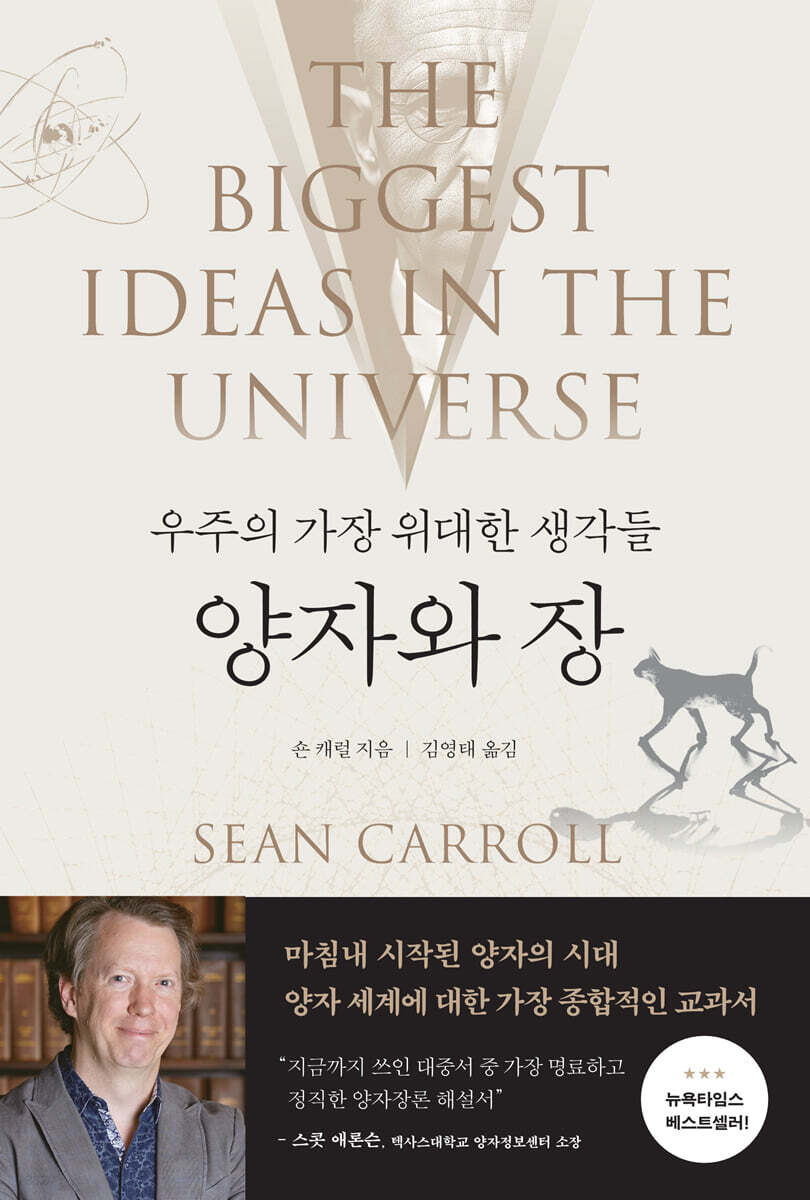
Quantum and Jang
 |
Description
Book Introduction
- A word from MD
- On the 100th anniversary of the birth of quantum physics, another masterpiece was published.
Sean Carroll, a theoretical physicist of our time, tells us about the quantum world.
It clearly explains the basic principles of quantum mechanics, particle physics, and quantum field theory.
The first half deals with concepts, and the second half deals with how the universe actually came to be.
- Min-gyu Son, PD of Natural Sciences
The Greatest Ideas in the Universe, Part 2
The quantum era has finally begun,
The most comprehensive guide to the quantum world
This book is the second in the three-part series "The Greatest Ideas in the Universe" by Sean Carroll, a leading theoretical physicist of the 21st century, and deals with quantum field theory, a core concept in modern physics.
This book, which explains the remarkable transition from the classical worldview to the quantum worldview, encompassing the fundamental principles of quantum mechanics, particle physics, and quantum field theory, allows readers to delve into the deep meaning of the laws of physics and learn the mindset of a physicist.
Modern physics is based on quantum field theory.
Quantum mechanics is not simply a new theory that describes physics; it is expected to bring about innovation in various fields such as artificial intelligence, biotechnology, and materials science through quantum computers, quantum cryptography, and quantum sensors.
This book, the most faithful textbook on quantum field theory that can fundamentally transform modern life, explores the world of quantum mechanics with explanations that anyone can understand while maintaining scientific depth.
The quantum era has finally begun,
The most comprehensive guide to the quantum world
This book is the second in the three-part series "The Greatest Ideas in the Universe" by Sean Carroll, a leading theoretical physicist of the 21st century, and deals with quantum field theory, a core concept in modern physics.
This book, which explains the remarkable transition from the classical worldview to the quantum worldview, encompassing the fundamental principles of quantum mechanics, particle physics, and quantum field theory, allows readers to delve into the deep meaning of the laws of physics and learn the mindset of a physicist.
Modern physics is based on quantum field theory.
Quantum mechanics is not simply a new theory that describes physics; it is expected to bring about innovation in various fields such as artificial intelligence, biotechnology, and materials science through quantum computers, quantum cryptography, and quantum sensors.
This book, the most faithful textbook on quantum field theory that can fundamentally transform modern life, explores the world of quantum mechanics with explanations that anyone can understand while maintaining scientific depth.
- You can preview some of the book's contents.
Preview
index
introduction
1 Wave function
2 measurements
3 Entanglement
Chapter 4
5 Interactions
6 Effective field theory
7 scale
8 Symmetry
9 gauge theory
10 awards
11 substances
12 atoms
Appendix Fourier Transform
Translator's Note
Search
1 Wave function
2 measurements
3 Entanglement
Chapter 4
5 Interactions
6 Effective field theory
7 scale
8 Symmetry
9 gauge theory
10 awards
11 substances
12 atoms
Appendix Fourier Transform
Translator's Note
Search
Detailed image

Into the book
By the early 20th century, classical mechanics was firmly established.
Twenty-five years later, we have the first complete theory of quantum mechanics.
Twenty-five years later, quantum electrodynamics emerged as the first established quantum field theory.
And 25 years later, physicists completed the Standard Model of particle physics, which remains a successful theory to this day.
This is the journey we are embarking on, and it involves some of the most amazing ideas humanity has ever encountered.
--- From the "Preface" on p.12-13
The core of quantum mechanics is that what you see is not what exists.
Of course, the two are related, and neither is permissible.
But when we measure a quantum system, aren't we simply observing its quantum state before the measurement? In general, we can't even observe it.
We observe partial and incomplete aspects of a state, and in the process, we irreversibly change the state.
This is why, unlike in classical physics, 'measurement' is considered one of the biggest ideas in quantum physics.
As mentioned earlier, there is little consensus about what is going on behind the scenes.
Physicists and philosophers have called this the measurement problem.
--- From p.52-53 “2 Measurements”
What does a chapter consist of? There is no satisfactory answer to this question.
In the context of quantum field theory, fields are not "made of" anything. Fields are what make up everything else.
You shouldn't be surprised by this.
If you delve deep enough into what constitutes a thing, you cannot help but conclude that 'here is the bare stuff of reality, and it is not made of anything else.'
--- p.115 From Chapter 4
Every Feynman figure tells a story.
Some particles come in and interact by exchanging with other particles, and another set of particles is emitted.
However, not all particles are created equal.
All the lines coming in and going out represent 'real' particles that actually exist.
But a line that is entirely inside the shape? One that starts at some vertex of the shape and ends at another vertex, never reaching the outside world? represents a virtual particle.
Virtual particles are not real particles.
Virtual particles represent real processes—the interacting vibrations of sets of quantum fields—but they are not the real particles of the real world that we can observe in experiments.
--- p.168 From “5 Interactions”
The interaction between quarks and gluons is strong, not weak.
We learned that quantum field theory predicts the properties of particles by first examining free field theory (where there is no interaction at all) and then considering the interactions between particles through perturbation theory.
Because there are no small parameters inside nucleons, such as the fine-structure constant that allows for perturbation theory, assuming that nucleons are a collection of weakly interacting particles does not tell us what is actually happening.
Nucleons are objects that require thorough application of quantum field theory, and to understand them, we must take quantum field theory seriously.
--- p.221 From "7 Scales"
Nature doesn't care how we represent quark vectors by their components or what direction their axes are. It's just a choice we make for our convenience, not a fundamental feature of the universe.
That's why symmetry exists.
It has nothing to do with physics which way we point the field vectors relative to the axes, and symmetry often means that there are multiple equivalent ways to represent the same physical situation.
For single quark fields, what matters is the length of the vector.
When we start comparing single fields at different points in space-time or across different fields, the relative angles between color vectors start to become important.
These properties? The lengths of individual vectors, the angles between vectors? are exactly invariant under the SU(3) transform.
--- p.270 From “9 Gauge Theory”
To understand the spin statistics theorem, let's think a little more about what 'spin' means.
For classical objects, spin is the 'rate of rotation' around an axis of rotation.
The laws of nature are characterized by symmetry, which means that the fundamental laws do not change even when we rotate our reference frame.
And Noether's theorem implies the existence of a conserved physical quantity associated with symmetry, and in the case of rotation, the conserved quantity is the angular momentum of the object.
Unlike classical objects, quantum particles can have an intrinsic spin that changes only their orientation in space without changing their total angular momentum.
Electrons have spin-1/2, photons have spin-1.
--- p.330-331 From “11 Materials”
The core theory is clearly not the final theory of physics.
The core theory fails to account for dark matter or strong gravitational fields, and exhibits a variety of contingencies and fine-tunings that suggest a more complete explanation is needed.
People have some ideas about what the complete theory is, but we don't know for sure.
We also don't know how close we are to a final theory.
A paper with the final answer may be published tomorrow, or we may still be searching for the answer a thousand years from now.
Twenty-five years later, we have the first complete theory of quantum mechanics.
Twenty-five years later, quantum electrodynamics emerged as the first established quantum field theory.
And 25 years later, physicists completed the Standard Model of particle physics, which remains a successful theory to this day.
This is the journey we are embarking on, and it involves some of the most amazing ideas humanity has ever encountered.
--- From the "Preface" on p.12-13
The core of quantum mechanics is that what you see is not what exists.
Of course, the two are related, and neither is permissible.
But when we measure a quantum system, aren't we simply observing its quantum state before the measurement? In general, we can't even observe it.
We observe partial and incomplete aspects of a state, and in the process, we irreversibly change the state.
This is why, unlike in classical physics, 'measurement' is considered one of the biggest ideas in quantum physics.
As mentioned earlier, there is little consensus about what is going on behind the scenes.
Physicists and philosophers have called this the measurement problem.
--- From p.52-53 “2 Measurements”
What does a chapter consist of? There is no satisfactory answer to this question.
In the context of quantum field theory, fields are not "made of" anything. Fields are what make up everything else.
You shouldn't be surprised by this.
If you delve deep enough into what constitutes a thing, you cannot help but conclude that 'here is the bare stuff of reality, and it is not made of anything else.'
--- p.115 From Chapter 4
Every Feynman figure tells a story.
Some particles come in and interact by exchanging with other particles, and another set of particles is emitted.
However, not all particles are created equal.
All the lines coming in and going out represent 'real' particles that actually exist.
But a line that is entirely inside the shape? One that starts at some vertex of the shape and ends at another vertex, never reaching the outside world? represents a virtual particle.
Virtual particles are not real particles.
Virtual particles represent real processes—the interacting vibrations of sets of quantum fields—but they are not the real particles of the real world that we can observe in experiments.
--- p.168 From “5 Interactions”
The interaction between quarks and gluons is strong, not weak.
We learned that quantum field theory predicts the properties of particles by first examining free field theory (where there is no interaction at all) and then considering the interactions between particles through perturbation theory.
Because there are no small parameters inside nucleons, such as the fine-structure constant that allows for perturbation theory, assuming that nucleons are a collection of weakly interacting particles does not tell us what is actually happening.
Nucleons are objects that require thorough application of quantum field theory, and to understand them, we must take quantum field theory seriously.
--- p.221 From "7 Scales"
Nature doesn't care how we represent quark vectors by their components or what direction their axes are. It's just a choice we make for our convenience, not a fundamental feature of the universe.
That's why symmetry exists.
It has nothing to do with physics which way we point the field vectors relative to the axes, and symmetry often means that there are multiple equivalent ways to represent the same physical situation.
For single quark fields, what matters is the length of the vector.
When we start comparing single fields at different points in space-time or across different fields, the relative angles between color vectors start to become important.
These properties? The lengths of individual vectors, the angles between vectors? are exactly invariant under the SU(3) transform.
--- p.270 From “9 Gauge Theory”
To understand the spin statistics theorem, let's think a little more about what 'spin' means.
For classical objects, spin is the 'rate of rotation' around an axis of rotation.
The laws of nature are characterized by symmetry, which means that the fundamental laws do not change even when we rotate our reference frame.
And Noether's theorem implies the existence of a conserved physical quantity associated with symmetry, and in the case of rotation, the conserved quantity is the angular momentum of the object.
Unlike classical objects, quantum particles can have an intrinsic spin that changes only their orientation in space without changing their total angular momentum.
Electrons have spin-1/2, photons have spin-1.
--- p.330-331 From “11 Materials”
The core theory is clearly not the final theory of physics.
The core theory fails to account for dark matter or strong gravitational fields, and exhibits a variety of contingencies and fine-tunings that suggest a more complete explanation is needed.
People have some ideas about what the complete theory is, but we don't know for sure.
We also don't know how close we are to a final theory.
A paper with the final answer may be published tomorrow, or we may still be searching for the answer a thousand years from now.
--- p.370 From "12 Atoms"
Publisher's Review
From wave functions to quantum field theory and the standard model of particle physics
Sean Carroll's Quantum Physics Lectures for the Quantum Age
The history of physics has been filled with countless brilliant and innovative ideas.
But according to Sean Carroll, a professor of theoretical physics at Johns Hopkins University and the author of this book, there have only been two truly revolutionary shifts—paradigm shifts that overturned conventional thinking about the nature of reality.
These are classical mechanics of the late 17th century and quantum mechanics of the early 20th century.
The second book in the "Greatest Ideas in the Universe" trilogy, this book covers the core of modern physics, beginning with the fundamental concepts of quantum mechanics and extending to quantum field theory and the Standard Model of particle physics.
While the previous work, Space, Time, and Motion, dealt with classical mechanics and the theory of relativity, this book explores the world of quantum field theory, which is currently recognized as the only best method to explain the universe at the most profound level.
In the first half of this book, readers will learn about profound theoretical topics such as wave functions, entanglement, fields, Feynman diagrams, and the Higgs mechanism, and in the second half, they will understand what the universe is actually made of, why matter is solid, why antimatter exists, where the size of an atom comes from, and why the predictions of quantum field theory are so accurate.
This book will be the "greatest" journey, guiding readers toward the essence of the universe, beyond Newton and Einstein, and even beyond the intuitive thinking that has guided humanity for thousands of years.
Sean Carroll, considered one of the world's leading science commentators, will help readers learn the physicist's way of thinking through this book, which contains some of the most astonishing scientific concepts humanity has ever discovered.
A Journey to the Most Fundamental Truths Reached by Modern Physics
The need for quantum mechanics was first raised by the work of Max Planck and Albert Einstein, who discovered that light, contrary to physicists' expectations, was not a simple wave.
Under the right circumstances, light behaves as particles, which we now call photons.
A photon is an example of a quanta, a discrete packet of energy that follows the rules of quantum mechanics.
But the quantum is more complicated than that.
Things we think of as particles, such as electrons, protons, and neutrons, behave like waves in other situations.
Physicists were confused when they discovered that atoms and sub-atoms simultaneously possessed particle and wave properties that contradicted common sense.
Although there is no consensus on exactly what quantum mechanics is, physicists have used it to predict the structure of atoms and molecules and to precisely calculate how particles scatter from each other.
But at the same time, there is no agreement on what happens in the process of deriving their predictions and observations.
Unlike classical physics, in the quantum world, the very acts of ‘measurement’ and ‘observation’ seem to endow the system with special properties.
That is, when you measure the properties of a quantum system, those properties tend to change dramatically.
Quantum mechanics, which emerged to explain the mechanisms of the atomic world that simultaneously possesses the characteristics of both particles and waves, has left numerous physicists frustrated and confused.
Quantum field theory, which naturally arises when quantum mechanics is combined with the requirements of special relativity, is currently recognized as the only way to explain the universe at its most profound level.
On the basis of quantum field theory, modern physicists have been able to explain various phenomena that could not be explained by classical physics, such as Feynman diagrams, renormalization, gauge theory, symmetry breaking, and spin-statistics coupling.
Furthermore, by utilizing the characteristics of quantum, humanity is on the verge of an era of electronics using semiconductors, nuclear power generation using nuclear fission, and quantum computing and quantum communication utilizing quantum characteristics.
What are the hidden principles and forces that govern the universe?
After classical mechanics, exploration of quantum field theory for a more comprehensive understanding of the universe
Chapter 1 of this book covers the concept of 'wave function'.
The wave function, a concept proposed by Schrödinger to extend Louis de Broglie's idea of matter waves, specifies the quantum state of a system.
However, while a single particle is assigned only one wavefunction at every spatial location, things are not so simple when there is more than one particle.
The wave function contains the answer to the question of discontinuity in the universe.
Chapter 2 deals with the problem of ‘measurement’.
In classical mechanics, measurement was not a problem.
It was possible to accurately measure properties such as the position and velocity of an object.
But in quantum mechanics it's different.
When you measure the properties of a quantum system, those properties change dramatically.
The moment we measure a quantum system, we observe a partial and incomplete aspect of its state, and in the process, we irreversibly change the state.
This is precisely why, unlike in classical physics, ‘measurement’ is considered the biggest challenge in quantum physics.
Chapter 3 deals with 'entanglement', which makes predicting wave functions difficult.
In the quantum world, entanglement means more than just a simple correlation between things that already exist but are unknown to us.
The correlations of quantum entanglement exist beyond simple classical relationships.
Chapter 4 is about ‘field’.
Unlike in classical mechanics, in quantum mechanics, a field is a concept whose identity is difficult to define in a single word.
In the context of quantum field theory, fields are not 'made of' anything.
The chapter constitutes everything else.
Even when space is empty, the field exists.
Here, we explore not only quantum fields, but also field concepts such as field texture, field energy, free fields, and field creation and destruction.
Chapter 5 examines the "interactions" that make our universe such an interesting place.
The interaction of particles goes beyond the concept of 'scattering', as the vibrations of certain fields overlap, and those vibrations induce vibrations of other fields that are combined, causing an infinite amount of activity.
Chapter 6 deals with 'effective field theory', which can be said to be an absolutely core concept of modern physics.
Effective field theory is defined as a set of effective coupling constants, and has been extended to various topics in cosmology, such as the growth of structure and the generation of gravitational waves by spiraling black holes.
It can be said that effective field theory is at the center of modern particle physics.
How did our universe come to be what it is today?
Exploring the various properties and substances that characterize our universe
The topic to be examined in Chapter 7 is ‘scale.’
A relatively easy-to-visualize topic, scale focuses on what our known universe is actually made of, and in particular, the various scales of mass and energy that characterize our world.
Chapter 8 deals with the concept of ‘symmetry’.
In classical mechanics, especially in the theory of relativity, symmetry is a very useful theory.
But when it comes to quantum field theory, symmetry is elevated from being a useful concept to an 'absolutely essential' concept.
In a sense, the forces of nature arise directly from a special symmetry of the fundamental fields known as 'gauge invariance'.
The topic covered in Chapter 9 is a relatively unfamiliar one called ‘gauge theory.’
Gauge theory is a special field theory with a special type of symmetry.
The idea itself is simple, but the concept has enormous consequences.
Because it is a powerful principle that supports the power of nature.
The topic of Chapter 10, 'phase', refers to a state in which a single substance exhibits multiple physical properties, and is a term borrowed from macroscopic physics.
Even though substances are made of the same basic material, their phases can have different properties, such as density or the speed of sound within the substance.
Chapter 11 begins with a very simple question about 'matter'.
'Why are atoms hard?' 'How can we gather a group of atoms to make an object?' The real reason why matter is hard is because electrons are fermions, and fermions have special properties.
Here we examine the properties of fermions and their relationship to fermion particles and spin.
Chapter 12 explores the 'atom', which is most closely related to the formation of our universe.
What makes our universe so interesting and complex is the presence of many different types of stable atomic nuclei, each positively charged and capable of capturing electrons, allowing for many different forms of chemistry to emerge.
If the parameters of particle physics had been just slightly different, our universe would have been completely different, or there would have been no atoms, no chemistry, and no life.
Sean Carroll's Quantum Physics Lectures for the Quantum Age
The history of physics has been filled with countless brilliant and innovative ideas.
But according to Sean Carroll, a professor of theoretical physics at Johns Hopkins University and the author of this book, there have only been two truly revolutionary shifts—paradigm shifts that overturned conventional thinking about the nature of reality.
These are classical mechanics of the late 17th century and quantum mechanics of the early 20th century.
The second book in the "Greatest Ideas in the Universe" trilogy, this book covers the core of modern physics, beginning with the fundamental concepts of quantum mechanics and extending to quantum field theory and the Standard Model of particle physics.
While the previous work, Space, Time, and Motion, dealt with classical mechanics and the theory of relativity, this book explores the world of quantum field theory, which is currently recognized as the only best method to explain the universe at the most profound level.
In the first half of this book, readers will learn about profound theoretical topics such as wave functions, entanglement, fields, Feynman diagrams, and the Higgs mechanism, and in the second half, they will understand what the universe is actually made of, why matter is solid, why antimatter exists, where the size of an atom comes from, and why the predictions of quantum field theory are so accurate.
This book will be the "greatest" journey, guiding readers toward the essence of the universe, beyond Newton and Einstein, and even beyond the intuitive thinking that has guided humanity for thousands of years.
Sean Carroll, considered one of the world's leading science commentators, will help readers learn the physicist's way of thinking through this book, which contains some of the most astonishing scientific concepts humanity has ever discovered.
A Journey to the Most Fundamental Truths Reached by Modern Physics
The need for quantum mechanics was first raised by the work of Max Planck and Albert Einstein, who discovered that light, contrary to physicists' expectations, was not a simple wave.
Under the right circumstances, light behaves as particles, which we now call photons.
A photon is an example of a quanta, a discrete packet of energy that follows the rules of quantum mechanics.
But the quantum is more complicated than that.
Things we think of as particles, such as electrons, protons, and neutrons, behave like waves in other situations.
Physicists were confused when they discovered that atoms and sub-atoms simultaneously possessed particle and wave properties that contradicted common sense.
Although there is no consensus on exactly what quantum mechanics is, physicists have used it to predict the structure of atoms and molecules and to precisely calculate how particles scatter from each other.
But at the same time, there is no agreement on what happens in the process of deriving their predictions and observations.
Unlike classical physics, in the quantum world, the very acts of ‘measurement’ and ‘observation’ seem to endow the system with special properties.
That is, when you measure the properties of a quantum system, those properties tend to change dramatically.
Quantum mechanics, which emerged to explain the mechanisms of the atomic world that simultaneously possesses the characteristics of both particles and waves, has left numerous physicists frustrated and confused.
Quantum field theory, which naturally arises when quantum mechanics is combined with the requirements of special relativity, is currently recognized as the only way to explain the universe at its most profound level.
On the basis of quantum field theory, modern physicists have been able to explain various phenomena that could not be explained by classical physics, such as Feynman diagrams, renormalization, gauge theory, symmetry breaking, and spin-statistics coupling.
Furthermore, by utilizing the characteristics of quantum, humanity is on the verge of an era of electronics using semiconductors, nuclear power generation using nuclear fission, and quantum computing and quantum communication utilizing quantum characteristics.
What are the hidden principles and forces that govern the universe?
After classical mechanics, exploration of quantum field theory for a more comprehensive understanding of the universe
Chapter 1 of this book covers the concept of 'wave function'.
The wave function, a concept proposed by Schrödinger to extend Louis de Broglie's idea of matter waves, specifies the quantum state of a system.
However, while a single particle is assigned only one wavefunction at every spatial location, things are not so simple when there is more than one particle.
The wave function contains the answer to the question of discontinuity in the universe.
Chapter 2 deals with the problem of ‘measurement’.
In classical mechanics, measurement was not a problem.
It was possible to accurately measure properties such as the position and velocity of an object.
But in quantum mechanics it's different.
When you measure the properties of a quantum system, those properties change dramatically.
The moment we measure a quantum system, we observe a partial and incomplete aspect of its state, and in the process, we irreversibly change the state.
This is precisely why, unlike in classical physics, ‘measurement’ is considered the biggest challenge in quantum physics.
Chapter 3 deals with 'entanglement', which makes predicting wave functions difficult.
In the quantum world, entanglement means more than just a simple correlation between things that already exist but are unknown to us.
The correlations of quantum entanglement exist beyond simple classical relationships.
Chapter 4 is about ‘field’.
Unlike in classical mechanics, in quantum mechanics, a field is a concept whose identity is difficult to define in a single word.
In the context of quantum field theory, fields are not 'made of' anything.
The chapter constitutes everything else.
Even when space is empty, the field exists.
Here, we explore not only quantum fields, but also field concepts such as field texture, field energy, free fields, and field creation and destruction.
Chapter 5 examines the "interactions" that make our universe such an interesting place.
The interaction of particles goes beyond the concept of 'scattering', as the vibrations of certain fields overlap, and those vibrations induce vibrations of other fields that are combined, causing an infinite amount of activity.
Chapter 6 deals with 'effective field theory', which can be said to be an absolutely core concept of modern physics.
Effective field theory is defined as a set of effective coupling constants, and has been extended to various topics in cosmology, such as the growth of structure and the generation of gravitational waves by spiraling black holes.
It can be said that effective field theory is at the center of modern particle physics.
How did our universe come to be what it is today?
Exploring the various properties and substances that characterize our universe
The topic to be examined in Chapter 7 is ‘scale.’
A relatively easy-to-visualize topic, scale focuses on what our known universe is actually made of, and in particular, the various scales of mass and energy that characterize our world.
Chapter 8 deals with the concept of ‘symmetry’.
In classical mechanics, especially in the theory of relativity, symmetry is a very useful theory.
But when it comes to quantum field theory, symmetry is elevated from being a useful concept to an 'absolutely essential' concept.
In a sense, the forces of nature arise directly from a special symmetry of the fundamental fields known as 'gauge invariance'.
The topic covered in Chapter 9 is a relatively unfamiliar one called ‘gauge theory.’
Gauge theory is a special field theory with a special type of symmetry.
The idea itself is simple, but the concept has enormous consequences.
Because it is a powerful principle that supports the power of nature.
The topic of Chapter 10, 'phase', refers to a state in which a single substance exhibits multiple physical properties, and is a term borrowed from macroscopic physics.
Even though substances are made of the same basic material, their phases can have different properties, such as density or the speed of sound within the substance.
Chapter 11 begins with a very simple question about 'matter'.
'Why are atoms hard?' 'How can we gather a group of atoms to make an object?' The real reason why matter is hard is because electrons are fermions, and fermions have special properties.
Here we examine the properties of fermions and their relationship to fermion particles and spin.
Chapter 12 explores the 'atom', which is most closely related to the formation of our universe.
What makes our universe so interesting and complex is the presence of many different types of stable atomic nuclei, each positively charged and capable of capturing electrons, allowing for many different forms of chemistry to emerge.
If the parameters of particle physics had been just slightly different, our universe would have been completely different, or there would have been no atoms, no chemistry, and no life.
GOODS SPECIFICS
- Date of issue: June 27, 2025
- Page count, weight, size: 400 pages | 694g | 152*223*22mm
- ISBN13: 9791166893568
You may also like
카테고리
korean


korean

![GQ KOREA Mark (Monthly): December [2025]](http://librairie.coreenne.fr/cdn/shop/files/8ef265dbbfbf186523ed75ba7319009d.jpg?v=1765340328&width=3840)


