

Design Concept Dictionary
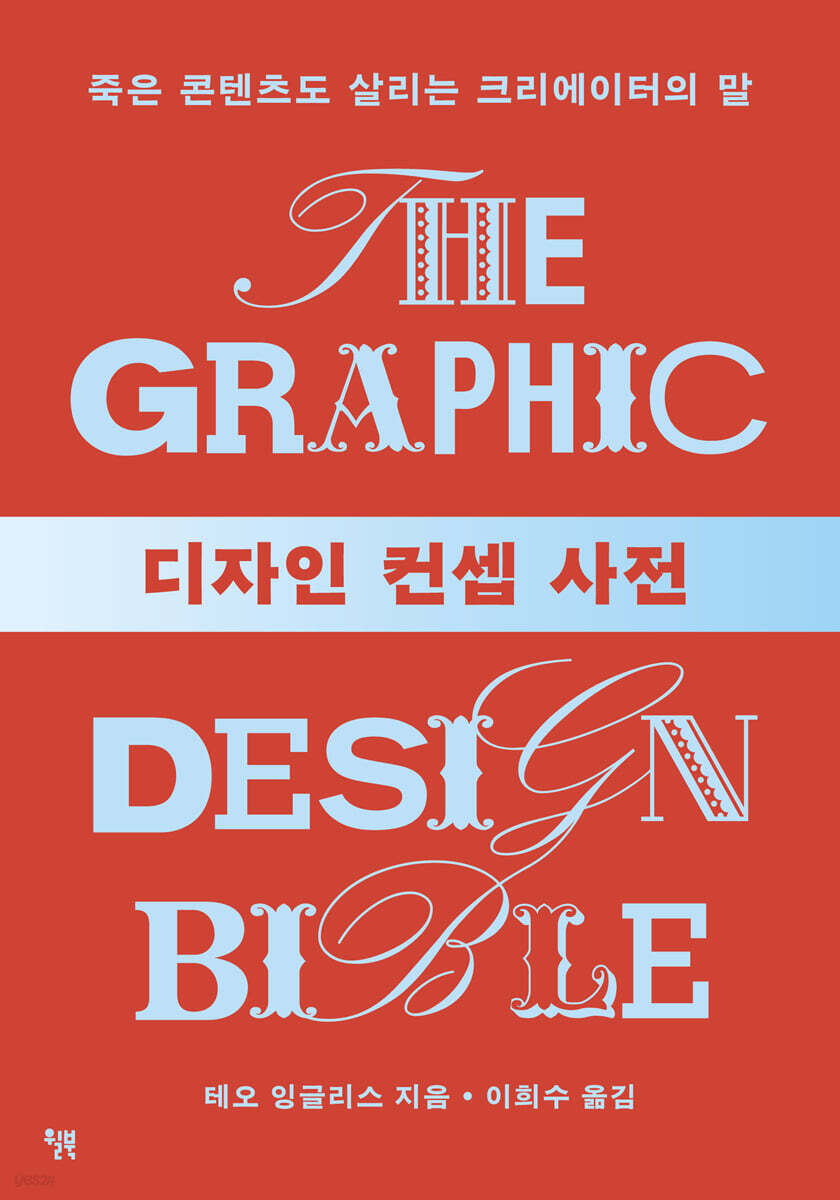 |
Description
Book Introduction
* In an age where sight is everything, those with sense survive.
* The minimum design vocabulary every creator should have
* “Turn off Pinterest and read this book.” Strong recommendations from veteran designers including Han Myeong-su (Chief Creative Officer, Baedal Minjok), Scheme on West (Senior Layout Artist, Disney/Pixar), and A-Hot (author of “Design Multiplication Table”)
“Graphic design works wherever there are words and images.”
For creators in an era where communication is based on images rather than words, aesthetic sense is essential.
To help you effectively communicate and showcase your ideas, I've carefully selected 82 core graphic design themes and organized them systematically for easy overview.
There are terms that sound familiar yet still vague: avant-garde and postmodernism, modernism and mid-century modern, art nouveau and art deco, retro and pastiche.
"Design Concept Dictionary" clearly introduces knowledge that is difficult to explain even though images vaguely come to mind, and it also provides useful materials for planning and idea sketching, along with abundant examples.
The Design Concept Dictionary also explores the journey of graphic design, from the artwork of ancient Greek and Roman stonemasons to the thumbnails of social media.
By closely examining the new styles and trends that emerged in each era, we expand our understanding of the cultural context and social function of design by penetrating and connecting the flow.
Anyone who wants to work creatively must thoroughly study the theory so that design becomes one with the content as a means of conveying ideas and adding perspective.
Design thinking skills are becoming increasingly important, especially as generative AI technology advances, enabling anyone to plan and execute content.
Author Theo Inglis, who has studied graphic design for a long time, studied art and design criticism at the Royal College of Art in London, served as chief designer at the prestigious literary magazine Granta, and also worked as a journalist specializing in design and visual culture.
We also interviewed designer Ken Garland, whose 1963 manifesto, "First Things First," became a moral compass for graphic designers everywhere.
Inglis compiled the experiences he had accumulated in academia and the field, and published the "Design Concept Dictionary" to organize the theory and practice of graphic design that has been developed sporadically over the past 150 years.
Myungsoo Han, Chief Creative Officer of Woowa Brothers and considered one of the first-generation web designers in Korea; Scheme on West, who worked as a senior layout artist at Disney and Pixar; and A-Hot, author of the best-selling book "Design Multiplication Table," recommend this book as an archive where creators can learn the basics of design and find refreshing inspiration.
This book will serve as a solid guide for anyone from students just starting out in graphic design to designers running out of ideas, planners collaborating with designers, evaluating content, and providing direction, to anyone seeking to develop their design sensibilities.
* The minimum design vocabulary every creator should have
* “Turn off Pinterest and read this book.” Strong recommendations from veteran designers including Han Myeong-su (Chief Creative Officer, Baedal Minjok), Scheme on West (Senior Layout Artist, Disney/Pixar), and A-Hot (author of “Design Multiplication Table”)
“Graphic design works wherever there are words and images.”
For creators in an era where communication is based on images rather than words, aesthetic sense is essential.
To help you effectively communicate and showcase your ideas, I've carefully selected 82 core graphic design themes and organized them systematically for easy overview.
There are terms that sound familiar yet still vague: avant-garde and postmodernism, modernism and mid-century modern, art nouveau and art deco, retro and pastiche.
"Design Concept Dictionary" clearly introduces knowledge that is difficult to explain even though images vaguely come to mind, and it also provides useful materials for planning and idea sketching, along with abundant examples.
The Design Concept Dictionary also explores the journey of graphic design, from the artwork of ancient Greek and Roman stonemasons to the thumbnails of social media.
By closely examining the new styles and trends that emerged in each era, we expand our understanding of the cultural context and social function of design by penetrating and connecting the flow.
Anyone who wants to work creatively must thoroughly study the theory so that design becomes one with the content as a means of conveying ideas and adding perspective.
Design thinking skills are becoming increasingly important, especially as generative AI technology advances, enabling anyone to plan and execute content.
Author Theo Inglis, who has studied graphic design for a long time, studied art and design criticism at the Royal College of Art in London, served as chief designer at the prestigious literary magazine Granta, and also worked as a journalist specializing in design and visual culture.
We also interviewed designer Ken Garland, whose 1963 manifesto, "First Things First," became a moral compass for graphic designers everywhere.
Inglis compiled the experiences he had accumulated in academia and the field, and published the "Design Concept Dictionary" to organize the theory and practice of graphic design that has been developed sporadically over the past 150 years.
Myungsoo Han, Chief Creative Officer of Woowa Brothers and considered one of the first-generation web designers in Korea; Scheme on West, who worked as a senior layout artist at Disney and Pixar; and A-Hot, author of the best-selling book "Design Multiplication Table," recommend this book as an archive where creators can learn the basics of design and find refreshing inspiration.
This book will serve as a solid guide for anyone from students just starting out in graphic design to designers running out of ideas, planners collaborating with designers, evaluating content, and providing direction, to anyone seeking to develop their design sensibilities.
- You can preview some of the book's contents.
Preview
index
introduction
Chapter 1 History
The Roots of Graphic Design
avant-garde
Bauhaus
New typography
Mid-Century Modern
Swiss style
Creative Revolution
design agency
Internationalist style
counterculture
Postmodernism
digital graphic design
Graphic design blackout
Chapter 2 Theory
Semiotics
aesthetics
Gestalt
color theory
logo
decoration
Default
Vernacular
propaganda
Design Politics
Professional ethics
gender
human race
sexuality
whole milk
Design and Art
Designer turned author
Chapter 3 Execution
grid
Hierarchy
proportion
style
Problem solving
Graphic wit
pictogram
visual language
Coincidence and accident
Illustration
picture
Art Direction
abstract
collage
Accessibility
Resistance and protests
environment
cliché
Retro
pastiche
Trompe l'oeil
Type that becomes an image
Chapter 4 Typography
Typography Terms
The Origins of Typography
Serif font
Sans serif font
display body
Script font
Non-Latin fonts
Lettering
Postmodern typography
digital typography
Psychology of Fonts
Chapter 5 Media
poster
advertisement
book cover
book
Editorial Design
Album cover
Brand Identity
packaging
Wayfinding and signage
Infographic
motion graphics
website
UI/UX design
social media
annotation
References
Photo credit
Acknowledgements
Chapter 1 History
The Roots of Graphic Design
avant-garde
Bauhaus
New typography
Mid-Century Modern
Swiss style
Creative Revolution
design agency
Internationalist style
counterculture
Postmodernism
digital graphic design
Graphic design blackout
Chapter 2 Theory
Semiotics
aesthetics
Gestalt
color theory
logo
decoration
Default
Vernacular
propaganda
Design Politics
Professional ethics
gender
human race
sexuality
whole milk
Design and Art
Designer turned author
Chapter 3 Execution
grid
Hierarchy
proportion
style
Problem solving
Graphic wit
pictogram
visual language
Coincidence and accident
Illustration
picture
Art Direction
abstract
collage
Accessibility
Resistance and protests
environment
cliché
Retro
pastiche
Trompe l'oeil
Type that becomes an image
Chapter 4 Typography
Typography Terms
The Origins of Typography
Serif font
Sans serif font
display body
Script font
Non-Latin fonts
Lettering
Postmodern typography
digital typography
Psychology of Fonts
Chapter 5 Media
poster
advertisement
book cover
book
Editorial Design
Album cover
Brand Identity
packaging
Wayfinding and signage
Infographic
motion graphics
website
UI/UX design
social media
annotation
References
Photo credit
Acknowledgements
Detailed image

Into the book
Creating good graphic design requires creativity and thinking skills.
This means that it is not just about using the eyes and hands, but also about capturing a person's soul, heart, reason, and tastes.
Advances in science and technology have made graphic design much faster and less labor-intensive than it was a few decades ago, so it's inevitable that some of the designer's work will be replaced by machines and left behind by human hands.
To become a designer who continues to create relevant, meaningful, and successful results, you need to learn to use your brain more than just master techniques.
To do that, you need to be able to penetrate ideas and theories and become adept at critical thinking.
---From the "Preface"
If we want to see more Black, Indigenous, and People of Color (BIPOC) individuals advance in the graphic design industry, having white people acting as gatekeepers isn't the best scenario.
Recently, voices calling for the 'decolonization' of graphic design itself have been growing louder.
This means that we must break away from the Western values and norms that have dominated the design field so far, centered on Europeans and white people.
In other words, rather than following a single correct answer or standard, the concept of graphic design itself must be reconstructed in a way that equally respects and reflects different cultural backgrounds and perspectives.
---From "Chapter 2 Theory│Race"
While graphic design can be rigidly disciplined, focusing on precision and logic, it also has a free and spontaneous side, striving to create something intriguing or complex rather than striving for perfection.
Inspiration can come from unexpected places, so designers are often called thieving magpies, soaking up ideas and visual stimuli like sponges as they wander the world around them.
---From "Chapter 3 Execution│Coincidence and Accident"
Lettering is somewhat related to typography, but is completely distinct from it.
This is because it involves creating new characters without using characters from an existing font.
The word lettering implies creating text to suit the needs of the design.
Many lettering artists are skilled in calligraphy, but lettering and calligraphy are two completely different disciplines.
If lettering is the art of 'drawing letters', calligraphy is the art of 'writing letters'.
In other words, calligraphy is something you can expect consistency from.
This is because the same hand writes the text using a writing instrument in one style from beginning to end.
Lettering, on the other hand, has no restrictions on the method or uniformity of creating letters.
Back in the day when all letters were created by hand, the term 'hand lettering' was used, but in the computer age, lettering is usually done digitally.
---From "Chapter 4 Typography│Lettering"
Advances in science and technology have brought about tremendous changes in record design.
The 12-inch LP sleeve gave way to the much smaller cassette tape and compact disc (CD), and later to digital thumbnails no bigger than a postage stamp.
With the internet and streaming services leading to a significant decline in record sales, album covers have become less important than they once were, while music videos have become increasingly important.
Still, album covers are important in setting the overall tone of an artist's music and can even serve as the foundation for cross-media marketing campaigns.
Often, the designs of smaller indie labels are the most interesting or innovative, and designers put a lot of effort into adding creative imagery to the music.
Music is not originally visual.
It is these very characteristics that provide the opportunity to take on interesting challenges and stay on the cutting edge of trends.
This means that it is not just about using the eyes and hands, but also about capturing a person's soul, heart, reason, and tastes.
Advances in science and technology have made graphic design much faster and less labor-intensive than it was a few decades ago, so it's inevitable that some of the designer's work will be replaced by machines and left behind by human hands.
To become a designer who continues to create relevant, meaningful, and successful results, you need to learn to use your brain more than just master techniques.
To do that, you need to be able to penetrate ideas and theories and become adept at critical thinking.
---From the "Preface"
If we want to see more Black, Indigenous, and People of Color (BIPOC) individuals advance in the graphic design industry, having white people acting as gatekeepers isn't the best scenario.
Recently, voices calling for the 'decolonization' of graphic design itself have been growing louder.
This means that we must break away from the Western values and norms that have dominated the design field so far, centered on Europeans and white people.
In other words, rather than following a single correct answer or standard, the concept of graphic design itself must be reconstructed in a way that equally respects and reflects different cultural backgrounds and perspectives.
---From "Chapter 2 Theory│Race"
While graphic design can be rigidly disciplined, focusing on precision and logic, it also has a free and spontaneous side, striving to create something intriguing or complex rather than striving for perfection.
Inspiration can come from unexpected places, so designers are often called thieving magpies, soaking up ideas and visual stimuli like sponges as they wander the world around them.
---From "Chapter 3 Execution│Coincidence and Accident"
Lettering is somewhat related to typography, but is completely distinct from it.
This is because it involves creating new characters without using characters from an existing font.
The word lettering implies creating text to suit the needs of the design.
Many lettering artists are skilled in calligraphy, but lettering and calligraphy are two completely different disciplines.
If lettering is the art of 'drawing letters', calligraphy is the art of 'writing letters'.
In other words, calligraphy is something you can expect consistency from.
This is because the same hand writes the text using a writing instrument in one style from beginning to end.
Lettering, on the other hand, has no restrictions on the method or uniformity of creating letters.
Back in the day when all letters were created by hand, the term 'hand lettering' was used, but in the computer age, lettering is usually done digitally.
---From "Chapter 4 Typography│Lettering"
Advances in science and technology have brought about tremendous changes in record design.
The 12-inch LP sleeve gave way to the much smaller cassette tape and compact disc (CD), and later to digital thumbnails no bigger than a postage stamp.
With the internet and streaming services leading to a significant decline in record sales, album covers have become less important than they once were, while music videos have become increasingly important.
Still, album covers are important in setting the overall tone of an artist's music and can even serve as the foundation for cross-media marketing campaigns.
Often, the designs of smaller indie labels are the most interesting or innovative, and designers put a lot of effort into adding creative imagery to the music.
Music is not originally visual.
It is these very characteristics that provide the opportunity to take on interesting challenges and stay on the cutting edge of trends.
---From "Chapter 5 Media│Album Cover"
Publisher's Review
Even dead content can be revived
82 themes woven together
Graphic Design Bible
"Design Concept Dictionary" is a book that provides a quick overview of graphic design, serves as a source of new inspiration, and helps you master the entire process from content planning to execution.
Graphic design has grown at a remarkably rapid pace since its emergence, transcending diverse fields and permeating every way we understand and express the world.
From the endless stream of advertising images flooding our social media feeds, to products with redesigned packaging, to algorithmically tailored thumbnails tailored to our tastes, graphic design is no longer confined to posters.
In an age where appearance has become everything, content can be said to be influenced by design sense.
Known in the UK and US as “a must-have book for every creator to keep on their bookshelf,” the Dictionary of Design Concepts emphasizes that design is not just a pretty decoration, but a means of conveying ideas.
This is especially important today, as advances in generative AI technology have dramatically reduced working hours and eliminated talent and technical limitations, while also raising concerns about bias, copyright infringement, and human replaceability.
In an era where everyone plans content, it's more important to be adept at critical thinking and have a thorough understanding of ideas and theories than to master techniques.
This book comprehensively covers the history, theory, and practice of graphic design, helping anyone who wants to work creatively to master the language of design.
Let's open this idea book that will awaken your tired soul and mind at this very moment.
I will show you the idea in my head in 1 second.
A design language that transforms sensation into reality
As the form of content becomes as important as its substance, design is no longer a technology confined to a specific field.
Visual communication is a core element of brand strategy and should be considered from the planning stage.
As design becomes central to communication across all fields, even non-experts need to possess a minimum level of design knowledge to communicate clearly.
The "Design Concept Dictionary" allows all creators to read together and communicate concretely the images that come to mind.
From avant-garde to Bauhaus, creative revolution, and vernacular, terms that sound familiar yet still vague are clearly explained.
Collaborating with designers or leveraging generative AI models will require designing appropriate prompts to achieve the desired results.
Let's say you ask for a clunky, crude, distracting, yet attractive thumbnail.
It would be quite difficult to achieve the desired result with only vague and abstract expressions.
Any planner or designer who reads this book will clearly convey their planning intent by using the precise word "vernacular" without any room for misunderstanding or confusion.
If you understand design concepts and theories, you will have a powerful communication tool at your disposal throughout the entire process, from content planning to execution.
If you want to explain why something is odd about a design, or if you want to present an opinion based on logic rather than just feeling, you need to start by honing your language.
After all, a person with sense is someone who can express his thoughts properly.
Design language is the most powerful weapon that can transform that feeling into reality.
From the ancient Greek and Roman stonemasonry art
From thumbnails on social media to
Everything about design at a glance
Design has always evolved with the times.
Theo Inglis meticulously examines the styles and trends that prevailed in each period, while also examining the cultural context and social function of design, interpreting it as a visual language that reflects the spirit of the times.
"Design Concept Dictionary" beautifully maps the vast world of graphic design, encompassing everything from classic sculptures to motion graphics and social media.
“Creativity and thinking skills are required to create good graphic design.
As he said, “It is not enough to just use your eyes and hands, but you have to capture a person’s soul, heart, reason, and taste,” now the ability to express your own sensibility is more important than flashy techniques.
Having design knowledge is not just a matter of expression; it also changes the depth and direction of your thinking.
Elegant Brothers? Han Myeong-su, Chief Creative Officer of Baedal Minjok and considered one of Korea's first-generation web designers, says, "If your mind is blank from learning AI tools, brainstorming ideas, and keeping up with trends, boldly turn off the dazzling Pinterest and Behance and browse the table of contents in the 'Design Concept Dictionary'," leading us by the hand.
Scheme on West, a former senior layout artist at Disney?Pixar, and A-Hot, author of the best-selling "Design Multiplication Table," recommend this book as an archive for creators to learn the fundamentals of design and find refreshing inspiration.
This book will serve as a solid guide for anyone from students just starting out in graphic design to designers running out of ideas, planners collaborating with designers, evaluating content, and providing direction, to anyone seeking to develop their design sensibilities.
82 themes woven together
Graphic Design Bible
"Design Concept Dictionary" is a book that provides a quick overview of graphic design, serves as a source of new inspiration, and helps you master the entire process from content planning to execution.
Graphic design has grown at a remarkably rapid pace since its emergence, transcending diverse fields and permeating every way we understand and express the world.
From the endless stream of advertising images flooding our social media feeds, to products with redesigned packaging, to algorithmically tailored thumbnails tailored to our tastes, graphic design is no longer confined to posters.
In an age where appearance has become everything, content can be said to be influenced by design sense.
Known in the UK and US as “a must-have book for every creator to keep on their bookshelf,” the Dictionary of Design Concepts emphasizes that design is not just a pretty decoration, but a means of conveying ideas.
This is especially important today, as advances in generative AI technology have dramatically reduced working hours and eliminated talent and technical limitations, while also raising concerns about bias, copyright infringement, and human replaceability.
In an era where everyone plans content, it's more important to be adept at critical thinking and have a thorough understanding of ideas and theories than to master techniques.
This book comprehensively covers the history, theory, and practice of graphic design, helping anyone who wants to work creatively to master the language of design.
Let's open this idea book that will awaken your tired soul and mind at this very moment.
I will show you the idea in my head in 1 second.
A design language that transforms sensation into reality
As the form of content becomes as important as its substance, design is no longer a technology confined to a specific field.
Visual communication is a core element of brand strategy and should be considered from the planning stage.
As design becomes central to communication across all fields, even non-experts need to possess a minimum level of design knowledge to communicate clearly.
The "Design Concept Dictionary" allows all creators to read together and communicate concretely the images that come to mind.
From avant-garde to Bauhaus, creative revolution, and vernacular, terms that sound familiar yet still vague are clearly explained.
Collaborating with designers or leveraging generative AI models will require designing appropriate prompts to achieve the desired results.
Let's say you ask for a clunky, crude, distracting, yet attractive thumbnail.
It would be quite difficult to achieve the desired result with only vague and abstract expressions.
Any planner or designer who reads this book will clearly convey their planning intent by using the precise word "vernacular" without any room for misunderstanding or confusion.
If you understand design concepts and theories, you will have a powerful communication tool at your disposal throughout the entire process, from content planning to execution.
If you want to explain why something is odd about a design, or if you want to present an opinion based on logic rather than just feeling, you need to start by honing your language.
After all, a person with sense is someone who can express his thoughts properly.
Design language is the most powerful weapon that can transform that feeling into reality.
From the ancient Greek and Roman stonemasonry art
From thumbnails on social media to
Everything about design at a glance
Design has always evolved with the times.
Theo Inglis meticulously examines the styles and trends that prevailed in each period, while also examining the cultural context and social function of design, interpreting it as a visual language that reflects the spirit of the times.
"Design Concept Dictionary" beautifully maps the vast world of graphic design, encompassing everything from classic sculptures to motion graphics and social media.
“Creativity and thinking skills are required to create good graphic design.
As he said, “It is not enough to just use your eyes and hands, but you have to capture a person’s soul, heart, reason, and taste,” now the ability to express your own sensibility is more important than flashy techniques.
Having design knowledge is not just a matter of expression; it also changes the depth and direction of your thinking.
Elegant Brothers? Han Myeong-su, Chief Creative Officer of Baedal Minjok and considered one of Korea's first-generation web designers, says, "If your mind is blank from learning AI tools, brainstorming ideas, and keeping up with trends, boldly turn off the dazzling Pinterest and Behance and browse the table of contents in the 'Design Concept Dictionary'," leading us by the hand.
Scheme on West, a former senior layout artist at Disney?Pixar, and A-Hot, author of the best-selling "Design Multiplication Table," recommend this book as an archive for creators to learn the fundamentals of design and find refreshing inspiration.
This book will serve as a solid guide for anyone from students just starting out in graphic design to designers running out of ideas, planners collaborating with designers, evaluating content, and providing direction, to anyone seeking to develop their design sensibilities.
GOODS SPECIFICS
- Date of issue: September 4, 2025
- Page count, weight, size: 488 pages | 1,068g | 154*220*32mm
- ISBN13: 9791155818503
- ISBN10: 1155818504
You may also like
카테고리
korean


korean

![GQ KOREA Mark (Monthly): December [2025]](http://librairie.coreenne.fr/cdn/shop/files/8ef265dbbfbf186523ed75ba7319009d.jpg?v=1765340328&width=3840)


