

Backyard Birding Club
 |
Description
Book Introduction
In 2016, Tan, 64, was overwhelmed by the reality of fake news and hate becoming the norm, and the country being more divided than ever.
To find solace and peace, she turned to nature.
I went to nature journal classes to learn how to draw, and attended birdwatching groups.
Then, he suddenly realizes that there are a lot of birds in his backyard, and decides to make it a bird paradise.
In other words, this book is a collection of 90 journal entries that Tan wrote while observing backyard birds for six years from 2017 to 2022, with some additional writing.
However, it is difficult to say that it is simply a collection of diaries.
The illustrations in the diary are no ordinary affair, but the 40 or so meticulously executed drawings demonstrate Tan's exceptional talent as an artist (and her deep interest in birds), making the book a work of art.
Meanwhile, this book, which he calls “a record of obsession,” is a piece of journalism that vividly demonstrates Tan’s boundless curiosity, childlike imagination, and tenacious investigative power.
It records the entire life cycle of birds, including their ecology, feeding, nesting, and mating, and discovers scientific facts that even professional birders and ornithologists are unaware of, but it is difficult to call it a science book.
Rather, it is reminiscent of a novel, as the renowned birder and author David Sibley writes in his introduction, “with a host of characters: a heretical hermit thrush, a comical toucan, and a small but brave hummingbird.”
Under the tutelage of mentors, including 13-year-old Fiona Gillogly, who is the very embodiment of "deliberate curiosity," Tan succeeds in literally "becoming a bird" and translating their lives into human language.
As this book demonstrates, all it took was a lot of love, attention, and a little (excessive) imagination.
To find solace and peace, she turned to nature.
I went to nature journal classes to learn how to draw, and attended birdwatching groups.
Then, he suddenly realizes that there are a lot of birds in his backyard, and decides to make it a bird paradise.
In other words, this book is a collection of 90 journal entries that Tan wrote while observing backyard birds for six years from 2017 to 2022, with some additional writing.
However, it is difficult to say that it is simply a collection of diaries.
The illustrations in the diary are no ordinary affair, but the 40 or so meticulously executed drawings demonstrate Tan's exceptional talent as an artist (and her deep interest in birds), making the book a work of art.
Meanwhile, this book, which he calls “a record of obsession,” is a piece of journalism that vividly demonstrates Tan’s boundless curiosity, childlike imagination, and tenacious investigative power.
It records the entire life cycle of birds, including their ecology, feeding, nesting, and mating, and discovers scientific facts that even professional birders and ornithologists are unaware of, but it is difficult to call it a science book.
Rather, it is reminiscent of a novel, as the renowned birder and author David Sibley writes in his introduction, “with a host of characters: a heretical hermit thrush, a comical toucan, and a small but brave hummingbird.”
Under the tutelage of mentors, including 13-year-old Fiona Gillogly, who is the very embodiment of "deliberate curiosity," Tan succeeds in literally "becoming a bird" and translating their lives into human language.
As this book demonstrates, all it took was a lot of love, attention, and a little (excessive) imagination.
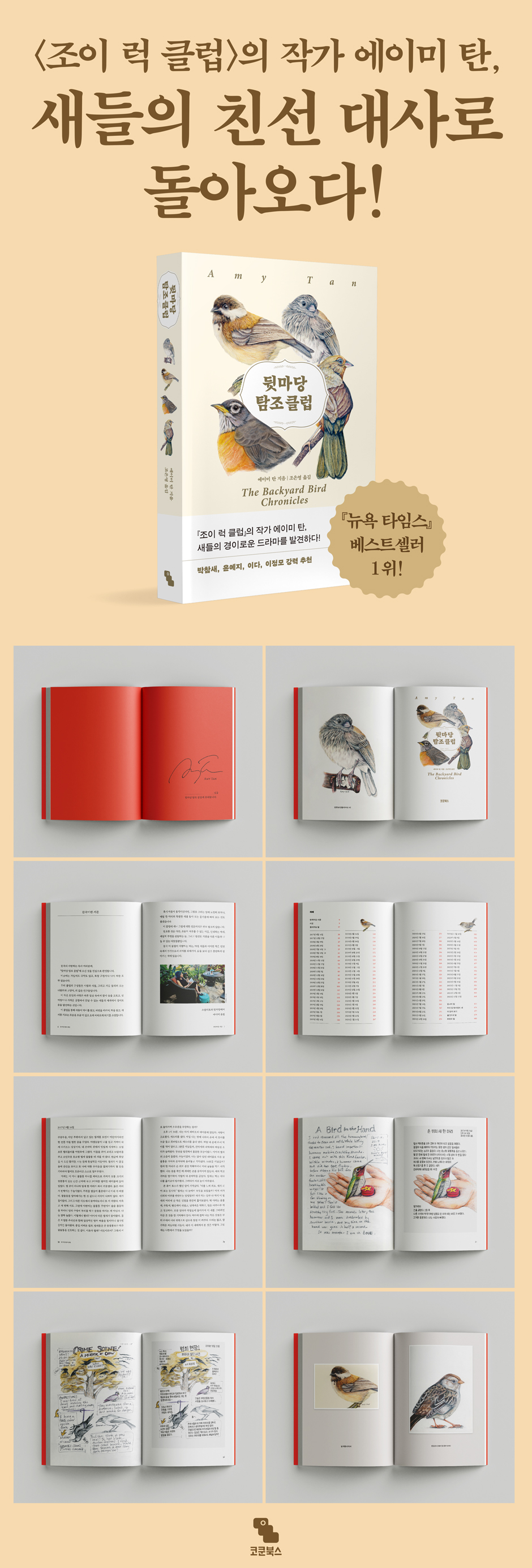
- You can preview some of the book's contents.
Preview
index
Preface to the Korean edition
introduction
Introduction
September 16, 2017
December 17, 2017
March 29, 2018
June 20, 2018
July 10, 2018 (1)
July 10, 2018 (2)
August 18, 2018
November 10, 2018
November 17, 2018
November 21, 2018
December 3, 2018
December 18, 2018
December 23, 2018
December 27, 2018
December 28, 2018
December 30, 2018
January 10, 2019
January 30, 2019
January 31, 2019
February 15, 2019
April 29, 2019
May 4, 2019
May 6, 2019
May 16, 2019
June 16, 2019
June 19, 2019
June 30, 2019
August 3, 2019
October 13, 2019
October 20, 2019
October 21, 2019
October 29, 2019
November 9, 2019
November 11, 2019
November 14, 2019
November 22, 2019
November 28, 2019
December 4, 2019
December 9, 2019
December 21, 2019
January 1, 2020
January 7, 2020
January 14, 2020
March 9, 2020
May 12, 2020
May 16, 2020
May 22, 2020
May 31, 2020
June 13, 2020
July 16, 2020
July 28, 2020
September 1, 2020
October 12, 2020
October 20, 2020
October 27, 2020
October 30, 2020
November 24, 2020
November 26, 2020
December 9, 2020
January 17, 2021
January 18, 2021
January 27, 2021
February 7, 2021
February 8, 2021
March 21, 2021
June 23, 2021
June 29, 2021
July 14, 2021
July 15, 2021
August 21, 2021
September 26, 2021
October 24, 2021
November 30, 2021
January 8, 2022
January 14, 2022
January 21, 2022
February 4, 2022
February 28, 2022
March 19, 2022
April 20, 2022
April 25, 2022
July 6, 2022
July 8, 2022
August 31, 2022
September 20, 2022
September 30, 2022
November 9, 2022
December 2, 2022
December 6, 2022
December 15, 2022
Acknowledgements
Birds in our backyard
Read more
Translator's Note
Recommendation
introduction
Introduction
September 16, 2017
December 17, 2017
March 29, 2018
June 20, 2018
July 10, 2018 (1)
July 10, 2018 (2)
August 18, 2018
November 10, 2018
November 17, 2018
November 21, 2018
December 3, 2018
December 18, 2018
December 23, 2018
December 27, 2018
December 28, 2018
December 30, 2018
January 10, 2019
January 30, 2019
January 31, 2019
February 15, 2019
April 29, 2019
May 4, 2019
May 6, 2019
May 16, 2019
June 16, 2019
June 19, 2019
June 30, 2019
August 3, 2019
October 13, 2019
October 20, 2019
October 21, 2019
October 29, 2019
November 9, 2019
November 11, 2019
November 14, 2019
November 22, 2019
November 28, 2019
December 4, 2019
December 9, 2019
December 21, 2019
January 1, 2020
January 7, 2020
January 14, 2020
March 9, 2020
May 12, 2020
May 16, 2020
May 22, 2020
May 31, 2020
June 13, 2020
July 16, 2020
July 28, 2020
September 1, 2020
October 12, 2020
October 20, 2020
October 27, 2020
October 30, 2020
November 24, 2020
November 26, 2020
December 9, 2020
January 17, 2021
January 18, 2021
January 27, 2021
February 7, 2021
February 8, 2021
March 21, 2021
June 23, 2021
June 29, 2021
July 14, 2021
July 15, 2021
August 21, 2021
September 26, 2021
October 24, 2021
November 30, 2021
January 8, 2022
January 14, 2022
January 21, 2022
February 4, 2022
February 28, 2022
March 19, 2022
April 20, 2022
April 25, 2022
July 6, 2022
July 8, 2022
August 31, 2022
September 20, 2022
September 30, 2022
November 9, 2022
December 2, 2022
December 6, 2022
December 15, 2022
Acknowledgements
Birds in our backyard
Read more
Translator's Note
Recommendation
Detailed image
Into the book
In a way, drawing a bird is like discovering a new bird that appears on the paper in front of you.
The work involves drawing and erasing lines and shapes, drawing curves, and sharpening or softening edges to discover the details that will recreate the essence of the bird.
And when you're done with that, a little piece of truth finally reveals itself before your eyes.
--- p.10
Sympathizing with birds is only the beginning of birdwatching.
A wise exploration mentor would say this:
“Yes, that is the name of the bird.
But what you really need to know is the bird itself.” Knowing the names of the characters and their abilities and personalities will reveal a new, infinitely expanding drama before us.
This book is about the process of truly getting to know birds, learning their stories and gaining a new understanding of the world through their relationships.
--- p.15
Since I can't drive, Lou always took me to the nature journal class and outdoor class location.
But classes were only held once a month.
If I only knew how to drive, I would have visited all the local parks, nature preserves, and bird “hot spots” that the eBird app suggested.
But a year later, I realized I could keep a nature journal even from very close quarters.
It was right behind our house.
--- p.29
If I were to sell this house to birds, I would advertise it as, "When it rains, the rain runs down the green roof, making a jingle bell sound, and the family can sit underneath it, sipping a drink and enjoying the view of San Francisco Bay."
--- p.30
The sketches and writings in the book are a record of my life.
It contains everything that has puzzled me, thrilled me, made me laugh, and made me sad.
They are like the scars on my knees that I hurt so badly when I was young; they are filled with rebellion and courage, curiosity and discovery, pain and the determination not to cry.
The words and illustrations in this book contain everything that changed me from the naive person who was curious and amazed when I saw a bird for the first time.
--- p.35
A minute later, the hummingbird flew to within a few centimeters of my face and looked me in the eye.
A gentle breeze blows from the flapping of wings.
There was no sign of fear in the guy.
Rather, I was the one who was worried, “Will that little sword stab my eye?”
Was he just naturally curious? Or was he trying to browbeat me into believing this honey pot was his? I don't know what he was thinking, but either way, he came back.
And he recognized me.
We became acquainted.
I am in love.
--- p.42
The American black-headed grouse is a very messy eater.
As it turns out, most of the birds in the swan family are lazy and unclean.
These birds, commonly known as finches, eat one seed and drop four of them on the ground.
I don't know the hidden truth behind this extravagance, but it made the blackbirds very happy.
How grateful we are to have food conveniently delivered to the ground.
Rats also join this floor cleaning crew, but they leave their own poop behind instead.
--- p.47
How bad is polluted air for wild birds?
I have a friend who keeps birds at home, and he said that his beloved parrot died immediately after inhaling smoke from the kitchen.
Are wild birds that sensitive? Could it be that somewhere, there are fields and forests teeming with beautiful birds, their lungs damaged by smoke, that have died? If the birds are truly leaving because of smoke, we're witnessing in real time how the environment can rapidly deplete bird populations.
--- p.75
I wonder if the crows mourn their dead comrades.
Judging by the fact that everyone has gathered from all over the place to pay their respects (or is it a gathering of violent groups seeking revenge), the crow doll must resemble a leader crow who was revered by the flock.
Or are they mourning the death of a fellow human being they've never met? Humans do.
I mourn for the victims of 9/11, for the young students killed in school shootings, for fictional characters who seem less real than fake crows.
--- p.96
Today, for some reason, a female hummingbird chased a male away from the honeydew pot on the porch and returned triumphantly.
The bird drank the honey water for over a minute.
In the afternoon, another female enjoyed a meal undisturbed from the honeydew pot on the patio.
Is it the same female? Or is a radical feminist movement finally emerging among hummingbirds? Or is this the beginning of breeding season? --- p.107
The bush magpies also dropped many good seeds on the ground.
Maybe it was a habit of burying it in the ground like an acorn.
It's not that it wasn't, but the sunflower seeds that fell to the ground sprouted, grew, bloomed, and produced seeds.
But before I could harvest the sunflower seeds, magpies swarmed in and ate the fresh seeds right from the flower heads.
If this isn't farming, what else could it be? Another lovely gesture.
--- p.115
The next day, finches were bustling back and forth on the patio and in the nearby bushes.
It seemed as if he was losing his mind due to the desperation to find food.
I was looking out the bathroom window when a few came up to the window and looked at me.
"That guy, did he fill his stomach on time?" A golden pheasant and a rarely seen purple pheasant knocked on the window with their beaks.
Are they knocking for me to hear? Their beaks seemed to be saying, "Give me some food."
--- p.124
If that bird really heard me and thought I was a challenger, then my ability to speak bird language isn't as bad as I thought.
No, maybe the birds also felt the insult I received when they were young and other people teased me by imitating my (Chinese) mother scolding me.
--- p.132
I already know from reading that California scrub jays store a huge amount of acorns.
According to one source, there are between 3,500 and 6,000 of them per year (who could have counted all those?).
Why do bush jays need to hide thousands of acorns? And why do they spend so much time invading our feeders instead of collecting them? --- p.238
The world was locked down because of COVID-19 and we were all forced to stay at home.
Everything around us—from grocery stores to doorknobs to the people around us—was a potential vector for disease and death.
But it's not a bird.
Birds are a healing balm and a comfort.
--- p.249
It is said that the size of a young crow is about 80 to 100 percent of the size of an adult.
The torso usually appears taller because its legs are straighter.
The chicks are easily distinguished by their shorter beaks, blue eyes, and pink lips.
And when it's their turn for their parents to pick their feathers or it's their turn to eat, they open their beaks wide and scream like a disobedient child, but the problem is that it's a daily occurrence.
It's amazing that such competitive and demanding birds grow up to be cooperative family members.
At what point will crows learn that they are not the center of the universe? --- p.271
I asked Bernd Heinrich if he knew why birds like finches throw away so many seeds.
As it turns out, he and other scientists had studied this issue in the 1990s.
He counted and measured each seed the birds had discarded, analyzing it with the same precision as always.
The short answer to my question is:
Songbirds prefer sunflower seeds that are relatively short, plump, and have shells because they have a higher oil content.
When these birds see a seed, they evaluate it in half a second and mercilessly discard the ones with lower density until they find the one they like.
It's not much different from tapping on the outside of a watermelon to pick out a delicious one.
--- p.301
In the past, we filled four bowls with mealworms, but it took a long time and was very expensive.
So, even though I reduce the bowl to one and fill it up as needed, I still get about 1,000 in a day.
I don't have children, so I save money to pay for mealworms.
If I had children, I would be paying for my grandchildren's college tuition by now.
So I can buy millions of mealworms.
--- p.313
There are many ways in which birds demonstrate their status.
If you film their behavior at high speed, you will see many signals that combine wing beats, head turns, eye contact, eyebrow and chest raises, and body posture changes.
I want to understand the language of birds.
Because I'm so curious about what they're gossiping about me among themselves.
--- p.332
Most art photographs or illustrations featuring hummingbirds always feature hummingbirds.
Because the water lilies are more colorful, sing, and put on an amazing show.
The less conspicuous female bird often receives little attention and is often ignored unless she is with her chicks in the nest.
From today onwards, I plan to draw a female hummingbird in detail.
I will think about what she does to ensure that her irresponsible husband's descendants survive.
--- p.386
I often remind myself that terms that describe human emotions like trust should not be used with birds, but anthropomorphism is a start to seeing birds from their perspective.
I'm analyzing the properties of human emotions to see if I can discover anything about them in bird behavior.
What about two baby geese sitting side by side, watching the downpour? Then, the male removed a tick from the female's feather.
Is that how birds express their love? Do humans express love better? Will my husband, Lou, pick out the lice in my scalp and eat them? --- p.397
What does play mean to birds? I first wondered this when I saw them swinging on a bird feeder stand.
It seemed like an act without any purpose at all.
At least that's what it looked like to me.
It wasn't looking for food or trying to attack anyone.
The behavior involved unstable states, balance, and repetitive movements.
When birds swing, do they feel like they're perched on a tree swaying in the wind? Are they trying to show off their skills? Do other birds have to watch their enjoyment? What about water slides? Is there something like this in nature? The birds that come to my yard can't swim, and they don't enter water of unknown depth.
So, did Tohi, who jumped into the pouring water without thinking, know that it was a shallow bathtub and that he could slide down it? --- p.410
I decided to inspect the birdhouse myself to find out what was causing the problem.
But as soon as I opened the door to the new house, a woodpecker flew away.
'Oh my! Who's living here?' I quickly counted three eggs with my eyes, closed the door, and came down.
I was worried that the bird might not come back.
The parents were clearly agitated.
He cursed repeatedly, “Chika-Chika-Chika,” and then disappeared into the fuchsia.
--- p.419
People often talk about how clever birds are.
So, is it too much of a stretch to say a bird can do what my dog often does? When Bobo wants to play, he taps my leg and runs toward the toy cabinet, stopping mid-run to make sure I understand and follow his commands.
Could it be something similar with the house owl? If a bird intentionally began interacting with humans, I think it's a smart bird.
If the bird keeps trying to communicate with you about a specific problem, such as filling its favorite feeder, then it is a genius.
--- p.440
The bush jay claims a kind of ownership over the tree.
That doesn't mean they build nests in trees.
The oak tree is simply one of the many waypoints they use in their daily routine of raiding and gathering acorns.
As it happens, Jack Gedney of Wild Bird Unlimited has covered this topic before.
To summarize roughly, it is as follows.
If we assume that a single bush jay burrows thousands of acorns somewhere each year, then over the past 140 years they have buried millions of acorns in our village.
The evidence is the numerous oak trees growing in our village.
So, according to the law of inheritance, these trees are owned by the bush jay.
--- p.441
I plan to start a new journal in January.
There, I intend to write more about what happens in the trees, as well as the ground where sparrows and quails live and build their nests.
I will go outside, sit on a low chair, and watch their activities on the ground.
We will see where sparrows and quails live and nest, and where quails hide.
To do that, you would have to hold your breath and freeze without making a sound.
If you stay still for more than an hour, you might freeze to death.
For the sake of beauty and the birds, I'd be willing to sacrifice that much.
The work involves drawing and erasing lines and shapes, drawing curves, and sharpening or softening edges to discover the details that will recreate the essence of the bird.
And when you're done with that, a little piece of truth finally reveals itself before your eyes.
--- p.10
Sympathizing with birds is only the beginning of birdwatching.
A wise exploration mentor would say this:
“Yes, that is the name of the bird.
But what you really need to know is the bird itself.” Knowing the names of the characters and their abilities and personalities will reveal a new, infinitely expanding drama before us.
This book is about the process of truly getting to know birds, learning their stories and gaining a new understanding of the world through their relationships.
--- p.15
Since I can't drive, Lou always took me to the nature journal class and outdoor class location.
But classes were only held once a month.
If I only knew how to drive, I would have visited all the local parks, nature preserves, and bird “hot spots” that the eBird app suggested.
But a year later, I realized I could keep a nature journal even from very close quarters.
It was right behind our house.
--- p.29
If I were to sell this house to birds, I would advertise it as, "When it rains, the rain runs down the green roof, making a jingle bell sound, and the family can sit underneath it, sipping a drink and enjoying the view of San Francisco Bay."
--- p.30
The sketches and writings in the book are a record of my life.
It contains everything that has puzzled me, thrilled me, made me laugh, and made me sad.
They are like the scars on my knees that I hurt so badly when I was young; they are filled with rebellion and courage, curiosity and discovery, pain and the determination not to cry.
The words and illustrations in this book contain everything that changed me from the naive person who was curious and amazed when I saw a bird for the first time.
--- p.35
A minute later, the hummingbird flew to within a few centimeters of my face and looked me in the eye.
A gentle breeze blows from the flapping of wings.
There was no sign of fear in the guy.
Rather, I was the one who was worried, “Will that little sword stab my eye?”
Was he just naturally curious? Or was he trying to browbeat me into believing this honey pot was his? I don't know what he was thinking, but either way, he came back.
And he recognized me.
We became acquainted.
I am in love.
--- p.42
The American black-headed grouse is a very messy eater.
As it turns out, most of the birds in the swan family are lazy and unclean.
These birds, commonly known as finches, eat one seed and drop four of them on the ground.
I don't know the hidden truth behind this extravagance, but it made the blackbirds very happy.
How grateful we are to have food conveniently delivered to the ground.
Rats also join this floor cleaning crew, but they leave their own poop behind instead.
--- p.47
How bad is polluted air for wild birds?
I have a friend who keeps birds at home, and he said that his beloved parrot died immediately after inhaling smoke from the kitchen.
Are wild birds that sensitive? Could it be that somewhere, there are fields and forests teeming with beautiful birds, their lungs damaged by smoke, that have died? If the birds are truly leaving because of smoke, we're witnessing in real time how the environment can rapidly deplete bird populations.
--- p.75
I wonder if the crows mourn their dead comrades.
Judging by the fact that everyone has gathered from all over the place to pay their respects (or is it a gathering of violent groups seeking revenge), the crow doll must resemble a leader crow who was revered by the flock.
Or are they mourning the death of a fellow human being they've never met? Humans do.
I mourn for the victims of 9/11, for the young students killed in school shootings, for fictional characters who seem less real than fake crows.
--- p.96
Today, for some reason, a female hummingbird chased a male away from the honeydew pot on the porch and returned triumphantly.
The bird drank the honey water for over a minute.
In the afternoon, another female enjoyed a meal undisturbed from the honeydew pot on the patio.
Is it the same female? Or is a radical feminist movement finally emerging among hummingbirds? Or is this the beginning of breeding season? --- p.107
The bush magpies also dropped many good seeds on the ground.
Maybe it was a habit of burying it in the ground like an acorn.
It's not that it wasn't, but the sunflower seeds that fell to the ground sprouted, grew, bloomed, and produced seeds.
But before I could harvest the sunflower seeds, magpies swarmed in and ate the fresh seeds right from the flower heads.
If this isn't farming, what else could it be? Another lovely gesture.
--- p.115
The next day, finches were bustling back and forth on the patio and in the nearby bushes.
It seemed as if he was losing his mind due to the desperation to find food.
I was looking out the bathroom window when a few came up to the window and looked at me.
"That guy, did he fill his stomach on time?" A golden pheasant and a rarely seen purple pheasant knocked on the window with their beaks.
Are they knocking for me to hear? Their beaks seemed to be saying, "Give me some food."
--- p.124
If that bird really heard me and thought I was a challenger, then my ability to speak bird language isn't as bad as I thought.
No, maybe the birds also felt the insult I received when they were young and other people teased me by imitating my (Chinese) mother scolding me.
--- p.132
I already know from reading that California scrub jays store a huge amount of acorns.
According to one source, there are between 3,500 and 6,000 of them per year (who could have counted all those?).
Why do bush jays need to hide thousands of acorns? And why do they spend so much time invading our feeders instead of collecting them? --- p.238
The world was locked down because of COVID-19 and we were all forced to stay at home.
Everything around us—from grocery stores to doorknobs to the people around us—was a potential vector for disease and death.
But it's not a bird.
Birds are a healing balm and a comfort.
--- p.249
It is said that the size of a young crow is about 80 to 100 percent of the size of an adult.
The torso usually appears taller because its legs are straighter.
The chicks are easily distinguished by their shorter beaks, blue eyes, and pink lips.
And when it's their turn for their parents to pick their feathers or it's their turn to eat, they open their beaks wide and scream like a disobedient child, but the problem is that it's a daily occurrence.
It's amazing that such competitive and demanding birds grow up to be cooperative family members.
At what point will crows learn that they are not the center of the universe? --- p.271
I asked Bernd Heinrich if he knew why birds like finches throw away so many seeds.
As it turns out, he and other scientists had studied this issue in the 1990s.
He counted and measured each seed the birds had discarded, analyzing it with the same precision as always.
The short answer to my question is:
Songbirds prefer sunflower seeds that are relatively short, plump, and have shells because they have a higher oil content.
When these birds see a seed, they evaluate it in half a second and mercilessly discard the ones with lower density until they find the one they like.
It's not much different from tapping on the outside of a watermelon to pick out a delicious one.
--- p.301
In the past, we filled four bowls with mealworms, but it took a long time and was very expensive.
So, even though I reduce the bowl to one and fill it up as needed, I still get about 1,000 in a day.
I don't have children, so I save money to pay for mealworms.
If I had children, I would be paying for my grandchildren's college tuition by now.
So I can buy millions of mealworms.
--- p.313
There are many ways in which birds demonstrate their status.
If you film their behavior at high speed, you will see many signals that combine wing beats, head turns, eye contact, eyebrow and chest raises, and body posture changes.
I want to understand the language of birds.
Because I'm so curious about what they're gossiping about me among themselves.
--- p.332
Most art photographs or illustrations featuring hummingbirds always feature hummingbirds.
Because the water lilies are more colorful, sing, and put on an amazing show.
The less conspicuous female bird often receives little attention and is often ignored unless she is with her chicks in the nest.
From today onwards, I plan to draw a female hummingbird in detail.
I will think about what she does to ensure that her irresponsible husband's descendants survive.
--- p.386
I often remind myself that terms that describe human emotions like trust should not be used with birds, but anthropomorphism is a start to seeing birds from their perspective.
I'm analyzing the properties of human emotions to see if I can discover anything about them in bird behavior.
What about two baby geese sitting side by side, watching the downpour? Then, the male removed a tick from the female's feather.
Is that how birds express their love? Do humans express love better? Will my husband, Lou, pick out the lice in my scalp and eat them? --- p.397
What does play mean to birds? I first wondered this when I saw them swinging on a bird feeder stand.
It seemed like an act without any purpose at all.
At least that's what it looked like to me.
It wasn't looking for food or trying to attack anyone.
The behavior involved unstable states, balance, and repetitive movements.
When birds swing, do they feel like they're perched on a tree swaying in the wind? Are they trying to show off their skills? Do other birds have to watch their enjoyment? What about water slides? Is there something like this in nature? The birds that come to my yard can't swim, and they don't enter water of unknown depth.
So, did Tohi, who jumped into the pouring water without thinking, know that it was a shallow bathtub and that he could slide down it? --- p.410
I decided to inspect the birdhouse myself to find out what was causing the problem.
But as soon as I opened the door to the new house, a woodpecker flew away.
'Oh my! Who's living here?' I quickly counted three eggs with my eyes, closed the door, and came down.
I was worried that the bird might not come back.
The parents were clearly agitated.
He cursed repeatedly, “Chika-Chika-Chika,” and then disappeared into the fuchsia.
--- p.419
People often talk about how clever birds are.
So, is it too much of a stretch to say a bird can do what my dog often does? When Bobo wants to play, he taps my leg and runs toward the toy cabinet, stopping mid-run to make sure I understand and follow his commands.
Could it be something similar with the house owl? If a bird intentionally began interacting with humans, I think it's a smart bird.
If the bird keeps trying to communicate with you about a specific problem, such as filling its favorite feeder, then it is a genius.
--- p.440
The bush jay claims a kind of ownership over the tree.
That doesn't mean they build nests in trees.
The oak tree is simply one of the many waypoints they use in their daily routine of raiding and gathering acorns.
As it happens, Jack Gedney of Wild Bird Unlimited has covered this topic before.
To summarize roughly, it is as follows.
If we assume that a single bush jay burrows thousands of acorns somewhere each year, then over the past 140 years they have buried millions of acorns in our village.
The evidence is the numerous oak trees growing in our village.
So, according to the law of inheritance, these trees are owned by the bush jay.
--- p.441
I plan to start a new journal in January.
There, I intend to write more about what happens in the trees, as well as the ground where sparrows and quails live and build their nests.
I will go outside, sit on a low chair, and watch their activities on the ground.
We will see where sparrows and quails live and nest, and where quails hide.
To do that, you would have to hold your breath and freeze without making a sound.
If you stay still for more than an hour, you might freeze to death.
For the sake of beauty and the birds, I'd be willing to sacrifice that much.
--- p.465
Publisher's Review
Amy Tan, author of The Joy Luck Club,
Discover the wondrous drama of birds!
Park Cham-sae, Yoon Ye-ji, Lee Da, and Lee Jeong-mo strongly recommend!
Novelist Amy Tan returns as a goodwill ambassador for birds.
Amy Tan is a well-known novelist in Korea, known for her 1989 novel The Joy Luck Club and the film of the same name.
The Joy Luck Club was a huge success not only in the United States but also around the world, making Tan's name known to the world.
Surprisingly, this novel was her debut.
Although he has released many works since then, they have generally not received as much acclaim as his first work.
Now in Korea, Amy Tan has become a person of the past known only to the generation that remembers the famous novel and movie.
Amy Tan, who had been quiet for a while, published an unexpected book in 2024.
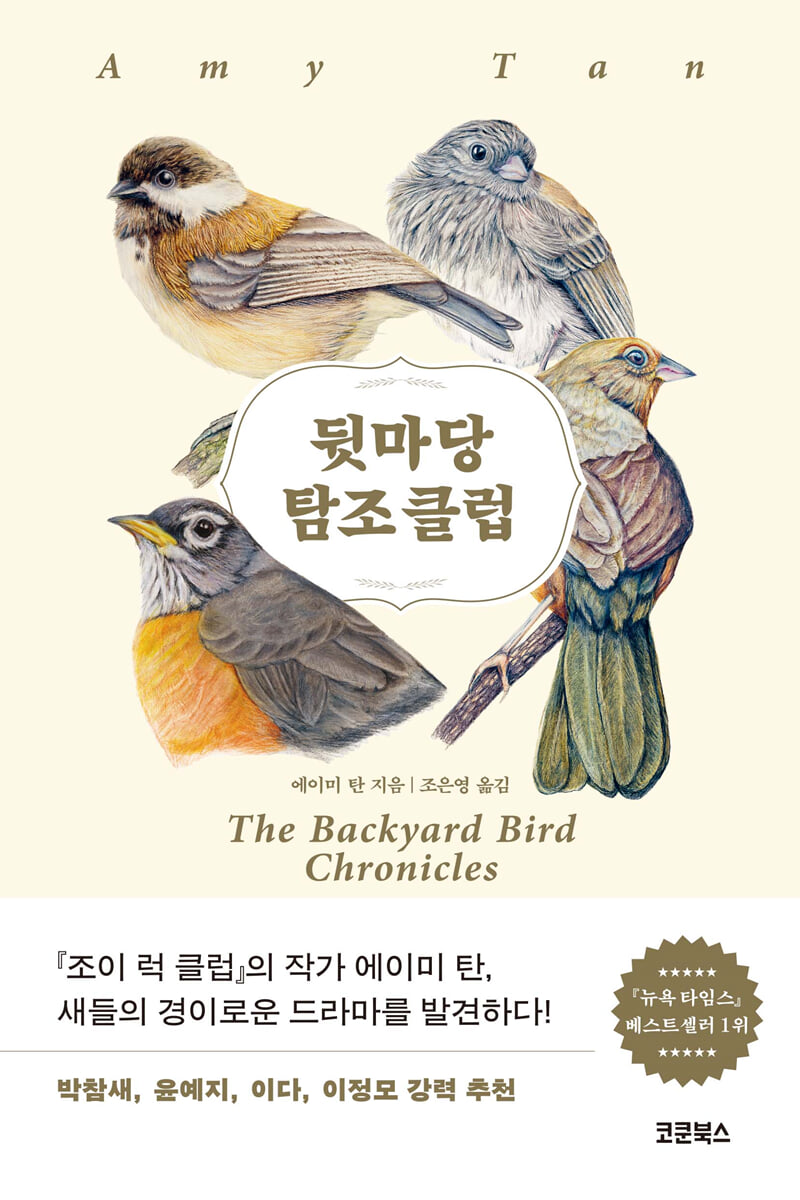
The Backyard Bird Chronicles, the Korean title is 『Backyard Birding Club』.
As the title suggests, this book tells the story of the birds Amy Tan observed in her backyard over six years.
It reached number one on the New York Times bestseller list immediately after publication and remained on the list for 54 weeks.
This book has sold 350,000 copies in the United States alone, reaffirming Tan's reputation.
This time, not only as a brilliant novelist, but as, as the Boston Globe put it, “an incredibly charming ambassador for birds.”
The wondrous drama of birds, captured in over 130 paintings.
In 2016, Tan, 64, was overwhelmed by the reality of fake news and hate becoming the norm, and the country being more divided than ever.
To find solace and peace, she turned to nature.
I went to nature journal classes to learn how to draw, and attended birdwatching groups.
Then, he suddenly realizes that there are a lot of birds in his backyard, and decides to make it a bird paradise.
In other words, this book is a collection of 90 journal entries that Tan wrote while observing backyard birds for six years from 2017 to 2022, with some additional writing.
However, it is difficult to say that it is simply a collection of diaries.
The illustrations in the diary are no ordinary affair, but the 40 or so meticulously executed drawings demonstrate Tan's exceptional talent as an artist (and her deep interest in birds), making the book a work of art.
Meanwhile, this book, which he calls “a record of obsession,” is a piece of journalism that vividly demonstrates Tan’s boundless curiosity, childlike imagination, and tenacious investigative power.
It records the entire life cycle of birds, including their ecology, feeding, nesting, and mating, and discovers scientific facts that even professional birders and ornithologists are unaware of, but it is difficult to call it a science book.
Rather, it is reminiscent of a novel, as the renowned birder and author David Sibley writes in his introduction, “with a host of characters: a heretical hermit thrush, a comical toucan, and a small but brave hummingbird.”
Under the tutelage of mentors, including 13-year-old Fiona Gillogly, who is the very embodiment of "deliberate curiosity," Tan literally "becomes a bird" and succeeds in translating their lives into human language.
As this book demonstrates, all it took was a lot of love, attention, and a little (excessive) imagination.
Exploration becomes a trend.
According to a 2011 report by the U.S. Fish and Wildlife Service, more than 46 million Americans (20% of the population) enjoy birdwatching.
There are a staggering 660,000 birdwatching-related jobs, with an economic impact of $40 trillion.
Birding is one of the most active citizen science activities in North America, with Christmas birding, particularly in Canada and the United States, breaking records each year.
The most recent 124th Christmas Birdwatch, which ran from December 14, 2023, to January 5, 2024, saw 83,186 participants and 40,871,030 birds observed.
They are doing what scientists dare not do.
In Korea, the Seoul area birdwatching group 'Birds of Seoul' began Christmas birdwatching in 2018 and began collecting observation records in 2019.
The observation results are currently available on the website Natureling (www.naturing.net).
In other words, the popularity of birdwatching has been steadily rising in Korea, even during the COVID-19 period.
Birdwatching groups are springing up in every region and neighborhood, and even at this very moment, there are birdwatchers somewhere, desperately trying to capture unidentified species. Birdwatching influencers are active on social media, and there are quite a few celebrities who call themselves birdwatchers, like actress Kim Tae-ri and novelist Jeong Se-rang.
This is the background to the recent trend of birdwatching becoming popular among the younger generation as a hobby that allows them to quietly commune with nature without harming anyone.
How to look at living beings again
Bird watching usually means going outdoors to observe the ecology and habitats of birds.
Anyone who has ever visited a bird-rich area, such as a migratory bird sanctuary, has likely seen someone observing and recording birds with binoculars or a large camera lens.
It's not an easy activity for someone like Amy Tan, who hates crowds and doesn't have a license.
Perhaps that is why the exploration culture is changing little by little these days.
There are many people who go for a walk in a nearby mountain, park, or arboretum, listen to the sounds of birds, guess the species, try to lure birds to land on their hands with food, or write down the birds they observe in a journal.
This means that rather than focusing on taking pictures of birds (with a camera), there are more and more birders who, like Tan, want to “feel the birds, become the birds” and understand them more deeply.
As former director of the National Science Museum in Gwacheon, Lee Jeong-mo, wrote in his recommendation, the core theme that runs through this book is “how to see life.”
“It is easy to say that you love nature, but it is difficult to respect and look at nature.
In order to capture the feeling of 'seeing' in the quickly passing time, you must slow down and lower your gaze.
In this slow time, Amy Tan learns to care for her ailing body, calm her distracted mind, and look at herself again.
…This book holds special meaning for Korean readers, who live in a society that moves exceptionally fast, plans without rest, and is increasingly disconnected from nature.
Birds still fly in our sky, and unknown birds fly into the trees in our yard.
"Backyard Birding Club" proposes a new way of life, the life of an observer, that begins with the curiosity to not just pass by a bird but to ask, "What could it be?"
… This book is not about birds, but about how to look at living beings again.”
When you truly see birds again, everything that affects their lives takes on meaning and context.
By knowing birds, you come to know rain, wind, insects, and frogs. By watching birds, you come to see plants, and you come to remember the forests, fields, and tidal flats that each bird prefers.
And I think about dinosaurs (the ancestors of birds), the Ice Age, ocean currents, continental drift, evolution, and geography.
I find myself standing in it and discovering a new side of myself.
If it's a witty new book (Birds as Windows to Life!!!), it's even better, and if it's written by the great Amy Tan, it's even better.
It will be the perfect antidote to all the harmful things of the past years.
- Lit Hub, “The Most Anticipated Books of 2024”
Let's put this book into the hands of children.
You will definitely be loved.
- Sarah Beth West, Shelf Awareness
A nature lover's ode to birds.
- 『Kirkus Review』
Discover the wondrous drama of birds!
Park Cham-sae, Yoon Ye-ji, Lee Da, and Lee Jeong-mo strongly recommend!
Novelist Amy Tan returns as a goodwill ambassador for birds.
Amy Tan is a well-known novelist in Korea, known for her 1989 novel The Joy Luck Club and the film of the same name.
The Joy Luck Club was a huge success not only in the United States but also around the world, making Tan's name known to the world.
Surprisingly, this novel was her debut.
Although he has released many works since then, they have generally not received as much acclaim as his first work.
Now in Korea, Amy Tan has become a person of the past known only to the generation that remembers the famous novel and movie.
Amy Tan, who had been quiet for a while, published an unexpected book in 2024.
The Backyard Bird Chronicles, the Korean title is 『Backyard Birding Club』.
As the title suggests, this book tells the story of the birds Amy Tan observed in her backyard over six years.
It reached number one on the New York Times bestseller list immediately after publication and remained on the list for 54 weeks.
This book has sold 350,000 copies in the United States alone, reaffirming Tan's reputation.
This time, not only as a brilliant novelist, but as, as the Boston Globe put it, “an incredibly charming ambassador for birds.”
The wondrous drama of birds, captured in over 130 paintings.
In 2016, Tan, 64, was overwhelmed by the reality of fake news and hate becoming the norm, and the country being more divided than ever.
To find solace and peace, she turned to nature.
I went to nature journal classes to learn how to draw, and attended birdwatching groups.
Then, he suddenly realizes that there are a lot of birds in his backyard, and decides to make it a bird paradise.
In other words, this book is a collection of 90 journal entries that Tan wrote while observing backyard birds for six years from 2017 to 2022, with some additional writing.
However, it is difficult to say that it is simply a collection of diaries.
The illustrations in the diary are no ordinary affair, but the 40 or so meticulously executed drawings demonstrate Tan's exceptional talent as an artist (and her deep interest in birds), making the book a work of art.
Meanwhile, this book, which he calls “a record of obsession,” is a piece of journalism that vividly demonstrates Tan’s boundless curiosity, childlike imagination, and tenacious investigative power.
It records the entire life cycle of birds, including their ecology, feeding, nesting, and mating, and discovers scientific facts that even professional birders and ornithologists are unaware of, but it is difficult to call it a science book.
Rather, it is reminiscent of a novel, as the renowned birder and author David Sibley writes in his introduction, “with a host of characters: a heretical hermit thrush, a comical toucan, and a small but brave hummingbird.”
Under the tutelage of mentors, including 13-year-old Fiona Gillogly, who is the very embodiment of "deliberate curiosity," Tan literally "becomes a bird" and succeeds in translating their lives into human language.
As this book demonstrates, all it took was a lot of love, attention, and a little (excessive) imagination.
Exploration becomes a trend.
According to a 2011 report by the U.S. Fish and Wildlife Service, more than 46 million Americans (20% of the population) enjoy birdwatching.
There are a staggering 660,000 birdwatching-related jobs, with an economic impact of $40 trillion.
Birding is one of the most active citizen science activities in North America, with Christmas birding, particularly in Canada and the United States, breaking records each year.
The most recent 124th Christmas Birdwatch, which ran from December 14, 2023, to January 5, 2024, saw 83,186 participants and 40,871,030 birds observed.
They are doing what scientists dare not do.
In Korea, the Seoul area birdwatching group 'Birds of Seoul' began Christmas birdwatching in 2018 and began collecting observation records in 2019.
The observation results are currently available on the website Natureling (www.naturing.net).
In other words, the popularity of birdwatching has been steadily rising in Korea, even during the COVID-19 period.
Birdwatching groups are springing up in every region and neighborhood, and even at this very moment, there are birdwatchers somewhere, desperately trying to capture unidentified species. Birdwatching influencers are active on social media, and there are quite a few celebrities who call themselves birdwatchers, like actress Kim Tae-ri and novelist Jeong Se-rang.
This is the background to the recent trend of birdwatching becoming popular among the younger generation as a hobby that allows them to quietly commune with nature without harming anyone.
How to look at living beings again
Bird watching usually means going outdoors to observe the ecology and habitats of birds.
Anyone who has ever visited a bird-rich area, such as a migratory bird sanctuary, has likely seen someone observing and recording birds with binoculars or a large camera lens.
It's not an easy activity for someone like Amy Tan, who hates crowds and doesn't have a license.
Perhaps that is why the exploration culture is changing little by little these days.
There are many people who go for a walk in a nearby mountain, park, or arboretum, listen to the sounds of birds, guess the species, try to lure birds to land on their hands with food, or write down the birds they observe in a journal.
This means that rather than focusing on taking pictures of birds (with a camera), there are more and more birders who, like Tan, want to “feel the birds, become the birds” and understand them more deeply.
As former director of the National Science Museum in Gwacheon, Lee Jeong-mo, wrote in his recommendation, the core theme that runs through this book is “how to see life.”
“It is easy to say that you love nature, but it is difficult to respect and look at nature.
In order to capture the feeling of 'seeing' in the quickly passing time, you must slow down and lower your gaze.
In this slow time, Amy Tan learns to care for her ailing body, calm her distracted mind, and look at herself again.
…This book holds special meaning for Korean readers, who live in a society that moves exceptionally fast, plans without rest, and is increasingly disconnected from nature.
Birds still fly in our sky, and unknown birds fly into the trees in our yard.
"Backyard Birding Club" proposes a new way of life, the life of an observer, that begins with the curiosity to not just pass by a bird but to ask, "What could it be?"
… This book is not about birds, but about how to look at living beings again.”
When you truly see birds again, everything that affects their lives takes on meaning and context.
By knowing birds, you come to know rain, wind, insects, and frogs. By watching birds, you come to see plants, and you come to remember the forests, fields, and tidal flats that each bird prefers.
And I think about dinosaurs (the ancestors of birds), the Ice Age, ocean currents, continental drift, evolution, and geography.
I find myself standing in it and discovering a new side of myself.
If it's a witty new book (Birds as Windows to Life!!!), it's even better, and if it's written by the great Amy Tan, it's even better.
It will be the perfect antidote to all the harmful things of the past years.
- Lit Hub, “The Most Anticipated Books of 2024”
Let's put this book into the hands of children.
You will definitely be loved.
- Sarah Beth West, Shelf Awareness
A nature lover's ode to birds.
- 『Kirkus Review』
GOODS SPECIFICS
- Date of issue: June 5, 2025
- Page count, weight, size: 500 pages | 762g | 140*205*28mm
- ISBN13: 9791197831799
- ISBN10: 1197831797
You may also like
카테고리
korean


korean

![GQ KOREA Mark (Monthly): December [2025]](http://librairie.coreenne.fr/cdn/shop/files/8ef265dbbfbf186523ed75ba7319009d.jpg?v=1765340328&width=3840)


