

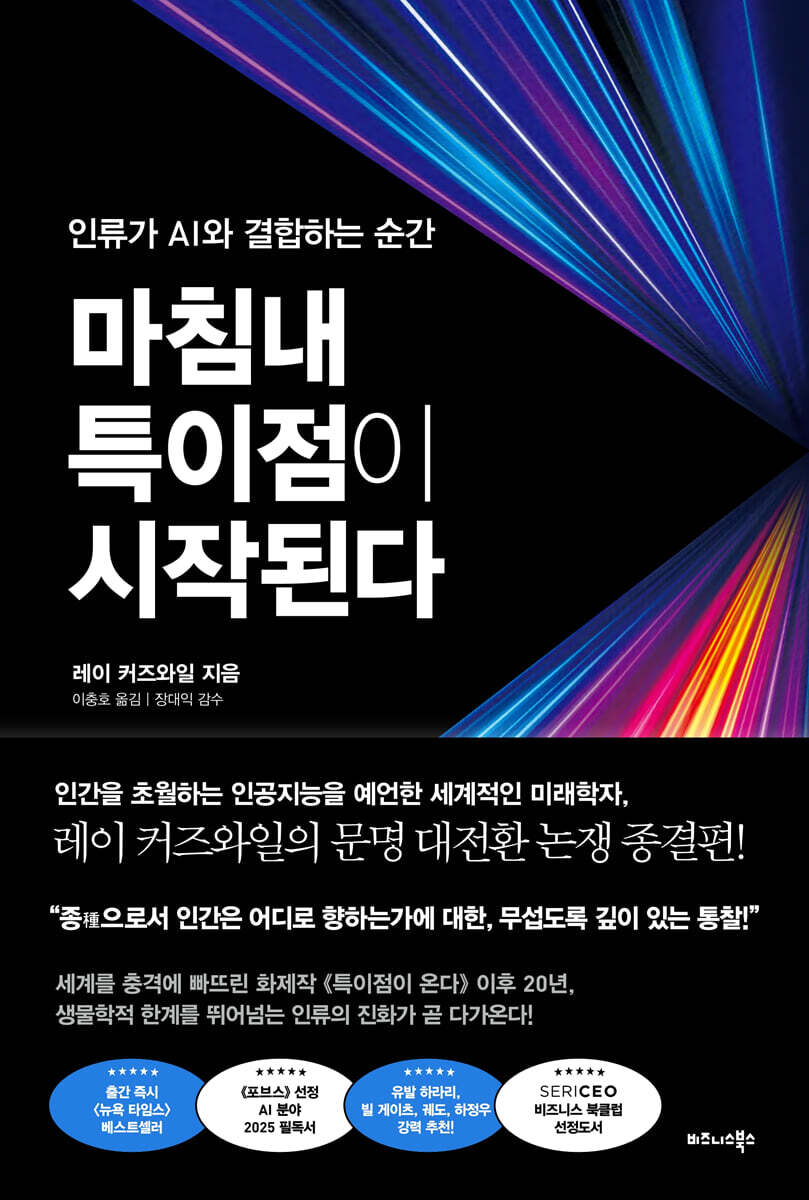
The singularity finally begins
 |
Description
Book Introduction
- A word from MD
-
A whole new world awaits in 20 years.Ray Kurzweil predicted the advent of AI in “The Singularity is Near.”
In this new work, he explains the singularity in more detail.
Humans will become living beings with AI embedded in their bodies.
In a future driven by computer science, neuroscience, and biotechnology, humans will become wiser and live longer.
June 20, 2025. Natural Science PD Son Min-gyu
A world-renowned futurist who predicted artificial intelligence that surpasses humans.
Ray Kurzweil's 20-year-old singularity debate concludes!
Highly recommended by Yuval Harari, Bill Gates, Orbit, and Ha Jung-woo!
An instant New York Times bestseller!
[Forbes] Must-read book of the year!
Ray Kurzweil's long-awaited new book, "The Singularity Has Begun," has finally been published. Amidst the astonishing progress in AI that continues to astonish the world, this book, which became an instant bestseller, reassesses his predictions, which have already become reality today, while presenting various examples of progress toward the "singularity," which will forever change human life.
When he first mentioned artificial intelligence that would surpass human intelligence in his 1990 book, “The Age of Intelligent Machines,” and when he predicted that AI would eventually become conscious in his 1999 book, “Homo Sapiens in the 21st Century,” most scholars estimated that it would take at least 100 years for his claims to come true.
At the time, AI was an unknown future for the public.
But now that artificial intelligence is driving nearly every change in the world, there is a movement to re-evaluate Kurzweil's singularity prediction, led by Silicon Valley Big Tech leaders like Jensen Huang and Elon Musk.
This book covers a wide range of topics, including extending lifespan by augmenting physical functions and overcoming biological limitations, connecting the brain to the cloud to realize a future where cognitive abilities are multiplied millions of times, how exponentially developing technology solves social problems, the impact of artificial intelligence on employment, labor, and wealth, and even philosophical debates about AI ethics. It also meticulously poses questions that humanity must face in this era of change.
Who am I, and what is consciousness? How far can human intelligence expand when combined with AI? How should we envision the future of humanity, a species transformed by this? As the prospect of humanity transcending biological limitations and endlessly evolving becomes increasingly real, this book offers the best insights for preparing for the world to come.
“The singularity is approaching.
“near the singularity; unclear which side.”
- Sam Altman, CEO of OpenAI
“We are on the event horizon of the singularity.”
- Elon Musk, Tesla CEO
Ray Kurzweil's 20-year-old singularity debate concludes!
Highly recommended by Yuval Harari, Bill Gates, Orbit, and Ha Jung-woo!
An instant New York Times bestseller!
[Forbes] Must-read book of the year!
Ray Kurzweil's long-awaited new book, "The Singularity Has Begun," has finally been published. Amidst the astonishing progress in AI that continues to astonish the world, this book, which became an instant bestseller, reassesses his predictions, which have already become reality today, while presenting various examples of progress toward the "singularity," which will forever change human life.
When he first mentioned artificial intelligence that would surpass human intelligence in his 1990 book, “The Age of Intelligent Machines,” and when he predicted that AI would eventually become conscious in his 1999 book, “Homo Sapiens in the 21st Century,” most scholars estimated that it would take at least 100 years for his claims to come true.
At the time, AI was an unknown future for the public.
But now that artificial intelligence is driving nearly every change in the world, there is a movement to re-evaluate Kurzweil's singularity prediction, led by Silicon Valley Big Tech leaders like Jensen Huang and Elon Musk.
This book covers a wide range of topics, including extending lifespan by augmenting physical functions and overcoming biological limitations, connecting the brain to the cloud to realize a future where cognitive abilities are multiplied millions of times, how exponentially developing technology solves social problems, the impact of artificial intelligence on employment, labor, and wealth, and even philosophical debates about AI ethics. It also meticulously poses questions that humanity must face in this era of change.
Who am I, and what is consciousness? How far can human intelligence expand when combined with AI? How should we envision the future of humanity, a species transformed by this? As the prospect of humanity transcending biological limitations and endlessly evolving becomes increasingly real, this book offers the best insights for preparing for the world to come.
“The singularity is approaching.
“near the singularity; unclear which side.”
- Sam Altman, CEO of OpenAI
“We are on the event horizon of the singularity.”
- Elon Musk, Tesla CEO
- You can preview some of the book's contents.
Preview
index
Reviewer's note
preface
Chapter 1: Where Are We in the Six Stages?
Chapter 2: Reinventing Intelligence
What does reinventing intelligence mean? | The birth of AI | The cerebellum: A modular architecture | The neocortex: A self-modifying, hierarchical, and flexible structure | Deep learning: Reproducing the capabilities of the neocortex | What is still needed for AI? | Passing the Turing Test | Scaling the neocortex to the cloud
Chapter 3 Who am I?
What is consciousness? | Zombies, qualia, and the difficult problem of consciousness | Determinism, emergence, and the free will dilemma | Can there be multiple brains with free will? | Is a conscious 'second self' really me? | A near-impossible being | Afterlife | What kind of person can I become?
Chapter 4: Life is Improving Exponentially
Why public opinion differs from the actual statistics | Technology has actually improved almost every aspect of life | Literacy and education | Access to flush toilets, electricity, radio, television, and computers | Life expectancy | Poverty reduction and income growth | Violence reduction | Growth of renewable energy | Spread of democracy | We are now entering a steep phase of exponential growth | Approaching the complete replacement of fossil fuels | Clean water for all | Vertical farming and land liberation | 3D printing to revolutionize manufacturing and distribution | 3D-printed buildings | We will reach escape velocity in lifespan by 2030 | The tide is rising sharply
Chapter 5 The Future of Jobs: Good or Bad?
The Current Revolution | Destruction and Creation | Will This Time Be Different? | So Where Are We Going?
Chapter 6: Health and Well-being in the Next 30 Years
The 2020s: The Convergence of AI and Biotechnology | The 2030s and 2040s: The Development and Perfection of Nanotechnology | Nanotechnology Applications for Health and Longevity
Chapter 7 Risk
Promise and Peril | Nuclear Weapons | Biotechnology | Nanotechnology | Artificial Intelligence
Chapter 8: A Conversation with Cassandra
Acknowledgements
Appendix: Price-Performance of Calculations, 1939–2023
main
Search
preface
Chapter 1: Where Are We in the Six Stages?
Chapter 2: Reinventing Intelligence
What does reinventing intelligence mean? | The birth of AI | The cerebellum: A modular architecture | The neocortex: A self-modifying, hierarchical, and flexible structure | Deep learning: Reproducing the capabilities of the neocortex | What is still needed for AI? | Passing the Turing Test | Scaling the neocortex to the cloud
Chapter 3 Who am I?
What is consciousness? | Zombies, qualia, and the difficult problem of consciousness | Determinism, emergence, and the free will dilemma | Can there be multiple brains with free will? | Is a conscious 'second self' really me? | A near-impossible being | Afterlife | What kind of person can I become?
Chapter 4: Life is Improving Exponentially
Why public opinion differs from the actual statistics | Technology has actually improved almost every aspect of life | Literacy and education | Access to flush toilets, electricity, radio, television, and computers | Life expectancy | Poverty reduction and income growth | Violence reduction | Growth of renewable energy | Spread of democracy | We are now entering a steep phase of exponential growth | Approaching the complete replacement of fossil fuels | Clean water for all | Vertical farming and land liberation | 3D printing to revolutionize manufacturing and distribution | 3D-printed buildings | We will reach escape velocity in lifespan by 2030 | The tide is rising sharply
Chapter 5 The Future of Jobs: Good or Bad?
The Current Revolution | Destruction and Creation | Will This Time Be Different? | So Where Are We Going?
Chapter 6: Health and Well-being in the Next 30 Years
The 2020s: The Convergence of AI and Biotechnology | The 2030s and 2040s: The Development and Perfection of Nanotechnology | Nanotechnology Applications for Health and Longevity
Chapter 7 Risk
Promise and Peril | Nuclear Weapons | Biotechnology | Nanotechnology | Artificial Intelligence
Chapter 8: A Conversation with Cassandra
Acknowledgements
Appendix: Price-Performance of Calculations, 1939–2023
main
Search
Detailed image
.jpg)
Into the book
“In the 2030s, autonomous AI and nanotechnology will advance, integrating humans and machines to unprecedented levels, while simultaneously raising expectations and risks.
If we respond effectively to the scientific, ethical, social, and political challenges these developments pose, life on Earth will be dramatically changed for the better by 2045.
Conversely, if we fail, our very survival may be at risk.
So this book deals with our ultimate approach to singularities.
That is, it deals with the opportunities and dangers we must face together as the last generation of the world we know.” --- From the “Preface”
Humanity now lives in the fourth era, where advanced technologies are already producing results that surpass our comprehension in some tasks. Accelerated progress is also occurring in many aspects of the Turing Test that AI has yet to fully master.
We will enter the fifth era at the very moment when the Turing Test is passed, which I predict will be in 2029.
One key capability that will be perfected in the 2030s is connecting the upper regions of our neocortex to the cloud, which will directly and dramatically expand our thinking.
AI will now become an extension of ourselves rather than a competitor.” --- From “Chapter 1, ‘Where Are We on the Six Stages?’”
“Today, actors can only convey what their characters are thinking through words or outward physical expressions.
But we may eventually encounter art that directly transmits to our brains the raw thoughts of characters, poorly organized and unspoken.
The 'brain-computer' interface will bring us just this kind of cultural enrichment.
(Omitted) This technology will allow us to merge with the superintelligence we are creating, so we will essentially be remaking ourselves.
By freeing ourselves from the confines of our skulls and processing on a substrate millions of times faster than our biological tissues, our minds will be empowered to grow exponentially, ultimately expanding our intelligence millions of times.
This is the core of the singularity as I define it.” --- From “Chapter 2 ‘Reinventing Intelligence’”
“The singularity promises to free us from all these limitations.
For thousands of years, humanity has increasingly gained control over the process that determines who we become.
Medicine has helped us overcome injuries and disabilities.
Cosmetics have allowed us to personalize our appearance according to our personal taste.
Many people use legal or illegal drugs to correct psychological imbalances or to experience different states of consciousness.
The ability to access information more broadly enriches our minds and allows us to form mental habits that physically rewire our brains.
Art and literature can help us empathize with people we've never met and help us cultivate virtue.
(Omitted) Imagine how much better we could make ourselves when the day comes when we can directly program our brains.” --- From “Chapter 3 ‘Who Am I?’”
“Some people are concerned about issues of fairness and inequality.
A common criticism of these life-extension predictions is that only the wealthy will benefit from radical life-extension technologies.
To this end, I suggest looking back at the history of mobile phones.
Even 30 years ago, only the truly wealthy could afford cell phones, and those phones weren't particularly powerful.
Billions of people now own cell phones, and they do more than just make calls with them.
Now, mobile phones have become memory expanders that provide access to virtually all human knowledge.
These technologies start out expensive and limited in performance.
And by the time the performance is perfected, the price will drop to a level that almost everyone can afford.
The reason lies in the exponential improvement in price-performance ratio, which is a unique characteristic of information technology.” --- From “Chapter 4 ‘Life is improving exponentially’”
“When thinking about the future, it is a misconception to imagine a world where humans compete with AI-powered machines.
To illustrate, imagine a time traveler carrying a smartphone from 2024 and traveling back to 1924.
To people of Calvin Coolidge's time, this man's intelligence would have seemed truly superhuman.
He can solve advanced math problems with ease, translate major languages quite well, play chess better than a grandmaster, and utilize all the information on Wikipedia.
To people in 1924, the powers of time travel would seem to have been vastly enhanced by smartphones.
(Omitted) Even when faced with the cognitive challenges of a prosperous future, we will most likely not be competing with AI, just as we are not competing with smartphones today.” --- From “Chapter 5, ‘The Future of Jobs: Good or Bad?’”
“When medicine relied solely on human doctors passing down their expertise to the next generation and arduous laboratory experiments, innovation progressed slowly and linearly.
But AI can learn from far more data than human doctors, gaining experience from billions of procedures instead of the thousands a human doctor might experience over a lifetime.
And because AI benefits from exponential improvements in underlying hardware, the growing role of AI in medicine will also exponentially benefit health services.
Using these tools, we are already finding answers to biochemical problems, and by digitally searching through all possible options, we are finding solutions in hours instead of years.” --- From “Chapter 6, ‘Health and Well-being in the Next 30 Years’”
“An optimistic argument based on free-market principles suggests that each step toward superintelligence will depend on market acceptance.
In other words, general AI will be created by humans to solve real-world human problems, and there will be a strong incentive to optimize it for beneficial purposes. Because AI emerges within a highly integrated economic infrastructure, it will inevitably reflect our values, because in a significant sense, AI will become us.
We have already entered the era of 'human-machine' civilization.
Ultimately, the most important approach to making AI safe is to protect and improve human governance and social institutions.
“The best way to avoid destructive conflict in the future is to continue to develop our ethical ideals, which have already significantly reduced violence over the past few decades.”
If we respond effectively to the scientific, ethical, social, and political challenges these developments pose, life on Earth will be dramatically changed for the better by 2045.
Conversely, if we fail, our very survival may be at risk.
So this book deals with our ultimate approach to singularities.
That is, it deals with the opportunities and dangers we must face together as the last generation of the world we know.” --- From the “Preface”
Humanity now lives in the fourth era, where advanced technologies are already producing results that surpass our comprehension in some tasks. Accelerated progress is also occurring in many aspects of the Turing Test that AI has yet to fully master.
We will enter the fifth era at the very moment when the Turing Test is passed, which I predict will be in 2029.
One key capability that will be perfected in the 2030s is connecting the upper regions of our neocortex to the cloud, which will directly and dramatically expand our thinking.
AI will now become an extension of ourselves rather than a competitor.” --- From “Chapter 1, ‘Where Are We on the Six Stages?’”
“Today, actors can only convey what their characters are thinking through words or outward physical expressions.
But we may eventually encounter art that directly transmits to our brains the raw thoughts of characters, poorly organized and unspoken.
The 'brain-computer' interface will bring us just this kind of cultural enrichment.
(Omitted) This technology will allow us to merge with the superintelligence we are creating, so we will essentially be remaking ourselves.
By freeing ourselves from the confines of our skulls and processing on a substrate millions of times faster than our biological tissues, our minds will be empowered to grow exponentially, ultimately expanding our intelligence millions of times.
This is the core of the singularity as I define it.” --- From “Chapter 2 ‘Reinventing Intelligence’”
“The singularity promises to free us from all these limitations.
For thousands of years, humanity has increasingly gained control over the process that determines who we become.
Medicine has helped us overcome injuries and disabilities.
Cosmetics have allowed us to personalize our appearance according to our personal taste.
Many people use legal or illegal drugs to correct psychological imbalances or to experience different states of consciousness.
The ability to access information more broadly enriches our minds and allows us to form mental habits that physically rewire our brains.
Art and literature can help us empathize with people we've never met and help us cultivate virtue.
(Omitted) Imagine how much better we could make ourselves when the day comes when we can directly program our brains.” --- From “Chapter 3 ‘Who Am I?’”
“Some people are concerned about issues of fairness and inequality.
A common criticism of these life-extension predictions is that only the wealthy will benefit from radical life-extension technologies.
To this end, I suggest looking back at the history of mobile phones.
Even 30 years ago, only the truly wealthy could afford cell phones, and those phones weren't particularly powerful.
Billions of people now own cell phones, and they do more than just make calls with them.
Now, mobile phones have become memory expanders that provide access to virtually all human knowledge.
These technologies start out expensive and limited in performance.
And by the time the performance is perfected, the price will drop to a level that almost everyone can afford.
The reason lies in the exponential improvement in price-performance ratio, which is a unique characteristic of information technology.” --- From “Chapter 4 ‘Life is improving exponentially’”
“When thinking about the future, it is a misconception to imagine a world where humans compete with AI-powered machines.
To illustrate, imagine a time traveler carrying a smartphone from 2024 and traveling back to 1924.
To people of Calvin Coolidge's time, this man's intelligence would have seemed truly superhuman.
He can solve advanced math problems with ease, translate major languages quite well, play chess better than a grandmaster, and utilize all the information on Wikipedia.
To people in 1924, the powers of time travel would seem to have been vastly enhanced by smartphones.
(Omitted) Even when faced with the cognitive challenges of a prosperous future, we will most likely not be competing with AI, just as we are not competing with smartphones today.” --- From “Chapter 5, ‘The Future of Jobs: Good or Bad?’”
“When medicine relied solely on human doctors passing down their expertise to the next generation and arduous laboratory experiments, innovation progressed slowly and linearly.
But AI can learn from far more data than human doctors, gaining experience from billions of procedures instead of the thousands a human doctor might experience over a lifetime.
And because AI benefits from exponential improvements in underlying hardware, the growing role of AI in medicine will also exponentially benefit health services.
Using these tools, we are already finding answers to biochemical problems, and by digitally searching through all possible options, we are finding solutions in hours instead of years.” --- From “Chapter 6, ‘Health and Well-being in the Next 30 Years’”
“An optimistic argument based on free-market principles suggests that each step toward superintelligence will depend on market acceptance.
In other words, general AI will be created by humans to solve real-world human problems, and there will be a strong incentive to optimize it for beneficial purposes. Because AI emerges within a highly integrated economic infrastructure, it will inevitably reflect our values, because in a significant sense, AI will become us.
We have already entered the era of 'human-machine' civilization.
Ultimately, the most important approach to making AI safe is to protect and improve human governance and social institutions.
“The best way to avoid destructive conflict in the future is to continue to develop our ethical ideals, which have already significantly reduced violence over the past few decades.”
--- From Chapter 7, "Danger"
Publisher's Review
Humanity has been walking towards the singularity for thousands of years.
We've just entered the full sprint phase!
“The ultimate thinking machine,” “an indefatigable genius,” “the most influential figure in AI,” “America’s greatest mind,” “the Edison of the 21st century.”
This is a phrase that describes world-renowned futurist Ray Kurzweil.
Twenty years ago, Kurzweil's radical assertion in The Singularity Is Near that innovations in biotechnology, nanotechnology, and robotics would blur the lines between humans and machines sparked shock and controversy worldwide.
But now, as we approach 2029, the year he predicted would mark the emergence of computers indistinguishable from human intelligence, AI is demonstrating remarkable achievements even in fields previously expected to remain the domain of humans, making us realize that the singularity has finally arrived.
Singularity refers to the moment when technological development is so rapid and its impact so profound that a new civilization emerges that changes it beyond reversal.
As the subtitle suggests, “The moment humanity merges with AI,” Kurzweil defines this as “the event where artificial intelligence becomes so tightly integrated with our brains that the intelligence and consciousness that biology gave us is amplified millions of times over.”
In "The Singularity Begins," he consistently demonstrates the relevance of his argument and details how progress toward the singularity is being realized.
Just as Darwin showed that all life originated from roots of long ages, this book suggests that the accumulated time of information processing is leading to the fusion of humans and software. It provides deeper insight into where the changes of the past 20 years have brought us today, and how we, standing on the brink of a new human civilization, should understand the future of the next 20 years.
Human lifespan, labor, wealth and power, life and death
A new civilization that will be exponentially transformed by AI!
Just as smartphones have already become brain-extension devices, providing access to virtually all human knowledge, and have become part of ourselves, the future convergence of humans and AI, which extends our brains to the cloud, will significantly advance human capabilities across all fields.
In other words, in the post-singularity world where humans transcend their biological limitations, our lifespan, labor and industry, wealth and power, welfare and security, life and death, and even our very existence will change.
Fully immersive virtual reality that directly inputs simulated sensory data into the brain and merges it with actual reality; "afterlife" technology that digitally uploads human consciousness and allows for restoration or transplantation of new forms of life after biological death; agriculture liberated from land limitations through advanced AI design; decentralization of production and distribution enabled by 3D printing; innovation in the energy sector that completely replaces fossil fuels...
Kurzweil predicts that AI will revolutionize medicine in particular, as cell-sized nanobots that can infiltrate our bodies to repair and augment the function of our organs, and AI's pattern recognition capabilities that will allow it to design personalized prevention or treatment plans for diseases faster and more accurately than human doctors, are already highly advanced.
Of course, if the brain's information and consciousness become replicable and non-biological parts are combined, we cannot leave out the question of identity: is it really us?
Kurzweil explains this dilemma as a continuum of information patterns.
What maintains identity is information and function, not structure and material.
According to this, subjective consciousness can exist outside of biological and physical frameworks, and the realization of self-correcting abilities that allow us to directly program ourselves allows us to take full responsibility for who we are.
The world that pioneer Kurzweil has long imagined is much closer than you think.
Brimming with ingenious ideas and concepts about the future to come, this book meticulously backs up its arguments with cutting-edge case studies and research, along with a wealth of graphs, statistics, and references, all backed by thorough historical and scientific evidence. It also paints a captivating yet chillingly vivid picture of the seemingly elusive world beyond the singularity.
“If a future AI were to make a groundbreaking scientific discovery or write a compelling novel through some other computational process, would there be any reason to question how it did so? If an AI could so eloquently claim to be conscious, on what ethical grounds could we claim that only our own biology could produce valuable perceptions?” - Excerpt from the text
The birth of humanity redesigning itself,
We will definitely witness that moment!
There are still remaining flaws in artificial intelligence that faithfully replicate the capabilities of the human neocortex.
These are things like contextual memory, common-sense reasoning, and social interaction.
But Kurzweil is optimistic that AI will soon close this gap, fueled by the rapidly increasing availability of richer and more extensive training data, improvements in algorithms that help AI learn and infer more efficiently, and, most importantly, the exponential increase in the price-performance of computation.
Kurzweil explains this with a term he coined himself, the "law of accelerating returns," which is the phenomenon whereby a particular technology creates a feedback loop of innovation.
Based on this, Kurzweil's vision for the future is filled with positive philosophy. While there will be challenges due to the acceleration of AI, technological advancement is not linear, and the technologies that solve these problems are also advancing exponentially.
For example, fully automated tasks will effectively lead to high-skilling by allowing certain occupations to be switched to other tasks.
Instead of depleting the Earth's resources through radical life extension, we will discover vast resources through technologies that optimize how we use them.
“When people imagine one change, they think that nothing else will change.
But in reality, with each job disappearance, many positive changes occur, and these changes occur just as quickly as the disruptive changes.” - From the text
Artificial intelligence and human intelligence will evolve together, not compete, but combine, opening up new possibilities.
If, as Kurzweil predicts, humanity reaches "escape velocity" through advancements in nanomedicine around 2030, we will witness it in our lifetime.
According to his classification, we are now the final generation living in the fourth age of the universe, and the moment we pass the "Turing Test," which determines whether AI has the ability to function indistinguishably from humans, we will enter the fifth age. As one of the most experienced developers and entrepreneurs in the AI field, he continues to inspire "singularitarians" around the world, recently attracting attention for his investment in the development of humanoid robots. He describes this time as "the most crucial and exciting time in human history."
“Kurzweil started out with numbers and data, but soon became a philosopher who explores the boundaries of existence and the fabric of humanity.
The singularity is not a milestone we suddenly reach, but begins the very moment we begin to doubt ourselves and rewrite.
This book asks us:
“What kind of person, what kind of being do you want to be when facing this change?”
As Professor Jang Dae-ik, who supervised this book, said, "The Singularity Has Finally Begun" goes beyond predicting the future. It poses questions and food for thought that everyone should consider at least once in the era of the singularity, when not only all the concepts that made up our world, but even we ourselves, will be redefined.
Kurzweil's culmination of 60 years of AI research and his magnum opus, "The Singularity Has Begun," will be the most essential guidebook for managers and industry professionals contemplating a future vision for the AI era, investors studying technology companies, and anyone else who fearlessly envisions the world to come.
We've just entered the full sprint phase!
“The ultimate thinking machine,” “an indefatigable genius,” “the most influential figure in AI,” “America’s greatest mind,” “the Edison of the 21st century.”
This is a phrase that describes world-renowned futurist Ray Kurzweil.
Twenty years ago, Kurzweil's radical assertion in The Singularity Is Near that innovations in biotechnology, nanotechnology, and robotics would blur the lines between humans and machines sparked shock and controversy worldwide.
But now, as we approach 2029, the year he predicted would mark the emergence of computers indistinguishable from human intelligence, AI is demonstrating remarkable achievements even in fields previously expected to remain the domain of humans, making us realize that the singularity has finally arrived.
Singularity refers to the moment when technological development is so rapid and its impact so profound that a new civilization emerges that changes it beyond reversal.
As the subtitle suggests, “The moment humanity merges with AI,” Kurzweil defines this as “the event where artificial intelligence becomes so tightly integrated with our brains that the intelligence and consciousness that biology gave us is amplified millions of times over.”
In "The Singularity Begins," he consistently demonstrates the relevance of his argument and details how progress toward the singularity is being realized.
Just as Darwin showed that all life originated from roots of long ages, this book suggests that the accumulated time of information processing is leading to the fusion of humans and software. It provides deeper insight into where the changes of the past 20 years have brought us today, and how we, standing on the brink of a new human civilization, should understand the future of the next 20 years.
Human lifespan, labor, wealth and power, life and death
A new civilization that will be exponentially transformed by AI!
Just as smartphones have already become brain-extension devices, providing access to virtually all human knowledge, and have become part of ourselves, the future convergence of humans and AI, which extends our brains to the cloud, will significantly advance human capabilities across all fields.
In other words, in the post-singularity world where humans transcend their biological limitations, our lifespan, labor and industry, wealth and power, welfare and security, life and death, and even our very existence will change.
Fully immersive virtual reality that directly inputs simulated sensory data into the brain and merges it with actual reality; "afterlife" technology that digitally uploads human consciousness and allows for restoration or transplantation of new forms of life after biological death; agriculture liberated from land limitations through advanced AI design; decentralization of production and distribution enabled by 3D printing; innovation in the energy sector that completely replaces fossil fuels...
Kurzweil predicts that AI will revolutionize medicine in particular, as cell-sized nanobots that can infiltrate our bodies to repair and augment the function of our organs, and AI's pattern recognition capabilities that will allow it to design personalized prevention or treatment plans for diseases faster and more accurately than human doctors, are already highly advanced.
Of course, if the brain's information and consciousness become replicable and non-biological parts are combined, we cannot leave out the question of identity: is it really us?
Kurzweil explains this dilemma as a continuum of information patterns.
What maintains identity is information and function, not structure and material.
According to this, subjective consciousness can exist outside of biological and physical frameworks, and the realization of self-correcting abilities that allow us to directly program ourselves allows us to take full responsibility for who we are.
The world that pioneer Kurzweil has long imagined is much closer than you think.
Brimming with ingenious ideas and concepts about the future to come, this book meticulously backs up its arguments with cutting-edge case studies and research, along with a wealth of graphs, statistics, and references, all backed by thorough historical and scientific evidence. It also paints a captivating yet chillingly vivid picture of the seemingly elusive world beyond the singularity.
“If a future AI were to make a groundbreaking scientific discovery or write a compelling novel through some other computational process, would there be any reason to question how it did so? If an AI could so eloquently claim to be conscious, on what ethical grounds could we claim that only our own biology could produce valuable perceptions?” - Excerpt from the text
The birth of humanity redesigning itself,
We will definitely witness that moment!
There are still remaining flaws in artificial intelligence that faithfully replicate the capabilities of the human neocortex.
These are things like contextual memory, common-sense reasoning, and social interaction.
But Kurzweil is optimistic that AI will soon close this gap, fueled by the rapidly increasing availability of richer and more extensive training data, improvements in algorithms that help AI learn and infer more efficiently, and, most importantly, the exponential increase in the price-performance of computation.
Kurzweil explains this with a term he coined himself, the "law of accelerating returns," which is the phenomenon whereby a particular technology creates a feedback loop of innovation.
Based on this, Kurzweil's vision for the future is filled with positive philosophy. While there will be challenges due to the acceleration of AI, technological advancement is not linear, and the technologies that solve these problems are also advancing exponentially.
For example, fully automated tasks will effectively lead to high-skilling by allowing certain occupations to be switched to other tasks.
Instead of depleting the Earth's resources through radical life extension, we will discover vast resources through technologies that optimize how we use them.
“When people imagine one change, they think that nothing else will change.
But in reality, with each job disappearance, many positive changes occur, and these changes occur just as quickly as the disruptive changes.” - From the text
Artificial intelligence and human intelligence will evolve together, not compete, but combine, opening up new possibilities.
If, as Kurzweil predicts, humanity reaches "escape velocity" through advancements in nanomedicine around 2030, we will witness it in our lifetime.
According to his classification, we are now the final generation living in the fourth age of the universe, and the moment we pass the "Turing Test," which determines whether AI has the ability to function indistinguishably from humans, we will enter the fifth age. As one of the most experienced developers and entrepreneurs in the AI field, he continues to inspire "singularitarians" around the world, recently attracting attention for his investment in the development of humanoid robots. He describes this time as "the most crucial and exciting time in human history."
“Kurzweil started out with numbers and data, but soon became a philosopher who explores the boundaries of existence and the fabric of humanity.
The singularity is not a milestone we suddenly reach, but begins the very moment we begin to doubt ourselves and rewrite.
This book asks us:
“What kind of person, what kind of being do you want to be when facing this change?”
As Professor Jang Dae-ik, who supervised this book, said, "The Singularity Has Finally Begun" goes beyond predicting the future. It poses questions and food for thought that everyone should consider at least once in the era of the singularity, when not only all the concepts that made up our world, but even we ourselves, will be redefined.
Kurzweil's culmination of 60 years of AI research and his magnum opus, "The Singularity Has Begun," will be the most essential guidebook for managers and industry professionals contemplating a future vision for the AI era, investors studying technology companies, and anyone else who fearlessly envisions the world to come.
GOODS SPECIFICS
- Date of issue: June 13, 2025
- Format: Hardcover book binding method guide
- Page count, weight, size: 552 pages | 152*225*35mm
- ISBN13: 9791162544259
- ISBN10: 1162544252
You may also like
카테고리
korean


korean

![GQ KOREA Mark (Monthly): December [2025]](http://librairie.coreenne.fr/cdn/shop/files/8ef265dbbfbf186523ed75ba7319009d.jpg?v=1765340328&width=3840)


