

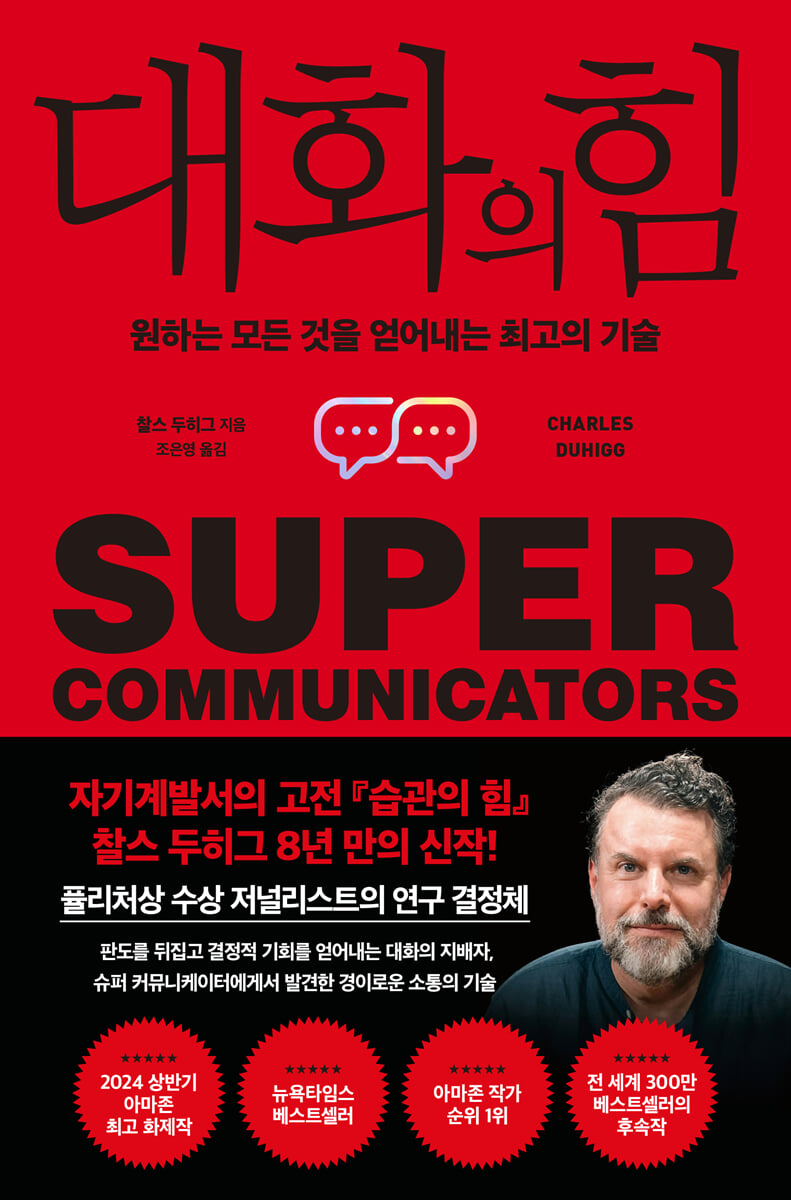
The power of conversation
 |
Description
Book Introduction
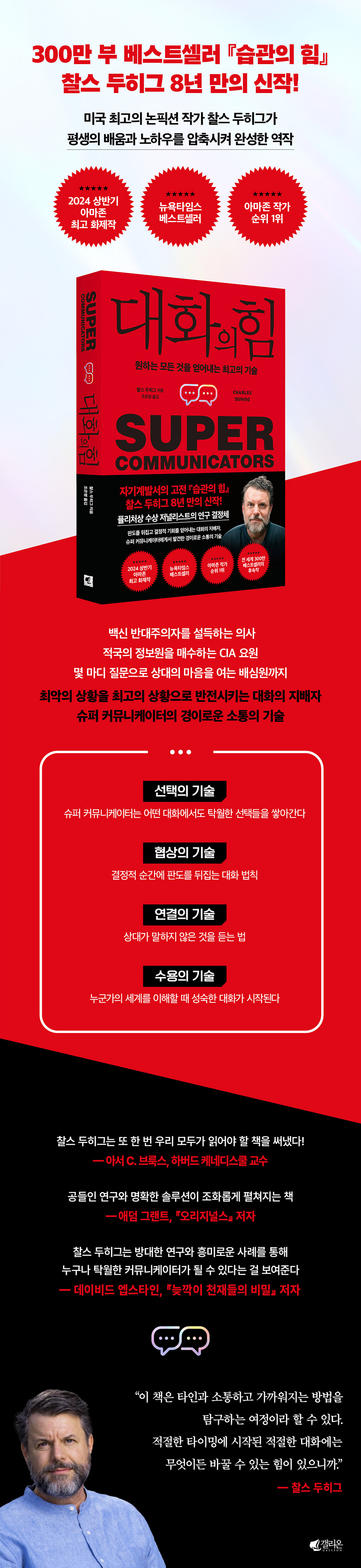
*** New book by Pulitzer Prize-winning journalist Charles Duhigg *** *** Amazon's Top Trending Releases of the First Half of 2024 *** *** New York Times Bestseller *** *** Amazon Author Ranking #1 *** “Charles Duhigg has once again written a book we all need to read!” - Arthur C. Brooks, Professor, Harvard Kennedy School “A book that harmoniously unfolds meticulous research and clear solutions.” - Adam Grant, author of Originals Charles Duhigg, author of the 3 million-copy bestseller "The Power of Habit," has released his first new book in eight years! The master of conversation who turns the worst situation into the best. The Amazing Communication Skills of Super Communicators "The Power of Conversation" is the new book by Charles Duhigg, a Pulitzer Prize-winning journalist and one of America's best nonfiction writers, published after eight years. This was news of a new book after a long time, and it became a hot topic in the global publishing world even before its release, and after its release, it received an explosive response from readers who had been waiting for Charles Duhigg's self-help book. The true value of Duhigg's writing style, which presents clear solutions to universal topics like 'habits' and 'conversation' by providing new and interesting examples to make reading fun, is fully revealed in 'The Power of Conversation'. The author, who conducted an experiment to break bad habits on his own to unravel the mechanisms of habit, now identifies exceptional super communicators and dissects their abilities in detail. From doctors who persuade anti-vaxxers, CIA agents who recruit spies, and jurors who open their minds with a few questions, the super communicators Duhigg meets turn the worst into the best. Using the weapon we use every day, conversation. If you can internalize the conversational techniques presented in this book, you too can become a super communicator. |
- You can preview some of the book's contents.
Preview
index
Part 1: The Art of Choice: Every conversation is made up of countless choices.
Chapter 1: Conversation is the most powerful tool in the world.
How a CIA rookie recruit recruited a spy in the Middle East.
Why are conversations with some people enjoyable and others frustrating?
What Happens in Your Brain When You Have a Conversation
Tell the other person what they want to hear
Part 2: The Art of Negotiation: How to Get What You Want
Chapter 2: Every Conversation Is a Negotiation
_The juror's question that overturned the controversial verdict
quiet negotiations
Why Patients Doubt Their Doctors
Something special about the jurors
A great negotiator is an artist.
Why We Fall for Absurd Conspiracy Theories
The power to capture the decisive moment
Part 3: The Art of Connection: We Crave Connection with Others
Chapter 3: The Changes That Happen When I Tell My Story
_“When was the last time you cried in front of someone else?”
One question that changed my life
What a 60-minute conversation can change
Exposing vulnerability
Emotional contagion
How to get deeper quickly
Sometimes you have to ask sensitive questions
Why Are Emotions So Important?
Chapter 4: The Art of Hearing What the Other Person Isn't Saying
Why "The Big Bang Theory," which was on the verge of being canceled, became the best sitcom ever
What kind of applicants do NASA interviewers select?
People can tell a fake smile in a second.
Send nonverbal signals
How to Communicate Under Extreme Stress
Physicists who have difficulty communicating emotions
Chapter 5: How Dialogue Resolves Conflict
_A Dialogue Experiment Between a Victim of a Mass Shooting and a Gun Fanatic
When the gap in opinions is not narrowed
People who avoid conflict
How to show that you're listening
The Crucial Difference Between Unhappy and Happy Couples
Why do people leave mean comments?
Part 4: The Art of Acceptance: Accepting Conversations Change the World
Chapter 6: Mature Conversations Begin When You Understand Someone's World
How to persuade anti-vaccine advocates
Things Stereotypes Destroy
We are all complex beings
How Doctors Convince Anti-Vaccineists
Chapter 7: The Magic of Conversation That Reveals Myself Fully
Why Netflix's Head of Communications Was Fired
Netflix in crisis with just one word
Why are some conversations so difficult?
Avoiding uncomfortable conversations gets you nowhere.
Chapter 1: Conversation is the most powerful tool in the world.
How a CIA rookie recruit recruited a spy in the Middle East.
Why are conversations with some people enjoyable and others frustrating?
What Happens in Your Brain When You Have a Conversation
Tell the other person what they want to hear
Part 2: The Art of Negotiation: How to Get What You Want
Chapter 2: Every Conversation Is a Negotiation
_The juror's question that overturned the controversial verdict
quiet negotiations
Why Patients Doubt Their Doctors
Something special about the jurors
A great negotiator is an artist.
Why We Fall for Absurd Conspiracy Theories
The power to capture the decisive moment
Part 3: The Art of Connection: We Crave Connection with Others
Chapter 3: The Changes That Happen When I Tell My Story
_“When was the last time you cried in front of someone else?”
One question that changed my life
What a 60-minute conversation can change
Exposing vulnerability
Emotional contagion
How to get deeper quickly
Sometimes you have to ask sensitive questions
Why Are Emotions So Important?
Chapter 4: The Art of Hearing What the Other Person Isn't Saying
Why "The Big Bang Theory," which was on the verge of being canceled, became the best sitcom ever
What kind of applicants do NASA interviewers select?
People can tell a fake smile in a second.
Send nonverbal signals
How to Communicate Under Extreme Stress
Physicists who have difficulty communicating emotions
Chapter 5: How Dialogue Resolves Conflict
_A Dialogue Experiment Between a Victim of a Mass Shooting and a Gun Fanatic
When the gap in opinions is not narrowed
People who avoid conflict
How to show that you're listening
The Crucial Difference Between Unhappy and Happy Couples
Why do people leave mean comments?
Part 4: The Art of Acceptance: Accepting Conversations Change the World
Chapter 6: Mature Conversations Begin When You Understand Someone's World
How to persuade anti-vaccine advocates
Things Stereotypes Destroy
We are all complex beings
How Doctors Convince Anti-Vaccineists
Chapter 7: The Magic of Conversation That Reveals Myself Fully
Why Netflix's Head of Communications Was Fired
Netflix in crisis with just one word
Why are some conversations so difficult?
Avoiding uncomfortable conversations gets you nowhere.
Detailed image
Into the book
I wrote this book to answer this question.
Why do conversations flow smoothly with some people, while others feel blocked and suffocated? Over the past 20 years, numerous studies have been published attempting to answer this question.
Learning this wisdom will enable us to listen more clearly and speak more engagingly.
We know that the human brain has evolved to crave connection with others.
When you meet someone you both agree with, your eyes dilate simultaneously, your pulses sync, you feel similar emotions, and you begin to complete each other's sentences in your heads.
This phenomenon, known as 'neural entrainment', makes people feel good.
As we live, we sometimes encounter such joyful moments, but I don't think there's a specific reason for them; I just think it's because we happened to meet someone we can communicate well with.
On the other hand, there are times when you desperately want to get closer to someone, but things don't go as planned.
--- p.9
Looking back, I knew I was failing in my relationships with the people who mattered most to me, but I didn't know what to do.
This kind of failure is very fatal to me.
Because as a writer, I am someone who practically makes a living through communication.
Why is it so hard for me to get close to the people who matter most to me and listen to their stories? I realized I wasn't alone in this confusion.
Everyone sometimes fails to listen to their friends or colleagues, fails to understand their true feelings, and fails to hear what they are really trying to say.
Moreover, we ourselves often speak in a way that others do not understand.
--- pp.11-12
Instead of calling these people "super communicators," scientists prefer to use the terms "central players" or "key informants."
But Sibus knew what kind of people they were.
They were the friends you looked to when you needed advice, the bosses you often called upon to lead, and the coworkers everyone welcomed as mood makers.
Sibus himself performed on stage with super communicators, sought them out at parties, and voted for them.
There were even times when I unknowingly took on the role of a super communicator.
But none of the research papers Sievers read explained why some people were more synchronized than others.
So, Sibus planned his own experiment.
--- p.32
Ede's biggest mistake was believing she knew everything her patients wanted before meeting them.
So he felt confident that he could objectively advise patients and explain their options so they could make informed decisions.
“But it’s not a good idea to start a negotiation assuming you know what the other party wants,” Malhotra said.
This is the beginning of a conversation about decision-making.
Figuring out what each person wants to talk about.
Of course, to find out what someone wants, you can simply ask, “What do you want?”
However, if the other person is unsure themselves, embarrassed to speak, unsure of how to express their wishes, or feels that revealing too much will put them at a disadvantage, it is bound to fail.
--- p.76
You just met someone.
It could be a friend of a friend, a recent coworker, or even someone you met on a blind date.
By greeting each other and briefly introducing your backgrounds, you are no longer in the 'what do you want to say?' state.
Then, as expected, silence flows.
What should I say now? The best way to quickly become friends is to start asking questions.
However, it is impossible to answer all 36 questions in this session.
Well then, let's start with question number 3.
“Do you practice before you make a call?” If you’re short on time, start with the more in-depth number 18.
You don't need a PhD in psychology to know that asking, "What's the most terrifying memory you've ever had?" isn't a good strategy.
If you ask a stranger outside the lab this question, you're already booked for countless lonely nights ahead.
In reality, those 36 questions aren't very helpful.
So what exactly are you asking?
--- pp.133-134
“As I said, you’re going to pair up with someone you just met and have a 10-minute conversation,” Nick Epley told hedge fund managers.
Many of the attendees flew here and had never met each other before.
Epley explained that they were conducting an experiment and asked each partner to exchange three specific questions.
“If you had a crystal ball in front of you that could tell you the future, would you look at it?” “What are you most grateful for in your daily life?” “Can you tell me a story about a time when you cried in front of someone?” Epley could have started slowly with a lighthearted question like, “Where did you go on vacation last time?”
In designing a quick way to become friends, the Aarons assumed that they should start with shallow questions.
--- p.138
Now NASA needed someone who could control their emotions, be sensitive to the feelings of others, and be open with their colleagues even in the high-stress situations of being confined in a confined space hundreds of kilometers from Earth.
McGuire joined NASA in the wake of the debacle of the Apollo 7 mission and has spent the past 20 years screening astronaut candidates, looking for clues about who might be prone to depression or belligerence.
But now, as space missions become longer, the conditions have become much more demanding.
NASA needed to find astronauts who not only had no psychological weaknesses, but were, in fact, vulnerable.
A person with high emotional intelligence who can endure the tension, boredom, arguments, and anxiety that come with living in a vacuum-like space for months at a time, and get along well with colleagues.
But McGuire knew how difficult it would be to select a candidate with such qualities.
--- pp.152-153
There is no one right way to get closer to others.
There are many techniques to make conversation easier and less awkward.
There are also tips to help you better understand your partner and hear what they are trying to say.
These conversation strategies can be more or less effective depending on the circumstances, the type of conversation you're having, and the type of relationship you want to have.
Sometimes you get there, sometimes you don't.
But what's important is that you 'want' to get closer, that you 'want' to understand, and that you 'want' to have deep conversations.
Even if it's difficult and scary, even if it's easier to just turn around and leave.
The technology and foresight to satisfy the connection we crave certainly exist.
They are worth learning, practicing, and implementing.
Whether you call it love, friendship, or just a quick, pleasant conversation, having genuine, meaningful relationships is the most important thing in life.
Why do conversations flow smoothly with some people, while others feel blocked and suffocated? Over the past 20 years, numerous studies have been published attempting to answer this question.
Learning this wisdom will enable us to listen more clearly and speak more engagingly.
We know that the human brain has evolved to crave connection with others.
When you meet someone you both agree with, your eyes dilate simultaneously, your pulses sync, you feel similar emotions, and you begin to complete each other's sentences in your heads.
This phenomenon, known as 'neural entrainment', makes people feel good.
As we live, we sometimes encounter such joyful moments, but I don't think there's a specific reason for them; I just think it's because we happened to meet someone we can communicate well with.
On the other hand, there are times when you desperately want to get closer to someone, but things don't go as planned.
--- p.9
Looking back, I knew I was failing in my relationships with the people who mattered most to me, but I didn't know what to do.
This kind of failure is very fatal to me.
Because as a writer, I am someone who practically makes a living through communication.
Why is it so hard for me to get close to the people who matter most to me and listen to their stories? I realized I wasn't alone in this confusion.
Everyone sometimes fails to listen to their friends or colleagues, fails to understand their true feelings, and fails to hear what they are really trying to say.
Moreover, we ourselves often speak in a way that others do not understand.
--- pp.11-12
Instead of calling these people "super communicators," scientists prefer to use the terms "central players" or "key informants."
But Sibus knew what kind of people they were.
They were the friends you looked to when you needed advice, the bosses you often called upon to lead, and the coworkers everyone welcomed as mood makers.
Sibus himself performed on stage with super communicators, sought them out at parties, and voted for them.
There were even times when I unknowingly took on the role of a super communicator.
But none of the research papers Sievers read explained why some people were more synchronized than others.
So, Sibus planned his own experiment.
--- p.32
Ede's biggest mistake was believing she knew everything her patients wanted before meeting them.
So he felt confident that he could objectively advise patients and explain their options so they could make informed decisions.
“But it’s not a good idea to start a negotiation assuming you know what the other party wants,” Malhotra said.
This is the beginning of a conversation about decision-making.
Figuring out what each person wants to talk about.
Of course, to find out what someone wants, you can simply ask, “What do you want?”
However, if the other person is unsure themselves, embarrassed to speak, unsure of how to express their wishes, or feels that revealing too much will put them at a disadvantage, it is bound to fail.
--- p.76
You just met someone.
It could be a friend of a friend, a recent coworker, or even someone you met on a blind date.
By greeting each other and briefly introducing your backgrounds, you are no longer in the 'what do you want to say?' state.
Then, as expected, silence flows.
What should I say now? The best way to quickly become friends is to start asking questions.
However, it is impossible to answer all 36 questions in this session.
Well then, let's start with question number 3.
“Do you practice before you make a call?” If you’re short on time, start with the more in-depth number 18.
You don't need a PhD in psychology to know that asking, "What's the most terrifying memory you've ever had?" isn't a good strategy.
If you ask a stranger outside the lab this question, you're already booked for countless lonely nights ahead.
In reality, those 36 questions aren't very helpful.
So what exactly are you asking?
--- pp.133-134
“As I said, you’re going to pair up with someone you just met and have a 10-minute conversation,” Nick Epley told hedge fund managers.
Many of the attendees flew here and had never met each other before.
Epley explained that they were conducting an experiment and asked each partner to exchange three specific questions.
“If you had a crystal ball in front of you that could tell you the future, would you look at it?” “What are you most grateful for in your daily life?” “Can you tell me a story about a time when you cried in front of someone?” Epley could have started slowly with a lighthearted question like, “Where did you go on vacation last time?”
In designing a quick way to become friends, the Aarons assumed that they should start with shallow questions.
--- p.138
Now NASA needed someone who could control their emotions, be sensitive to the feelings of others, and be open with their colleagues even in the high-stress situations of being confined in a confined space hundreds of kilometers from Earth.
McGuire joined NASA in the wake of the debacle of the Apollo 7 mission and has spent the past 20 years screening astronaut candidates, looking for clues about who might be prone to depression or belligerence.
But now, as space missions become longer, the conditions have become much more demanding.
NASA needed to find astronauts who not only had no psychological weaknesses, but were, in fact, vulnerable.
A person with high emotional intelligence who can endure the tension, boredom, arguments, and anxiety that come with living in a vacuum-like space for months at a time, and get along well with colleagues.
But McGuire knew how difficult it would be to select a candidate with such qualities.
--- pp.152-153
There is no one right way to get closer to others.
There are many techniques to make conversation easier and less awkward.
There are also tips to help you better understand your partner and hear what they are trying to say.
These conversation strategies can be more or less effective depending on the circumstances, the type of conversation you're having, and the type of relationship you want to have.
Sometimes you get there, sometimes you don't.
But what's important is that you 'want' to get closer, that you 'want' to understand, and that you 'want' to have deep conversations.
Even if it's difficult and scary, even if it's easier to just turn around and leave.
The technology and foresight to satisfy the connection we crave certainly exist.
They are worth learning, practicing, and implementing.
Whether you call it love, friendship, or just a quick, pleasant conversation, having genuine, meaningful relationships is the most important thing in life.
--- p.319
Publisher's Review
Charles Duhigg, America's greatest nonfiction writer,
A masterpiece that encapsulates a lifetime of learning and know-how.
Charles Duhigg, Pulitzer Prize-winning journalist and author of the best-selling book The Power of Habit, which sparked a worldwide "habit" craze, returns after eight years with a new topic: "conversation."
"The Power of Conversation" is the result of research undertaken by the author, who was frustrated and failed in his relationships with others, to develop his own communication skills.
Charles Duhigg said, “Looking back, I knew I was failing in my relationships with the people who mattered most to me, but I didn’t know what to do.
“This failure is very fatal to me,” he asks himself, and begins to explore the art of conversation as a way to overcome the strained relationship.
To do this, I consulted with hundreds of scientists and thinkers, reviewed hundreds of academic papers, and met with negotiation experts from the FBI and CIA, a psychoanalyst from NASA, the head of communications at Netflix, and the writers of The Big Bang Theory.
This book provides an engaging and enjoyable read by presenting cutting-edge case studies, while also weaving in meticulous research and insightful solutions.
This book fully demonstrates the true value of Doohickey's self-help books.
What makes someone who dominates the conversation different?
Conversational Rules Discovered from Super Communicators
When you're going through a tough time, who do you want to confide in? Is there someone you feel you can share both sad and happy moments with? Now, let me ask you again.
Is that person in your head the funniest person in your life? (Probably not.)
(Perhaps you are the person who laughs more than others.) Or are you the smartest person you know? (Probably not.)
(In fact, after talking to him, I feel smarter.) So what is it about him that makes him such a great conversationalist? "The Power of Conversation" is a book that answers this question clearly and honestly.
Charles Duhigg calls these individuals with exceptional communication skills "super communicators" and dissects their amazing abilities one by one.
They are negotiators who can turn adverse situations around in an instant and strategists who can create decisive changes in ordinary conversations.
And he is also a magician of empathy who can read the other person's mind and create a strong bond.
They show us that the tool we use every day, conversation, can be the most powerful weapon in the world.
FBI crisis negotiator, Netflix executive who created communications guide
Doctors fight against anti-COVID-19 white papers…
The Secret of Those Who Get What They Want Through Conversation
When complex situations arise, the FBI crisis negotiating team deploys all-weather negotiator Felix Sigala.
People thought the ultimate negotiator would be tall, handsome, and trustworthy, but Sigala is just an ordinary middle-aged man with a mustache and a potbelly.
It takes less than an hour for Sigala to get someone she just met to tell her the most intimate story of their life.
Sigala encourages the other person to explain how they see the world, and then shows that she is listening intently.
Whenever the other person reveals their feelings without realizing it, Sigala responds by revealing her own feelings as well.
These small choices create a trustworthy conversation environment.
He spoke to the researchers who were amazed by Sigala's abilities.
“I just used some simple techniques.
There's no magic here." In other words, anyone can become a super communicator if they learn conversation skills.
The cases presented in the book are by no means stories about the intuitive and instinctive speaking skills of geniuses.
The conversational skills we discovered from super communicators are methods that even ordinary people like us can learn and master.
Even those who lack confidence in conversation will gain the confidence to become super communicators.
Conversation is our brain, our body, and
Changes the way we experience the world
How do you tap into the emotions of someone who has closed off their heart? How do you navigate a cautious and uncomfortable conversation? How do you demonstrate nonverbal cues that are more effective than words? Charles Duhigg says nothing is more important than understanding the type of conversation you're having before you even begin.
Most human conversations fall into three main types.
1. Dialogue for decision making 2.
Conversation about sharing feelings 3.
A conversation about social identity.
Most misunderstandings in conversation occur when people are talking together but are having different types of conversations.
If I offer a practical solution when the other person wants to express their feelings, then we are essentially speaking different languages.
For example, if you go home from work and badmouth your boss to your spouse (“I’m going crazy because of you, boss!”), and your spouse offers a solution (“How about treating me to lunch?”), you’re bound to have a conflict.
The most important thing in conversation is to be in “a state of nervous sync” with the other person.
Super communicators are people who are more in sync with others than others.
They induce synchronization by making the way they communicate with each other consistent.
The book identifies three types of conversation, breaks down the skills needed for each type, and clearly states the essential truth that to communicate with others, you must connect with them.
How to communicate, how to build relationships, and how to live
That's the most important thing in life.
The author's epilogue that concludes this book is impressive.
Charles Duhigg reflects on the conversations he's had over the past year, writing them down as he remembers them.
Why was it so difficult to listen to others? Why did I quickly adopt a defensive stance, pretending not to notice when I knew they were trying to share their feelings? Why did I talk so much and listen so little? He interviewed countless people over a long period of time for this book, and came to a profound realization.
What we all ultimately want is to 'want' to be close to the other person.
We want to understand and have deep conversations.
Even if it's difficult and scary and it's easier to just avoid it.
There certainly are conversational techniques that can satisfy the connection we crave.
Because having a genuine and meaningful relationship with someone is the most important thing in life.
Charles Duhigg knows what the most important question for us in this disconnected age is.
Returning after eight years of profound insight, Charles Duhigg invites readers into a world of fascinating and timely conversation.
A masterpiece that encapsulates a lifetime of learning and know-how.
Charles Duhigg, Pulitzer Prize-winning journalist and author of the best-selling book The Power of Habit, which sparked a worldwide "habit" craze, returns after eight years with a new topic: "conversation."
"The Power of Conversation" is the result of research undertaken by the author, who was frustrated and failed in his relationships with others, to develop his own communication skills.
Charles Duhigg said, “Looking back, I knew I was failing in my relationships with the people who mattered most to me, but I didn’t know what to do.
“This failure is very fatal to me,” he asks himself, and begins to explore the art of conversation as a way to overcome the strained relationship.
To do this, I consulted with hundreds of scientists and thinkers, reviewed hundreds of academic papers, and met with negotiation experts from the FBI and CIA, a psychoanalyst from NASA, the head of communications at Netflix, and the writers of The Big Bang Theory.
This book provides an engaging and enjoyable read by presenting cutting-edge case studies, while also weaving in meticulous research and insightful solutions.
This book fully demonstrates the true value of Doohickey's self-help books.
What makes someone who dominates the conversation different?
Conversational Rules Discovered from Super Communicators
When you're going through a tough time, who do you want to confide in? Is there someone you feel you can share both sad and happy moments with? Now, let me ask you again.
Is that person in your head the funniest person in your life? (Probably not.)
(Perhaps you are the person who laughs more than others.) Or are you the smartest person you know? (Probably not.)
(In fact, after talking to him, I feel smarter.) So what is it about him that makes him such a great conversationalist? "The Power of Conversation" is a book that answers this question clearly and honestly.
Charles Duhigg calls these individuals with exceptional communication skills "super communicators" and dissects their amazing abilities one by one.
They are negotiators who can turn adverse situations around in an instant and strategists who can create decisive changes in ordinary conversations.
And he is also a magician of empathy who can read the other person's mind and create a strong bond.
They show us that the tool we use every day, conversation, can be the most powerful weapon in the world.
FBI crisis negotiator, Netflix executive who created communications guide
Doctors fight against anti-COVID-19 white papers…
The Secret of Those Who Get What They Want Through Conversation
When complex situations arise, the FBI crisis negotiating team deploys all-weather negotiator Felix Sigala.
People thought the ultimate negotiator would be tall, handsome, and trustworthy, but Sigala is just an ordinary middle-aged man with a mustache and a potbelly.
It takes less than an hour for Sigala to get someone she just met to tell her the most intimate story of their life.
Sigala encourages the other person to explain how they see the world, and then shows that she is listening intently.
Whenever the other person reveals their feelings without realizing it, Sigala responds by revealing her own feelings as well.
These small choices create a trustworthy conversation environment.
He spoke to the researchers who were amazed by Sigala's abilities.
“I just used some simple techniques.
There's no magic here." In other words, anyone can become a super communicator if they learn conversation skills.
The cases presented in the book are by no means stories about the intuitive and instinctive speaking skills of geniuses.
The conversational skills we discovered from super communicators are methods that even ordinary people like us can learn and master.
Even those who lack confidence in conversation will gain the confidence to become super communicators.
Conversation is our brain, our body, and
Changes the way we experience the world
How do you tap into the emotions of someone who has closed off their heart? How do you navigate a cautious and uncomfortable conversation? How do you demonstrate nonverbal cues that are more effective than words? Charles Duhigg says nothing is more important than understanding the type of conversation you're having before you even begin.
Most human conversations fall into three main types.
1. Dialogue for decision making 2.
Conversation about sharing feelings 3.
A conversation about social identity.
Most misunderstandings in conversation occur when people are talking together but are having different types of conversations.
If I offer a practical solution when the other person wants to express their feelings, then we are essentially speaking different languages.
For example, if you go home from work and badmouth your boss to your spouse (“I’m going crazy because of you, boss!”), and your spouse offers a solution (“How about treating me to lunch?”), you’re bound to have a conflict.
The most important thing in conversation is to be in “a state of nervous sync” with the other person.
Super communicators are people who are more in sync with others than others.
They induce synchronization by making the way they communicate with each other consistent.
The book identifies three types of conversation, breaks down the skills needed for each type, and clearly states the essential truth that to communicate with others, you must connect with them.
How to communicate, how to build relationships, and how to live
That's the most important thing in life.
The author's epilogue that concludes this book is impressive.
Charles Duhigg reflects on the conversations he's had over the past year, writing them down as he remembers them.
Why was it so difficult to listen to others? Why did I quickly adopt a defensive stance, pretending not to notice when I knew they were trying to share their feelings? Why did I talk so much and listen so little? He interviewed countless people over a long period of time for this book, and came to a profound realization.
What we all ultimately want is to 'want' to be close to the other person.
We want to understand and have deep conversations.
Even if it's difficult and scary and it's easier to just avoid it.
There certainly are conversational techniques that can satisfy the connection we crave.
Because having a genuine and meaningful relationship with someone is the most important thing in life.
Charles Duhigg knows what the most important question for us in this disconnected age is.
Returning after eight years of profound insight, Charles Duhigg invites readers into a world of fascinating and timely conversation.
GOODS SPECIFICS
- Date of issue: June 25, 2024
- Page count, weight, size: 364 pages | 731g | 145*220*30mm
- ISBN13: 9788901285108
- ISBN10: 890128510X
You may also like
카테고리
korean


korean

![ELLE 엘르 스페셜 에디션 A형 : 12월 [2025]](http://librairie.coreenne.fr/cdn/shop/files/b8e27a3de6c9538896439686c6b0e8fb.jpg?v=1766436872&width=3840)


