

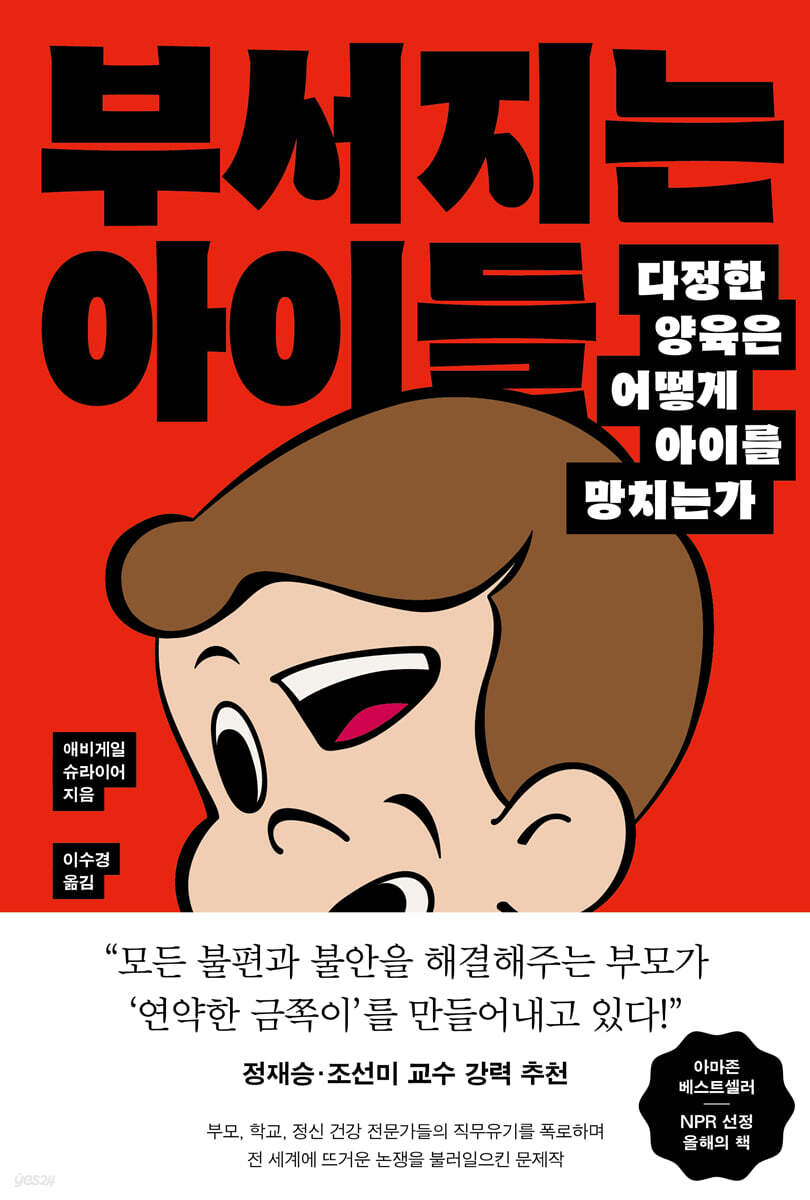
Broken Children
 |
Description
Book Introduction
- A word from MD
-
Protection and empathy spoil the child.The world is becoming safer for children.
Not only parents, but also schools, society, and hospitals treat children with protection and empathy.
But might this parenting style be making children vulnerable? This book poses provocative questions about loving parenting.
April 29, 2025. Humanities PD Son Min-gyu
★ Highly recommended by Professors Jeong Jae-seung and Cho Sun-mi ★
★ Amazon · New York Times Bestseller ★
★ Selected as 'Book of the Year' by National Public Radio (NPR) ★
Children who are insecure, lethargic, and self-absorbed
Why are there so many?
A painful reflection that began with a provocative question,
Debunking the myth of 'emotionally respectful parenting - affectionate parents'!
The generation that grew up under authoritarian parents vowed to raise their children differently.
I studied all kinds of coaching and parenting books, listened to my child, frequently asked about his feelings and thoughts, and took his opinion into consideration when making important decisions in the household, doing my best to take care of him with care.
As a result, our children are growing up as 'empty shell adults' who cannot do things on their own, from making friends to being on time for work, and who blame others for all their problems and only assert their own rights.
Why are our children, who grew up with unprecedented protection and care, becoming so insecure, helpless, and self-absorbed, "weak monsters"?
"Broken Children" starkly exposes the negative consequences that the illusion of "emotionally respectful parenting" and "affectionate parents," which have become the standard parenting methods of our time, have had on children's growth processes as well as society as a whole.
It delves into the current state of affairs in which parenting initiatives have been "outsourced" from parents to professionals, exposes the reality of psychotherapy and drug treatment being abused instead of firm discipline, and sharply points out the essence and principles of parenting for nurturing a strong individual.
This book, which has received rave reviews from numerous English-speaking scholars and influencers, has sparked heated debate around the world, prompting painful reflection from parents, and has been selected as one of the '2024 Books of the Year' by National Public Radio (NPR) as well as an Amazon and New York Times bestseller.
★ Amazon · New York Times Bestseller ★
★ Selected as 'Book of the Year' by National Public Radio (NPR) ★
Children who are insecure, lethargic, and self-absorbed
Why are there so many?
A painful reflection that began with a provocative question,
Debunking the myth of 'emotionally respectful parenting - affectionate parents'!
The generation that grew up under authoritarian parents vowed to raise their children differently.
I studied all kinds of coaching and parenting books, listened to my child, frequently asked about his feelings and thoughts, and took his opinion into consideration when making important decisions in the household, doing my best to take care of him with care.
As a result, our children are growing up as 'empty shell adults' who cannot do things on their own, from making friends to being on time for work, and who blame others for all their problems and only assert their own rights.
Why are our children, who grew up with unprecedented protection and care, becoming so insecure, helpless, and self-absorbed, "weak monsters"?
"Broken Children" starkly exposes the negative consequences that the illusion of "emotionally respectful parenting" and "affectionate parents," which have become the standard parenting methods of our time, have had on children's growth processes as well as society as a whole.
It delves into the current state of affairs in which parenting initiatives have been "outsourced" from parents to professionals, exposes the reality of psychotherapy and drug treatment being abused instead of firm discipline, and sharply points out the essence and principles of parenting for nurturing a strong individual.
This book, which has received rave reviews from numerous English-speaking scholars and influencers, has sparked heated debate around the world, prompting painful reflection from parents, and has been selected as one of the '2024 Books of the Year' by National Public Radio (NPR) as well as an Amazon and New York Times bestseller.
- You can preview some of the book's contents.
Preview
index
Recommendation
Before we begin
Author's Note.
Why Are Our Children Getting Sick?
Part 1.
Poisonous treatment
Chapter 1.
People who live off their parents' anxiety
The irony of treatment making the disease worse
Does psychotherapy really help?
Drug Abuse Prevention Program Turned into a 'Scratch-and-Run'
Wanting to help vs. being helpful
Children who became victims of parliamentary disease
Chapter 2.
The crisis brought about by the 'age of treatment'
Diagnosis becomes social media profile
Treatments increased, but depression did not decrease.
A huge mistake adults make
And no one warned me
Disaster Generation
How Unnecessary Anxiety Amplifies
Some anxiety is created
A generation that feels helpless
“I’m getting help making friends at college.”
The mental health industry has become a blue ocean.
Chapter 3.
10 Words That Deceive Us
“Shall we focus on how you feel right now?”
“Let’s revisit that memory.”
“Your ultimate goal is happiness.”
“If it makes you uncomfortable, I’ll get rid of it.”
“How can you leave the kids alone?”
“This child has a serious illness.”
“If you have a problem, you need to take medicine.”
“Come on, tell me about your trauma.”
“You can cut off contact with ‘toxic’ parents.”
“Ask permission first before doing anything.”
rampant emotional health anxiety
Part 2.
Affectionate Parenting Spreads Like a Virus
Chapter 4.
How Empathy and Consideration Spoil Children
'Emotional Check-In' Becomes a Daily Routine
Potential Risks of School Psychotherapy
Water the weeds instead of the flowers
Good intentions, bad results
“Why on earth do they want to know this stuff at school?”
Emotional health becomes a priority in education.
Things you have to learn through direct experience
Question your parents
Chapter 5.
The Birth of Fragile Monsters
Have you heard of 'restorative justice'?
Twisted behavior, lenient response
Overused consideration: Changing the school landscape
The vast web of childhood trauma
Resilience isn't something you develop with someone else's help.
Chapter 6.
Kings of the Trauma Empire
“None of this is your fault.”
Are childhood traumas stored in the body?
The most horrific disaster since frontal lobotomy
Trauma Theory: Changing Parenting Style
Elementary school students are not veterans
Can emotional trauma permanently change the brain?
Fickle and unstable memories
Memory Poker Tournament
Who is the real perpetrator?
Adults in desperate need of data
Chapter 7.
Let's explore all the child's emotions.
Irresponsible and unnecessary questions
What the Survey Indicates
Children who are being encouraged
What Happens When You Focus Only on Yourself
Chapter 8.
The Emergence of the Child Narcissist
The tyranny of emotions
The illusion that empathy is always good
Children accusing each other
Chapter 9.
Parents who lose authority, children who fall apart
Flowers don't bloom in sweet sugar powder.
'Stop it, just let it go' parenting method
“I want to punch my mom in the face.”
Parents who don't scold
Discipline is not a matter of taste.
A Gentle Dad's Sad Parenting Diary
“My child is so sensitive!”
Children with a sense of entitlement
Authority and responsibility are outsourced
Permissive Parents vs. Authoritarian Parents vs. Authoritative Parents
In front of a love that is so overflowing that it is suffocating
Parents out of control, anxious children
Children need adult authority.
Why Extremist Groups Thrive
The consequences of having unauthoritative parents
Chapter 10.
Save discipline and give medicine
Children who are robbed of their own opportunities
Anxiety and depression aren't necessarily bad things.
The story of an eleven-year-old boy taking antidepressants.
Adults who chose the easiest way
You know your child best
Part 3.
The place we need to find answers isn't the counseling room.
Chapter 11.
The courage to step back from your child's life
'Relationships' aren't defined by experts.
Remove one third right now
Children are not weak, you just make them so.
What to Learn from a Three-Year-Old in Japan
Real Choice vs. Fake Choice
What is true independence?
What People Who Survived the Great Depression Have in Common
What Parents Who Have Lost Their Laughter Should Remember
Connected life and stable relationships
The value of believing that you are not alone
Chapter 12.
It builds immunity to life
Childhood is the greatest opportunity in life.
Take the label of diagnosis away from your child.
You are a parent, be proud.
Acknowledgements
main
References
Search
Before we begin
Author's Note.
Why Are Our Children Getting Sick?
Part 1.
Poisonous treatment
Chapter 1.
People who live off their parents' anxiety
The irony of treatment making the disease worse
Does psychotherapy really help?
Drug Abuse Prevention Program Turned into a 'Scratch-and-Run'
Wanting to help vs. being helpful
Children who became victims of parliamentary disease
Chapter 2.
The crisis brought about by the 'age of treatment'
Diagnosis becomes social media profile
Treatments increased, but depression did not decrease.
A huge mistake adults make
And no one warned me
Disaster Generation
How Unnecessary Anxiety Amplifies
Some anxiety is created
A generation that feels helpless
“I’m getting help making friends at college.”
The mental health industry has become a blue ocean.
Chapter 3.
10 Words That Deceive Us
“Shall we focus on how you feel right now?”
“Let’s revisit that memory.”
“Your ultimate goal is happiness.”
“If it makes you uncomfortable, I’ll get rid of it.”
“How can you leave the kids alone?”
“This child has a serious illness.”
“If you have a problem, you need to take medicine.”
“Come on, tell me about your trauma.”
“You can cut off contact with ‘toxic’ parents.”
“Ask permission first before doing anything.”
rampant emotional health anxiety
Part 2.
Affectionate Parenting Spreads Like a Virus
Chapter 4.
How Empathy and Consideration Spoil Children
'Emotional Check-In' Becomes a Daily Routine
Potential Risks of School Psychotherapy
Water the weeds instead of the flowers
Good intentions, bad results
“Why on earth do they want to know this stuff at school?”
Emotional health becomes a priority in education.
Things you have to learn through direct experience
Question your parents
Chapter 5.
The Birth of Fragile Monsters
Have you heard of 'restorative justice'?
Twisted behavior, lenient response
Overused consideration: Changing the school landscape
The vast web of childhood trauma
Resilience isn't something you develop with someone else's help.
Chapter 6.
Kings of the Trauma Empire
“None of this is your fault.”
Are childhood traumas stored in the body?
The most horrific disaster since frontal lobotomy
Trauma Theory: Changing Parenting Style
Elementary school students are not veterans
Can emotional trauma permanently change the brain?
Fickle and unstable memories
Memory Poker Tournament
Who is the real perpetrator?
Adults in desperate need of data
Chapter 7.
Let's explore all the child's emotions.
Irresponsible and unnecessary questions
What the Survey Indicates
Children who are being encouraged
What Happens When You Focus Only on Yourself
Chapter 8.
The Emergence of the Child Narcissist
The tyranny of emotions
The illusion that empathy is always good
Children accusing each other
Chapter 9.
Parents who lose authority, children who fall apart
Flowers don't bloom in sweet sugar powder.
'Stop it, just let it go' parenting method
“I want to punch my mom in the face.”
Parents who don't scold
Discipline is not a matter of taste.
A Gentle Dad's Sad Parenting Diary
“My child is so sensitive!”
Children with a sense of entitlement
Authority and responsibility are outsourced
Permissive Parents vs. Authoritarian Parents vs. Authoritative Parents
In front of a love that is so overflowing that it is suffocating
Parents out of control, anxious children
Children need adult authority.
Why Extremist Groups Thrive
The consequences of having unauthoritative parents
Chapter 10.
Save discipline and give medicine
Children who are robbed of their own opportunities
Anxiety and depression aren't necessarily bad things.
The story of an eleven-year-old boy taking antidepressants.
Adults who chose the easiest way
You know your child best
Part 3.
The place we need to find answers isn't the counseling room.
Chapter 11.
The courage to step back from your child's life
'Relationships' aren't defined by experts.
Remove one third right now
Children are not weak, you just make them so.
What to Learn from a Three-Year-Old in Japan
Real Choice vs. Fake Choice
What is true independence?
What People Who Survived the Great Depression Have in Common
What Parents Who Have Lost Their Laughter Should Remember
Connected life and stable relationships
The value of believing that you are not alone
Chapter 12.
It builds immunity to life
Childhood is the greatest opportunity in life.
Take the label of diagnosis away from your child.
You are a parent, be proud.
Acknowledgements
main
References
Search
Detailed image

Into the book
Unlike our parents' generation, we were determined to be parenting professionals who were sensitive to our children's emotional health.
I decided to be a parent who listens to my child, frequently asks about his or her feelings and thoughts, observes his or her mood, accepts his or her opinions when making important household decisions, and, if possible, anticipates and responds to his or her distress and concerns.
To do that, you have to become a parent who values your 'relationship' with your child.
I wanted to break down the barriers of authority that past generations had built between parents and children, and become parents who view their children as team members, mentees, and friends.
Above all, we wanted to raise our children 'happily'.
--- "Author's Note.
From "Why Are Our Children Getting Sick?"
Affirming and empathizing with anxiety robs children of the opportunity to overcome difficult challenges and creates a child who "can't really do anything," says Ortiz.
Try forcing your child to sleep in a house filled with ordinary noises like a sibling snoring, the wind howling outside, or the creaking of floorboards.
Eventually, you will fall asleep.
More importantly, the child realizes that he or she can 'fall asleep' even in such an environment.
--- Chapter 3.
From "Ten Words That Deceive Us"
Why did making friends suddenly require the supervision and guidance of a school counselor? Kennair emphasized that interpersonal skills are inherently acquired through trial and error in real life.
The same goes for emotional regulation skills.
Let's say your child gets a bad grade on a test and starts throwing a tantrum and crying.
Your classmates will look at you strangely and avoid you.
Then, the child must either study harder for the next test or learn to manage his emotions by learning to deal with the disappointment of receiving a bad grade.
Emotional regulation skills aren't something you learn in a classroom, Kennair said.
The way to overcome the frustration of not making the baseball team is not through verbal lessons in the classroom, but through 'experiencing the experience of not making the baseball team firsthand.'
--- Chapter 4.
From "How Empathy and Consideration Spoil Children"
Every teacher I interviewed said that student tantrums and aggression, yelling at teachers, throwing things in the classroom, slamming doors, and sexual harassment had increased in the past decade.
The school's policy is that a significant part of the problem is that children don't seem to be able to control their own behavior.
In other words, the school believes that although it may not be an outdated viewpoint to expect self-control and self-discipline from students, it is excessive and therefore does not require it.
--- Chapter 5.
From "The Birth of Fragile Monsters"
I asked if treating every child as if they had experienced trauma might lead them to reconstruct their past, making it seem darker or more frightening than it actually was.
"that's right.
If you're rewarded with attention or recognition for telling a horrible story, then yes.
That's Skinner's basic concept. If someone says, 'I think I have a hidden trauma, but I can't remember it,' it's just boring and doesn't get any attention.
But imagine if the person next to you were telling a story about being abused in a Satanic ritual,” Loftus said. Children who participate in group therapy may “remember” things that never happened or exaggerate their memories of things that did happen to make them more dramatic.
A child who has recently experienced something 'really' tragic deserves more careful attention and consideration.
However, 'trauma-informed treatment' and 'trauma-informed education' begin treatment assuming that the child has been wounded.
So, naturally, the parliamentary disease effect is bound to follow.
--- 「Chapter 6.
From "The Kings of the Trauma Empire"
“I teach that only the student’s thoughts and feelings are important.
It's like saying there's no need to trust or respect adults.
Adults don't know better than you, and only your feelings are accurate.
So you're basically letting the young narcissists run wild and giving them a reason to attack each other."
--- 「Chapter 8.
From "The Emergence of the Child Narcissist"
These days, young people are reporting professors to their schools for not using new terms (the list is growing) to replace problematic language—for example, language perceived as offensive to a particular group or lacking political correctness.
They report their dissatisfied superiors' behavior to the HR department with the impulsive attitude of a vengeful prosecutor.
They are free from shyness, awkwardness, and self-reflection.
The next question we naturally ask is this:
Who raised these children?
--- 「Chapter 8.
From "The Emergence of the Child Narcissist"
Can you imagine your parents being at a loss in that situation? Can you imagine yourself, four or five years old, kicking, hitting, or biting them? You might think something like this.
'If I were your parents, I would have been beaten with a stick.' Or you might think something like this.
'But I was afraid of my parents.
I don't want children to be afraid of me.' Don't worry.
Kids these days are absolutely not afraid of their parents.
They think their parents are good people.
And they often look down on their parents.
The parenting coach mentioned above recommends telling your children:
“Honey, I know you’re upset because Mom gave you a blue cup instead of a green one (or because she told you to stop cleaning up that fort you worked so hard to build).
But next time you get angry, try clenching your fist or stamping your feet on the floor.
Or tell your mom what the problem is.
Then Mom will help you.” (...) Parents try to act like psychotherapists, not making moral judgments, not scolding their children for misbehaving, and acting as if they have no control over the situation.
--- 「Chapter 9.
From "Parents Who Lose Authority, Children Who Fall Apart"
We emailed the teacher begging him to look into the missing assignments, we implored the coach to let our child join the sports team he was eliminated from, and we emailed the principal threatening legal action if the coach didn't immediately admit our child to the team.
But when we took a step back and looked, a different picture appeared.
I saw a child who hit his friend and was not punished.
The child, who failed to correct his behavior, eventually began taking medication.
I also saw a child who couldn't concentrate in class because he was looking at his smartphone all morning.
The child was also a nuisance to other students.
We gave the child some medicine too.
'Reassurance' is the word most often used by gentle parents when they finally hear their child's diagnosis and receive a prescription from the doctor.
“I can’t tell you how relieved I am to know what the cause of the problem is,” many parents said.
--- Chapter 10.
From "Spare on discipline and give medicine"
It may not be only the parents' fault that they have forgotten humor these days.
There are many reasons why parenting books these days are poor, but the most annoying thing is that they are all so serious and lack humor.
These poorly written books make every moment we spend with our children heavy and serious.
It outlines parenting techniques to practice, situations to monitor, and problems to be aware of, and suggests that parents should feel guilty when they fail to do these things well.
It warns that inappropriate parental behavior can have serious consequences, making parenting a world filled with depression and stress.
--- Chapter 11.
From "The Courage to Step Back from a Child's Life"
The reason childhood exists is to make friends with unpredictable personalities, to lose at baseball games, to stand up to bullies, to fall down and pick yourself up, and to help your friends.
Taking a risk, trying something, getting hurt, trying and failing, and finally doing it.
Kids need this.
When we, the parents, were still living in the next room.
It's a happy childhood to spend time doing things like that.
It's like getting a little taste of all the pain of the adult world.
In doing so, children develop immunity to the toxicity of pain and loss.
I decided to be a parent who listens to my child, frequently asks about his or her feelings and thoughts, observes his or her mood, accepts his or her opinions when making important household decisions, and, if possible, anticipates and responds to his or her distress and concerns.
To do that, you have to become a parent who values your 'relationship' with your child.
I wanted to break down the barriers of authority that past generations had built between parents and children, and become parents who view their children as team members, mentees, and friends.
Above all, we wanted to raise our children 'happily'.
--- "Author's Note.
From "Why Are Our Children Getting Sick?"
Affirming and empathizing with anxiety robs children of the opportunity to overcome difficult challenges and creates a child who "can't really do anything," says Ortiz.
Try forcing your child to sleep in a house filled with ordinary noises like a sibling snoring, the wind howling outside, or the creaking of floorboards.
Eventually, you will fall asleep.
More importantly, the child realizes that he or she can 'fall asleep' even in such an environment.
--- Chapter 3.
From "Ten Words That Deceive Us"
Why did making friends suddenly require the supervision and guidance of a school counselor? Kennair emphasized that interpersonal skills are inherently acquired through trial and error in real life.
The same goes for emotional regulation skills.
Let's say your child gets a bad grade on a test and starts throwing a tantrum and crying.
Your classmates will look at you strangely and avoid you.
Then, the child must either study harder for the next test or learn to manage his emotions by learning to deal with the disappointment of receiving a bad grade.
Emotional regulation skills aren't something you learn in a classroom, Kennair said.
The way to overcome the frustration of not making the baseball team is not through verbal lessons in the classroom, but through 'experiencing the experience of not making the baseball team firsthand.'
--- Chapter 4.
From "How Empathy and Consideration Spoil Children"
Every teacher I interviewed said that student tantrums and aggression, yelling at teachers, throwing things in the classroom, slamming doors, and sexual harassment had increased in the past decade.
The school's policy is that a significant part of the problem is that children don't seem to be able to control their own behavior.
In other words, the school believes that although it may not be an outdated viewpoint to expect self-control and self-discipline from students, it is excessive and therefore does not require it.
--- Chapter 5.
From "The Birth of Fragile Monsters"
I asked if treating every child as if they had experienced trauma might lead them to reconstruct their past, making it seem darker or more frightening than it actually was.
"that's right.
If you're rewarded with attention or recognition for telling a horrible story, then yes.
That's Skinner's basic concept. If someone says, 'I think I have a hidden trauma, but I can't remember it,' it's just boring and doesn't get any attention.
But imagine if the person next to you were telling a story about being abused in a Satanic ritual,” Loftus said. Children who participate in group therapy may “remember” things that never happened or exaggerate their memories of things that did happen to make them more dramatic.
A child who has recently experienced something 'really' tragic deserves more careful attention and consideration.
However, 'trauma-informed treatment' and 'trauma-informed education' begin treatment assuming that the child has been wounded.
So, naturally, the parliamentary disease effect is bound to follow.
--- 「Chapter 6.
From "The Kings of the Trauma Empire"
“I teach that only the student’s thoughts and feelings are important.
It's like saying there's no need to trust or respect adults.
Adults don't know better than you, and only your feelings are accurate.
So you're basically letting the young narcissists run wild and giving them a reason to attack each other."
--- 「Chapter 8.
From "The Emergence of the Child Narcissist"
These days, young people are reporting professors to their schools for not using new terms (the list is growing) to replace problematic language—for example, language perceived as offensive to a particular group or lacking political correctness.
They report their dissatisfied superiors' behavior to the HR department with the impulsive attitude of a vengeful prosecutor.
They are free from shyness, awkwardness, and self-reflection.
The next question we naturally ask is this:
Who raised these children?
--- 「Chapter 8.
From "The Emergence of the Child Narcissist"
Can you imagine your parents being at a loss in that situation? Can you imagine yourself, four or five years old, kicking, hitting, or biting them? You might think something like this.
'If I were your parents, I would have been beaten with a stick.' Or you might think something like this.
'But I was afraid of my parents.
I don't want children to be afraid of me.' Don't worry.
Kids these days are absolutely not afraid of their parents.
They think their parents are good people.
And they often look down on their parents.
The parenting coach mentioned above recommends telling your children:
“Honey, I know you’re upset because Mom gave you a blue cup instead of a green one (or because she told you to stop cleaning up that fort you worked so hard to build).
But next time you get angry, try clenching your fist or stamping your feet on the floor.
Or tell your mom what the problem is.
Then Mom will help you.” (...) Parents try to act like psychotherapists, not making moral judgments, not scolding their children for misbehaving, and acting as if they have no control over the situation.
--- 「Chapter 9.
From "Parents Who Lose Authority, Children Who Fall Apart"
We emailed the teacher begging him to look into the missing assignments, we implored the coach to let our child join the sports team he was eliminated from, and we emailed the principal threatening legal action if the coach didn't immediately admit our child to the team.
But when we took a step back and looked, a different picture appeared.
I saw a child who hit his friend and was not punished.
The child, who failed to correct his behavior, eventually began taking medication.
I also saw a child who couldn't concentrate in class because he was looking at his smartphone all morning.
The child was also a nuisance to other students.
We gave the child some medicine too.
'Reassurance' is the word most often used by gentle parents when they finally hear their child's diagnosis and receive a prescription from the doctor.
“I can’t tell you how relieved I am to know what the cause of the problem is,” many parents said.
--- Chapter 10.
From "Spare on discipline and give medicine"
It may not be only the parents' fault that they have forgotten humor these days.
There are many reasons why parenting books these days are poor, but the most annoying thing is that they are all so serious and lack humor.
These poorly written books make every moment we spend with our children heavy and serious.
It outlines parenting techniques to practice, situations to monitor, and problems to be aware of, and suggests that parents should feel guilty when they fail to do these things well.
It warns that inappropriate parental behavior can have serious consequences, making parenting a world filled with depression and stress.
--- Chapter 11.
From "The Courage to Step Back from a Child's Life"
The reason childhood exists is to make friends with unpredictable personalities, to lose at baseball games, to stand up to bullies, to fall down and pick yourself up, and to help your friends.
Taking a risk, trying something, getting hurt, trying and failing, and finally doing it.
Kids need this.
When we, the parents, were still living in the next room.
It's a happy childhood to spend time doing things like that.
It's like getting a little taste of all the pain of the adult world.
In doing so, children develop immunity to the toxicity of pain and loss.
--- 「Chapter 12.
"It builds immunity to life"
"It builds immunity to life"
Publisher's Review
The illusion of 'emotionally respectful parenting - affectionate parents'
How did we destroy the inner self of our children?
A generation that has received unprecedented support and consideration
Growing up as a vulnerable and dependent adult
A compelling insight into a global phenomenon
In 2023, a teacher made an extreme choice in an elementary school classroom in Seoul.
In 2024, there was an incident where a homeroom teacher at an elementary school in Jeonju was replaced a whopping six times.
In both cases, the background was pointed out to be the persistent malicious complaints filed by parents who claimed that 'they hurt my child's feelings.'
In fact, in schools, 'reading students' minds' has long been a hot topic, such as not marking incorrect answers to avoid hurting the child, or being careful not to make the child feel ashamed when the teacher points out the answer.
But this is not just our country's story.
In Western societies, "emotional check-ins" to check on students' feelings have become a daily classroom routine, and even students who commit school violence are not subject to any sanctions under the principle that they should be treated with emotional consideration.
How did parenting practices that prioritize protecting a child's emotions become a global phenomenon? Why are there so many insecure, helpless, and self-absorbed children? And what impact does this have on individual development and society as a whole?
"Broken Children" offers a compelling insight into how a generation that has received unprecedented support and care is growing into vulnerable and dependent adults.
Hailed as "one of the most astute observers of education," world-renowned investigative journalist Abigail Schreyer, based on in-depth interviews with hundreds of parents, teachers, youth, and mental health professionals, as well as extensive reporting, sheds stark light on the parenting crisis facing our time.
The book, which exposes the dereliction of duty by parents, teachers, and mental health professionals, quickly became a controversial work, sparking fierce debate with its provocative claims.
Parents who solve all inconveniences and anxieties
Creating 'fragile gold'!
The generation that grew up under oppressive parents vowed to raise their children differently.
With the determination to become a "friend-like parent" who is sensitive to their child's emotions, I studied all kinds of expert coaching and parenting books, always listened to my child, frequently asked about his or her feelings and thoughts, and actively reflected his or her opinions when making important household decisions.
Parents also secretly took pride in never saying “no” to their children or punishing them.
Instead of sending a firm message to children during the disciplinary process, they confused them by using words closer to 'choice' and 'preference'.
In this way, parents have lost control by relinquishing their authority and have become weaklings who beg their children to do what they are supposed to do.
Along with this, Schreyer criticizes the current state of parents who are desperate to eliminate even the smallest inconveniences their children feel.
Children are deprived of the normal disruptions and stresses that are essential for their development because parents treat even the smallest inconveniences as if they were poisons, like “wearing a bathing cap to keep water out of their eyes during bath time and carefully peeling the sesame seeds off their hamburger buns.”
And this, according to neuropsychologists interviewed by the author, is also the background to why many children these days suffer from anxiety disorders and phobias.
In this way, children grow up without even the opportunity to get back up after experiencing, experiencing, and being frustrated.
Outsourcing Parenting: Raising 'Little Narcissists'
Adults who chose drugs over alcohol
Schreyer points out that behind broken children are parents who have given up the initiative in parenting and the 'experts' who have taken over.
Parents who lost control of their children turned to mental health professionals in the name of understanding their children's psychology and emotions.
In this process, even children who were experiencing natural confusion and depression, rather than those who truly needed counseling and treatment, began to be labeled with a diagnosis.
Parents were reassured by the expert's words, "This child is bound to be that way," and counseling and medication became the means of parenting instead of firm teaching and discipline.
Here, some mental health professionals have abused trauma theory, originally applied to veterans, on children and adolescents, raising children to blame everything on childhood experiences or emotional wounds.
As a result, children no longer try to solve problems on their own, but instead post their diagnosis on their social media profiles and consume it as part of their identity.
The author sharply delves into the reality of how "depressed narcissists" are raised, obsessed with their own emotions and content with their own narratives, and unfilteredly reveals the mechanisms by which children's resilience is seriously undermined.
From broken children to 'empty shell adults'
How Emotionally Respectful Parenting Shakes the Roots of Community
According to American public school teachers interviewed by the author, there has been a sharp increase in the past decade in instances where students “throw tantrums, cry, scream, throw things, threaten suicide, swear at teachers, or sexually harass them.”
However, schools that fall into the trap of 'respecting emotions' interpret such problem behavior as a 'cry for help' and respond leniently.
Additionally, children who complain of depression or anxiety are given 'educational consideration' by being exempted from homework and tests without any restrictions.
Schools have lost their role as institutions that teach children to respect community norms and cultivate self-discipline.
The problem is that these children, who do not receive the necessary sanctions and teachings, are unable to do even basic tasks on their own, blame everything on trauma and their parents, and enter society as 'empty shell adults' with no will to improve their lives.
This is precisely why not only parents and teachers, but society as a whole, must pay attention to the crisis in parenting in our time.
"Broken Children" warns that this type of parenting that prioritizes emotions and resolves all discomfort and anxiety leaves individuals helpless and ultimately weakens the resilience of the entire community.
“Flowers don’t bloom in sweet sugar powder.”
A poignant reflection on the "essence" of parenting, something everyone has forgotten.
The reason childhood exists is to experience taking risks, trying, failing, getting hurt, and finally succeeding.
In doing so, children develop immunity to the toxic effects of pain and loss.
But adults have ignored this fact for a long time.
And then we belittled their abilities and assumed that kids today would never be able to do what we took for granted at their age.
Abigail Schreyer emphasizes that “children thrive much better when they have less than they do now,” and suggests having the “courage to step back” from your child’s life.
The idea is to stop the pointless and useless interference and intervention and give people the opportunity to take risks and have a "real choice" to learn and grow.
"Broken Children," which directly exposed the blind spots of the values that this era has taken for granted, such as "emotionally respectful parenting" and "affectionate parents," led to explosive self-confessions from parents around the world, such as, "After reading it, I realized that I was the one who was ruining my child," "This book perfectly resonated with the concerns I had while raising a child," and "It's an uncomfortable issue, but one that we have to address at least once."
As the saying goes, “It takes a village to raise a child,” this book is a bitter pill that should be read not only by families raising children, but also by everyone interested in making our society healthy.
How did we destroy the inner self of our children?
A generation that has received unprecedented support and consideration
Growing up as a vulnerable and dependent adult
A compelling insight into a global phenomenon
In 2023, a teacher made an extreme choice in an elementary school classroom in Seoul.
In 2024, there was an incident where a homeroom teacher at an elementary school in Jeonju was replaced a whopping six times.
In both cases, the background was pointed out to be the persistent malicious complaints filed by parents who claimed that 'they hurt my child's feelings.'
In fact, in schools, 'reading students' minds' has long been a hot topic, such as not marking incorrect answers to avoid hurting the child, or being careful not to make the child feel ashamed when the teacher points out the answer.
But this is not just our country's story.
In Western societies, "emotional check-ins" to check on students' feelings have become a daily classroom routine, and even students who commit school violence are not subject to any sanctions under the principle that they should be treated with emotional consideration.
How did parenting practices that prioritize protecting a child's emotions become a global phenomenon? Why are there so many insecure, helpless, and self-absorbed children? And what impact does this have on individual development and society as a whole?
"Broken Children" offers a compelling insight into how a generation that has received unprecedented support and care is growing into vulnerable and dependent adults.
Hailed as "one of the most astute observers of education," world-renowned investigative journalist Abigail Schreyer, based on in-depth interviews with hundreds of parents, teachers, youth, and mental health professionals, as well as extensive reporting, sheds stark light on the parenting crisis facing our time.
The book, which exposes the dereliction of duty by parents, teachers, and mental health professionals, quickly became a controversial work, sparking fierce debate with its provocative claims.
Parents who solve all inconveniences and anxieties
Creating 'fragile gold'!
The generation that grew up under oppressive parents vowed to raise their children differently.
With the determination to become a "friend-like parent" who is sensitive to their child's emotions, I studied all kinds of expert coaching and parenting books, always listened to my child, frequently asked about his or her feelings and thoughts, and actively reflected his or her opinions when making important household decisions.
Parents also secretly took pride in never saying “no” to their children or punishing them.
Instead of sending a firm message to children during the disciplinary process, they confused them by using words closer to 'choice' and 'preference'.
In this way, parents have lost control by relinquishing their authority and have become weaklings who beg their children to do what they are supposed to do.
Along with this, Schreyer criticizes the current state of parents who are desperate to eliminate even the smallest inconveniences their children feel.
Children are deprived of the normal disruptions and stresses that are essential for their development because parents treat even the smallest inconveniences as if they were poisons, like “wearing a bathing cap to keep water out of their eyes during bath time and carefully peeling the sesame seeds off their hamburger buns.”
And this, according to neuropsychologists interviewed by the author, is also the background to why many children these days suffer from anxiety disorders and phobias.
In this way, children grow up without even the opportunity to get back up after experiencing, experiencing, and being frustrated.
Outsourcing Parenting: Raising 'Little Narcissists'
Adults who chose drugs over alcohol
Schreyer points out that behind broken children are parents who have given up the initiative in parenting and the 'experts' who have taken over.
Parents who lost control of their children turned to mental health professionals in the name of understanding their children's psychology and emotions.
In this process, even children who were experiencing natural confusion and depression, rather than those who truly needed counseling and treatment, began to be labeled with a diagnosis.
Parents were reassured by the expert's words, "This child is bound to be that way," and counseling and medication became the means of parenting instead of firm teaching and discipline.
Here, some mental health professionals have abused trauma theory, originally applied to veterans, on children and adolescents, raising children to blame everything on childhood experiences or emotional wounds.
As a result, children no longer try to solve problems on their own, but instead post their diagnosis on their social media profiles and consume it as part of their identity.
The author sharply delves into the reality of how "depressed narcissists" are raised, obsessed with their own emotions and content with their own narratives, and unfilteredly reveals the mechanisms by which children's resilience is seriously undermined.
From broken children to 'empty shell adults'
How Emotionally Respectful Parenting Shakes the Roots of Community
According to American public school teachers interviewed by the author, there has been a sharp increase in the past decade in instances where students “throw tantrums, cry, scream, throw things, threaten suicide, swear at teachers, or sexually harass them.”
However, schools that fall into the trap of 'respecting emotions' interpret such problem behavior as a 'cry for help' and respond leniently.
Additionally, children who complain of depression or anxiety are given 'educational consideration' by being exempted from homework and tests without any restrictions.
Schools have lost their role as institutions that teach children to respect community norms and cultivate self-discipline.
The problem is that these children, who do not receive the necessary sanctions and teachings, are unable to do even basic tasks on their own, blame everything on trauma and their parents, and enter society as 'empty shell adults' with no will to improve their lives.
This is precisely why not only parents and teachers, but society as a whole, must pay attention to the crisis in parenting in our time.
"Broken Children" warns that this type of parenting that prioritizes emotions and resolves all discomfort and anxiety leaves individuals helpless and ultimately weakens the resilience of the entire community.
“Flowers don’t bloom in sweet sugar powder.”
A poignant reflection on the "essence" of parenting, something everyone has forgotten.
The reason childhood exists is to experience taking risks, trying, failing, getting hurt, and finally succeeding.
In doing so, children develop immunity to the toxic effects of pain and loss.
But adults have ignored this fact for a long time.
And then we belittled their abilities and assumed that kids today would never be able to do what we took for granted at their age.
Abigail Schreyer emphasizes that “children thrive much better when they have less than they do now,” and suggests having the “courage to step back” from your child’s life.
The idea is to stop the pointless and useless interference and intervention and give people the opportunity to take risks and have a "real choice" to learn and grow.
"Broken Children," which directly exposed the blind spots of the values that this era has taken for granted, such as "emotionally respectful parenting" and "affectionate parents," led to explosive self-confessions from parents around the world, such as, "After reading it, I realized that I was the one who was ruining my child," "This book perfectly resonated with the concerns I had while raising a child," and "It's an uncomfortable issue, but one that we have to address at least once."
As the saying goes, “It takes a village to raise a child,” this book is a bitter pill that should be read not only by families raising children, but also by everyone interested in making our society healthy.
GOODS SPECIFICS
- Date of issue: May 2, 2025
- Page count, weight, size: 432 pages | 774g | 152*225*25mm
- ISBN13: 9788901294698
- ISBN10: 8901294699
You may also like
카테고리
korean


korean

![GQ KOREA Mark (Monthly): December [2025]](http://librairie.coreenne.fr/cdn/shop/files/8ef265dbbfbf186523ed75ba7319009d.jpg?v=1765340328&width=3840)


