

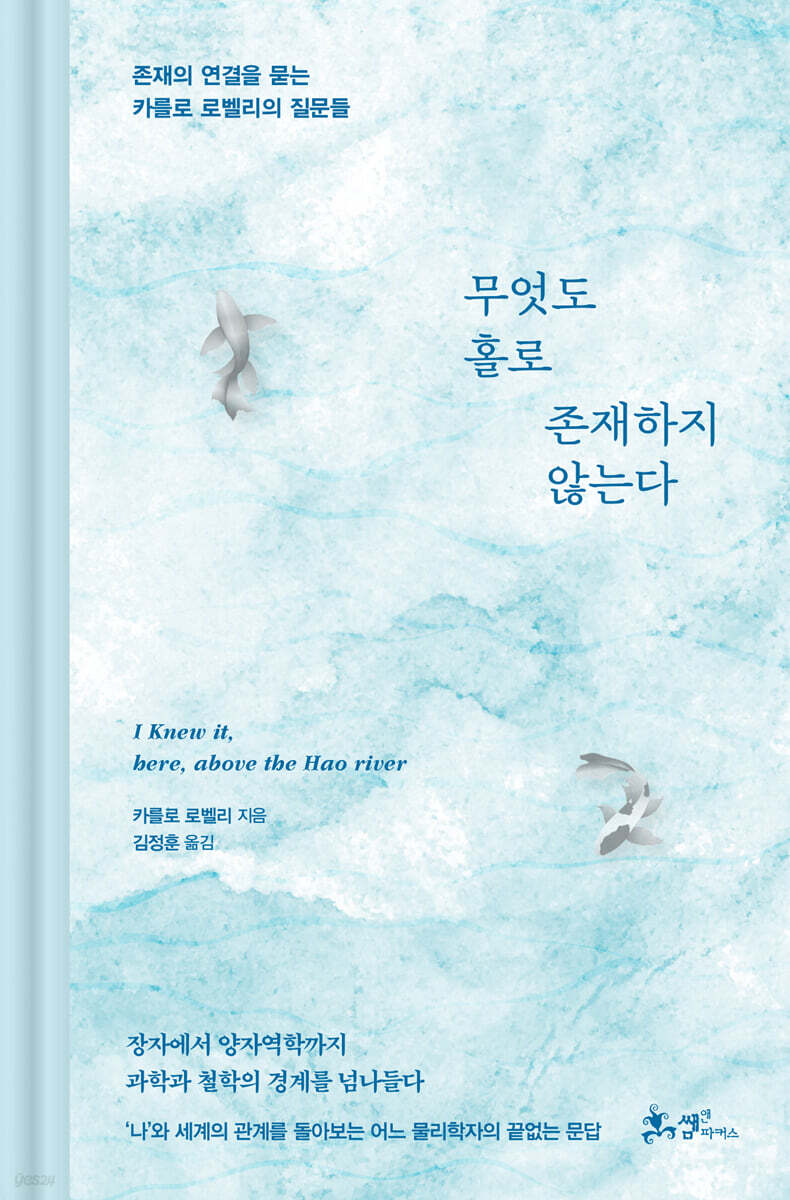
Nothing exists alone.
 |
Description
Book Introduction
“We are all part of the world,
“That connection forms a world.”
Between science and philosophy, physicist Carlo Rovelli sees the world through a balanced lens.
Questions about the "connected world" permeate 13 years of contributions, speeches, discussions, and interviews.
"Nothing Exists Alone" is the first essay by world-renowned physicist Carlo Rovelli.
We have collected articles and comments contributed to various global media outlets, including the Italian daily Corriere della Sera.
The author, who has traced the physical phenomena of the universe across time and space, now turns his attention to the stories of people living in reality, the science and philosophy that underlie them, and the true meaning of art.
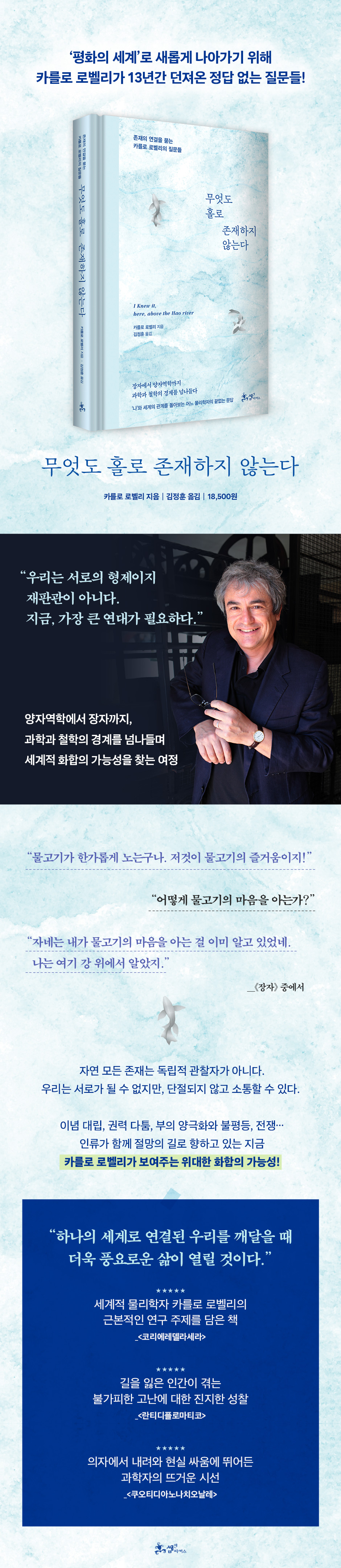
In this book, the author connects the anecdote of "The Joy of Fish" from the great classic "Zhuangzi" with quantum mechanics, transcending the boundaries between science and philosophy to infinitely expand the questions about the "connected world" that he has long explored.
The author, who says that the world is made up of the interactions of all beings and that 'cooperation' rather than distinction between self and others is the truth of nature, continuously presents a better vision for the present world and the next generation.
What underpins "Nothing Exists Alone" is the assertion that we can escape the errors of the existing world by asking "questions without answers" without relying on certainty.
From Kepler and Galileo, who went against common sense to overturn the Earth-centered view of the universe, to Heidegger's ontology that the essence of the 'self' is not fixed but is formed through relationships with the world, to Beethoven's 'Missa Solemnis', which shows that music can only gain its own meaning through appreciation, the history of science and art shows the truth that we can advance to a new world when we go beyond established boundaries.
Not believing only what is believed, but paying attention to discoveries that have never been made before.
This is not an attitude that is only necessary in science.
To address common challenges facing humanity, such as ideological conflicts, entrenched inequalities, class conflicts, and environmental issues, we need to be open to hearing what others have to say.
This book explores the remarkable intellectual journey of a world-renowned physicist who seeks “a deeper connection to our daily lives beyond simple scientific curiosity.”
“That connection forms a world.”
Between science and philosophy, physicist Carlo Rovelli sees the world through a balanced lens.
Questions about the "connected world" permeate 13 years of contributions, speeches, discussions, and interviews.
"Nothing Exists Alone" is the first essay by world-renowned physicist Carlo Rovelli.
We have collected articles and comments contributed to various global media outlets, including the Italian daily Corriere della Sera.
The author, who has traced the physical phenomena of the universe across time and space, now turns his attention to the stories of people living in reality, the science and philosophy that underlie them, and the true meaning of art.
In this book, the author connects the anecdote of "The Joy of Fish" from the great classic "Zhuangzi" with quantum mechanics, transcending the boundaries between science and philosophy to infinitely expand the questions about the "connected world" that he has long explored.
The author, who says that the world is made up of the interactions of all beings and that 'cooperation' rather than distinction between self and others is the truth of nature, continuously presents a better vision for the present world and the next generation.
What underpins "Nothing Exists Alone" is the assertion that we can escape the errors of the existing world by asking "questions without answers" without relying on certainty.
From Kepler and Galileo, who went against common sense to overturn the Earth-centered view of the universe, to Heidegger's ontology that the essence of the 'self' is not fixed but is formed through relationships with the world, to Beethoven's 'Missa Solemnis', which shows that music can only gain its own meaning through appreciation, the history of science and art shows the truth that we can advance to a new world when we go beyond established boundaries.
Not believing only what is believed, but paying attention to discoveries that have never been made before.
This is not an attitude that is only necessary in science.
To address common challenges facing humanity, such as ideological conflicts, entrenched inequalities, class conflicts, and environmental issues, we need to be open to hearing what others have to say.
This book explores the remarkable intellectual journey of a world-renowned physicist who seeks “a deeper connection to our daily lives beyond simple scientific curiosity.”
- You can preview some of the book's contents.
Preview
index
Preface to the Korean edition: A very small curiosity that connects the world
Zhuangzi, Knowing the Joy of Fish │ Happy May Day │ It All Began in the Sea of Lesbos │ Anish Kapoor and Our Sleepwalking │ Music │ The World, Under One Sky │ Us vs. Them │ Hypocrisy │ The Rest of Afghanistan │ Reflections on International Legitimacy │ A Very Simple Proposal for Humanity │ Kepler's Dream │ Galileo's Mistake │ Parts of Parts │ Roger Penrose │ Giorgio Parisi │ Roberto Calasso │ Gino Strada │ Liliana Cavani │ Brunetto Latini, Dante, Gauss, Einstein │ The Being of Being │ How Far Away is the Sun? │ What is a Stone? │ Small Treasures for Youth │ Survival Together │ We Are Fragile │ Quackery │ The Transfer of Wealth │ Inequality and Wealth in the United States and Italy │ General Relativity, the Great Love │ Entanglement │ Enthusiasm and Doubt Surrounding the Muon │ The Meaning of Pure Science │ Beyond Our Round Window │ Pain │ Watchman, How Much Has the Night Passed? │ Again, Zhuangzi, Knowing the Joy of Fish
References
Zhuangzi, Knowing the Joy of Fish │ Happy May Day │ It All Began in the Sea of Lesbos │ Anish Kapoor and Our Sleepwalking │ Music │ The World, Under One Sky │ Us vs. Them │ Hypocrisy │ The Rest of Afghanistan │ Reflections on International Legitimacy │ A Very Simple Proposal for Humanity │ Kepler's Dream │ Galileo's Mistake │ Parts of Parts │ Roger Penrose │ Giorgio Parisi │ Roberto Calasso │ Gino Strada │ Liliana Cavani │ Brunetto Latini, Dante, Gauss, Einstein │ The Being of Being │ How Far Away is the Sun? │ What is a Stone? │ Small Treasures for Youth │ Survival Together │ We Are Fragile │ Quackery │ The Transfer of Wealth │ Inequality and Wealth in the United States and Italy │ General Relativity, the Great Love │ Entanglement │ Enthusiasm and Doubt Surrounding the Muon │ The Meaning of Pure Science │ Beyond Our Round Window │ Pain │ Watchman, How Much Has the Night Passed? │ Again, Zhuangzi, Knowing the Joy of Fish
References
Detailed image
Into the book
Knowledge, mind, and the pleasure felt by fish do not exist outside of nature.
It's not in some distant, unreachable realm.
They are normal aspects of nature, the names we give to the complex structures of nature, of which we are a part.
Our talking about them and gaining knowledge about them is also an aspect of nature.
--- p.17, "Zhuangzi, Knowing the Joy of Fish"
Shapes and textures are interpreted and connected by our brains.
It resonates.
Everything we see resonates.
When we see a chair, we know it is a chair, and the chair resonates with the functions we know it has, and with countless memories connected to other chairs we have experienced.
There is no such thing as just a thing.
--- p.38, "Annish Kapoor and Our Sleepwalking"
The Earth is small, humanity is fragile, and we face grave danger.
(…) Now is the time for humanity to strive to do so globally.
The recent rise of globalization has been costly and problematic, but it has also opened up extraordinary opportunities.
That is global cooperation.
It is time to shift the focus of public debate to the enormous benefits that can only be achieved through cooperation, not competition.
I hope politicians will listen and lead the world order in this direction.
--- p.107~108, "A Very Simple Suggestion for Humanity"
Galileo's extreme efforts to overturn what is taken for granted are the pathos of this massive book, and in my view the most brilliant core of science.
It is about giving us new, deeper eyes to look at the world.
It is the same today.
The best science confronts the obvious and pushes through hardship.
Galileo opened the way.
And all of this comes from a book that is fundamentally and completely wrong from a scientific standpoint.
--- p.123, "Galileo's Mistake"
Philosophy has always been a wonderful source of ideas and perspectives.
To be cautious, I think the limitation of much philosophy lies in mistaking individual perspectives for fundamental ones, and in seeking ultimate certainty and foundation.
Perhaps it's the ambition to find an absolute starting point, and then the next generation questions it.
I don't find it interesting to try to find the ultimate foundation.
What exactly does "fundamental" mean? It depends on your perspective.
--- p.177, “The Existence of Being”
The only strategy we have to defend ourselves from this crisis is to strengthen global cooperation.
In all fields, including politics, economics and science.
The pandemic is not over, and it will not be the last serious crisis humanity faces.
There have already been other warnings, such as those about the risk of a pandemic.
If world politics pursues openness, cooperation, and the joint resolution of humanity's problems, we can overcome this crisis.
But if we isolate ourselves and are governed by the destructive logic of 'us first,' we will harm ourselves.
--- p.219~220, "Together We Survive"
Zhuangzi's thought contains an important response to Bohr's seemingly disappointing view that "physics is not about the world, but about what we can say about the world."
The answer lies right within the question.
“What’s the difference?” Isn’t what we can say about the world an aspect of the world itself?
It's not in some distant, unreachable realm.
They are normal aspects of nature, the names we give to the complex structures of nature, of which we are a part.
Our talking about them and gaining knowledge about them is also an aspect of nature.
--- p.17, "Zhuangzi, Knowing the Joy of Fish"
Shapes and textures are interpreted and connected by our brains.
It resonates.
Everything we see resonates.
When we see a chair, we know it is a chair, and the chair resonates with the functions we know it has, and with countless memories connected to other chairs we have experienced.
There is no such thing as just a thing.
--- p.38, "Annish Kapoor and Our Sleepwalking"
The Earth is small, humanity is fragile, and we face grave danger.
(…) Now is the time for humanity to strive to do so globally.
The recent rise of globalization has been costly and problematic, but it has also opened up extraordinary opportunities.
That is global cooperation.
It is time to shift the focus of public debate to the enormous benefits that can only be achieved through cooperation, not competition.
I hope politicians will listen and lead the world order in this direction.
--- p.107~108, "A Very Simple Suggestion for Humanity"
Galileo's extreme efforts to overturn what is taken for granted are the pathos of this massive book, and in my view the most brilliant core of science.
It is about giving us new, deeper eyes to look at the world.
It is the same today.
The best science confronts the obvious and pushes through hardship.
Galileo opened the way.
And all of this comes from a book that is fundamentally and completely wrong from a scientific standpoint.
--- p.123, "Galileo's Mistake"
Philosophy has always been a wonderful source of ideas and perspectives.
To be cautious, I think the limitation of much philosophy lies in mistaking individual perspectives for fundamental ones, and in seeking ultimate certainty and foundation.
Perhaps it's the ambition to find an absolute starting point, and then the next generation questions it.
I don't find it interesting to try to find the ultimate foundation.
What exactly does "fundamental" mean? It depends on your perspective.
--- p.177, “The Existence of Being”
The only strategy we have to defend ourselves from this crisis is to strengthen global cooperation.
In all fields, including politics, economics and science.
The pandemic is not over, and it will not be the last serious crisis humanity faces.
There have already been other warnings, such as those about the risk of a pandemic.
If world politics pursues openness, cooperation, and the joint resolution of humanity's problems, we can overcome this crisis.
But if we isolate ourselves and are governed by the destructive logic of 'us first,' we will harm ourselves.
--- p.219~220, "Together We Survive"
Zhuangzi's thought contains an important response to Bohr's seemingly disappointing view that "physics is not about the world, but about what we can say about the world."
The answer lies right within the question.
“What’s the difference?” Isn’t what we can say about the world an aspect of the world itself?
--- p.305, "Again, Zhuangzi, Knowing the Joy of Fish"
Publisher's Review
Carlo Rovelli's passionate exploration into new worlds
“Towards the edge of knowledge that has never been seen before,
“That bold journey is the best science.”
World-renowned theoretical physicist Carlo Rovelli has led many readers into the fascinating world of science with his broad perspective, boundless curiosity, and beautiful literary style through several bestsellers, including “The World as We See It Is Not Real,” “Time Does Not Pass,” and “The World Would Not Exist Without Me.”
The power of Rovelli's writing comes not from scientific knowledge itself, but from his deep concern to examine our lives through science.
In this new book, the author's concerns and curiosity extend beyond science to various fields of study, including philosophy, art, history, and language.
I have met you as a 'scientist' through several books.
So, some of you may find my stories a little unfamiliar.
But this book doesn't change the fact that I am a scientist.
The topics covered have simply expanded beyond simple scientific curiosity and have deeper connections to our everyday lives.
_From the 'Korean edition preface'
“Nothing exists alone” begins with a passage from the great classic of Eastern thought, “Zhuangzi.”
A wealthy man, strolling along the river, sees a leisurely fish and says, “That is the joy of fish.”
When the person accompanying him asked how he knew the fish's mind, Jangja answered.
“You knew that I knew the mind of a fish.
I knew it here on the river.” This enigmatic conversation marks a remarkable leap from “the joy of fish” to “the nature of consciousness.”
The pleasure of the fish and the observation of the intestines, the mind or knowledge, that is, 'consciousness', are not outside of nature.
This mystical perspective also extends to quantum mechanics.
Zhuangzi's thought and quantum mechanics envision a 'connected world', which serves as a useful tool for understanding the reality of the world.
As the Italian daily Corriere della Sera commented, Nothing Exists Alone contains “Carlo Rovelli’s fundamental research themes.”
This book is the author's first step in expanding his world.
The passionate cry of a scientist coming out of the lab
“May we, who are different from each other, meet in one world.”
From quantum mechanics to the Zhuangzi, what possibilities might the "connected world" Carlo Rovelli focuses on open up? As seen in the anecdote from the Zhuangzi, the idea that "knowledge, the mind, and the joy felt by fish are not located in some distant, unreachable realm outside of nature, but rather are aspects and parts of nature itself" allows us to overcome the "impossibility of knowing the mind of another."
You can't get into someone's mind, but you can get closer to them.
The ultimate theme of this book is that the world is built on communication and harmony as its fundamental principles.
However, the author criticizes that humanity today is behaving in a way that is far from communication and harmony.
The great powers are only interested in strengthening their military power, claiming a world order led by their own countries, and calculating which victory will benefit them.
The world's crises sometimes seem distant, creating the illusion that we live in peace.
But the shadow of violence that threatens to shatter everyday life now looms over the world.
The author says that we must recognize the crisis ourselves and overcome it.
The way we understand the world directly affects the way we live.
(…) When we realize that we are part of the world and recognize our connectedness with all beings, we can live more empathetic and responsible lives.
_From the 'Korean edition preface'
There was a time when I believed there was a 'certain truth'.
In faith, philosophy, and even science, humanity has sought to maintain certainty, but all such attempts have failed.
As the author says, the moment when the power of science truly shines is when it destroys the illusion of certain truth.
The author finds the path humanity should take in harmony, unity, and solidarity.
And it presents a vision of rebelling against the false order we have always believed in and establishing a new order for all beings.
In this book, the author reveals his strong commitment to peaceful practice, “so that his small voice can contribute in some way.”
In the near future, we envision a day when everyone can escape from their own pressures and enjoy freedom and happiness.
Don't live with dissatisfaction, unfulfilled dreams, grumbling, or anxiety about a future that depends on others.
Take your future into your own hands.
Rather than opposing each other, we live together.
Changing the world is the most beautiful adventure.
Life is beautiful when it burns and shines.
_From the text
“Towards the edge of knowledge that has never been seen before,
“That bold journey is the best science.”
World-renowned theoretical physicist Carlo Rovelli has led many readers into the fascinating world of science with his broad perspective, boundless curiosity, and beautiful literary style through several bestsellers, including “The World as We See It Is Not Real,” “Time Does Not Pass,” and “The World Would Not Exist Without Me.”
The power of Rovelli's writing comes not from scientific knowledge itself, but from his deep concern to examine our lives through science.
In this new book, the author's concerns and curiosity extend beyond science to various fields of study, including philosophy, art, history, and language.
I have met you as a 'scientist' through several books.
So, some of you may find my stories a little unfamiliar.
But this book doesn't change the fact that I am a scientist.
The topics covered have simply expanded beyond simple scientific curiosity and have deeper connections to our everyday lives.
_From the 'Korean edition preface'
“Nothing exists alone” begins with a passage from the great classic of Eastern thought, “Zhuangzi.”
A wealthy man, strolling along the river, sees a leisurely fish and says, “That is the joy of fish.”
When the person accompanying him asked how he knew the fish's mind, Jangja answered.
“You knew that I knew the mind of a fish.
I knew it here on the river.” This enigmatic conversation marks a remarkable leap from “the joy of fish” to “the nature of consciousness.”
The pleasure of the fish and the observation of the intestines, the mind or knowledge, that is, 'consciousness', are not outside of nature.
This mystical perspective also extends to quantum mechanics.
Zhuangzi's thought and quantum mechanics envision a 'connected world', which serves as a useful tool for understanding the reality of the world.
As the Italian daily Corriere della Sera commented, Nothing Exists Alone contains “Carlo Rovelli’s fundamental research themes.”
This book is the author's first step in expanding his world.
The passionate cry of a scientist coming out of the lab
“May we, who are different from each other, meet in one world.”
From quantum mechanics to the Zhuangzi, what possibilities might the "connected world" Carlo Rovelli focuses on open up? As seen in the anecdote from the Zhuangzi, the idea that "knowledge, the mind, and the joy felt by fish are not located in some distant, unreachable realm outside of nature, but rather are aspects and parts of nature itself" allows us to overcome the "impossibility of knowing the mind of another."
You can't get into someone's mind, but you can get closer to them.
The ultimate theme of this book is that the world is built on communication and harmony as its fundamental principles.
However, the author criticizes that humanity today is behaving in a way that is far from communication and harmony.
The great powers are only interested in strengthening their military power, claiming a world order led by their own countries, and calculating which victory will benefit them.
The world's crises sometimes seem distant, creating the illusion that we live in peace.
But the shadow of violence that threatens to shatter everyday life now looms over the world.
The author says that we must recognize the crisis ourselves and overcome it.
The way we understand the world directly affects the way we live.
(…) When we realize that we are part of the world and recognize our connectedness with all beings, we can live more empathetic and responsible lives.
_From the 'Korean edition preface'
There was a time when I believed there was a 'certain truth'.
In faith, philosophy, and even science, humanity has sought to maintain certainty, but all such attempts have failed.
As the author says, the moment when the power of science truly shines is when it destroys the illusion of certain truth.
The author finds the path humanity should take in harmony, unity, and solidarity.
And it presents a vision of rebelling against the false order we have always believed in and establishing a new order for all beings.
In this book, the author reveals his strong commitment to peaceful practice, “so that his small voice can contribute in some way.”
In the near future, we envision a day when everyone can escape from their own pressures and enjoy freedom and happiness.
Don't live with dissatisfaction, unfulfilled dreams, grumbling, or anxiety about a future that depends on others.
Take your future into your own hands.
Rather than opposing each other, we live together.
Changing the world is the most beautiful adventure.
Life is beautiful when it burns and shines.
_From the text
GOODS SPECIFICS
- Date of issue: June 2, 2025
- Format: Hardcover book binding method guide
- Page count, weight, size: 312 pages | 396g | 121*187*22mm
- ISBN13: 9791194755210
- ISBN10: 1194755216
You may also like
카테고리
korean


korean

![GQ KOREA Mark (Monthly): December [2025]](http://librairie.coreenne.fr/cdn/shop/files/8ef265dbbfbf186523ed75ba7319009d.jpg?v=1765340328&width=3840)


