

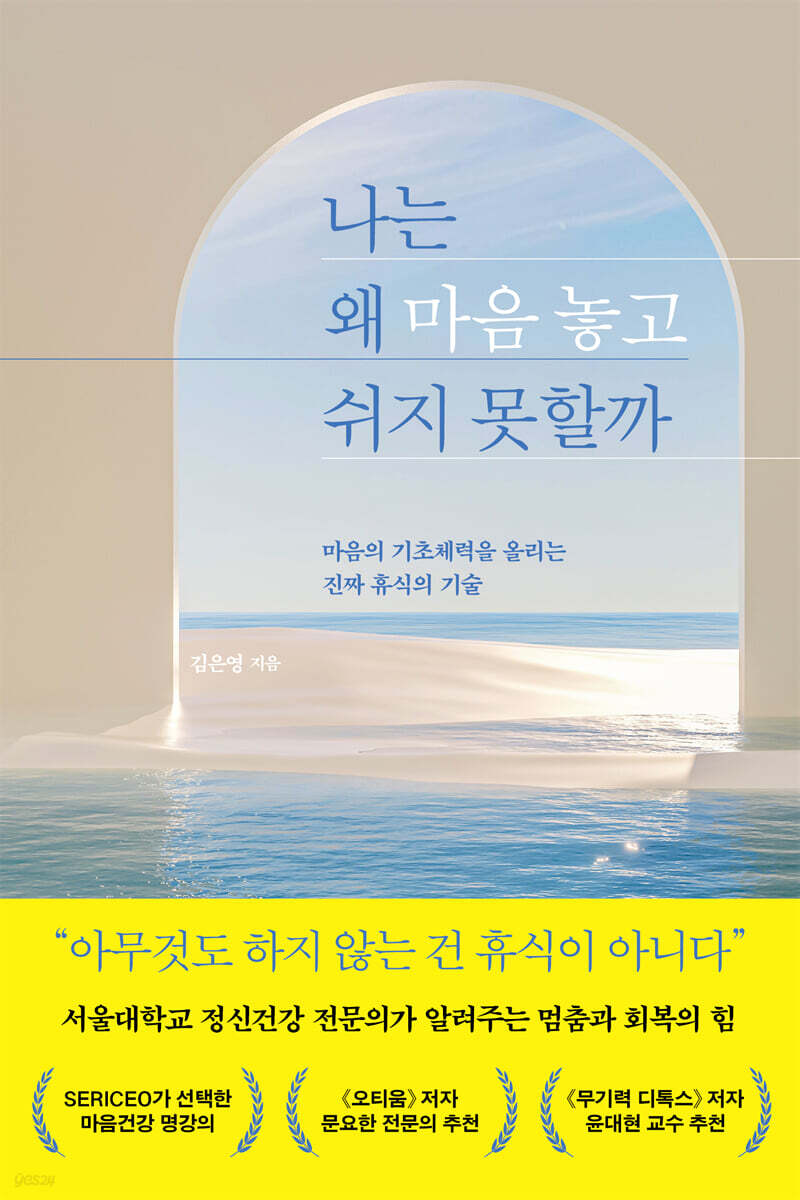
Why can't I rest easy?
 |
Description
Book Introduction
- A word from MD
-
You have to rest when you have to restIf you are tired no matter how much you rest, you may be suffering from chronic fatigue.
Why does chronic fatigue occur? It's because we're constantly exposed to stress and don't get enough rest.
You may be resting the wrong way.
Let's turn our attention away from excessive drinking and smartphones.
This is the book that should catch your eye.
April 29, 2025. Humanities PD Son Min-gyu
“Digging deep into the essence of good rest that leads to recovery.”
Moon Yo-han, MD, a psychiatrist and author of "Otium"
“It contains all the latest information and academic advancements on precious rest.”
Daehyun Yoon, Professor of Psychiatry at Seoul National University and author of "Apathy Detox"
When was the last time you felt refreshed, saying, "I had a good rest"? Do you find it hard to let go of work, even though you long for just one day of rest? Are you wasting your rare free time staring at electronic devices? If you feel fatigued no matter how much you rest, it's because your body and mind are missing out on the rest they need.
Professor Eunyoung Kim, a specialist in psychiatry at Seoul National University, diagnoses that modern people have forgotten how to rest as they are caught up in the highly competitive social atmosphere.
To this end, I have published a book titled "Why Can't I Rest Peacefully?", which systematically compiles effective rest methods to suggest a "real rest" method that recharges quality energy.
This book goes beyond the superficial advice of "you need to get enough rest." It identifies the causes of constant fatigue and redefines the standards for "true rest," helping you address the root causes that are sacrificing your energy.
Additionally, based on the latest brain science and psychiatry information and clinical experience, we design a "personalized rest" that is just right for you, and suggest ways to restore your body and mind and solutions to increase vitality.
If you want to address what's draining your precious energy and truly relax and enjoy it, read this book to discover what relaxation techniques will work best for you.
You will be able to break the cycle of lethargy, burnout, overwork, and self-reproach and move forward into a truly vibrant life.
Moon Yo-han, MD, a psychiatrist and author of "Otium"
“It contains all the latest information and academic advancements on precious rest.”
Daehyun Yoon, Professor of Psychiatry at Seoul National University and author of "Apathy Detox"
When was the last time you felt refreshed, saying, "I had a good rest"? Do you find it hard to let go of work, even though you long for just one day of rest? Are you wasting your rare free time staring at electronic devices? If you feel fatigued no matter how much you rest, it's because your body and mind are missing out on the rest they need.
Professor Eunyoung Kim, a specialist in psychiatry at Seoul National University, diagnoses that modern people have forgotten how to rest as they are caught up in the highly competitive social atmosphere.
To this end, I have published a book titled "Why Can't I Rest Peacefully?", which systematically compiles effective rest methods to suggest a "real rest" method that recharges quality energy.
This book goes beyond the superficial advice of "you need to get enough rest." It identifies the causes of constant fatigue and redefines the standards for "true rest," helping you address the root causes that are sacrificing your energy.
Additionally, based on the latest brain science and psychiatry information and clinical experience, we design a "personalized rest" that is just right for you, and suggest ways to restore your body and mind and solutions to increase vitality.
If you want to address what's draining your precious energy and truly relax and enjoy it, read this book to discover what relaxation techniques will work best for you.
You will be able to break the cycle of lethargy, burnout, overwork, and self-reproach and move forward into a truly vibrant life.
- You can preview some of the book's contents.
Preview
index
Introduction: To all who have forgotten how to rest without worry
Part 1: It's okay to just relax
Chapter 1: Why Doesn't Resting Make Me Feel Better?
- Can I really rest?
- You need to rest right now
- How to get real rest
There's a reason why Part 2 is so tiring.
Chapter 2: Why Can't I Rest Easy?
- I'm anxious even if I do it, and I'm anxious even if I don't do it
- Are you really 'too busy' to rest?
- If you feel guilty when you play
- Thoughts that whip me and keep me from resting
- A person who can't stand it when things don't go as planned
- If you feel like you've been living a life of nothing but wasted effort
Chapter 3: Why Do I Get Tired Even When I'm Still?
- I keep putting it off, and it gets harder.
- A life like a machine that moves the same every day
- A person who is frustrated because he doesn't know what to do
- I'm tired of dreaming but not taking action.
- If your life is empty because you have nothing you want to do
Part 3: A solid life with a solid rest
Chapter 4: Rest to Increase Your Mental Strength
Mindfulness, the first step toward becoming aware of your state
- A vivid sense of everyday life awakened by mindfulness
- Develop the ability to play and rest well
- How to design the rest I truly need
- The secret to sustaining myself even when everything feels overwhelming
Chapter 5: Sustainable Rest to Protect Precious Energy
- Let's recognize and let go of negative emotions.
- How to free yourself from the anxiety that plagues you
- First aid to put out the urgent fire in your heart
- Embrace me warmly and kindly
- Creating a resting place where I can rest my mind.
Conclusion: Until we reach true rest
References
Part 1: It's okay to just relax
Chapter 1: Why Doesn't Resting Make Me Feel Better?
- Can I really rest?
- You need to rest right now
- How to get real rest
There's a reason why Part 2 is so tiring.
Chapter 2: Why Can't I Rest Easy?
- I'm anxious even if I do it, and I'm anxious even if I don't do it
- Are you really 'too busy' to rest?
- If you feel guilty when you play
- Thoughts that whip me and keep me from resting
- A person who can't stand it when things don't go as planned
- If you feel like you've been living a life of nothing but wasted effort
Chapter 3: Why Do I Get Tired Even When I'm Still?
- I keep putting it off, and it gets harder.
- A life like a machine that moves the same every day
- A person who is frustrated because he doesn't know what to do
- I'm tired of dreaming but not taking action.
- If your life is empty because you have nothing you want to do
Part 3: A solid life with a solid rest
Chapter 4: Rest to Increase Your Mental Strength
Mindfulness, the first step toward becoming aware of your state
- A vivid sense of everyday life awakened by mindfulness
- Develop the ability to play and rest well
- How to design the rest I truly need
- The secret to sustaining myself even when everything feels overwhelming
Chapter 5: Sustainable Rest to Protect Precious Energy
- Let's recognize and let go of negative emotions.
- How to free yourself from the anxiety that plagues you
- First aid to put out the urgent fire in your heart
- Embrace me warmly and kindly
- Creating a resting place where I can rest my mind.
Conclusion: Until we reach true rest
References
Detailed image

Into the book
“Why on earth am I living such a tiring life?”
This is the question of my life.
I will probably be asking myself this question until I die.
Once you start thinking like this, it doesn't go away easily.
The meaning of work, the meaning of family, life and death, the meaning of happiness and unhappiness, etc… … .
As thoughts continue to follow one another, the mind becomes increasingly cluttered.
--- p.5
This book is the answer to these questions.
This is the result of my research, both for myself and to help, even if only a little, the countless people who have thankfully believed in me and come to me during the most difficult and painful moments.
Rather than simply suggesting a few rules and activities for resting, we've tried to include useful information that will help you understand yourself deeply and design a 'personalized' rest that's just right for you.
Here, various psychological theories and proven treatments used in psychiatry and treatment are incorporated throughout.
--- p.7
Rest does not require any special qualifications.
To do what I want to do for a long time, healthily and with motivation, I just need a 'work-rest' rhythm where I do what I need to do with a moderate amount of tension and then relax my body and mind sufficiently and rest.
(....) When I say, “There is no such thing as the right to rest,” patients are surprised and ask back:
“Can I really rest?”
--- p.25
If we look around us, we see people who work hard but also generously dedicate their time and energy to loving, caring, and sharing friendships.
So where do they get their energy? Rest.
Rest is a major source of energy for work and love.
You need to rest properly to be able to work as much as you want, and you need to be recharged internally to be able to love as much as you want.
Rest is an important aspect of life that is essential for creating a satisfying life where work and love are properly balanced.
This is why everyone needs proper, self-directed rest.
--- p.28~29
Surprisingly, many people think of rest as simply 'doing nothing'.
In fact, it is surprisingly easy to temporarily stop what you are doing.
In reality, many people spend hours on social media, internet articles, or YouTube without even realizing it while working.
And then I think that I've rested enough since I 'didn't work and just played'.
(....) Then let's think about it.
After spending time like this, did you experience a sense of rest, both physical and mental? Unfortunately, most of the workers and students I met didn't feel satisfied with the short break they had taken advantage of for a proper rest. Instead, they regretted wasting time, unable to focus on their work.
(...) Those who have difficulty resting properly do not have this problem because they are physically unable to stop working.
Rather, it is because they do not know how to recover their body and mind proactively and subjectively.
--- p.48~49
Only you know what kind of rest will work for you.
Because only by examining the sensations and emotions felt deep within your body and mind can you truly experience a sense of relaxation.
The only person who can be my relaxation designer is me.
To achieve proper rest, it is more important to be curious about yourself and pay attention to the emotions and sensations you experience in the big and small moments of everyday life than to consider external factors like the cost of activities, social skills, or environment.
--- p.58~59
So how can we cultivate the ability to enjoy life? Many people today, rather than seeking out uplifting situations or focusing on pleasant sensations to create a joyful life, are accustomed to dwelling on the pain, fear, and shame within themselves, and avoiding such emotions.
To achieve joy, it is just as important to broaden the range of positive emotions you experience and strengthen those emotions as it is to try to eliminate negative emotions.
--- p.98
Asking yourself forward-looking questions like, "What small steps can I take tomorrow to increase my moments of comfort and relaxation?", "What will fill me with comfort and energy?", or "What could I do with 10 minutes of downtime?" allows you to reflect deeply on the topic and explore various possibilities, even if there's no clear answer right away.
By consistently asking these good questions, you'll gain the ideas and courage to make changes, and you'll be able to move forward toward positive life changes.
--- p.112
The ability to play and rest is the power to experience everything from heightened excitement and joy to deep, calm comfort, and it provides a powerful foundation for resilience, allowing us to respond quickly and flexibly to stress and adapt to situations.
When you are feeling tired and worn out, the comfort and care you receive from others can be a great source of strength.
But the ability to fill yourself with joy and energy when you need it, or to relax and reach a state of calm, is even more empowering.
There are limits to being with others, but I am always with myself, and ultimately, the person who can take care of me whenever and wherever I need is myself.
--- p.239
While it's true that the foundation for the ability to play and relax is laid during childhood, even as adults, if we can recognize areas where we lack, we can still develop the ability to play and relax by filling those areas with positive experiences.
This is because the mind changes dynamically depending on what I am experiencing at the moment.
If you have positive experiences, mental growth can begin at any time in life and continue throughout your life.
--- p.243
Designing a personalized break for myself is like tapping into positive resources in a timely manner.
The more positive resources we have, the more we can reduce unnecessary tension and create peace and joy in our daily lives.
Moreover, no matter how difficult and arduous the moment of crisis may be, you can create a place of rest where you can take a moment to breathe and find peace of mind.
This is the question of my life.
I will probably be asking myself this question until I die.
Once you start thinking like this, it doesn't go away easily.
The meaning of work, the meaning of family, life and death, the meaning of happiness and unhappiness, etc… … .
As thoughts continue to follow one another, the mind becomes increasingly cluttered.
--- p.5
This book is the answer to these questions.
This is the result of my research, both for myself and to help, even if only a little, the countless people who have thankfully believed in me and come to me during the most difficult and painful moments.
Rather than simply suggesting a few rules and activities for resting, we've tried to include useful information that will help you understand yourself deeply and design a 'personalized' rest that's just right for you.
Here, various psychological theories and proven treatments used in psychiatry and treatment are incorporated throughout.
--- p.7
Rest does not require any special qualifications.
To do what I want to do for a long time, healthily and with motivation, I just need a 'work-rest' rhythm where I do what I need to do with a moderate amount of tension and then relax my body and mind sufficiently and rest.
(....) When I say, “There is no such thing as the right to rest,” patients are surprised and ask back:
“Can I really rest?”
--- p.25
If we look around us, we see people who work hard but also generously dedicate their time and energy to loving, caring, and sharing friendships.
So where do they get their energy? Rest.
Rest is a major source of energy for work and love.
You need to rest properly to be able to work as much as you want, and you need to be recharged internally to be able to love as much as you want.
Rest is an important aspect of life that is essential for creating a satisfying life where work and love are properly balanced.
This is why everyone needs proper, self-directed rest.
--- p.28~29
Surprisingly, many people think of rest as simply 'doing nothing'.
In fact, it is surprisingly easy to temporarily stop what you are doing.
In reality, many people spend hours on social media, internet articles, or YouTube without even realizing it while working.
And then I think that I've rested enough since I 'didn't work and just played'.
(....) Then let's think about it.
After spending time like this, did you experience a sense of rest, both physical and mental? Unfortunately, most of the workers and students I met didn't feel satisfied with the short break they had taken advantage of for a proper rest. Instead, they regretted wasting time, unable to focus on their work.
(...) Those who have difficulty resting properly do not have this problem because they are physically unable to stop working.
Rather, it is because they do not know how to recover their body and mind proactively and subjectively.
--- p.48~49
Only you know what kind of rest will work for you.
Because only by examining the sensations and emotions felt deep within your body and mind can you truly experience a sense of relaxation.
The only person who can be my relaxation designer is me.
To achieve proper rest, it is more important to be curious about yourself and pay attention to the emotions and sensations you experience in the big and small moments of everyday life than to consider external factors like the cost of activities, social skills, or environment.
--- p.58~59
So how can we cultivate the ability to enjoy life? Many people today, rather than seeking out uplifting situations or focusing on pleasant sensations to create a joyful life, are accustomed to dwelling on the pain, fear, and shame within themselves, and avoiding such emotions.
To achieve joy, it is just as important to broaden the range of positive emotions you experience and strengthen those emotions as it is to try to eliminate negative emotions.
--- p.98
Asking yourself forward-looking questions like, "What small steps can I take tomorrow to increase my moments of comfort and relaxation?", "What will fill me with comfort and energy?", or "What could I do with 10 minutes of downtime?" allows you to reflect deeply on the topic and explore various possibilities, even if there's no clear answer right away.
By consistently asking these good questions, you'll gain the ideas and courage to make changes, and you'll be able to move forward toward positive life changes.
--- p.112
The ability to play and rest is the power to experience everything from heightened excitement and joy to deep, calm comfort, and it provides a powerful foundation for resilience, allowing us to respond quickly and flexibly to stress and adapt to situations.
When you are feeling tired and worn out, the comfort and care you receive from others can be a great source of strength.
But the ability to fill yourself with joy and energy when you need it, or to relax and reach a state of calm, is even more empowering.
There are limits to being with others, but I am always with myself, and ultimately, the person who can take care of me whenever and wherever I need is myself.
--- p.239
While it's true that the foundation for the ability to play and relax is laid during childhood, even as adults, if we can recognize areas where we lack, we can still develop the ability to play and relax by filling those areas with positive experiences.
This is because the mind changes dynamically depending on what I am experiencing at the moment.
If you have positive experiences, mental growth can begin at any time in life and continue throughout your life.
--- p.243
Designing a personalized break for myself is like tapping into positive resources in a timely manner.
The more positive resources we have, the more we can reduce unnecessary tension and create peace and joy in our daily lives.
Moreover, no matter how difficult and arduous the moment of crisis may be, you can create a place of rest where you can take a moment to breathe and find peace of mind.
--- p.345
Publisher's Review
If I stay still, I become anxious,
I don't have the strength to do anything,
For you who think that resting is only temporary
The art of true relaxation that strengthens the basic physical strength of the mind
Even though they work the same hours, some people work efficiently, get enough rest, and live energetically, while others struggle to keep up with the daily tasks.
There are bound to be big differences in the level of satisfaction with life.
Why do these differences arise? Professor Kim Eun-young, a specialist in psychiatry at Seoul National University, explains that the strength of our "ability to play and rest" determines how well we can maintain a stable daily routine.
People with a strong capacity for play and rest are able to cope well with both large and small stresses in their daily lives and have good resilience, allowing them to focus steadily on work and relax comfortably in their free time.
On the other hand, people who lack the ability to play and rest tend to suppress their anxiety and handle work when they feel mentally burdened, and due to lack of resilience, they are unable to relax even in their free time.
Therefore, the author argues that if you want to design a comfortable and leisurely life, you must focus on sufficiently developing the 'ability to play and rest' above all else.
“Doing nothing is not rest!”
The true conditions of rest we didn't know about
The author is a specialist with 12 years of experience treating the mental health of over 10,000 young people at the Seoul National University Mental Health Center, and a 'rest' expert who has been giving lectures on rest, self-care, and stress management for entrepreneurs and leaders at SERICEO since 2020.
In this book, the author identifies common, flawed rest habits we see around us and suggests practical ways to improve them.
In particular, as a mental health specialist who has treated tens of thousands of patients, the author has come to realize that many people consider 'doing nothing' and 'being still' to be rest.
In reality, many people spend their free time looking at their smartphones or lying in bed, thinking that they have rested enough because they have been 'playing around' instead of working.
But as we all know, this kind of rest doesn't replenish quality energy and leaves only a feeling of emptiness, of having wasted time.
The author specifically defines rest as “a state of stopping physical and mental activity for a moment, catching one’s breath, and recovering one’s body and mind for survival (p. 50).”
And he explains that for true rest, the two elements of ‘pause’ and ‘recovery’ must coexist.
For example, spending free time mindlessly looking at your phone satisfies the requirement of 'pause' but does not meet the requirement of 'recovery', so it is not a good way to relax.
Let's look at the items below and reflect on how much of the relaxation methods I've thought about so far meet the criteria for 'true relaxation.'
Simply checking the direction of your rest can help relieve the heavy burden of life and bring about positive changes in your daily life.
1.
Do you feel a clear sense of positive emotion and feeling?
2.
Do positive emotions and feelings persist after rest?
3.
Does rest give me the senses and emotions I need?
4.
Was the break voluntary? Was it done actively?
5.
Is this a healthy and sustainable way to live?
“Relaxation doesn’t require qualifications.”
The first step toward true recovery
“Can I really rest?”
This is something the author has heard countless times in the clinic.
But there were times when even he himself could not give a proper answer to this question.
The author also lived “with the feeling that a day would have to be 36 hours long to do everything, play, and rest (p. 78).”
Even as I grew exhausted from the endless cycle of treatment, research, lectures, childbirth, and childcare, I tried every relaxation method that others recommended to instill comfort and vitality in myself.
But even when I had free time, I couldn't lie down comfortably, and with the uncomfortable feeling that I had to do something, I kept checking my email out of habit and couldn't let go of preparing for the lecture.
Living contradictory days where he rests harder than anyone else but cannot, the author realized that the core of his problem was that he was 'not mentally prepared to rest.'
The biggest problem I faced was that I was neither prepared nor in the right frame of mind to properly use my time to rest.
I couldn't just lament, "All working moms are like that," like people in similar situations who came to the clinic with burnout.
It took a process of exploring why I felt I had no time, how I could secure time while working, and how I would spend it if I did.
This important fact finally came to my attention after days of worrying about how to rest.
(Page 80)
Truly effective rest begins with identifying what is keeping you from resting.
The author compiles case studies of various patients he has encountered in his clinic, helping anyone identify the problems they are experiencing and understand their causes.
This book broadly and delicately diagnoses the minds of those who are exhausted from the tension and burden of procrastination, those who criticize and whip themselves for not being worthy of rest, those who live as if always being chased by something and cannot rest for a moment, those who escape into work or highly addictive activities, those who have fallen into mannerism due to the repetitive daily routine, and even those who find life difficult even though they do not do anything special.
In this way, this book introduces the 'real relaxation method' that promotes a healthy life through three parts and five chapters based on the author's accumulated clinical cases, the latest research, and personal experiences.
Part 1, consisting of one chapter, identifies the reasons why we get tired and cannot rest properly, and presents the conditions for 'true rest' that we have been missing.
In Part 2, we diagnose the reasons why we cannot rest comfortably and end up overworking ourselves (Chapter 2) and the fundamental causes of our inner fatigue even when we are still (Part 3), and we analyze each case in detail and provide practical solutions to resolve each problem.
Part 3 guides you through how to develop the ability to 'play well and rest well' (Chapter 4), and guides you through designing long-term rest that goes beyond short-term fatigue relief and continuously maintains a healthy daily life (Chapter 5).
"Why Can't I Rest?" is a journey to correct the elements that sap the vitality of our precious daily lives and to discover the rest that our bodies and minds truly desire.
We will explore how to develop the ability to 'play and rest', a systematic approach to sustainable recovery, mindfulness to awaken positive feelings in small moments of daily life, creating an environment for rest, self-care to manage my mental state, and rest to refresh myself. We will also look at how to find positive resources around me that can provide positive feelings anytime, anywhere.
If you're losing the meaning of life due to your busy daily life, I recommend this book written by a relaxation expert.
It will provide solutions that will bring you a sense of deep rest and increase your overall satisfaction in your daily life.
I don't have the strength to do anything,
For you who think that resting is only temporary
The art of true relaxation that strengthens the basic physical strength of the mind
Even though they work the same hours, some people work efficiently, get enough rest, and live energetically, while others struggle to keep up with the daily tasks.
There are bound to be big differences in the level of satisfaction with life.
Why do these differences arise? Professor Kim Eun-young, a specialist in psychiatry at Seoul National University, explains that the strength of our "ability to play and rest" determines how well we can maintain a stable daily routine.
People with a strong capacity for play and rest are able to cope well with both large and small stresses in their daily lives and have good resilience, allowing them to focus steadily on work and relax comfortably in their free time.
On the other hand, people who lack the ability to play and rest tend to suppress their anxiety and handle work when they feel mentally burdened, and due to lack of resilience, they are unable to relax even in their free time.
Therefore, the author argues that if you want to design a comfortable and leisurely life, you must focus on sufficiently developing the 'ability to play and rest' above all else.
“Doing nothing is not rest!”
The true conditions of rest we didn't know about
The author is a specialist with 12 years of experience treating the mental health of over 10,000 young people at the Seoul National University Mental Health Center, and a 'rest' expert who has been giving lectures on rest, self-care, and stress management for entrepreneurs and leaders at SERICEO since 2020.
In this book, the author identifies common, flawed rest habits we see around us and suggests practical ways to improve them.
In particular, as a mental health specialist who has treated tens of thousands of patients, the author has come to realize that many people consider 'doing nothing' and 'being still' to be rest.
In reality, many people spend their free time looking at their smartphones or lying in bed, thinking that they have rested enough because they have been 'playing around' instead of working.
But as we all know, this kind of rest doesn't replenish quality energy and leaves only a feeling of emptiness, of having wasted time.
The author specifically defines rest as “a state of stopping physical and mental activity for a moment, catching one’s breath, and recovering one’s body and mind for survival (p. 50).”
And he explains that for true rest, the two elements of ‘pause’ and ‘recovery’ must coexist.
For example, spending free time mindlessly looking at your phone satisfies the requirement of 'pause' but does not meet the requirement of 'recovery', so it is not a good way to relax.
Let's look at the items below and reflect on how much of the relaxation methods I've thought about so far meet the criteria for 'true relaxation.'
Simply checking the direction of your rest can help relieve the heavy burden of life and bring about positive changes in your daily life.
1.
Do you feel a clear sense of positive emotion and feeling?
2.
Do positive emotions and feelings persist after rest?
3.
Does rest give me the senses and emotions I need?
4.
Was the break voluntary? Was it done actively?
5.
Is this a healthy and sustainable way to live?
“Relaxation doesn’t require qualifications.”
The first step toward true recovery
“Can I really rest?”
This is something the author has heard countless times in the clinic.
But there were times when even he himself could not give a proper answer to this question.
The author also lived “with the feeling that a day would have to be 36 hours long to do everything, play, and rest (p. 78).”
Even as I grew exhausted from the endless cycle of treatment, research, lectures, childbirth, and childcare, I tried every relaxation method that others recommended to instill comfort and vitality in myself.
But even when I had free time, I couldn't lie down comfortably, and with the uncomfortable feeling that I had to do something, I kept checking my email out of habit and couldn't let go of preparing for the lecture.
Living contradictory days where he rests harder than anyone else but cannot, the author realized that the core of his problem was that he was 'not mentally prepared to rest.'
The biggest problem I faced was that I was neither prepared nor in the right frame of mind to properly use my time to rest.
I couldn't just lament, "All working moms are like that," like people in similar situations who came to the clinic with burnout.
It took a process of exploring why I felt I had no time, how I could secure time while working, and how I would spend it if I did.
This important fact finally came to my attention after days of worrying about how to rest.
(Page 80)
Truly effective rest begins with identifying what is keeping you from resting.
The author compiles case studies of various patients he has encountered in his clinic, helping anyone identify the problems they are experiencing and understand their causes.
This book broadly and delicately diagnoses the minds of those who are exhausted from the tension and burden of procrastination, those who criticize and whip themselves for not being worthy of rest, those who live as if always being chased by something and cannot rest for a moment, those who escape into work or highly addictive activities, those who have fallen into mannerism due to the repetitive daily routine, and even those who find life difficult even though they do not do anything special.
In this way, this book introduces the 'real relaxation method' that promotes a healthy life through three parts and five chapters based on the author's accumulated clinical cases, the latest research, and personal experiences.
Part 1, consisting of one chapter, identifies the reasons why we get tired and cannot rest properly, and presents the conditions for 'true rest' that we have been missing.
In Part 2, we diagnose the reasons why we cannot rest comfortably and end up overworking ourselves (Chapter 2) and the fundamental causes of our inner fatigue even when we are still (Part 3), and we analyze each case in detail and provide practical solutions to resolve each problem.
Part 3 guides you through how to develop the ability to 'play well and rest well' (Chapter 4), and guides you through designing long-term rest that goes beyond short-term fatigue relief and continuously maintains a healthy daily life (Chapter 5).
"Why Can't I Rest?" is a journey to correct the elements that sap the vitality of our precious daily lives and to discover the rest that our bodies and minds truly desire.
We will explore how to develop the ability to 'play and rest', a systematic approach to sustainable recovery, mindfulness to awaken positive feelings in small moments of daily life, creating an environment for rest, self-care to manage my mental state, and rest to refresh myself. We will also look at how to find positive resources around me that can provide positive feelings anytime, anywhere.
If you're losing the meaning of life due to your busy daily life, I recommend this book written by a relaxation expert.
It will provide solutions that will bring you a sense of deep rest and increase your overall satisfaction in your daily life.
GOODS SPECIFICS
- Date of issue: April 15, 2025
- Page count, weight, size: 356 pages | 522g | 140*210*24mm
- ISBN13: 9791172540531
You may also like
카테고리
korean


korean

![GQ KOREA Mark (Monthly): December [2025]](http://librairie.coreenne.fr/cdn/shop/files/8ef265dbbfbf186523ed75ba7319009d.jpg?v=1765340328&width=3840)


