

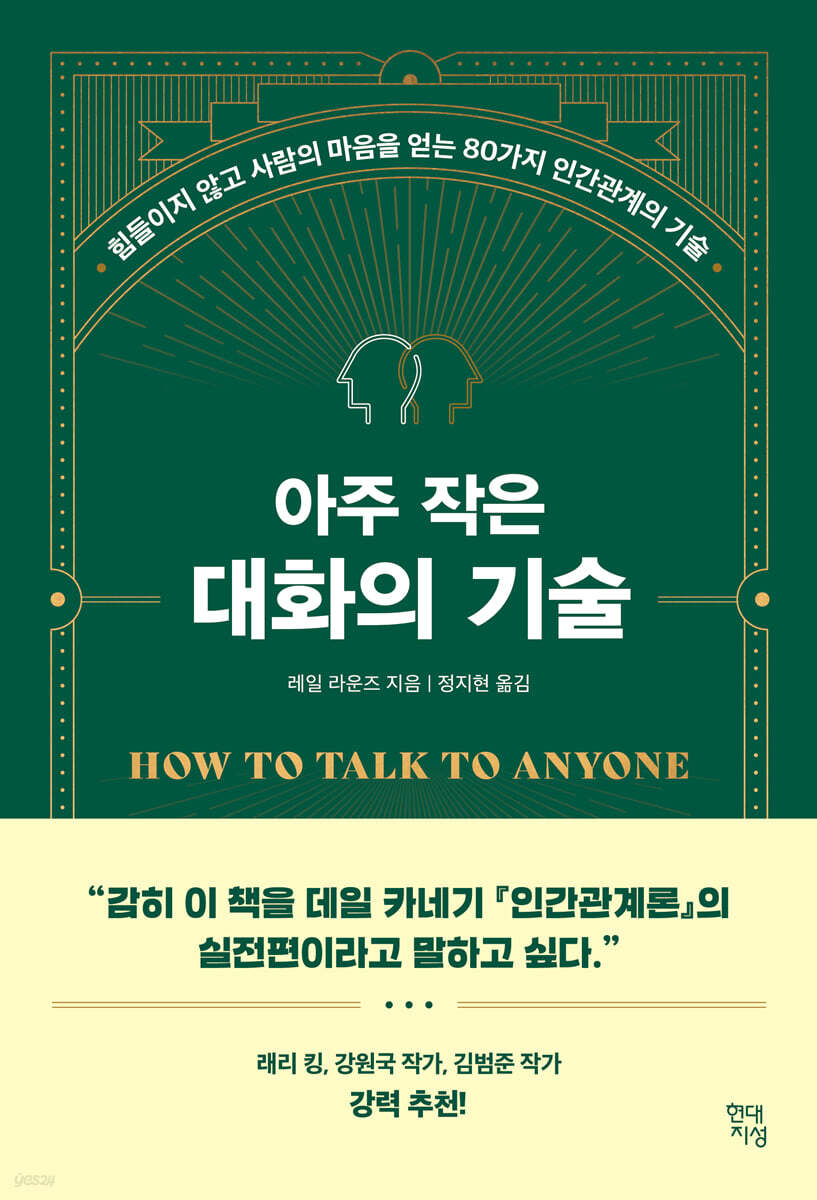
The Art of Small Talk
 |
Description
Book Introduction
“I dare say this book is Dale Carnegie’s 『How to Win Friends and Influence People』
I would like to say that it is a practical version.”
Larry King, Kang Won-guk, and Kim Beom-jun
Highly recommended!
People who are rich in relationships
I use this 'small but certain' technique today too.
There are people in the world who are loved by everyone and welcomed everywhere.
They excel in business, are respected socially, and enjoy rich relationships.
We call them 'relationship rich'.
What is their secret? Surprisingly, the answer lies in the art of small talk.
Through conversation, they open the other person's heart, build trust, and bring about positive change.
He embraces the grieving with a single word of sincere comfort, and sometimes melts the cold atmosphere with a witty joke.
Great leaders, outstanding salespeople, and experts in their fields all share these characteristics.
They have the quick wit to say the right thing at the right time, the ability to keep the conversation going, and the sensitivity to sometimes express empathy through silence.
"The Art of Small Conversations" delves into the communication secrets of these interpersonal relationships.
It covers everything from first impressions to win people over, to how to handle difficult conversations, to conflict resolution strategies.
In addition to these, the 80 skills introduced in this book, including the skills to read and empathize with others' emotions and confidently express your opinions in front of others, will make you a master of conversation.
Since its publication in 2003, this book has maintained its position as a top bestseller in the communications category on Amazon in the United States for over 20 years.
It is also notable that there are over 13,000 reviews written by readers around the world who were impressed by the excellent effects after applying it in their daily lives, and the number is still increasing.
Rather than abstract theories, it contains practical content that anyone can apply to various situations they encounter in their daily lives, so you can immediately see its value no matter what technology you use.
The quality of life ultimately comes from the quality of human relationships.
And even at this very moment, wealthy people in human relations are utilizing the techniques contained in this book.
Let's learn rather than envy, and let's learn at least one thing rather than resent.
Like those who captivate people's hearts with the art of small talk, why not start learning these skills one by one starting today?
None of the 80 methods introduced in this book are worth discarding.
I read each and every one, underlining and marking them with stars.
The author provides vivid examples that fit our emotions and situations, as if he wrote the book exclusively for Korean readers.
I dare say that this book is a practical version of Dale Carnegie's 'How to Win Friends and Influence People'.
--- Kang Won-guk | Author of "Kang Won-guk's Life Study" and "The President's Writing"
I would like to say that it is a practical version.”
Larry King, Kang Won-guk, and Kim Beom-jun
Highly recommended!
People who are rich in relationships
I use this 'small but certain' technique today too.
There are people in the world who are loved by everyone and welcomed everywhere.
They excel in business, are respected socially, and enjoy rich relationships.
We call them 'relationship rich'.
What is their secret? Surprisingly, the answer lies in the art of small talk.
Through conversation, they open the other person's heart, build trust, and bring about positive change.
He embraces the grieving with a single word of sincere comfort, and sometimes melts the cold atmosphere with a witty joke.
Great leaders, outstanding salespeople, and experts in their fields all share these characteristics.
They have the quick wit to say the right thing at the right time, the ability to keep the conversation going, and the sensitivity to sometimes express empathy through silence.
"The Art of Small Conversations" delves into the communication secrets of these interpersonal relationships.
It covers everything from first impressions to win people over, to how to handle difficult conversations, to conflict resolution strategies.
In addition to these, the 80 skills introduced in this book, including the skills to read and empathize with others' emotions and confidently express your opinions in front of others, will make you a master of conversation.
Since its publication in 2003, this book has maintained its position as a top bestseller in the communications category on Amazon in the United States for over 20 years.
It is also notable that there are over 13,000 reviews written by readers around the world who were impressed by the excellent effects after applying it in their daily lives, and the number is still increasing.
Rather than abstract theories, it contains practical content that anyone can apply to various situations they encounter in their daily lives, so you can immediately see its value no matter what technology you use.
The quality of life ultimately comes from the quality of human relationships.
And even at this very moment, wealthy people in human relations are utilizing the techniques contained in this book.
Let's learn rather than envy, and let's learn at least one thing rather than resent.
Like those who captivate people's hearts with the art of small talk, why not start learning these skills one by one starting today?
None of the 80 methods introduced in this book are worth discarding.
I read each and every one, underlining and marking them with stars.
The author provides vivid examples that fit our emotions and situations, as if he wrote the book exclusively for Korean readers.
I dare say that this book is a practical version of Dale Carnegie's 'How to Win Friends and Influence People'.
--- Kang Won-guk | Author of "Kang Won-guk's Life Study" and "The President's Writing"
- You can preview some of the book's contents.
Preview
index
Entering
Part 1.
A unique presence: How to come across as a pretty decent person without saying a word.
1. Micro-Tuning: Speed Matters
2 Eye Contact: To appear intelligent and insightful
3 How to Create Affinity Through Eye Contact
4. Have an attitude that makes you look like a winner wherever you go.
5. Respect the other person's 'inner child'
6 How to Become Best Friends the First Time You Meet
7 Ways to Appear 100 Percent Trustworthy
8. Read people's minds through facial expressions and gestures.
9 Communication Techniques for Completing a Conversation Through Heart-to-Heart Conversation
Part 2.
Mastering the Beginning: The Art of Starting and Maintaining Captivating Conversations
10 Mood Matching Makes Small Talk a Success
11. The First Step to Communication: How to Make Your First Meeting Enjoyable
12 To get others to talk to me
13 Interest Approach: This is how to approach new relationships.
14 How to participate in natural conversation
15 Let your smile be heard
16 How to answer obvious questions in a non-obvious way
17 Add a Spoonful of Wit to Your Job Description
18 Introductions That Keep the Conversation Going
Become a 19-Word Detective
20 Principles of Engaging Conversation: Shine the Spotlight on the Other Person
21 How to Stop Worrying About What to Say Next
22 Ways to Get Your Partner Talking
23 The moment when a sincere story opens the door to the heart
24 Prepare a conversation package that sets the mood
Part 3.
Situational Conversation Strategies: Small but Embarrassing Communication Skills
25 Find out what the other person is doing (without asking)
26 Most Attractive Ways to Present Your Work
27 Secrets to Adding Sense to Conversations
28 One ultimate technique to make stories bloom
29 If you want favor, use second-person speaking.
30 Don't show the same smile to everyone
31 If you don't want to look like an idiot
32 Steal Wording from Motivational Experts
33 Winners' Talk: Don't Hide Behind Euphemisms
34 Worst Conversation Habits
35 Ways to Deliver Bad News (and Make Someone Like You More)
36 When you don't want to answer questions
37 Be specific about your reasons for gratitude.
38 Phone Etiquette to Make a Good Impression
39 How to Understand Between the Lines in a Phone Call
Part 4.
The Art of Winning People: 25 Ways to Stand Out Wherever You Go
40 How to Become a Modern Renaissance Man
41 How to Appear Knowledgeable About Someone's Occupation or Hobbies
42 Find out what your partner is most interested in.
43 Identify hot issues
44 Learn global manners, the success or failure of your conversation depends on them.
45 Learn some technical terms
46 Conversation becomes easier when you adapt to the other person's style.
47 Echo in the other person's language
48 The Power of Metaphor: The Secret Weapon of Communication
49 Empathy Expression 1: Empathizing with Meaningful Sounds
50 Empathy Expressions 2: Empathizing Through Multiple Senses
51 Four-Step Conversation Strategy to Deepen Relationships
52 The bond created by shared experiences
53 Complimenting Someone Behind Their Backs: How to Genuinely Acknowledge Someone
54 Convey good feelings
55 Secrets to Sincere Compliments
56 Praise in Parentheses: The Art of Subtly Captivating
57 Give a compliment that kills you sometimes
58 How to Make Someone Smile with a Small Compliment
59 Praise at the right time is like apples of gold in settings of silver.
60 Accept compliments from others.
61 The Art of Giving the Most Meaningful Compliments in Life
62 How to Attract People at a Gathering
63 Make the other person the protagonist
64 Leave your own trace of conversation
Part 5.
The Communication Skills of the 1% Pros: 80% of Success Depends on This
65. Forgive your opponent's mistakes and gain favor in return.
66 Small favors that spark conversation
67. Be clear about the benefits that will be returned to people.
68 How to Make Someone Want to Do You a Favor
69 When giving a favor, do it without expectations.
At the 70th party, only light conversation is allowed.
71 Eat only when you are eating.
72 Respect the other person's resting place
73 Things You Need to Know Before Sharing Important Information
74 Keys to Sales Success: How to Read Nonverbal Cues
75 Use the other person's feelings as the key
76 How to Make Someone Like You Even When You Make Mistakes
77 The Winner's Dignity, the Skill of Saving Face
78 Smart Strategies That Will Make You a VIP
79 The leader claps first
80. High-level players excel at self-objectification.
Americas
Part 1.
A unique presence: How to come across as a pretty decent person without saying a word.
1. Micro-Tuning: Speed Matters
2 Eye Contact: To appear intelligent and insightful
3 How to Create Affinity Through Eye Contact
4. Have an attitude that makes you look like a winner wherever you go.
5. Respect the other person's 'inner child'
6 How to Become Best Friends the First Time You Meet
7 Ways to Appear 100 Percent Trustworthy
8. Read people's minds through facial expressions and gestures.
9 Communication Techniques for Completing a Conversation Through Heart-to-Heart Conversation
Part 2.
Mastering the Beginning: The Art of Starting and Maintaining Captivating Conversations
10 Mood Matching Makes Small Talk a Success
11. The First Step to Communication: How to Make Your First Meeting Enjoyable
12 To get others to talk to me
13 Interest Approach: This is how to approach new relationships.
14 How to participate in natural conversation
15 Let your smile be heard
16 How to answer obvious questions in a non-obvious way
17 Add a Spoonful of Wit to Your Job Description
18 Introductions That Keep the Conversation Going
Become a 19-Word Detective
20 Principles of Engaging Conversation: Shine the Spotlight on the Other Person
21 How to Stop Worrying About What to Say Next
22 Ways to Get Your Partner Talking
23 The moment when a sincere story opens the door to the heart
24 Prepare a conversation package that sets the mood
Part 3.
Situational Conversation Strategies: Small but Embarrassing Communication Skills
25 Find out what the other person is doing (without asking)
26 Most Attractive Ways to Present Your Work
27 Secrets to Adding Sense to Conversations
28 One ultimate technique to make stories bloom
29 If you want favor, use second-person speaking.
30 Don't show the same smile to everyone
31 If you don't want to look like an idiot
32 Steal Wording from Motivational Experts
33 Winners' Talk: Don't Hide Behind Euphemisms
34 Worst Conversation Habits
35 Ways to Deliver Bad News (and Make Someone Like You More)
36 When you don't want to answer questions
37 Be specific about your reasons for gratitude.
38 Phone Etiquette to Make a Good Impression
39 How to Understand Between the Lines in a Phone Call
Part 4.
The Art of Winning People: 25 Ways to Stand Out Wherever You Go
40 How to Become a Modern Renaissance Man
41 How to Appear Knowledgeable About Someone's Occupation or Hobbies
42 Find out what your partner is most interested in.
43 Identify hot issues
44 Learn global manners, the success or failure of your conversation depends on them.
45 Learn some technical terms
46 Conversation becomes easier when you adapt to the other person's style.
47 Echo in the other person's language
48 The Power of Metaphor: The Secret Weapon of Communication
49 Empathy Expression 1: Empathizing with Meaningful Sounds
50 Empathy Expressions 2: Empathizing Through Multiple Senses
51 Four-Step Conversation Strategy to Deepen Relationships
52 The bond created by shared experiences
53 Complimenting Someone Behind Their Backs: How to Genuinely Acknowledge Someone
54 Convey good feelings
55 Secrets to Sincere Compliments
56 Praise in Parentheses: The Art of Subtly Captivating
57 Give a compliment that kills you sometimes
58 How to Make Someone Smile with a Small Compliment
59 Praise at the right time is like apples of gold in settings of silver.
60 Accept compliments from others.
61 The Art of Giving the Most Meaningful Compliments in Life
62 How to Attract People at a Gathering
63 Make the other person the protagonist
64 Leave your own trace of conversation
Part 5.
The Communication Skills of the 1% Pros: 80% of Success Depends on This
65. Forgive your opponent's mistakes and gain favor in return.
66 Small favors that spark conversation
67. Be clear about the benefits that will be returned to people.
68 How to Make Someone Want to Do You a Favor
69 When giving a favor, do it without expectations.
At the 70th party, only light conversation is allowed.
71 Eat only when you are eating.
72 Respect the other person's resting place
73 Things You Need to Know Before Sharing Important Information
74 Keys to Sales Success: How to Read Nonverbal Cues
75 Use the other person's feelings as the key
76 How to Make Someone Like You Even When You Make Mistakes
77 The Winner's Dignity, the Skill of Saving Face
78 Smart Strategies That Will Make You a VIP
79 The leader claps first
80. High-level players excel at self-objectification.
Americas
Detailed image

Into the book
If you look around, there are people who are doing well and who seem to have nothing to envy.
Whether you speak confidently in a business meeting or lead the atmosphere at any social gathering,
Surprisingly, he has a great job, a wonderful spouse, and great friends.
He has a large bank account and lives in a wealthy neighborhood.
But wait! Most of them aren't smarter than you.
I didn't even study much.
They're not even better looking! So what's the secret to their success? (If you think it's because they were born with a silver spoon in their mouth, married well, or were simply lucky, you've learned nothing more.
In fact, such people are very few in number.) As a result, they are good at handling people.
That is the core skill that this book is trying to talk about.
(…)
So what's their secret? There are probably several.
The economic power that strengthens friendships and makes people treat others generously, the secret to winning hearts, the way of speaking that wins everyone's love, etc.
They also have the characteristics that allow them to join good companies and thrive, the appeal that turns customers into repeat customers, and the competitive edge that makes people buy from them rather than their competitors.
It is true that everyone has one or two of these special moves, and the more you have, the more powerful you appear.
People who have a lot of that are the great winners.
In this book, "The Art of Small Conversations," I'll share 80 small but effective techniques that winners use every day.
Through this, you too can master the game of life and achieve whatever you desire.
--- pp.15-16
One day, I was visiting Bob's studio.
I asked how he could capture people's personalities so accurately.
“It’s simple.
“Just look at the people.”
“No, I’m just curious about how you figure out people’s personalities.
“Aren’t you trying to find out about their past or lifestyle in advance?”
“No, I just look at them.”
Bob explained in detail.
“Almost all of a person’s personality traits are revealed in their appearance, posture, and movements.
For example…,” he explained, pointing to a caricature of a politician.
"look.
“This smile is Clinton’s boyish charm, these shoulders the awkwardness of George W. Bush Sr., these eyes the charm of Reagan, this tilted head the cunning of Nixon, this nose the pride of Franklin Roosevelt,” he said. “According to him, it’s all in the face and body.”
First impressions are strong and don't fade away.
In a world where information is overflowing and stimulation is overwhelming, our brains are reeling.
Quick judgment is necessary to understand the world and get things done.
So every time people meet you, they take a snapshot in their head.
That image becomes the data they continually refer to.
--- pp.26-27
The problem is that even in important conversations, if you feel nervous or threatened, you will react in a way that resembles lying.
For example, a young man bragging about his business success to an attractive woman might adjust his posture to avoid being noticed, and a woman talking about her company's sales to an important client might touch her neck nervously.
However, problems can arise depending on the situation.
A businessman pulling on his collar may not be because he's nervous, but because it's hot in the room.
When politicians blink excessively while giving speeches outdoors, it could be because of the dust.
But even with these other causes, unnatural movements can still make the other person feel strange or think the speaker is lying.
Communication experts, well aware of this danger, thoroughly eliminate the possibility of appearing vulnerable.
They keep their eyes fixed on the listener and never bring their hands to their face.
Even if your arm is numb, don't rub it, and even if your nose is ticklish, don't touch it.
You don't pull on your collar because it's hot, and you don't blink excessively because there's dust in your eyes.
In public, he doesn't even wipe away sweat or block out the sunlight.
I tolerate the discomfort for a moment because I know that showing anxiety lowers my credibility.
--- pp.64-64
A few years ago, my friend Diane and I went to a party full of elegant people.
Everyone there seemed to be living wonderful lives.
Later, talking about that party, I asked Diane:
“Diane, there were a lot of fun people at that party.
“Who did you enjoy talking to the most?”
Diane answered without hesitation, “Of course, Dan Smith.”
“What do you do for a living?”
“Well, I don’t know about that.”
“Where do you live?”
“I don’t know that either.”
“Then what are his interests?”
“Well, we didn’t talk about that.”
“Diane, what on earth were you talking about with that guy?” I asked.
“Well, he mostly asked me.”
Diane could tell she had met a master conversationalist.
By chance, a few months later, I had the opportunity to meet Dan.
It turns out Dan lives in Paris and has homes in the south of France and the Swiss Alps.
He travels the world producing sound and light programs about pyramids and ancient ruins, and enjoys gliding and scuba diving.
Isn't that a truly interesting life? Yet, he barely talked about himself.
Diane mentioned that she didn't know much about Dan even after talking to him.
Dan's answer was simple.
“You can learn a lot more by asking people you meet for the first time about their stories.
“I always try to shine the spotlight on the other person.” Confident people like this know that listening is more important than speaking.
That's how you captivate your opponent.
--- pp.116-117
Customer service experts see mistakes as opportunities.
They know that mistakes are actually moments that can shine a brand.
If the other person makes a mistake and suffers, you should immediately move beyond that issue and provide them with a greater benefit.
The principle is, “Let the other person benefit from my mistakes.”
One time, I was in a major client's office and tripped on the carpet and broke a vase.
The next day, I paid the price with a new vase and fresh roses, which were significantly more expensive.
The customer said that every time he called, he looked at the vase and smiled.
Although it was expensive, I felt it conveyed a level of thoughtfulness that money cannot express.
My mistake turned into someone else's advantage, and our relationship became stronger.
--- pp.328-329
Imagine you're sitting in an auditorium with hundreds of colleagues, listening to a CEO present a new idea.
You might think that your facial expressions won't be visible to the person standing on the podium.
But that's a mistake.
The person standing on the podium perceives the audience's smiles, frowns, shining eyes, and other signals that symbolize human intelligence.
The representative also looks at the audience somewhat anxiously while giving the presentation, watching everything.
Notice the gaze, the empathetic and unempathetic employees, and who has the potential to become a winner.
How can that be?
Because the winners in the audience show their support even when they don't agree with the president's opinion.
They know what it's like to stand on the podium.
I understand that even the strongest person can't help but worry about how people will react when speaking in front of others.
When a company leader stands before a microphone, electrifies the room, captivating the audience with his captivating final words, does he not know who was moved and who remained indifferent? Even as he concludes his speech, bows his head in thanks, he remembers precisely who gave the first applause and how quickly and passionately it was given.
Be the first to clap, the first to stand, and if the atmosphere allows, the first to shout 'Bravo'.
This way, you can share some of the energy that the person on the stage enjoys.
Whether you speak confidently in a business meeting or lead the atmosphere at any social gathering,
Surprisingly, he has a great job, a wonderful spouse, and great friends.
He has a large bank account and lives in a wealthy neighborhood.
But wait! Most of them aren't smarter than you.
I didn't even study much.
They're not even better looking! So what's the secret to their success? (If you think it's because they were born with a silver spoon in their mouth, married well, or were simply lucky, you've learned nothing more.
In fact, such people are very few in number.) As a result, they are good at handling people.
That is the core skill that this book is trying to talk about.
(…)
So what's their secret? There are probably several.
The economic power that strengthens friendships and makes people treat others generously, the secret to winning hearts, the way of speaking that wins everyone's love, etc.
They also have the characteristics that allow them to join good companies and thrive, the appeal that turns customers into repeat customers, and the competitive edge that makes people buy from them rather than their competitors.
It is true that everyone has one or two of these special moves, and the more you have, the more powerful you appear.
People who have a lot of that are the great winners.
In this book, "The Art of Small Conversations," I'll share 80 small but effective techniques that winners use every day.
Through this, you too can master the game of life and achieve whatever you desire.
--- pp.15-16
One day, I was visiting Bob's studio.
I asked how he could capture people's personalities so accurately.
“It’s simple.
“Just look at the people.”
“No, I’m just curious about how you figure out people’s personalities.
“Aren’t you trying to find out about their past or lifestyle in advance?”
“No, I just look at them.”
Bob explained in detail.
“Almost all of a person’s personality traits are revealed in their appearance, posture, and movements.
For example…,” he explained, pointing to a caricature of a politician.
"look.
“This smile is Clinton’s boyish charm, these shoulders the awkwardness of George W. Bush Sr., these eyes the charm of Reagan, this tilted head the cunning of Nixon, this nose the pride of Franklin Roosevelt,” he said. “According to him, it’s all in the face and body.”
First impressions are strong and don't fade away.
In a world where information is overflowing and stimulation is overwhelming, our brains are reeling.
Quick judgment is necessary to understand the world and get things done.
So every time people meet you, they take a snapshot in their head.
That image becomes the data they continually refer to.
--- pp.26-27
The problem is that even in important conversations, if you feel nervous or threatened, you will react in a way that resembles lying.
For example, a young man bragging about his business success to an attractive woman might adjust his posture to avoid being noticed, and a woman talking about her company's sales to an important client might touch her neck nervously.
However, problems can arise depending on the situation.
A businessman pulling on his collar may not be because he's nervous, but because it's hot in the room.
When politicians blink excessively while giving speeches outdoors, it could be because of the dust.
But even with these other causes, unnatural movements can still make the other person feel strange or think the speaker is lying.
Communication experts, well aware of this danger, thoroughly eliminate the possibility of appearing vulnerable.
They keep their eyes fixed on the listener and never bring their hands to their face.
Even if your arm is numb, don't rub it, and even if your nose is ticklish, don't touch it.
You don't pull on your collar because it's hot, and you don't blink excessively because there's dust in your eyes.
In public, he doesn't even wipe away sweat or block out the sunlight.
I tolerate the discomfort for a moment because I know that showing anxiety lowers my credibility.
--- pp.64-64
A few years ago, my friend Diane and I went to a party full of elegant people.
Everyone there seemed to be living wonderful lives.
Later, talking about that party, I asked Diane:
“Diane, there were a lot of fun people at that party.
“Who did you enjoy talking to the most?”
Diane answered without hesitation, “Of course, Dan Smith.”
“What do you do for a living?”
“Well, I don’t know about that.”
“Where do you live?”
“I don’t know that either.”
“Then what are his interests?”
“Well, we didn’t talk about that.”
“Diane, what on earth were you talking about with that guy?” I asked.
“Well, he mostly asked me.”
Diane could tell she had met a master conversationalist.
By chance, a few months later, I had the opportunity to meet Dan.
It turns out Dan lives in Paris and has homes in the south of France and the Swiss Alps.
He travels the world producing sound and light programs about pyramids and ancient ruins, and enjoys gliding and scuba diving.
Isn't that a truly interesting life? Yet, he barely talked about himself.
Diane mentioned that she didn't know much about Dan even after talking to him.
Dan's answer was simple.
“You can learn a lot more by asking people you meet for the first time about their stories.
“I always try to shine the spotlight on the other person.” Confident people like this know that listening is more important than speaking.
That's how you captivate your opponent.
--- pp.116-117
Customer service experts see mistakes as opportunities.
They know that mistakes are actually moments that can shine a brand.
If the other person makes a mistake and suffers, you should immediately move beyond that issue and provide them with a greater benefit.
The principle is, “Let the other person benefit from my mistakes.”
One time, I was in a major client's office and tripped on the carpet and broke a vase.
The next day, I paid the price with a new vase and fresh roses, which were significantly more expensive.
The customer said that every time he called, he looked at the vase and smiled.
Although it was expensive, I felt it conveyed a level of thoughtfulness that money cannot express.
My mistake turned into someone else's advantage, and our relationship became stronger.
--- pp.328-329
Imagine you're sitting in an auditorium with hundreds of colleagues, listening to a CEO present a new idea.
You might think that your facial expressions won't be visible to the person standing on the podium.
But that's a mistake.
The person standing on the podium perceives the audience's smiles, frowns, shining eyes, and other signals that symbolize human intelligence.
The representative also looks at the audience somewhat anxiously while giving the presentation, watching everything.
Notice the gaze, the empathetic and unempathetic employees, and who has the potential to become a winner.
How can that be?
Because the winners in the audience show their support even when they don't agree with the president's opinion.
They know what it's like to stand on the podium.
I understand that even the strongest person can't help but worry about how people will react when speaking in front of others.
When a company leader stands before a microphone, electrifies the room, captivating the audience with his captivating final words, does he not know who was moved and who remained indifferent? Even as he concludes his speech, bows his head in thanks, he remembers precisely who gave the first applause and how quickly and passionately it was given.
Be the first to clap, the first to stand, and if the atmosphere allows, the first to shout 'Bravo'.
This way, you can share some of the energy that the person on the stage enjoys.
--- pp.338-339
Publisher's Review
From business to everyday relationships,
Powerful communication skills that can turn any opponent into your ally!
There are people in the world who receive love and respect wherever they go.
They dominate the business world with their excellent communication skills and enjoy rich interpersonal relationships.
I wonder what their secret is.
I am reminded of an insurance planner I met a while ago.
In our first meeting, he asked me about my dreams for the future and brought up my love for family.
Before I knew it, I was talking about my outlook on life.
As it turned out, this was a unique principle that allowed people to open their hearts.
The way executives of a certain company conduct meetings is quite unique.
At first glance, it may seem like nothing special, but he read the minds of the attendees with unique questions.
Create an atmosphere where everyone can express their opinions honestly.
This is because he intended to make it feel 'safe' to freely share various ideas here.
As a result, the conference room was filled with fresh ideas.
Before meeting a customer, a salesperson always finds out the customer's interests and characteristics in advance.
Based on this, prepare conversation topics and focus on listening when meeting with customers.
Accurately understand the customer's needs and sometimes even express empathy when listening to their concerns.
Through these meticulous efforts, he builds trust with his customers and achieves outstanding sales results.
Even among his colleagues, he is known as an expert at building rapport with customers.
In fact, these people have a special weapon called the 'art of very small talk'.
It is the alchemy of words and actions that has been honed over many years.
Capture the other person's heart with just one word and build strong trust through sincere conversation.
Additionally, he uses his witty remarks to smoothly resolve difficult relationships.
Another secret to their brilliance lies in their facial expressions and gestures.
Every smile on your face, every angle of your nod is a calculated strategy.
Even when they don't speak, their presence is strong.
Likewise, conversational masters employ a variety of communication strategies appropriate to the situation, from word choice to appropriate silence and sometimes overwhelming charisma.
For them, every moment of life is a stage.
In this book, "The Art of Small Conversations," the author identifies the small magics found in excellent communication, one by one, and transforms them into "communication skills" that anyone can easily use in their daily lives.
All of these discoveries and the secrets to success of outstanding leaders are included in this book.
Some of them are subtle or unexpected, but they are all easily accessible.
These are 80 communication tips that anyone can use in their daily lives, including communication skills that are revealed through words and actions, as well as nonverbal communication techniques.
1% of conversationalists use this without fail
80 Conversational Alchemy
In fact, we make a strong impression on others even before we start a conversation.
Since more than 80% of first impressions are determined by clothing and body language, we can guess the importance of nonverbal expressions.
The secret to excellent communication skills lies in the countless strategies embedded in every word and every facial expression.
Sometimes it moves people's hearts with logical reasoning, and sometimes with emotional stories.
Appropriately controlling the order of speaking and the depth of questions is also an important skill.
Of course, all of this doesn't happen overnight.
Conversational masters have honed these skills over a long period of time and have acquired them 'intentionally'.
I put all my effort into choosing the optimal strategy for the situation and developing the insight to understand my opponent's tendencies.
The secret is contained entirely in this one book.
Let me give you some examples.
#1 A smile that slowly spreads across your face.
When you greet someone, don't smile right away.
Automatically smiling at anyone the moment you make eye contact isn't the best strategy.
Instead, take a moment to gaze at the other person's face and immerse yourself completely in their presence.
Then, in response to the other person, let a big, bright, warm smile fill your face and overflow from your eyes.
#5 Treat the other person like a child who wants to be acknowledged.
When you first meet someone, treat them like a baby.
As soon as you finish greeting, give the other person attention and a reward.
Don't forget to turn your body and eyes toward the other person and smile warmly.
Focus on the other person as if you were looking at a child holding onto their trouser leg and smiling brightly.
By doing this, you can convey the message, 'You are very special to me.'
#19 Become a word detective.
Look for clues that tell you what topics the other person prefers to talk about.
The other person is likely to give away the clue without even knowing it.
When you find a clue, expand the conversation as if you were taking a 'bait'.
Like Sherlock Holmes, let's look for clues to the other person's favorite conversation topic.
#27 Use unusual expressions often as synonyms.
Find synonyms for frequently used words.
And try using those words yourself, as if you were wearing new shoes.
If you like it, use it more often.
Remember, the difference between an average vocabulary and a rich, creative vocabulary is only about 50 words.
If you practice just one word a day for two months, you too can become a universally recognized master of the language.
#50 Use sensory language that is appropriate to the situation.
It is important to understand what sense the other person is using and use empathetic words that match that.
For visual people, it shows that you understand the other person with words of visual empathy, for auditory people, it shows that you understand the other person with words of auditory empathy, and for kinesthetic people, it shows that you understand the other person with words of kinesthetic empathy.
The 80 techniques introduced in this book will become powerful weapons in any situation.
From how to make a good first impression, to the wisdom to wisely resolve conflict, to the know-how of persuasion and negotiation.
As you master the art of conversation, one by one, you will soon find yourself achieving what you want.
An eternal classic in communication,
Dale Carnegie's practical version of 'How to Win Friends and Influence People'!
Dale Carnegie's "How to Win Friends and Influence People" has inspired countless people, but we in modern times need more concrete advice.
In today's ever-changing world, simply saying "smile" or "praise" is not enough.
People have become more complex and perceptive.
We quickly recognize the truth contained in outward gestures.
Author Ray Rounds inherits the spirit of How to Win Friends and Influence People, but goes one step further.
She delves into the secrets of success of today's shining 'superstars' in various fields.
From politicians to CEOs, journalists, and even Hollywood actors.
It is a thorough analysis of the words and actions of various characters.
And we discovered a common conversation technique they used.
Facial expressions, gestures, tone of voice, even subtle differences in word choice.
All of this was a powerful weapon that moved people's hearts.
The book details the techniques discovered.
Now you have your own powerful secret weapon, combining the timeless truths presented by Dale Carnegie with a smart, modern sensibility.
As you master each of the 80 skills, your ordinary interpersonal relationships will change in an amazing way.
People who are drawn to your charm will open their hearts wide.
Let's learn the wisdom of communication that transcends the times.
Powerful communication skills that can turn any opponent into your ally!
There are people in the world who receive love and respect wherever they go.
They dominate the business world with their excellent communication skills and enjoy rich interpersonal relationships.
I wonder what their secret is.
I am reminded of an insurance planner I met a while ago.
In our first meeting, he asked me about my dreams for the future and brought up my love for family.
Before I knew it, I was talking about my outlook on life.
As it turned out, this was a unique principle that allowed people to open their hearts.
The way executives of a certain company conduct meetings is quite unique.
At first glance, it may seem like nothing special, but he read the minds of the attendees with unique questions.
Create an atmosphere where everyone can express their opinions honestly.
This is because he intended to make it feel 'safe' to freely share various ideas here.
As a result, the conference room was filled with fresh ideas.
Before meeting a customer, a salesperson always finds out the customer's interests and characteristics in advance.
Based on this, prepare conversation topics and focus on listening when meeting with customers.
Accurately understand the customer's needs and sometimes even express empathy when listening to their concerns.
Through these meticulous efforts, he builds trust with his customers and achieves outstanding sales results.
Even among his colleagues, he is known as an expert at building rapport with customers.
In fact, these people have a special weapon called the 'art of very small talk'.
It is the alchemy of words and actions that has been honed over many years.
Capture the other person's heart with just one word and build strong trust through sincere conversation.
Additionally, he uses his witty remarks to smoothly resolve difficult relationships.
Another secret to their brilliance lies in their facial expressions and gestures.
Every smile on your face, every angle of your nod is a calculated strategy.
Even when they don't speak, their presence is strong.
Likewise, conversational masters employ a variety of communication strategies appropriate to the situation, from word choice to appropriate silence and sometimes overwhelming charisma.
For them, every moment of life is a stage.
In this book, "The Art of Small Conversations," the author identifies the small magics found in excellent communication, one by one, and transforms them into "communication skills" that anyone can easily use in their daily lives.
All of these discoveries and the secrets to success of outstanding leaders are included in this book.
Some of them are subtle or unexpected, but they are all easily accessible.
These are 80 communication tips that anyone can use in their daily lives, including communication skills that are revealed through words and actions, as well as nonverbal communication techniques.
1% of conversationalists use this without fail
80 Conversational Alchemy
In fact, we make a strong impression on others even before we start a conversation.
Since more than 80% of first impressions are determined by clothing and body language, we can guess the importance of nonverbal expressions.
The secret to excellent communication skills lies in the countless strategies embedded in every word and every facial expression.
Sometimes it moves people's hearts with logical reasoning, and sometimes with emotional stories.
Appropriately controlling the order of speaking and the depth of questions is also an important skill.
Of course, all of this doesn't happen overnight.
Conversational masters have honed these skills over a long period of time and have acquired them 'intentionally'.
I put all my effort into choosing the optimal strategy for the situation and developing the insight to understand my opponent's tendencies.
The secret is contained entirely in this one book.
Let me give you some examples.
#1 A smile that slowly spreads across your face.
When you greet someone, don't smile right away.
Automatically smiling at anyone the moment you make eye contact isn't the best strategy.
Instead, take a moment to gaze at the other person's face and immerse yourself completely in their presence.
Then, in response to the other person, let a big, bright, warm smile fill your face and overflow from your eyes.
#5 Treat the other person like a child who wants to be acknowledged.
When you first meet someone, treat them like a baby.
As soon as you finish greeting, give the other person attention and a reward.
Don't forget to turn your body and eyes toward the other person and smile warmly.
Focus on the other person as if you were looking at a child holding onto their trouser leg and smiling brightly.
By doing this, you can convey the message, 'You are very special to me.'
#19 Become a word detective.
Look for clues that tell you what topics the other person prefers to talk about.
The other person is likely to give away the clue without even knowing it.
When you find a clue, expand the conversation as if you were taking a 'bait'.
Like Sherlock Holmes, let's look for clues to the other person's favorite conversation topic.
#27 Use unusual expressions often as synonyms.
Find synonyms for frequently used words.
And try using those words yourself, as if you were wearing new shoes.
If you like it, use it more often.
Remember, the difference between an average vocabulary and a rich, creative vocabulary is only about 50 words.
If you practice just one word a day for two months, you too can become a universally recognized master of the language.
#50 Use sensory language that is appropriate to the situation.
It is important to understand what sense the other person is using and use empathetic words that match that.
For visual people, it shows that you understand the other person with words of visual empathy, for auditory people, it shows that you understand the other person with words of auditory empathy, and for kinesthetic people, it shows that you understand the other person with words of kinesthetic empathy.
The 80 techniques introduced in this book will become powerful weapons in any situation.
From how to make a good first impression, to the wisdom to wisely resolve conflict, to the know-how of persuasion and negotiation.
As you master the art of conversation, one by one, you will soon find yourself achieving what you want.
An eternal classic in communication,
Dale Carnegie's practical version of 'How to Win Friends and Influence People'!
Dale Carnegie's "How to Win Friends and Influence People" has inspired countless people, but we in modern times need more concrete advice.
In today's ever-changing world, simply saying "smile" or "praise" is not enough.
People have become more complex and perceptive.
We quickly recognize the truth contained in outward gestures.
Author Ray Rounds inherits the spirit of How to Win Friends and Influence People, but goes one step further.
She delves into the secrets of success of today's shining 'superstars' in various fields.
From politicians to CEOs, journalists, and even Hollywood actors.
It is a thorough analysis of the words and actions of various characters.
And we discovered a common conversation technique they used.
Facial expressions, gestures, tone of voice, even subtle differences in word choice.
All of this was a powerful weapon that moved people's hearts.
The book details the techniques discovered.
Now you have your own powerful secret weapon, combining the timeless truths presented by Dale Carnegie with a smart, modern sensibility.
As you master each of the 80 skills, your ordinary interpersonal relationships will change in an amazing way.
People who are drawn to your charm will open their hearts wide.
Let's learn the wisdom of communication that transcends the times.
GOODS SPECIFICS
- Date of issue: May 24, 2024
- Page count, weight, size: 352 pages | 524g | 152*223*21mm
- ISBN13: 9791139716795
- ISBN10: 1139716794
You may also like
카테고리
korean


korean

![GQ KOREA Mark (Monthly): December [2025]](http://librairie.coreenne.fr/cdn/shop/files/8ef265dbbfbf186523ed75ba7319009d.jpg?v=1765340328&width=3840)


