

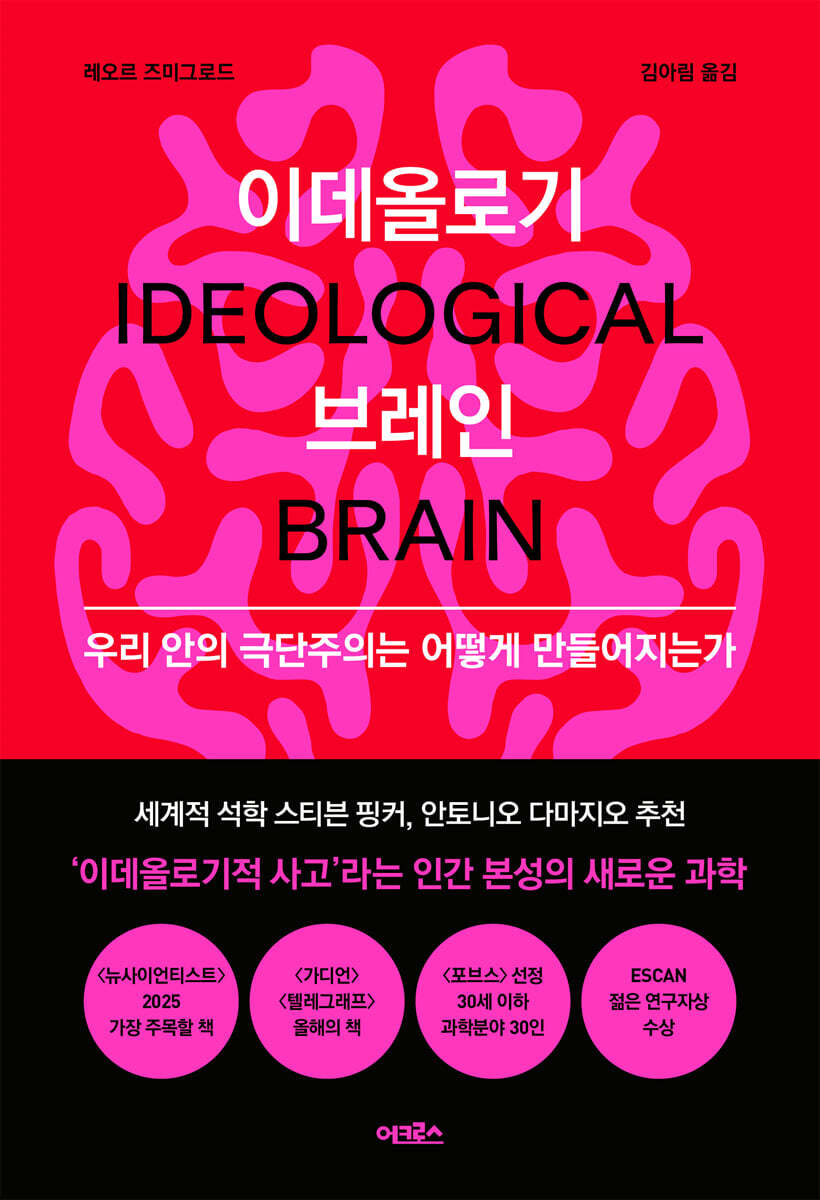
Ideology Brain
 |
Description
Book Introduction
“Why are some people conservative and others progressive?” This question has long been a major research topic for examining human political attitudes and decision-making through the lens of science.
But Dr. Leo Zmigrod, a pioneer in 'political neuroscience,' argues that it is now time to move on to the next question.
The question that points to the essence behind the phenomenon is not whether one believes in some ideology, but rather why humans fall into ideological thinking.
Using methods from experimental psychology, cognitive science, and neuroscience, the author demonstrates the surprising fact that political beliefs are not simply social products shaped by external circumstances, but rather permeate our brains, connecting us to neural structures and cellular levels.
He illuminates the complex interplay between biology and environment that makes some people more susceptible to extremism—in other words, which brains are particularly vulnerable to ideological thinking, while others are more flexible and capable of free-thinking.
As people feel threatened by their physical safety—whether it's a pandemic, the rise of far-right populism, or war or natural disasters—they become more susceptible to extremism.
This book encourages us to use the tools of neuroscience to zoom in on what's happening inside us, and to cultivate our ability to resist dichotomous thinking and authority, as opposed to the human tendency to impose ideology.
But Dr. Leo Zmigrod, a pioneer in 'political neuroscience,' argues that it is now time to move on to the next question.
The question that points to the essence behind the phenomenon is not whether one believes in some ideology, but rather why humans fall into ideological thinking.
Using methods from experimental psychology, cognitive science, and neuroscience, the author demonstrates the surprising fact that political beliefs are not simply social products shaped by external circumstances, but rather permeate our brains, connecting us to neural structures and cellular levels.
He illuminates the complex interplay between biology and environment that makes some people more susceptible to extremism—in other words, which brains are particularly vulnerable to ideological thinking, while others are more flexible and capable of free-thinking.
As people feel threatened by their physical safety—whether it's a pandemic, the rise of far-right populism, or war or natural disasters—they become more susceptible to extremism.
This book encourages us to use the tools of neuroscience to zoom in on what's happening inside us, and to cultivate our ability to resist dichotomous thinking and authority, as opposed to the human tendency to impose ideology.
- You can preview some of the book's contents.
Preview
index
Prologue: Everything Originates Within Our Bodies
PART 1 Idols: Our Brains Always Thirst for Ideology
1 People with an ideology
What is Ideology? | Clues to Everything
2 Some experiments
Find the rules of the game | Ideological rigidity
3 Metaphors We Believe
Stereotypes about ideologues | How the brain connects mind and body
PART 2 Mind and Myth: How the Mind Thinks, Perceives, and Works
4 The Birth of Ideology
Reflections from Prison | Ideology, the Science of Ideas | Dreaming of True Enlightenment
5 The Age of Delusion and Illusion
The Derision of "Mad Science" | The Ideology of Marx and Engels | A Tangled Thread | The Connection Between Ideology and Consciousness
6 Our Brain
The human brain loves prediction | Building coherence from chaos | The brain craves attention
7 Ideological Thinking
We Immerse Yourself in It | Dogmatism and Intellectual Humility | Focusing on Structure Over Substance
PART 3 Origins: Innate or Made?
8 Which came first, the chicken or the egg?
In Search of Potential Fascists | Submissive Brains, Resistant Brains
9 Young Authoritarians
Children who haven't learned the art of self-censorship | Rigidity is everywhere.
10 Brainwashed Babies
When habits start to become ingrained in the brain | Children with strong prejudices
11 People with Stiff Hearts
Why Flexibility in Thinking Matters | Brexit and Nationalist Ideology | Is the Right Naturally Rigid? | Opposites Meet
12 Is rigidity hardwired into our genes?
The Biological Basis of Psychological Rigidity | The COMT Gene and Dopamine Levels | The Epigenetics of Extremism
PART 4 RESULTS: HOW IDEOS SHAPES OUR BODIES AND BRAIN
13 The Thought That Keeps Darwin Up at Night
A Phrase Almost Erased from the History of Science | The Impact of Religion on the Brain
14 Political Illusions
Can an Objective World Exist? | The Connection Between Optical and Political Illusions | Revenge on Ideology: Restoring Sense
15 What Your Trembling Fingertips Are Telling You
Differences Between Political Opinions and Physiological Responses | Conservatism and the Negativity Bias Hypothesis | Sensitivity: How We Experience the World
16 Ideology in a Brain Scanner
Questions of Political Neuroscience | Political Ideology and Brain Anatomy | The Most Famous Region of Our Brain
PART 5 FREEDOM: BEING FREEDOM FROM THE Shackles of Ideology
17 The Spiral to Extremism
Sucked Deeper and Deeper | The Spiral Metaphor | The Neurophysiology of Stress and Ideology
18 Finding a nest that protects us
What the Bullied Brain Does | Fear of Death and Our Reactions | Kids Trying to Escape the Nest
19 Other Stories
Embracing the Unknown Tightly | The Final Experiment
Epilogue: Going Off the Script
PART 1 Idols: Our Brains Always Thirst for Ideology
1 People with an ideology
What is Ideology? | Clues to Everything
2 Some experiments
Find the rules of the game | Ideological rigidity
3 Metaphors We Believe
Stereotypes about ideologues | How the brain connects mind and body
PART 2 Mind and Myth: How the Mind Thinks, Perceives, and Works
4 The Birth of Ideology
Reflections from Prison | Ideology, the Science of Ideas | Dreaming of True Enlightenment
5 The Age of Delusion and Illusion
The Derision of "Mad Science" | The Ideology of Marx and Engels | A Tangled Thread | The Connection Between Ideology and Consciousness
6 Our Brain
The human brain loves prediction | Building coherence from chaos | The brain craves attention
7 Ideological Thinking
We Immerse Yourself in It | Dogmatism and Intellectual Humility | Focusing on Structure Over Substance
PART 3 Origins: Innate or Made?
8 Which came first, the chicken or the egg?
In Search of Potential Fascists | Submissive Brains, Resistant Brains
9 Young Authoritarians
Children who haven't learned the art of self-censorship | Rigidity is everywhere.
10 Brainwashed Babies
When habits start to become ingrained in the brain | Children with strong prejudices
11 People with Stiff Hearts
Why Flexibility in Thinking Matters | Brexit and Nationalist Ideology | Is the Right Naturally Rigid? | Opposites Meet
12 Is rigidity hardwired into our genes?
The Biological Basis of Psychological Rigidity | The COMT Gene and Dopamine Levels | The Epigenetics of Extremism
PART 4 RESULTS: HOW IDEOS SHAPES OUR BODIES AND BRAIN
13 The Thought That Keeps Darwin Up at Night
A Phrase Almost Erased from the History of Science | The Impact of Religion on the Brain
14 Political Illusions
Can an Objective World Exist? | The Connection Between Optical and Political Illusions | Revenge on Ideology: Restoring Sense
15 What Your Trembling Fingertips Are Telling You
Differences Between Political Opinions and Physiological Responses | Conservatism and the Negativity Bias Hypothesis | Sensitivity: How We Experience the World
16 Ideology in a Brain Scanner
Questions of Political Neuroscience | Political Ideology and Brain Anatomy | The Most Famous Region of Our Brain
PART 5 FREEDOM: BEING FREEDOM FROM THE Shackles of Ideology
17 The Spiral to Extremism
Sucked Deeper and Deeper | The Spiral Metaphor | The Neurophysiology of Stress and Ideology
18 Finding a nest that protects us
What the Bullied Brain Does | Fear of Death and Our Reactions | Kids Trying to Escape the Nest
19 Other Stories
Embracing the Unknown Tightly | The Final Experiment
Epilogue: Going Off the Script
Detailed image
Into the book
Thanks to my experiments conducted during the tumultuous months leading up to the Brexit referendum in the UK and the 2016 US presidential election, I became one of the first scientists to use methods from cognitive and neuroscience to study the origins and consequences of ideological thinking.
I recruited participants online, including radical activists writing for right-wing platforms, young Germans living in post-reunification Berlin, and pensioners in a remote village in England.
It encompassed a wide range of inclinations and classes, from traditionalists to radical progressives.
--- From the "Prologue"
We may simply have faith, but we may also be captivated or possessed by that faith.
Today, powerful measurement tools allow us to examine the consequences of ideological rigidity across human perception, cognition, physiology, and neurological processes.
Our bodies are influenced by the ideologies that surround us.
What we believe is reflected in our biological body.
--- From Chapter 1, “People with Ideology”
In fact, your brain reveals your political views and biases in strange, profound, and surprising ways.
Such approaches raise questions about how we understand the tensions between nature and nurture, risk and resilience, freedom and fate.
If our ideological beliefs are linked to cognitive and neural response patterns, we must confront new questions about how our bodies engage with politics, and how we can resist, change, and exercise individual agency.
--- From Chapter 2, “A Certain Experiment”
Has ideology ever been a scientific rather than political issue? But by examining the history of ideology, we can uncover traces of how language, history, and science intersect and traverse in unexpected ways.
Then, a problem that started out as a scientific problem may later become a relic of politics or history, and a few centuries later, it will be reborn as an entirely new scientific endeavor.
--- From Chapter 3, “Metaphors We Believe in”
The two things ideological narratives do—predict and communicate—are also things the brain wants to do.
The brain seeks certainty, so it finds systematic theories about everything in the world fascinating.
Also, because the brain loves community, it finds theories that people share among the “theories about the world” fantastic.
If we look at the internal structure of ideology, we find that human cognitive abilities and ideology have similar properties.
Ideologies seem to have two essential characteristics: rigid doctrine and rigid identity.
--- From Chapter 7, “Ideological Thinking”
If we are born with an innate vulnerability, we need to figure out what characteristics make us vulnerable.
We must understand that our individual cognitive characteristics and biological responses give rise to powerful 'isms' that make us willing to hurt, harm, kill, and cause harm.
--- From Chapter 8, “Which Comes First, the Chicken or the Egg?”
The far right and the far left were cognitively similar.
Both extremes struggled to adapt, create, and change their mental schemata, even in neutral, apolitical situations.
This rigidity of extremism brings us back to the old 'horseshoe theories' that fascism and communism will eventually meet at the edge.
This is a theory that the far left and the far right are similar in terms of narrow-mindedness and rigidity.
--- From Chapter 11, “People with Stiff Hearts”
Rigidity of thought does not arise out of thin air, nor does it originate from some metaphysical wellspring of the soul.
Individual differences in stiffness are revealed through interacting biological markers.
There is no single gene that causes dogmatism.
All psychological traits are shaped by multiple genetic mechanisms.
Just as there's no single gene that determines our charisma, our sense of humor, our sadistic tendencies, or how easily we cry or laugh, there's no single gene that explains our belligerence.
--- From Chapter 12, “Is Rigidity Written in Our Genes?”
People who rejected stark economic inequality showed significantly higher negative physiological arousal responses when watching a video about struggling homeless people compared to when watching a neutral video.
Their bodies clearly showed their pain.
In contrast, participants who justified the system did not show a spike in psychophysiological indicators when they viewed videos of homeless people.
In fact, the physiological responses of those exposed to the harsh conditions of the homeless were virtually indistinguishable from those of those exposed to videos of people making coffee or fishing.
Their bodies showed little expression of the agony, sadness, anger, or pain that comes with witnessing the suffering of others.
People who follow an ideology that justifies hierarchical structures are instinctively insensitive.
Our most intimate physiological responses reveal information about our ideology.
--- From Chapter 15, “What Your Trembling Fingertips Are Telling Us”
Several recent studies have shown that when participants watched inflammatory political videos, the brains of left-wing participants became "synchronized" with the brains of other left-wing participants, while the brains of right-wing participants became "synchronized" with the brains of other right-wing participants.
The media was flooded with headlines calling it “neural polarization.”
But what this result means is that people who think similarly react in similar ways.
--- From Chapter 16, “Ideology in the Brain Scanner”
People who are immersed in ideology undergo changes.
Not only are the beliefs that an individual explicitly expresses or doesn't express, but their broader cognition, instinctual responses, physiology, and entire brain are altered.
Individual tendencies and ideological communities reinforce each other, making certain traits more prominent or prioritized.
For example, when an ideology that preys on the fear of chaos and upheaval combines with an inflexible and unstable person, the result will be a more stubborn personality than that of a person in a moderate community.
--- From Chapter 17, “Spiral Towards Extremism”
While it is true that adolescent brains are most susceptible to ideological dogma, this is partly because their brains are so actively trying to understand the world and then be understood.
The adolescent brain craves models of reality that it can predict and participate in.
I recruited participants online, including radical activists writing for right-wing platforms, young Germans living in post-reunification Berlin, and pensioners in a remote village in England.
It encompassed a wide range of inclinations and classes, from traditionalists to radical progressives.
--- From the "Prologue"
We may simply have faith, but we may also be captivated or possessed by that faith.
Today, powerful measurement tools allow us to examine the consequences of ideological rigidity across human perception, cognition, physiology, and neurological processes.
Our bodies are influenced by the ideologies that surround us.
What we believe is reflected in our biological body.
--- From Chapter 1, “People with Ideology”
In fact, your brain reveals your political views and biases in strange, profound, and surprising ways.
Such approaches raise questions about how we understand the tensions between nature and nurture, risk and resilience, freedom and fate.
If our ideological beliefs are linked to cognitive and neural response patterns, we must confront new questions about how our bodies engage with politics, and how we can resist, change, and exercise individual agency.
--- From Chapter 2, “A Certain Experiment”
Has ideology ever been a scientific rather than political issue? But by examining the history of ideology, we can uncover traces of how language, history, and science intersect and traverse in unexpected ways.
Then, a problem that started out as a scientific problem may later become a relic of politics or history, and a few centuries later, it will be reborn as an entirely new scientific endeavor.
--- From Chapter 3, “Metaphors We Believe in”
The two things ideological narratives do—predict and communicate—are also things the brain wants to do.
The brain seeks certainty, so it finds systematic theories about everything in the world fascinating.
Also, because the brain loves community, it finds theories that people share among the “theories about the world” fantastic.
If we look at the internal structure of ideology, we find that human cognitive abilities and ideology have similar properties.
Ideologies seem to have two essential characteristics: rigid doctrine and rigid identity.
--- From Chapter 7, “Ideological Thinking”
If we are born with an innate vulnerability, we need to figure out what characteristics make us vulnerable.
We must understand that our individual cognitive characteristics and biological responses give rise to powerful 'isms' that make us willing to hurt, harm, kill, and cause harm.
--- From Chapter 8, “Which Comes First, the Chicken or the Egg?”
The far right and the far left were cognitively similar.
Both extremes struggled to adapt, create, and change their mental schemata, even in neutral, apolitical situations.
This rigidity of extremism brings us back to the old 'horseshoe theories' that fascism and communism will eventually meet at the edge.
This is a theory that the far left and the far right are similar in terms of narrow-mindedness and rigidity.
--- From Chapter 11, “People with Stiff Hearts”
Rigidity of thought does not arise out of thin air, nor does it originate from some metaphysical wellspring of the soul.
Individual differences in stiffness are revealed through interacting biological markers.
There is no single gene that causes dogmatism.
All psychological traits are shaped by multiple genetic mechanisms.
Just as there's no single gene that determines our charisma, our sense of humor, our sadistic tendencies, or how easily we cry or laugh, there's no single gene that explains our belligerence.
--- From Chapter 12, “Is Rigidity Written in Our Genes?”
People who rejected stark economic inequality showed significantly higher negative physiological arousal responses when watching a video about struggling homeless people compared to when watching a neutral video.
Their bodies clearly showed their pain.
In contrast, participants who justified the system did not show a spike in psychophysiological indicators when they viewed videos of homeless people.
In fact, the physiological responses of those exposed to the harsh conditions of the homeless were virtually indistinguishable from those of those exposed to videos of people making coffee or fishing.
Their bodies showed little expression of the agony, sadness, anger, or pain that comes with witnessing the suffering of others.
People who follow an ideology that justifies hierarchical structures are instinctively insensitive.
Our most intimate physiological responses reveal information about our ideology.
--- From Chapter 15, “What Your Trembling Fingertips Are Telling Us”
Several recent studies have shown that when participants watched inflammatory political videos, the brains of left-wing participants became "synchronized" with the brains of other left-wing participants, while the brains of right-wing participants became "synchronized" with the brains of other right-wing participants.
The media was flooded with headlines calling it “neural polarization.”
But what this result means is that people who think similarly react in similar ways.
--- From Chapter 16, “Ideology in the Brain Scanner”
People who are immersed in ideology undergo changes.
Not only are the beliefs that an individual explicitly expresses or doesn't express, but their broader cognition, instinctual responses, physiology, and entire brain are altered.
Individual tendencies and ideological communities reinforce each other, making certain traits more prominent or prioritized.
For example, when an ideology that preys on the fear of chaos and upheaval combines with an inflexible and unstable person, the result will be a more stubborn personality than that of a person in a moderate community.
--- From Chapter 17, “Spiral Towards Extremism”
While it is true that adolescent brains are most susceptible to ideological dogma, this is partly because their brains are so actively trying to understand the world and then be understood.
The adolescent brain craves models of reality that it can predict and participate in.
--- From Chapter 18, “In Search of the Nest That Protects Us”
Publisher's Review
A New Science of Human Nature: 'Ideological Thinking'
A pioneer in 'political neuroscience' that has caught the world's attention reveals
The hidden brain mechanisms that influence our beliefs and behavior
★★★Recommended by world-renowned scholars Steven Pinker and Antonio Damasio
★★★New Scientist's Most Notable Books of 2025
★★★Forbes' 30 Scientists Under 30
We live each day with countless thoughts and value judgments.
At this time, all that moves our hearts is belief.
Beliefs provide the standards that enable us to distinguish right from wrong, good from evil.
Whether it's a religious issue, a political issue, or a very small and insignificant decision.
But the problems begin when this belief veers into dogmatism, nationalism, and extremism.
Some people view the world in dichotomous terms and are so passionate about their beliefs that they commit violence against others and even sacrifice their own lives.
On the other hand, some people are not hesitant to flexibly change their thinking depending on the situation.
Where does this difference stem from? What drives human thought to extremes? Is it the influence of the surrounding environment, or is it an individual's innate trait?
The answer can be found in the human brain.
Dr. Leo Zmigrod, a pioneer in political neuroscience, uses his groundbreaking research to uncover the hidden mechanisms that influence our beliefs and behavior.
Using methods from experimental psychology, cognitive science, and neuroscience, the author demonstrates the startling fact that political beliefs are not simply social products shaped by external circumstances, but can penetrate our brains and fundamentally alter neural structure and cellular function.
He illuminates the complex interplay between biology and environment that makes some people more susceptible to extremism—in other words, which brains are particularly vulnerable to ideological thinking, while others are more flexible and capable of free-thinking.
Why don't people change their minds?
The more people are unable to change their minds, the more they cling to their political ideology.
In 2015, as Islamic fundamentalism grew in power, the author heard news that young British girls were heading to Syria to join ISIS, and a big question came to mind.
“Why did those girls do it and not other girls?” The media pointed to things like lack of education and social instability, but they did not provide a sufficient answer.
He decides to look at this issue through the lens of his field of study, neuroscience.
What's different about the brains of girls who fall into extremism? Dr. Zmigrod is one of the first scientists to connect the field of politics with neuroscience to study the origins and consequences of ideological thinking, pioneering "political neuroscience."
Ideology is a kind of narrative about how the world works and how it should work.
It contains very strict norms about how we should think, how we should act, and how we should interact with others, and it condemns any deviation from these norms.
At this point, by 'owning' ideology, we satisfy the human desire to understand the world as a single, coherent world.
They also strengthen their own beliefs by longing to belong to a group of people with the same ideology.
In this way, the more our brains become immersed in ideology, the more they become trapped in ‘rigidity of thought.’
Through a simple experiment, the authors show that people with strong ideological tendencies often have difficulty accepting new information and shifting their thinking.
In this experiment, researchers ask participants to sort cards according to various rules, such as their shape or color.
Participants quickly figure out the rules, but soon realize that they no longer work.
This is because the researchers changed the rules without the participants' knowledge.
At this time, people who are vulnerable to ideological thinking cannot accept change and stick to the old rules.
However, people who tend to think freely and resist ideological thinking will change their behavior when there is evidence that the rules have changed.
What's remarkable about this experiment is that the participants' responses reflected not just cognitive rigidity, but also a rigidity in their adherence to social ideologies.
In simple terms, the more difficult it is for people to accept even simple rule changes, the more likely they are to fall into political or religious extremism, and conversely, the more likely they are to be immersed in political or religious extremism, the more cognitively rigid they are.
Is extremism innate or made?
A provocative exploration that will uncover the connection between our brains and political beliefs.
Part 1 of this book, "Idols," explains the metaphors that have been used to explain ideology in our society and proposes a new way to explore the brain that thinks ideologically by integrating politics and neuroscience.
Part 2, “Mind and Myth,” examines the birth and history of ideology and refutes false myths about ideology.
Also, the essence of ideology studies is the so-called 'progressive vs.
He emphasizes that we need to break away from the 'conservative' frame and shift our perspective from 'what political ideology do you believe in?' to 'why ideology has such a powerful influence on people.'
And in Part 3, “Origins,” we explore where ideology comes from if not all individuals are equally vulnerable to it.
It's a bit of a chicken-and-egg problem: do individual personality and cognitive traits influence ideology? Or does immersion in rigid ideologies affect our brain function? The author explains the cognitive and biological characteristics that make individuals particularly vulnerable to ideological dogma, from personal habits to cognitive rigidity and even dopamine genes.
For example, we introduce a study conducted by psychologist Else Frenkel-Brunswick in the 1940s in which she interviewed hundreds of children and examined the correlation between cognitive rigidity and ideological rigidity in children who had not yet formed political beliefs, and how children with strong prejudices distorted their memories to reinforce their beliefs.
Meanwhile, the author's research revealed that people with the most rigid thinking styles have genetically different factors in how dopamine levels are regulated in their brains.
People with rigid thinking tend to have lower dopamine levels in the prefrontal cortex and higher dopamine levels in the striatum, a key structure in the midbrain.
By discovering fundamental differences in the brain reward circuitry of those who are ideologically vulnerable and those who are not, we demonstrate once again that changing ideology is not simply a matter of changing opinions, but rather a change that occurs at a biological level.
As a result, we shift our focus from the question of 'origins' to the question of 'consequences', asking what changes occur in the brains and bodies of those vulnerable to ideological thinking.
How can we free ourselves from the shackles of ideology?
Why a flexible attitude is important, according to cutting-edge neuroscience.
Can we truly consider the world we live in today a single, shared world? The ever-increasing polarization makes it seem as if each person is living a completely different reality.
But this is not just a metaphor, it is true.
This is because immersion in a rigid ideology changes the way we perceive the world by influencing our sensory perceptions, emotions, physiological responses, and brain structure and function.
People who are deeply immersed in a political ideology are more likely to process information in a distorted way than those with a moderate orientation.
In fact, the author reports experimental results showing that “left-leaning centrists” are the most cognitively flexible.
Part 4, “Results,” tells the story of how the ideologies surrounding us shape our bodies and brains.
By examining how ideology actually alters our visual experience (the link between visual and political illusions) and how brain regions responsible for emotional processing operate in dramatically different ways depending on political leanings (the conservatism and negativity bias hypothesis), it demonstrates how deeply ideology can penetrate the human brain structure through modern science and technology.
Finally, Part 5, “Freedom,” points out that while our genetic and environmental influences can lead to rigid thinking, this does not mean genetic determinism or the absence of free will.
Ultimately, we have the ability to choose how passionately we embrace or reject any ideology.
Whether it's a pandemic, the rise of far-right populism, war, or natural disasters, people are more susceptible to extremism when they feel threatened by their physical safety.
This is because emotions like fear and dread push our brains to reinforce our own beliefs.
The author argues that by using the tools of neuroscience to zoom in on what's happening inside us, we can increase our ability to resist irrational rules and authority, countering the human nature of imposing ideology.
In today's world of increasing polarization and extremism, this must-read book shares astonishing insights from the forefront of neuroscience, guiding us toward a world free from pernicious dogma.
A pioneer in 'political neuroscience' that has caught the world's attention reveals
The hidden brain mechanisms that influence our beliefs and behavior
★★★Recommended by world-renowned scholars Steven Pinker and Antonio Damasio
★★★New Scientist's Most Notable Books of 2025
★★★Forbes' 30 Scientists Under 30
We live each day with countless thoughts and value judgments.
At this time, all that moves our hearts is belief.
Beliefs provide the standards that enable us to distinguish right from wrong, good from evil.
Whether it's a religious issue, a political issue, or a very small and insignificant decision.
But the problems begin when this belief veers into dogmatism, nationalism, and extremism.
Some people view the world in dichotomous terms and are so passionate about their beliefs that they commit violence against others and even sacrifice their own lives.
On the other hand, some people are not hesitant to flexibly change their thinking depending on the situation.
Where does this difference stem from? What drives human thought to extremes? Is it the influence of the surrounding environment, or is it an individual's innate trait?
The answer can be found in the human brain.
Dr. Leo Zmigrod, a pioneer in political neuroscience, uses his groundbreaking research to uncover the hidden mechanisms that influence our beliefs and behavior.
Using methods from experimental psychology, cognitive science, and neuroscience, the author demonstrates the startling fact that political beliefs are not simply social products shaped by external circumstances, but can penetrate our brains and fundamentally alter neural structure and cellular function.
He illuminates the complex interplay between biology and environment that makes some people more susceptible to extremism—in other words, which brains are particularly vulnerable to ideological thinking, while others are more flexible and capable of free-thinking.
Why don't people change their minds?
The more people are unable to change their minds, the more they cling to their political ideology.
In 2015, as Islamic fundamentalism grew in power, the author heard news that young British girls were heading to Syria to join ISIS, and a big question came to mind.
“Why did those girls do it and not other girls?” The media pointed to things like lack of education and social instability, but they did not provide a sufficient answer.
He decides to look at this issue through the lens of his field of study, neuroscience.
What's different about the brains of girls who fall into extremism? Dr. Zmigrod is one of the first scientists to connect the field of politics with neuroscience to study the origins and consequences of ideological thinking, pioneering "political neuroscience."
Ideology is a kind of narrative about how the world works and how it should work.
It contains very strict norms about how we should think, how we should act, and how we should interact with others, and it condemns any deviation from these norms.
At this point, by 'owning' ideology, we satisfy the human desire to understand the world as a single, coherent world.
They also strengthen their own beliefs by longing to belong to a group of people with the same ideology.
In this way, the more our brains become immersed in ideology, the more they become trapped in ‘rigidity of thought.’
Through a simple experiment, the authors show that people with strong ideological tendencies often have difficulty accepting new information and shifting their thinking.
In this experiment, researchers ask participants to sort cards according to various rules, such as their shape or color.
Participants quickly figure out the rules, but soon realize that they no longer work.
This is because the researchers changed the rules without the participants' knowledge.
At this time, people who are vulnerable to ideological thinking cannot accept change and stick to the old rules.
However, people who tend to think freely and resist ideological thinking will change their behavior when there is evidence that the rules have changed.
What's remarkable about this experiment is that the participants' responses reflected not just cognitive rigidity, but also a rigidity in their adherence to social ideologies.
In simple terms, the more difficult it is for people to accept even simple rule changes, the more likely they are to fall into political or religious extremism, and conversely, the more likely they are to be immersed in political or religious extremism, the more cognitively rigid they are.
Is extremism innate or made?
A provocative exploration that will uncover the connection between our brains and political beliefs.
Part 1 of this book, "Idols," explains the metaphors that have been used to explain ideology in our society and proposes a new way to explore the brain that thinks ideologically by integrating politics and neuroscience.
Part 2, “Mind and Myth,” examines the birth and history of ideology and refutes false myths about ideology.
Also, the essence of ideology studies is the so-called 'progressive vs.
He emphasizes that we need to break away from the 'conservative' frame and shift our perspective from 'what political ideology do you believe in?' to 'why ideology has such a powerful influence on people.'
And in Part 3, “Origins,” we explore where ideology comes from if not all individuals are equally vulnerable to it.
It's a bit of a chicken-and-egg problem: do individual personality and cognitive traits influence ideology? Or does immersion in rigid ideologies affect our brain function? The author explains the cognitive and biological characteristics that make individuals particularly vulnerable to ideological dogma, from personal habits to cognitive rigidity and even dopamine genes.
For example, we introduce a study conducted by psychologist Else Frenkel-Brunswick in the 1940s in which she interviewed hundreds of children and examined the correlation between cognitive rigidity and ideological rigidity in children who had not yet formed political beliefs, and how children with strong prejudices distorted their memories to reinforce their beliefs.
Meanwhile, the author's research revealed that people with the most rigid thinking styles have genetically different factors in how dopamine levels are regulated in their brains.
People with rigid thinking tend to have lower dopamine levels in the prefrontal cortex and higher dopamine levels in the striatum, a key structure in the midbrain.
By discovering fundamental differences in the brain reward circuitry of those who are ideologically vulnerable and those who are not, we demonstrate once again that changing ideology is not simply a matter of changing opinions, but rather a change that occurs at a biological level.
As a result, we shift our focus from the question of 'origins' to the question of 'consequences', asking what changes occur in the brains and bodies of those vulnerable to ideological thinking.
How can we free ourselves from the shackles of ideology?
Why a flexible attitude is important, according to cutting-edge neuroscience.
Can we truly consider the world we live in today a single, shared world? The ever-increasing polarization makes it seem as if each person is living a completely different reality.
But this is not just a metaphor, it is true.
This is because immersion in a rigid ideology changes the way we perceive the world by influencing our sensory perceptions, emotions, physiological responses, and brain structure and function.
People who are deeply immersed in a political ideology are more likely to process information in a distorted way than those with a moderate orientation.
In fact, the author reports experimental results showing that “left-leaning centrists” are the most cognitively flexible.
Part 4, “Results,” tells the story of how the ideologies surrounding us shape our bodies and brains.
By examining how ideology actually alters our visual experience (the link between visual and political illusions) and how brain regions responsible for emotional processing operate in dramatically different ways depending on political leanings (the conservatism and negativity bias hypothesis), it demonstrates how deeply ideology can penetrate the human brain structure through modern science and technology.
Finally, Part 5, “Freedom,” points out that while our genetic and environmental influences can lead to rigid thinking, this does not mean genetic determinism or the absence of free will.
Ultimately, we have the ability to choose how passionately we embrace or reject any ideology.
Whether it's a pandemic, the rise of far-right populism, war, or natural disasters, people are more susceptible to extremism when they feel threatened by their physical safety.
This is because emotions like fear and dread push our brains to reinforce our own beliefs.
The author argues that by using the tools of neuroscience to zoom in on what's happening inside us, we can increase our ability to resist irrational rules and authority, countering the human nature of imposing ideology.
In today's world of increasing polarization and extremism, this must-read book shares astonishing insights from the forefront of neuroscience, guiding us toward a world free from pernicious dogma.
GOODS SPECIFICS
- Date of issue: April 17, 2025
- Page count, weight, size: 380 pages | 538g | 147*215*22mm
- ISBN13: 9791167742018
You may also like
카테고리
korean


korean

![GQ KOREA Mark (Monthly): December [2025]](http://librairie.coreenne.fr/cdn/shop/files/8ef265dbbfbf186523ed75ba7319009d.jpg?v=1765340328&width=3840)


