

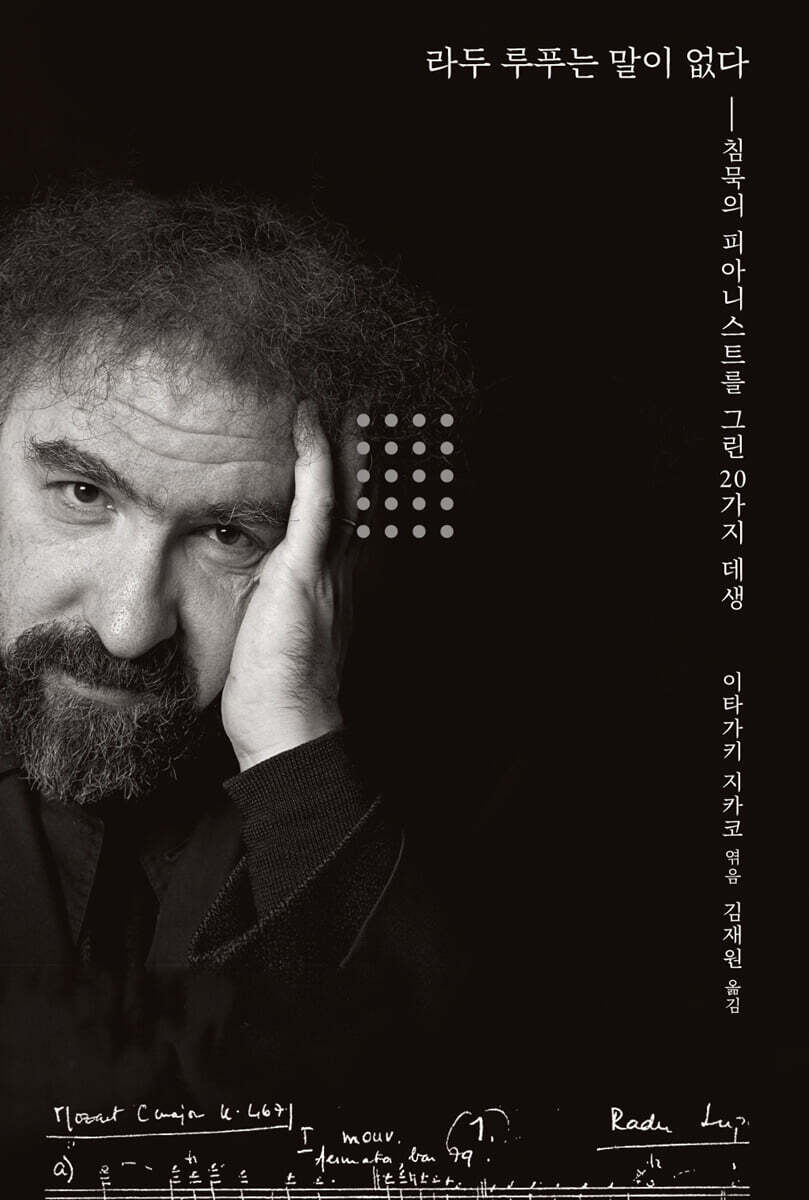
Radu Lupu is silent
 |
Description
Book Introduction
"Radu Lupu Doesn't Speak," a book that contains the music, thoughts, and human side of the "silent pianist" Radu Lupu, who refused any interviews or recordings and retired in June 2019, passed away in April 2022, has been published.
The vivid testimonies of 20 musicians, tuners, managers, and writers who interacted with Lupu and made music with him, including Schiff, Barenboim, Kyung-wha Chung, Seong-jin Cho, Welsermöst, Maisky, Kepeleck, Bavouzet, Görner, Cassar, and Isserlis, provide a multifaceted portrait of Radu Lupu, the “musician’s musician.”
This book contains untold stories about Radu Lupu, who was “music itself,” such as the story of Seong-Jin Cho, who was depressed from the tension of the Chopin Competition, being moved by a phone call of support from Lupu; the story of the Cleveland Orchestra members gathered in the waiting room during the intermission of a Beethoven piano concerto concerto and crying with emotion; and the story of Lupu moving another piano from downstairs to play with John Ogden after hearing him play at a party in Moscow.
This is a unique and valuable book about the 'mysterious pianist' Radu Lupu, who rarely revealed himself.
The vivid testimonies of 20 musicians, tuners, managers, and writers who interacted with Lupu and made music with him, including Schiff, Barenboim, Kyung-wha Chung, Seong-jin Cho, Welsermöst, Maisky, Kepeleck, Bavouzet, Görner, Cassar, and Isserlis, provide a multifaceted portrait of Radu Lupu, the “musician’s musician.”
This book contains untold stories about Radu Lupu, who was “music itself,” such as the story of Seong-Jin Cho, who was depressed from the tension of the Chopin Competition, being moved by a phone call of support from Lupu; the story of the Cleveland Orchestra members gathered in the waiting room during the intermission of a Beethoven piano concerto concerto and crying with emotion; and the story of Lupu moving another piano from downstairs to play with John Ogden after hearing him play at a party in Moscow.
This is a unique and valuable book about the 'mysterious pianist' Radu Lupu, who rarely revealed himself.
- You can preview some of the book's contents.
Preview
index
Entering
Part 1: The Story of Radu Lupu through 20 Interviews and Contributions
[Andrassy Schiff] Dedicated to Lupu
[Mischa Maisky] Meeting Radu was invaluable, and the time we spent making music together was special.
[Boris Petrushansky] The memories I made with Lupu in Moscow are deeply engraved in my memory.
[An Kepelec] The moment I heard the first note, I will never forget the emotion and admiration that spread through my heart.
[Jung Kyung-hwa] The souls of those who listen to the music played by Radu soar to heaven through its magical power.
[Didier Decotini] As a friend, I don't want to bother Radu any longer because he hates recording.
[Jessica Nasmith & Robin Luck] Why I Don't Do Interviews - "If I Had Something to Say
“I will do it only through music.”
[Luke Guthrie] I've heard Radu's "Song" countless times, and I've been so shocked that I can't sit down at the piano anymore.
[Jenny Vogel] A Night Walk in Frozen New York: A Few Mistakes Could Have Canceled Your Performance
[Helen Turner] A proud perfectionist.
But he wasn't the type of person who gave the manager a hard time.
[Daniel Barenboim] I feel a special affinity with Radu because we understand each other well through music.
[Franz Welsemöst] "How to Pursue Beauty" Shared with Radu We Understood Each Other Musically
[Philippe Cassar] A Landscape of the Inner World, Delivered in a Quiet Voice by Radu Lupu
[Jang E-Flam Babouzet] The Musical Philosophy Radu Taught Me When I Was Wandering Through Life
[Michel Branges] It's not the sound of the piano, it's the sound of Radu Lupu.
[Nelson Goerner & Rusudan Goerner] Advice full of charm and discovery.
All his words are engraved in my heart.
[Yuliana Avdeeva] Radu's Russian is very rich.
He's a good listener and always gives something.
[Jo Seong-jin] "I don't teach, I just listen." ― Lessons in Lausanne
[Steven Isserlis] A Journey with Radu Lupu
[Elizabeth Wilson] Radu Lupu - Reminiscing about his student days in Moscow
Part 2: Towards Radu Lupu
To conclude the story
Radu Lupu Chronology
Part 1: The Story of Radu Lupu through 20 Interviews and Contributions
[Andrassy Schiff] Dedicated to Lupu
[Mischa Maisky] Meeting Radu was invaluable, and the time we spent making music together was special.
[Boris Petrushansky] The memories I made with Lupu in Moscow are deeply engraved in my memory.
[An Kepelec] The moment I heard the first note, I will never forget the emotion and admiration that spread through my heart.
[Jung Kyung-hwa] The souls of those who listen to the music played by Radu soar to heaven through its magical power.
[Didier Decotini] As a friend, I don't want to bother Radu any longer because he hates recording.
[Jessica Nasmith & Robin Luck] Why I Don't Do Interviews - "If I Had Something to Say
“I will do it only through music.”
[Luke Guthrie] I've heard Radu's "Song" countless times, and I've been so shocked that I can't sit down at the piano anymore.
[Jenny Vogel] A Night Walk in Frozen New York: A Few Mistakes Could Have Canceled Your Performance
[Helen Turner] A proud perfectionist.
But he wasn't the type of person who gave the manager a hard time.
[Daniel Barenboim] I feel a special affinity with Radu because we understand each other well through music.
[Franz Welsemöst] "How to Pursue Beauty" Shared with Radu We Understood Each Other Musically
[Philippe Cassar] A Landscape of the Inner World, Delivered in a Quiet Voice by Radu Lupu
[Jang E-Flam Babouzet] The Musical Philosophy Radu Taught Me When I Was Wandering Through Life
[Michel Branges] It's not the sound of the piano, it's the sound of Radu Lupu.
[Nelson Goerner & Rusudan Goerner] Advice full of charm and discovery.
All his words are engraved in my heart.
[Yuliana Avdeeva] Radu's Russian is very rich.
He's a good listener and always gives something.
[Jo Seong-jin] "I don't teach, I just listen." ― Lessons in Lausanne
[Steven Isserlis] A Journey with Radu Lupu
[Elizabeth Wilson] Radu Lupu - Reminiscing about his student days in Moscow
Part 2: Towards Radu Lupu
To conclude the story
Radu Lupu Chronology
Into the book
“I want to publish a book about you in Japan.
“Can you give me permission?” The artist who has stubbornly refused interviews for a long time, stopped recording long ago, and even refused to allow broadcast recordings, is an artist who values his privacy to the extreme. That artist is Lupu.
I thought the answer would be 'no'.
“Dear Chikako, of course I won’t say anything, but if you want to, I’ll leave it to you.
“I hope you have good results.”
--- p.5
You yourself are well aware that you are far more than just a pianist.
You play and think like a composer, understanding the form and structure of a piece, grasping the hierarchy of its major components, and handling even the smallest details without hesitation.
Some of the greatest conductors have that ability, but luckily you never had to conduct.
Just by extending both hands, the piano transformed into an orchestra with countless tones and resonances.
- András Schiff, pianist
--- p.37
One day, Radu and Daniel Barenboim were playing a game of guessing the song.
It was a game where you had to guess the title of a song by listening to only the first chord or first note of the song.
I found it hard to believe that someone could guess what a song was based on just one note. - Mischa Maisky, pianist
--- p.44
“I told you it (the variations) doesn’t like me very much!” In other words, he didn’t say, “I don’t like that piece,” but rather, “that piece doesn’t like me.”
This is in line with a passage from Neuhaus's book, The Art of Piano Playing.
When a student loudly declared that he was sick of Beethoven's Appassionata Sonata, Neuhaus countered:
“It’s not you who’s sick of it, it’s the work!” It’s unclear whether Radu knew this, but he probably did.
In any case, the ethics of these two great artists are clearly in agreement.
-Boris Petrushansky, pianist
--- p.60
The first few notes were played by a then unknown Romanian.
That was Radu Lupu.
I will never forget the emotion and admiration that spread through my heart at that moment.
The theme of Haydn's "Andante and Variations" in F minor resonated through the young musician's fingers in a simple, mournful, and gentle way, and its poetry moved my heart.
- Anne Kepeleck, pianist
--- p.62~64
One day, Christopher called Radu and me to Decca's studio.
Christopher sat in the middle of the studio and pressed play, and it was that Debussy and Franck recording from three years ago.
We sat quietly for a while and started listening.
I concentrated silently, and Radu was also silent.
After two or three minutes of silence, Christopher spoke.
“Radu, what do you think?” “Well, if Mizu Jeong is okay with it, then I’m fine with it.” Then he asked me.
“What do you think, Kyunghwa?” “If Mr. Lupu likes it, then I like it too,” Christopher said with a smile.
“Okay, then let’s release it!” That’s how this recording came to be in the world.
- Jeong Kyung-wha, violinist
--- p.68~69
Radu paid all the expenses for the recording sessions to Decca and bought the rights.
The piece I remember is the D.850 sonata and the other one is a middle period sonata.
In the end, the recording never saw the light of day.
Even though the excellent recording tape was completed and completely ready for release, Radu never changed his mind.
- Didier Decotini, artistic director from the Decca label
--- p.72
When Radu arrived at the office, he hugged all the employees, then came up to the second floor where I was and greeted me with the words, “Have you ever heard this joke?”
When Radu arrived, the receptionist would call us over the phone, and my colleague and I would say, “It’ll take a while to get to the second floor.”
Anyway, he was loved by all the employees.
Radu treated everyone with the same amount of sincerity and time, regardless of whether they were part-time secretaries, managers, or the president.
Everyone respected him, and even those who weren't on staff would go to his concerts.
- Jessica Nasmith, UK Country Manager
--- p.78
Radu's performance brought a light to the piece that I had never seen before.
From the introduction of the song, I was overwhelmed by its technique.
And above all, the part where the first theme returns… …all the great pianists, including Rubinstein, play that part like this: ‘Tan tan ttara ran.’
But Radu's playing style was different from anyone else's.
- Luke Guthrie, pianist
--- p.93
The next morning, we received a call from Lincoln Center to our office.
After hearing from the person who bought the ticket that Radu was canceling the concert, they posted a notice of the cancellation at the ticket booth on the day and have just started the process of refunding the tickets.
The situation was finally resolved when Abe, who was startled, desperately explained that the concert would go on as scheduled.
This is a story that made all the managers burst into laughter.
This is happening because it's Radu.
- Jenny Vogel, Americas Manager
--- p.96
He often said that he found microphones burdensome because a performance 'recorded' by a microphone cannot be changed.
I was also concerned that I might not like the piano I was using.
I had no idea it would take me several days to perform something I could be proud of.
If it's a concert, once the main performance is over, that's it.
Ultimately, he wanted to make the recordings top-notch.
- Helen Turner, UK Country Manager
--- p.99
The reason Radu is able to build an intimate relationship with each and every one of his listeners is because he doesn't think about the listener.
It may sound paradoxical, but it really is.
When you're focused on the music, you usually forget about the audience.
He approaches the audience without being conscious of them and brings them onto the stage.
By doing so, it gives the feeling that I am playing just for you.
- Daniel Barenboim, conductor and pianist
--- p.102~104
It was just like magic.
The New York audience usually coughs during his performances, but not once after he plays his first note.
I remember being speechless after this magical performance.
I was truly touched.
Radu and I rode the elevator together to the waiting room, and Radu, leaning against the wall of the elevator, told me that it was a really enjoyable performance.
It was the last song of the first half of the performance, and during the intermission, all the orchestra members came to the waiting room.
After the performance, everyone was crying.
It was truly a unique moment.
- Franz Welsermöst, conductor
--- p.112
When I enter a concert hall to hear Radu Lupu play, after a few minutes the distance between him on stage and me in the audience disappears.
He immediately draws me into a bubble of silence, like a magician.
And in the song he plays that day, he tells me, in a small voice, the scenery of his inner world that he vaguely witnessed.
- Philippe Cassard, pianist
--- p.115
Zoltan Kochish, who was my close friend, admired Radu the most.
Their music is fundamentally different.
Kochishu plays every note at 200 percent with energy and intensity that grabs the listener's attention.
In Radu's case, that doesn't happen.
As he himself said, it is a performance that 'does not expect anything and lets the music play itself.'
The audience is drawn to where he is and immersed in his musical world.
Radu never grabs you by the scruff of the neck.
- Jean-Flam Babouzet, pianist
--- p.124
Radu's touch is a mystery.
It's really fascinating how his playing sounds so different from other pianists.
Many pianists ask me, 'Can you make a sound like Radu?'
(…) Even if I spent two months preparing for a piano, no one could make a sound like Radu.
That's not the sound of the piano, it's the sound of Radu Lupu.
- Michel Branges, piano tuner
--- p.132
My friends in Moscow said that they thought Radu would become a conductor rather than a pianist.
I once asked Radu why he chose the piano.
“Well… I played it first.
And then it worked out well.
“I don’t know why.” Come to think of it, Radu always conducts when he listens to music.
- Rusudan Goerner, pianist
--- p.142
I once asked about Schubert's sonatas.
When asked which sonata was the most difficult, he answered that it was the later Sonata No. 19 in C minor.
The most difficult piece for me is the last Sonata No. 21 in B flat major.
But Radu said that the song was easier than the C minor one.
This B-flat major sonata is a very special piece to me, and if I could hear just one piece of music before I die, I would like to hear it played by Radu.
His agogic is special.
It always flows like water without any sharp edges.
It's amazing how slowly he plays.
If you try to play it in a flowing manner, you will most likely end up playing at a fast tempo so that the music does not break.
But Radu can maintain the flow while playing at a leisurely tempo.
- Seong-jin Cho, pianist
--- p.151
One of Radu's finest performances was the one he gave in London.
This was his first time on stage at Wigmore Hall in about 15 years.
He suddenly appeared as a substitute at a gala concert and played Schubert's Sonata No. 21 in B-flat major, D.960.
Anyone lucky enough to see this performance will never forget his performance.
It was a clear revelation.
From the time the first note resonates until the last note dies down, we have traveled from heaven to hell and back again.
When the song ended, it felt like I had returned from another world.
- Steven Isserlis, cellist
--- p.156
Radu, who played the instrument, was an angel himself.
A gentle angel was saying his final goodbyes.
Everything was so natural and so simple.
It was a rare, ideal performance that made me feel like this is how Mozart should be played.
And at the end, one more touching moment awaited us.
This is Brahms, who played as an encore.
And the curtain fell.
Without any of the usual announcements or fanfare, Radu retired.
- Steven Isserlis, cellist
--- p.165~166
I was so impressed by Radu's performance that I couldn't even imagine, and then I was just dumbfounded and shocked.
I've never heard a performance like that before.
Radu was, of course, an outstanding pianist with a beautiful sound and impressive dynamic range.
But that's not the point.
Radu's performance is lyrical, full of joy, and at the same time tragic, giving the impression of a genuine, passionate exchange with Schubert's private world, a true experience of the process of music creation from its very source.
(…) I was speechless at that time and could not convey to Radu any of the emotions I felt.
I became a lifelong fan in an instant. - Elizabeth Wilson, author and Lupu's first wife
--- p.179~180
Perhaps Radu Lupu imagined himself not as a pianist or a musician, but as music itself.
I can't shake that thought.
In short, it is the incarnation of music and music as an incarnation.
In that sense, Lupu was music itself.
A musician who has not made a name for himself through music, but who is the home where music resides, the place where music resides while it remains in this world.
At least at some point during the concert, Lupu was there.
- Takaakira Aosawa, columnist
“Can you give me permission?” The artist who has stubbornly refused interviews for a long time, stopped recording long ago, and even refused to allow broadcast recordings, is an artist who values his privacy to the extreme. That artist is Lupu.
I thought the answer would be 'no'.
“Dear Chikako, of course I won’t say anything, but if you want to, I’ll leave it to you.
“I hope you have good results.”
--- p.5
You yourself are well aware that you are far more than just a pianist.
You play and think like a composer, understanding the form and structure of a piece, grasping the hierarchy of its major components, and handling even the smallest details without hesitation.
Some of the greatest conductors have that ability, but luckily you never had to conduct.
Just by extending both hands, the piano transformed into an orchestra with countless tones and resonances.
- András Schiff, pianist
--- p.37
One day, Radu and Daniel Barenboim were playing a game of guessing the song.
It was a game where you had to guess the title of a song by listening to only the first chord or first note of the song.
I found it hard to believe that someone could guess what a song was based on just one note. - Mischa Maisky, pianist
--- p.44
“I told you it (the variations) doesn’t like me very much!” In other words, he didn’t say, “I don’t like that piece,” but rather, “that piece doesn’t like me.”
This is in line with a passage from Neuhaus's book, The Art of Piano Playing.
When a student loudly declared that he was sick of Beethoven's Appassionata Sonata, Neuhaus countered:
“It’s not you who’s sick of it, it’s the work!” It’s unclear whether Radu knew this, but he probably did.
In any case, the ethics of these two great artists are clearly in agreement.
-Boris Petrushansky, pianist
--- p.60
The first few notes were played by a then unknown Romanian.
That was Radu Lupu.
I will never forget the emotion and admiration that spread through my heart at that moment.
The theme of Haydn's "Andante and Variations" in F minor resonated through the young musician's fingers in a simple, mournful, and gentle way, and its poetry moved my heart.
- Anne Kepeleck, pianist
--- p.62~64
One day, Christopher called Radu and me to Decca's studio.
Christopher sat in the middle of the studio and pressed play, and it was that Debussy and Franck recording from three years ago.
We sat quietly for a while and started listening.
I concentrated silently, and Radu was also silent.
After two or three minutes of silence, Christopher spoke.
“Radu, what do you think?” “Well, if Mizu Jeong is okay with it, then I’m fine with it.” Then he asked me.
“What do you think, Kyunghwa?” “If Mr. Lupu likes it, then I like it too,” Christopher said with a smile.
“Okay, then let’s release it!” That’s how this recording came to be in the world.
- Jeong Kyung-wha, violinist
--- p.68~69
Radu paid all the expenses for the recording sessions to Decca and bought the rights.
The piece I remember is the D.850 sonata and the other one is a middle period sonata.
In the end, the recording never saw the light of day.
Even though the excellent recording tape was completed and completely ready for release, Radu never changed his mind.
- Didier Decotini, artistic director from the Decca label
--- p.72
When Radu arrived at the office, he hugged all the employees, then came up to the second floor where I was and greeted me with the words, “Have you ever heard this joke?”
When Radu arrived, the receptionist would call us over the phone, and my colleague and I would say, “It’ll take a while to get to the second floor.”
Anyway, he was loved by all the employees.
Radu treated everyone with the same amount of sincerity and time, regardless of whether they were part-time secretaries, managers, or the president.
Everyone respected him, and even those who weren't on staff would go to his concerts.
- Jessica Nasmith, UK Country Manager
--- p.78
Radu's performance brought a light to the piece that I had never seen before.
From the introduction of the song, I was overwhelmed by its technique.
And above all, the part where the first theme returns… …all the great pianists, including Rubinstein, play that part like this: ‘Tan tan ttara ran.’
But Radu's playing style was different from anyone else's.
- Luke Guthrie, pianist
--- p.93
The next morning, we received a call from Lincoln Center to our office.
After hearing from the person who bought the ticket that Radu was canceling the concert, they posted a notice of the cancellation at the ticket booth on the day and have just started the process of refunding the tickets.
The situation was finally resolved when Abe, who was startled, desperately explained that the concert would go on as scheduled.
This is a story that made all the managers burst into laughter.
This is happening because it's Radu.
- Jenny Vogel, Americas Manager
--- p.96
He often said that he found microphones burdensome because a performance 'recorded' by a microphone cannot be changed.
I was also concerned that I might not like the piano I was using.
I had no idea it would take me several days to perform something I could be proud of.
If it's a concert, once the main performance is over, that's it.
Ultimately, he wanted to make the recordings top-notch.
- Helen Turner, UK Country Manager
--- p.99
The reason Radu is able to build an intimate relationship with each and every one of his listeners is because he doesn't think about the listener.
It may sound paradoxical, but it really is.
When you're focused on the music, you usually forget about the audience.
He approaches the audience without being conscious of them and brings them onto the stage.
By doing so, it gives the feeling that I am playing just for you.
- Daniel Barenboim, conductor and pianist
--- p.102~104
It was just like magic.
The New York audience usually coughs during his performances, but not once after he plays his first note.
I remember being speechless after this magical performance.
I was truly touched.
Radu and I rode the elevator together to the waiting room, and Radu, leaning against the wall of the elevator, told me that it was a really enjoyable performance.
It was the last song of the first half of the performance, and during the intermission, all the orchestra members came to the waiting room.
After the performance, everyone was crying.
It was truly a unique moment.
- Franz Welsermöst, conductor
--- p.112
When I enter a concert hall to hear Radu Lupu play, after a few minutes the distance between him on stage and me in the audience disappears.
He immediately draws me into a bubble of silence, like a magician.
And in the song he plays that day, he tells me, in a small voice, the scenery of his inner world that he vaguely witnessed.
- Philippe Cassard, pianist
--- p.115
Zoltan Kochish, who was my close friend, admired Radu the most.
Their music is fundamentally different.
Kochishu plays every note at 200 percent with energy and intensity that grabs the listener's attention.
In Radu's case, that doesn't happen.
As he himself said, it is a performance that 'does not expect anything and lets the music play itself.'
The audience is drawn to where he is and immersed in his musical world.
Radu never grabs you by the scruff of the neck.
- Jean-Flam Babouzet, pianist
--- p.124
Radu's touch is a mystery.
It's really fascinating how his playing sounds so different from other pianists.
Many pianists ask me, 'Can you make a sound like Radu?'
(…) Even if I spent two months preparing for a piano, no one could make a sound like Radu.
That's not the sound of the piano, it's the sound of Radu Lupu.
- Michel Branges, piano tuner
--- p.132
My friends in Moscow said that they thought Radu would become a conductor rather than a pianist.
I once asked Radu why he chose the piano.
“Well… I played it first.
And then it worked out well.
“I don’t know why.” Come to think of it, Radu always conducts when he listens to music.
- Rusudan Goerner, pianist
--- p.142
I once asked about Schubert's sonatas.
When asked which sonata was the most difficult, he answered that it was the later Sonata No. 19 in C minor.
The most difficult piece for me is the last Sonata No. 21 in B flat major.
But Radu said that the song was easier than the C minor one.
This B-flat major sonata is a very special piece to me, and if I could hear just one piece of music before I die, I would like to hear it played by Radu.
His agogic is special.
It always flows like water without any sharp edges.
It's amazing how slowly he plays.
If you try to play it in a flowing manner, you will most likely end up playing at a fast tempo so that the music does not break.
But Radu can maintain the flow while playing at a leisurely tempo.
- Seong-jin Cho, pianist
--- p.151
One of Radu's finest performances was the one he gave in London.
This was his first time on stage at Wigmore Hall in about 15 years.
He suddenly appeared as a substitute at a gala concert and played Schubert's Sonata No. 21 in B-flat major, D.960.
Anyone lucky enough to see this performance will never forget his performance.
It was a clear revelation.
From the time the first note resonates until the last note dies down, we have traveled from heaven to hell and back again.
When the song ended, it felt like I had returned from another world.
- Steven Isserlis, cellist
--- p.156
Radu, who played the instrument, was an angel himself.
A gentle angel was saying his final goodbyes.
Everything was so natural and so simple.
It was a rare, ideal performance that made me feel like this is how Mozart should be played.
And at the end, one more touching moment awaited us.
This is Brahms, who played as an encore.
And the curtain fell.
Without any of the usual announcements or fanfare, Radu retired.
- Steven Isserlis, cellist
--- p.165~166
I was so impressed by Radu's performance that I couldn't even imagine, and then I was just dumbfounded and shocked.
I've never heard a performance like that before.
Radu was, of course, an outstanding pianist with a beautiful sound and impressive dynamic range.
But that's not the point.
Radu's performance is lyrical, full of joy, and at the same time tragic, giving the impression of a genuine, passionate exchange with Schubert's private world, a true experience of the process of music creation from its very source.
(…) I was speechless at that time and could not convey to Radu any of the emotions I felt.
I became a lifelong fan in an instant. - Elizabeth Wilson, author and Lupu's first wife
--- p.179~180
Perhaps Radu Lupu imagined himself not as a pianist or a musician, but as music itself.
I can't shake that thought.
In short, it is the incarnation of music and music as an incarnation.
In that sense, Lupu was music itself.
A musician who has not made a name for himself through music, but who is the home where music resides, the place where music resides while it remains in this world.
At least at some point during the concert, Lupu was there.
- Takaakira Aosawa, columnist
--- p.237
Publisher's Review
Let me confess first.
Of all the pianists alive in this world, no one has impressed me as deeply as you.
- András Schiff, pianist
Radu's music is special.
When music passes through his hands, it acquires magical powers, and the soul of the listener is lifted to heaven.
And yet it is infinitely human and incredibly concise.
- Jeong Kyung-wha, violinist
The most difficult piece for me is [Schubert's] last Sonata No. 21 in B-flat major.
This B-flat major sonata is a very special piece to me, and if I could hear just one piece of music before I die, I would like to hear it played by Radu.
- Seong-jin Cho, pianist
Many pianists ask me, 'Can you make a sound like Radu?'
(…) Even if I spent two months preparing for a piano, no one could make a sound like Radu.
That's not the sound of the piano, it's the sound of Radu Lupu.
- Michel Branges, piano tuner
He approaches the audience without being conscious of them and brings them onto the stage.
By doing so, it gives the feeling that I am playing just for you.
- Daniel Barenboim, conductor and pianist
I was speechless at that time and couldn't convey to Radu any of the emotions I was feeling.
I became a lifelong fan in an instant. - Elizabeth Wilson, author and Lupu's first wife
Approaching Radu Lupu, the 'silent pianist'
A journey of longing and respect, love and friendship, passion and joy
"Radu Lupu Doesn't Speak," a book that contains the music, thoughts, and human side of the "silent pianist" Radu Lupu, who refused any interviews or recordings and retired in June 2019, passed away in April 2022, has been published.
The vivid testimonies of 20 musicians, tuners, managers, and writers who interacted with Lupu and made music with him, including Schiff, Barenboim, Kyung-wha Chung, Seong-jin Cho, Welsermöst, Maisky, Kepeleck, Bavouzet, Görner, Cassar, and Isserlis, provide a multifaceted portrait of Radu Lupu, the “musician’s musician.”
Radu Lupu, who grew out his hair and beard and whom the boy Seong-jin Cho thought resembled Brahms when he first saw the album, is perceived by the public as a 'reclusive artist' (in Korea, he is known as 'the pianist Seong-jin Cho most respects').
Lupu liked to play only for the moment and was skeptical about recording his performances and reproducing them in another time and space through albums.
"Radu Lupu is Silent" is a unique and valuable book about the mysterious pianist Radu Lupu, who produced a unique sound that no one else could achieve, yet rarely revealed himself.
The book's journey to Lupu, who left few interviews, is filled with 'stories' instead of words.
The book's journey to revive Lupu, who left behind few records, leads to an unforgettable, eternal, musical 'moment'.
This is a book that makes readers want to listen to music and make music.
Lupu's musical talent was truly exceptional, even in the music world.
Magical piano playing skills, incredible memorization ability, and the ability to master not only piano parts but also orchestration.
But it is impossible to describe his beautiful tone and unique legato in words.
The special 'stories' introduced in this book by top musicians and colleagues who worked with Lupu inevitably bring back the emotions of those moments they witnessed and treasured.
After the Brahms piano sonata performance, he went backstage and saw Alfred Brendel crying in front of Lupu; during the intermission of the Beethoven piano concerto, the Cleveland Orchestra members gathered in the waiting room and cried together; and at a party in Moscow, Lupu was listening to John Ogden's performance of [Rhapsody in Blue] and found a piano, then brought one downstairs and played it with him. These scenes make you feel as if you are witnessing them in the same space.
Lupu was, as artists often are, sensitive about his work, but in other areas he was easygoing and kind.
He was a senior who sincerely listened to the concerns of many junior musicians, including Jo Seong-jin, and a colleague who took a long time to come up to the second floor because he was cracking jokes with all the agency office staff.
The book also includes an anecdote about how, even before a concert, he wanted to watch the Wimbledon tennis match broadcast, so he placed a small TV on top of the piano and practiced.
Of course, there are stories of hardships due to the political realities of his native Romania and the international situation in the midst of the Cold War, but Lupu was positive, energetic, and overcame the crisis with composure.
Editor Chikako Itagaki, who worked as Radu Lupu's Japanese manager, received permission to publish this book the day after Lupu's farewell concert in Lucerne in 2019.
“Dear Chikako, of course I won’t say anything, but if you want to, I’ll leave it to you.
“I hope you have great success.” After that, I completed the book by compiling interviews and contributions from about 20 people living around the world.
Part 1 consists of writings and interviews with 20 prominent musicians, including Schiff, Barenboim, and Seong-Jin Cho, as well as colleagues in the music world, including those of Lupu and his first wife, Elizabeth Wilson, a fellow Moscow Conservatory alumnus and music biographer. Part 2 consists of a critique by music columnist Takaakira Aosawa.
It also includes over 40 illustrations, including unpublished photos provided by the bereaved family, and a chronological table outlining Lupu's life.
The testimonies that portray Lupu in the book are based on each person's memories, and are made up of small fragments of a certain moment in the past.
Ultimately, it is the reader who puts these small pieces together to build the final impression of Lupu.
In other words, 『Radu Lupu is silent』 is a single musical score.
There are clues like musical notes in it, and the reader reads them as if playing a piece.
It's easy and dangerous to read a biography and believe you understand everything about that person's life.
However, this book allows the reader to approach, overlap, and interpret on his own much more freely than a linearly structured biography.
『Radu Lupu is Silent』 conveys not only the inspiration contained in the art of music, but also the longing, love, friendship, passion, and joy that everyone wants to cherish and protect, through Radu Lupu, who was “the house where music stays,” “the musician who becomes the dwelling place for music when it stays in this world,” and “music itself.”
Just like Lupu's magical 'touch', which not only makes a sound but also makes the reverberation that soon fades and the silence and stillness that follows become music, six years have passed since his last performance and three years have passed since he passed away, and a long aftertaste, like a silence that we do not want to break, remains with us.
Of all the pianists alive in this world, no one has impressed me as deeply as you.
- András Schiff, pianist
Radu's music is special.
When music passes through his hands, it acquires magical powers, and the soul of the listener is lifted to heaven.
And yet it is infinitely human and incredibly concise.
- Jeong Kyung-wha, violinist
The most difficult piece for me is [Schubert's] last Sonata No. 21 in B-flat major.
This B-flat major sonata is a very special piece to me, and if I could hear just one piece of music before I die, I would like to hear it played by Radu.
- Seong-jin Cho, pianist
Many pianists ask me, 'Can you make a sound like Radu?'
(…) Even if I spent two months preparing for a piano, no one could make a sound like Radu.
That's not the sound of the piano, it's the sound of Radu Lupu.
- Michel Branges, piano tuner
He approaches the audience without being conscious of them and brings them onto the stage.
By doing so, it gives the feeling that I am playing just for you.
- Daniel Barenboim, conductor and pianist
I was speechless at that time and couldn't convey to Radu any of the emotions I was feeling.
I became a lifelong fan in an instant. - Elizabeth Wilson, author and Lupu's first wife
Approaching Radu Lupu, the 'silent pianist'
A journey of longing and respect, love and friendship, passion and joy
"Radu Lupu Doesn't Speak," a book that contains the music, thoughts, and human side of the "silent pianist" Radu Lupu, who refused any interviews or recordings and retired in June 2019, passed away in April 2022, has been published.
The vivid testimonies of 20 musicians, tuners, managers, and writers who interacted with Lupu and made music with him, including Schiff, Barenboim, Kyung-wha Chung, Seong-jin Cho, Welsermöst, Maisky, Kepeleck, Bavouzet, Görner, Cassar, and Isserlis, provide a multifaceted portrait of Radu Lupu, the “musician’s musician.”
Radu Lupu, who grew out his hair and beard and whom the boy Seong-jin Cho thought resembled Brahms when he first saw the album, is perceived by the public as a 'reclusive artist' (in Korea, he is known as 'the pianist Seong-jin Cho most respects').
Lupu liked to play only for the moment and was skeptical about recording his performances and reproducing them in another time and space through albums.
"Radu Lupu is Silent" is a unique and valuable book about the mysterious pianist Radu Lupu, who produced a unique sound that no one else could achieve, yet rarely revealed himself.
The book's journey to Lupu, who left few interviews, is filled with 'stories' instead of words.
The book's journey to revive Lupu, who left behind few records, leads to an unforgettable, eternal, musical 'moment'.
This is a book that makes readers want to listen to music and make music.
Lupu's musical talent was truly exceptional, even in the music world.
Magical piano playing skills, incredible memorization ability, and the ability to master not only piano parts but also orchestration.
But it is impossible to describe his beautiful tone and unique legato in words.
The special 'stories' introduced in this book by top musicians and colleagues who worked with Lupu inevitably bring back the emotions of those moments they witnessed and treasured.
After the Brahms piano sonata performance, he went backstage and saw Alfred Brendel crying in front of Lupu; during the intermission of the Beethoven piano concerto, the Cleveland Orchestra members gathered in the waiting room and cried together; and at a party in Moscow, Lupu was listening to John Ogden's performance of [Rhapsody in Blue] and found a piano, then brought one downstairs and played it with him. These scenes make you feel as if you are witnessing them in the same space.
Lupu was, as artists often are, sensitive about his work, but in other areas he was easygoing and kind.
He was a senior who sincerely listened to the concerns of many junior musicians, including Jo Seong-jin, and a colleague who took a long time to come up to the second floor because he was cracking jokes with all the agency office staff.
The book also includes an anecdote about how, even before a concert, he wanted to watch the Wimbledon tennis match broadcast, so he placed a small TV on top of the piano and practiced.
Of course, there are stories of hardships due to the political realities of his native Romania and the international situation in the midst of the Cold War, but Lupu was positive, energetic, and overcame the crisis with composure.
Editor Chikako Itagaki, who worked as Radu Lupu's Japanese manager, received permission to publish this book the day after Lupu's farewell concert in Lucerne in 2019.
“Dear Chikako, of course I won’t say anything, but if you want to, I’ll leave it to you.
“I hope you have great success.” After that, I completed the book by compiling interviews and contributions from about 20 people living around the world.
Part 1 consists of writings and interviews with 20 prominent musicians, including Schiff, Barenboim, and Seong-Jin Cho, as well as colleagues in the music world, including those of Lupu and his first wife, Elizabeth Wilson, a fellow Moscow Conservatory alumnus and music biographer. Part 2 consists of a critique by music columnist Takaakira Aosawa.
It also includes over 40 illustrations, including unpublished photos provided by the bereaved family, and a chronological table outlining Lupu's life.
The testimonies that portray Lupu in the book are based on each person's memories, and are made up of small fragments of a certain moment in the past.
Ultimately, it is the reader who puts these small pieces together to build the final impression of Lupu.
In other words, 『Radu Lupu is silent』 is a single musical score.
There are clues like musical notes in it, and the reader reads them as if playing a piece.
It's easy and dangerous to read a biography and believe you understand everything about that person's life.
However, this book allows the reader to approach, overlap, and interpret on his own much more freely than a linearly structured biography.
『Radu Lupu is Silent』 conveys not only the inspiration contained in the art of music, but also the longing, love, friendship, passion, and joy that everyone wants to cherish and protect, through Radu Lupu, who was “the house where music stays,” “the musician who becomes the dwelling place for music when it stays in this world,” and “music itself.”
Just like Lupu's magical 'touch', which not only makes a sound but also makes the reverberation that soon fades and the silence and stillness that follows become music, six years have passed since his last performance and three years have passed since he passed away, and a long aftertaste, like a silence that we do not want to break, remains with us.
GOODS SPECIFICS
- Date of issue: May 1, 2025
- Format: Hardcover book binding method guide
- Page count, weight, size: 248 pages | 128*188*20mm
- ISBN13: 9791192884431
- ISBN10: 1192884434
You may also like
카테고리
korean


korean

![GQ KOREA Mark (Monthly): December [2025]](http://librairie.coreenne.fr/cdn/shop/files/8ef265dbbfbf186523ed75ba7319009d.jpg?v=1765340328&width=3840)


