

The betrayal of dopamine
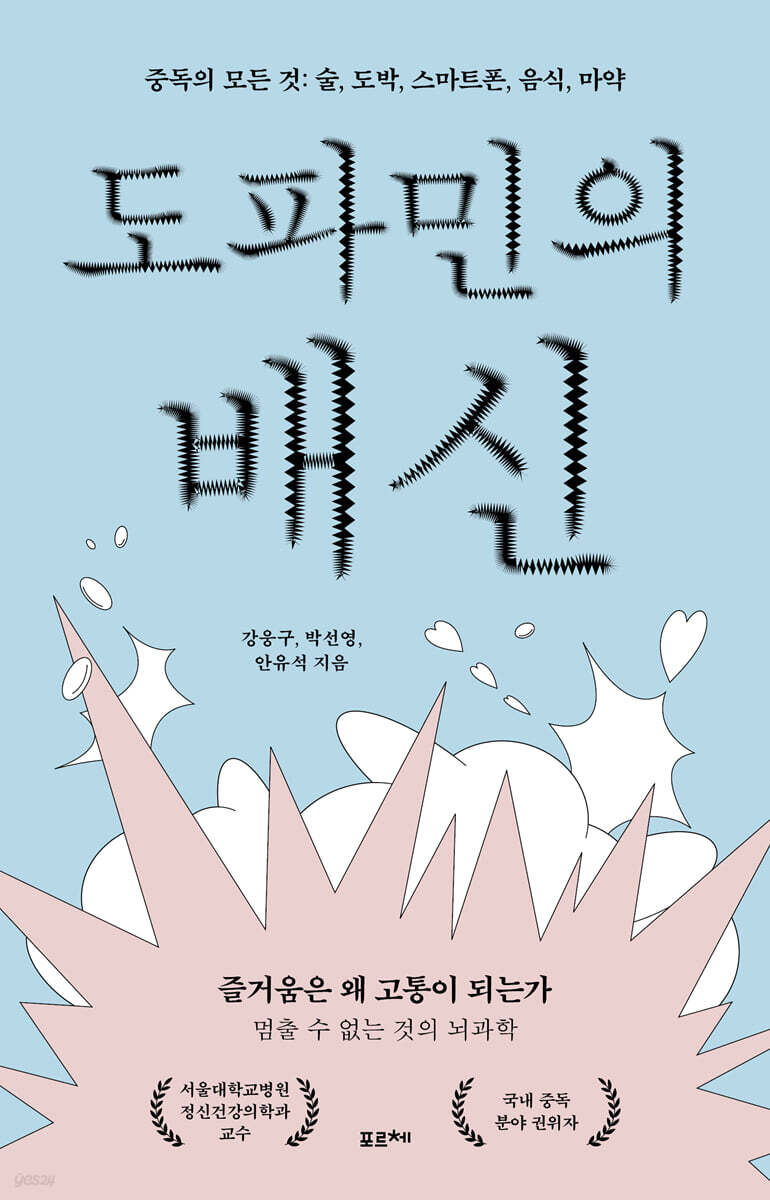 |
Description
Book Introduction
Alcohol, gambling, games, social media, food, drugs…
You're still hearing the whispers of dopamine
Is your brain ready to withstand all these temptations?
An expert in addiction at Seoul National University Hospital speaks
Rediscovering the addictions we're obsessed with
Addiction is not simply a matter of willpower.
Alcohol, drugs, gambling, smartphones, even food—all forms of "use disorders" are deeply ingrained in the daily lives of modern people.
But why do we become obsessed with certain things? "The Betrayal of Dopamine," co-authored by Professor Kang Woong-gu, Professor Park Seon-yeong, and Professor Ahn Yu-seok of the Department of Psychiatry at Seoul National University Hospital, analyzes addiction within the context of neuroscience and society, exploring why we can't stop.
In particular, Professor Kang Woong-gu, a leading first-generation addiction treatment psychiatrist in Korea, provides the most scientific and realistic guide to addiction based on his clinical experience and research achievements accumulated while treating addicted patients for over 30 years.
This book views addiction not as a problem of individual weakness, but as a combination of the brain's dopamine-driven reward system and social factors.
Dopamine is an essential neurotransmitter that helps us survive, but in modern society, it controls our behavior through repeated stimulation and causes addiction.
Rather than a simple moral judgment, it analyzes what addiction is, how it develops, and how to escape it from the perspective of brain science and psychiatry.
You're still hearing the whispers of dopamine
Is your brain ready to withstand all these temptations?
An expert in addiction at Seoul National University Hospital speaks
Rediscovering the addictions we're obsessed with
Addiction is not simply a matter of willpower.
Alcohol, drugs, gambling, smartphones, even food—all forms of "use disorders" are deeply ingrained in the daily lives of modern people.
But why do we become obsessed with certain things? "The Betrayal of Dopamine," co-authored by Professor Kang Woong-gu, Professor Park Seon-yeong, and Professor Ahn Yu-seok of the Department of Psychiatry at Seoul National University Hospital, analyzes addiction within the context of neuroscience and society, exploring why we can't stop.
In particular, Professor Kang Woong-gu, a leading first-generation addiction treatment psychiatrist in Korea, provides the most scientific and realistic guide to addiction based on his clinical experience and research achievements accumulated while treating addicted patients for over 30 years.
This book views addiction not as a problem of individual weakness, but as a combination of the brain's dopamine-driven reward system and social factors.
Dopamine is an essential neurotransmitter that helps us survive, but in modern society, it controls our behavior through repeated stimulation and causes addiction.
Rather than a simple moral judgment, it analyzes what addiction is, how it develops, and how to escape it from the perspective of brain science and psychiatry.
- You can preview some of the book's contents.
Preview
index
About this book - 4
Chapter 1: What is Addiction?
Compassionate care is needed ─ 12
Where does addiction begin? ─ 15
How Addiction Became a Disease ─ 27
People Between Happiness and Ruin ─ 37
Chapter 2: How Our Brains Get Addicted
How Addiction Controls Your Brain ─ 46
Does Dopamine Make Us Happy? ─ 59
The moment your brain becomes addicted to drugs ─ 71
Chapter 3: We Live in an Addicted Society
Drug Addiction, Dependence, and Abuse ─ 82
Gambling Addiction: People Who Can't Stop ─ 103
Cyber Addiction: People Trapped on Their Smartphones ─ 116
Food Addiction: People Who Have Difficulty Eating ─ 129
Addiction: Where Is Our Responsibility? ─ 137
Chapter 4: The Road Back to Normal
Emancipation from Slavery ─ 148
How to Treat Addiction ─ 158
Strategies for Treating Addiction ─ 172
Defeating Addictive Drugs Individually ─ 192
Alcohol | Central nervous system depressants | Opioids | Central nervous system stimulants | Hallucinogens | Marijuana | Other drugs
My and Our Addiction Liberation Journal ─ 246
Concluding the Book ─ 260
Chapter 1: What is Addiction?
Compassionate care is needed ─ 12
Where does addiction begin? ─ 15
How Addiction Became a Disease ─ 27
People Between Happiness and Ruin ─ 37
Chapter 2: How Our Brains Get Addicted
How Addiction Controls Your Brain ─ 46
Does Dopamine Make Us Happy? ─ 59
The moment your brain becomes addicted to drugs ─ 71
Chapter 3: We Live in an Addicted Society
Drug Addiction, Dependence, and Abuse ─ 82
Gambling Addiction: People Who Can't Stop ─ 103
Cyber Addiction: People Trapped on Their Smartphones ─ 116
Food Addiction: People Who Have Difficulty Eating ─ 129
Addiction: Where Is Our Responsibility? ─ 137
Chapter 4: The Road Back to Normal
Emancipation from Slavery ─ 148
How to Treat Addiction ─ 158
Strategies for Treating Addiction ─ 172
Defeating Addictive Drugs Individually ─ 192
Alcohol | Central nervous system depressants | Opioids | Central nervous system stimulants | Hallucinogens | Marijuana | Other drugs
My and Our Addiction Liberation Journal ─ 246
Concluding the Book ─ 260
Detailed image

Into the book
Addiction is an inevitable byproduct of our enjoyment of culture.
This is the book's basic stance on addiction.
Addictive drugs and behaviors are not things to be banished from our culture, but rather things to be lived with and managed.
Moving away from the position that 'complete cessation is the only goal of treatment,' we understand and treat patients from the perspective that the ultimate goal of addiction treatment is 'maintaining a healthy lifestyle.'
--- 「1.
From "Affectionate treatment is needed"
What these resources have in common is that they are surplus and not necessary for survival.
These are hobbies enjoyed in the spare time after essential needs are met, and did not exist when humans evolved.
Therefore, our brain does not have a circuit that homeostatically regulates the desire for such objects.
--- 「3.
From "How did addiction become a disease?"
Conversely, children who lack the ability to focus are diagnosed with attention deficit hyperactivity disorder (ADHD).
For children who cannot sit still and focus on the teacher during class and wander around, using dopamine-increasing medications to treat ADHD can help them regain the ability to focus on the teacher.
--- 「6.
From "Does Dopamine Make Us Happy?"
Drinking and smoking are also actions that are done out of simple habit rather than with active intention.
First of all, I don't really have a craving for them, but I use them without thinking because they are so common that I happen to notice them.
These are objects so accessible that they can be obtained without any effort, and all I have to do is simply consume them.
--- 「11.
Among those with food addiction and difficulty eating
Because drug withdrawal can cause strong cravings, detoxification should be done first if withdrawal is likely to occur.
Detoxification treatment always involves reversing the mutation, that is, allowing the body to re-adapt to a state without the drug.
Cravings during withdrawal are difficult to overcome with normal willpower, and some drugs can be life-threatening if not properly treated during withdrawal.
--- 「15.
From “Strategies for Treating Addiction”
Getting treatment makes it much easier to regain the autonomy that addiction has taken away.
But to go for treatment, I need to have the calm courage to accept the negative looks directed at me.
Being avoidant or defensive can lead to loss of access to treatment.
What is needed is not a strong willpower to quit drugs and gambling, but the courage and determination to seek treatment.
This is the book's basic stance on addiction.
Addictive drugs and behaviors are not things to be banished from our culture, but rather things to be lived with and managed.
Moving away from the position that 'complete cessation is the only goal of treatment,' we understand and treat patients from the perspective that the ultimate goal of addiction treatment is 'maintaining a healthy lifestyle.'
--- 「1.
From "Affectionate treatment is needed"
What these resources have in common is that they are surplus and not necessary for survival.
These are hobbies enjoyed in the spare time after essential needs are met, and did not exist when humans evolved.
Therefore, our brain does not have a circuit that homeostatically regulates the desire for such objects.
--- 「3.
From "How did addiction become a disease?"
Conversely, children who lack the ability to focus are diagnosed with attention deficit hyperactivity disorder (ADHD).
For children who cannot sit still and focus on the teacher during class and wander around, using dopamine-increasing medications to treat ADHD can help them regain the ability to focus on the teacher.
--- 「6.
From "Does Dopamine Make Us Happy?"
Drinking and smoking are also actions that are done out of simple habit rather than with active intention.
First of all, I don't really have a craving for them, but I use them without thinking because they are so common that I happen to notice them.
These are objects so accessible that they can be obtained without any effort, and all I have to do is simply consume them.
--- 「11.
Among those with food addiction and difficulty eating
Because drug withdrawal can cause strong cravings, detoxification should be done first if withdrawal is likely to occur.
Detoxification treatment always involves reversing the mutation, that is, allowing the body to re-adapt to a state without the drug.
Cravings during withdrawal are difficult to overcome with normal willpower, and some drugs can be life-threatening if not properly treated during withdrawal.
--- 「15.
From “Strategies for Treating Addiction”
Getting treatment makes it much easier to regain the autonomy that addiction has taken away.
But to go for treatment, I need to have the calm courage to accept the negative looks directed at me.
Being avoidant or defensive can lead to loss of access to treatment.
What is needed is not a strong willpower to quit drugs and gambling, but the courage and determination to seek treatment.
--- 「17.
From “My and Our Addiction Liberation Diary”
From “My and Our Addiction Liberation Diary”
Publisher's Review
The moment when something good becomes an unstoppable pain,
Pleasure destroys us.
Why do we get caught up in things we want to break but can't?
The moment you fall into the dopamine trap, addiction begins.
Addiction is no longer a strange word for modern people, and the pleasures that surround us can turn into fatal dependence at any time.
From alcohol, drug, and gambling addictions to smartphone, social media, shopping, and food addictions—we analyze the principles of addiction that permeate every aspect of our lives with the greatest accuracy and depth.
The paradoxical phenomenon of things that entertain us and enrich our lives in one area of culture now disempowering and dominating us is unfolding in real time.
Addiction cannot be explained by saying, "I have weak willpower."
Because addiction is not a personal weakness, but a problem created by the brain's reward system and modern society.
In particular, the way dopamine works is at the root of all addictions we easily fall into, such as smartphones, social media, gambling, food, alcohol, and drugs.
The reason why something that used to make us happy suddenly starts to dominate our lives is because of dopamine.
Dopamine predicts rewards, creates anticipation, and encourages repetition of behaviors.
That is, because of the way dopamine works, we become obsessed with certain behaviors (smartphones, gambling, binge eating, drugs, etc.).
It scientifically explains how dopamine trains our brains, why certain behaviors become unstoppable the more they are repeated, and suggests ways to break free from the process of addiction formation.
We are all on the edge of addiction
Can you be sure you are not addicted?
Instead of blame, addiction treatment is needed.
The First Step to Scientific Understanding for a Brain Unshackled by Dopamine
Addiction isn't something that only happens to certain people.
Because addiction is a distortion of an instinctive physiological process.
Addicts say things like, “I’ll quit drinking now,” or “I’ll never gamble again,” but they repeatedly engage in addictive behaviors and constantly disappoint others. However, they are not bad people who should be punished.
Because their brains are already out of the normal reward system.
This book explains that addiction is not simply a bad habit, but a state of altered brain function.
Addiction doesn't come from strong pleasure.
The problem is repetitive rewards.
We are not pursuing intense pleasure, but rather we are in a state of constant expectation of reward.
The more we repeat these small experiences, whether it's a drink, a gamble, or a social media notification, the more our brain craves them.
If you understand this principle, you can break free from the mechanisms of addiction that you have unknowingly fallen into.
The book explains the behavioral patterns of those addicted to alcohol, methamphetamine, gambling, and drugs, emphasizing that what they truly need is not blame, but scientifically proven treatment.
Can I be certain I'm free from addiction? Understanding how dopamine works and how modern society exploits it can provide clues to breaking free from the swamp of addiction.
This book will serve as a powerful guide to help you understand the true nature of addiction and regain self-control.
While this book is not intended as a direct treatment guide for those with addiction, it will provide insights for readers struggling with addiction and offer new perspectives to professionals and policymakers.
Pleasure destroys us.
Why do we get caught up in things we want to break but can't?
The moment you fall into the dopamine trap, addiction begins.
Addiction is no longer a strange word for modern people, and the pleasures that surround us can turn into fatal dependence at any time.
From alcohol, drug, and gambling addictions to smartphone, social media, shopping, and food addictions—we analyze the principles of addiction that permeate every aspect of our lives with the greatest accuracy and depth.
The paradoxical phenomenon of things that entertain us and enrich our lives in one area of culture now disempowering and dominating us is unfolding in real time.
Addiction cannot be explained by saying, "I have weak willpower."
Because addiction is not a personal weakness, but a problem created by the brain's reward system and modern society.
In particular, the way dopamine works is at the root of all addictions we easily fall into, such as smartphones, social media, gambling, food, alcohol, and drugs.
The reason why something that used to make us happy suddenly starts to dominate our lives is because of dopamine.
Dopamine predicts rewards, creates anticipation, and encourages repetition of behaviors.
That is, because of the way dopamine works, we become obsessed with certain behaviors (smartphones, gambling, binge eating, drugs, etc.).
It scientifically explains how dopamine trains our brains, why certain behaviors become unstoppable the more they are repeated, and suggests ways to break free from the process of addiction formation.
We are all on the edge of addiction
Can you be sure you are not addicted?
Instead of blame, addiction treatment is needed.
The First Step to Scientific Understanding for a Brain Unshackled by Dopamine
Addiction isn't something that only happens to certain people.
Because addiction is a distortion of an instinctive physiological process.
Addicts say things like, “I’ll quit drinking now,” or “I’ll never gamble again,” but they repeatedly engage in addictive behaviors and constantly disappoint others. However, they are not bad people who should be punished.
Because their brains are already out of the normal reward system.
This book explains that addiction is not simply a bad habit, but a state of altered brain function.
Addiction doesn't come from strong pleasure.
The problem is repetitive rewards.
We are not pursuing intense pleasure, but rather we are in a state of constant expectation of reward.
The more we repeat these small experiences, whether it's a drink, a gamble, or a social media notification, the more our brain craves them.
If you understand this principle, you can break free from the mechanisms of addiction that you have unknowingly fallen into.
The book explains the behavioral patterns of those addicted to alcohol, methamphetamine, gambling, and drugs, emphasizing that what they truly need is not blame, but scientifically proven treatment.
Can I be certain I'm free from addiction? Understanding how dopamine works and how modern society exploits it can provide clues to breaking free from the swamp of addiction.
This book will serve as a powerful guide to help you understand the true nature of addiction and regain self-control.
While this book is not intended as a direct treatment guide for those with addiction, it will provide insights for readers struggling with addiction and offer new perspectives to professionals and policymakers.
GOODS SPECIFICS
- Date of issue: March 5, 2025
- Page count, weight, size: 264 pages | 440g | 140*218*18mm
- ISBN13: 9791194634034
- ISBN10: 1194634036
You may also like
카테고리
korean


korean

![GQ KOREA Mark (Monthly): December [2025]](http://librairie.coreenne.fr/cdn/shop/files/8ef265dbbfbf186523ed75ba7319009d.jpg?v=1765340328&width=3840)


