

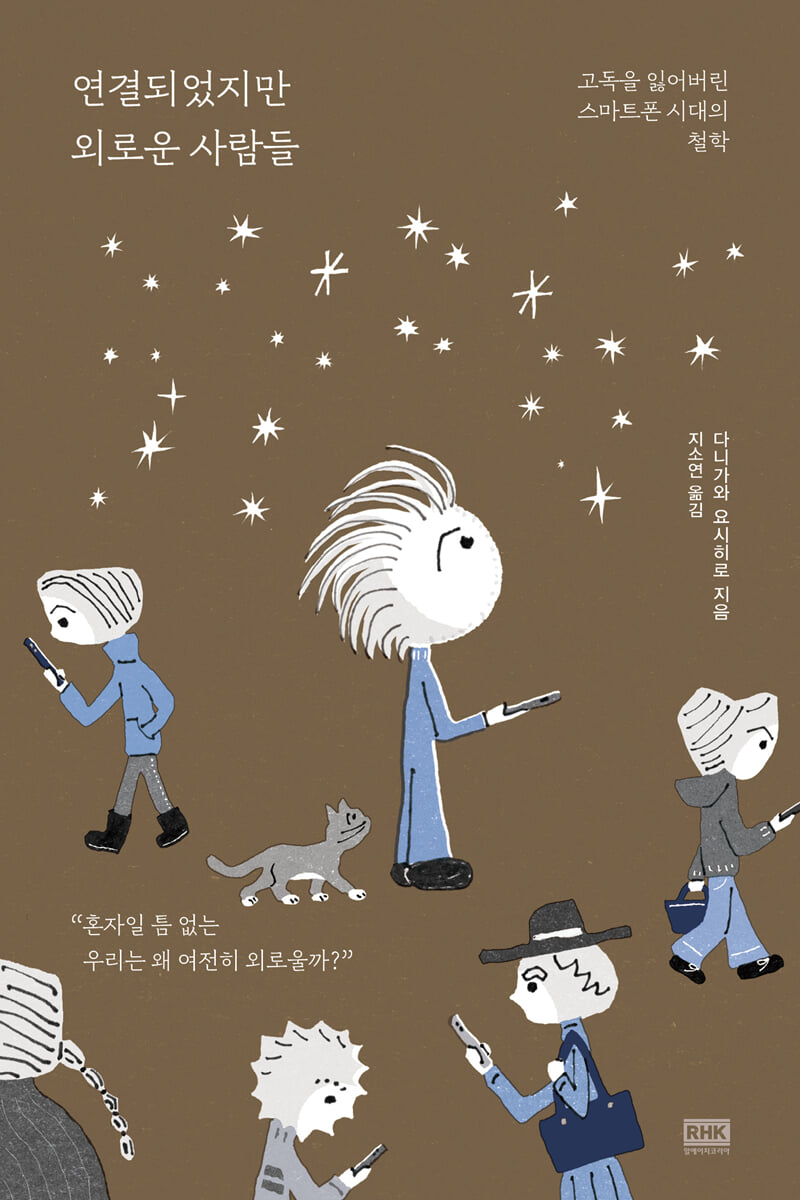
Connected but lonely people
 |
Description
Book Introduction
Losing time with myself in this busy world
About the 'solitude' and 'philosophy' we need
★ Recommended by Kim Gyul-wool, Lee Yeon, and Lee Chung-nyeong
Modern society is an 'always-on society' where we are always connected to others.
A society where you can call anyone, anywhere, anytime, hear real-time news from anywhere in the world, and express your thoughts and opinions online at any time.
But ironically, people became lonelier.
Multitasking without time to spare, being caught up in sensational reels and information, and losing sleep scrolling through your phone for no apparent reason are all ways to escape loneliness.
This is a vicious cycle.
Why do we feel lonely, even though we're always busy and surrounded by each other? The author of this book, Yoshihiro Tanigawa, a young Japanese philosopher, explains that it's because we've lost the time for "solitude."
People live together in a crowded space called a city, but they do not care about each other's thoughts and opinions.
He just keeps talking about himself.
Living in the city, we lose time to think deeply about emotions and phenomena and to talk to ourselves.
On the surface, it may seem like everything is going well, but the emotions that need to be dealt with are not being addressed, leading to depression and an inability to handle even the most complex tasks.
To us like this, the author recommends philosophy.
He says that if we engage in the reflections and conversations that have been going on for 2,500 years with the masters of knowledge, we can face ourselves.
By combining the stories of philosophers such as Nietzsche, Ortega, Hannah Arendt, and Pascal with popular culture such as Evangelion, Drive My Car, and Enter the Dragon, it points out how sick modern people are, and makes us face our own lapses into ‘hedonistic languor’ and ‘depressive pleasure.’
And it teaches us through philosophy how to live healthily and 'truly' in this uncertain world.
About the 'solitude' and 'philosophy' we need
★ Recommended by Kim Gyul-wool, Lee Yeon, and Lee Chung-nyeong
Modern society is an 'always-on society' where we are always connected to others.
A society where you can call anyone, anywhere, anytime, hear real-time news from anywhere in the world, and express your thoughts and opinions online at any time.
But ironically, people became lonelier.
Multitasking without time to spare, being caught up in sensational reels and information, and losing sleep scrolling through your phone for no apparent reason are all ways to escape loneliness.
This is a vicious cycle.
Why do we feel lonely, even though we're always busy and surrounded by each other? The author of this book, Yoshihiro Tanigawa, a young Japanese philosopher, explains that it's because we've lost the time for "solitude."
People live together in a crowded space called a city, but they do not care about each other's thoughts and opinions.
He just keeps talking about himself.
Living in the city, we lose time to think deeply about emotions and phenomena and to talk to ourselves.
On the surface, it may seem like everything is going well, but the emotions that need to be dealt with are not being addressed, leading to depression and an inability to handle even the most complex tasks.
To us like this, the author recommends philosophy.
He says that if we engage in the reflections and conversations that have been going on for 2,500 years with the masters of knowledge, we can face ourselves.
By combining the stories of philosophers such as Nietzsche, Ortega, Hannah Arendt, and Pascal with popular culture such as Evangelion, Drive My Car, and Enter the Dragon, it points out how sick modern people are, and makes us face our own lapses into ‘hedonistic languor’ and ‘depressive pleasure.’
And it teaches us through philosophy how to live healthily and 'truly' in this uncertain world.
- You can preview some of the book's contents.
Preview
index
prolog
Chapter 1.
A guide for those lost on the road
: How to survive in a zombie movie without dying
A society where people gather together and chatter loudly (without listening to what others say)
ㆍModern people judge and decide on their own.
The less self-doubt a person has, the more peaceful he or she is.
We live like people who die early in zombie movies.
Modern people are surrounded by immediate and fragmentary stimuli.
ㆍThere is a need to leave the mystery as a mystery.
ㆍDistinguish between 'relief' and 'stuffiness'
ㆍThe path we must take in the future
The 'adventure' of doubting oneself
[Column] Mass Society Theory, Media Theory, and Object Relations Theory
Chapter 2.
A philosophy for not thinking for yourself
: The power to think based on the problem-solving methods of geniuses
ㆍIs philosophy thinking for oneself?
Even philosophers watch Netflix and wear Dr. Martens.
ㆍIf you think about it yourself, the output is ordinary.
ㆍCaution is more important than strength.
ㆍLearn thinking skills like learning how to walk in the forest
A world that doesn't revolve around questions and answers
The two wheels of knowledge and imagination
ㆍ2,500 years of problem-solving skills are mine
ㆍWhy you shouldn't try to understand too quickly
Two common mistakes made when learning philosophy
ㆍLet's learn before we unlearn.
Sensemaking also requires knowledge and imagination.
ㆍHaving a rich imagination means having a wide repertoire of imagination.
ㆍLet various people live inside me
ㆍThree things to keep in mind when exploring philosophy
[Column] The Pragmatist Perspective
Chapter 3.
The 'solitude' lost while connected
: Philosophy of the smartphone age
ㆍOur society changed by smartphones
ㆍForgotten senses in the 'always-on society'
Loss of 'solitude' - People distracted by reflexive communication
The attention economy and smartphones are stealing our focus.
Loss of 'solitude' - people who cannot be with themselves
ㆍYou can become 'lonely' in 'isolation' - Hannah Arendt's philosophy
Where have 'solitude' and 'loneliness' gone?
Solitude to be properly hurt
ㆍIf you don't want to suppress your emotions
Solitude is necessary even when you are happy.
People who fill their free time with yet another multitasking activity
Smartphones slow down our ability to understand emotions.
ㆍTo not suppress your senses - Lesson 1 of Enter the Dragon
The true meaning of “Don’t think, feel!” - Lesson 2 of Enter the Dragon
Don't be distracted by your fingertips - Lesson 3 from Enter the Dragon
[Column] Rediscovering the Value of Solitude and Isolation
Chapter 4.
How to Create Solitude and Hobbies
: A conversation brought about by passive receptivity
People who are anxious about being left out
ㆍEmotions are not as simple as instant.
ㆍWe are swayed by loneliness - Thinking through 〈Evangelion〉, Part 1
ㆍHow to deal with loneliness, hobbies - Thinking through Evangelion, Part 2
ㆍThere are many people inside me - Thinking with Evangelion, Part 3
Hobbies Bring Loneliness - Thinking Through Evangelion, Part 4
ㆍA hobby is a conversation with riddles - Thinking through Evangelion, Part 5
ㆍA conversation between 'the written me' and 'the me who rewrites'
ㆍSelf-dialogue that begins when creating something
ㆍRemake it over and over again until you are satisfied with it.
ㆍThe ability to embrace 'uncertainty'
ㆍPassive acceptance that transcends time
ㆍWhat we need to live with uncertainty
ㆍAttitude of self-doubt, passive acceptance
ㆍThe study of philosophy is the cultivation of passive receptivity.
ㆍBeing with uncertainty in solitude
[Column] Why Weave Culture and Philosophy Together
Chapter 5.
A society that tries to forget boredom through a busy daily life
Is an Active Daily Life Empty? - Pascal and the Philosophy of Mood Change
People who turn away from boredom and anxiety
The coronavirus that has robbed us of our "change of mood."
ㆍThe boredom and anxiety that lie dormant in your heart
We cannot live properly without raising our motivation.
ㆍIs mental health an individual's responsibility?
The relationship between the need for constant growth and mental health
Steve Jobs' advice doesn't help.
ㆍDon't follow the voice of your heart
The dangers of "following your heart" as taught by Chekhov
Flexible work styles are good for self-development (but they don't save people).
Excessive concern for oneself interferes with self-talk.
ㆍInterest in oneself is compatible with the attention economy (in a bad way).
[Column] Existence and Loneliness in the Post-Fordist Era
Chapter 6.
Boredom is a sign that something needs to change.
ㆍImmerse yourself in 'pleasurable languor' to cope with anxiety
ㆍA soft coma brought on by a smartphone
ㆍFeeling bored when away from stimulation
ㆍStop focusing and jump into something simple and attractive.
ㆍThe complex entity called mood
ㆍThe voice of the mind is not always 'positive'
ㆍThe gap that makes us uncomfortable
ㆍChanges in sensation are signals to change behavior.
ㆍAttitude toward facing boredom
ㆍEstablish a self-governing area and enjoy solitude.
ㆍSometimes, hobbies bring back painful memories.
ㆍYou can only become affectionate by facing 'suffering'.
The process of facing the past is important - the movie "Drive My Car"
ㆍWe are forced to change flexibly in a harsh environment.
ㆍWe are always imperfect
ㆍHumans want to know because they do not know perfectly.
ㆍThe joy of continuing to learn, philosophy
[Column] A Combination of Existentialism, Object Relations Theory, and Consumer Society Theory
Epilogue
Reviews
Americas
Chapter 1.
A guide for those lost on the road
: How to survive in a zombie movie without dying
A society where people gather together and chatter loudly (without listening to what others say)
ㆍModern people judge and decide on their own.
The less self-doubt a person has, the more peaceful he or she is.
We live like people who die early in zombie movies.
Modern people are surrounded by immediate and fragmentary stimuli.
ㆍThere is a need to leave the mystery as a mystery.
ㆍDistinguish between 'relief' and 'stuffiness'
ㆍThe path we must take in the future
The 'adventure' of doubting oneself
[Column] Mass Society Theory, Media Theory, and Object Relations Theory
Chapter 2.
A philosophy for not thinking for yourself
: The power to think based on the problem-solving methods of geniuses
ㆍIs philosophy thinking for oneself?
Even philosophers watch Netflix and wear Dr. Martens.
ㆍIf you think about it yourself, the output is ordinary.
ㆍCaution is more important than strength.
ㆍLearn thinking skills like learning how to walk in the forest
A world that doesn't revolve around questions and answers
The two wheels of knowledge and imagination
ㆍ2,500 years of problem-solving skills are mine
ㆍWhy you shouldn't try to understand too quickly
Two common mistakes made when learning philosophy
ㆍLet's learn before we unlearn.
Sensemaking also requires knowledge and imagination.
ㆍHaving a rich imagination means having a wide repertoire of imagination.
ㆍLet various people live inside me
ㆍThree things to keep in mind when exploring philosophy
[Column] The Pragmatist Perspective
Chapter 3.
The 'solitude' lost while connected
: Philosophy of the smartphone age
ㆍOur society changed by smartphones
ㆍForgotten senses in the 'always-on society'
Loss of 'solitude' - People distracted by reflexive communication
The attention economy and smartphones are stealing our focus.
Loss of 'solitude' - people who cannot be with themselves
ㆍYou can become 'lonely' in 'isolation' - Hannah Arendt's philosophy
Where have 'solitude' and 'loneliness' gone?
Solitude to be properly hurt
ㆍIf you don't want to suppress your emotions
Solitude is necessary even when you are happy.
People who fill their free time with yet another multitasking activity
Smartphones slow down our ability to understand emotions.
ㆍTo not suppress your senses - Lesson 1 of Enter the Dragon
The true meaning of “Don’t think, feel!” - Lesson 2 of Enter the Dragon
Don't be distracted by your fingertips - Lesson 3 from Enter the Dragon
[Column] Rediscovering the Value of Solitude and Isolation
Chapter 4.
How to Create Solitude and Hobbies
: A conversation brought about by passive receptivity
People who are anxious about being left out
ㆍEmotions are not as simple as instant.
ㆍWe are swayed by loneliness - Thinking through 〈Evangelion〉, Part 1
ㆍHow to deal with loneliness, hobbies - Thinking through Evangelion, Part 2
ㆍThere are many people inside me - Thinking with Evangelion, Part 3
Hobbies Bring Loneliness - Thinking Through Evangelion, Part 4
ㆍA hobby is a conversation with riddles - Thinking through Evangelion, Part 5
ㆍA conversation between 'the written me' and 'the me who rewrites'
ㆍSelf-dialogue that begins when creating something
ㆍRemake it over and over again until you are satisfied with it.
ㆍThe ability to embrace 'uncertainty'
ㆍPassive acceptance that transcends time
ㆍWhat we need to live with uncertainty
ㆍAttitude of self-doubt, passive acceptance
ㆍThe study of philosophy is the cultivation of passive receptivity.
ㆍBeing with uncertainty in solitude
[Column] Why Weave Culture and Philosophy Together
Chapter 5.
A society that tries to forget boredom through a busy daily life
Is an Active Daily Life Empty? - Pascal and the Philosophy of Mood Change
People who turn away from boredom and anxiety
The coronavirus that has robbed us of our "change of mood."
ㆍThe boredom and anxiety that lie dormant in your heart
We cannot live properly without raising our motivation.
ㆍIs mental health an individual's responsibility?
The relationship between the need for constant growth and mental health
Steve Jobs' advice doesn't help.
ㆍDon't follow the voice of your heart
The dangers of "following your heart" as taught by Chekhov
Flexible work styles are good for self-development (but they don't save people).
Excessive concern for oneself interferes with self-talk.
ㆍInterest in oneself is compatible with the attention economy (in a bad way).
[Column] Existence and Loneliness in the Post-Fordist Era
Chapter 6.
Boredom is a sign that something needs to change.
ㆍImmerse yourself in 'pleasurable languor' to cope with anxiety
ㆍA soft coma brought on by a smartphone
ㆍFeeling bored when away from stimulation
ㆍStop focusing and jump into something simple and attractive.
ㆍThe complex entity called mood
ㆍThe voice of the mind is not always 'positive'
ㆍThe gap that makes us uncomfortable
ㆍChanges in sensation are signals to change behavior.
ㆍAttitude toward facing boredom
ㆍEstablish a self-governing area and enjoy solitude.
ㆍSometimes, hobbies bring back painful memories.
ㆍYou can only become affectionate by facing 'suffering'.
The process of facing the past is important - the movie "Drive My Car"
ㆍWe are forced to change flexibly in a harsh environment.
ㆍWe are always imperfect
ㆍHumans want to know because they do not know perfectly.
ㆍThe joy of continuing to learn, philosophy
[Column] A Combination of Existentialism, Object Relations Theory, and Consumer Society Theory
Epilogue
Reviews
Americas
Detailed image

Into the book
Nietzsche thought that modern people were very clumsy at looking straight at the anxiety of life or coexisting with it.
Those who are attracted to philosophy are likely to be those who, like Nietzsche, sympathize with this 'immaturity of life'.
How great would it be if there was a philosophy that could soothe the anxiety of those who work hard every day?
This book was written with that in mind.
--- p.6~7
This means that learning Nietzsche's philosophy is treated like eating fast food or uploading videos to TikTok.
(Omitted) It is the same with appreciating literature or movies, with learning, and with forming relationships based on friendship or love.
Some people want their conversations, their studies, and their relationships to be as predictable as they can be, just as they can finish their ordered hamburger in minutes.
In other words, we want to make it easy to achieve our goals by providing clear and easy-to-accept stimuli.
--- p.50
Some people say that it is important to learn and become more cultured now, as if they were recommending a simple music quiz.
What's really important is a life of listening to music, but I consider it a form of culture to build up knowledge so that I can guess the title of a song just by listening to the intro.
But a cultured person naturally means someone who lives with music.
--- p.51
In other words, we must learn how and where to use any knowledge.
Here, I would like to call ‘how and where to use knowledge’ ‘imagination.’
No matter what expert or philosopher we are taught, we must learn not only 'knowledge' but also 'imagination'.
(Omitted) This problem also exists when people think they have read the entire book by only reading reviews or summaries.
Just looking at reviews or summaries doesn't give you a full understanding of where to apply the knowledge.
Therefore, those who are satisfied with just reading the summary are only trying to see the book as 'knowledge' and not learn the 'imagination' contained within it.
--- p.87
Our task is not to interpret things in our own way, but to understand what kind of landscape unfolds when we look at the world through the philosopher's concepts and systems.
In short, it is about understanding knowledge according to the person's imagination (method) and moving concepts according to the person's thought system.
If you neglect this process and suddenly try to understand it in your own way, it is like trying to run before you can even walk.
However, it is not easy even for experts to completely understand the philosopher's system (the entire picture of philosophy).
--- p.100~101
The true meaning of the term 'rich imagination' is to create an ecosystem rich in diversity, that is, a state in which there are various types of others within oneself.
In other words, it is cultivating the garden called oneself into a place where various plants grow.
As you cultivate yourself into a wide-open space, like creating a garden, you will naturally find opportunities to doubt yourself, as Ortega says.
--- p.111
Sherry Turkle calls this situation, where we can use portable devices to access information or engage in other communications from places other than our own, the "always-on society."
The keyword of the philosophy of the smartphone era is ‘always-on connection.’
In a society where we are always connected, our daily lives are filled with multiple tasks, and we end up unable to focus on anything, especially when human relationships are scarce, she described this state as “connected, but alone.”
--- p.136
When you have suffered a shock so severe that you cannot fully maintain yourself, it is most important to listen to your heart and accept the pain anew, rather than denying it or feigning indifference.
At this time, 'loneliness' is the most annoying enemy.
This is because, in a situation where we are constantly in contact with many people or things, we are swept away by various stimuli and cannot carefully understand the situation by talking to ourselves.
(Omitted) Solitude is necessary to properly face the wounds.
If you're always trying to casually upload everything online or stay connected to others, you're probably trying to miss out on something important.
So, modern people who are accustomed to smartphones are very bad at dealing with anxiety.
--- p.155~157
“The reason we don’t seek the blessings of solitude is because we view the time needed to be alone as a resource to be utilized.” In reality, aren’t we trying to fill our free time with various other things instead of using it to engage in solitude?
People with their smartphones in hand have lost the time to enjoy the scenery or quietly listen to the sounds around them.
This is because the moment you pick up your smartphone, you instinctively start doing all sorts of short tasks.
--- p.163
When loneliness grows in our hearts, we find ourselves being swayed by our emotions as if they were in control of us, rather than us taking control of our emotions.
Loneliness or FOMO involves a desire for others, but it does not mean thinking about or caring for 'others'.
In reality, the only thing that's there is the desire to not feel alone, and the spotlight of attention is focused solely on you.
What we feel when we are faced with loneliness is not curiosity about others and the world.
--- p.198
Passive acceptance is nothing less than the power to ask yourself if you might be lost.
Only then can we obtain various questions from the riddle.
In short, passive receptivity is the attitude of not blindly searching for answers in one's own head, but rather embracing the mystery that cannot be fully solved, thereby deriving something new.
--- p.239
Pascal believed that the true goal was to 'turn away from boredom and anxiety'.
Various activities and interactions with others are 'entertainment' to take one's eyes off the boredom and anxiety that are difficult to escape.
'Entertainment' is also translated as 'change of mood'.
Boredom and anxiety remind us of the miserable fate of humans who will one day face death, and the word 'mood change' carries the nuance of diverting attention from such feelings and releasing emotions.
That is, the idea that diversion (distracting oneself) is a way for humans to pay less attention to their own misery.
The reason Pascal compared humans to a 'reed' that sways back and forth is because he believed that humans had a miserable fate.
Those who are attracted to philosophy are likely to be those who, like Nietzsche, sympathize with this 'immaturity of life'.
How great would it be if there was a philosophy that could soothe the anxiety of those who work hard every day?
This book was written with that in mind.
--- p.6~7
This means that learning Nietzsche's philosophy is treated like eating fast food or uploading videos to TikTok.
(Omitted) It is the same with appreciating literature or movies, with learning, and with forming relationships based on friendship or love.
Some people want their conversations, their studies, and their relationships to be as predictable as they can be, just as they can finish their ordered hamburger in minutes.
In other words, we want to make it easy to achieve our goals by providing clear and easy-to-accept stimuli.
--- p.50
Some people say that it is important to learn and become more cultured now, as if they were recommending a simple music quiz.
What's really important is a life of listening to music, but I consider it a form of culture to build up knowledge so that I can guess the title of a song just by listening to the intro.
But a cultured person naturally means someone who lives with music.
--- p.51
In other words, we must learn how and where to use any knowledge.
Here, I would like to call ‘how and where to use knowledge’ ‘imagination.’
No matter what expert or philosopher we are taught, we must learn not only 'knowledge' but also 'imagination'.
(Omitted) This problem also exists when people think they have read the entire book by only reading reviews or summaries.
Just looking at reviews or summaries doesn't give you a full understanding of where to apply the knowledge.
Therefore, those who are satisfied with just reading the summary are only trying to see the book as 'knowledge' and not learn the 'imagination' contained within it.
--- p.87
Our task is not to interpret things in our own way, but to understand what kind of landscape unfolds when we look at the world through the philosopher's concepts and systems.
In short, it is about understanding knowledge according to the person's imagination (method) and moving concepts according to the person's thought system.
If you neglect this process and suddenly try to understand it in your own way, it is like trying to run before you can even walk.
However, it is not easy even for experts to completely understand the philosopher's system (the entire picture of philosophy).
--- p.100~101
The true meaning of the term 'rich imagination' is to create an ecosystem rich in diversity, that is, a state in which there are various types of others within oneself.
In other words, it is cultivating the garden called oneself into a place where various plants grow.
As you cultivate yourself into a wide-open space, like creating a garden, you will naturally find opportunities to doubt yourself, as Ortega says.
--- p.111
Sherry Turkle calls this situation, where we can use portable devices to access information or engage in other communications from places other than our own, the "always-on society."
The keyword of the philosophy of the smartphone era is ‘always-on connection.’
In a society where we are always connected, our daily lives are filled with multiple tasks, and we end up unable to focus on anything, especially when human relationships are scarce, she described this state as “connected, but alone.”
--- p.136
When you have suffered a shock so severe that you cannot fully maintain yourself, it is most important to listen to your heart and accept the pain anew, rather than denying it or feigning indifference.
At this time, 'loneliness' is the most annoying enemy.
This is because, in a situation where we are constantly in contact with many people or things, we are swept away by various stimuli and cannot carefully understand the situation by talking to ourselves.
(Omitted) Solitude is necessary to properly face the wounds.
If you're always trying to casually upload everything online or stay connected to others, you're probably trying to miss out on something important.
So, modern people who are accustomed to smartphones are very bad at dealing with anxiety.
--- p.155~157
“The reason we don’t seek the blessings of solitude is because we view the time needed to be alone as a resource to be utilized.” In reality, aren’t we trying to fill our free time with various other things instead of using it to engage in solitude?
People with their smartphones in hand have lost the time to enjoy the scenery or quietly listen to the sounds around them.
This is because the moment you pick up your smartphone, you instinctively start doing all sorts of short tasks.
--- p.163
When loneliness grows in our hearts, we find ourselves being swayed by our emotions as if they were in control of us, rather than us taking control of our emotions.
Loneliness or FOMO involves a desire for others, but it does not mean thinking about or caring for 'others'.
In reality, the only thing that's there is the desire to not feel alone, and the spotlight of attention is focused solely on you.
What we feel when we are faced with loneliness is not curiosity about others and the world.
--- p.198
Passive acceptance is nothing less than the power to ask yourself if you might be lost.
Only then can we obtain various questions from the riddle.
In short, passive receptivity is the attitude of not blindly searching for answers in one's own head, but rather embracing the mystery that cannot be fully solved, thereby deriving something new.
--- p.239
Pascal believed that the true goal was to 'turn away from boredom and anxiety'.
Various activities and interactions with others are 'entertainment' to take one's eyes off the boredom and anxiety that are difficult to escape.
'Entertainment' is also translated as 'change of mood'.
Boredom and anxiety remind us of the miserable fate of humans who will one day face death, and the word 'mood change' carries the nuance of diverting attention from such feelings and releasing emotions.
That is, the idea that diversion (distracting oneself) is a way for humans to pay less attention to their own misery.
The reason Pascal compared humans to a 'reed' that sways back and forth is because he believed that humans had a miserable fate.
--- p.254
Publisher's Review
Stopped in the middle of life
The power of philosophy that awakens us
In this book, Yoshihiro Tanigawa, a young Japanese philosopher, says that we need two things in our lives: solitude and philosophy.
But in an age where clarity and immediacy are considered virtues, is there any field more remote than philosophy? Because "time is money," anything difficult, ambiguous, or time-consuming tends to recede from people's attention.
Oh, it might be different if it's a video with a title like "3-minute summary! Just watch this."
Modern people have a desire to understand everything easily.
This desire is precisely why self-improvement and short-form content are gaining popularity over philosophy and reasoning, which require persistence and sustained strength.
If you pursue what is quick and easy, you will end up only taking what you want to see and hear, and you will end up falling into stubbornness and dogmatism.
The author says that in this age where it is easy to become absorbed in oneself, 'philosophy' is even more necessary.
“Everyone only cares about themselves, they think that a world where only they feel good is enough, and they are too busy caring about their own opinions and image.
They confidently comment on experts without questioning their own opinions, and even those who believe in pseudoscience come up with ridiculous theories and say, "Tsk tsk, you must be so lacking in information," and treat scientists like idiots.
“It seems as if we have lost interest in other people and the world.” (pp. 31-32)
Philosophy cracks the narrow-minded thinking we have.
It breaks down stubbornness and dogmatism and opens the way for imagination and wisdom to flow in.
Moreover, contrary to its reputation as an ambiguous discipline, philosophy, which has addressed the problems and conflicts facing our times, solves problems and changes our perspective on the world when it deeply penetrates our lives.
As Epictetus likened philosophy to a hospital, the reason we need philosophy is to treat problems that arise.
Just as we cannot live our entire lives without getting sick or injured, philosophy is also like a hospital, which is essential even if it is not needed right now.
“For modern people who are accustomed to information that is as easily consumed as processed food, philosophy feels increasingly unfamiliar and difficult.
We are losing the ability to think deeply.
The author introduces philosophy not as a simple academic discipline, but as a tool for looking at life.
Rather than struggling to find the right answer, it's about thinking it through to the end, and sometimes carrying uncomfortable questions with you.
“Philosophy thus helps us regain the power of thought we have lost.” (From the recommendation)
In that sense, 『Connected But Lonely People』 becomes a starting point for looking at life from a philosophical perspective.
Let's stop ignoring the anxieties and worries we feel in life and face them head-on through the stories of philosophers.
How did we lose our solitude?
We have forgotten how to be ourselves
As the poet said, “Everyone was sick, but no one was sick,” modern people have many problems that are rarely revealed.
Among them, author Yoshihiro Tanigawa points out that 'loneliness has been lost'.
When we say 'solitude', we tend to think of 'loneliness', but many philosophers, including Hannah Arendt, have distinguished between the two.
Loneliness is 'a state of wanting to depend on others even though I am surrounded by many people,' while solitude is 'a way of existing with myself in silence.'
The author says that what modern people suffering from loneliness need to regain is 'solitude.'
So how did we become lonely and lose our solitude?
“What we have lost (are about to lose) here is ‘solitude.’
People cannot stand boredom and crave stimulation and communication.
It also means that you cannot be with yourself.
“The word ‘solitude’ implies the importance of spending time alone, without seeking stimulation or reacting to others.” (p. 144)
It's easy to understand when we look back at ourselves, unable to put our phones down day or night.
This era can be called the 'smartphone era', as our dependence on them is growing, to the point where we spend only a few hours a day looking away from screens such as smartphones or tablet PCs.
In addition, our unquenchable passion for self-improvement leaves us no room for loneliness.
Modern people literally fill their schedules without rest and constantly motivate themselves, as if they can't stand not doing anything, such as 'God's Life', 'Miracle Morning', and 'Side Project'.
It's not that it's 'fun', but rather that they're afraid of facing the anxieties and worries of life in the silence, so they turn their attention to the wrong places, such as short, intense stimulation, entertainment, and multitasking.
Meanwhile, our inner selves and emotions were neglected.
People who don't know how to be alone end up falling into deep depression because they can't properly process the emotions they feel from major events in their lives, and they sometimes feel deeply regretful about their lives that feel like a shell.
The author painfully criticizes these portraits of modern people through this book.
How can I regain my solitude?
How to start a conversation with me
Solitude is necessary for everyone because it allows us to step out from the crowd and look inside ourselves.
Some people have to fully experience and digest the great happiness that comes with having a child, while others have to fully experience the great shock and sadness that comes with losing a loved one.
It is an essential element for leading a healthy life and for building healthy relationships with others.
In this book, the author introduces various ways to bring about loneliness in everyday life, and among them, the method that is dealt with in depth is none other than 'hobby'.
A 'hobby' allows for isolation and solitude because it is an area where one can be free from the distractions of others and is not done for profit or reputation.
When we create or grow something as a hobby, we are carrying on an unspoken conversation with that object.
This book uses writing and gardening as examples. When we garden, we don't know everything about the size and speed of the crops.
Because we don't know whether or not it will bear fruit safely, we examine the stems and leaves and go through trial and error.
“This means that through creation, that is, through the hobby of ‘making something and growing something,’ we must constantly go back and forth between ‘self’ and ‘other’ and have a continuous dialogue with ourselves.
“It can be said that hobbies lead directly to solitude, because thinking (self-talk) becomes possible in solitude.” (p. 210)
“At this time, the ‘something’ we create appears before us as an ‘other’ (question).
When we create or grow something, it means that the object exists outside of us while being connected to us.
So when we write poetry or grow watermelons, we ask the poetry and the watermelons many questions.
“The act of figuring out what questions the ‘something’ you create poses to you is inextricably linked to your hobby.” (p. 211)
That is, through hobbies, we accept that there are areas we do not understand, and we anticipate and imagine the possibilities that uncertainty brings.
It is a process of adopting a different way of life from the one that pursues simple and clear answers.
In addition, through the methods of "solitude" introduced by the author, we hope to escape the dangers of stubbornness and dogmatism, grow step by step, and live in bonds with those around us.
The power of philosophy that awakens us
In this book, Yoshihiro Tanigawa, a young Japanese philosopher, says that we need two things in our lives: solitude and philosophy.
But in an age where clarity and immediacy are considered virtues, is there any field more remote than philosophy? Because "time is money," anything difficult, ambiguous, or time-consuming tends to recede from people's attention.
Oh, it might be different if it's a video with a title like "3-minute summary! Just watch this."
Modern people have a desire to understand everything easily.
This desire is precisely why self-improvement and short-form content are gaining popularity over philosophy and reasoning, which require persistence and sustained strength.
If you pursue what is quick and easy, you will end up only taking what you want to see and hear, and you will end up falling into stubbornness and dogmatism.
The author says that in this age where it is easy to become absorbed in oneself, 'philosophy' is even more necessary.
“Everyone only cares about themselves, they think that a world where only they feel good is enough, and they are too busy caring about their own opinions and image.
They confidently comment on experts without questioning their own opinions, and even those who believe in pseudoscience come up with ridiculous theories and say, "Tsk tsk, you must be so lacking in information," and treat scientists like idiots.
“It seems as if we have lost interest in other people and the world.” (pp. 31-32)
Philosophy cracks the narrow-minded thinking we have.
It breaks down stubbornness and dogmatism and opens the way for imagination and wisdom to flow in.
Moreover, contrary to its reputation as an ambiguous discipline, philosophy, which has addressed the problems and conflicts facing our times, solves problems and changes our perspective on the world when it deeply penetrates our lives.
As Epictetus likened philosophy to a hospital, the reason we need philosophy is to treat problems that arise.
Just as we cannot live our entire lives without getting sick or injured, philosophy is also like a hospital, which is essential even if it is not needed right now.
“For modern people who are accustomed to information that is as easily consumed as processed food, philosophy feels increasingly unfamiliar and difficult.
We are losing the ability to think deeply.
The author introduces philosophy not as a simple academic discipline, but as a tool for looking at life.
Rather than struggling to find the right answer, it's about thinking it through to the end, and sometimes carrying uncomfortable questions with you.
“Philosophy thus helps us regain the power of thought we have lost.” (From the recommendation)
In that sense, 『Connected But Lonely People』 becomes a starting point for looking at life from a philosophical perspective.
Let's stop ignoring the anxieties and worries we feel in life and face them head-on through the stories of philosophers.
How did we lose our solitude?
We have forgotten how to be ourselves
As the poet said, “Everyone was sick, but no one was sick,” modern people have many problems that are rarely revealed.
Among them, author Yoshihiro Tanigawa points out that 'loneliness has been lost'.
When we say 'solitude', we tend to think of 'loneliness', but many philosophers, including Hannah Arendt, have distinguished between the two.
Loneliness is 'a state of wanting to depend on others even though I am surrounded by many people,' while solitude is 'a way of existing with myself in silence.'
The author says that what modern people suffering from loneliness need to regain is 'solitude.'
So how did we become lonely and lose our solitude?
“What we have lost (are about to lose) here is ‘solitude.’
People cannot stand boredom and crave stimulation and communication.
It also means that you cannot be with yourself.
“The word ‘solitude’ implies the importance of spending time alone, without seeking stimulation or reacting to others.” (p. 144)
It's easy to understand when we look back at ourselves, unable to put our phones down day or night.
This era can be called the 'smartphone era', as our dependence on them is growing, to the point where we spend only a few hours a day looking away from screens such as smartphones or tablet PCs.
In addition, our unquenchable passion for self-improvement leaves us no room for loneliness.
Modern people literally fill their schedules without rest and constantly motivate themselves, as if they can't stand not doing anything, such as 'God's Life', 'Miracle Morning', and 'Side Project'.
It's not that it's 'fun', but rather that they're afraid of facing the anxieties and worries of life in the silence, so they turn their attention to the wrong places, such as short, intense stimulation, entertainment, and multitasking.
Meanwhile, our inner selves and emotions were neglected.
People who don't know how to be alone end up falling into deep depression because they can't properly process the emotions they feel from major events in their lives, and they sometimes feel deeply regretful about their lives that feel like a shell.
The author painfully criticizes these portraits of modern people through this book.
How can I regain my solitude?
How to start a conversation with me
Solitude is necessary for everyone because it allows us to step out from the crowd and look inside ourselves.
Some people have to fully experience and digest the great happiness that comes with having a child, while others have to fully experience the great shock and sadness that comes with losing a loved one.
It is an essential element for leading a healthy life and for building healthy relationships with others.
In this book, the author introduces various ways to bring about loneliness in everyday life, and among them, the method that is dealt with in depth is none other than 'hobby'.
A 'hobby' allows for isolation and solitude because it is an area where one can be free from the distractions of others and is not done for profit or reputation.
When we create or grow something as a hobby, we are carrying on an unspoken conversation with that object.
This book uses writing and gardening as examples. When we garden, we don't know everything about the size and speed of the crops.
Because we don't know whether or not it will bear fruit safely, we examine the stems and leaves and go through trial and error.
“This means that through creation, that is, through the hobby of ‘making something and growing something,’ we must constantly go back and forth between ‘self’ and ‘other’ and have a continuous dialogue with ourselves.
“It can be said that hobbies lead directly to solitude, because thinking (self-talk) becomes possible in solitude.” (p. 210)
“At this time, the ‘something’ we create appears before us as an ‘other’ (question).
When we create or grow something, it means that the object exists outside of us while being connected to us.
So when we write poetry or grow watermelons, we ask the poetry and the watermelons many questions.
“The act of figuring out what questions the ‘something’ you create poses to you is inextricably linked to your hobby.” (p. 211)
That is, through hobbies, we accept that there are areas we do not understand, and we anticipate and imagine the possibilities that uncertainty brings.
It is a process of adopting a different way of life from the one that pursues simple and clear answers.
In addition, through the methods of "solitude" introduced by the author, we hope to escape the dangers of stubbornness and dogmatism, grow step by step, and live in bonds with those around us.
GOODS SPECIFICS
- Date of issue: February 24, 2025
- Page count, weight, size: 392 pages | 500g | 140*210*26mm
- ISBN13: 9788925573977
- ISBN10: 8925573970
You may also like
카테고리
korean


korean

![ELLE 엘르 스페셜 에디션 A형 : 12월 [2025]](http://librairie.coreenne.fr/cdn/shop/files/b8e27a3de6c9538896439686c6b0e8fb.jpg?v=1766436872&width=3840)


