

Walking through the forest of mathematics
 |
Description
Book Introduction
★ Recommended by mathematician Kim Min-hyung, physicist Kim Hyeon-cheol, and director of the National Institute of Mathematical Sciences Choi Yun-seong ★
“Understanding the essence of mathematics!”
A master of topology and a teacher of the Mathematical Olympiad
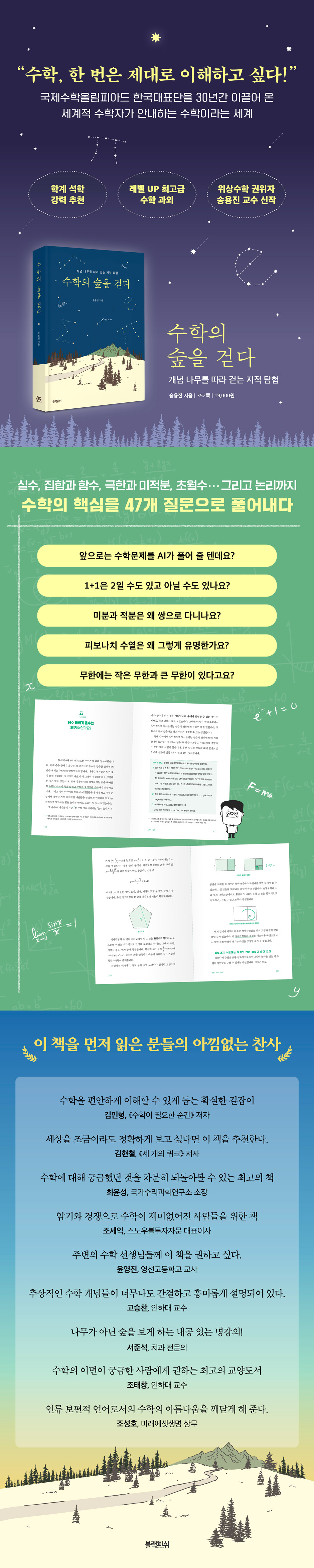
47 Mathematical Concepts Walks with Professor Song Yong-jin
What image do you have of "math"? Everyone's perception will vary: a labyrinth with no exit, a difficult but desirable friend, or a fun game.
One thing is clear: mathematics is a difficult subject.
Even concepts and symbols that seem simple are actually things that countless mathematicians have worked hard to understand and organize.
That is why the basic concepts of mathematics are not easy to understand and acquire.
If you have ever experienced mental distress because of studying math, it is natural.
Although difficult to learn and understand, mathematics is a necessary subject for our lives.
It is a required subject in school studies and cannot be omitted when explaining economic and social phenomena or historical trends.
It is a unique discipline and intellectual legacy that has evolved alongside human civilization for thousands of years. It also fosters the logical, critical, and problem-solving skills that are even more essential in the AI era.
This is why you need to know mathematics even if you are not a science or engineering major.
But how well do we truly understand mathematics, such an important subject? In the face of fierce competition, haven't we been so focused on memorizing formulas and solving problems that we barely have time to understand them? Haven't we been lost in the dense canopy, missing the forest for the trees? Professor Song Yong-jin, a world-renowned authority on topology and the leader of the Korean delegation to the International Mathematical Olympiad for 30 years, wrote this book, "Walking Through the Forest of Mathematics," to quench the thirst for mathematics felt by many.
The author has dedicated his entire life to the forefront of mathematics education, and has selected 47 concepts and principles that students of mathematics find curious and difficult to understand.
It carefully selects core mathematical concepts such as real numbers, sets and functions, limits and calculus, and clearly explains their true meaning using appropriate analogies and examples.
I recommend this book not only to students majoring in mathematics or preparing for entrance exams, but also to anyone who is curious and inquisitive about mathematics.
It is also recommended reading for educators, including mathematics teachers, as it provides opportunities for insight and methods for teaching mathematics effectively.
“Understanding the essence of mathematics!”
A master of topology and a teacher of the Mathematical Olympiad
47 Mathematical Concepts Walks with Professor Song Yong-jin
What image do you have of "math"? Everyone's perception will vary: a labyrinth with no exit, a difficult but desirable friend, or a fun game.
One thing is clear: mathematics is a difficult subject.
Even concepts and symbols that seem simple are actually things that countless mathematicians have worked hard to understand and organize.
That is why the basic concepts of mathematics are not easy to understand and acquire.
If you have ever experienced mental distress because of studying math, it is natural.
Although difficult to learn and understand, mathematics is a necessary subject for our lives.
It is a required subject in school studies and cannot be omitted when explaining economic and social phenomena or historical trends.
It is a unique discipline and intellectual legacy that has evolved alongside human civilization for thousands of years. It also fosters the logical, critical, and problem-solving skills that are even more essential in the AI era.
This is why you need to know mathematics even if you are not a science or engineering major.
But how well do we truly understand mathematics, such an important subject? In the face of fierce competition, haven't we been so focused on memorizing formulas and solving problems that we barely have time to understand them? Haven't we been lost in the dense canopy, missing the forest for the trees? Professor Song Yong-jin, a world-renowned authority on topology and the leader of the Korean delegation to the International Mathematical Olympiad for 30 years, wrote this book, "Walking Through the Forest of Mathematics," to quench the thirst for mathematics felt by many.
The author has dedicated his entire life to the forefront of mathematics education, and has selected 47 concepts and principles that students of mathematics find curious and difficult to understand.
It carefully selects core mathematical concepts such as real numbers, sets and functions, limits and calculus, and clearly explains their true meaning using appropriate analogies and examples.
I recommend this book not only to students majoring in mathematics or preparing for entrance exams, but also to anyone who is curious and inquisitive about mathematics.
It is also recommended reading for educators, including mathematics teachers, as it provides opportunities for insight and methods for teaching mathematics effectively.
- You can preview some of the book's contents.
Preview
index
Introduction: Let's take a look back at mathematics with a relaxed mind.
Part 1: The Value of Mathematics - Mathematics: The Key to Finding Truth
1.
Do I really have to study math?
2.
I'm not good at math. What should I do?
3.
How can I make studying math easy and fun?
4.
'Mathematics is the language of God'. Isn't that too grandiose?
5.
Is mathematics a 'discovery' or an 'invention'?
6.
What kind of research do mathematicians do?
7.
In the future, AI will solve math problems?
Part 2 Mistakes - Intellectual Time to Read Numbers
8.
Can 1+1 be 2 or not?
9.
So what is √2?
10.
Why is 0 such an important number?
11.
Why is a negative number times a negative number positive?
12.
Is it necessary to rationalize the denominator?
13.
I find 90° more comfortable than π/2?
Part 3: Sets and Functions - The Box That Holds Everything
14.
Is a set really a necessary concept?
15.
How are sets used in logic?
16.
You multiply the sets together?
17.
Why are coordinates so important?
18.
Shouldn't a function be understood as input and output?
19.
Why should we distinguish between functions and graphs?
20.
What are one-to-one functions and surjective functions?
21.
What does continuous function mean?
Part 4: Limits and Calculus - Into the Beautiful World of Infinity
22.
But isn't 0.999... a number less than 1?
23.
Isn't the limit not a specific number but a situation that is approaching it?
24.
Why do differentiation and integration go together?
25.
Why does the mean value theorem appear so often?
26.
Why should I learn calculus?
27.
Why is the natural constant e important?
28.
Exponential functions are difficult to define?
29.
Is dy/dx actually a fraction?
30.
How are inverse functions used?
Part 5: The Mystery of Numbers - A Story About Numbers That Hold the Secrets of the World
31.
Why are minorities important?
32.
What is the imaginary number i?
33.
What's the secret behind complex numbers?
34.
Why is π called a mysterious number?
35.
How accurately is the approximation of π found?
36.
What is a transcendental number?
37.
Why is the Fibonacci sequence so famous?
Part 6: Mathematics and Logic - How to Develop Your Thinking Power
38.
Logic is not philosophy, it's mathematics?
39.
What is modern logic?
40.
What kind of logic is needed to study mathematics?
41.
Is it 'to be satisfied' or 'to satisfy'?
42.
Why is the law of reductio ad absurdum difficult?
43.
Is mathematical induction really perfect?
44.
What is the maximum value of the open interval (0, 1)?
45.
In infinity, there are small infinities and big infinities?
46.
Why are there more irrational numbers than rational numbers?
47.
What is Greek axiomatic mathematics?
Part 1: The Value of Mathematics - Mathematics: The Key to Finding Truth
1.
Do I really have to study math?
2.
I'm not good at math. What should I do?
3.
How can I make studying math easy and fun?
4.
'Mathematics is the language of God'. Isn't that too grandiose?
5.
Is mathematics a 'discovery' or an 'invention'?
6.
What kind of research do mathematicians do?
7.
In the future, AI will solve math problems?
Part 2 Mistakes - Intellectual Time to Read Numbers
8.
Can 1+1 be 2 or not?
9.
So what is √2?
10.
Why is 0 such an important number?
11.
Why is a negative number times a negative number positive?
12.
Is it necessary to rationalize the denominator?
13.
I find 90° more comfortable than π/2?
Part 3: Sets and Functions - The Box That Holds Everything
14.
Is a set really a necessary concept?
15.
How are sets used in logic?
16.
You multiply the sets together?
17.
Why are coordinates so important?
18.
Shouldn't a function be understood as input and output?
19.
Why should we distinguish between functions and graphs?
20.
What are one-to-one functions and surjective functions?
21.
What does continuous function mean?
Part 4: Limits and Calculus - Into the Beautiful World of Infinity
22.
But isn't 0.999... a number less than 1?
23.
Isn't the limit not a specific number but a situation that is approaching it?
24.
Why do differentiation and integration go together?
25.
Why does the mean value theorem appear so often?
26.
Why should I learn calculus?
27.
Why is the natural constant e important?
28.
Exponential functions are difficult to define?
29.
Is dy/dx actually a fraction?
30.
How are inverse functions used?
Part 5: The Mystery of Numbers - A Story About Numbers That Hold the Secrets of the World
31.
Why are minorities important?
32.
What is the imaginary number i?
33.
What's the secret behind complex numbers?
34.
Why is π called a mysterious number?
35.
How accurately is the approximation of π found?
36.
What is a transcendental number?
37.
Why is the Fibonacci sequence so famous?
Part 6: Mathematics and Logic - How to Develop Your Thinking Power
38.
Logic is not philosophy, it's mathematics?
39.
What is modern logic?
40.
What kind of logic is needed to study mathematics?
41.
Is it 'to be satisfied' or 'to satisfy'?
42.
Why is the law of reductio ad absurdum difficult?
43.
Is mathematical induction really perfect?
44.
What is the maximum value of the open interval (0, 1)?
45.
In infinity, there are small infinities and big infinities?
46.
Why are there more irrational numbers than rational numbers?
47.
What is Greek axiomatic mathematics?
Detailed image
Into the book
Although mathematics pursues the pursuit of perfect solutions through precise logic, the process of obtaining the answers is more important than the answers themselves.
It's not much different from school math or entrance exam math.
So in mathematics, when evaluating, you should evaluate the process of coming up with the answer, not the answer itself.
So even if the answer you get is wrong (due to a simple calculation error, etc.), you should be given full marks if the process of getting the answer is correct.
This method is maintained in descriptive tests such as the 2nd and 3rd tests of the Korean Mathematical Olympiad and the International Mathematical Olympiad.
--- From the "Preface"
If an AI could solve math problems as well as the best gifted students, it would quickly surpass all humans, but that is not the current situation.
That's because AI has a fundamental weakness when it comes to specialized mathematics.
Unlike Go, mathematics has very complex game rules.
There are many fields in mathematics.
There are hundreds of fields, and their content and nature are very diverse.
So, among them, there will be areas that AI can access relatively easily and areas that it will find difficult to access.
The easy areas are likely to be areas that focus on calculations and obtaining specific answers or approximations, while the difficult areas are likely to be areas that involve a lot of abstract mathematical concepts.
--- 「Part 1, Chapter 7.
In the future, AI will solve math problems, right?
To cut to the chase, the answer to the question, “Why is 1 plus 1 equal to 2?” is very simple.
The answer is, “Because the definition of 2 is 1 plus 1.”
In other words, it is simply the number 1+1 expressed with the symbol and name 2.
The same goes for the number 3.
3 is simply a number that represents 1+1+1, or 2+1.
So 1 plus 1 must be 2 and it can't be any other number.
So why did Russell and Whitehead go to such great lengths to prove this simple fact? There's a compelling reason behind it.
--- 「Part 2, Chapter 8.
"Can 1+1 be 2 or not?"
Students are accustomed to using the symbol (0, 1) as a subset of real numbers and are confident that they know what it is.
But when I ask students (college students) “If x is an element of the set (0, 1), then what is x?”, strangely enough, they are not very good at answering.
There may be students who think, 'The professor is asking something strange,' and are unable to answer, but it seems that many of them are unable to answer because they have never taken out the definition and concept of (0, 1) in their heads and expressed it in words.
The answer to this question is, of course, “x is a real number greater than 0 and less than 1,” and the answer is actually quite easy.
--- 「Part 3, 14.
Is a set a necessary concept?
Differentiation is the instantaneous rate of change of the function value (at a point), and it is expressed as the slope of the tangent line to the graph.
And integration, originally intended to calculate the area (or volume) of a region, doesn't seem to have any connection with differentiation and integration? While they share the similarity of breaking something down into smaller pieces and then taking its limit, the nature of the values they seek seems completely different.
Historically, mathematicians considered the concept of integration before differentiation.
When calculating the area of an object (similarly to the length of a curve or the volume of an object), the effort to approximate the total area by dividing the object into small squares and adding their areas (this is called the piecewise quadrature method) began with ancient Greek mathematicians.
The representative mathematician is Archimedes (287-212 BC), who is considered one of the three greatest mathematicians in history.
It is a well-known story that he knew exactly the volume of a sphere and a cylinder (probably through the method of sectionalization).
--- 「Part 4, 24.
Why do differentiation and integration go together?
π is a transcendental number, so it cannot be constructed with a straightedge and compass.
The reason why it is impossible to construct a line segment of length π from a line segment of length 1 using a straightedge and a compass is because the process of finding a new point with a compass and drawing a line segment connecting the two points or drawing a circle can all be expressed as a 'polynomial' of degree 2 or lower.
Nevertheless, people often appear who claim to have constructed π.
In the past, when math professors did not recognize their proofs, some people would spend a lot of money to advertise their proofs in major newspapers.
--- 「Part 5, 36.
From "What is a transcendental number?"
When people hear the word 'infinity', they usually think of infinity (∞).
Infinity is an 'imaginary number' larger than any real number.
However, in mathematics, when we talk about infinity, we usually talk about 'sets' rather than 'numbers'.
Now let's talk about infinite sets.
An infinite set is, of course, a set with infinitely many elements.
If we write it as a symbol, the set A where |A|=∞ is called an infinite set.
Although infinity is not a topic covered in high school mathematics, these days, thanks to the availability of YouTube and documentaries, many people are somewhat familiar with or curious about it.
Let's start by explaining the definition of an infinite set and some of its basic properties.
It's not much different from school math or entrance exam math.
So in mathematics, when evaluating, you should evaluate the process of coming up with the answer, not the answer itself.
So even if the answer you get is wrong (due to a simple calculation error, etc.), you should be given full marks if the process of getting the answer is correct.
This method is maintained in descriptive tests such as the 2nd and 3rd tests of the Korean Mathematical Olympiad and the International Mathematical Olympiad.
--- From the "Preface"
If an AI could solve math problems as well as the best gifted students, it would quickly surpass all humans, but that is not the current situation.
That's because AI has a fundamental weakness when it comes to specialized mathematics.
Unlike Go, mathematics has very complex game rules.
There are many fields in mathematics.
There are hundreds of fields, and their content and nature are very diverse.
So, among them, there will be areas that AI can access relatively easily and areas that it will find difficult to access.
The easy areas are likely to be areas that focus on calculations and obtaining specific answers or approximations, while the difficult areas are likely to be areas that involve a lot of abstract mathematical concepts.
--- 「Part 1, Chapter 7.
In the future, AI will solve math problems, right?
To cut to the chase, the answer to the question, “Why is 1 plus 1 equal to 2?” is very simple.
The answer is, “Because the definition of 2 is 1 plus 1.”
In other words, it is simply the number 1+1 expressed with the symbol and name 2.
The same goes for the number 3.
3 is simply a number that represents 1+1+1, or 2+1.
So 1 plus 1 must be 2 and it can't be any other number.
So why did Russell and Whitehead go to such great lengths to prove this simple fact? There's a compelling reason behind it.
--- 「Part 2, Chapter 8.
"Can 1+1 be 2 or not?"
Students are accustomed to using the symbol (0, 1) as a subset of real numbers and are confident that they know what it is.
But when I ask students (college students) “If x is an element of the set (0, 1), then what is x?”, strangely enough, they are not very good at answering.
There may be students who think, 'The professor is asking something strange,' and are unable to answer, but it seems that many of them are unable to answer because they have never taken out the definition and concept of (0, 1) in their heads and expressed it in words.
The answer to this question is, of course, “x is a real number greater than 0 and less than 1,” and the answer is actually quite easy.
--- 「Part 3, 14.
Is a set a necessary concept?
Differentiation is the instantaneous rate of change of the function value (at a point), and it is expressed as the slope of the tangent line to the graph.
And integration, originally intended to calculate the area (or volume) of a region, doesn't seem to have any connection with differentiation and integration? While they share the similarity of breaking something down into smaller pieces and then taking its limit, the nature of the values they seek seems completely different.
Historically, mathematicians considered the concept of integration before differentiation.
When calculating the area of an object (similarly to the length of a curve or the volume of an object), the effort to approximate the total area by dividing the object into small squares and adding their areas (this is called the piecewise quadrature method) began with ancient Greek mathematicians.
The representative mathematician is Archimedes (287-212 BC), who is considered one of the three greatest mathematicians in history.
It is a well-known story that he knew exactly the volume of a sphere and a cylinder (probably through the method of sectionalization).
--- 「Part 4, 24.
Why do differentiation and integration go together?
π is a transcendental number, so it cannot be constructed with a straightedge and compass.
The reason why it is impossible to construct a line segment of length π from a line segment of length 1 using a straightedge and a compass is because the process of finding a new point with a compass and drawing a line segment connecting the two points or drawing a circle can all be expressed as a 'polynomial' of degree 2 or lower.
Nevertheless, people often appear who claim to have constructed π.
In the past, when math professors did not recognize their proofs, some people would spend a lot of money to advertise their proofs in major newspapers.
--- 「Part 5, 36.
From "What is a transcendental number?"
When people hear the word 'infinity', they usually think of infinity (∞).
Infinity is an 'imaginary number' larger than any real number.
However, in mathematics, when we talk about infinity, we usually talk about 'sets' rather than 'numbers'.
Now let's talk about infinite sets.
An infinite set is, of course, a set with infinitely many elements.
If we write it as a symbol, the set A where |A|=∞ is called an infinite set.
Although infinity is not a topic covered in high school mathematics, these days, thanks to the availability of YouTube and documentaries, many people are somewhat familiar with or curious about it.
Let's start by explaining the definition of an infinite set and some of its basic properties.
--- 「Part 6, 45.
In infinity, there are small infinities and big infinities, right?
In infinity, there are small infinities and big infinities, right?
Publisher's Review
“I want to master math without getting lost!”
Leading the Korean delegation to the International Mathematical Olympiad
A friendly concept lesson from a world-renowned mathematician
What are your thoughts on the subject of mathematics? It's a crucial subject, requiring a total of 12 years of study across elementary, middle, and high school. It fosters skills (such as logic, critical thinking, and problem-solving) that are becoming increasingly crucial in the AI era. However, it's also a challenging field.
Everyone has probably experienced the frustration of solving countless workbooks and memorizing formulas only to find their grades don't improve, or the experience of getting the same problem wrong the next time.
There must have been at least one moment when you wanted to give up on studying, feeling guilty and thinking, "It's because I lack the basics!"
Although it is so difficult, mathematics is a really important subject.
It is a required subject in school studies and cannot be omitted when explaining economic and social phenomena or historical trends.
It is also valuable as the only academic discipline and intellectual heritage that has developed alongside human civilization for thousands of years.
This is why you need to know mathematics even if you are not a science or engineering major.
But how well do we truly understand the concepts of mathematics? Haven't we been so focused on memorizing formulas and passing out workbooks that we barely have time to understand them? Haven't we been lost in the dense canopy, missing the forest for the trees? In our study, focused on problem solving and memorization, have we lost sight of the essence of mathematics? Professor Song Yong-jin, a world-renowned authority on topology and the leader of the Korean delegation to the International Mathematical Olympiad for 30 years, wrote "Walking Through the Forest of Mathematics" to address this lack of understanding.
“Understanding math is such a wonderful thing.”
In the AI era, we will find answers to the future world.
Time to meet the essence of thousands of years of intelligence
The author, who has dedicated himself to the forefront of mathematics education, has compiled 47 of the countless questions he receives while teaching students into this book, along with helpful answers.
We carefully select core mathematical concepts such as real numbers, sets and functions, limits and calculus, and help you fully understand their true meaning and digest them in your head.
Part 1 discusses the value of mathematics by discussing whether it is necessary to study difficult mathematics and whether it is necessary to study mathematics diligently in a world where AI will solve mathematical problems.
In parts 2 to 5, we move into the forest of mathematical concepts in earnest.
It defines mathematical concepts that we have taken for granted, such as 'Why is 1+1 2?' and 'Why does multiplying a negative number by a negative number result in a positive number?' It also resolves questions about their legitimacy, such as 'Is a set really a necessary concept?' and 'Why do we need to learn calculus?'
It also covers well-known and important concepts that may slightly exceed the high school curriculum, such as 'What is a transcendental number?' and 'What is the mean value theorem for integrals?', and in the final 6th part, it even tells an interesting story about logic.
The author does not teach simple problem-solving techniques or tell students to memorize formulas.
It explains concepts and principles that can be easily confused using appropriate analogies and examples.
This conceptual guide is filled with the author's intense reflections, detailed explanations, and wisdom, having spent his entire life studying mathematics and working in the field, including creating problems for the annual college entrance exam.
If you've ever felt uneasy or regretful about not being able to fully understand math no matter how much you studied it, try this book.
I recommend this book not only to students preparing for college entrance exams or majoring in mathematics, but also to anyone with intellectual curiosity and interest in mathematics.
It is also recommended reading for educators, including math teachers, as it provides methods and ideas for effectively teaching math to students.
"Walking through the Forest of Mathematics" will bring you the joy of mathematical thinking and help you realize the beauty of mathematics as a universal language for humanity.
Leading the Korean delegation to the International Mathematical Olympiad
A friendly concept lesson from a world-renowned mathematician
What are your thoughts on the subject of mathematics? It's a crucial subject, requiring a total of 12 years of study across elementary, middle, and high school. It fosters skills (such as logic, critical thinking, and problem-solving) that are becoming increasingly crucial in the AI era. However, it's also a challenging field.
Everyone has probably experienced the frustration of solving countless workbooks and memorizing formulas only to find their grades don't improve, or the experience of getting the same problem wrong the next time.
There must have been at least one moment when you wanted to give up on studying, feeling guilty and thinking, "It's because I lack the basics!"
Although it is so difficult, mathematics is a really important subject.
It is a required subject in school studies and cannot be omitted when explaining economic and social phenomena or historical trends.
It is also valuable as the only academic discipline and intellectual heritage that has developed alongside human civilization for thousands of years.
This is why you need to know mathematics even if you are not a science or engineering major.
But how well do we truly understand the concepts of mathematics? Haven't we been so focused on memorizing formulas and passing out workbooks that we barely have time to understand them? Haven't we been lost in the dense canopy, missing the forest for the trees? In our study, focused on problem solving and memorization, have we lost sight of the essence of mathematics? Professor Song Yong-jin, a world-renowned authority on topology and the leader of the Korean delegation to the International Mathematical Olympiad for 30 years, wrote "Walking Through the Forest of Mathematics" to address this lack of understanding.
“Understanding math is such a wonderful thing.”
In the AI era, we will find answers to the future world.
Time to meet the essence of thousands of years of intelligence
The author, who has dedicated himself to the forefront of mathematics education, has compiled 47 of the countless questions he receives while teaching students into this book, along with helpful answers.
We carefully select core mathematical concepts such as real numbers, sets and functions, limits and calculus, and help you fully understand their true meaning and digest them in your head.
Part 1 discusses the value of mathematics by discussing whether it is necessary to study difficult mathematics and whether it is necessary to study mathematics diligently in a world where AI will solve mathematical problems.
In parts 2 to 5, we move into the forest of mathematical concepts in earnest.
It defines mathematical concepts that we have taken for granted, such as 'Why is 1+1 2?' and 'Why does multiplying a negative number by a negative number result in a positive number?' It also resolves questions about their legitimacy, such as 'Is a set really a necessary concept?' and 'Why do we need to learn calculus?'
It also covers well-known and important concepts that may slightly exceed the high school curriculum, such as 'What is a transcendental number?' and 'What is the mean value theorem for integrals?', and in the final 6th part, it even tells an interesting story about logic.
The author does not teach simple problem-solving techniques or tell students to memorize formulas.
It explains concepts and principles that can be easily confused using appropriate analogies and examples.
This conceptual guide is filled with the author's intense reflections, detailed explanations, and wisdom, having spent his entire life studying mathematics and working in the field, including creating problems for the annual college entrance exam.
If you've ever felt uneasy or regretful about not being able to fully understand math no matter how much you studied it, try this book.
I recommend this book not only to students preparing for college entrance exams or majoring in mathematics, but also to anyone with intellectual curiosity and interest in mathematics.
It is also recommended reading for educators, including math teachers, as it provides methods and ideas for effectively teaching math to students.
"Walking through the Forest of Mathematics" will bring you the joy of mathematical thinking and help you realize the beauty of mathematics as a universal language for humanity.
GOODS SPECIFICS
- Date of issue: March 25, 2025
- Page count, weight, size: 352 pages | 492g | 152*210*25mm
- ISBN13: 9788968334931
- ISBN10: 8968334935
You may also like
카테고리
korean


korean

![GQ KOREA Mark (Monthly): December [2025]](http://librairie.coreenne.fr/cdn/shop/files/8ef265dbbfbf186523ed75ba7319009d.jpg?v=1765340328&width=3840)


