

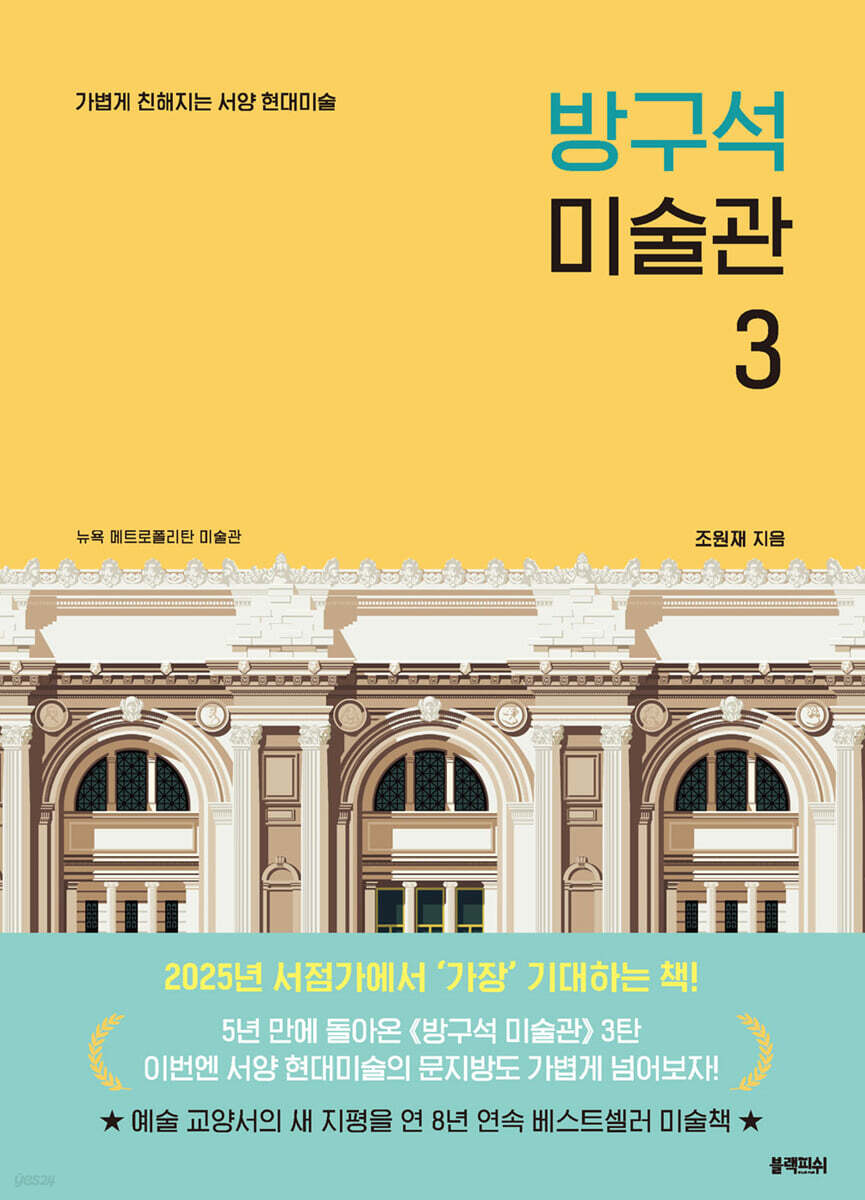
Corner Art Gallery 3
 |
Description
Book Introduction
★ The 'most' anticipated book in the bookstore! ★
“The third installment of the 《Corner Art Gallery》 returns after five years.
This time, let’s lightly cross the threshold of Western modern art!”
A best-selling art book for eight consecutive years, breaking new ground in art education.
《The Corner Art Gallery》, which has been a bestseller for eight consecutive years since its first publication in 2018 and opened a new horizon for art education, returns after five years with its third installment, "Western Modern Art." Author Cho Won-jae, who has helped over 450,000 readers become enthusiastic about art, takes on a new challenge with this third installment.
This is to introduce the avant-garde, groundbreaking, and innovative world of works by modern artists active in the 20th century, centered in America, to readers who are only familiar with the art of modern artists such as Manet, Monet, Degas, Cézanne, and Van Gogh, who were active in 19th century Paris, and provide them with a fresh intellectual shock and aesthetic pleasure!
The author, who tells the story of art in a delightful way with his unique and savory storytelling, once again invites art world giants into his "corner" to reveal everything from their private lives to the hidden stories behind famous paintings.
Readers who say, “I know Picasso, but I don’t know what happens after that!” or “Modern art? Isn’t that child’s play?” please trust me and follow me just one more time.
From Piet Mondrian, the 'Charles Darwin of the art world' who constantly evolved, to surrealist Salvador Dali, who ran with the single desire to see 'golden rain', to Andy Warhol, the emperor of pop art who was both a 'reproduction machine' and 'jealousy incarnate', you will find yourself completely immersed in the fun of modern art for the first time in your life as you delve into the true nature of these artists.
Meanwhile, we can confidently say that “Banggu-Cork Art Museum” is indeed “Banggu-Cork Art Museum” as it contains a total of 130 plates.
Because of copyright issues, you can appreciate modern art works that have not been easily covered in popular art books at a glance. So, if you are a reader who is hesitant to visit an art museum, why not try getting acquainted with 'modern art' first with this book?
- You can preview some of the book's contents.
Preview
index
Entering
Banggu Seok Art Museum Artist Genealogy
01 Piet Mondrian, a pioneer of geometric abstract art
Come to think of it, he's the Charles Darwin of the art world?
02 Salvador Dali, the epitome of surrealism
Was it a streetcar called desire without brakes?
03 Alberto Giacometti, a master of 20th-century modern sculpture
You've been waiting endlessly for a height that won't come?
04 Jackson Pollock, the legend of American modern art
In fact, is he the legendary loser that everyone acknowledged?
05 Mark Rothko, the pioneer of color field painting
Turns out I was a perpetual outsider?
06 Andy Warhol, the Emperor of Pop Art
It was a very blatant copy machine?
References
List of illustrations
Detailed image

Into the book
▼ Salvador Dali, the epitome of surrealism,
Was it a streetcar called desire without brakes?
The long-awaited arrival of the Surrealists in Cadaqués is finally upon us! René Magritte and his wife, Paul Éluard and his wife, Gala, and Camille Goemans, a Surrealist art dealer, arrive.
The Surrealists had just arrived and were yet to become accustomed to Spain's characteristically frenetic climate.
We reveal to them the masterpiece of conversion that runs through them.
As they carefully examine the painting, they soon begin to doubt their own eyes and are soon shocked.
Why on earth would that be? Because the man in the picture was wearing "shit pants"!
Surrealists acknowledge Dali's high level of precise painting skills in "Dark Play."
Also, based on such skills, the artist's ability to reproduce the unconscious world hidden within him more clearly and vividly than other surrealist painters is highly evaluated.
The numerous bizarre and incomprehensible shapes and provocative images expressing sexual desire found throughout the painting were not considered problematic as they were elements that were already commonly expressed by Surrealists based on Freudian psychoanalysis.
"But shit? Was it really necessary to draw shit? That filthy thing?! " Magritte, Paul Eluard, Gala, and Goemans are troubled.
One wonders whether Dali intentionally painted poop to create visual shock, or whether he actually painted poop because the image of poop was latent in his subconscious.
On the other hand, when we see Dali, with his bizarre mustache and sideburns, wearing eccentric clothes, and acting like a lunatic without any shame, we look at him with suspicion, wondering if he is truly insane or if he suffers from coprophagia.
Surrealism was an art form in which artists explored their own unconsciousness and expressed it through their works, and it should not be a diary or blackboard for the mentally ill.
'Is it right to include this provocative guy in surrealism?' Dali cleverly defends the surrealists who are wondering.
"As our leader Breton defined it in the First Manifesto of Surrealism, isn't Surrealism the expression of the unconscious, free from the constraints of reason and all aesthetic and moral preconceptions, through the unhindered expression of images that arise in the mind? That's just what I did.
In the world of the unconscious, whether it's shit or crystal, there is no hierarchy and everything is equal.
“The hierarchy between dung and crystal is nothing more than an aesthetic and moral prejudice.” The Surrealists could only nod in agreement with Dali’s logical argument.
▼ Alberto Giacometti, a master of 20th-century modern sculpture,
You've been waiting endlessly for a height that won't come?
After about three years of staring intently at the head, the conclusion was a 10cm-tall head that looked like a toy.
At the age of 36, Giacometti felt that neither of these things would work out, so he decided to create a full-body portrait.
As it is a full-body statue, it will be larger than a head statue, so I started with a full-body statue about 50cm in size using plaster.
But strangely enough, as the work progressed, it seemed to get smaller and smaller. What was surprising was that the sculptor couldn't stop the sculpture from shrinking.
In the end, the full-body statue he created is reduced to 10cm in size again.
A full-body statue that looks like a toothpick(?) placed on top of a huge support.
Even the sculptor himself was bewildered by the absurd results that he couldn't understand.
I tried to make it again to get out of this dead end, but the result was once again a full-body statue the size of a toothpick.
Even after repeating it dozens of times, the result was the same.
(syncopation)
Giacometti is caught in the endless cycle of work, trying to achieve the impossible ideal of 'reproducing what I see'.
In that image, the figures of Estragon and Vladimir, who are waiting endlessly for Godot, who is unknown and may not come at any time, overlap like a decalcomania.
Perhaps this is why, five years before he passed away from a failing heart, the 60-year-old Giacometti created the 'Tree' to be used as a stage prop for the play 'Waiting for Godot'.
In other words, didn't Giacometti, watching this play, realize that he too was a human being, just like Estragon and Vladimir, who were endlessly waiting for Godot to come?
▼ Jackson Pollock, the legend of American modern art,
In fact, is he the legendary loser that everyone acknowledged?
“Anyone who saw his early works would have said he would be better off as a tennis player or a plumber.”
This is what Jackson Pollock's older brother, a legend in modern art, said about his early works.
It's a bit surprising, isn't it? Pollock, revered as one of the greatest modern artists, would rather be a plumber.
The comment that he lacked drawing skills was something he heard from a colleague when he was twenty-four, when he was in the prime of his drawing career.
Actually, I've heard a lot.
Drawing is the foundational skill of painting, and it is fatal for an artist to lack this skill.
Nevertheless, Jackson Pollock is called a great legendary artist and an artist who cannot be left out of the history of 20th century modern art.
How can that be?
Moreover, if we look beyond Pollock's so-called great paintings and delve into his private life, surprisingly, words like 'wanker' and 'raucous' come to mind.
Is it just me? Of the numerous injection-related episodes surrounding him, let's briefly delve into a relatively mild one. One day, a drunken Pollock visits the home of fellow artist Arshile Gorky.
While they were having a quiet conversation, Pollock suddenly got excited and pointed to Gorky's painting, mocking it as shit.
Pollock is said to have run away in a panic, leaving Gorky's shouting behind him.
Also, one day, he went to a friend's exhibition, tore up and destroyed the artwork without permission, and even went to the friend's house and committed a terrorist act by throwing rocks and breaking the window.
(It is said that he ended up getting beaten up by his friend and broke off their friendship.) Around the age of 35, he is said to have shown up drunk at a gallery that had no particular connection with him and caused a disturbance, shouting, “I am better than the ×× who painted the paintings hanging here!”
How could a man who routinely drank, caused trouble for those around him, and even had poor drawing skills become a legend in modern art? Now, the truth is revealed.
--- From the text
Publisher's Review
From Pollock, the 'bad boy', to Dali, who painted 'shit pants',
Modern art masters in my corner of the room?
Even complex art becomes fun with this non-face-to-face art talk!
Abstractionism, surrealism, drip painting, color field painting, readymade, pop art… .
The constantly emerging art trends are difficult and complex to understand even when you just hear about them.
What if you could join "The Corner Art Gallery" at such a time? Break free from tedious theories and delve into art for what it is: a guaranteed joy!
Salvador Dali, who focused on the 'world of the unconscious' by drawing 'shitty pants' and 'melting clocks' in his paintings.
Jackson Pollock, an alcoholic and a total rascal, was completely captivated by the "atomic world" after the Hiroshima bombing during World War II.
Is his signature art technique, "drip painting," so unpredictable it resembles himself? Alberto Giacometti, the master of 20th-century modern sculpture, devoted himself to "reproducing exactly what I saw," yet for years he produced countless "toothpick-sized sculptures." Mark Rothko's fiery color-field paintings are said to embody the "essence of tragedy."
《Corner Art Gallery》, which puts aside the "authority" and "pretentiousness" inherent in art, doggedly pursues and delves into the artistic perspective born from a single person's "life"! Transcending time and background, we delve into the unexpected daily lives of artists who seemed like mere neighbors, and delve into the lives of artists brimming with humanity.
You may soon forget all about artistic trends and techniques, and experience a thrilling moment where artistic inspiration and thrills overflow throughout your body!
“What happened to art after Picasso?”
Following Picasso and Duchamp,
The art history of 'breakthroughs' and 'reversals' that led the 20th century!
Picasso, the groundbreaking genius painter of the 20th century, and Duchamp, the creator of modern art who turned the world upside down with his work, “Fountain,” which featured a toilet as a work of art.
How has art changed and evolved since then? Have even more groundbreaking artists emerged to challenge their legacy?
Jackson Pollock, who felt that paintings had life and wanted to enter the painting and become a part of it.
He tried to become a kind of "shaman" and communicate with paintings? On the other hand, Andy Warhol, the "replication machine," wanted to become a machine.
By introducing the 'silkscreen' technique to the world of fine art and mass-producing works, he easily destroyed the existing stereotype that 'artworks must be created entirely by the artist and that each work created in this way must be the only one in the world'!
The book vividly unfolds the history of art, filled with the "shocks" and "reversals" of the new masters who revolutionized 20th-century art in ways never before seen.
From Mondrian and Pollock, the representatives of abstract art, to Giacometti, the master of 20th-century modern sculpture, Rothko, the pioneer of color field painting, and Dali and Warhol, who elevated commercial art to their own art form.
Let's enjoy a 'new aesthetic shock' that surpasses the first and second installments, along with six modern art masters who have brought unprecedented disruption to the art world.
“Boldly lowering the threshold for contemporary art!”
130+ illustrations + ‘Genealogy of Artists of the Corner Art Museum’,
The definitive edition encompassing modern and contemporary art!
The book "Corner Art Gallery" boldly lowers the threshold for art by lightly breaking the stereotype that "art is the exclusive domain of the noble and elegant."
If the first installment announced the birth and development of modernist art, and the second installment conveyed the true flavor of Korean modern art and presented a balanced cultural sensibility between Eastern and Western art, this third installment presents at a glance the flow of 'Western modern art' that has evolved since the 20th century.
Furthermore, the new 'Genealogy of Artists of the Corner Art Museum' has been included, allowing readers to closely trace the history of art from the modern era to the present.
Additionally, the book generously includes over 130 pieces of modern art that are not easily accessible in Korea.
You can enjoy a variety of works by major artists who led 20th-century modern art, including six representative artists including Mondrian and Warhol, as well as Clyfford Still, Barnett Newman, Robert Rauschenberg, Jasper Johns, and Roy Lichtenstein.
It is even more meaningful to be able to see, through rich images, how artists, each with their own distinct styles, influenced each other and solidified the art world.
What makes this book special is the unique storytelling of author Wonjae Jo, who makes even heavy subjects feel light and approachable.
Moreover, the author's unique 'power of contemplation', which meticulously examines the artist's life and philosophy, shines even brighter in this third installment.
So, even if you find modern art somewhat difficult and uncomfortable, there's no need to worry.
No matter what perspective you choose or how you choose to appreciate art, this book, "The Corner Art Gallery," will help you get started by approaching art with your heart, not your head.
GOODS SPECIFICS
- Date of issue: April 15, 2025
- Page count, weight, size: 384 pages | 620g | 152*210*24mm
- ISBN13: 9788968334948
- ISBN10: 8968334943
You may also like
카테고리
korean


korean


