

black hole
 |
Description
Book Introduction
- A word from MD
-
Black Holes, Elegant Unknown BeingsBlack holes formed when stars die are powerful enough to suck everything in, but they vary greatly in size.
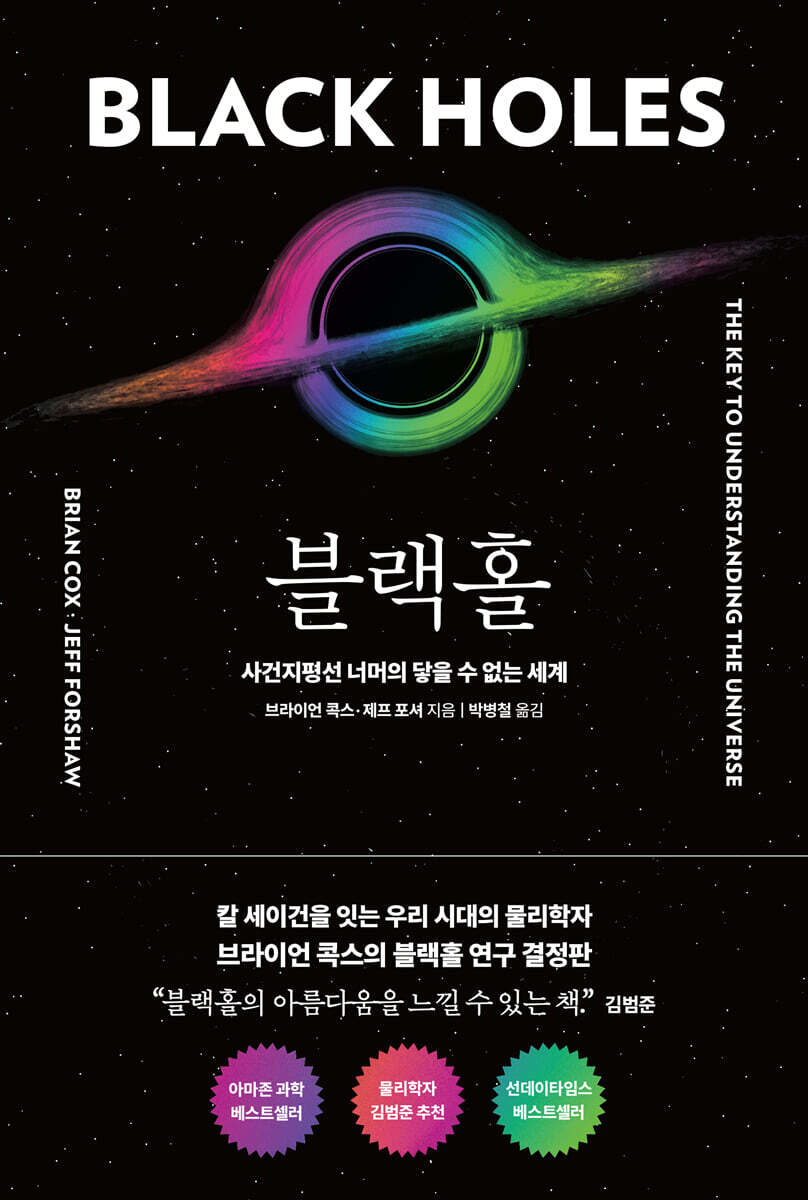
This book is the definitive edition of Brian Cox's black hole research.
What lies beyond the event horizon? The path to black holes is filled with the sacred discoveries of modern physics, from the theory of relativity to quantum mechanics.
April 8, 2025. Natural Science PD Son Min-gyu
A physicist of our time, following in the footsteps of Carl Sagan
Brian Cox's definitive black hole research!
"A book that allows you to experience the beauty of black holes." Recommended by physicist Kim Beom-jun
A 'black hole' is something that everyone knows about but no one knows about.
It's said, "To understand black holes, you need to know almost everything about physics." Black holes are an essential part of any study of physics and astronomy, and it's impossible to enter the universe without going through them. Brian Cox, who rose to fame through appearances in BBC science documentaries like "The Amazing Universe" and "The Amazing Life," is a physicist who has played a key role in sharing the mysteries of science with the general public, earning him the reputation of "the next Carl Sagan."
He has conducted research with Jeff Faucher, who teaches particle physics at the same university, and has published several bestsellers, including “Quantum Universe” and “The E=mc2 Story.”
This time, the research of two physicists turns to black holes.
As the title suggests, the subject of this book is black holes.
The book opens with numerous debates and research by scientists who struggled to uncover the true nature of black holes.
Research that began out of curiosity has reached the level of inferring the origin of the universe and the fundamental properties of space-time from black holes.
It is full of content that readers interested in black holes would have heard of at least once, such as quantum mechanics, event horizons, general relativity, singularities, Hawking radiation, Kerr black holes, Schwarzschild solutions, and Penrose diagrams.
The moment we open the first page, we immediately realize why understanding black holes is so difficult.
To enter the world of black holes, you need to know quantum mechanics, relativity, and thermodynamics, which means you need to know almost everything about physics.
A century-long scientific journey through the frontiers of physics, from Einstein to Stephen Hawking and today's quantum mechanics research, leads to the startling conclusion that our universe may be a giant quantum computer.
This book is by no means easy, but as physicist Professor Kim Beom-jun says, if you read it carefully, following the author's kind guidance, you will be able to vividly experience the beauty of black holes.
Brian Cox's definitive black hole research!
"A book that allows you to experience the beauty of black holes." Recommended by physicist Kim Beom-jun
A 'black hole' is something that everyone knows about but no one knows about.
It's said, "To understand black holes, you need to know almost everything about physics." Black holes are an essential part of any study of physics and astronomy, and it's impossible to enter the universe without going through them. Brian Cox, who rose to fame through appearances in BBC science documentaries like "The Amazing Universe" and "The Amazing Life," is a physicist who has played a key role in sharing the mysteries of science with the general public, earning him the reputation of "the next Carl Sagan."
He has conducted research with Jeff Faucher, who teaches particle physics at the same university, and has published several bestsellers, including “Quantum Universe” and “The E=mc2 Story.”
This time, the research of two physicists turns to black holes.
As the title suggests, the subject of this book is black holes.
The book opens with numerous debates and research by scientists who struggled to uncover the true nature of black holes.
Research that began out of curiosity has reached the level of inferring the origin of the universe and the fundamental properties of space-time from black holes.
It is full of content that readers interested in black holes would have heard of at least once, such as quantum mechanics, event horizons, general relativity, singularities, Hawking radiation, Kerr black holes, Schwarzschild solutions, and Penrose diagrams.
The moment we open the first page, we immediately realize why understanding black holes is so difficult.
To enter the world of black holes, you need to know quantum mechanics, relativity, and thermodynamics, which means you need to know almost everything about physics.
A century-long scientific journey through the frontiers of physics, from Einstein to Stephen Hawking and today's quantum mechanics research, leads to the startling conclusion that our universe may be a giant quantum computer.
This book is by no means easy, but as physicist Professor Kim Beom-jun says, if you read it carefully, following the author's kind guidance, you will be able to vividly experience the beauty of black holes.
- You can preview some of the book's contents.
Preview
index
Chapter 1: A Brief History of Black Holes
Chapter 2: The Unification of Time and Space
Chapter 3: Containing Infinity in a Finite Vessel
Chapter 4: Bending Spacetime
Chapter 5: Into the Black Hole
Chapter 6: White Holes and Wormholes
Chapter 7: Kerr's Wonderland
Chapter 8: Real Black Holes Created by Star Collapse
Chapter 9: Thermodynamics of Black Holes
Chapter 10 Hawking Radiation
Chapter 11 Spaghettification and Evaporation
Chapter 12 One-Handed Clapping
Chapter 13: The Holographic World
Chapter 14: Island in the Flowing Water
Chapter 15: Perfect Code
Acknowledgments | Translator's Note | Notes | Image Sources | Index
Chapter 2: The Unification of Time and Space
Chapter 3: Containing Infinity in a Finite Vessel
Chapter 4: Bending Spacetime
Chapter 5: Into the Black Hole
Chapter 6: White Holes and Wormholes
Chapter 7: Kerr's Wonderland
Chapter 8: Real Black Holes Created by Star Collapse
Chapter 9: Thermodynamics of Black Holes
Chapter 10 Hawking Radiation
Chapter 11 Spaghettification and Evaporation
Chapter 12 One-Handed Clapping
Chapter 13: The Holographic World
Chapter 14: Island in the Flowing Water
Chapter 15: Perfect Code
Acknowledgments | Translator's Note | Notes | Image Sources | Index
Detailed image

Into the book
If the universe was designed by someone, the designer was probably a mathematician.
--- p.52
The picture of flat spacetime represented by a Penrose diagram is truly beautiful.
Isn't all time and all space neatly contained within a finite rhombus? Every event, past and future, anywhere in the universe, exists somewhere within this diagram.
--- p.94
Black holes clearly exist in our universe.
With such a mysterious celestial body stimulating our desire to explore, we have no choice but to accept the challenge.
--- p.242
Physicists love paradoxes.
It's not because he has a quirky personality, but because he secretly hopes that his worldview will collapse.
Also, this is not because I hate the world, but because my understanding of nature deepens with each conceptual major thought.
A good scientist would rather have new beliefs born through his research than have his own beliefs confirmed.
--- p.302
Black holes have fascinated leading physicists for the past 100 years.
Because physics is a science that pursues both understanding and fascination.
As I struggled to understand the infinitely vast and distant sky, I arrived at the strange and beautiful land of goblins, the holographic universe.
It seems perhaps inevitable that in the pursuit of the grand and the novel, one will discover something fascinating.
And without exception, these fascinating objects of discovery have brought us enormous benefits.
--- p.52
The picture of flat spacetime represented by a Penrose diagram is truly beautiful.
Isn't all time and all space neatly contained within a finite rhombus? Every event, past and future, anywhere in the universe, exists somewhere within this diagram.
--- p.94
Black holes clearly exist in our universe.
With such a mysterious celestial body stimulating our desire to explore, we have no choice but to accept the challenge.
--- p.242
Physicists love paradoxes.
It's not because he has a quirky personality, but because he secretly hopes that his worldview will collapse.
Also, this is not because I hate the world, but because my understanding of nature deepens with each conceptual major thought.
A good scientist would rather have new beliefs born through his research than have his own beliefs confirmed.
--- p.302
Black holes have fascinated leading physicists for the past 100 years.
Because physics is a science that pursues both understanding and fascination.
As I struggled to understand the infinitely vast and distant sky, I arrived at the strange and beautiful land of goblins, the holographic universe.
It seems perhaps inevitable that in the pursuit of the grand and the novel, one will discover something fascinating.
And without exception, these fascinating objects of discovery have brought us enormous benefits.
--- p.372
Publisher's Review
The most beautiful celestial object created by nature: a black hole
A fantastic space exploration that will reveal the relationship between gravity and space-time.
At the center of the Milky Way lies a celestial body with a mass four million times that of the Sun.
Time and space in that area are so distorted by it that even light cannot escape.
The interior of the sphere with a radius of 12 million kilometers at the center of the Milky Way is completely cut off from the outside.
The surface of this sphere is the 'event horizon'.
According to general relativity, there is a singularity, the 'end of time', right there.
The world beyond the event horizon that contains the singularity is a black hole.
This book guides readers along the path that physics has taken over the past 100 years, including the distorted time and space of black holes, Penrose diagrams that illustrate the space-time of black holes, wormholes and white holes, Kerr's black holes, black holes and thermodynamics, Hawking radiation, quantum entanglement, and the principle of holography.
A black hole, something everyone knows but no one knows about.
A black hole is the remnant of the largest star that once existed at the center of the Milky Way.
It is created naturally when matter clumps together due to gravity and there is no more space for it to exist normally.
The laws of physics demonstrate the existence of black holes, but their specific properties remain largely unknown.
Even now, physicists are struggling to figure out what cannot be known by existing laws.
Black holes exist in a space-time where the laws of gravity, quantum mechanics, and thermodynamics cannot coexist peacefully.
So, physicists in the past denied the existence of black holes, saying, “There must be some factor that prevents the creation of black holes.”
Even Einstein said in 1939 that “black holes do not exist in the real world.”
Since then, many scholars, including Subramanian Chandrasekhar, Robert Oppenheimer, John Archibald Wheeler, and Roger Penrose, have recognized black holes not as “unwanted cosmic monsters” but as “inevitable consequences of the universe.”
The idea that our universe is a world inside a quantum computer
In 1974, when Stephen Hawking announced the theory of black hole radiation (Hawking radiation), black holes entered the field of quantum mechanics as well as gravity.
Black holes have emerged as the optimal model for testing theories that combine quantum mechanics and gravity.
As the relationship between gravity and quantum theory began to be revealed, black hole research entered a new era.
The dual relationship between the theory of gravity and quantum theory was revealed when Argentine physicist Juan Maldacena announced the holographic principle, which states that “the theory of gravity defined in anti-de Sitter space is identical to the quantum theory defined at its boundary.”
The author introduces 'quantum entanglement' here, and goes so far as to speculate that "gravity and quantum theory may be connected through entanglement."
The reason why this claim is credible can be found in the words of the translator, Park Byeong-cheol.
Unlike other popular physics books that just shove in references and then slink away, “Cox himself rows the boat and takes the reader across the river.”
In a detailed and vivid tone, Cox suggests that the very nature of time and space may be a vast network of quantum bits, that we may be living inside a giant quantum computer.
For a century, leading physicists have been chasing the majestic and mysterious black hole, discovering a fascinating world, and the results have invariably benefited us.
I look forward to the future that the boundless research on black holes will bring.
A fantastic space exploration that will reveal the relationship between gravity and space-time.
At the center of the Milky Way lies a celestial body with a mass four million times that of the Sun.
Time and space in that area are so distorted by it that even light cannot escape.
The interior of the sphere with a radius of 12 million kilometers at the center of the Milky Way is completely cut off from the outside.
The surface of this sphere is the 'event horizon'.
According to general relativity, there is a singularity, the 'end of time', right there.
The world beyond the event horizon that contains the singularity is a black hole.
This book guides readers along the path that physics has taken over the past 100 years, including the distorted time and space of black holes, Penrose diagrams that illustrate the space-time of black holes, wormholes and white holes, Kerr's black holes, black holes and thermodynamics, Hawking radiation, quantum entanglement, and the principle of holography.
A black hole, something everyone knows but no one knows about.
A black hole is the remnant of the largest star that once existed at the center of the Milky Way.
It is created naturally when matter clumps together due to gravity and there is no more space for it to exist normally.
The laws of physics demonstrate the existence of black holes, but their specific properties remain largely unknown.
Even now, physicists are struggling to figure out what cannot be known by existing laws.
Black holes exist in a space-time where the laws of gravity, quantum mechanics, and thermodynamics cannot coexist peacefully.
So, physicists in the past denied the existence of black holes, saying, “There must be some factor that prevents the creation of black holes.”
Even Einstein said in 1939 that “black holes do not exist in the real world.”
Since then, many scholars, including Subramanian Chandrasekhar, Robert Oppenheimer, John Archibald Wheeler, and Roger Penrose, have recognized black holes not as “unwanted cosmic monsters” but as “inevitable consequences of the universe.”
The idea that our universe is a world inside a quantum computer
In 1974, when Stephen Hawking announced the theory of black hole radiation (Hawking radiation), black holes entered the field of quantum mechanics as well as gravity.
Black holes have emerged as the optimal model for testing theories that combine quantum mechanics and gravity.
As the relationship between gravity and quantum theory began to be revealed, black hole research entered a new era.
The dual relationship between the theory of gravity and quantum theory was revealed when Argentine physicist Juan Maldacena announced the holographic principle, which states that “the theory of gravity defined in anti-de Sitter space is identical to the quantum theory defined at its boundary.”
The author introduces 'quantum entanglement' here, and goes so far as to speculate that "gravity and quantum theory may be connected through entanglement."
The reason why this claim is credible can be found in the words of the translator, Park Byeong-cheol.
Unlike other popular physics books that just shove in references and then slink away, “Cox himself rows the boat and takes the reader across the river.”
In a detailed and vivid tone, Cox suggests that the very nature of time and space may be a vast network of quantum bits, that we may be living inside a giant quantum computer.
For a century, leading physicists have been chasing the majestic and mysterious black hole, discovering a fascinating world, and the results have invariably benefited us.
I look forward to the future that the boundless research on black holes will bring.
GOODS SPECIFICS
- Date of issue: April 2, 2025
- Page count, weight, size: 392 pages | 558g | 145*215*25mm
- ISBN13: 9788925573939
- ISBN10: 8925573938
You may also like
카테고리
korean


korean

![GQ KOREA Mark (Monthly): December [2025]](http://librairie.coreenne.fr/cdn/shop/files/8ef265dbbfbf186523ed75ba7319009d.jpg?v=1765340328&width=3840)


