

The world of analog
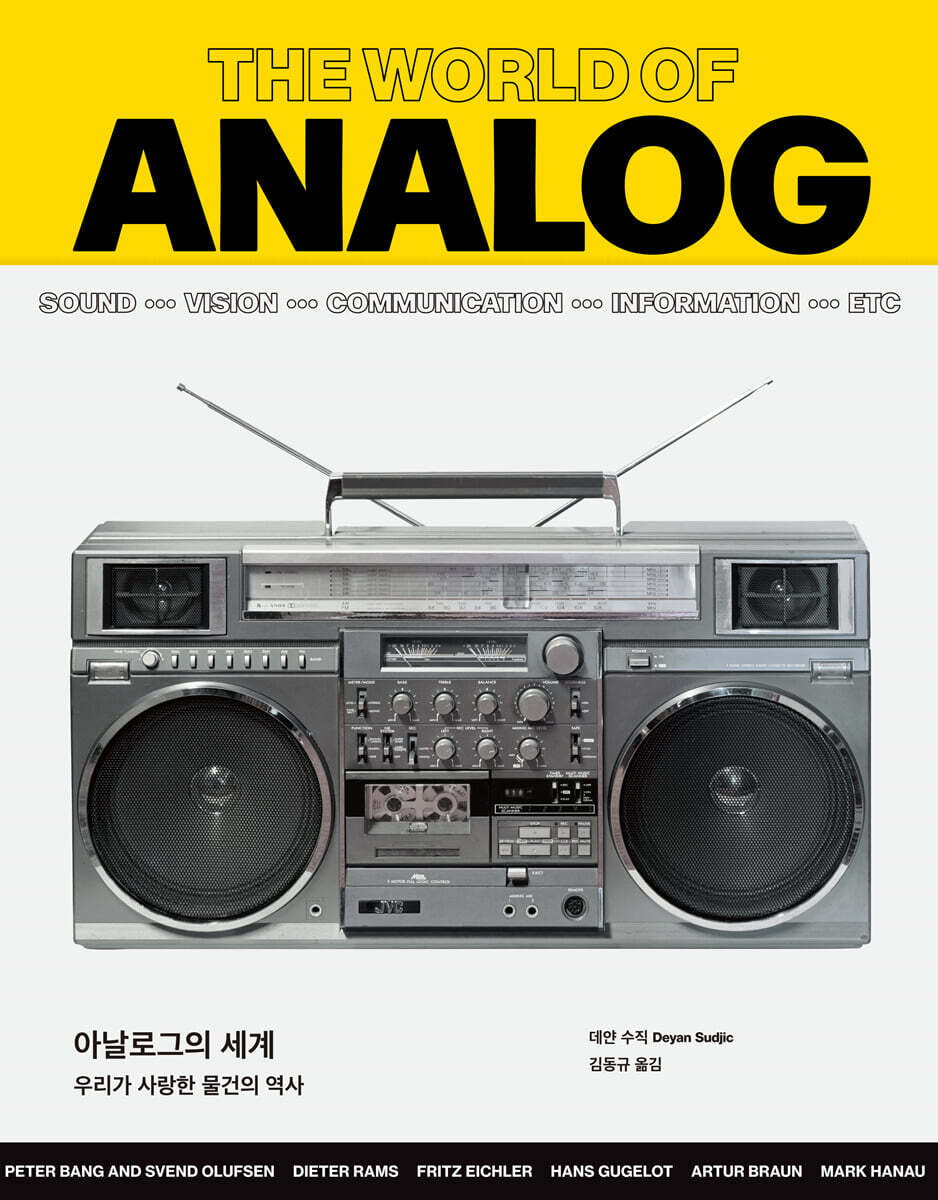 |
Description
Book Introduction
- A word from MD
-
The history of the things we love250 of the most beautiful objects, carefully selected by the director of London's Design Museum.
Analog objects, with their unique properties and emotions that cannot be replaced by digital devices, even evoke deep longing.
In modern society, where everything flows quickly and automatically, the aesthetics of 'passivity' and 'slowness' give us the leisure to pause and breathe.
April 22, 2025. Art PD Ahn Hyun-jae
This one book is an analog museum!
Carefully selected by the director of the London Design Museum
250 of the Most Beautiful Analog Objects on Display
The analog world seemed to be coming to an end with the digital revolution of the 1980s.
But analog objects still have a place in our daily lives.
Even though digital technology is much more convenient, cheaper, and faster, we still miss and long for analog technology.
Analog objects have a beautiful physicality and emotional quality that digital devices cannot replace.
There are also physical interactions, such as pressing a button to turn it on, turning a dial to set the desired frequency, or adjusting the camera's light output.
There's a reason why modern people, feeling an inexplicable sense of alienation in a world of dull mechanical noises and intangible pixels, long for the analog era.
Edited by Dejan Suzik, Honorary Director of London's Design Museum, this book is full of praise for the analog world.
From the moment Edison first developed the phonograph to the 21st century's two-meter-tall mega-speakers, this book conveys the beautiful analog world we love through words and photos, including turntables, vinyl, transistor radios, televisions, telephones, film cameras, wristwatches, and typewriters.
Packed with fascinating information and stunning illustrations, this book is a beautifully analog celebration of the ways we communicated through recorded music, telling time, writing letters, watching films, and taking photographs.
- You can preview some of the book's contents.
Preview
index
Introduction
Chapter 1 Sound
Records / Record Players / Radios / Radiograms / Open-Reel Tape Recorders / Cassette Tape Players and Recorders / 8-Track Cassette Players / Boomboxes
+Album Art
+Sony
+Mario Bellini
Chapter 2 Vision
Photo / Camera / Film / Television / Video
+Kodak
+The impact of television broadcasting
+Philippe Stark
Chapter 3: Communication
Telephones / Typewriters / Typemakers / Copiers / Teleprinters and Fax Machines
+Ettoresotsass
+QWERTY keyboard
+Olivetti
Chapter 4: Information
Measuring instrument / Clock / Clock radio / Timer / Wristwatch / Calculator
+Brown
+Richard Sapper
+Wristwatch
Designer Directory
Sound / Vision / Communication / Information
Detailed image

Into the book
Until the early 21st century, analog technology was the driving force behind the world.
This technology fully reflected the ingenuity of the engineers and the creativity of the designers who implemented it.
From Beatles album covers to Kodachrome color film, the byproducts of analog technology were a compressed reflection of contemporary culture.
It was the entity that measured our lives.
---From "Introduction"
In the 1940s, James Laver, a curator at the Victoria and Albert Museum in London, half-jokingly coined his own laws to describe the processes fashion goes through.
'Clothes that are too ahead of their time are not appropriate to wear.
Clothes that are slightly ahead of their time are considered bold, but when the time is right, they are recognized as chic.
Then, the trend quickly passes and it eventually turns into an ugly thing.
After that, the fashion becomes something fun, something cute, something attractive, and ultimately something beautiful. Analog products are similar in that respect.
In other words, once avant-garde items become merely cute after the trend passes, and eventually become collector's items.
---From "Introduction"
The record has acquired the potential to follow in the footsteps of opera and novels in the past century and to tell its own narrative.
The order of the songs on an album is essential to enjoying it, and it also provides a charm that cannot be found in today's digital music streaming.
The same goes for the album title and jacket design.
It was a typical example of the communication theory that the medium controls the message.
---From "Chapter 1 'Sound'"
The cycle of change in technology and style is as rapid as that of fashion, and as a result, the history of analog audio equipment is so astonishing and diverse that it could be considered a history of taste and culture.
---From "Chapter 1 'Sound'"
Jensen said:
“Making a fountain pen, writing poetry, directing a play, and designing a locomotive all require the same elements and materials.
It requires perspective, creativity, new ideas, understanding, and above all, the ability to rework almost infinitely.
“That ‘endless repetition’ is the most cruel torture for me.” The Beolit radio, with its scientific-feeling slide rule-style tuning dial, faithfully embodies Jensen’s concept of a design that is “different but not strange.”
---From "Chapter 1 'Sound'"
When Braun introduced a device that combined a record player and a radio with a clear acrylic resin cover, competitors derided it as "Snow White's coffin."
However, this model, created by Dieter Rams, who established Braun's identity over a period of 20 years, became the universal standard for record players long after Braun stopped manufacturing audio.
The inclusion of some wood in the case was the last vestige of the contemporary perception that household electronic devices should be viewed as furniture.
---From "Chapter 1 'Sound'"
“Enjoy the moving sound in your own world.
“Put it in your pocket, turn it on, and you’ll only feel the weight of the music.” This is one of the advertising slogans for Sony’s WM2 model, the first to use the brand name Walkman.
The concept of hiding in one's personal space captured the essence of the Walkman, which differentiated it from any existing product, and also signaled an era in which earphones became a universal means of listening to music.
The technology itself hasn't changed much from existing dictation recorders, but the way it's used has brought about a major change in people's behavior.
Since the advent of this device, music has become a personal experience.
With its eye-catching black and silver body, green dots, and orange rubber headphones, this Sony device was the first example of an industrial designer polishing an electronic device like a jewel.
---From "Chapter 1 'Sound'"
The JVC RC M-90 boombox, which was prominently featured on the cover of the Beastie Boys' 2005 greatest hit album, Solid Gold Hits, was so old that it was considered a rare vintage electronic item at the time.
This product had a radio function and played tapes, but it did not play CDs, which were a precursor to the digital era that appeared at the end of the analog era.
This device was part of a very special moment in music culture.
The cover of the 1985 debut album "Radio" by famous American rapper LL Cool J was almost completely covered with the image of this M-90.
In 1963, when this portable record player category was born, there was the Philips EL 3300, a battery-powered player for outdoor use.
This iconic piece of urban youth culture takes on a completely different meaning when held discreetly on a garden table or held up to shoulder height.
---From "Chapter 1 'Sound'"
Just as paper books and letterpress printing survived thanks to those who yearned for the delicacy and craftsmanship of their pre-digital era, analog photography and film are also recognized as specialized skills and retain their presence today.
---From Chapter 2, 'Vision'
The achievements of Eastman and the company he founded, Kodak (named after the first product he sold), in the field of photography were comparable to what Steve Jobs and Apple did in the computer industry a century later.
He transformed photography, once considered a specialist field due to its complex scientific process, into a simple task that anyone can tackle.
Eastman simultaneously developed a photography method that used cellulose roll film, which was much lighter and easier to handle than glass plates, and a camera that could use the film he created.
---From Chapter 2, 'Vision'
An even more dramatic change was the way television news, vividly conveying the horrors of famine and war into living rooms, profoundly influenced political life.
The Vietnam War, often referred to as America's first war, has lost its impact over time, but its aftereffects remain persistent and often serve as a spark for large-scale protests.
The government, concerned about the influence of various political contents on voters, attempted to control them in various ways and at various levels.
---From Chapter 2, 'Vision'
Of all the analog technologies that emerged in the 19th century, the one that had the greatest impact on the world was the use of electric current to transmit messages along copper wires.
This technology brought about a huge change in humanity's concept of time, sense of distance, and communication methods.
(Omitted) As the amount of data transmitted increased, more copper was required.
In the late 19th century, the streets of New York were filled with intricately intertwined layers of copper wire, like a spider's web, hanging over the heads of pedestrians.
---From Chapter 3, 'Communication'
The relatively inexpensive availability of copiers could be interpreted as a political tool in the long run.
Authoritarian regimes during the Cold War viewed any technology that could help spread political dissent as threatening and sought to control it.
In those days, typewriters and copiers were strictly regulated items.
---From Chapter 3, 'Communication'
Until the late 20th century, analog technology was used to describe physical phenomena such as size, time, sound, temperature, electric current, and light intensity, as well as to measure, record, remember, and store all kinds of information.
And for this purpose, writing, paper, printing, etc. were invented first, and later dials and measuring instruments, etc. appeared.
Humanity has used this technology in everything from weather forecasting to disease treatment.
---From Chapter 4, “Information”
Thanks to the human tendency to express one's tastes and lifestyle through possessions and to pass them on to future generations, mechanical watches have acquired a kind of jewel-like character.
While many analog technologies have met an unexpected and premature end in their evolutionary journey, watches remain more refined and beautiful than ever.
---From Chapter 4, “Information”
The person who led this design team from 1955 was Dieter Rams, who is said to have had the greatest influence on post-war German industrial design.
Under Rams' direction, Braun produced toasters, clocks, wristwatches, radios, hi-fi audio, televisions, and cinema cameras.
Rams once described his design philosophy as being on the same level as a butler for a British aristocrat.
In other words, it is an object that does not reveal its presence when not in use, but operates naturally like flowing water when absolutely necessary.
Artist Richard Hamilton has long used Braun products as subject matter in his work.
He once said, “Just as Mont Sainte-Victoire had a profound influence on the work of Paul Cézanne, Braun products have had the same influence on me.”
The brilliant design logic that Rams applied to all the products he designed also deeply inspired Jonathan Ive, a British designer who later designed Apple products together with Steve Jobs.
Rams rejected all notions of ephemeral fashion, intentional obsolescence, and conspicuous consumption.
While he wholeheartedly supported the spirit of "less is more" advocated by architect Mies van der Rohe, he added his own unique touch, proposing a new concept: good design is a design that seems to be lacking, yet is an improvement over the previous one.
---From Chapter 4, “Information”
Publisher's Review
In the digital age, what we long for more is "sensory experiences."
Analog things we loved back then
The 2024 film [Perfect Days] stimulated nostalgia and curiosity for cassette tapes and cassette players.
As streaming became the way we listened to music, people's hearts began to turn more towards vinyl records and cassette tapes.
Analog items that seemed to have lost their utility in the digital age, such as turntables, vinyl records, cassette tapes, Walkmans, film cameras, transistor radios, camcorders, and mechanical wristwatches, are enjoying a second heyday.
Digital technology has made our lives more convenient, but it has also alienated us.
As digital expands in all directions, what people miss is experiences that touch their 'sense'.
Objects are inanimate beings, but humans touch them, manipulate them, and develop a strange attachment to them.
Those attachments come together to create a space filled with your own emotions and feelings.
In that context, modern people long for analog objects and want to bring them into their daily lives.
Actor Tom Hanks is famous for collecting 250 analog typewriters.
“Every time I type on the typewriter, I feel like I’m doing something important,” he said. “It’s a pleasure that can’t be compared to using a laptop, which I have no choice but to use.”
Detailed pictorials of rare items you won't find anywhere else
An exciting story of technology, design, and innovation that transcends an era.
This book examines the 100-year period in which analog technology emerged in the early 19th century, reached its heyday in the mid-to-late 20th century, and then declined with the advent of the iPhone.
The author, Honorary Director of the London Design Museum and Professor of Design and Architecture at Lancaster University, UK, has carefully selected 250 of the most innovative and beautiful analog devices that have emerged alongside technological advancements, and examines in detail how these objects have transformed our daily lives, society, and culture.
The four themes of this special ground exhibition are: tools for hearing (Sound), tools for seeing (Vision), tools for communicating (Communication), and tools for measuring (Information).
Sound covers the period from the moment Edison developed the world's first phonograph, to the emergence of the LP, which gave birth to the modern music format of the album with seven three-minute tracks per side, and the creation of a new art genre called the 'album cover'.
It's also fascinating to look at the role radio played during two world wars and the Cold War.
The vision explains how television has permeated the world's thinking and transformed daily life, from the moment the advent of the camera, which ushered in an era of self-expression, fundamentally re-examined the meaning and purpose of art.
Also of interest are the information on communication, which describes the advent of the telephone that completely changed humanity's concept of time and distance, and the rise of wristwatches brought about by war.
Along with this, you can meet various stories such as companies that have contributed the most to design, such as Sony, Braun, Brion Vega, and Bang & Olufsen, and the evolution of music formats from vinyl to compact discs.
Having experienced the great transition from the analog to the digital age, Dejan Sukjong selected 250 analog objects that symbolize the times gone by and displayed them in large, vivid photographic images to showcase their innovative technology and bold design aesthetics at a glance.
In this way, we can thoroughly examine objects with groundbreaking designs that we have never seen before and rare items that we have always wanted to see in person.
Just looking at the details of each item will make you lose track of time.
The author's analog technology, deep understanding of design, insight into the trends of the times, and broad literary and artistic knowledge, combined with his thoughtful affection for the analog world, provide unexpectedly moving and inspiring experiences.
In today's world, where AI permeates every aspect of human life, the last bastion that only humans can enjoy is analog sensibility rather than digital efficiency.
When you feel overwhelmed by the abundance of information, content, and convenience, and find it difficult to find a place to settle down, why not try opening this book?
As you savor the stories of the engineers and designers who created these beautiful objects, you will rediscover the allure of everyday objects that transcend generations and time, as well as the value of human sensibility, creativity, and beauty that you will never want to lose.
GOODS SPECIFICS
- Date of issue: May 6, 2025
- Format: Hardcover book binding method guide
- Page count, weight, size: 304 pages | 1,356g | 220*283*25mm
- ISBN13: 9791193063910
- ISBN10: 1193063914
You may also like
카테고리
korean


korean


