

Hidden potential
 |
Description
Book Introduction
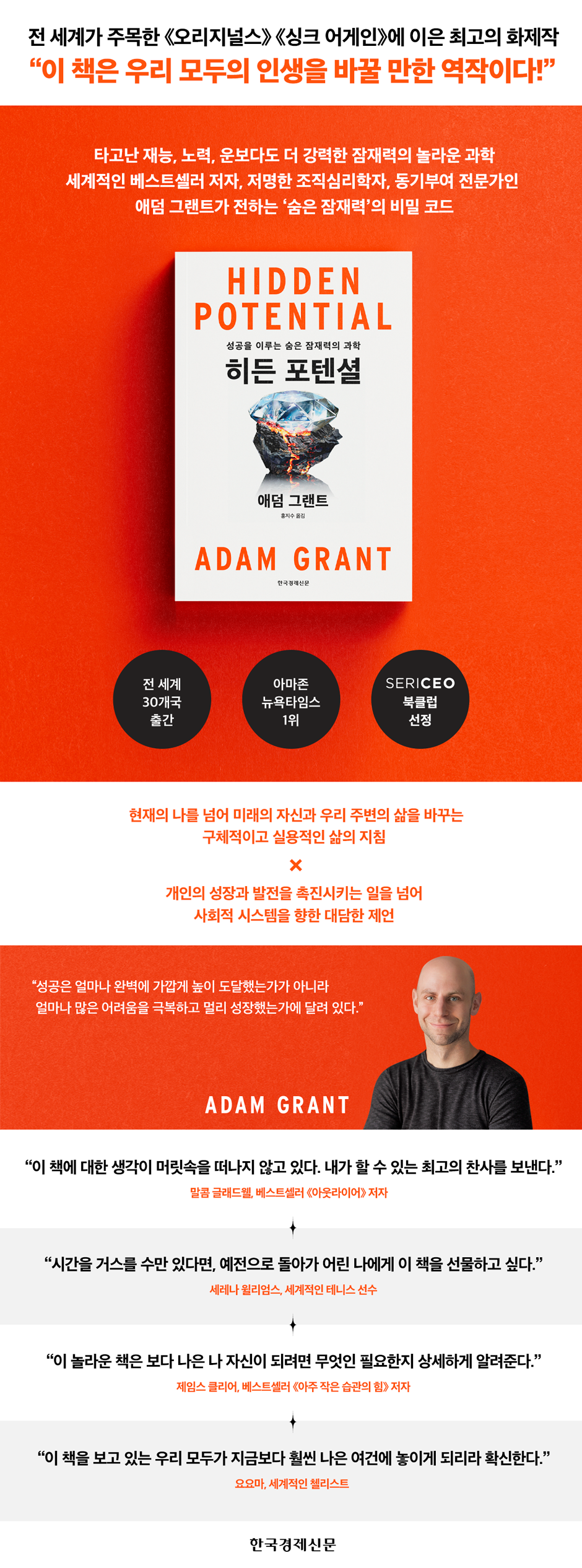
The most talked-about work following Originals and Think Again
World-renowned bestselling author, renowned organizational psychologist, and motivational expert Adam Grant Shares the Secret Code to Hidden Potential Innate talent is simply the result of differences in opportunity, environment, and motivation. Anyone can fly higher and further by unleashing their "hidden potential"! With an excellent selection of topics that cross the fields of psychology, economics, management, and self-development, as well as action guidelines and positive influences that help our lives... Adam Grant, the author of "Give and Take," "Originals," and "Think Again," which have created sensational responses with each of his books and established themselves as international bestsellers, and the youngest tenured professor of organizational psychology at the Wharton School, has published "Hidden Potential," a story about how we can elevate ourselves and others to unexpected levels. We often focus on our innate talents and easily overlook the hidden potential that can be discovered and nurtured later. And for those who fail to realize this potential and are underestimated and buried, it is assumed that it is due to a lack of individual ability and failure of effort. But that's not the case. The author reveals that the current prevalent criterion of achievement and achievement-based learning in our society stems from unequal opportunities and systems. He offers concrete and feasible guidelines and methods for discovering and nurturing talent with true, hidden potential who can overcome these obstacles. |
- You can preview some of the book's contents.
Preview
index
Introduction _ Growing Roses in Concrete
Part 1: Character and Skills - The Power to Jump Further
Chapter 1: Creatures of Discomfort: Embracing the Unbearable Awkwardness of Learning
Chapter 2: The Human Sponge: Building the Capacity to Absorb and Adapt
Chapter 3: The Imperfectionist: Finding the Optimum Between Defect and Flawlessness
Part 2: Temporary Structures That Motivate You _ Overcoming Obstacles to Growth
Chapter 4: Planned Play and Rest: Injecting Passion into Your Daily Life
Chapter 5: Breaking Out of the Stagnation: The Roundabout Path to Progress
Chapter 6 Defying Gravity: The Art of Flying on One's Own
Part 3: A System That Creates Opportunities - Opening Wide the Doors and Windows of Opportunity
Chapter 7: A Society Where Every Child Leads: Designing Schools That Unleash Students' Potential
Chapter 8: Digging for Gold: Unearthing Collective Intelligence in Your Team
Chapter 9: Uncovering Hidden Talent
Going out _ Going a long way
Effective action guidelines to realize your hidden potential
Acknowledgements
main
Part 1: Character and Skills - The Power to Jump Further
Chapter 1: Creatures of Discomfort: Embracing the Unbearable Awkwardness of Learning
Chapter 2: The Human Sponge: Building the Capacity to Absorb and Adapt
Chapter 3: The Imperfectionist: Finding the Optimum Between Defect and Flawlessness
Part 2: Temporary Structures That Motivate You _ Overcoming Obstacles to Growth
Chapter 4: Planned Play and Rest: Injecting Passion into Your Daily Life
Chapter 5: Breaking Out of the Stagnation: The Roundabout Path to Progress
Chapter 6 Defying Gravity: The Art of Flying on One's Own
Part 3: A System That Creates Opportunities - Opening Wide the Doors and Windows of Opportunity
Chapter 7: A Society Where Every Child Leads: Designing Schools That Unleash Students' Potential
Chapter 8: Digging for Gold: Unearthing Collective Intelligence in Your Team
Chapter 9: Uncovering Hidden Talent
Going out _ Going a long way
Effective action guidelines to realize your hidden potential
Acknowledgements
main
Detailed image
Into the book
What appear to be differences in innate ability are often actually differences in opportunity and motivation.
We make the fatal mistake of focusing on visible starting points when assessing potential.
In a world obsessed with innate talent, we tend to assume that the most promising people are those who stand out at first glance.
However, the talents that high achievers display at a young age vary greatly.
If we judge people solely on the talent they display at a very young age, many people's potential will remain buried and unseen.
It is impossible to predict the end point based on the starting point.
Given the right opportunities and the motivation to learn, anyone can achieve great things.
Potential isn't about where you start, it's about how far you go.
Therefore, we need to focus more on how far we have traveled rather than where we started.
--- p.14~15
Character is often confused with personality, but they are not the same.
Personality is the qualities or tendencies that you have.
It is a primal instinct to think, feel and act.
Character is the ability to prioritize your values over your instincts.
It's easy to take initiative or take decisive action when everything is going well.
The true test of character is whether you can uphold those values when the odds are against you.
Personality is how you react in normal times, and character is how you respond in difficult times.
Character skills help you transcend your tendencies and stay true to your principles.
No matter where you are today, there is absolutely no reason why you cannot cultivate your character skills right now.
--- p.37~38
If perfectionism were a drug, it should come with a warning about its common side effects.
'Caution: May cause stunted growth.' Perfectionism locks us into an increasingly narrow field of vision and causes us to avoid mistakes.
It blocks us from seeing the broader issues and makes us obsessed with honing increasingly narrow skills.
Even if you don't consider yourself a perfectionist, you've probably experienced these tendencies while working on important tasks.
When we're working on a project that's truly important to us, we all feel the urge to fix and polish it until it's perfect.
However, to make great strides, we must acknowledge that perfection is a mirage.
And we must learn to tolerate appropriate imperfections.
--- p.101~102
Stephen Curry is the son of an NBA player, but he didn't receive a scholarship from a single elite basketball university.
When he graduated from high school, he was greatly underrated.
On a five-star scale, he was about a three-star.
The summer before his senior year, a coach from Davidson College came to watch Curry play.
“He was in bad shape.
“He would throw the ball into the stands, drop the ball he was handed, dribble it over his own feet, and miss his shots,” the coach recalled, adding:
“But not once during the game did he blame the referee or his teammates.
Even sitting on the bench, he consistently cheered for his team and did not lose heart.
“I can’t forget that impression of him.”
--- p.142~143
Many people around them were suspicious of the Golden Thirteen.
There were moments when they doubted themselves.
But they trusted each other and were determined to forge new paths for others.
It is possible to face obstacles alone.
But when we combine our strength with others, we reach the highest heights.
If several trustworthy people trust us, you should trust them.
When ignorant, negative critics judge us unfavorably, we need to remind ourselves of what we are fighting for.
--- p.216
You shouldn't judge people solely by the heights they've reached.
A system that favors applicants who have already achieved outstanding results tends to undervalue and overlook candidates who have the inherent potential to achieve great things.
If we confuse past achievements with future potential, we miss out on those who have overcome significant obstacles and achieved great things.
We need to consider how steep the hill they climbed, how far they climbed, and how they grew along the way.
The true value of a diamond is not determined by whether it shines brightly from the start, but by how it reacts to heat and pressure.
--- p.289
Many people dream of achieving their goals.
They measure their progress by the status they attain and the praise they receive from others.
But the most important achievements are the most difficult to measure.
The most meaningful growth is not in building a career, but in building character.
Success is not simply about achieving goals.
It is a life that practices the values we cherish.
There is no higher value than the desire to be better tomorrow than we are today.
There is no greater accomplishment than that which unleashes our hidden potential.
We make the fatal mistake of focusing on visible starting points when assessing potential.
In a world obsessed with innate talent, we tend to assume that the most promising people are those who stand out at first glance.
However, the talents that high achievers display at a young age vary greatly.
If we judge people solely on the talent they display at a very young age, many people's potential will remain buried and unseen.
It is impossible to predict the end point based on the starting point.
Given the right opportunities and the motivation to learn, anyone can achieve great things.
Potential isn't about where you start, it's about how far you go.
Therefore, we need to focus more on how far we have traveled rather than where we started.
--- p.14~15
Character is often confused with personality, but they are not the same.
Personality is the qualities or tendencies that you have.
It is a primal instinct to think, feel and act.
Character is the ability to prioritize your values over your instincts.
It's easy to take initiative or take decisive action when everything is going well.
The true test of character is whether you can uphold those values when the odds are against you.
Personality is how you react in normal times, and character is how you respond in difficult times.
Character skills help you transcend your tendencies and stay true to your principles.
No matter where you are today, there is absolutely no reason why you cannot cultivate your character skills right now.
--- p.37~38
If perfectionism were a drug, it should come with a warning about its common side effects.
'Caution: May cause stunted growth.' Perfectionism locks us into an increasingly narrow field of vision and causes us to avoid mistakes.
It blocks us from seeing the broader issues and makes us obsessed with honing increasingly narrow skills.
Even if you don't consider yourself a perfectionist, you've probably experienced these tendencies while working on important tasks.
When we're working on a project that's truly important to us, we all feel the urge to fix and polish it until it's perfect.
However, to make great strides, we must acknowledge that perfection is a mirage.
And we must learn to tolerate appropriate imperfections.
--- p.101~102
Stephen Curry is the son of an NBA player, but he didn't receive a scholarship from a single elite basketball university.
When he graduated from high school, he was greatly underrated.
On a five-star scale, he was about a three-star.
The summer before his senior year, a coach from Davidson College came to watch Curry play.
“He was in bad shape.
“He would throw the ball into the stands, drop the ball he was handed, dribble it over his own feet, and miss his shots,” the coach recalled, adding:
“But not once during the game did he blame the referee or his teammates.
Even sitting on the bench, he consistently cheered for his team and did not lose heart.
“I can’t forget that impression of him.”
--- p.142~143
Many people around them were suspicious of the Golden Thirteen.
There were moments when they doubted themselves.
But they trusted each other and were determined to forge new paths for others.
It is possible to face obstacles alone.
But when we combine our strength with others, we reach the highest heights.
If several trustworthy people trust us, you should trust them.
When ignorant, negative critics judge us unfavorably, we need to remind ourselves of what we are fighting for.
--- p.216
You shouldn't judge people solely by the heights they've reached.
A system that favors applicants who have already achieved outstanding results tends to undervalue and overlook candidates who have the inherent potential to achieve great things.
If we confuse past achievements with future potential, we miss out on those who have overcome significant obstacles and achieved great things.
We need to consider how steep the hill they climbed, how far they climbed, and how they grew along the way.
The true value of a diamond is not determined by whether it shines brightly from the start, but by how it reacts to heat and pressure.
--- p.289
Many people dream of achieving their goals.
They measure their progress by the status they attain and the praise they receive from others.
But the most important achievements are the most difficult to measure.
The most meaningful growth is not in building a career, but in building character.
Success is not simply about achieving goals.
It is a life that practices the values we cherish.
There is no higher value than the desire to be better tomorrow than we are today.
There is no greater accomplishment than that which unleashes our hidden potential.
--- p.332
Publisher's Review
A new book by Adam Grant, Wharton's youngest tenured professor, after three years
“There is no greater accomplishment than the accomplishment of unleashing the potential hidden within us!”
The Amazing Science of Potential, More Powerful Than Innate Talent, Hard Work, or Luck
★★★ Published in 30 countries worldwide ★★★
★★★ #1 Amazon and New York Times bestseller immediately after publication ★★★
★★★ SERI CEO Business Book Club Selection ★★★
★★★ Highly recommended by Malcolm Gladwell, Serena Williams, Yo-Yo Ma, and James Clear ★★★
Adam Grant is a world-renowned organizational psychologist, one of the world's leading motivational experts, and a social scientist.
Through his previous work, 『Originals』, he presented a new type of talent who does not conform to the trend, goes against the times, and rejects outdated traditions. Through 『Think Again』, he delivered very original messages, such as emphasizing that rethinking and questioning all the convictions and beliefs one has held so far can become true wisdom.
And after three years, we return to the story of 'potential', the hidden driving force that promotes growth and development for many people.
In this book, he shows that talents and qualities that stand out are not innate but cultivated, and that anyone, not just special people, can discover and develop their hidden potential to achieve their goals, using very practical strategies and realistic advice.
“Everyone has hidden potential.
This book is about how to realize that potential.
There is a widespread belief that greatness is usually innate, not nurtured.
But you don't have to be a prodigy to achieve great things.
“My goal is to show everyone how to achieve great things.” – From the author’s words
We live in a world obsessed with talent.
But when we admire those with innate talent, we tend to overlook how far we can reach ourselves and underestimate the scope and limits of the skills we can learn.
More people around us than we think doubt and underestimate their own abilities.
This is because we have lived in a society where a winner-takes-all culture is prevalent and evaluations are based on results and performance.
But our progress depends not on how hard we try and work, but on how well we learn and grow.
The author argues that growth depends more on how we nurture and develop ourselves than on the talents or qualities we believe we are born with.
It directly challenges the fundamental propositions and assumptions we have known and believed until now, and presents a powerful framework for raising goals and aspirations and achieving results that exceed expectations.
“Become an imperfectionist who faces discomfort and absorbs it like a sponge!”
Great and surprising ways to rediscover and nurture the potential hidden within us.
The training begins, unlocking the potential for anyone to achieve great things.
This book is divided into three parts.
First, in Part 1, we will learn about the 'character skills' that enable us to realize our potential and leap forward.
Character skills are behavioral types that can be learned later in life. They are abilities that can be developed and refined through one's own will and effort, such as initiative, friendliness, self-control, and determination, rather than being innate qualities or principles.
The ability to maintain character can help a chronic procrastinator meet deadlines, a shy and introverted person find the courage to speak out against injustice, and a class bully refrain from getting into a fistfight with his teammates before a crucial game.
More important than outstanding talent or a smart brain is character, and ultimately, people with good character are successful.
This is in line with the author's previous work, "Give and Take," which broke the proposition that only the most toxic people succeed and argued that only those who "compromise, are considerate, and give unconditionally" succeed.
The author cites the examples of a stand-up comedian who became famous through writing, a student who speaks five or six languages, a female CEO who escaped poverty by becoming a human sponge, and a former boxer who became a successful self-taught architect to convey that skills can be acquired when you give up familiar methods, tolerate and accept discomfort, make more mistakes, absorb more, and become a human sponge who can tolerate imperfections instead of striving for perfection.
Part 2 explores how to realize your potential by creating motivational “temporary structures.”
Even if you have strong character and skills, no one is free from situations where they become mentally and physically exhausted, experience doubts, or experience stagnation.
To maintain good results and momentum, you may need to step back and explore different paths.
The author introduces the cases of the 13 golden people, including a musician who overcame hearing impairment through planned play, a trainer who transformed an underachieving athlete into a star, and a black naval officer who proved everyone wrong. He emphasizes that to reach one's potential, one must enjoy oneself, not view trial and error as failure, and find new ways to coach others or collaborate with one another.
The final third part explores ways to build a 'social system' that provides open opportunities to those who have been undervalued.
There are many cases where the doors of opportunity that society should open to people with potential are unfairly closed.
If so, you have to make the door yourself.
It shows how schools, companies, and institutions can redesign their workforces to unearth hidden talents, like pearls in the ground or diamonds in the rough.
Learn how Finland, with its world-leading education system, can help every child achieve their full potential. Analyze the Chilean mine rescue, one of the most miraculous in human history, to learn what it takes to be a better leader and team. From NASA's astronaut selection process to prestigious university admissions and corporate job interviews, we explore how to fix the flaws in our current hiring systems and increase our chances of identifying the underprivileged and the late bloomers.
“Developing potential is a path to social growth that goes beyond the individual!”
The Ultimate Self-Growth Practice to Turn Your Ordinary Life Around
If you want to make tomorrow better than today, this is a must-read book.
Adam Grant offers a compelling proposal for practical ways to discover and nurture hidden talent overlooked by today's refined evaluation criteria, extending beyond the individual perspective to encompass the broader social system.
Weaving together groundbreaking data and evidence, startling insights, and vivid anecdotes, it guides us from classrooms to boardrooms, from the playground to the Olympic stadium, and from underground to outer space.
Through countless examples of people who have achieved their potential in a wide variety of situations, he discovered a common thread: as individuals achieve remarkable progress, they transform themselves, others, and even the world around them for the better.
The secret code of potential that the author proposes is not so far away.
We must all strive to cultivate the character skills within ourselves, becoming our own coaches and helping to serve as temporary structures for our children as parents, for our students as leaders, and for our staff as managers.
It is also very important to create a system that provides opportunities.
Ultimately, rather than striving to find a few geniuses, we can unleash the great potential inherent in humanity by establishing a society where every child excels and a system that allows everyone to discover the talents and strengths that lie dormant within them.
The true measure of your hidden potential is not how high you reach, but how much progress and development you make.
True success is not about how close to perfection you reach, but how far you overcome difficulties and grow.
So, if today I have grown a little more than yesterday, it is clearly a sign of hidden potential and a great achievement.
The author stated that he hopes this book will serve as a temporary shield for readers.
Now, using this book as a temporary structure, it is our turn to leap forward.
I am confident that this will serve as a guide to help many people who want to become 'better today than yesterday' and 'better tomorrow than today' achieve the best self-growth.
“There is no greater accomplishment than the accomplishment of unleashing the potential hidden within us!”
The Amazing Science of Potential, More Powerful Than Innate Talent, Hard Work, or Luck
★★★ Published in 30 countries worldwide ★★★
★★★ #1 Amazon and New York Times bestseller immediately after publication ★★★
★★★ SERI CEO Business Book Club Selection ★★★
★★★ Highly recommended by Malcolm Gladwell, Serena Williams, Yo-Yo Ma, and James Clear ★★★
Adam Grant is a world-renowned organizational psychologist, one of the world's leading motivational experts, and a social scientist.
Through his previous work, 『Originals』, he presented a new type of talent who does not conform to the trend, goes against the times, and rejects outdated traditions. Through 『Think Again』, he delivered very original messages, such as emphasizing that rethinking and questioning all the convictions and beliefs one has held so far can become true wisdom.
And after three years, we return to the story of 'potential', the hidden driving force that promotes growth and development for many people.
In this book, he shows that talents and qualities that stand out are not innate but cultivated, and that anyone, not just special people, can discover and develop their hidden potential to achieve their goals, using very practical strategies and realistic advice.
“Everyone has hidden potential.
This book is about how to realize that potential.
There is a widespread belief that greatness is usually innate, not nurtured.
But you don't have to be a prodigy to achieve great things.
“My goal is to show everyone how to achieve great things.” – From the author’s words
We live in a world obsessed with talent.
But when we admire those with innate talent, we tend to overlook how far we can reach ourselves and underestimate the scope and limits of the skills we can learn.
More people around us than we think doubt and underestimate their own abilities.
This is because we have lived in a society where a winner-takes-all culture is prevalent and evaluations are based on results and performance.
But our progress depends not on how hard we try and work, but on how well we learn and grow.
The author argues that growth depends more on how we nurture and develop ourselves than on the talents or qualities we believe we are born with.
It directly challenges the fundamental propositions and assumptions we have known and believed until now, and presents a powerful framework for raising goals and aspirations and achieving results that exceed expectations.
“Become an imperfectionist who faces discomfort and absorbs it like a sponge!”
Great and surprising ways to rediscover and nurture the potential hidden within us.
The training begins, unlocking the potential for anyone to achieve great things.
This book is divided into three parts.
First, in Part 1, we will learn about the 'character skills' that enable us to realize our potential and leap forward.
Character skills are behavioral types that can be learned later in life. They are abilities that can be developed and refined through one's own will and effort, such as initiative, friendliness, self-control, and determination, rather than being innate qualities or principles.
The ability to maintain character can help a chronic procrastinator meet deadlines, a shy and introverted person find the courage to speak out against injustice, and a class bully refrain from getting into a fistfight with his teammates before a crucial game.
More important than outstanding talent or a smart brain is character, and ultimately, people with good character are successful.
This is in line with the author's previous work, "Give and Take," which broke the proposition that only the most toxic people succeed and argued that only those who "compromise, are considerate, and give unconditionally" succeed.
The author cites the examples of a stand-up comedian who became famous through writing, a student who speaks five or six languages, a female CEO who escaped poverty by becoming a human sponge, and a former boxer who became a successful self-taught architect to convey that skills can be acquired when you give up familiar methods, tolerate and accept discomfort, make more mistakes, absorb more, and become a human sponge who can tolerate imperfections instead of striving for perfection.
Part 2 explores how to realize your potential by creating motivational “temporary structures.”
Even if you have strong character and skills, no one is free from situations where they become mentally and physically exhausted, experience doubts, or experience stagnation.
To maintain good results and momentum, you may need to step back and explore different paths.
The author introduces the cases of the 13 golden people, including a musician who overcame hearing impairment through planned play, a trainer who transformed an underachieving athlete into a star, and a black naval officer who proved everyone wrong. He emphasizes that to reach one's potential, one must enjoy oneself, not view trial and error as failure, and find new ways to coach others or collaborate with one another.
The final third part explores ways to build a 'social system' that provides open opportunities to those who have been undervalued.
There are many cases where the doors of opportunity that society should open to people with potential are unfairly closed.
If so, you have to make the door yourself.
It shows how schools, companies, and institutions can redesign their workforces to unearth hidden talents, like pearls in the ground or diamonds in the rough.
Learn how Finland, with its world-leading education system, can help every child achieve their full potential. Analyze the Chilean mine rescue, one of the most miraculous in human history, to learn what it takes to be a better leader and team. From NASA's astronaut selection process to prestigious university admissions and corporate job interviews, we explore how to fix the flaws in our current hiring systems and increase our chances of identifying the underprivileged and the late bloomers.
“Developing potential is a path to social growth that goes beyond the individual!”
The Ultimate Self-Growth Practice to Turn Your Ordinary Life Around
If you want to make tomorrow better than today, this is a must-read book.
Adam Grant offers a compelling proposal for practical ways to discover and nurture hidden talent overlooked by today's refined evaluation criteria, extending beyond the individual perspective to encompass the broader social system.
Weaving together groundbreaking data and evidence, startling insights, and vivid anecdotes, it guides us from classrooms to boardrooms, from the playground to the Olympic stadium, and from underground to outer space.
Through countless examples of people who have achieved their potential in a wide variety of situations, he discovered a common thread: as individuals achieve remarkable progress, they transform themselves, others, and even the world around them for the better.
The secret code of potential that the author proposes is not so far away.
We must all strive to cultivate the character skills within ourselves, becoming our own coaches and helping to serve as temporary structures for our children as parents, for our students as leaders, and for our staff as managers.
It is also very important to create a system that provides opportunities.
Ultimately, rather than striving to find a few geniuses, we can unleash the great potential inherent in humanity by establishing a society where every child excels and a system that allows everyone to discover the talents and strengths that lie dormant within them.
The true measure of your hidden potential is not how high you reach, but how much progress and development you make.
True success is not about how close to perfection you reach, but how far you overcome difficulties and grow.
So, if today I have grown a little more than yesterday, it is clearly a sign of hidden potential and a great achievement.
The author stated that he hopes this book will serve as a temporary shield for readers.
Now, using this book as a temporary structure, it is our turn to leap forward.
I am confident that this will serve as a guide to help many people who want to become 'better today than yesterday' and 'better tomorrow than today' achieve the best self-growth.
GOODS SPECIFICS
- Date of issue: January 25, 2024
- Page count, weight, size: 392 pages | 684g | 152*225*22mm
- ISBN13: 9788947549363
- ISBN10: 8947549363
You may also like
카테고리
korean


korean

![GQ KOREA Mark (Monthly): December [2025]](http://librairie.coreenne.fr/cdn/shop/files/8ef265dbbfbf186523ed75ba7319009d.jpg?v=1765340328&width=3840)


