

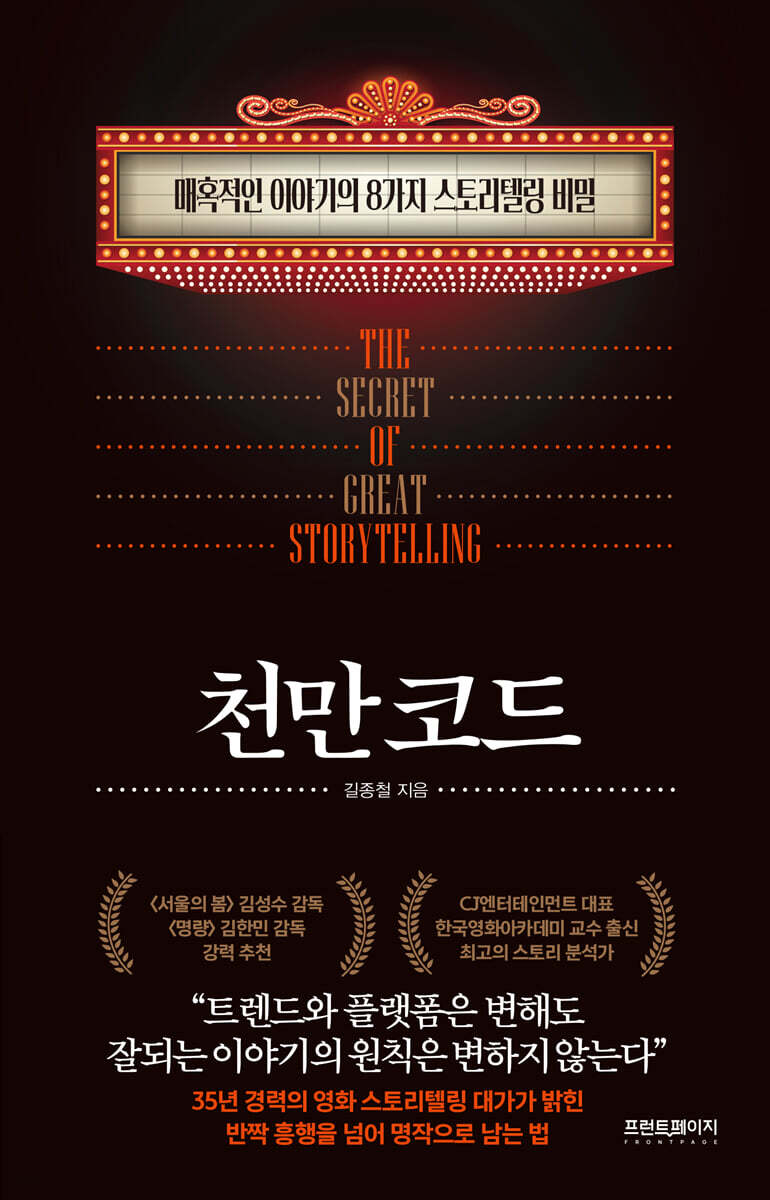
Ten million codes
 |
Description
Book Introduction
* Strongly recommended by Director Kim Sung-soo of “Spring in Seoul” and Director Kim Han-min of “Roaring Currents”!
* Story Education for the Content Age
“Even if trends and platforms change,
“The principles of a successful story don’t change.”
A storytelling master with experience as the CEO of CJ Entertainment reveals
How to Transform a Flash Flick into a Masterpiece
"In an age overflowing with stories, what makes a story so captivating?" "The Ten Million Code" answers this question with the secrets of storytelling discovered in South Korea's leading box office hit, the Ten Million Movie. Gil Jong-cheol, a former CEO of CJ Entertainment and a professor at the Korean Academy of Film Arts, has worked extensively in both the film industry and academia, delving into the box office success codes of these captivating stories, focusing on these ten million-viewer films.
Having witnessed both box office success and failure at the forefront of the film industry, the author has confirmed that hundreds of billions of won in production costs, a stellar cast, and large-scale marketing alone do not guarantee box office success.
In the end, it was none other than the story that moved people's hearts.
Realizing this, the author analyzed over 60 film cases, including eight Korean films that captivated audiences of all ages and genders and films that achieved great success both domestically and internationally, to derive the factors behind box office success. He discovered a successful storytelling strategy that remains unchanged even when trends change.
The author's first book, "The Ten Million Code," is a book that contains the results of his research and is a story education book that clearly explains the eight principles of storytelling that make successful stories.
- You can preview some of the book's contents.
Preview
index
Recommendation
Introduction | 25 years of experience, 10 years of teaching, one book
Prologue | How South Korea's most popular hit, "Ten Million Movie," is born.
Sequence 1: Protagonist Strategy: Make Your Protagonist Stand Out
Sequence 2: Inner Story: Make the central character shine with the surrounding characters.
Sequence 3 Narrative Truth: Make a Lie Believe It's True
Sequence 4 Plot Thread: Find the protagonist's consistent desire.
Sequence 5 Character Arc: Incorporate Change into the Story
Sequence 6: Emotional Release: Dig deep into the audience's catharsis.
Sequence 7: Metaphors of Life: Pay Attention to Life's Ironies
Sequence 8 Series Planning: Clarify What to Keep and What to Refresh
Epilogue | Humans create stories, and stories create humans.
Going Out | Ultimately, Story, Storytelling, and Story Design
annotation
List of movies with 10 million viewers
Detailed image

Into the book
A huge box office success, that is, a film that sells 10 million tickets, means that the film has attracted a lot of audiences, which means that it has penetrated and captured the hearts of the audience.
What exactly did the Ten Million Movies do to capture audiences' hearts? How did they captivate them? (…) Ultimately, capturing audiences' hearts and broadening their audience base means successfully communicating with them, and the key to that is storytelling.
---From "Prologue: How Korea's representative box office hit, '10 million movie', is born"
The success of a movie is like building a snowman: starting with a handful of snow, rolling a snowball, and eventually building a giant snowman.
That handful of solid snowballs is the main character in the movie.
Most audiences instinctively look for the main character first when a movie begins.
In a world of stories where various situations and diverse information are scattered, I want to find a center as quickly as possible, find something to lean on, and immerse myself in the story through that object.
This is how we humans naturally digest stories, embodied in our long-standing storytelling traditions.
(…) The most important point of contact in communicating with the audience is the protagonist, and clearly presenting the protagonist is essential for box office success.
---From "Sequence 1 Protagonist Strategy: Make the Protagonist Stand Out"
The limitation of the film medium is that it cannot directly show the inner thoughts of the characters.
It is not easy to directly express the inner world of a character and the inner story centered around the character in a movie.
However, it is not something that can be continuously explained through external narration.
This is because the camera cannot directly capture the image of a person, so a method of showing it indirectly is needed.
So, “Gwanghae: The Man Who Became King,” which focuses on the inner story, makes a bold move by placing various characters around the main character, Ha-seon.
---From "Sequence 2: Inner Story: Make the central character shine by placing the supporting characters"
<Roaring Currents> is designed to highlight the protagonist's inner conflict by dividing external conflicts into personal, social, and environmental conflicts and layering them.
Thus, Yi Sun-sin's inner world is emphasized, and his human side, leadership, and determination to save the country are deeply conveyed to the audience.
Behind the exhilarating feeling of victory in the dramatic comeback in the David-Goliath battle of 12 ships against 330 ships, the spiritual armament that transformed fear into courage and the leadership of Yi Sun-sin, who fought with the resolve to die, brought deep empathy and catharsis to the audience.
The writer creates a story by finding material from history, news, experience, and fantasy and constructing events based on that.
However, beyond the description and reproduction of the event, the author's thoughts and opinions regarding the event are important.
Writing thoughts and opinions persuasively is the way to get to the truth, and giving credibility to this narrative truth is the essence of storytelling.
---From "Sequence 3 Narrative Truth: Make People Believe Lies That Feel Real"
The protagonist, Song Woo-seok, does not yield to the injustice of society and believes in judicial justice, and tries to expose the illegal acts of state power through legal battles, but he is helplessly defeated by the injustice of injustice, that is, the tyranny of public power, and the truth is covered up.
The protagonist's ordeal is heightened to the extreme through complex denial.
Also, if the movie had ended here, the audience would have left the theater feeling helpless and frustrated.
If the story has a dark ending where the protagonist tries to create a better world but ultimately fails, it is difficult for the film to receive good marks as a popular film.
(…) However, our protagonist does not give in to the reality that nothing can be changed in court, and now chooses to take to the streets himself, lead protests, and directly confront state power.
He even refuses the position of corporate legal advisor, giving up both money and career advancement as a lawyer, and foolishly chooses to take the difficult path.
The film ends with Song Woo-seok evolving from a vulgar lawyer who was only concerned with his own financial gain to a human rights lawyer, a social activist, and a character who fights for justice to the end.
---From "Sequence 5 Character Arc: Be sure to include change in the story"
The irony depicted in the film resonates even more deeply because our reality, our lives, and our world are themselves cruelly ironic.
A story should capture the essence of life, but it should not be a mere copy of ordinary life, devoid of depth or meaning.
We need to portray someone's (the protagonist's) life so that we (the audience) can feel and accept it as our own.
That's storytelling.
And let's not forget.
The core keywords of storytelling are ‘conflict, dilemma, and irony.’
If “The Dark Knight” is a reference book on dilemmas, “Spring in Seoul” is a textbook on irony.
---From "Sequence 7 Metaphors of Life: Pay Attention to the Irony of Life"
As the series progresses, the familiarity that audiences feel can turn into boredom, and excessive newness can feel unfamiliar to the audience.
The "Outlaws" series clearly distinguished between what to keep and what to change from the previous film's settings in each sequel in order to give the audience what they want and take away what they don't want, and continued to vary these things.
This is the real secret behind the success of the "The Outlaws" series, which expanded to four films and became a blockbuster series that attracted over 40 million viewers combined.
Now, with four films under its belt, the "Outlaws" series has become a true franchise, showcasing a rich worldview and diverse characters, with the potential to expand in many directions in the future.
---From "Sequence 8 Series Planning: Clarify What to Keep and What to Renew"
There is always a gap between the speaker and the listener.
The message may or may not be conveyed to the listener as the speaker intended.
Storytelling is what fills that gap.
Depending on how you connect these gaps, communication can sometimes be successful, and sometimes misunderstandings can arise.
Ultimately, you can only create emotion through effective means.
There is a saying that 'there are no new stories under the sun'.
Throughout human history, countless stories have accumulated, and in an environment of diverse media that allows for easy communication with anyone around the world, the question of "how to tell the story" has become far more important than "what to tell the story."
---From "Going Out: Ultimately, Story, Storytelling, and Story Design"
Publisher's Review
Korea's representative box office hit, '10 Million Movies'
How is it born?
In an age where trends change faster than ever and tastes become more segmented, some say that mega-hits are now a thing of the past.
With the flood of content and the growing variety of platforms, it is difficult to produce a blockbuster that captures national attention.
However, there are still areas where we are looking forward to the birth of hit content that will thrill South Korea.
It's the film industry.
The number of 'ten million', which is one-fifth of the entire population, has become the standard for success, and its social and cultural impact is significant regardless of gender or age.
In that sense, it is no exaggeration to say that 'Ten Million Movies' is Korea's representative box office hit content.
Since Silmido, released in 2003, became the first domestic film to attract 10 million viewers, a total of 33 films have reached 10 million viewers.
With over a thousand films released each year, only a few achieve box office success, while the vast majority flop, how do these "ten million-viewer" films manage to capture and captivate the public? What makes these content so captivating?
When a film becomes a box office hit, there is a flood of analysis on the film's external factors, such as its socio-cultural context at the time of release, its stellar casting, and its marketing strategy. However, these factors are merely variable elements that can change at any time depending on the time and situation.
Accordingly, Professor Gil Jong-cheol, a professor of theater and film at Hanyang University and author of “The Ten Million Code,” points out “story” as an unchangeable element of success.
A master of film storytelling with 35 years of experience reveals
8 Storytelling Secrets to Captivating Tales
The author is a leading figure in the film industry, having served as a professor at the Korean Academy of Film Arts, a film education institute, and as the CEO of CJ Entertainment, Korea's largest film investment and distribution company.
During his tenure, he planned and produced “Gwanghae: The Man Who Became King,” which brought CJ its second 10 million-viewer film, and was at the center of the Korean film renaissance by releasing films such as “Snowpiercer,” “Cart,” and “A Werewolf Boy.”
The conclusion he reached based on his 35 years of experience is that the key to successful content lies in storytelling.
《The Ten Million Code》 is a book that compiles the diverse field experience and academic research results of the author, Professor Gil Jong-cheol. It focuses on eight films that have become examples of box office success, from the domestically most watched film, 《Roaring Currents》, to the most recent 10 million-viewer film, 《The Outlaws》 series. It also summons classic masterpieces such as Alfred Hitchcock's 《Psycho》 and Francis Ford Coppola's 《The Godfather》, as well as films that have been greatly loved both domestically and internationally, such as Disney's 《Frozen》 and Marvel's 《The Avengers》, and reveals the secrets of storytelling hidden within them.
The Thieves, which can be said to be the role model of Korean caper movies, has a protagonist strategy that fooled the audience with splendid multi-casting and presented a big plot twist; the narrative truth of Roaring Currents, which movedly reconstructed the incredible historical event of defeating 330 enemy ships with 13 ships; and the plot thread of Ode to My Father, which covered the protagonist's entire life without losing the framework of the story. This film comprehensively explores the story of movies and excitingly uncovers eight tens of millions of codes that are the secrets of box office success.
In an age overflowing with stories, if you've ever tried to create a captivating story, you'll be delighted to discover this book, packed with successful storytelling examples and insights.
Just as director Kim Han-min of “Roaring Currents” left a recommendation saying, “If you want to become a storyteller who captures the hearts of millions, I recommend this book,” this book generously provides readers with the secrets to creating a masterpiece rather than a fleeting hit.
After reading this book
Discover the real reason for fun and excitement
The film "Spring in Seoul" appeared like a comet at a time when theaters were still depressed due to the COVID-19 pandemic, confirming the truth that compelling storytelling can always move the hearts of audiences.
Why has this film, based on a true story with a widely known ending, sparked a wave of repeat viewings? The author identifies "irony" as the key word in the film's storytelling.
"Spring in Seoul" is a film filled with so many ironies that it could be called a textbook on irony.
In particular, the irony that this film brings to the forefront is the ‘inverted good and evil structure.’
It may seem like good should win because it is right, but in reality, good does not always win.
Even the right thing can fail.
In that sense, irony, which refers to a state in which two opposing or conflicting conditions exist simultaneously, is a metaphor for life and is a word that permeates human life.
“The irony depicted in the film resonates even more deeply because our reality, our lives, and our world are themselves cruelly ironic.
A story should capture the essence of life, but it should not be a mere copy of ordinary life, devoid of depth or meaning.
We need to portray someone's life so that we can feel and accept it as our own.
That's storytelling.”
In this way, "The Ten Million Code" goes beyond a detailed examination of the story of a ten million movie and goes into the essence of the story and the operating principles of storytelling.
So, after reading this book, you will be able to clearly see the structure of the story that you had not seen before, and you will be able to move beyond simply saying that it was 'fun' and tell the real reason why it was fun and moving.
Today, storytelling extends beyond the narrative medium and is applied in a variety of fields, including business and various educational and learning methods.
The era has arrived where the ability to design stories is no longer the exclusive domain of artists.
In that sense, this book, which presents excellent story design through friendly description, will serve as the most practical guide to the world of story for those who want to develop their own storytelling vision and skills.
GOODS SPECIFICS
- Date of issue: March 26, 2025
- Page count, weight, size: 296 pages | 424g | 135*210*20mm
- ISBN13: 9791193401422
- ISBN10: 1193401429
You may also like
카테고리
korean


korean


