

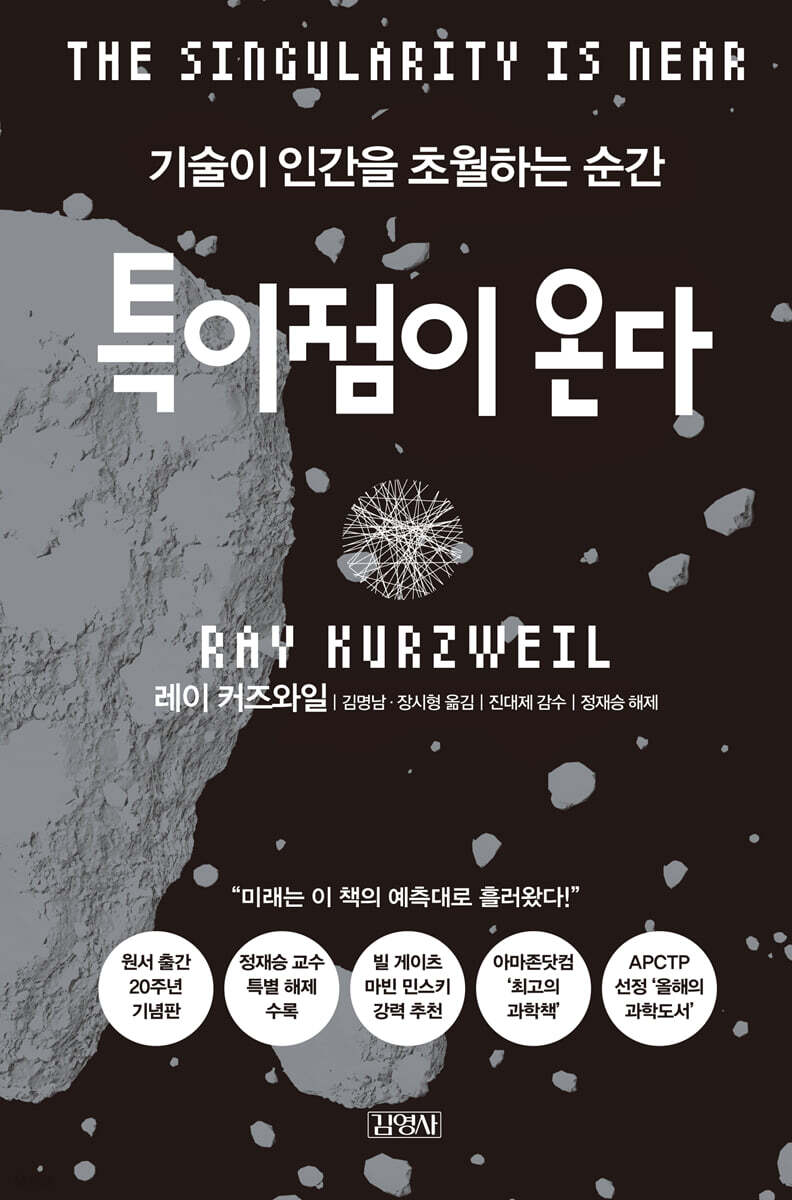
The singularity is coming
 |
Description
Book Introduction
The singularity is now closer.
20th Anniversary Edition of the Original Book - Includes a Special Commentary by KAIST Professor Jaeseung Jeong
Ray Kurzweil's The Singularity is Near, a classic of futurology that immediately created a global sensation upon its publication, returns with a new cover and special commentary to mark the 20th anniversary of the original publication.
This commemorative edition includes an introduction by KAIST Professor Jaeseung Jeong, who has been contemplating the future of science, technology, and humanity, providing an in-depth look at the changes over the past 20 years and future prospects.
As the original book's subtitle, "When Humanity Transcends Biology," suggests, this book explores the moment when humans no longer remain merely biological beings.
Kurzweil calls this point, where artificial intelligence surpasses human intelligence, biotechnology and nanotechnology redesign our bodies, and the line between reality and virtual reality blurs, the "singularity," and he predicts that point to be in 2045.
With technological advancement accelerating exponentially, the singularity is no longer a distant future story.
Medical nanobots flowing through our blood vessels, digitally stored consciousness, and intelligence spreading beyond the speed of light into space.
The acceleration of technology will fundamentally change the way humans exist.
But the world after the singularity is neither a simple utopia nor a dystopia.
It is a new era in which concepts we knew are being redefined.
Human lifespan, labor, consciousness, and even the meaning of life will change.
"The Singularity is Near" asks what we should choose in the midst of these changes.
As Professor Jeong Jae-seung wrote in the introduction, “The Singularity Is Near,” which “clearly presents the challenges and opportunities that modern people must face now that artificial intelligence has suddenly entered our daily lives,” is “a book that we should all keep by our side and frequently open throughout the 21st century.”
20th Anniversary Edition of the Original Book - Includes a Special Commentary by KAIST Professor Jaeseung Jeong
Ray Kurzweil's The Singularity is Near, a classic of futurology that immediately created a global sensation upon its publication, returns with a new cover and special commentary to mark the 20th anniversary of the original publication.
This commemorative edition includes an introduction by KAIST Professor Jaeseung Jeong, who has been contemplating the future of science, technology, and humanity, providing an in-depth look at the changes over the past 20 years and future prospects.
As the original book's subtitle, "When Humanity Transcends Biology," suggests, this book explores the moment when humans no longer remain merely biological beings.
Kurzweil calls this point, where artificial intelligence surpasses human intelligence, biotechnology and nanotechnology redesign our bodies, and the line between reality and virtual reality blurs, the "singularity," and he predicts that point to be in 2045.
With technological advancement accelerating exponentially, the singularity is no longer a distant future story.
Medical nanobots flowing through our blood vessels, digitally stored consciousness, and intelligence spreading beyond the speed of light into space.
The acceleration of technology will fundamentally change the way humans exist.
But the world after the singularity is neither a simple utopia nor a dystopia.
It is a new era in which concepts we knew are being redefined.
Human lifespan, labor, consciousness, and even the meaning of life will change.
"The Singularity is Near" asks what we should choose in the midst of these changes.
As Professor Jeong Jae-seung wrote in the introduction, “The Singularity Is Near,” which “clearly presents the challenges and opportunities that modern people must face now that artificial intelligence has suddenly entered our daily lives,” is “a book that we should all keep by our side and frequently open throughout the 21st century.”
- You can preview some of the book's contents.
Preview
index
clear
Prologue: The Power of Thought
1.
Six periods
Intuitive linear perspective versus historical exponential perspective
Six periods
The singularity is imminent
2.
Technological Evolution Theory: The Law of Accelerating Returns
The S-curve of technology in its life cycle
Moore's Law and Beyond
DNA sequencing, memory, communications, the Internet, miniaturization
Singularity as an economic demand
3.
Creating computational capacity on par with the human brain
The Sixth Paradigm of Computational Technology: Emerging Technologies Including 3D Molecular Computation
The computational capacity of the human brain
Limitations of operations
4.
Building Software with Human Intelligence: How to Reverse-Evaluate the Brain
An Overview of Brain Reverse Analysis
Is the human brain different from a computer?
A look inside the brain
Building a brain model
Brain-machine connection
Rapidly Developing Brain Reverse Analysis Research
Upload your brain
5. GNR: Three Overlapping Revolutions
Genetics: The Intersection of Information and Biology
Nanotechnology: The Intersection of Information and the Physical World
Robotics: Powerful AI
6.
What impacts will there be?
Effects on the human body
Effects on the brain
Impact on human lifespan
Impact on War: Remote, Robotic, Robust, Small-Scale, Virtual Reality Paradigms
Impact on learning
Impact on work
Impact on play
Impact on the fate of the universe's intelligence: Why humanity is likely to be unique.
7.
I am a singularitarian
The thorny problem of consciousness
Who am I? What am I?
Singularity as Transcendence
8.
The Inextricably Intertwined Hopes and Perils of GNR
Inextricably intertwined benefits…
…and danger
The various existential risks that will unfold
Defense preparations
The idea of giving up
The impact of the development and regulation of defense technology
GNR defense strategy
9.
Rebuttal to criticism
Various criticisms
Criticism that it is unbelievable
Criticism of Malthusians
Criticism of software
Criticism of analog processing methods
Criticism based on the complexity of neural information processing
Critiques of Microtubules and Quantum Computing
Critique of the Church-Turing thesis
A note on failure rates
Pointing out the 'binding' effect
A Critique of the Ontological Position: Can Computers Be Conscious?
Pointing out the gap between rich and poor
Pointing out the possibility of government regulation
Criticism of theistic positions
Criticism of the holistic view
Epilogue
Acknowledgements
Reviewer's Note
Translator's Note
Materials and Contact Information
Appendix: The Law of Accelerating Harvest Revisited
main
Search
Prologue: The Power of Thought
1.
Six periods
Intuitive linear perspective versus historical exponential perspective
Six periods
The singularity is imminent
2.
Technological Evolution Theory: The Law of Accelerating Returns
The S-curve of technology in its life cycle
Moore's Law and Beyond
DNA sequencing, memory, communications, the Internet, miniaturization
Singularity as an economic demand
3.
Creating computational capacity on par with the human brain
The Sixth Paradigm of Computational Technology: Emerging Technologies Including 3D Molecular Computation
The computational capacity of the human brain
Limitations of operations
4.
Building Software with Human Intelligence: How to Reverse-Evaluate the Brain
An Overview of Brain Reverse Analysis
Is the human brain different from a computer?
A look inside the brain
Building a brain model
Brain-machine connection
Rapidly Developing Brain Reverse Analysis Research
Upload your brain
5. GNR: Three Overlapping Revolutions
Genetics: The Intersection of Information and Biology
Nanotechnology: The Intersection of Information and the Physical World
Robotics: Powerful AI
6.
What impacts will there be?
Effects on the human body
Effects on the brain
Impact on human lifespan
Impact on War: Remote, Robotic, Robust, Small-Scale, Virtual Reality Paradigms
Impact on learning
Impact on work
Impact on play
Impact on the fate of the universe's intelligence: Why humanity is likely to be unique.
7.
I am a singularitarian
The thorny problem of consciousness
Who am I? What am I?
Singularity as Transcendence
8.
The Inextricably Intertwined Hopes and Perils of GNR
Inextricably intertwined benefits…
…and danger
The various existential risks that will unfold
Defense preparations
The idea of giving up
The impact of the development and regulation of defense technology
GNR defense strategy
9.
Rebuttal to criticism
Various criticisms
Criticism that it is unbelievable
Criticism of Malthusians
Criticism of software
Criticism of analog processing methods
Criticism based on the complexity of neural information processing
Critiques of Microtubules and Quantum Computing
Critique of the Church-Turing thesis
A note on failure rates
Pointing out the 'binding' effect
A Critique of the Ontological Position: Can Computers Be Conscious?
Pointing out the gap between rich and poor
Pointing out the possibility of government regulation
Criticism of theistic positions
Criticism of the holistic view
Epilogue
Acknowledgements
Reviewer's Note
Translator's Note
Materials and Contact Information
Appendix: The Law of Accelerating Harvest Revisited
main
Search
Detailed image

Into the book
While it's difficult to imagine a future civilization with intelligence far surpassing our own, our ability to construct mental models of reality allows us to reasonably envision what it might mean for humans to merge their biological thinking with the non-biological intelligence they create.
This is exactly what I want to say in this book.
--- p.37
What is a singularity? It refers to a future period in which the pace of technological change will accelerate so rapidly and its impact will be so profound that human life will be irreversibly transformed.
In this time of neither utopia nor dystopia, we will experience transformations in all the concepts we use to give meaning to our lives, from business models to the human lifespan.
Death is no exception.
Understanding the singularity changes our perspective on the meaning of the past and what lies ahead.
A precise understanding of singularity fundamentally changes our outlook on life, both universal and individual.
--- p.41~42
A close look at the history of technology quickly reveals that technological change is exponential.
Exponential growth is a common feature of all evolutionary processes, but technology is the best example of this.
This is the result of examining a wide range of technologies, from electronics to biology, and the scope of their influence, even the total amount of human knowledge or the size of the economy, using a variety of methods and timescales.
In fact, in addition to exponential growth, 'double' exponential growth is also often found.
The exponential growth rate (i.e. the exponent) itself refers to a phenomenon in which the rate of increase increases exponentially.
--- p.49
The pace of technological change will not be limited to the speed of the human mind.
Machine intelligence will self-feed back and improve its capabilities, and human intelligence without machine assistance will not be able to keep up with its pace.
--- p.67
The continued acceleration of technology is an inevitable consequence of the so-called law of accelerating returns.
The law of accelerating returns is a term I coined to describe the phenomenon that the evolutionary process accelerates, and its products also increase exponentially.
The products of evolution include information-related technologies such as computation.
The pace of advancement in these technologies is accelerating beyond what Moore's Law would predict.
Singularities are an inevitable consequence of the law of accelerating returns.
--- p.77~78
Evolution uses positive feedback.
That is, useful techniques that arise at one stage of evolutionary development are used to create the next stage.
Evolution has progressed more rapidly by building on the achievements of previous stages.
Evolution proceeds in a roundabout way.
Evolution created humans, humans created technology, and now humans are working with ever-evolving technology to create the next generation of technology.
In the age of singularity, the distinction between humans and technology will disappear.
It is not that humans will become like today's machines, but that machines will develop like today's humans and even beyond.
--- p.85
I predict 2045 will be the year of the singularity.
It will be a time when human capabilities undergo a profound and irreversible transformation.
By the mid-2040s, non-biological intelligence will dominate the world, but it will still be human civilization.
Humans transcend biology, not humanity.
--- p.197
Reflexivity is particularly highlighted in recent theories of language ability.
Noam Chomsky, in his early theories of language, argued that there are common properties among many languages, which is why different languages show similar aspects.
Furthermore, in a 2002 paper, Noam Chomsky, Mark Hauser, and Tecumseh Fitch argued that only humans possess the capacity for language because of a property called "reflexivity."
Recursion is the ability to take smaller parts, build larger chunks, use those chunks as parts to build other structures, and so on, repeatedly.
Thanks to this, we can create rich sentence and paragraph structures with a limited number of words.
--- p.268~269
In the first half of the 21st century, we will see three revolutions occurring one after another, overlapping each other.
A revolution in genetics, a revolution in nanotechnology, a revolution in robotics.
With this, the era I call the Fifth Period, the era of the Singularity, will begin.
We are currently in the early stages of the 'G (Genetics)' revolution.
We are learning to rewire the biology of the human body by understanding the information processing processes that life embodies.
We are learning how to eradicate disease, dramatically expand human potential, and dramatically extend lifespan.
But as Hans Moravec points out, no matter how freely we harness DNA-based biology, humans will remain 'second-rate robots.'
This means that once we fully understand how biology works and begin to refine it, the tools of biology alone will no longer be enough.
--- p.289~290
What will allow us to overcome the limitations of biology is the 'N (Nanotechnology)' revolution.
It will allow us to redesign and reassemble our bodies, our brains, and the world we live in at the molecular level.
The most powerful innovation is the coming 'R(Robotics)' revolution.
Human-level robots will emerge, modeled after human intelligence but redesigned to be even more powerful.
The R revolution is the most significant change.
Because intelligence is the most powerful 'force' in the universe.
--- p.290
The same goes for the body and brain.
The only difference is that while the methods of building maintenance are well known, the principles of life are not fully known.
However, as we are rapidly gaining knowledge about the development of biology and biochemical reactions, the day will soon come when we know enough.
We are now beginning to understand aging as a complex process, rather than a single, unavoidable event.
Strategies to reverse each of these aging processes are also emerging.
It is the use of various combinations of biotechnology technologies.
--- p.299~300
When we talk about controlling the genetic makeup of humans, we usually think of creating “designer babies.”
But the real value of gene therapy lies in changing the genes of adults.
It involves suppressing bad genes that cause disease, introducing good new genes that can slow down aging, and even rejuvenate.
--- p.303
The rise of nanotechnology could bring about significant changes to the environment.
For example, manufacturing and processing technologies that dramatically reduce pollutant emissions will emerge, and technologies that improve the pollution accumulated throughout the industrial age will also emerge.
Meeting our energy needs with renewable and clean energy sources, such as nano solar panels, will also have positive environmental consequences.
--- p.353~354
Of the three major revolutions (G, N, R) that will underpin the singularity, R (robotics) is the most profound.
This signifies the birth of non-biological intelligence that surpasses that of ordinary humans.
As more intelligent thought processes emerge, less intelligent beings will eventually be left behind, and intelligence will become the most powerful force in the universe. While the "R" in GNR stands for robotics, the real issue is strong AI (artificial intelligence that surpasses human intelligence).
But the reason we emphasize robotics is because intelligence needs a body, a physical entity, to influence the world.
--- p.367
Nanotechnology will be incredibly revolutionary, but powerful AI will have an unspeakably profound impact.
Nanotechnology may be powerful, but it is not inherently intelligent.
The power of nanotechnology is immense, but we may be able to figure out ways to control it.
On the other hand, superintelligence is essentially uncontrollable.
--- p.370
The era of powerful AI will gradually approach us.
As long as there is any gap between human and machine capabilities, skeptics of strong AI will nitpick and nitpick.
But we are likely to experience what Kasparov did in all fields of machine technology and knowledge.
As the exponential growth curve of machines reaches an inflection point, we will be surprised to discover that their performance has suddenly jumped from a marginal level to an overwhelming level.
--- p.411~412
As the G, N, and R revolutions intertwine, our fragile version 1.0 bodies will be transformed into more durable and capable version 2.0s.
Billions of nanobots will flow through the bloodstream of our bodies and brains, performing various tasks to improve our physical health, including fighting pathogens, correcting DNA errors, and eliminating toxins.
We could live indefinitely without growing old.
--- p.422
Wars will be fought with weapons utilizing nanobots, and virtual weapons will also proliferate.
Learning will initially take place online, but once the brain itself can connect online, it will be able to download new knowledge and skills without any cumbersome process.
All we have to do is create all kinds of knowledge, from music and art to mathematics and science.
Playing will also become a form of knowledge creation, so there will in fact be no clear boundary between work and play.
--- p.422
Robert Fraters estimates that if we could prevent just 50 percent of medically preventable diseases, life expectancy could increase by 150 years.
If we could prevent 90 percent of medical problems, we would live an extra 100 years; if we could prevent 99 percent, we would live over a thousand years.
When the biotechnology and nanotechnology revolutions are fully realized, virtually all medical causes of death can be overcome.
As we become increasingly non-biological, we may be able to 'back up ourselves' (meaning store key patterns of knowledge, skills, and personality), and then all known causes of death will become meaningless.
--- p.445
Today, through technological advancements, we have largely overcome the harsh human condition.
At least in developed countries.
Even in poor countries, the gap in life expectancy between citizens and those in developed countries is not that great.
Technological advancement follows a typical pattern: it starts with products that are unreliable and prohibitively expensive, then moves to slightly more expensive products with slightly better features, and then to relatively inexpensive products with reliable features.
Finally, technology has reached a level of effectiveness that makes it so effective, ubiquitous, and nearly free.
Radio, television, and cell phones followed this path.
The current Internet has reached a point where it is inexpensive and operates reliably.
--- p.476~477
I've been thinking about singularities for decades now.
It goes without saying that this is not an idea that will ever end.
I became interested in the relationship between human thought and computational technology in the 1960s, when I was a teenager.
In the 1970s, I began researching the acceleration of technological progress, and in the late 1980s, I wrote my first book on the subject.
So, I've been thinking for quite some time about how this transformation, already underway, and the various changes that will unfold in layers, will affect not only myself but also society.
--- p.520
The convergence of humans and technology is clearly an event that will bring about rapid change.
But it is an uphill climb that will enable amazing benefits, not a downhill climb that will lead you into Nietzsche's abyss.
Some people see post-fusion humans as a new 'species'.
But the very concept of paper is a purely biological concept, and yet change transcends biology itself.
The change known as the singularity is not the final stage in the long history of biological evolution.
It is a stage that completely surpasses biological evolution.
--- p.526~527
I believe in a pattern-based philosophy.
I believe that the existence of a country is fundamentally one perpetual pattern.
I am an evolving pattern, and I influence the evolution of my own patterns.
Knowledge is also a pattern.
It's different from information.
And losing knowledge is a great loss.
Therefore, the death of a person is the ultimate, greatest loss.
--- p.544
I think we should equally seriously consider the increasingly persistent and misguided voices of the Luddites who argue that we should abandon technological progress on a large scale to avoid the dangers of GNR.
Giving up is not the answer.
Sometimes, even when faced with rational fears, humans come up with irrational solutions.
If we continue to delay developing technologies that will overcome human suffering, the consequences will be dire.
--- p.574
It's easy to romanticize the past.
But it's important to remember that until very recently, most of humanity lived lives of extreme insecurity, where ordinary misfortunes could easily lead to disaster.
Two hundred years ago, the life expectancy for women in the country with the most records (Sweden) was around 35 years, which is very short compared to the current maximum life expectancy of 85 years for Japanese women.
The man was about 33 years old, which is still short compared to today's average of 79 years old.
Half a day's work was required to earn enough for dinner that evening, and most people's activities involved hard labor.
There was no social safety net.
Even now, some people live in such precarious circumstances, and that is why they cannot give up technological advancement and the economic growth that comes with it.
--- p.577
The continued potential to alleviate human suffering is a powerful driver of technological progress.
There is also the possibility that even greater economic benefits will be achieved in the future.
As various intertwined technologies advance at an accelerating pace, we are paving the way for gold-plated paths (there are many paths, because there is not just one path to technological advancement).
In a competitive environment, this path is followed for economic reasons.
Giving up on technological advancement is tantamount to economic suicide for individuals, companies, and nations.
--- p.579
I believe that it is good to maintain an open free market system for the gradual advancement of science and technology.
I believe that a process in which the market accepts and approves each stage of development is a constructive environment in which technology embodies human values.
Powerful AI will emerge from diverse efforts and become deeply rooted in the infrastructure of civilization.
Eventually, it will enter the body and brain.
In doing so, it will reflect human values.
Because we ourselves will be powerful AI.
If governments try to control technologies in secret through regulations, they will seep underground and create an unstable environment where they are more likely to be used in dangerous situations.
--- p.593~594
Technology will forever remain a double-edged sword.
It's simply a vast capacity that humanity can harness for a variety of purposes. While GNR could help overcome long-standing human problems like disease and poverty, it could also contribute to destructive ideals.
We have no choice but to use rapidly changing technologies to promote precious human values while simultaneously enhancing our defensive capabilities.
Unfortunately, there is no clear consensus on what are the most precious values of humanity.
This is exactly what I want to say in this book.
--- p.37
What is a singularity? It refers to a future period in which the pace of technological change will accelerate so rapidly and its impact will be so profound that human life will be irreversibly transformed.
In this time of neither utopia nor dystopia, we will experience transformations in all the concepts we use to give meaning to our lives, from business models to the human lifespan.
Death is no exception.
Understanding the singularity changes our perspective on the meaning of the past and what lies ahead.
A precise understanding of singularity fundamentally changes our outlook on life, both universal and individual.
--- p.41~42
A close look at the history of technology quickly reveals that technological change is exponential.
Exponential growth is a common feature of all evolutionary processes, but technology is the best example of this.
This is the result of examining a wide range of technologies, from electronics to biology, and the scope of their influence, even the total amount of human knowledge or the size of the economy, using a variety of methods and timescales.
In fact, in addition to exponential growth, 'double' exponential growth is also often found.
The exponential growth rate (i.e. the exponent) itself refers to a phenomenon in which the rate of increase increases exponentially.
--- p.49
The pace of technological change will not be limited to the speed of the human mind.
Machine intelligence will self-feed back and improve its capabilities, and human intelligence without machine assistance will not be able to keep up with its pace.
--- p.67
The continued acceleration of technology is an inevitable consequence of the so-called law of accelerating returns.
The law of accelerating returns is a term I coined to describe the phenomenon that the evolutionary process accelerates, and its products also increase exponentially.
The products of evolution include information-related technologies such as computation.
The pace of advancement in these technologies is accelerating beyond what Moore's Law would predict.
Singularities are an inevitable consequence of the law of accelerating returns.
--- p.77~78
Evolution uses positive feedback.
That is, useful techniques that arise at one stage of evolutionary development are used to create the next stage.
Evolution has progressed more rapidly by building on the achievements of previous stages.
Evolution proceeds in a roundabout way.
Evolution created humans, humans created technology, and now humans are working with ever-evolving technology to create the next generation of technology.
In the age of singularity, the distinction between humans and technology will disappear.
It is not that humans will become like today's machines, but that machines will develop like today's humans and even beyond.
--- p.85
I predict 2045 will be the year of the singularity.
It will be a time when human capabilities undergo a profound and irreversible transformation.
By the mid-2040s, non-biological intelligence will dominate the world, but it will still be human civilization.
Humans transcend biology, not humanity.
--- p.197
Reflexivity is particularly highlighted in recent theories of language ability.
Noam Chomsky, in his early theories of language, argued that there are common properties among many languages, which is why different languages show similar aspects.
Furthermore, in a 2002 paper, Noam Chomsky, Mark Hauser, and Tecumseh Fitch argued that only humans possess the capacity for language because of a property called "reflexivity."
Recursion is the ability to take smaller parts, build larger chunks, use those chunks as parts to build other structures, and so on, repeatedly.
Thanks to this, we can create rich sentence and paragraph structures with a limited number of words.
--- p.268~269
In the first half of the 21st century, we will see three revolutions occurring one after another, overlapping each other.
A revolution in genetics, a revolution in nanotechnology, a revolution in robotics.
With this, the era I call the Fifth Period, the era of the Singularity, will begin.
We are currently in the early stages of the 'G (Genetics)' revolution.
We are learning to rewire the biology of the human body by understanding the information processing processes that life embodies.
We are learning how to eradicate disease, dramatically expand human potential, and dramatically extend lifespan.
But as Hans Moravec points out, no matter how freely we harness DNA-based biology, humans will remain 'second-rate robots.'
This means that once we fully understand how biology works and begin to refine it, the tools of biology alone will no longer be enough.
--- p.289~290
What will allow us to overcome the limitations of biology is the 'N (Nanotechnology)' revolution.
It will allow us to redesign and reassemble our bodies, our brains, and the world we live in at the molecular level.
The most powerful innovation is the coming 'R(Robotics)' revolution.
Human-level robots will emerge, modeled after human intelligence but redesigned to be even more powerful.
The R revolution is the most significant change.
Because intelligence is the most powerful 'force' in the universe.
--- p.290
The same goes for the body and brain.
The only difference is that while the methods of building maintenance are well known, the principles of life are not fully known.
However, as we are rapidly gaining knowledge about the development of biology and biochemical reactions, the day will soon come when we know enough.
We are now beginning to understand aging as a complex process, rather than a single, unavoidable event.
Strategies to reverse each of these aging processes are also emerging.
It is the use of various combinations of biotechnology technologies.
--- p.299~300
When we talk about controlling the genetic makeup of humans, we usually think of creating “designer babies.”
But the real value of gene therapy lies in changing the genes of adults.
It involves suppressing bad genes that cause disease, introducing good new genes that can slow down aging, and even rejuvenate.
--- p.303
The rise of nanotechnology could bring about significant changes to the environment.
For example, manufacturing and processing technologies that dramatically reduce pollutant emissions will emerge, and technologies that improve the pollution accumulated throughout the industrial age will also emerge.
Meeting our energy needs with renewable and clean energy sources, such as nano solar panels, will also have positive environmental consequences.
--- p.353~354
Of the three major revolutions (G, N, R) that will underpin the singularity, R (robotics) is the most profound.
This signifies the birth of non-biological intelligence that surpasses that of ordinary humans.
As more intelligent thought processes emerge, less intelligent beings will eventually be left behind, and intelligence will become the most powerful force in the universe. While the "R" in GNR stands for robotics, the real issue is strong AI (artificial intelligence that surpasses human intelligence).
But the reason we emphasize robotics is because intelligence needs a body, a physical entity, to influence the world.
--- p.367
Nanotechnology will be incredibly revolutionary, but powerful AI will have an unspeakably profound impact.
Nanotechnology may be powerful, but it is not inherently intelligent.
The power of nanotechnology is immense, but we may be able to figure out ways to control it.
On the other hand, superintelligence is essentially uncontrollable.
--- p.370
The era of powerful AI will gradually approach us.
As long as there is any gap between human and machine capabilities, skeptics of strong AI will nitpick and nitpick.
But we are likely to experience what Kasparov did in all fields of machine technology and knowledge.
As the exponential growth curve of machines reaches an inflection point, we will be surprised to discover that their performance has suddenly jumped from a marginal level to an overwhelming level.
--- p.411~412
As the G, N, and R revolutions intertwine, our fragile version 1.0 bodies will be transformed into more durable and capable version 2.0s.
Billions of nanobots will flow through the bloodstream of our bodies and brains, performing various tasks to improve our physical health, including fighting pathogens, correcting DNA errors, and eliminating toxins.
We could live indefinitely without growing old.
--- p.422
Wars will be fought with weapons utilizing nanobots, and virtual weapons will also proliferate.
Learning will initially take place online, but once the brain itself can connect online, it will be able to download new knowledge and skills without any cumbersome process.
All we have to do is create all kinds of knowledge, from music and art to mathematics and science.
Playing will also become a form of knowledge creation, so there will in fact be no clear boundary between work and play.
--- p.422
Robert Fraters estimates that if we could prevent just 50 percent of medically preventable diseases, life expectancy could increase by 150 years.
If we could prevent 90 percent of medical problems, we would live an extra 100 years; if we could prevent 99 percent, we would live over a thousand years.
When the biotechnology and nanotechnology revolutions are fully realized, virtually all medical causes of death can be overcome.
As we become increasingly non-biological, we may be able to 'back up ourselves' (meaning store key patterns of knowledge, skills, and personality), and then all known causes of death will become meaningless.
--- p.445
Today, through technological advancements, we have largely overcome the harsh human condition.
At least in developed countries.
Even in poor countries, the gap in life expectancy between citizens and those in developed countries is not that great.
Technological advancement follows a typical pattern: it starts with products that are unreliable and prohibitively expensive, then moves to slightly more expensive products with slightly better features, and then to relatively inexpensive products with reliable features.
Finally, technology has reached a level of effectiveness that makes it so effective, ubiquitous, and nearly free.
Radio, television, and cell phones followed this path.
The current Internet has reached a point where it is inexpensive and operates reliably.
--- p.476~477
I've been thinking about singularities for decades now.
It goes without saying that this is not an idea that will ever end.
I became interested in the relationship between human thought and computational technology in the 1960s, when I was a teenager.
In the 1970s, I began researching the acceleration of technological progress, and in the late 1980s, I wrote my first book on the subject.
So, I've been thinking for quite some time about how this transformation, already underway, and the various changes that will unfold in layers, will affect not only myself but also society.
--- p.520
The convergence of humans and technology is clearly an event that will bring about rapid change.
But it is an uphill climb that will enable amazing benefits, not a downhill climb that will lead you into Nietzsche's abyss.
Some people see post-fusion humans as a new 'species'.
But the very concept of paper is a purely biological concept, and yet change transcends biology itself.
The change known as the singularity is not the final stage in the long history of biological evolution.
It is a stage that completely surpasses biological evolution.
--- p.526~527
I believe in a pattern-based philosophy.
I believe that the existence of a country is fundamentally one perpetual pattern.
I am an evolving pattern, and I influence the evolution of my own patterns.
Knowledge is also a pattern.
It's different from information.
And losing knowledge is a great loss.
Therefore, the death of a person is the ultimate, greatest loss.
--- p.544
I think we should equally seriously consider the increasingly persistent and misguided voices of the Luddites who argue that we should abandon technological progress on a large scale to avoid the dangers of GNR.
Giving up is not the answer.
Sometimes, even when faced with rational fears, humans come up with irrational solutions.
If we continue to delay developing technologies that will overcome human suffering, the consequences will be dire.
--- p.574
It's easy to romanticize the past.
But it's important to remember that until very recently, most of humanity lived lives of extreme insecurity, where ordinary misfortunes could easily lead to disaster.
Two hundred years ago, the life expectancy for women in the country with the most records (Sweden) was around 35 years, which is very short compared to the current maximum life expectancy of 85 years for Japanese women.
The man was about 33 years old, which is still short compared to today's average of 79 years old.
Half a day's work was required to earn enough for dinner that evening, and most people's activities involved hard labor.
There was no social safety net.
Even now, some people live in such precarious circumstances, and that is why they cannot give up technological advancement and the economic growth that comes with it.
--- p.577
The continued potential to alleviate human suffering is a powerful driver of technological progress.
There is also the possibility that even greater economic benefits will be achieved in the future.
As various intertwined technologies advance at an accelerating pace, we are paving the way for gold-plated paths (there are many paths, because there is not just one path to technological advancement).
In a competitive environment, this path is followed for economic reasons.
Giving up on technological advancement is tantamount to economic suicide for individuals, companies, and nations.
--- p.579
I believe that it is good to maintain an open free market system for the gradual advancement of science and technology.
I believe that a process in which the market accepts and approves each stage of development is a constructive environment in which technology embodies human values.
Powerful AI will emerge from diverse efforts and become deeply rooted in the infrastructure of civilization.
Eventually, it will enter the body and brain.
In doing so, it will reflect human values.
Because we ourselves will be powerful AI.
If governments try to control technologies in secret through regulations, they will seep underground and create an unstable environment where they are more likely to be used in dangerous situations.
--- p.593~594
Technology will forever remain a double-edged sword.
It's simply a vast capacity that humanity can harness for a variety of purposes. While GNR could help overcome long-standing human problems like disease and poverty, it could also contribute to destructive ideals.
We have no choice but to use rapidly changing technologies to promote precious human values while simultaneously enhancing our defensive capabilities.
Unfortunately, there is no clear consensus on what are the most precious values of humanity.
--- p.600
Publisher's Review
A Vision of Human-Machine Civilization Predicted by World-Renowned Scholars
“The future has unfolded as predicted in this book!”
★Commemorative edition of the original book's 20th anniversary
★Includes special commentary by KAIST Professor Jaeseung Jeong
★Highly recommended by Jang Dong-seon, Jang Kang-myeong, Bill Gates, and Marvin Minsky!
★Amazon.com's 'Best Science Books'
★Selected as "Science Book of the Year" by the Asia Pacific Center for Theoretical Physics
Ray Kurzweil's "The Singularity is Near," which caused a worldwide sensation upon its publication in 2005, has returned in a 20th anniversary edition.
The author's radical prediction that artificial intelligence, nanotechnology, and biotechnology could fundamentally transform human intelligence and the human body shocked many and sparked heated debate.
Celebrating the 20th anniversary of the original publication, this commemorative edition features a new cover and a special introduction by Professor Jaeseung Jeong of KAIST, providing deeper insight into the changes over the past 20 years and what Kurzweil's predictions mean for us today.
Singularity refers to the moment when the speed of scientific and technological development increases exponentially, leading to the advent of a new civilization that surpasses human intelligence and capabilities.
In this book, Kurzweil predicts that the singularity will arrive around 2045, after which humanity will no longer be confined by biological limitations.
Biotechnology is fundamentally changing the human body, nanotechnology is conquering disease, and artificial intelligence is reaching a stage where it can improve itself.
An era where the boundaries between reality and virtual reality disappear, and human consciousness is stored digitally, leading to a new form of life.
Now it's not just science fiction, it's becoming increasingly real.
A book that will give birth to a thousand science fiction books in the future
Humans become machines and machines become humans!
In this book, Kurzweil makes two key arguments.
First, the singularity inevitably arrives.
The basis for this is the GNR (G: genetic engineering, N: nanotechnology, R: robotics and artificial intelligence) revolution.
Kurzweil argues that human existence will be fundamentally transformed when humanity fully understands the principles of biology through genetic engineering and can freely manipulate them through nanotechnology.
The decisive factor here is artificial intelligence (AI).
Once artificial intelligence with human-level intelligence emerges, it is only a matter of time before we can create even better artificial intelligence.
Ultimately, when artificial intelligence emerges that completely controls the material world and surpasses human capabilities, civilization will be out of the hands of biological humans.
The important thing is that we must prepare now so that artificial intelligence can become not just a tool, but humanity's 'descendants.'
Second, the singularity is imminent.
Kurzweil explains this as the 'Law of Accelerating Returns'.
A term he coined himself, comparing it to the 'law of diminishing returns' in economics, which states that the returns from information technology grow at an accelerated rate.
In this book, he examines the historical development of technology in various fields, noting and detailing the recurring pattern of major technologies developing exponentially while creating synergy with adjacent fields.
According to Moore's Law, the number of transistors in a chip doubles every 18 months, and Kurzweil says that this exponential growth applies to all of information technology, and ultimately, as all industries become information-based, the pace of technological advancement will accelerate.
And the thing about exponential growth is that change happens much faster than people expect.
It is highly likely that the singularity that seemed like a distant future event is actually approaching right before our eyes.
Based on this logic, the vision of the future that Kurzweil presents is beyond imagination.
Medical nanorobots that flow through blood vessels to treat disease, living in fully immersive virtual reality, technology that digitizes human brain information to achieve eternal life, and even plans to spread intelligence into space.
These are stories that are hard to believe without reliable scientific evidence.
But Kurzweil's prediction is not just fantasy.
As a forward-thinking inventor and technology analyst, he has predicted the future with remarkable accuracy in the past.
In this book, he develops a hypothesis based on a large amount of scientific evidence, examines various scenarios, and develops his logic.
The vision he presents may be uncomfortable and difficult to accept, but even if the singularity doesn't arrive in perfect form, some of it is likely to become reality.
This book is not simply a prediction book.
What choices should we make amid the changes brought about by the singularity? It's worth considering why tech leaders like Bill Gates are paying attention to Kurzweil's arguments.
"The Singularity is Near" is a challenging yet profound book that provides essential insights for preparing for the future.
“It is rare to find a book that predicts the future so broadly in space and time, and so persistently and scientifically.
Anyone discussing the future inevitably encounters Kurzweil at some point.
Therefore, the significance of this book, which synthesizes Kurzweil's thoughts without missing a single piece, is clear in every way.” (From the translator's note)
Why should you read "The Singularity Is Near" in the 21st century?
In his 1990 book, “The Age of Intelligent Machines,” Ray Kurzweil suggested the possibility that artificial intelligence could surpass human intelligence, and in his 1999 book, “The Age of Spiritual Machines” (Korean translation title: “Homo Sapiens in the 21st Century”), he argued that AI would eventually become conscious.
And in 2005, in The Singularity is Near, he went even further, establishing the concept of technological singularity and predicting its arrival in 2045.
The prediction was that innovations in artificial intelligence, biotechnology, and nanotechnology (the GNR revolution) would blur the lines between humans and machines, fundamentally changing the very concept of what it means to be human.
This book has been at the center of heated debate ever since its publication.
Those who believe that technological advancement will open up infinite possibilities for humanity highly praise it as a “prophecy from a future information technology guru” and “a book that will change the way you see the world.”
Critics, on the other hand, sarcastically label it as "the pipe dream of a nerd who knows nothing but science" and "the exaggerated propaganda of a singularity salesman who is trying to scare and deceive people."
But what is certain is that the trend of technology moving in a direction that surpasses humans cannot be denied.
Twenty years later, where are we now? In 2024, Kurzweil published "The Singularity Is Nearer," a mid-term review of "The Singularity Is Near."
This book examines the technological advancements of the past 20 years, examines its own predictions, and reflects the latest scientific and technological advancements, demonstrating that the "Law of Accelerating Returns" and the "GNR Revolution," which were examined in detail in "The Singularity Is Near," are still valid.
We are no longer stuck at the stage of asking, 'Will the singularity come?'
The important question is, 'What should we do when that moment comes?'
For humanity living in the 21st century, “The Singularity is Near” is not simply a book predicting the future.
It is a starting point for understanding and preparing for the direction of change we will face.
“This book shines even brighter when read and discussed together.
True value can be found when we gain insight into the larger landscape of technology and civilization without dwelling on the accuracy or error of specific predictions.
It is also useful for developing a macroscopic perspective on how various fields interact and converge beyond a specific area.
"The Singularity is Near" offers crucial insights into 21st-century technological advancements and future society, clearly presenting the challenges and opportunities modern people must face as artificial intelligence rapidly enters our daily lives.
“This is a book we should all keep close by and read often throughout the 21st century.” (From “The Singularity Is Coming, Are We Ready,” by Jaeseung Jeong)
“The future has unfolded as predicted in this book!”
★Commemorative edition of the original book's 20th anniversary
★Includes special commentary by KAIST Professor Jaeseung Jeong
★Highly recommended by Jang Dong-seon, Jang Kang-myeong, Bill Gates, and Marvin Minsky!
★Amazon.com's 'Best Science Books'
★Selected as "Science Book of the Year" by the Asia Pacific Center for Theoretical Physics
Ray Kurzweil's "The Singularity is Near," which caused a worldwide sensation upon its publication in 2005, has returned in a 20th anniversary edition.
The author's radical prediction that artificial intelligence, nanotechnology, and biotechnology could fundamentally transform human intelligence and the human body shocked many and sparked heated debate.
Celebrating the 20th anniversary of the original publication, this commemorative edition features a new cover and a special introduction by Professor Jaeseung Jeong of KAIST, providing deeper insight into the changes over the past 20 years and what Kurzweil's predictions mean for us today.
Singularity refers to the moment when the speed of scientific and technological development increases exponentially, leading to the advent of a new civilization that surpasses human intelligence and capabilities.
In this book, Kurzweil predicts that the singularity will arrive around 2045, after which humanity will no longer be confined by biological limitations.
Biotechnology is fundamentally changing the human body, nanotechnology is conquering disease, and artificial intelligence is reaching a stage where it can improve itself.
An era where the boundaries between reality and virtual reality disappear, and human consciousness is stored digitally, leading to a new form of life.
Now it's not just science fiction, it's becoming increasingly real.
A book that will give birth to a thousand science fiction books in the future
Humans become machines and machines become humans!
In this book, Kurzweil makes two key arguments.
First, the singularity inevitably arrives.
The basis for this is the GNR (G: genetic engineering, N: nanotechnology, R: robotics and artificial intelligence) revolution.
Kurzweil argues that human existence will be fundamentally transformed when humanity fully understands the principles of biology through genetic engineering and can freely manipulate them through nanotechnology.
The decisive factor here is artificial intelligence (AI).
Once artificial intelligence with human-level intelligence emerges, it is only a matter of time before we can create even better artificial intelligence.
Ultimately, when artificial intelligence emerges that completely controls the material world and surpasses human capabilities, civilization will be out of the hands of biological humans.
The important thing is that we must prepare now so that artificial intelligence can become not just a tool, but humanity's 'descendants.'
Second, the singularity is imminent.
Kurzweil explains this as the 'Law of Accelerating Returns'.
A term he coined himself, comparing it to the 'law of diminishing returns' in economics, which states that the returns from information technology grow at an accelerated rate.
In this book, he examines the historical development of technology in various fields, noting and detailing the recurring pattern of major technologies developing exponentially while creating synergy with adjacent fields.
According to Moore's Law, the number of transistors in a chip doubles every 18 months, and Kurzweil says that this exponential growth applies to all of information technology, and ultimately, as all industries become information-based, the pace of technological advancement will accelerate.
And the thing about exponential growth is that change happens much faster than people expect.
It is highly likely that the singularity that seemed like a distant future event is actually approaching right before our eyes.
Based on this logic, the vision of the future that Kurzweil presents is beyond imagination.
Medical nanorobots that flow through blood vessels to treat disease, living in fully immersive virtual reality, technology that digitizes human brain information to achieve eternal life, and even plans to spread intelligence into space.
These are stories that are hard to believe without reliable scientific evidence.
But Kurzweil's prediction is not just fantasy.
As a forward-thinking inventor and technology analyst, he has predicted the future with remarkable accuracy in the past.
In this book, he develops a hypothesis based on a large amount of scientific evidence, examines various scenarios, and develops his logic.
The vision he presents may be uncomfortable and difficult to accept, but even if the singularity doesn't arrive in perfect form, some of it is likely to become reality.
This book is not simply a prediction book.
What choices should we make amid the changes brought about by the singularity? It's worth considering why tech leaders like Bill Gates are paying attention to Kurzweil's arguments.
"The Singularity is Near" is a challenging yet profound book that provides essential insights for preparing for the future.
“It is rare to find a book that predicts the future so broadly in space and time, and so persistently and scientifically.
Anyone discussing the future inevitably encounters Kurzweil at some point.
Therefore, the significance of this book, which synthesizes Kurzweil's thoughts without missing a single piece, is clear in every way.” (From the translator's note)
Why should you read "The Singularity Is Near" in the 21st century?
In his 1990 book, “The Age of Intelligent Machines,” Ray Kurzweil suggested the possibility that artificial intelligence could surpass human intelligence, and in his 1999 book, “The Age of Spiritual Machines” (Korean translation title: “Homo Sapiens in the 21st Century”), he argued that AI would eventually become conscious.
And in 2005, in The Singularity is Near, he went even further, establishing the concept of technological singularity and predicting its arrival in 2045.
The prediction was that innovations in artificial intelligence, biotechnology, and nanotechnology (the GNR revolution) would blur the lines between humans and machines, fundamentally changing the very concept of what it means to be human.
This book has been at the center of heated debate ever since its publication.
Those who believe that technological advancement will open up infinite possibilities for humanity highly praise it as a “prophecy from a future information technology guru” and “a book that will change the way you see the world.”
Critics, on the other hand, sarcastically label it as "the pipe dream of a nerd who knows nothing but science" and "the exaggerated propaganda of a singularity salesman who is trying to scare and deceive people."
But what is certain is that the trend of technology moving in a direction that surpasses humans cannot be denied.
Twenty years later, where are we now? In 2024, Kurzweil published "The Singularity Is Nearer," a mid-term review of "The Singularity Is Near."
This book examines the technological advancements of the past 20 years, examines its own predictions, and reflects the latest scientific and technological advancements, demonstrating that the "Law of Accelerating Returns" and the "GNR Revolution," which were examined in detail in "The Singularity Is Near," are still valid.
We are no longer stuck at the stage of asking, 'Will the singularity come?'
The important question is, 'What should we do when that moment comes?'
For humanity living in the 21st century, “The Singularity is Near” is not simply a book predicting the future.
It is a starting point for understanding and preparing for the direction of change we will face.
“This book shines even brighter when read and discussed together.
True value can be found when we gain insight into the larger landscape of technology and civilization without dwelling on the accuracy or error of specific predictions.
It is also useful for developing a macroscopic perspective on how various fields interact and converge beyond a specific area.
"The Singularity is Near" offers crucial insights into 21st-century technological advancements and future society, clearly presenting the challenges and opportunities modern people must face as artificial intelligence rapidly enters our daily lives.
“This is a book we should all keep close by and read often throughout the 21st century.” (From “The Singularity Is Coming, Are We Ready,” by Jaeseung Jeong)
GOODS SPECIFICS
- Date of issue: March 13, 2025
- Format: Hardcover book binding method guide
- Page count, weight, size: 852 pages | 1,114g | 143*215*55mm
- ISBN13: 9791173320873
- ISBN10: 1173320873
You may also like
카테고리
korean


korean

![GQ KOREA Mark (Monthly): December [2025]](http://librairie.coreenne.fr/cdn/shop/files/8ef265dbbfbf186523ed75ba7319009d.jpg?v=1765340328&width=3840)


