

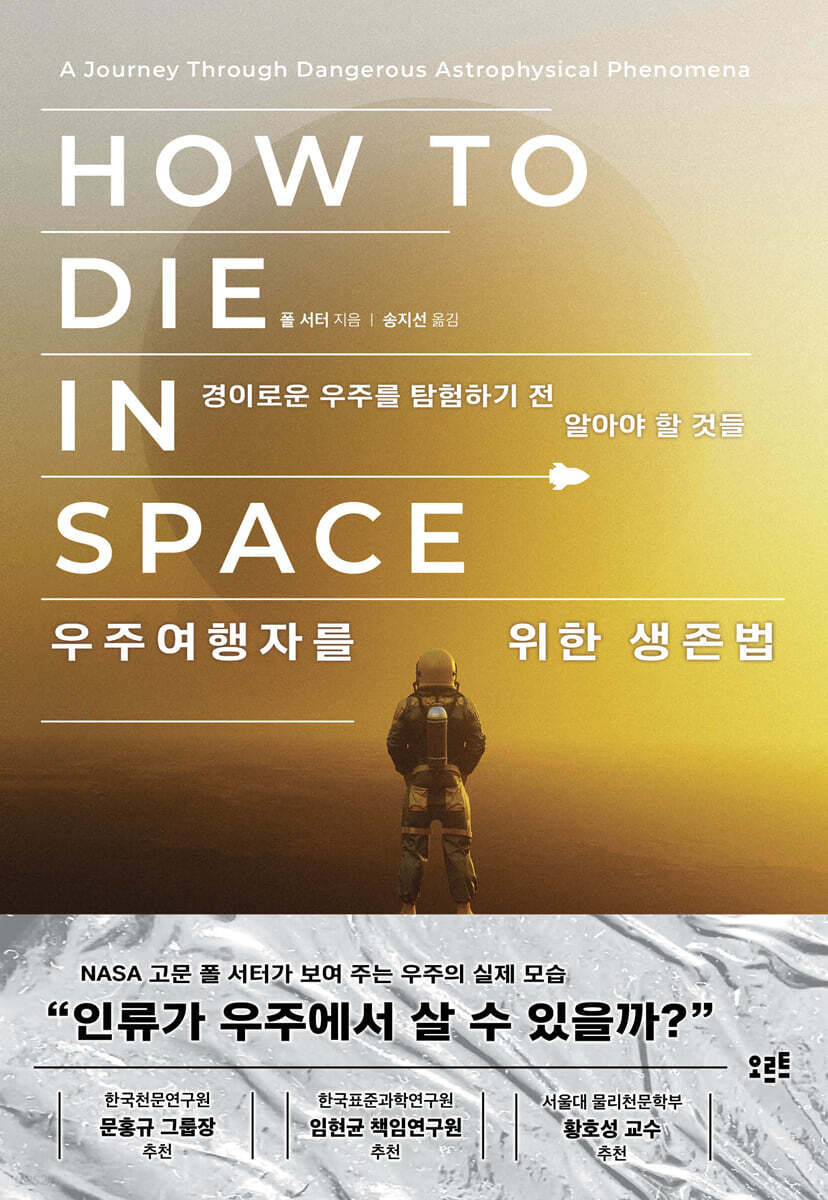
Survival Guide for Space Travelers
 |
Description
Book Introduction
- A word from MD
-
Space travel from the corner of your roomYou don't have to be as rich as Elon Musk to start space travel right now.
This one book is enough.
This book, about virtual space travel, was written and translated by an astronomer.
Could anything about Earth and the universe be this entertaining and accurate? A masterpiece that rivals Carl Sagan's "Cosmos."
April 22, 2025. Natural Science PD Son Min-gyu
In this dangerous universe, are you ready to survive?
NASA Advisor Shows What Space Really Looks Like
Space is a rough place.
In the vacuum of space, our bodies would expand to twice their size, and cosmic rays would cause serious problems in an instant.
Not only are there threats from black holes and quasars, but what if you get hit by a micrometeorite moving at 30,000 kilometers per hour?
How will we survive all these threats? Can humanity even survive in space? In this book, astrophysicist Paul Sutter, a NASA consultant, presents the true picture of space and scientifically and humorously explains everything humanity has learned to survive the threats of space.
This is a book that readers who yearn for space should keep by their side and use as a guide.
NASA Advisor Shows What Space Really Looks Like
Space is a rough place.
In the vacuum of space, our bodies would expand to twice their size, and cosmic rays would cause serious problems in an instant.
Not only are there threats from black holes and quasars, but what if you get hit by a micrometeorite moving at 30,000 kilometers per hour?
How will we survive all these threats? Can humanity even survive in space? In this book, astrophysicist Paul Sutter, a NASA consultant, presents the true picture of space and scientifically and humorously explains everything humanity has learned to survive the threats of space.
This is a book that readers who yearn for space should keep by their side and use as a guide.
- You can preview some of the book's contents.
Preview
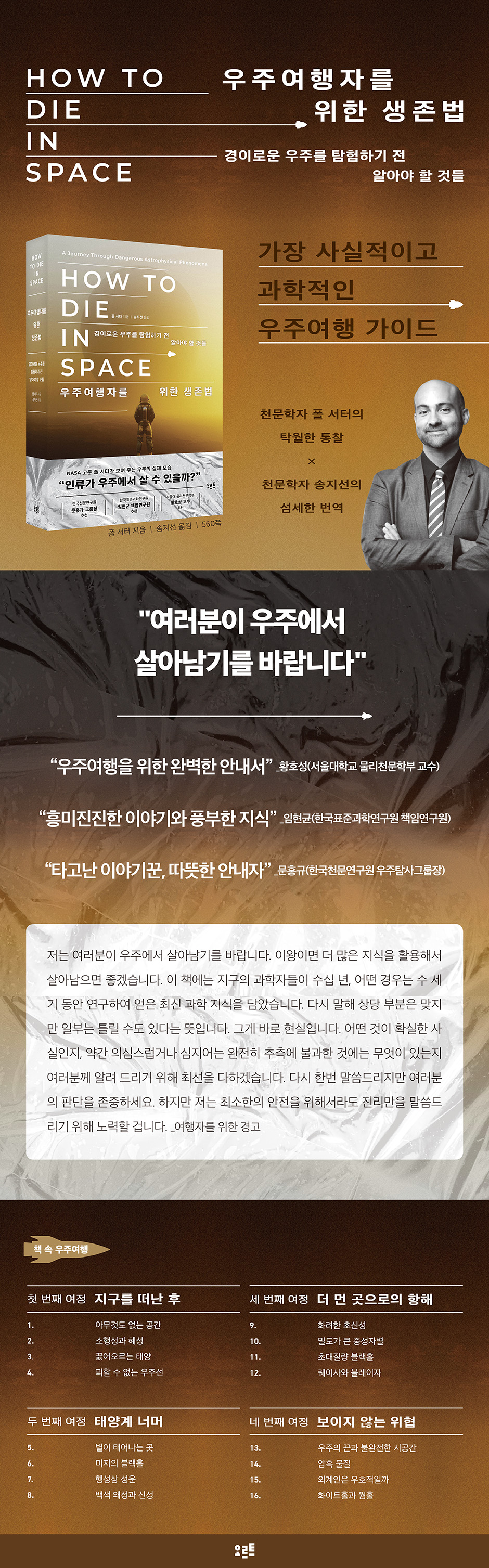
index
To our Korean readers: Let's share our dreams together.
Getting Started: A Warning for Travelers
[First Journey: After Leaving Earth]
1.
A space with nothing
2.
Asteroids and comets
3.
boiling sun
4.
Inescapable spaceship
[Second Journey: Beyond the Solar System]
5.
Where stars are born
6.
unknown black hole
7.
planetary nebula
8.
White dwarfs and novae
[Third Journey: A Voyage Further Away]
9.
A brilliant supernova
10.
Neutron stars and magnetars
11.
supermassive black hole
12.
Quasars and blazars
[Fourth Journey: The Invisible Threat]
13.
Cosmic strings and imperfect spacetime
14.
dark matter
15.
Are aliens friendly?
16.
White holes and wormholes
In closing: A final warning
Translator's Note: Let your imagination run wild.
annotation
Getting Started: A Warning for Travelers
[First Journey: After Leaving Earth]
1.
A space with nothing
2.
Asteroids and comets
3.
boiling sun
4.
Inescapable spaceship
[Second Journey: Beyond the Solar System]
5.
Where stars are born
6.
unknown black hole
7.
planetary nebula
8.
White dwarfs and novae
[Third Journey: A Voyage Further Away]
9.
A brilliant supernova
10.
Neutron stars and magnetars
11.
supermassive black hole
12.
Quasars and blazars
[Fourth Journey: The Invisible Threat]
13.
Cosmic strings and imperfect spacetime
14.
dark matter
15.
Are aliens friendly?
16.
White holes and wormholes
In closing: A final warning
Translator's Note: Let your imagination run wild.
annotation
Detailed image
Into the book
I hope you survive in space.
If possible, I would like to survive by utilizing more knowledge.
This book contains the latest scientific knowledge gained by Earth's scientists over decades, and in some cases centuries, of research.
In other words, a lot of it is true, but some of it may be wrong.
That's the reality.
I'll do my best to let you know what's definitely true, what's a little questionable, or even just pure speculation.
Again, I want to say this: please respect your judgment.
But I will try to tell you only the truth, at least for the sake of safety.
--- From "Warnings for Travelers"
Let me just say one thing.
Please don't do that.
The air in your lungs is at the familiar and comfortable atmospheric pressure of 1 atmosphere.
But the muscles and sticky tissues inside your throat aren't built to maintain one atmosphere of atmospheric pressure in a vacuum.
No matter how hard you try to hold your breath, the air in your lungs will find its way out, and when it does, it will do so quickly and violently, spreading out into a vacuum and damaging (perhaps permanently) your throat and (perhaps permanently) the more delicate tissues in your lungs, the alveoli, which carry oxygen to the bloodstream, which is now sparse.
--- From "Space of Nothing"
To understand how powerful a punch this thing can pack, remember that its energy is concentrated in a very small mass.
That energy is a combination of speed and magnitude.
Getting hit in the face by a fastball probably wouldn't be a good thing, right? If the ball were a little smaller, you'd have to throw it faster to maintain the same total energy.
Like a bullet, you know.
Who likes getting hit in the face with a bullet?
Now make it smaller than a bullet so it moves faster.
Smaller and smaller, so faster and smaller.
If we keep making it smaller and smaller until it becomes as small as a fundamental particle, it will accelerate to almost the speed of light.
--- From "The Inevitable Spaceship"
The surface where the escape velocity is exactly equal to the speed of light is called the event horizon.
The reason the word horizon is included in the name is because horizon represents an edge, a boundary.
When you stand on a planet, the limit of what you can see from its surface is the horizon.
Beyond that, a completely new world will unfold.
Therefore, the horizon of a black hole is also the point of entry into a new, unknown world, a world that is potentially unknowable.
Why the word "incident"? Well, it's probably because that's where interesting things happen.
I'm talking about an event like a party.
It's a party, but it's also a place where you can die.
--- From "Unknown Black Hole"
There is a word that can be used as an analogy to everyday life.
It is the 'unbind' state.
We are bound.
Because the atoms and molecules that make up our bodies are bound together by various forces.
With enough energy, like a grenade, you can rip apart the molecules in your body and send them flying in all directions.
You will no longer be bound.
You will also die.
This process does not occur often because it requires a lot of energy and is generally considered very strenuous.
It takes a tremendous amount of energy to keep a white dwarf from being bound.
White dwarfs have enough mass to form stars, but that mass is compressed into something about the size of a rocky planet.
--- From "The Brilliant Supernova"
In 1977, the Big Ear radio telescope outside Columbus, Ohio, recorded an exceptionally strong signal that lasted 72 seconds.
These waves were 30 times stronger than the cosmic background radio waves.
It also occurred at a very unusual frequency, the frequency that neutral hydrogen naturally emits.
Was it a coincidence? Jerry R., who was in charge of observation that night,
Eamon was so impressed that he wrote “Wow!” on the printout.
So the name recorded in the history books is the Wow! signal.
What could this signal have been? I have no idea.
Since that lonely night in 1977, this signal has not been heard again in radio observations, even with larger and more extensive methods.
If they were aliens, they would have said "Goodbye" just once before their civilization was forever ended and then disappeared.
--- From "Are Aliens Friendly?"
Again, we're faced with another physicist who enjoys ruining this delusional party we're having, by misleading us into believing that the mathematics of general relativity might actually exist, leading us astray.
Just because Einstein said so doesn't mean it will happen.
It is one of the hottest questions in physics today (and since physics existed).
Time travel to the past seems to be forbidden (there is no evidence that it is actually possible), but it is unclear why it is forbidden.
Perhaps the ultimate answer lies hidden behind the arcane mathematics of wormholes.
--- From "White Holes and Wormholes"
It has already been made abundantly, and painfully clear, that space is a dangerous place.
But it's also beautiful.
It is certainly a very sublime, unusual, wondrous and thought-provoking place.
A canvas painted in the brilliant colors of matter and energy.
Physics is the brush on that canvas.
For centuries the universe has been waiting for us.
When you peel back a layer of mystery, a new mystery is revealed.
The universe is waiting for us to travel.
Can't you hear the sounds of space? We're stuck on this planet, so what we can learn is limited, so we must go into space.
You have to put your hands in new soil and see new light.
To learn, understand and feel.
If possible, I would like to survive by utilizing more knowledge.
This book contains the latest scientific knowledge gained by Earth's scientists over decades, and in some cases centuries, of research.
In other words, a lot of it is true, but some of it may be wrong.
That's the reality.
I'll do my best to let you know what's definitely true, what's a little questionable, or even just pure speculation.
Again, I want to say this: please respect your judgment.
But I will try to tell you only the truth, at least for the sake of safety.
--- From "Warnings for Travelers"
Let me just say one thing.
Please don't do that.
The air in your lungs is at the familiar and comfortable atmospheric pressure of 1 atmosphere.
But the muscles and sticky tissues inside your throat aren't built to maintain one atmosphere of atmospheric pressure in a vacuum.
No matter how hard you try to hold your breath, the air in your lungs will find its way out, and when it does, it will do so quickly and violently, spreading out into a vacuum and damaging (perhaps permanently) your throat and (perhaps permanently) the more delicate tissues in your lungs, the alveoli, which carry oxygen to the bloodstream, which is now sparse.
--- From "Space of Nothing"
To understand how powerful a punch this thing can pack, remember that its energy is concentrated in a very small mass.
That energy is a combination of speed and magnitude.
Getting hit in the face by a fastball probably wouldn't be a good thing, right? If the ball were a little smaller, you'd have to throw it faster to maintain the same total energy.
Like a bullet, you know.
Who likes getting hit in the face with a bullet?
Now make it smaller than a bullet so it moves faster.
Smaller and smaller, so faster and smaller.
If we keep making it smaller and smaller until it becomes as small as a fundamental particle, it will accelerate to almost the speed of light.
--- From "The Inevitable Spaceship"
The surface where the escape velocity is exactly equal to the speed of light is called the event horizon.
The reason the word horizon is included in the name is because horizon represents an edge, a boundary.
When you stand on a planet, the limit of what you can see from its surface is the horizon.
Beyond that, a completely new world will unfold.
Therefore, the horizon of a black hole is also the point of entry into a new, unknown world, a world that is potentially unknowable.
Why the word "incident"? Well, it's probably because that's where interesting things happen.
I'm talking about an event like a party.
It's a party, but it's also a place where you can die.
--- From "Unknown Black Hole"
There is a word that can be used as an analogy to everyday life.
It is the 'unbind' state.
We are bound.
Because the atoms and molecules that make up our bodies are bound together by various forces.
With enough energy, like a grenade, you can rip apart the molecules in your body and send them flying in all directions.
You will no longer be bound.
You will also die.
This process does not occur often because it requires a lot of energy and is generally considered very strenuous.
It takes a tremendous amount of energy to keep a white dwarf from being bound.
White dwarfs have enough mass to form stars, but that mass is compressed into something about the size of a rocky planet.
--- From "The Brilliant Supernova"
In 1977, the Big Ear radio telescope outside Columbus, Ohio, recorded an exceptionally strong signal that lasted 72 seconds.
These waves were 30 times stronger than the cosmic background radio waves.
It also occurred at a very unusual frequency, the frequency that neutral hydrogen naturally emits.
Was it a coincidence? Jerry R., who was in charge of observation that night,
Eamon was so impressed that he wrote “Wow!” on the printout.
So the name recorded in the history books is the Wow! signal.
What could this signal have been? I have no idea.
Since that lonely night in 1977, this signal has not been heard again in radio observations, even with larger and more extensive methods.
If they were aliens, they would have said "Goodbye" just once before their civilization was forever ended and then disappeared.
--- From "Are Aliens Friendly?"
Again, we're faced with another physicist who enjoys ruining this delusional party we're having, by misleading us into believing that the mathematics of general relativity might actually exist, leading us astray.
Just because Einstein said so doesn't mean it will happen.
It is one of the hottest questions in physics today (and since physics existed).
Time travel to the past seems to be forbidden (there is no evidence that it is actually possible), but it is unclear why it is forbidden.
Perhaps the ultimate answer lies hidden behind the arcane mathematics of wormholes.
--- From "White Holes and Wormholes"
It has already been made abundantly, and painfully clear, that space is a dangerous place.
But it's also beautiful.
It is certainly a very sublime, unusual, wondrous and thought-provoking place.
A canvas painted in the brilliant colors of matter and energy.
Physics is the brush on that canvas.
For centuries the universe has been waiting for us.
When you peel back a layer of mystery, a new mystery is revealed.
The universe is waiting for us to travel.
Can't you hear the sounds of space? We're stuck on this planet, so what we can learn is limited, so we must go into space.
You have to put your hands in new soil and see new light.
To learn, understand and feel.
--- From "The Last Warning"
Publisher's Review
What threats will we face in space?
And are we ready to go out into space and face those threats?
It's truly the age of space. NASA is working on the Artemis program to return humans to the Moon, and SpaceX is pursuing a human colony on Mars.
China already operates its own space station, Japan has successfully landed on the moon, and India is pursuing manned spaceflight.
Space exploration is actively being pursued not only at the government level but also in the private sector, and commercial spaceflight programs have made space travel possible for ordinary people if they so desire.
But how much do we really know about space? Perhaps we only harbor vague longings, like romantic gazes at the night sky. Space is dangerous.
There are countless threats in space, from the vacuum of space and cosmic radiation we face the moment we leave Earth's embrace, to the risk of collisions with meteorites large and small, to supernovae, black holes, neutron stars, and dark matter.
Can we avoid these threats? Can we overcome the difficulties and colonize Mars?
A book containing all the knowledge mankind has ever discovered about survival in space!
Unraveled with the astronomer's outstanding insight and the astronomer's delicate translation
The most realistic and scientific face of the universe
Paul Sutter, an astrophysicist who works as an advisor to NASA, says space is a "dangerous place."
And the knowledge you need to know to survive in that dangerous space is included in this book, How to Die in Space.
This book begins with the scientific meaning of the "vacuum" we will encounter when we leave Earth, and contains the knowledge we need to know to survive as we travel beyond our solar system, beyond our galaxy, and into the far reaches of space.
All the scientific knowledge that humanity has discovered so far is explained, including black holes, general relativity, and even quantum mechanics concepts involving quarks and spin.
To keep readers from getting bored, the author appropriately mixes in his unique humor and tells a story as if he were telling a story. The translator, an astronomer, delivers an accurate and detailed translation that preserves his signature "cosmic humor" while making difficult theories and concepts much easier to understand.
After reading this book, which presents the universe realistically and scientifically, your illusion of a "beautiful universe" may be shattered.
Because space is a dangerous place that you cannot travel to without preparation.
However, if you follow the author's story, which is based on solid evidence and theory, you will come to realize just how wondrous, magnificent, and breathtakingly beautiful the universe is.
And are we ready to go out into space and face those threats?
It's truly the age of space. NASA is working on the Artemis program to return humans to the Moon, and SpaceX is pursuing a human colony on Mars.
China already operates its own space station, Japan has successfully landed on the moon, and India is pursuing manned spaceflight.
Space exploration is actively being pursued not only at the government level but also in the private sector, and commercial spaceflight programs have made space travel possible for ordinary people if they so desire.
But how much do we really know about space? Perhaps we only harbor vague longings, like romantic gazes at the night sky. Space is dangerous.
There are countless threats in space, from the vacuum of space and cosmic radiation we face the moment we leave Earth's embrace, to the risk of collisions with meteorites large and small, to supernovae, black holes, neutron stars, and dark matter.
Can we avoid these threats? Can we overcome the difficulties and colonize Mars?
A book containing all the knowledge mankind has ever discovered about survival in space!
Unraveled with the astronomer's outstanding insight and the astronomer's delicate translation
The most realistic and scientific face of the universe
Paul Sutter, an astrophysicist who works as an advisor to NASA, says space is a "dangerous place."
And the knowledge you need to know to survive in that dangerous space is included in this book, How to Die in Space.
This book begins with the scientific meaning of the "vacuum" we will encounter when we leave Earth, and contains the knowledge we need to know to survive as we travel beyond our solar system, beyond our galaxy, and into the far reaches of space.
All the scientific knowledge that humanity has discovered so far is explained, including black holes, general relativity, and even quantum mechanics concepts involving quarks and spin.
To keep readers from getting bored, the author appropriately mixes in his unique humor and tells a story as if he were telling a story. The translator, an astronomer, delivers an accurate and detailed translation that preserves his signature "cosmic humor" while making difficult theories and concepts much easier to understand.
After reading this book, which presents the universe realistically and scientifically, your illusion of a "beautiful universe" may be shattered.
Because space is a dangerous place that you cannot travel to without preparation.
However, if you follow the author's story, which is based on solid evidence and theory, you will come to realize just how wondrous, magnificent, and breathtakingly beautiful the universe is.
GOODS SPECIFICS
- Date of issue: April 10, 2025
- Page count, weight, size: 560 pages | 869g | 145*2,110*35mm
- ISBN13: 9791197680458
- ISBN10: 1197680454
You may also like
카테고리
korean


korean

![GQ KOREA Mark (Monthly): December [2025]](http://librairie.coreenne.fr/cdn/shop/files/8ef265dbbfbf186523ed75ba7319009d.jpg?v=1765340328&width=3840)


