

The days we forgot
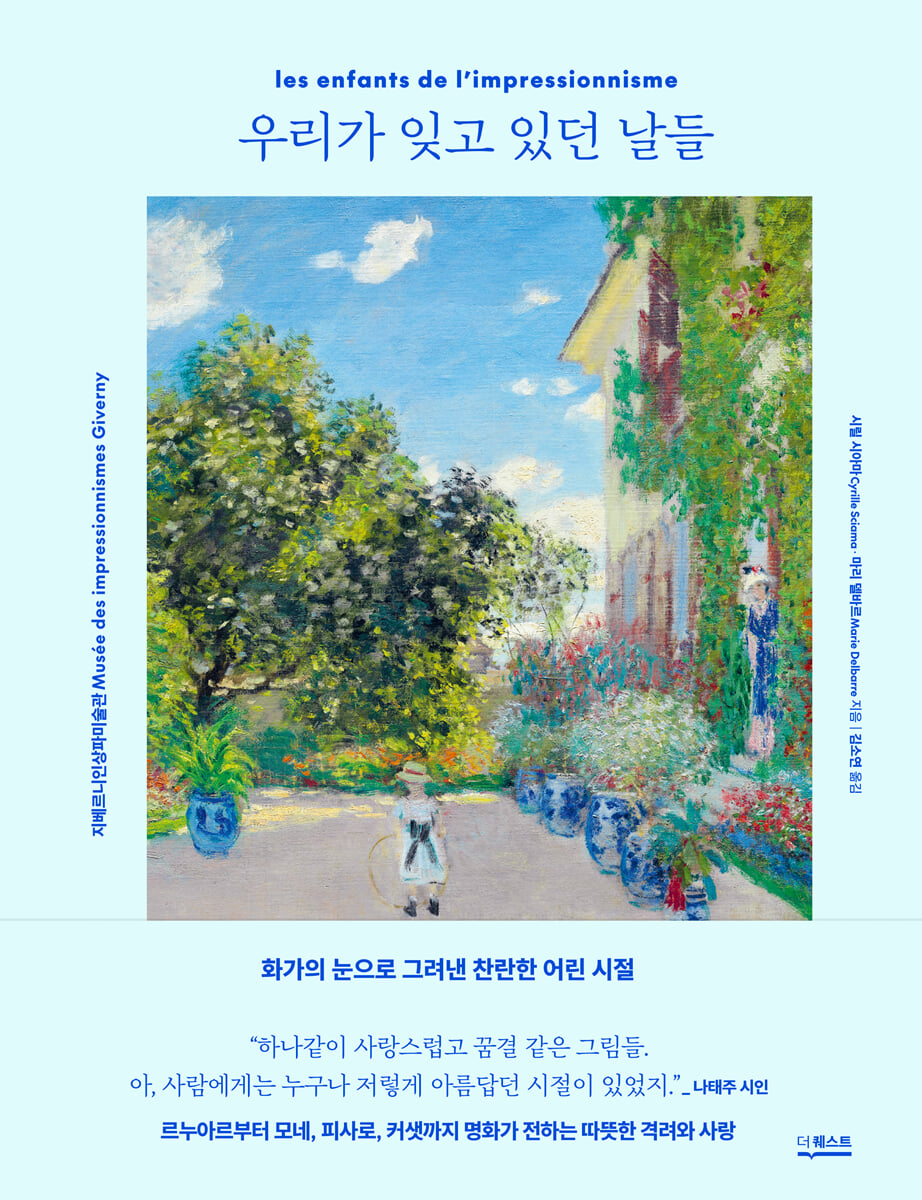 |
Description
Book Introduction
- A word from MD
-
Warmth and love depicted by painters of lightChildren and childhood scenes depicted with soft brushstrokes and warm colors by Impressionist painters such as Renoir, Monet, Pissarro, and Cassatt.
The delicate paintings bring back memories of childhood and the love I received then.
150 high-quality illustrations, carefully selected by the Giverny Impressionist Museum, offer a special pictorial stroll for art-loving readers.
April 22, 2025. Art PD Ahn Hyun-jae
Renoir, Monet, Pissarro, Cassatt…
The warmth and love of childhood depicted by the 'painters of light'
* Highly recommended by poet Na Tae-ju and art essayist Lee So-young!
* 150 masterpieces carefully selected by the Giverny Museum of Fine Arts in France
* Includes letters, family photos, and unpublished essays from Impressionist painters you meet for the first time.
* High-quality illustrations and expert commentary, as if brought straight from an art gallery
Koreans' favorite Impressionist masters capture their shining childhood moments! 150 masterpieces hand-picked from the Musée des Impressionnismes Giverny, France, the birthplace of Impressionism, rekindle childhood memories. "Days We Forgot" was published.
This book, a poem combining high-quality illustrations with in-depth commentary by expert curators, will be the perfect gift for those of us who need warmth in life.
- You can preview some of the book's contents.
Preview
index
Introduction: The warmth of childhood remembered through pictures
Part 1.
A longed-for haven, the embrace of family
Pierre-Auguste Renoir, Gabriel and Jean
Camille Pissarro, "Woman Doing Laundry"
Part 2.
Children loved by the artist
The world of children that Renoir encountered
Pierre-Auguste Renoir, "Painting Scene"
Claude Monet, Interior Scene
_Monet, the meaning of family
Paul Gauguin, Interior with Aline Gauguin
Part 3.
Let's play together tomorrow too
_What should I play with?
_Bert Morisot, Child with a Doll or Interior of a Country House
André Brouillet, The Girl in Red
Part 4.
Moments of learning
_A mind that grows through reading and writing
_Etienne Moronellaton, "The Young Art Lover"
Camille Pissarro, 'The Ideal and Wonderful Father'
Part 5.
Joy of the Midday
_Animal Friends and Children's Secret Garden
Claude Monet, The Painter's House at Argenteuil
Part 6.
The feeling of taking out new clothes
_Boys in princess dresses and girls in men's suits
Daniel de Monpre, Portrait of the Painter's Daughter or a Spanish Princess
Part 7.
The long-awaited summer vacation
_Playing on the beach
Part 8.
To a wider world
_Adolescence, a time to dream of the future
Henry Scott Tuke, Portrait of Jack Rowling
Julie Manet, the girl loved by the Impressionist painters
Attachment
_The biographies of some painters
_List of exhibited works
_Some references
_Search
Detailed image

Into the book
Is there anything more beautiful in this world than the children lovingly depicted by Claude Monet, Pierre-Auguste Renoir, and Berthe Morisot? This near-perfect harmony of art and life, interwoven with poppies, seesaws, music lessons, and butterfly chases, is woven into our collective memories.
--- p.35
“My father Renoir’s life was completely changed when my older brother Pierre was born.
“All theories lose their power before the sight of a newborn baby’s tiny thighs moving back and forth.”_ Jean Renoir, “Renoir,” 1982 (omitted) The reason children were so important in Renoir’s life and work may have been because, unlike the world of adults, the world of children has “the impression of nature, full of uncertainties yet possessing a strong harmony.”
--- p.81
As you know, mealtimes were one of the most important moments in Monet's life.
It was a time to stop what I was doing, take a break, and have fun and be happy when I could see my whole family together.
--- p.99
“The children are very happy.
I am very grateful to Madame Mirbeau for sending me such a lovely toy.
The kids are really happy.
“I hope this happiness will continue for the rest of my life.” _ Letter from Camille Pissarro to Mirbeau (December 29, 1892)
--- p.105
“Renoir opposed all attempts to educate children.
He wanted children to make their first contacts with the world on their own.
(…) I just thought that the objects and colors around children should always be beautiful.”
--- p.136
“Every time I bought a hat, I worried whether Renoir would like it.” —Julie Manet’s diary (January 8, 1898)
--- p.189
However, Cassatt detested the artificial and unnatural poses found in academic paintings.
She really wanted to portray a childlike appearance.
(Omitted) Morisot broke with the conventional wisdom of her time and abandoned the “sacred duty of motherhood” that women were expected to endure, and focused on her life as a painter.
She participated in all the Impressionist exhibitions except for the one in 1878, the year Julie was born, and supported them financially.
--- p.198
Regarding her son, Ludovic-Rodolph, who had just started living on his own in London at the age of 19, Camille, who was in Rouen, wrote to her eldest son, Lucien, in a letter dated August 12, 1898:
“If you stop your child from doing something bad, he will secretly do something worse.
At a young age, there's no stopping you from going where your passion leads you.
(…) So what advice should I give? The only thing that comes to mind is to have good judgment and a healthy dose of distrust.
“I just keep waiting for news from Rodolphe,” he said, adding that this was the reason he had been able to avoid the wrong path when he was younger.
“I had a strong driving force that led me to my current life.
It was art!”
--- p.245
In Renoir's portrait, Julie Manet boasts porcelain-colored skin and the exuberant energy of a child who grew up surrounded by happiness and love.
Warm childhood memories gave the girl the strength to move forward confidently into the future as an adult.
--- p.258
Publisher's Review
“When was your happiest moment?”
To us who are navigating the adult world
A warm greeting from a painting
Friends playing together in the garden, precious toys, sunny scenery, afternoon dinner table with family, beach where we went to play during summer vacation… … .
Impressionist paintings with their beautiful colors bring back fond memories that are cherished in a corner of our hearts.
Let's relive the love and joy of everyday life that we once enjoyed through the children and childhood scenes captured with soft brushstrokes and warm colors by masters such as Renoir, Monet, Pissarro, Mary Cassatt, and Berthe Morisot.
Childhood, resurrected through art, will continue to serve as a pillar of support for us as we move forward into the future, having now left the world of childhood.
Affectionate gaze, endless encouragement
From letters exchanged between painters and their families, friends, and neighbors,
Even the hidden backstories of the children in the picture
The book contains not only paintings, but also letters exchanged between the artists and their family, friends, and neighbors.
Sometimes I shower my child with encouragement for every step he takes, and other times I worry about his spelling skills.
In any case, the artist never loses his warm gaze toward the child.
The everyday moments and affectionate sentences of the artists, which can only be encountered through "Days We Forgot," double the emotion of the paintings and take us back to our childhood.
“Every morning, Georges leaves home at 7:30 and bravely walks the three kilometers alone to school.”
- A letter from Camille Pissarro to his eldest son
“Daughter, you have never been a source of sorrow to me for even a moment.”
- A letter left by Berthe Morisot to her only daughter
“I’m glad that flowers are blooming in the garden.
“When I get back, I have to garden with the kids.”
- Claude Monet, letter to his wife
“My father Renoir’s life changed when my older brother Pierre was born.”
- Records of Renoir's second son, Jean
A small art museum in a book,
And pieces of happiness to cherish forever
150 high-quality illustrations, carefully selected from the Giverny Impressionist Museum in France, provide a vivid sense of the museum as if it were moved into a book.
Additionally, the book includes a wide range of materials, including family photos of the artist, a wealth of commentary by a professional curator, and an unpublished essay by Camille Pissarro's great-grandson, allowing for a deeper understanding of the hidden stories and historical background of the work.
Readers who love art will enjoy a very special pictorial walk through this book.
GOODS SPECIFICS
- Date of issue: May 5, 2025
- Format: Hardcover book binding method guide
- Page count, weight, size: 304 pages | 1,066g | 188*249*25mm
- ISBN13: 9791140712885
- ISBN10: 1140712888
You may also like
카테고리
korean


korean


