

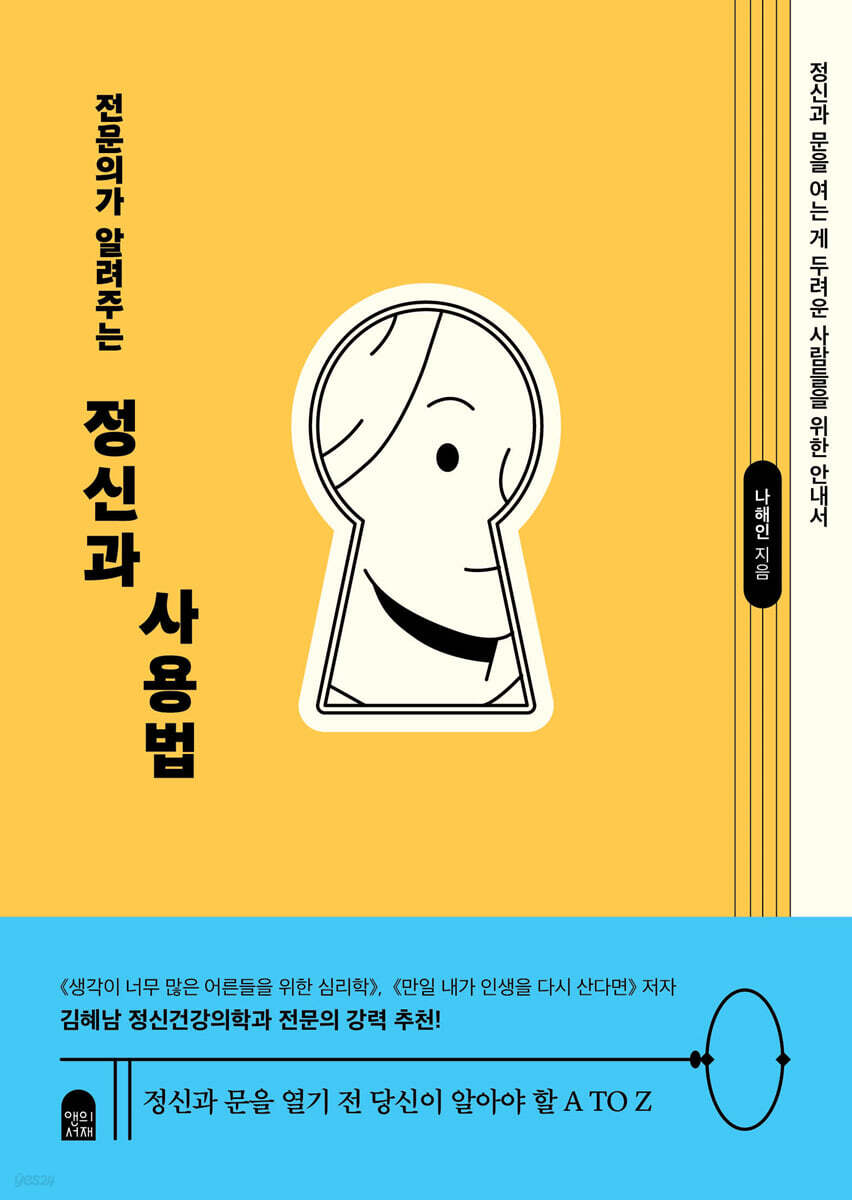
How to Use Psychiatry as Explained by a Specialist
 |
Description
Book Introduction
- A word from MD
-
A must-read for modern mental healthIn 2022, the Health Insurance Review & Assessment Service announced that the number of patients receiving treatment for depression exceeded 1 million.
Many people seek out hospitals for mental health, but there are still prejudices and misconceptions about psychiatry.
This book corrects such misunderstandings and provides helpful information on situations in which you should go to the hospital and how to choose a doctor and hospital.
January 3, 2025. Humanities PD Son Min-gyu
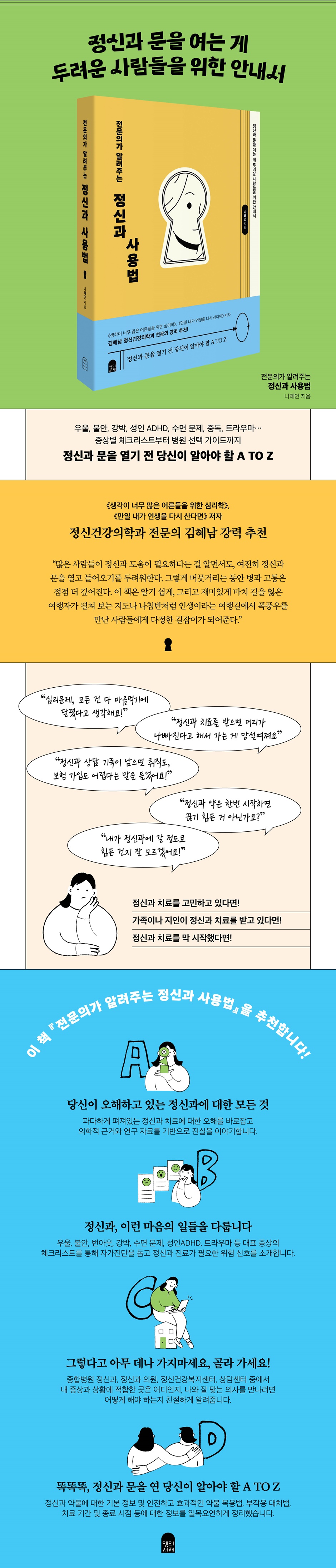
A Guide for Those Afraid to Open the Door to a Psychiatrist
From symptom checklists for depression, anxiety, obsessive-compulsive disorder, adult ADHD, and trauma to hospital selection guides.
Everything you need to know about psychiatry!
Author of "Psychology for Adults Who Think Too Much" and "If I Had My Life to Live Over"
★ Highly recommended by psychiatrist Dr. Hye-Nam Kim ★
Endless, infinite competition, a performance-driven society where we must prove ourselves with results at every moment, and ever-increasing individualism and the nuclear family… Psychiatric symptoms like anxiety, depression, obsessive-compulsive disorder, and trauma have become all too commonplace in modern life, where stress is rampant.
The problem is that while people try to dismiss their symptoms as 'not serious enough to warrant a hospital visit', their illness and pain are deepening.
There are countless people who reluctantly seek out psychiatrists only after their long-standing symptoms worsen to the point where they are interfering with their health, interpersonal relationships, and work life.
One of the main reasons for the growing problem is that 'many people are still afraid to open the door to a psychiatrist.'
The author, a psychiatrist who meets patients in the field, explains in this book in an easy-to-understand manner, using neuroscientific evidence, that the psychiatric symptoms we commonly experience are not simply a matter of 'weak will' or 'a matter of determination', but rather 'diseases requiring treatment' caused by a complex interaction of various causes.
For those who know they need help but still wander around the psychiatric clinic with vague fear, we correct the widespread misconceptions about psychiatry and provide information on various psychiatric symptoms, checklists, hospital selection guides, and treatment processes, helping them objectively reflect on their current situation and more comfortably cross the threshold of a psychiatric clinic.
If you're afraid to open the door to a psychiatrist even though you know the difficulties you have, if a family member or close acquaintance is suffering from psychiatric symptoms, or if you've started psychiatric treatment but still can't focus on treatment due to lingering anxiety, this book will be a ray of light for each cautious step you take in the darkness!
From symptom checklists for depression, anxiety, obsessive-compulsive disorder, adult ADHD, and trauma to hospital selection guides.
Everything you need to know about psychiatry!
Author of "Psychology for Adults Who Think Too Much" and "If I Had My Life to Live Over"
★ Highly recommended by psychiatrist Dr. Hye-Nam Kim ★
Endless, infinite competition, a performance-driven society where we must prove ourselves with results at every moment, and ever-increasing individualism and the nuclear family… Psychiatric symptoms like anxiety, depression, obsessive-compulsive disorder, and trauma have become all too commonplace in modern life, where stress is rampant.
The problem is that while people try to dismiss their symptoms as 'not serious enough to warrant a hospital visit', their illness and pain are deepening.
There are countless people who reluctantly seek out psychiatrists only after their long-standing symptoms worsen to the point where they are interfering with their health, interpersonal relationships, and work life.
One of the main reasons for the growing problem is that 'many people are still afraid to open the door to a psychiatrist.'
The author, a psychiatrist who meets patients in the field, explains in this book in an easy-to-understand manner, using neuroscientific evidence, that the psychiatric symptoms we commonly experience are not simply a matter of 'weak will' or 'a matter of determination', but rather 'diseases requiring treatment' caused by a complex interaction of various causes.
For those who know they need help but still wander around the psychiatric clinic with vague fear, we correct the widespread misconceptions about psychiatry and provide information on various psychiatric symptoms, checklists, hospital selection guides, and treatment processes, helping them objectively reflect on their current situation and more comfortably cross the threshold of a psychiatric clinic.
If you're afraid to open the door to a psychiatrist even though you know the difficulties you have, if a family member or close acquaintance is suffering from psychiatric symptoms, or if you've started psychiatric treatment but still can't focus on treatment due to lingering anxiety, this book will be a ray of light for each cautious step you take in the darkness!
- You can preview some of the book's contents.
Preview
index
prolog
PART A.
Everything You're Misunderstanding About Psychiatry
1.
Is psychiatry only for people with serious problems?
Psychiatry, a place where I can focus solely on myself
2.
It all depends on your mindset?
3.
Does psychiatric treatment make you stupid?
What happens if you don't get treatment in time
4.
Do other people also have this much of a hard time living?
How to make difficult situations a little less difficult
5.
If you have a psychiatric consultation record, it will be difficult to get a job or get insurance?
Could my medical records be leaked? / Is it hard to get a job? / Is it hard to get insurance?
6 Is it difficult to quit psychiatric medication once you start?
People around me tell me not to go to a psychiatrist or take medication.
PART B.
Psychiatry deals with these matters of the mind.
1.
melancholy
Am I Depressed? / Why Do We Get Depressed? / How to Get Out of Depression / Depression Self-Diagnosis Checklist
2.
unrest
Do I Have Anxiety Disorder? / Why Do We Get Anxious? / Overcoming Anxiety / Anxiety Self-Diagnosis Checklist
3.
Burnout
Am I Burning Out? / Why Do We Get Burned Out? / How to Get Out of Burnout / Burnout Self-Diagnosis Checklist
4.
adult ADHD
Do I Have Adult ADHD? / Why Does Adult ADHD Occur? / How to Get Rid of Adult ADHD / Adult ADHD Self-Diagnosis Checklist
5.
compulsion
Am I Obsessed? / Why Do We Fall Into Obsessions? / Breaking Free from Obsessions / Obsessive Compulsive Self-Diagnosis Checklist
6.
sleep problems
Do I Have Sleep Problems? / Why Does Insomnia Occur? / How to Overcome Insomnia / Insomnia Self-Diagnosis Checklist
7.
poisoning
Am I Addicted? / Why Do We Get Addicted? / Breaking Free from Addiction / Addiction Self-Diagnosis Checklist
8.
Trauma: A wound etched in the heart
Do I Have Trauma? / Why Trauma Occurs / How to Escape Trauma / Trauma Self-Assessment Checklist
PART C.
But don't just go anywhere, choose your own!
1.
General hospital psychiatry department, psychiatric clinic, mental health welfare center, counseling center… Where should I go?
General Hospital Psychiatry Department / Psychiatric Clinic / Mental Health Welfare Center / Counseling Center / Choose the institution that's right for you
2.
How to Find the Right Doctor for You Part 1 - What to Avoid
Don't go to a university hospital from the beginning / Don't read too much into the title / Don't dig too deep into the doctor's information
3.
How to Find the Right Doctor for You Part 2 - What to Watch for
Let's give ourselves enough time and effort for the treatment. Above all, let's be honest. If we try and it doesn't work out, let's find a new doctor.
4.
What happens on your first visit
Reception and waiting / Initial psychological examination / Counseling / Medication prescription and reservation
5.
Psychological testing, is it really necessary?
6.
First visit, what should I say and how?
When words are difficult, let's write them down / The clinic, a place where any story is allowed
7.
When do I need to be hospitalized?
PART D.
Knock knock, what you need to know about opening a psychiatric clinic
1.
Should I take the medicine even if there are side effects?
2.
Antidepressants, anti-anxiety medications… Take them wisely to ensure they work.
Antidepressants / anti-anxiety medications / sleeping pills / mood stabilizers / ADHD medications / anti-craving medications
3.
Safe and Effective Drug Instructions
Do I have to stick to the time I take my medication? / Can I drink alcohol while taking it? / Can I take other medications or herbal medicines at the same time?
4.
If you are not sure whether treatment has helped you get better
The mind gets better and worse through repetition / It is more important to go slowly and safely
5.
How long will I need to receive psychiatric treatment?
Maintenance therapy builds emotional resilience / The end of treatment is always an "open ending."
6.
Are there any other treatment options besides medication?
Psychotherapy / Cognitive Behavioral Therapy / Dialectical Behavioral Therapy / Machine-Based Therapy
7.
How to involve caregivers or friends in the treatment process
Support and listen / Objectively observe and communicate the client's condition / Be patient and supportive / Study to understand / Manage the caregiver's own mental health
8.
Things that are good to do together other than treatment
Meditation / Deep breathing / Progressive muscle relaxation / Exercise / Gratitude journal
Recommended Book List
PART A.
Everything You're Misunderstanding About Psychiatry
1.
Is psychiatry only for people with serious problems?
Psychiatry, a place where I can focus solely on myself
2.
It all depends on your mindset?
3.
Does psychiatric treatment make you stupid?
What happens if you don't get treatment in time
4.
Do other people also have this much of a hard time living?
How to make difficult situations a little less difficult
5.
If you have a psychiatric consultation record, it will be difficult to get a job or get insurance?
Could my medical records be leaked? / Is it hard to get a job? / Is it hard to get insurance?
6 Is it difficult to quit psychiatric medication once you start?
People around me tell me not to go to a psychiatrist or take medication.
PART B.
Psychiatry deals with these matters of the mind.
1.
melancholy
Am I Depressed? / Why Do We Get Depressed? / How to Get Out of Depression / Depression Self-Diagnosis Checklist
2.
unrest
Do I Have Anxiety Disorder? / Why Do We Get Anxious? / Overcoming Anxiety / Anxiety Self-Diagnosis Checklist
3.
Burnout
Am I Burning Out? / Why Do We Get Burned Out? / How to Get Out of Burnout / Burnout Self-Diagnosis Checklist
4.
adult ADHD
Do I Have Adult ADHD? / Why Does Adult ADHD Occur? / How to Get Rid of Adult ADHD / Adult ADHD Self-Diagnosis Checklist
5.
compulsion
Am I Obsessed? / Why Do We Fall Into Obsessions? / Breaking Free from Obsessions / Obsessive Compulsive Self-Diagnosis Checklist
6.
sleep problems
Do I Have Sleep Problems? / Why Does Insomnia Occur? / How to Overcome Insomnia / Insomnia Self-Diagnosis Checklist
7.
poisoning
Am I Addicted? / Why Do We Get Addicted? / Breaking Free from Addiction / Addiction Self-Diagnosis Checklist
8.
Trauma: A wound etched in the heart
Do I Have Trauma? / Why Trauma Occurs / How to Escape Trauma / Trauma Self-Assessment Checklist
PART C.
But don't just go anywhere, choose your own!
1.
General hospital psychiatry department, psychiatric clinic, mental health welfare center, counseling center… Where should I go?
General Hospital Psychiatry Department / Psychiatric Clinic / Mental Health Welfare Center / Counseling Center / Choose the institution that's right for you
2.
How to Find the Right Doctor for You Part 1 - What to Avoid
Don't go to a university hospital from the beginning / Don't read too much into the title / Don't dig too deep into the doctor's information
3.
How to Find the Right Doctor for You Part 2 - What to Watch for
Let's give ourselves enough time and effort for the treatment. Above all, let's be honest. If we try and it doesn't work out, let's find a new doctor.
4.
What happens on your first visit
Reception and waiting / Initial psychological examination / Counseling / Medication prescription and reservation
5.
Psychological testing, is it really necessary?
6.
First visit, what should I say and how?
When words are difficult, let's write them down / The clinic, a place where any story is allowed
7.
When do I need to be hospitalized?
PART D.
Knock knock, what you need to know about opening a psychiatric clinic
1.
Should I take the medicine even if there are side effects?
2.
Antidepressants, anti-anxiety medications… Take them wisely to ensure they work.
Antidepressants / anti-anxiety medications / sleeping pills / mood stabilizers / ADHD medications / anti-craving medications
3.
Safe and Effective Drug Instructions
Do I have to stick to the time I take my medication? / Can I drink alcohol while taking it? / Can I take other medications or herbal medicines at the same time?
4.
If you are not sure whether treatment has helped you get better
The mind gets better and worse through repetition / It is more important to go slowly and safely
5.
How long will I need to receive psychiatric treatment?
Maintenance therapy builds emotional resilience / The end of treatment is always an "open ending."
6.
Are there any other treatment options besides medication?
Psychotherapy / Cognitive Behavioral Therapy / Dialectical Behavioral Therapy / Machine-Based Therapy
7.
How to involve caregivers or friends in the treatment process
Support and listen / Objectively observe and communicate the client's condition / Be patient and supportive / Study to understand / Manage the caregiver's own mental health
8.
Things that are good to do together other than treatment
Meditation / Deep breathing / Progressive muscle relaxation / Exercise / Gratitude journal
Recommended Book List
Detailed image
Into the book
Few people who seek psychiatric care on their own are particularly unusual.
They rarely believe in extreme conspiracy theories, engage in violent protests, or inflict horrific harm on others.
Really strange people don't come to the hospital on their own.
People who come to the hospital on their own are ordinary people we meet in our lives.
I explain that they simply have an unusually high resolution of mind.
Those with higher resolution have more sophisticated camera lenses.
While others see the world through 1 million pixels, these people see it through 10 million pixels.
It clearly captures even the smallest details that others cannot see.
As a result, there are many things that are annoying and many things to be mindful of.
What others perceive as a stinging pain feels like the skin is being torn.
--- From "Is psychiatry only for people with serious problems?"
The brain has a habit of setting a long-lasting state as the default state.
If depression persists for a long time, the brain sets depression as its default state.
When a healthy and peaceful mind is the default, when you become depressed or anxious, you find this situation uncomfortable.
But as that period gets longer, I start to get confused about what I was like originally.
And we try to default to the emotions we've felt for the longest time, namely depression and anxiety, and stay in that state.
You shouldn't let your brain get to that point.
It is very important to get treatment early and get my baseline back to a healthy state.
--- From "Does psychiatric treatment make you stupid?"
One of the most concerning factors that can cause people to hesitate to seek psychiatric treatment is medication.
People who go to other departments and ask for more medication are reluctant to take psychiatric medication.
The background is the belief that once you start taking psychiatric medication, it is difficult to stop taking it.
There is a similar belief that 'psychiatric medications are narcotic and therefore addictive and highly dependent.'
First of all, psychiatric medications are not narcotics.
This is a misunderstanding that arose because psychiatric drugs, called ‘psychotropic drugs,’ were legally classified as ‘narcotics’ and managed together with narcotics.
'Psychotropic' means working 'towards' the mind.
Of course, because it affects the mind, it should not be misused.
So the country strictly controls it along with drugs.
Drugs belonging to this narcotic category are classified into categories 'A to C' according to the level of danger, and the closer they are to 'A', the more dangerous they are.
Psychiatric drugs are generally included in 'La'.
Therefore, if you receive a prescription after sufficient consultation with a specialist, there is no problem.
--- From "Is it hard to quit psychiatric drugs once you start?"
Don't put too much meaning into a doctor's career and title.
In general, the doctor that patients want is one who treats them warmly and with interest and enthusiasm.
A brilliant career or high academic achievement does not guarantee this.
We live in an era where hospitals also need marketing.
Doctors, who are obligated to keep patient information confidential, cannot promote their treatment cases.
So, a very common way to demonstrate expertise is to:
You can prove yourself by joining various academic societies, becoming a full member, or by completing professional courses or workshops.
Of course it's a great thing.
However, not all courses require the same amount of training or effort.
Some professional courses require two full years of training, while others issue certificates in just one day.
In other words, one line of experience does not guarantee a doctor's expertise or quality of care.
Have you ever felt like your resume didn't tell the whole story when you were looking for a job? Doctors are no exception.
They rarely believe in extreme conspiracy theories, engage in violent protests, or inflict horrific harm on others.
Really strange people don't come to the hospital on their own.
People who come to the hospital on their own are ordinary people we meet in our lives.
I explain that they simply have an unusually high resolution of mind.
Those with higher resolution have more sophisticated camera lenses.
While others see the world through 1 million pixels, these people see it through 10 million pixels.
It clearly captures even the smallest details that others cannot see.
As a result, there are many things that are annoying and many things to be mindful of.
What others perceive as a stinging pain feels like the skin is being torn.
--- From "Is psychiatry only for people with serious problems?"
The brain has a habit of setting a long-lasting state as the default state.
If depression persists for a long time, the brain sets depression as its default state.
When a healthy and peaceful mind is the default, when you become depressed or anxious, you find this situation uncomfortable.
But as that period gets longer, I start to get confused about what I was like originally.
And we try to default to the emotions we've felt for the longest time, namely depression and anxiety, and stay in that state.
You shouldn't let your brain get to that point.
It is very important to get treatment early and get my baseline back to a healthy state.
--- From "Does psychiatric treatment make you stupid?"
One of the most concerning factors that can cause people to hesitate to seek psychiatric treatment is medication.
People who go to other departments and ask for more medication are reluctant to take psychiatric medication.
The background is the belief that once you start taking psychiatric medication, it is difficult to stop taking it.
There is a similar belief that 'psychiatric medications are narcotic and therefore addictive and highly dependent.'
First of all, psychiatric medications are not narcotics.
This is a misunderstanding that arose because psychiatric drugs, called ‘psychotropic drugs,’ were legally classified as ‘narcotics’ and managed together with narcotics.
'Psychotropic' means working 'towards' the mind.
Of course, because it affects the mind, it should not be misused.
So the country strictly controls it along with drugs.
Drugs belonging to this narcotic category are classified into categories 'A to C' according to the level of danger, and the closer they are to 'A', the more dangerous they are.
Psychiatric drugs are generally included in 'La'.
Therefore, if you receive a prescription after sufficient consultation with a specialist, there is no problem.
--- From "Is it hard to quit psychiatric drugs once you start?"
Don't put too much meaning into a doctor's career and title.
In general, the doctor that patients want is one who treats them warmly and with interest and enthusiasm.
A brilliant career or high academic achievement does not guarantee this.
We live in an era where hospitals also need marketing.
Doctors, who are obligated to keep patient information confidential, cannot promote their treatment cases.
So, a very common way to demonstrate expertise is to:
You can prove yourself by joining various academic societies, becoming a full member, or by completing professional courses or workshops.
Of course it's a great thing.
However, not all courses require the same amount of training or effort.
Some professional courses require two full years of training, while others issue certificates in just one day.
In other words, one line of experience does not guarantee a doctor's expertise or quality of care.
Have you ever felt like your resume didn't tell the whole story when you were looking for a job? Doctors are no exception.
--- "How to find the right doctor for you 1.
Among the things to avoid
Among the things to avoid
Publisher's Review
+ If you are considering psychiatric treatment!
+ If your family or acquaintance is receiving psychiatric treatment!
+ If you have just started psychiatric treatment!
A TO Z: What You Need to Know Before Opening a Psychiatric Clinic
When I wrote my first book in 2002, I was told that it “lowered the threshold for psychiatry.”
It was said that it made the existence of psychiatry known to people suffering from mental pain.
22 years later, I came across this book.
And I was very happy.
Many people know they need psychiatric help, but they are still afraid to open the door and step into a psychiatric clinic.
While you hesitate like that, the illness and pain deepen.
The author approaches them quietly and speaks.
Very easy to understand and fun.
This book is like a map or compass for a lost traveler, and it serves as a kind guide for those who encounter storms on the journey of life.
With this book, all life's travelers will be able to continue their long journey without losing hope.
With a more solid step.
- Dr. Kim Hye-nam, a psychiatrist (author of "Psychology for Adults Who Think Too Much" and "If I Had My Life to Live Over")
The author examines the 'biological', 'environmental', and 'psychological/cognitive' causes of common depression, anxiety, obsession, addiction, insomnia, and trauma.
This makes it clear that these symptoms are not simply a matter of will or mindset, but rather a 'disease requiring treatment' that is caused by a combination of various factors.
In particular, through clinical cases of each symptom, neuroscientific analysis, treatment process, and checklist, it helps readers directly compare their symptoms with themselves and reflect on them, thereby helping them understand and accept themselves more deeply.
We also examine widespread unsubstantiated rumors and misconceptions about psychiatric medications and treatments, based on medical evidence.
This guides patients considering treatment or receiving treatment so that they can receive treatment based on accurate information.
In addition, this book covers everything from the key information you need to know to finding the right hospital and doctor for you, to the specific steps you will face during treatment, how to take medication to enhance the treatment effect, and how to deal with side effects.
"How to Use Psychiatry as Told by a Specialist" will serve as a caring guide to readers, helping them use psychiatry wisely by providing them with the necessary information and alleviating unnecessary fears, just as the author hopes.
How to Use Psychiatry as Explained by a Specialist
A.
Everything You're Misunderstanding About Psychiatry
'Are psychiatrists only for people with serious problems?', 'It all depends on your mindset?', 'Does psychiatric treatment make you stupid?', 'If you have a psychiatric consultation record, it'll be difficult to get a job or get insurance?', 'It's hard to stop taking psychiatric medication once you start?' We'll take a look at the widespread misconceptions about psychiatric treatment and uncover the truth based on medical evidence and various research data!
B.
Psychiatry deals with these matters of the mind.
Depression, anxiety, burnout, obsessive-compulsive disorder, sleep problems, addiction, trauma… This book covers the symptoms treated in psychiatry and introduces the medical causes of these symptoms.
It provides real-world examples, analysis, treatment methods, and even a simple self-diagnosis checklist, allowing readers to compare their own situations.
Additionally, by introducing warning signs that indicate the need for psychiatric treatment for each symptom, we help patients begin treatment before it is too late!
C.
But don't just go anywhere, choose your own!
Among the many institutions—general hospital psychiatric departments, psychiatric clinics, mental health welfare centers, counseling centers—which one is best suited to your symptoms and situation? How do I find the right doctor? What preparations should I make for my first visit and consultation? The author's experience and professional knowledge, drawn from meeting clients in the field, vividly capture key information!
D.
Knock knock, what you need to know about opening a psychiatric clinic
This course provides basic information on psychiatric medications such as antidepressants, anti-anxiety medications, and mood stabilizers, as well as safe and effective ways to take them and how to deal with side effects.
It also contains information on other possible psychiatric treatment methods besides counseling and medication, as well as the duration and end point of treatment.
In addition to useful information and treatment for clients and their caregivers, we've also organized meditation, progressive muscle relaxation, and gratitude journaling techniques that are good to do together!
+ If your family or acquaintance is receiving psychiatric treatment!
+ If you have just started psychiatric treatment!
A TO Z: What You Need to Know Before Opening a Psychiatric Clinic
When I wrote my first book in 2002, I was told that it “lowered the threshold for psychiatry.”
It was said that it made the existence of psychiatry known to people suffering from mental pain.
22 years later, I came across this book.
And I was very happy.
Many people know they need psychiatric help, but they are still afraid to open the door and step into a psychiatric clinic.
While you hesitate like that, the illness and pain deepen.
The author approaches them quietly and speaks.
Very easy to understand and fun.
This book is like a map or compass for a lost traveler, and it serves as a kind guide for those who encounter storms on the journey of life.
With this book, all life's travelers will be able to continue their long journey without losing hope.
With a more solid step.
- Dr. Kim Hye-nam, a psychiatrist (author of "Psychology for Adults Who Think Too Much" and "If I Had My Life to Live Over")
The author examines the 'biological', 'environmental', and 'psychological/cognitive' causes of common depression, anxiety, obsession, addiction, insomnia, and trauma.
This makes it clear that these symptoms are not simply a matter of will or mindset, but rather a 'disease requiring treatment' that is caused by a combination of various factors.
In particular, through clinical cases of each symptom, neuroscientific analysis, treatment process, and checklist, it helps readers directly compare their symptoms with themselves and reflect on them, thereby helping them understand and accept themselves more deeply.
We also examine widespread unsubstantiated rumors and misconceptions about psychiatric medications and treatments, based on medical evidence.
This guides patients considering treatment or receiving treatment so that they can receive treatment based on accurate information.
In addition, this book covers everything from the key information you need to know to finding the right hospital and doctor for you, to the specific steps you will face during treatment, how to take medication to enhance the treatment effect, and how to deal with side effects.
"How to Use Psychiatry as Told by a Specialist" will serve as a caring guide to readers, helping them use psychiatry wisely by providing them with the necessary information and alleviating unnecessary fears, just as the author hopes.
How to Use Psychiatry as Explained by a Specialist
A.
Everything You're Misunderstanding About Psychiatry
'Are psychiatrists only for people with serious problems?', 'It all depends on your mindset?', 'Does psychiatric treatment make you stupid?', 'If you have a psychiatric consultation record, it'll be difficult to get a job or get insurance?', 'It's hard to stop taking psychiatric medication once you start?' We'll take a look at the widespread misconceptions about psychiatric treatment and uncover the truth based on medical evidence and various research data!
B.
Psychiatry deals with these matters of the mind.
Depression, anxiety, burnout, obsessive-compulsive disorder, sleep problems, addiction, trauma… This book covers the symptoms treated in psychiatry and introduces the medical causes of these symptoms.
It provides real-world examples, analysis, treatment methods, and even a simple self-diagnosis checklist, allowing readers to compare their own situations.
Additionally, by introducing warning signs that indicate the need for psychiatric treatment for each symptom, we help patients begin treatment before it is too late!
C.
But don't just go anywhere, choose your own!
Among the many institutions—general hospital psychiatric departments, psychiatric clinics, mental health welfare centers, counseling centers—which one is best suited to your symptoms and situation? How do I find the right doctor? What preparations should I make for my first visit and consultation? The author's experience and professional knowledge, drawn from meeting clients in the field, vividly capture key information!
D.
Knock knock, what you need to know about opening a psychiatric clinic
This course provides basic information on psychiatric medications such as antidepressants, anti-anxiety medications, and mood stabilizers, as well as safe and effective ways to take them and how to deal with side effects.
It also contains information on other possible psychiatric treatment methods besides counseling and medication, as well as the duration and end point of treatment.
In addition to useful information and treatment for clients and their caregivers, we've also organized meditation, progressive muscle relaxation, and gratitude journaling techniques that are good to do together!
GOODS SPECIFICS
- Date of issue: December 23, 2024
- Page count, weight, size: 292 pages | 338g | 135*190*20mm
- ISBN13: 9791190710930
- ISBN10: 1190710935
You may also like
카테고리
korean


korean

![GQ KOREA Mark (Monthly): December [2025]](http://librairie.coreenne.fr/cdn/shop/files/8ef265dbbfbf186523ed75ba7319009d.jpg?v=1765340328&width=3840)


