

Mary Cassatt, painter of modern women
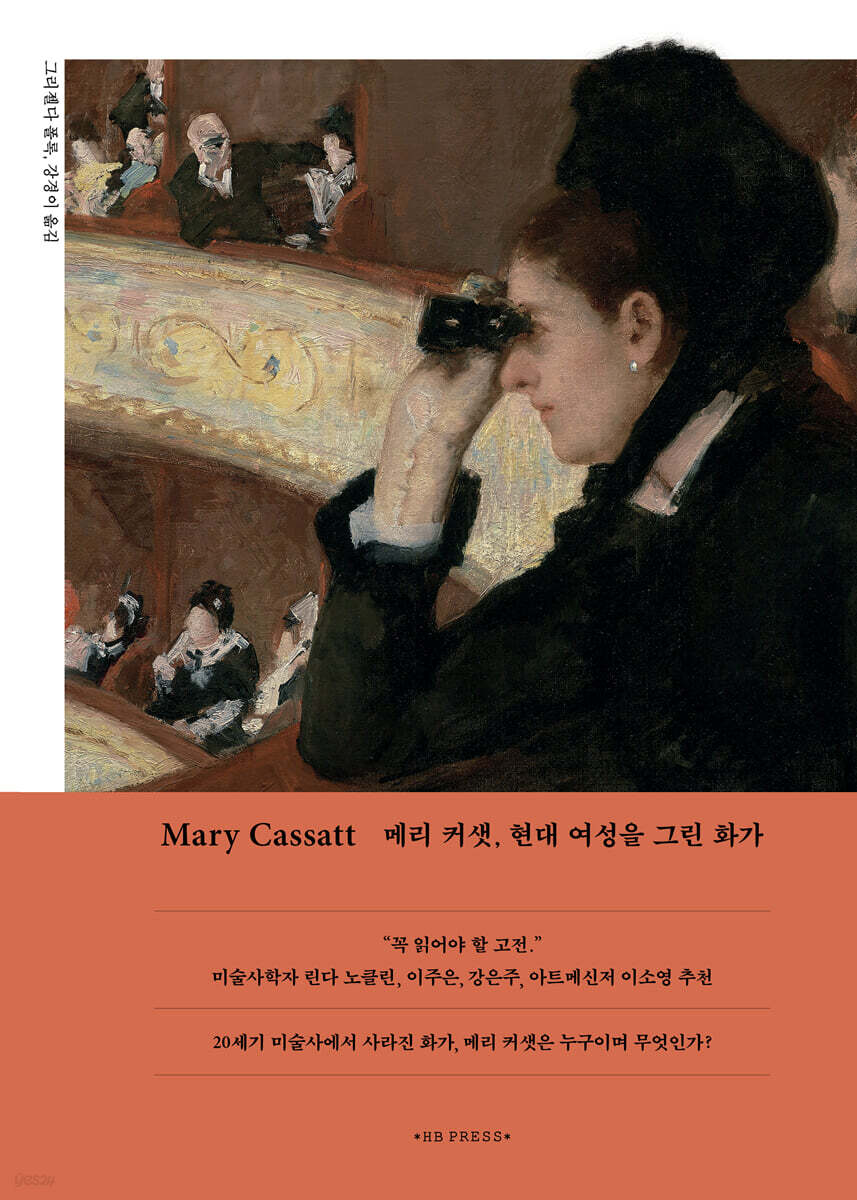 |
Description
Book Introduction
“When I told him I was going to paint a mural, Degas became furious and started criticizing me.
I became even stronger and said that no matter what happened, I would not give up on the mural.”
Letter from Mary Cassatt to her friend Louise Havemire, 1892
The year 1893 was a turning point for Mary Cassatt.
It was the year his art returned to his native America and 'reached' success in Paris.
That year, Cassatt made her American debut with the large mural Modern Woman, which was exhibited at the Chicago World's Fair.
And in November 1893, he exhibited over 100 works at his first solo exhibition held at the Galerie Paul Durand-Ruel in Paris.
In the exhibition catalog, art critic André Melliot concluded:
“I tell you the truth, if I had to name the noble, individual, and outstanding artists of today, I would say only Whistler and Cassatt.”
Why did Cassatt's masterpiece, a 19-meter-wide masterpiece, "Modern Woman," disappear completely? Was it destroyed? Is it buried in a museum basement? The imbalance between female and male artists persists, and the resulting misunderstandings persist.
For decades, Cassatt's work was dismissed as typically 'feminine', depicting 'tea and clothes, children's rooms'.
Mary Cassatt: Painter of Modern Women helps us gain a deeper understanding of Mary Cassatt, an American-born, Paris-based artist.
Mary Cassatt was a member of the Paris Impressionist group and was a painter who was deeply respected and loved by her contemporaries.
Cassatt's modernism is crucial to understanding the creative intersection of modern art and modern women.
His paintings from over a century ago have been re-evaluated in the 21st century and are beginning to capture the eyes and hearts of new audiences in the United States and Europe.
I became even stronger and said that no matter what happened, I would not give up on the mural.”
Letter from Mary Cassatt to her friend Louise Havemire, 1892
The year 1893 was a turning point for Mary Cassatt.
It was the year his art returned to his native America and 'reached' success in Paris.
That year, Cassatt made her American debut with the large mural Modern Woman, which was exhibited at the Chicago World's Fair.
And in November 1893, he exhibited over 100 works at his first solo exhibition held at the Galerie Paul Durand-Ruel in Paris.
In the exhibition catalog, art critic André Melliot concluded:
“I tell you the truth, if I had to name the noble, individual, and outstanding artists of today, I would say only Whistler and Cassatt.”
Why did Cassatt's masterpiece, a 19-meter-wide masterpiece, "Modern Woman," disappear completely? Was it destroyed? Is it buried in a museum basement? The imbalance between female and male artists persists, and the resulting misunderstandings persist.
For decades, Cassatt's work was dismissed as typically 'feminine', depicting 'tea and clothes, children's rooms'.
Mary Cassatt: Painter of Modern Women helps us gain a deeper understanding of Mary Cassatt, an American-born, Paris-based artist.
Mary Cassatt was a member of the Paris Impressionist group and was a painter who was deeply respected and loved by her contemporaries.
Cassatt's modernism is crucial to understanding the creative intersection of modern art and modern women.
His paintings from over a century ago have been re-evaluated in the 21st century and are beginning to capture the eyes and hearts of new audiences in the United States and Europe.
- You can preview some of the book's contents.
Preview
index
Preface to the Revised Edition
annual report
introduction.
Who and what is Mary Cassatt?
Chapter 1.
Mary Cassatt: Painter of the 'Modern Woman' 1893
Chapter 2.
American artists in the United States and abroad
Chapter 3.
Cassatt's Choices 1870-1877
Chapter 4.
Modern Women, Modern Spaces 1877-1891
Chapter 5.
The Maid and Her Mother: Color Print, 1891
Chapter 6.
The Modern Child 1895-1915
Reviews
Recommended Reading and References
List of illustrations
Search
annual report
introduction.
Who and what is Mary Cassatt?
Chapter 1.
Mary Cassatt: Painter of the 'Modern Woman' 1893
Chapter 2.
American artists in the United States and abroad
Chapter 3.
Cassatt's Choices 1870-1877
Chapter 4.
Modern Women, Modern Spaces 1877-1891
Chapter 5.
The Maid and Her Mother: Color Print, 1891
Chapter 6.
The Modern Child 1895-1915
Reviews
Recommended Reading and References
List of illustrations
Search
Detailed image

Into the book
While contemporaries considered a beautiful appearance or refined appearance that subtly revealed a mysterious sexual allure to be the core of mythic femininity, Cassatt specifically selected models of any class who did not attract an erotic gaze, so that the viewer could encounter the figures in the paintings as subjects rather than objects or myths.
Cassatt's paintings convey the psychological inner world of both children and adults.
Psychological interiority is the combination of thoughts and feelings that reveals the 'inner life', which Segard could probably only call the now-old-fashioned term 'soul'.
---From the "Preface"
In the great drawing-based art tradition, style signifies an integrated understanding of artistic creation that combines conceptual and technical implementation.
In art theory, style is implicitly treated as masculine and powerful.
Segard recognized Cassatt's style in the "Studies" (1886), which had once belonged to Degas and which had even been attributed to him by his executors after his death.
Above all, this painting was intended as a rebuttal to Degas's provocative and offensive statement that women do not even know what style is.
---From the "Preface"
The year 1893 was a turning point for Mary Cassatt.
It was the year his art returned to his native America and 'reached' success in Paris.
That year, Cassatt made her American debut with the large mural "Modern Woman," which was exhibited at the Chicago World's Fair.
And from November to December 1893, he exhibited over a hundred works at his first retrospective held at the Galerie Paul Durand-Ruel in Paris.
In the exhibition catalog, art critic André Melliot concluded:
“I tell you the truth, if you were to choose among the artists of today the only two who are noble, individual, and outstanding would be Whistler and Cassatt.” By beginning this book at 1893, a crucial midpoint in Cassatt’s career, we will be able to capture the key moments and themes of change that would define the body of work that comes under the name “Mary Cassatt.”
---From Chapter 1
Cassatt first appeared at the Salon under the name 'Mary Cassatt' in 1874.
It seems that it was at this Salon exhibition that Degas saw Cassatt's Aida and declared, "Here is someone who feels the same way I do."
Although this may not be true, it was not until the spring of 1877 that the two artists actually met, despite the events that occurred.
That year, Degas invited Cassatt to join the independent artists' group formed in 1874.
---From Chapter 3
On her second visit to Paris in 1875, Louise and Cassatt visited the Durand-Ruel Gallery on Boulevard Haussmann and the paint shop of Julien Tanguy on Rue Clozel.
Cassatt persuaded the young man to spend all his and his sister's allowances to buy Edgar Degas' pastel painting, "Ballet Rehearsal" (c. 1875).
The painting, which Louisine bought for 500 francs ($100), was the first Degas work purchased by an American.
In the notes left by Havemeyer, we can hear Cassatt's appreciation of this work.
“The drawing of the painting is as sure as that of the old painters, and the difficult problems of plane and perspective are handled with a masterly touch, and the beauty of the light and shade and color is literally captivating.”
---From Chapter 3
Cassatt later wrote:
“I like to draw children.
Children are very natural and truthful.
“Children have no hidden agenda,” said Cassatt, who began a series of paintings featuring a child in 1878.
This led to the memorable encounters between the artist and a young girl, including Girl in a Big Red Hat (1881) and Girl in a Straw Hat (1886).
"Girl in a Straw Hat" shows a working-class child wearing a jumper skirt over a simple chemise.
The child is wearing a large straw hat over his haphazardly cut hair.
Instead of an elaborately set backdrop, a pitiful little face looks slightly off-center, with a bewildered gaze, against a simple, Velazquez-esque gray background.
…In these paintings exploring the girl, Cassatt asks the questions of contemporary feminists.
Is there such a thing as a feminine nature, or do dominant gender concepts, as social imperatives, confine and limit both body and mind?
---From Chapter 4
His monumental work, Portrait of a Lady (aka The Painter's Mother Reading Le Figaro) (1878), which deals with the theme of a 'reading woman', depicts his mother, Catherine Cassatt, reading a newspaper, a symbol of Baudelairean modernity.
Catherine Cassatt sits in a floral armchair, similar to the one used by the girl in another of Cassatt's paintings, against a pale ivory wall.
Cassatt placed a mirror on the canvas that reflected part of the newspaper.
The interest that Cassatt's work had attracted within the new group can be seen in Manet's painting from 1879.
Manet painted a charming young woman reading an illustrated newspaper in the garden of a Parisian café.
---From Chapter 4
The theater was a special place where Cassatt made his debut in an Impressionist group exhibition.
Cassatt's theatrical paintings show how he took his place among the passionate and artistic intellectuals of this new art world.
… In the late 1870s, Cassatt would have watched Manet paint and paint cafés and café-concerts, experimenting with compositions, situations, and social character types, trying to condense all the complexities of modernity into a single picture.
…but in two details of this painting we can see that Manet's solution was influenced by his artistic exchange with Cassatt.
At the back of the Folies Bergère Bar, a long mirror stretches out, reflecting the audience and the audience.
And among the audience there is a woman dressed up nicely and wearing opera glasses.
In this woman's appearance, we can see that Manet deliberately cited Cassatt's 1878 painting "At the Screen."
---From Chapter 4
Mary Cassatt is known as an avant-garde printmaker as well as a 'new painter'.
In 1909, Frank Whitenkamp, curator of prints at the New York Public Library, praised Cassatt's etchings and drypoints for their "complete understanding of the nature of the medium (still delicate despite the solidity often emphasized by the models he used), an awareness of its possibilities and limitations, a masterful technique, solidity, a free spirit, a concise and honest expression, and a judicious economy of line."
But in another 1916 piece, Whitenkamp admitted that such robust prints might initially be “difficult” for viewers new to French modernism.
---From Chapter 5
Therefore, the paintings by Cassatt that are thought to be of mothers and children are in fact not such paintings at all.
Of course, there are also pictures about parenting.
However, the perspective of the painting is not that of a woman as a mother.
Cassette has never been a mother.
Cassatt's painting was painted in his daughter's place.
And as viewers, the position we identify with in his work is that of the daughter.
His paintings are an expression of the relationship between a daughter and her mother.
It can be read as a representation of changing femininity in an era where women's relationship with society has historically changed.
The femininity explored in Cassatt's paintings both defies the nature of the role his mother played in his life and is creatively shaped by its influence.
---From Chapter 5
What is new in Cassatt's later work is the image of a curious and thoughtful daughter.
For example, in “Woman with Sunflowers” (c. 1905), we meet the daughter, who holds a mirror tightly, turns her own face reflected in it away from the canvas, and makes eye contact with us, indirectly asking a question.
And in “Young Mother Sewing” (c. 1901), we meet a daughter who subtly points to the artist’s presence.
What the young girl's gaze brings to mind is the painter and his work that she faced at the moment when the picture was being painted.
Cassatt, a female artist, intellectual, painter, feminist, daughter, sister, friend, and curator, is now to us the 'other woman' who lived through a historic moment in feminism.
And the archaeological research of that period has immense value for modern feminism.
Cassatt's modernism is crucial to understanding the creative intersection of modern art and modern women.
Cassatt's paintings convey the psychological inner world of both children and adults.
Psychological interiority is the combination of thoughts and feelings that reveals the 'inner life', which Segard could probably only call the now-old-fashioned term 'soul'.
---From the "Preface"
In the great drawing-based art tradition, style signifies an integrated understanding of artistic creation that combines conceptual and technical implementation.
In art theory, style is implicitly treated as masculine and powerful.
Segard recognized Cassatt's style in the "Studies" (1886), which had once belonged to Degas and which had even been attributed to him by his executors after his death.
Above all, this painting was intended as a rebuttal to Degas's provocative and offensive statement that women do not even know what style is.
---From the "Preface"
The year 1893 was a turning point for Mary Cassatt.
It was the year his art returned to his native America and 'reached' success in Paris.
That year, Cassatt made her American debut with the large mural "Modern Woman," which was exhibited at the Chicago World's Fair.
And from November to December 1893, he exhibited over a hundred works at his first retrospective held at the Galerie Paul Durand-Ruel in Paris.
In the exhibition catalog, art critic André Melliot concluded:
“I tell you the truth, if you were to choose among the artists of today the only two who are noble, individual, and outstanding would be Whistler and Cassatt.” By beginning this book at 1893, a crucial midpoint in Cassatt’s career, we will be able to capture the key moments and themes of change that would define the body of work that comes under the name “Mary Cassatt.”
---From Chapter 1
Cassatt first appeared at the Salon under the name 'Mary Cassatt' in 1874.
It seems that it was at this Salon exhibition that Degas saw Cassatt's Aida and declared, "Here is someone who feels the same way I do."
Although this may not be true, it was not until the spring of 1877 that the two artists actually met, despite the events that occurred.
That year, Degas invited Cassatt to join the independent artists' group formed in 1874.
---From Chapter 3
On her second visit to Paris in 1875, Louise and Cassatt visited the Durand-Ruel Gallery on Boulevard Haussmann and the paint shop of Julien Tanguy on Rue Clozel.
Cassatt persuaded the young man to spend all his and his sister's allowances to buy Edgar Degas' pastel painting, "Ballet Rehearsal" (c. 1875).
The painting, which Louisine bought for 500 francs ($100), was the first Degas work purchased by an American.
In the notes left by Havemeyer, we can hear Cassatt's appreciation of this work.
“The drawing of the painting is as sure as that of the old painters, and the difficult problems of plane and perspective are handled with a masterly touch, and the beauty of the light and shade and color is literally captivating.”
---From Chapter 3
Cassatt later wrote:
“I like to draw children.
Children are very natural and truthful.
“Children have no hidden agenda,” said Cassatt, who began a series of paintings featuring a child in 1878.
This led to the memorable encounters between the artist and a young girl, including Girl in a Big Red Hat (1881) and Girl in a Straw Hat (1886).
"Girl in a Straw Hat" shows a working-class child wearing a jumper skirt over a simple chemise.
The child is wearing a large straw hat over his haphazardly cut hair.
Instead of an elaborately set backdrop, a pitiful little face looks slightly off-center, with a bewildered gaze, against a simple, Velazquez-esque gray background.
…In these paintings exploring the girl, Cassatt asks the questions of contemporary feminists.
Is there such a thing as a feminine nature, or do dominant gender concepts, as social imperatives, confine and limit both body and mind?
---From Chapter 4
His monumental work, Portrait of a Lady (aka The Painter's Mother Reading Le Figaro) (1878), which deals with the theme of a 'reading woman', depicts his mother, Catherine Cassatt, reading a newspaper, a symbol of Baudelairean modernity.
Catherine Cassatt sits in a floral armchair, similar to the one used by the girl in another of Cassatt's paintings, against a pale ivory wall.
Cassatt placed a mirror on the canvas that reflected part of the newspaper.
The interest that Cassatt's work had attracted within the new group can be seen in Manet's painting from 1879.
Manet painted a charming young woman reading an illustrated newspaper in the garden of a Parisian café.
---From Chapter 4
The theater was a special place where Cassatt made his debut in an Impressionist group exhibition.
Cassatt's theatrical paintings show how he took his place among the passionate and artistic intellectuals of this new art world.
… In the late 1870s, Cassatt would have watched Manet paint and paint cafés and café-concerts, experimenting with compositions, situations, and social character types, trying to condense all the complexities of modernity into a single picture.
…but in two details of this painting we can see that Manet's solution was influenced by his artistic exchange with Cassatt.
At the back of the Folies Bergère Bar, a long mirror stretches out, reflecting the audience and the audience.
And among the audience there is a woman dressed up nicely and wearing opera glasses.
In this woman's appearance, we can see that Manet deliberately cited Cassatt's 1878 painting "At the Screen."
---From Chapter 4
Mary Cassatt is known as an avant-garde printmaker as well as a 'new painter'.
In 1909, Frank Whitenkamp, curator of prints at the New York Public Library, praised Cassatt's etchings and drypoints for their "complete understanding of the nature of the medium (still delicate despite the solidity often emphasized by the models he used), an awareness of its possibilities and limitations, a masterful technique, solidity, a free spirit, a concise and honest expression, and a judicious economy of line."
But in another 1916 piece, Whitenkamp admitted that such robust prints might initially be “difficult” for viewers new to French modernism.
---From Chapter 5
Therefore, the paintings by Cassatt that are thought to be of mothers and children are in fact not such paintings at all.
Of course, there are also pictures about parenting.
However, the perspective of the painting is not that of a woman as a mother.
Cassette has never been a mother.
Cassatt's painting was painted in his daughter's place.
And as viewers, the position we identify with in his work is that of the daughter.
His paintings are an expression of the relationship between a daughter and her mother.
It can be read as a representation of changing femininity in an era where women's relationship with society has historically changed.
The femininity explored in Cassatt's paintings both defies the nature of the role his mother played in his life and is creatively shaped by its influence.
---From Chapter 5
What is new in Cassatt's later work is the image of a curious and thoughtful daughter.
For example, in “Woman with Sunflowers” (c. 1905), we meet the daughter, who holds a mirror tightly, turns her own face reflected in it away from the canvas, and makes eye contact with us, indirectly asking a question.
And in “Young Mother Sewing” (c. 1901), we meet a daughter who subtly points to the artist’s presence.
What the young girl's gaze brings to mind is the painter and his work that she faced at the moment when the picture was being painted.
Cassatt, a female artist, intellectual, painter, feminist, daughter, sister, friend, and curator, is now to us the 'other woman' who lived through a historic moment in feminism.
And the archaeological research of that period has immense value for modern feminism.
Cassatt's modernism is crucial to understanding the creative intersection of modern art and modern women.
---From Chapter 5
Publisher's Review
2020 Holbert Prize Art historian Griselda Pollock's masterpiece and a masterpiece in the history of feminist art
A revised edition, first published in Korea in 24 years, featuring 190 official collection illustrations.
Recommended by art historians Linda Nochlin, Kang Eun-ju, and Lee Ju-eun, and by artist Lee So-young of Art Messenger.
“Cassett’s understanding of life and art is profound and moving.” Asil Segard (author of the first biography of Mary Cassatt)
"Cassatt is, in fact, the most important figure in the history of graphic art." Frederick Childe Hassam (American Impressionist painter)
“They would be angry to see a rare and excellent work (by Mary Cassatt) displayed next to their own paintings.” Camille Pissarro, in a letter to his son Lucien
In 1904, the British art critic Winford Dewhurst, in his influential book Impressionist Painting: Origin and Development, which introduced contemporary French art, described the Impressionists as a mixed group of "independent fellow painters" and one of the first egalitarian art movements.
He mentioned three women who participated in the movement.
Berthe Morisot, Eva Gonzalez, and Mary Cassatt.
(Page 17)
Mary Cassatt actively interacted with and influenced the avant-garde painters of her time (now collectively called the Impressionists).
In particular, in the house of Edgar Degas, who introduced Mary Cassatt by saying, “Here is someone who feels like me,” around 90 prints of Mary Cassatt were discovered after his death.
Cassatt's painting [Study] (1886) was for a time mistakenly attributed to Degas.
Cassatt, who admired Manet, paid homage to him in works such as Boating on the River (1893), while the influence of Cassatt's At the Screen can be discerned in Manet's famous Bar at the Folies-Bergère (1882).
There is no doubt that Cassatt was a crucial and influential figure in the formation of European and American modernism.
It is natural that Picasso's Portrait of Gertrude Stein (1906) brings to mind Cassatt's rough, intense, and unruly modernism.
However, due to the biased sexism that is a characteristic of 20th-century modern art history, 'female artists' like Mary Cassatt are not receiving the recognition they deserve.
What Dewhurst took for granted in 1904 is not yet common knowledge.
The situation remains one in which some scholars continue to reintroduce female artists without delving deeper into their significance.
(Page 19)
Cassatt was able to treat the subjects of Degas, Manet, and Courbet from a different perspective than they had done.
Modernist painters portray the everyday world of life in the new space of the modern city through their works.
Just as Degas represented modern life through various working figures, including ballet dancers, prostitutes, jockeys, and laundresses, Cassatt addresses modernity from a social and historical perspective through children, mothers, and nannies.
If we move beyond biased perspectives, we can see that Cassatt was an influential painter in the history of art.
Throughout this book, author Griselda Pollock examines and analyzes Cassatt's work and life through the prism of feminist art history.
The author's research, which began in the 1970s amidst the question, "Who on earth was Mary Cassatt?", shifted the paradigm of art history around the time this book was published in the late 20th century.
Art historian Lee Ju-eun (professor of Cultural Contents at Konkuk University) summarizes the influence of Griselda Pollock and this book as follows.
“If I were asked to name art historians who changed the paradigm of art history in the late 20th century, the names Linda Nochlin and Griselda Pollock would come to mind first.
Thanks to Noklin, I finally realized that the history of art that excludes the perspectives of women, who make up half of humanity, is incomplete.
Thanks to Pollock, we learned how to read the work of female artists from a different angle, free from stereotypes.
…After reading Pollock, one realizes that Cassatt was not an independent artist, but an influential contemporary painter who was placed within the flow of art history.”
“This is by far the best book on the artist Mary Cassatt,” says art historian Linda Nochlin, author of Why Have There Been No Great Women Artists?
"I'm delighted that this must-read classic is now available in Korean," said art historian Lee Ju-eun, professor of cultural content at Konkuk University.
In her 1971 essay, Linda Nochlin asked, "Why have there been no great women artists?"
This was a signal flare for the history of feminist art, and on the other hand, it densely unearthed the history of great female artists.
The protagonist is the author of this book, Griselda Pollock, and the main character (great female artist) is Mary Cassatt.
Camille Pissarro, Berthe Morisot, and Mary Cassatt, a close collaborator of Edgar Degas, were the core painters of the Parisian Impressionist group and the only American.
Highly respected in both Europe and the United States, she boldly advocated for women's intellectual, creative, and political liberation. (Chapter 1: Mary Cassatt: The Painter of the "Modern Woman") With her insightful perspective and compositional ingenuity in various media, she depicted the nuanced social interactions of women in public and private spaces, such as the theater and intimate moments with children. (Chapter 4: Modern Women, Modern Spaces) In particular, her paintings, which meticulously observe and analyze the child's body and developing personality without sentimentality, are second to none. (Chapter 6: The Modern Child)
Author Griselda Pollock is an art historian who won the 2020 Holbert Prize for her outstanding work in feminist art history and cultural analysis.
Pollock retraces key moments in Cassatt's long artistic journey, examining his extensive European art studies and analyzing his profound understanding of the Old Masters, as well as his keen awareness of the influences of Manet and Courbet.
We also read in Cassatt's paintings the artist's extraordinary insight into modern women.
Since the first edition of this book was published in 1998, there have been many opportunities to see Mary Cassatt's work in large exhibitions across Europe.
This revised edition, now over 20 years later and enriched with a new preface and 190 color plates, guides 21st-century readers to a deeper appreciation of the world that this leading Impressionist painter uniquely discovered and depicted.
Author's Note
When this book was first published in 1998, the only other book about a female artist in Thames & Hudson's "Art World" series was Barbara Hepworth.
Since then, only Georgia O'Keeffe has been added.
The imbalance between female and male artists still persists, and the resulting misunderstandings persist.
So I'm so happy that Mary Cassatt is back in color.
This book provides a deeper understanding of Mary Cassatt, a radical artist born in the United States and active in Paris.
Cassatt was an artist who participated in the first egalitarian art movement in the history of art, a feminist who advocated for women's intellectual activities and political liberation, and a painter who enthusiastically participated in the art movement that he and his radical colleagues in Paris called 'New Art' and that we collectively call Impressionism, and was deeply respected and loved by his contemporaries.
Asil Segard, who wrote the first study on Cassat, saw him first and foremost as a "painter of children" and only then as a "painter of mothers".
This era of praise and nuanced insight was overtaken by the terrifying historical forces that devastated Europe during World War I.
By the 1970s, Segard's praise had faded in the face of the sexism that was rampant in the art world.
For a generation or two, Cassatt's modernism was overshadowed by stereotypes and perceptions that denigrated and excluded women, and his work was dismissed as typically 'feminine', depicting 'tea and clothes and children's rooms'.
It was only after a new feminist reassessment of the spaces and emotions of nineteenth-century femininity that the ways in which Cassatt's work engaged this period became clearly apparent.
We can now see Cassatt's influence in Manet's Bar at the Folies-Bergère, we can discern quotations from Manet's Olympia in Cassatt's prints, and we can sense Cassatt's portrait of her intellectual mother looming in Picasso's portrait of the great modernist intellectual Gertrude Stein.
That is the starting point for understanding Mary Cassatt's place in the history of modernism as a 'painter of modern women'.
A revised edition, first published in Korea in 24 years, featuring 190 official collection illustrations.
Recommended by art historians Linda Nochlin, Kang Eun-ju, and Lee Ju-eun, and by artist Lee So-young of Art Messenger.
“Cassett’s understanding of life and art is profound and moving.” Asil Segard (author of the first biography of Mary Cassatt)
"Cassatt is, in fact, the most important figure in the history of graphic art." Frederick Childe Hassam (American Impressionist painter)
“They would be angry to see a rare and excellent work (by Mary Cassatt) displayed next to their own paintings.” Camille Pissarro, in a letter to his son Lucien
In 1904, the British art critic Winford Dewhurst, in his influential book Impressionist Painting: Origin and Development, which introduced contemporary French art, described the Impressionists as a mixed group of "independent fellow painters" and one of the first egalitarian art movements.
He mentioned three women who participated in the movement.
Berthe Morisot, Eva Gonzalez, and Mary Cassatt.
(Page 17)
Mary Cassatt actively interacted with and influenced the avant-garde painters of her time (now collectively called the Impressionists).
In particular, in the house of Edgar Degas, who introduced Mary Cassatt by saying, “Here is someone who feels like me,” around 90 prints of Mary Cassatt were discovered after his death.
Cassatt's painting [Study] (1886) was for a time mistakenly attributed to Degas.
Cassatt, who admired Manet, paid homage to him in works such as Boating on the River (1893), while the influence of Cassatt's At the Screen can be discerned in Manet's famous Bar at the Folies-Bergère (1882).
There is no doubt that Cassatt was a crucial and influential figure in the formation of European and American modernism.
It is natural that Picasso's Portrait of Gertrude Stein (1906) brings to mind Cassatt's rough, intense, and unruly modernism.
However, due to the biased sexism that is a characteristic of 20th-century modern art history, 'female artists' like Mary Cassatt are not receiving the recognition they deserve.
What Dewhurst took for granted in 1904 is not yet common knowledge.
The situation remains one in which some scholars continue to reintroduce female artists without delving deeper into their significance.
(Page 19)
Cassatt was able to treat the subjects of Degas, Manet, and Courbet from a different perspective than they had done.
Modernist painters portray the everyday world of life in the new space of the modern city through their works.
Just as Degas represented modern life through various working figures, including ballet dancers, prostitutes, jockeys, and laundresses, Cassatt addresses modernity from a social and historical perspective through children, mothers, and nannies.
If we move beyond biased perspectives, we can see that Cassatt was an influential painter in the history of art.
Throughout this book, author Griselda Pollock examines and analyzes Cassatt's work and life through the prism of feminist art history.
The author's research, which began in the 1970s amidst the question, "Who on earth was Mary Cassatt?", shifted the paradigm of art history around the time this book was published in the late 20th century.
Art historian Lee Ju-eun (professor of Cultural Contents at Konkuk University) summarizes the influence of Griselda Pollock and this book as follows.
“If I were asked to name art historians who changed the paradigm of art history in the late 20th century, the names Linda Nochlin and Griselda Pollock would come to mind first.
Thanks to Noklin, I finally realized that the history of art that excludes the perspectives of women, who make up half of humanity, is incomplete.
Thanks to Pollock, we learned how to read the work of female artists from a different angle, free from stereotypes.
…After reading Pollock, one realizes that Cassatt was not an independent artist, but an influential contemporary painter who was placed within the flow of art history.”
“This is by far the best book on the artist Mary Cassatt,” says art historian Linda Nochlin, author of Why Have There Been No Great Women Artists?
"I'm delighted that this must-read classic is now available in Korean," said art historian Lee Ju-eun, professor of cultural content at Konkuk University.
In her 1971 essay, Linda Nochlin asked, "Why have there been no great women artists?"
This was a signal flare for the history of feminist art, and on the other hand, it densely unearthed the history of great female artists.
The protagonist is the author of this book, Griselda Pollock, and the main character (great female artist) is Mary Cassatt.
Camille Pissarro, Berthe Morisot, and Mary Cassatt, a close collaborator of Edgar Degas, were the core painters of the Parisian Impressionist group and the only American.
Highly respected in both Europe and the United States, she boldly advocated for women's intellectual, creative, and political liberation. (Chapter 1: Mary Cassatt: The Painter of the "Modern Woman") With her insightful perspective and compositional ingenuity in various media, she depicted the nuanced social interactions of women in public and private spaces, such as the theater and intimate moments with children. (Chapter 4: Modern Women, Modern Spaces) In particular, her paintings, which meticulously observe and analyze the child's body and developing personality without sentimentality, are second to none. (Chapter 6: The Modern Child)
Author Griselda Pollock is an art historian who won the 2020 Holbert Prize for her outstanding work in feminist art history and cultural analysis.
Pollock retraces key moments in Cassatt's long artistic journey, examining his extensive European art studies and analyzing his profound understanding of the Old Masters, as well as his keen awareness of the influences of Manet and Courbet.
We also read in Cassatt's paintings the artist's extraordinary insight into modern women.
Since the first edition of this book was published in 1998, there have been many opportunities to see Mary Cassatt's work in large exhibitions across Europe.
This revised edition, now over 20 years later and enriched with a new preface and 190 color plates, guides 21st-century readers to a deeper appreciation of the world that this leading Impressionist painter uniquely discovered and depicted.
Author's Note
When this book was first published in 1998, the only other book about a female artist in Thames & Hudson's "Art World" series was Barbara Hepworth.
Since then, only Georgia O'Keeffe has been added.
The imbalance between female and male artists still persists, and the resulting misunderstandings persist.
So I'm so happy that Mary Cassatt is back in color.
This book provides a deeper understanding of Mary Cassatt, a radical artist born in the United States and active in Paris.
Cassatt was an artist who participated in the first egalitarian art movement in the history of art, a feminist who advocated for women's intellectual activities and political liberation, and a painter who enthusiastically participated in the art movement that he and his radical colleagues in Paris called 'New Art' and that we collectively call Impressionism, and was deeply respected and loved by his contemporaries.
Asil Segard, who wrote the first study on Cassat, saw him first and foremost as a "painter of children" and only then as a "painter of mothers".
This era of praise and nuanced insight was overtaken by the terrifying historical forces that devastated Europe during World War I.
By the 1970s, Segard's praise had faded in the face of the sexism that was rampant in the art world.
For a generation or two, Cassatt's modernism was overshadowed by stereotypes and perceptions that denigrated and excluded women, and his work was dismissed as typically 'feminine', depicting 'tea and clothes and children's rooms'.
It was only after a new feminist reassessment of the spaces and emotions of nineteenth-century femininity that the ways in which Cassatt's work engaged this period became clearly apparent.
We can now see Cassatt's influence in Manet's Bar at the Folies-Bergère, we can discern quotations from Manet's Olympia in Cassatt's prints, and we can sense Cassatt's portrait of her intellectual mother looming in Picasso's portrait of the great modernist intellectual Gertrude Stein.
That is the starting point for understanding Mary Cassatt's place in the history of modernism as a 'painter of modern women'.
GOODS SPECIFICS
- Date of issue: March 20, 2025
- Page count, weight, size: 320 pages | 716g | 168*235*20mm
- ISBN13: 9791190314411
- ISBN10: 119031441X
You may also like
카테고리
korean


korean

![GQ KOREA Mark (Monthly): December [2025]](http://librairie.coreenne.fr/cdn/shop/files/8ef265dbbfbf186523ed75ba7319009d.jpg?v=1765340328&width=3840)


