

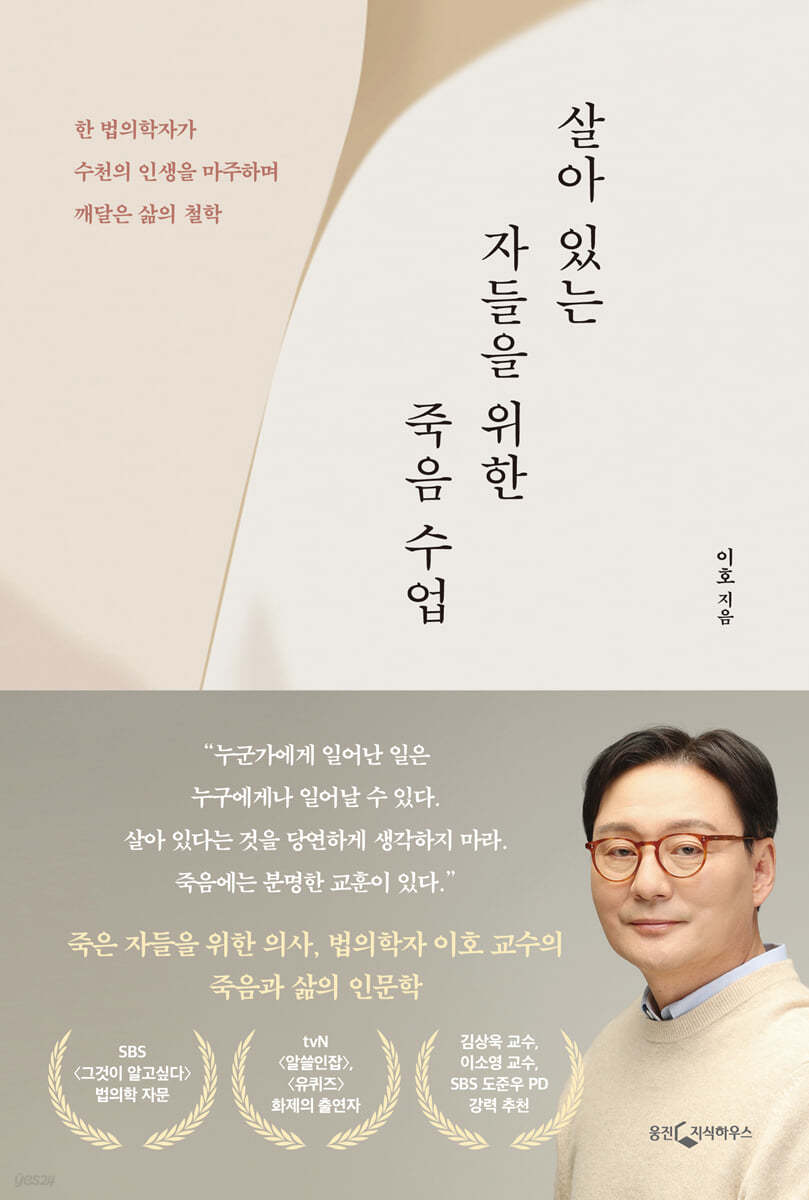
Death Lessons for the Living
 |
Description
Book Introduction
- A word from MD
-
Death Lessons for Love and SolidarityThere is no such thing as death without a cause, but in our society, 28,000 people die every year for unknown reasons.
Isn't this proof that South Korea is that tense?
Forensic scientist Professor Lee Ho has lived his life to care for even one more death.
Asking about the reason for death is so that we can love and be more in solidarity.
December 24, 2024. Humanities PD Son Min-gyu
★ SBS "I Want to Know That" Forensic Medicine Advisor
★ tvN's "Knowing Bros" and "You Quiz" are popular guests
★ Highly recommended by Professor Kim Sang-wook, Professor Lee So-young, and SBS PD Do Jun-woo
“Life is never taken for granted.
“Everyone who is alive and breathing at this moment is a miracle.”
Forensic pathologist Lee Ho tells us how he sees life from death.
Some stories of death and the meaning of life
Professor Lee Ho, a renowned reader, a forensic pathologist who encounters death every day, and a cheerful person like no other, tells us about 'Stories of Death' and reflects on the meaning and value of life.
Professor Lee Ho, who is a forensic pathologist consulting for “I Want to Know That” and is also familiar to the public through programs such as “Know-It-All” and “You Quiz,” said, “If you want to live well, you have to learn about death,” and published his first book, “Death Lessons for the Living.”
Having performed autopsies on approximately 4,000 dead bodies over the past 30 years, he tells the 'true meaning of life' through the stories of various deaths he has encountered in this book.
Sometimes, we feel lost about what it means to live, and we dream of a better tomorrow than today, but it can be difficult to find the way.
And sometimes, there are days when we suddenly feel anxious about the loss and death that will come to us someday.
That's when we have to learn about death.
The reason why the everyday life we let slip by without a second thought is precious, the reason why we must love the people around us who exist as if they were a given, is because the answer can be found in death, not in life.
Among the real stories of death that are more interesting than 'All the Butlers' and more curious than 'I Want to Know That', the story of life that only a forensic scientist can tell unfolds warmly and movingly.
★ tvN's "Knowing Bros" and "You Quiz" are popular guests
★ Highly recommended by Professor Kim Sang-wook, Professor Lee So-young, and SBS PD Do Jun-woo
“Life is never taken for granted.
“Everyone who is alive and breathing at this moment is a miracle.”
Forensic pathologist Lee Ho tells us how he sees life from death.
Some stories of death and the meaning of life
Professor Lee Ho, a renowned reader, a forensic pathologist who encounters death every day, and a cheerful person like no other, tells us about 'Stories of Death' and reflects on the meaning and value of life.
Professor Lee Ho, who is a forensic pathologist consulting for “I Want to Know That” and is also familiar to the public through programs such as “Know-It-All” and “You Quiz,” said, “If you want to live well, you have to learn about death,” and published his first book, “Death Lessons for the Living.”
Having performed autopsies on approximately 4,000 dead bodies over the past 30 years, he tells the 'true meaning of life' through the stories of various deaths he has encountered in this book.
Sometimes, we feel lost about what it means to live, and we dream of a better tomorrow than today, but it can be difficult to find the way.
And sometimes, there are days when we suddenly feel anxious about the loss and death that will come to us someday.
That's when we have to learn about death.
The reason why the everyday life we let slip by without a second thought is precious, the reason why we must love the people around us who exist as if they were a given, is because the answer can be found in death, not in life.
Among the real stories of death that are more interesting than 'All the Butlers' and more curious than 'I Want to Know That', the story of life that only a forensic scientist can tell unfolds warmly and movingly.
- You can preview some of the book's contents.
Preview
index
Introduction
Part 1 - The Dead Teach the Living
The doctor you meet at the very last moment of your life
Visible lies and invisible truths
No one heard the groans that day
How much should you grieve over the death of a loved one?
Becoming a companion to the most pitiful person
Exhumation and defense
Who should save a drowning child?
Some children who are neither perpetrators nor victims
A child I met before my life ended
Part 2 - How Far Is Life from Death?
A series of large and small dots that lead to death
Healing the hearts of the families left behind
On the search for meaning in life
What is good
Even if it's just a tiny piece
Never get excited
The person who saved the most, the person who saved the least
People make mistakes, you and I.
Which came first, the train or the railway?
Part 3 - My Death, Your Death, and Our Death
About the 299 cleanest corpses
The ship will sink again
The time it took a couple to collect a bag of acorns
I see life from death
What ultimately keeps us alive is the power of love.
We have the right to die in peace.
See the human, not the human body
My death, your death, our death
A letter delivered too late
Source of citation
Part 1 - The Dead Teach the Living
The doctor you meet at the very last moment of your life
Visible lies and invisible truths
No one heard the groans that day
How much should you grieve over the death of a loved one?
Becoming a companion to the most pitiful person
Exhumation and defense
Who should save a drowning child?
Some children who are neither perpetrators nor victims
A child I met before my life ended
Part 2 - How Far Is Life from Death?
A series of large and small dots that lead to death
Healing the hearts of the families left behind
On the search for meaning in life
What is good
Even if it's just a tiny piece
Never get excited
The person who saved the most, the person who saved the least
People make mistakes, you and I.
Which came first, the train or the railway?
Part 3 - My Death, Your Death, and Our Death
About the 299 cleanest corpses
The ship will sink again
The time it took a couple to collect a bag of acorns
I see life from death
What ultimately keeps us alive is the power of love.
We have the right to die in peace.
See the human, not the human body
My death, your death, our death
A letter delivered too late
Source of citation
Detailed image
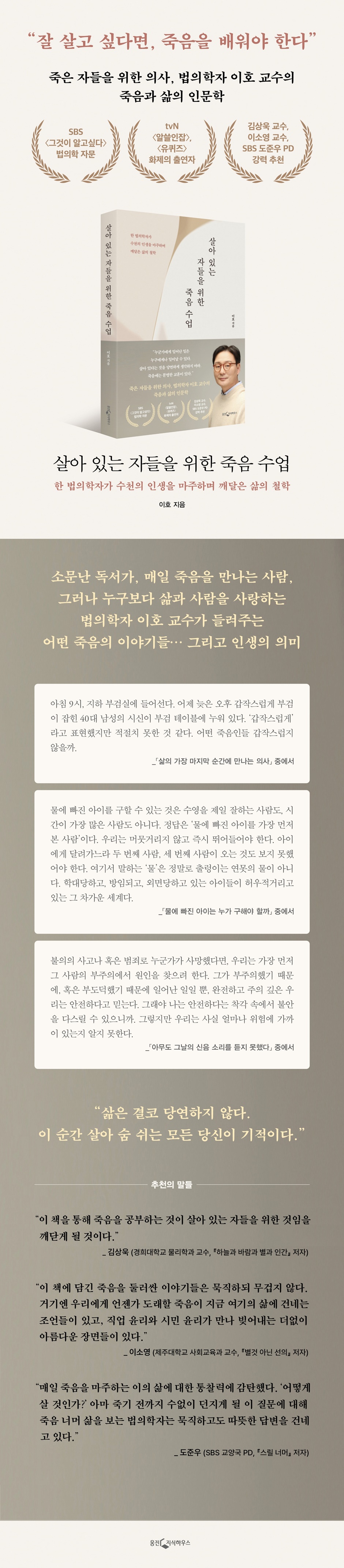
Into the book
At 9 o'clock in the morning, we enter the underground autopsy room.
The body of a man in his 40s, whose autopsy was suddenly scheduled late yesterday afternoon, lies on the autopsy table.
I said 'suddenly', but I don't think it's appropriate.
What death is not sudden?
Before the autopsy begins, you will receive a brief briefing about the case from the police officer in charge and the coroner.
This body was found drowned, and the cause of death must be determined as soon as possible, so the autopsy team and I are quickly starting preparations.
--- From "The Doctor You Meet at the Last Moment of Life"
All forensic scientists, like myself, follow the Ten Commandments of career choice.
These are people who willingly walked to a place with low wages, few opportunities for promotion, a wasteland with few people wanting to come, a place where their parents and wives were strongly against it.
These are people who chose to be where they are needed rather than where they want to be, people who chose to be where the guillotine awaits them rather than the crown.
The person who risked his life to reveal that the cause of death of Park Jong-cheol, who said, “I was hit with a hammer and died,” was torture, was actually forensic pathologist Hwang Jeok-jun.
If you think about it, there has never been a time in our society when forensic scientists sided with state power.
If he was someone who tried to deceive his conscience in the face of power and capital, he would not have chosen this path in the first place.
--- From "Visible Lies and Invisible Truths"
We believe that we are safe because we are alive like this now.
We believe that we deserve to be alive because we are righteous and perfect.
So we unconsciously think that someone's death is caused by that person.
If someone dies in an accident or a crime, the first thing we try to do is find the cause in that person's negligence.
We, who are perfectly attentive and careful, believe that we are safe, as it only happened because he was careless, or because someone next to him was immoral.
I want to believe that.
That way, I can control my anxiety under the illusion of safety.
But we don't actually know how close we are to danger.
We never want to acknowledge that death can strike us anytime, anywhere.
--- From "No one heard the groans that day"
Then, suddenly, I remembered the nine-year-old girl I met in the autopsy room today.
The mother discovered that her second daughter, who she thought was asleep with her older sister, did not wake up.
Saying goodbye all night isn't just something that adults do.
Meeting the mother and father of a child who left without saying goodbye after the autopsy is more heartbreaking than any other autopsy.
When a child dies suddenly, judicial authorities must force an autopsy to determine the possibility of child abuse.
Although it is a necessary process for the children, it is a painful moment for the forensic scientist who has to explain it while also considering the psychological trauma caused to the parents.
With the explanation that sudden death occurs in about one or two out of 100,000 people worldwide and the cause is still unknown, and that there is no way to know in advance or prevent it, my role as a parent is to be as considerate as possible so that parents do not blame themselves.
--- From "How Much Should I Grieve the Death of a Loved One?"
The answer may vary from person to person, but I would like to say that there is only one answer to this question.
It's not the best swimmer or the person with the most time who can save a drowning child.
The only correct answer is 'the first person to see the drowning child.'
We must jump in immediately without hesitation.
You must have been so busy running to the child that you didn't even see the second or third person coming.
The 'water' referred to in this thought experiment is not actually the water in a rippling pond.
It is a cold world where children are struggling, abused, neglected, and abandoned.
--- From "Who Should Save a Child Who Fell into Water?"
The fact that humans die is unchangeable, although it may be a little early, a little slow, or the method may be different.
So, I hope you don't spend your life trying to find answers to the tragedy that happened to you, asking, "Why did this happen to me?"
Because the answer to that absurdity cannot be found.
It must be so painful and difficult, but I hope you can somehow find meaning in living through it.
That is the most active resistance that humans, who are like dust living in the infinite universe, can do.
--- From "On the Search for Meaning in Life"
Typically, a single incident that results in three or more deaths is considered a major disaster.
This refers to incidents that result in tens or hundreds of casualties due to causes such as fire, explosion, collapse, fall, sinking, and natural disasters.
When a major disaster strikes, people often think that rescue workers, medical personnel, firefighters, police, and soldiers are all involved, but there is another essential resource: forensic pathologists.
Because we need to find the body and identify it.
Especially in cases of fire, explosion, building collapse, or airplane crash, the body is often so disfigured that it is impossible to identify the body with the naked eye, making the role of a forensic scientist crucial.
So, while forensic scientists are usually 'people who find the cause of death', at this time they become 'people who find people'.
Although it was a secondment to gain experience before becoming a full-time forensic scientist, Sampoong Department Store became my first forensic field site.
--- From "Even a Tiny Piece"
I have been working as a forensic scientist for nearly 30 years and have performed approximately 4,000 autopsies.
People who died in fires, people who decomposed in water, people who were horribly damaged in car accidents, people who were stabbed to death in fights, people who died from being beaten so much…
I saw the bodies of people who died in vain for various reasons.
But such horrific injuries are not traumatic to me at all.
The real trauma, the trauma that I still can't forget even after all these years, is the corpse that had no damage to any part of its body.
Even I, who have seen corpses for over 30 years, was speechless from the shock of that day. These were the 299 corpses that were the cleanest.
The first thing that struck me when I saw the bodies recovered from the Sewol ferry was that all of the victims were wearing life jackets.
--- From "About the 299 Cleanest Corpses"
Even looking at the Sewol ferry disaster, the arrows of criticism were directed at one individual.
At first, criticism was focused on Captain Lee Jun-seok, who had driven the ship, but as the investigation progressed, the target shifted to Chairman Yoo Byeong-eon, known as the real owner of Cheonghaejin Marine.
The situation unfolded as if this accident would not have happened if it weren't for Captain Lee Jun-seok and Chairman Yoo Byeong-eon.
Of course, they are clearly at fault.
But is that really the entire cause of the disaster? In a healthy society, even if there were a hundred people like Yoo Byung-eon, this kind of accident wouldn't have happened.
There needs to be more robust safeguards in place to prevent such people from committing wrongdoing, or even if they do commit wrongdoing, to prevent it from resulting in the sacrifice of hundreds of children.
A society that is completely devoid of holes due to just one requirement is clearly problematic.
The body of a man in his 40s, whose autopsy was suddenly scheduled late yesterday afternoon, lies on the autopsy table.
I said 'suddenly', but I don't think it's appropriate.
What death is not sudden?
Before the autopsy begins, you will receive a brief briefing about the case from the police officer in charge and the coroner.
This body was found drowned, and the cause of death must be determined as soon as possible, so the autopsy team and I are quickly starting preparations.
--- From "The Doctor You Meet at the Last Moment of Life"
All forensic scientists, like myself, follow the Ten Commandments of career choice.
These are people who willingly walked to a place with low wages, few opportunities for promotion, a wasteland with few people wanting to come, a place where their parents and wives were strongly against it.
These are people who chose to be where they are needed rather than where they want to be, people who chose to be where the guillotine awaits them rather than the crown.
The person who risked his life to reveal that the cause of death of Park Jong-cheol, who said, “I was hit with a hammer and died,” was torture, was actually forensic pathologist Hwang Jeok-jun.
If you think about it, there has never been a time in our society when forensic scientists sided with state power.
If he was someone who tried to deceive his conscience in the face of power and capital, he would not have chosen this path in the first place.
--- From "Visible Lies and Invisible Truths"
We believe that we are safe because we are alive like this now.
We believe that we deserve to be alive because we are righteous and perfect.
So we unconsciously think that someone's death is caused by that person.
If someone dies in an accident or a crime, the first thing we try to do is find the cause in that person's negligence.
We, who are perfectly attentive and careful, believe that we are safe, as it only happened because he was careless, or because someone next to him was immoral.
I want to believe that.
That way, I can control my anxiety under the illusion of safety.
But we don't actually know how close we are to danger.
We never want to acknowledge that death can strike us anytime, anywhere.
--- From "No one heard the groans that day"
Then, suddenly, I remembered the nine-year-old girl I met in the autopsy room today.
The mother discovered that her second daughter, who she thought was asleep with her older sister, did not wake up.
Saying goodbye all night isn't just something that adults do.
Meeting the mother and father of a child who left without saying goodbye after the autopsy is more heartbreaking than any other autopsy.
When a child dies suddenly, judicial authorities must force an autopsy to determine the possibility of child abuse.
Although it is a necessary process for the children, it is a painful moment for the forensic scientist who has to explain it while also considering the psychological trauma caused to the parents.
With the explanation that sudden death occurs in about one or two out of 100,000 people worldwide and the cause is still unknown, and that there is no way to know in advance or prevent it, my role as a parent is to be as considerate as possible so that parents do not blame themselves.
--- From "How Much Should I Grieve the Death of a Loved One?"
The answer may vary from person to person, but I would like to say that there is only one answer to this question.
It's not the best swimmer or the person with the most time who can save a drowning child.
The only correct answer is 'the first person to see the drowning child.'
We must jump in immediately without hesitation.
You must have been so busy running to the child that you didn't even see the second or third person coming.
The 'water' referred to in this thought experiment is not actually the water in a rippling pond.
It is a cold world where children are struggling, abused, neglected, and abandoned.
--- From "Who Should Save a Child Who Fell into Water?"
The fact that humans die is unchangeable, although it may be a little early, a little slow, or the method may be different.
So, I hope you don't spend your life trying to find answers to the tragedy that happened to you, asking, "Why did this happen to me?"
Because the answer to that absurdity cannot be found.
It must be so painful and difficult, but I hope you can somehow find meaning in living through it.
That is the most active resistance that humans, who are like dust living in the infinite universe, can do.
--- From "On the Search for Meaning in Life"
Typically, a single incident that results in three or more deaths is considered a major disaster.
This refers to incidents that result in tens or hundreds of casualties due to causes such as fire, explosion, collapse, fall, sinking, and natural disasters.
When a major disaster strikes, people often think that rescue workers, medical personnel, firefighters, police, and soldiers are all involved, but there is another essential resource: forensic pathologists.
Because we need to find the body and identify it.
Especially in cases of fire, explosion, building collapse, or airplane crash, the body is often so disfigured that it is impossible to identify the body with the naked eye, making the role of a forensic scientist crucial.
So, while forensic scientists are usually 'people who find the cause of death', at this time they become 'people who find people'.
Although it was a secondment to gain experience before becoming a full-time forensic scientist, Sampoong Department Store became my first forensic field site.
--- From "Even a Tiny Piece"
I have been working as a forensic scientist for nearly 30 years and have performed approximately 4,000 autopsies.
People who died in fires, people who decomposed in water, people who were horribly damaged in car accidents, people who were stabbed to death in fights, people who died from being beaten so much…
I saw the bodies of people who died in vain for various reasons.
But such horrific injuries are not traumatic to me at all.
The real trauma, the trauma that I still can't forget even after all these years, is the corpse that had no damage to any part of its body.
Even I, who have seen corpses for over 30 years, was speechless from the shock of that day. These were the 299 corpses that were the cleanest.
The first thing that struck me when I saw the bodies recovered from the Sewol ferry was that all of the victims were wearing life jackets.
--- From "About the 299 Cleanest Corpses"
Even looking at the Sewol ferry disaster, the arrows of criticism were directed at one individual.
At first, criticism was focused on Captain Lee Jun-seok, who had driven the ship, but as the investigation progressed, the target shifted to Chairman Yoo Byeong-eon, known as the real owner of Cheonghaejin Marine.
The situation unfolded as if this accident would not have happened if it weren't for Captain Lee Jun-seok and Chairman Yoo Byeong-eon.
Of course, they are clearly at fault.
But is that really the entire cause of the disaster? In a healthy society, even if there were a hundred people like Yoo Byung-eon, this kind of accident wouldn't have happened.
There needs to be more robust safeguards in place to prevent such people from committing wrongdoing, or even if they do commit wrongdoing, to prevent it from resulting in the sacrifice of hundreds of children.
A society that is completely devoid of holes due to just one requirement is clearly problematic.
--- From "The Ship Will Sink Again"
Publisher's Review
If you want to live well, you must learn to die.
Doctor for the Dead, Forensic Scientist Lee Ho-ui
Humanities of Death and Life
There is nothing we can be sure of about life, but one thing is certain.
We all die.
And there are things we know but pretend not to know.
That is, we can die at any time, any moment, right now.
An 80-year-old man dies, and an 8-year-old child dies.
They may suffer from illness, or be killed by an unexpected accident, or even by someone close to them.
The reason why we all know that death will come to everyone without warning, but do not admit it, is because it is so scary.
There are people who face death, which is so terrifying, every day.
We also meet people who met their end in the most unwanted ways: assault, murder, suicide, fire, and traffic accidents. Professor Lee Ho, the consulting forensic pathologist for SBS's "Unanswered Questions," is also familiar to the public through programs like tvN's "Knowing Bros," "Knowing Bros," and "You Quiz."
He said, “If you want to live well, you must learn to die,” and published his first book, “Death Lessons for the Living.”
Having performed autopsies on approximately 4,000 dead bodies over the past 30 years, he tells the 'true meaning of life' through 'Stories of Death' in this book.
“Don’t take life for granted.
We must not waste death.
“There is definitely a lesson there.”
In this book, Professor Lee Ho carefully unravels the stories of various deaths he has encountered.
A forensic pathologist is someone who determines the cause of death through an autopsy, but he goes further and listens to the final story the deceased tells through his body.
Part 1 of this book, "The Dead Teach the Living," contains stories of lawyers representing the deceased who died unjustly and tragically, unable to protest, such as a child who died from parental abuse, a wife who was murdered after a fight with her husband, and a high school girl who tragically lost her life to medical malpractice.
A general practitioner is someone who meets patients, but a forensic pathologist is someone who meets the bereaved family, not the patients, so his tone is always very careful.
In the story told in a calm manner, one can see the earnest wish and warm gaze for the peace of the deceased and their families.
In particular, when reading episodes such as “Who Should Save the Drowning Child” and “Children Who Are Neither Perpetrators nor Victims,” which contain stories of children being left alone due to crimes between family members, one is shocked by the reality that there are no support measures for the families of crime victims, another blind spot in our society.
“It is not the best swimmer or the person with the most time who can save a drowning child.
The only correct answer is 'the first person to see the drowning child.'
We must jump in immediately without hesitation.
You must have been so busy running to the child that you didn't even see the second or third person coming.
The 'water' referred to in this thought experiment is not actually the water in a rippling pond.
“It is a cold world where children who are abused, neglected, and abandoned are struggling.”
_ From "Who Should Save a Child Who Fell into Water?"
Part 2, "How Far Is Life from Death," addresses the topic that only when we accept death as a part of life does our life become worth living.
Professor Lee Ho is a renowned reader and is also well known as a forensic scientist with a deep knowledge of the humanities, including classics and philosophy.
When we are anxious about the imminent death, when we experience an unfortunate accident and cannot find hope for life, the message that what we should look forward to is 'a life in search of meaning' is richly expressed through Greek mythology and philosophy.
It also contains stories of major disasters that remain as historical tragedies in Korea, such as the Sampoong Department Store collapse, the Daegu subway fire, and the Sewol ferry sinking.
“Forensic scientists are people who ‘find the cause of death’ in normal times, but in a major disaster, they become people who ‘find people.’”
The sight of forensic scientists struggling day and night to find “even a single piece” of the deceased at the scene of a disaster where hundreds of people died and to deliver the bodies of the deceased to their bereaved families as intact as possible shows us another meaning of forensic medicine that we had not been aware of.
Part 3, “My Death, Your Death, and Our Death,” urges us to empathize with those who have suffered misfortune and to have a sense of solidarity as a community living in the same world.
Let's live in the world with the mindset of 'me, you, and us' rather than 'me, you, and them'.
The answer to the question, “How should we live?” is not something grandiose, but rather a story about cherishing our daily lives as they are, and ultimately, the story that love is what keeps us alive is depicted in a warm and touching way.
“Life is never taken for granted.
“Everyone who is alive and breathing at this moment is a miracle.”
Sometimes, we feel lost about what it means to live, and we dream of a better tomorrow than today, but it can be difficult to find the way.
And sometimes, there are days when we suddenly feel anxious about the loss and death that will come to us someday.
That's when we have to learn about death.
The reason why the everyday life we let slip by without a second thought is precious, the reason why we must love the people around us who exist as if they were a given, is because the answer can be found in death, not in life.
Let's learn about 'death for life' in earnest through this book that says, "If you want to live well, you must learn to die."
In the midst of real death stories that are more interesting than 'All the Things You Know' and more curious than 'I Want to Know That', we hear stories of life that only forensic scientists can tell.
Doctor for the Dead, Forensic Scientist Lee Ho-ui
Humanities of Death and Life
There is nothing we can be sure of about life, but one thing is certain.
We all die.
And there are things we know but pretend not to know.
That is, we can die at any time, any moment, right now.
An 80-year-old man dies, and an 8-year-old child dies.
They may suffer from illness, or be killed by an unexpected accident, or even by someone close to them.
The reason why we all know that death will come to everyone without warning, but do not admit it, is because it is so scary.
There are people who face death, which is so terrifying, every day.
We also meet people who met their end in the most unwanted ways: assault, murder, suicide, fire, and traffic accidents. Professor Lee Ho, the consulting forensic pathologist for SBS's "Unanswered Questions," is also familiar to the public through programs like tvN's "Knowing Bros," "Knowing Bros," and "You Quiz."
He said, “If you want to live well, you must learn to die,” and published his first book, “Death Lessons for the Living.”
Having performed autopsies on approximately 4,000 dead bodies over the past 30 years, he tells the 'true meaning of life' through 'Stories of Death' in this book.
“Don’t take life for granted.
We must not waste death.
“There is definitely a lesson there.”
In this book, Professor Lee Ho carefully unravels the stories of various deaths he has encountered.
A forensic pathologist is someone who determines the cause of death through an autopsy, but he goes further and listens to the final story the deceased tells through his body.
Part 1 of this book, "The Dead Teach the Living," contains stories of lawyers representing the deceased who died unjustly and tragically, unable to protest, such as a child who died from parental abuse, a wife who was murdered after a fight with her husband, and a high school girl who tragically lost her life to medical malpractice.
A general practitioner is someone who meets patients, but a forensic pathologist is someone who meets the bereaved family, not the patients, so his tone is always very careful.
In the story told in a calm manner, one can see the earnest wish and warm gaze for the peace of the deceased and their families.
In particular, when reading episodes such as “Who Should Save the Drowning Child” and “Children Who Are Neither Perpetrators nor Victims,” which contain stories of children being left alone due to crimes between family members, one is shocked by the reality that there are no support measures for the families of crime victims, another blind spot in our society.
“It is not the best swimmer or the person with the most time who can save a drowning child.
The only correct answer is 'the first person to see the drowning child.'
We must jump in immediately without hesitation.
You must have been so busy running to the child that you didn't even see the second or third person coming.
The 'water' referred to in this thought experiment is not actually the water in a rippling pond.
“It is a cold world where children who are abused, neglected, and abandoned are struggling.”
_ From "Who Should Save a Child Who Fell into Water?"
Part 2, "How Far Is Life from Death," addresses the topic that only when we accept death as a part of life does our life become worth living.
Professor Lee Ho is a renowned reader and is also well known as a forensic scientist with a deep knowledge of the humanities, including classics and philosophy.
When we are anxious about the imminent death, when we experience an unfortunate accident and cannot find hope for life, the message that what we should look forward to is 'a life in search of meaning' is richly expressed through Greek mythology and philosophy.
It also contains stories of major disasters that remain as historical tragedies in Korea, such as the Sampoong Department Store collapse, the Daegu subway fire, and the Sewol ferry sinking.
“Forensic scientists are people who ‘find the cause of death’ in normal times, but in a major disaster, they become people who ‘find people.’”
The sight of forensic scientists struggling day and night to find “even a single piece” of the deceased at the scene of a disaster where hundreds of people died and to deliver the bodies of the deceased to their bereaved families as intact as possible shows us another meaning of forensic medicine that we had not been aware of.
Part 3, “My Death, Your Death, and Our Death,” urges us to empathize with those who have suffered misfortune and to have a sense of solidarity as a community living in the same world.
Let's live in the world with the mindset of 'me, you, and us' rather than 'me, you, and them'.
The answer to the question, “How should we live?” is not something grandiose, but rather a story about cherishing our daily lives as they are, and ultimately, the story that love is what keeps us alive is depicted in a warm and touching way.
“Life is never taken for granted.
“Everyone who is alive and breathing at this moment is a miracle.”
Sometimes, we feel lost about what it means to live, and we dream of a better tomorrow than today, but it can be difficult to find the way.
And sometimes, there are days when we suddenly feel anxious about the loss and death that will come to us someday.
That's when we have to learn about death.
The reason why the everyday life we let slip by without a second thought is precious, the reason why we must love the people around us who exist as if they were a given, is because the answer can be found in death, not in life.
Let's learn about 'death for life' in earnest through this book that says, "If you want to live well, you must learn to die."
In the midst of real death stories that are more interesting than 'All the Things You Know' and more curious than 'I Want to Know That', we hear stories of life that only forensic scientists can tell.
GOODS SPECIFICS
- Date of issue: December 23, 2024
- Pages, weight, size: 272 pages | 396g | 135*200*18mm
- ISBN13: 9788901290713
- ISBN10: 8901290715
You may also like
카테고리
korean


korean

![GQ KOREA Mark (Monthly): December [2025]](http://librairie.coreenne.fr/cdn/shop/files/8ef265dbbfbf186523ed75ba7319009d.jpg?v=1765340328&width=3840)


