

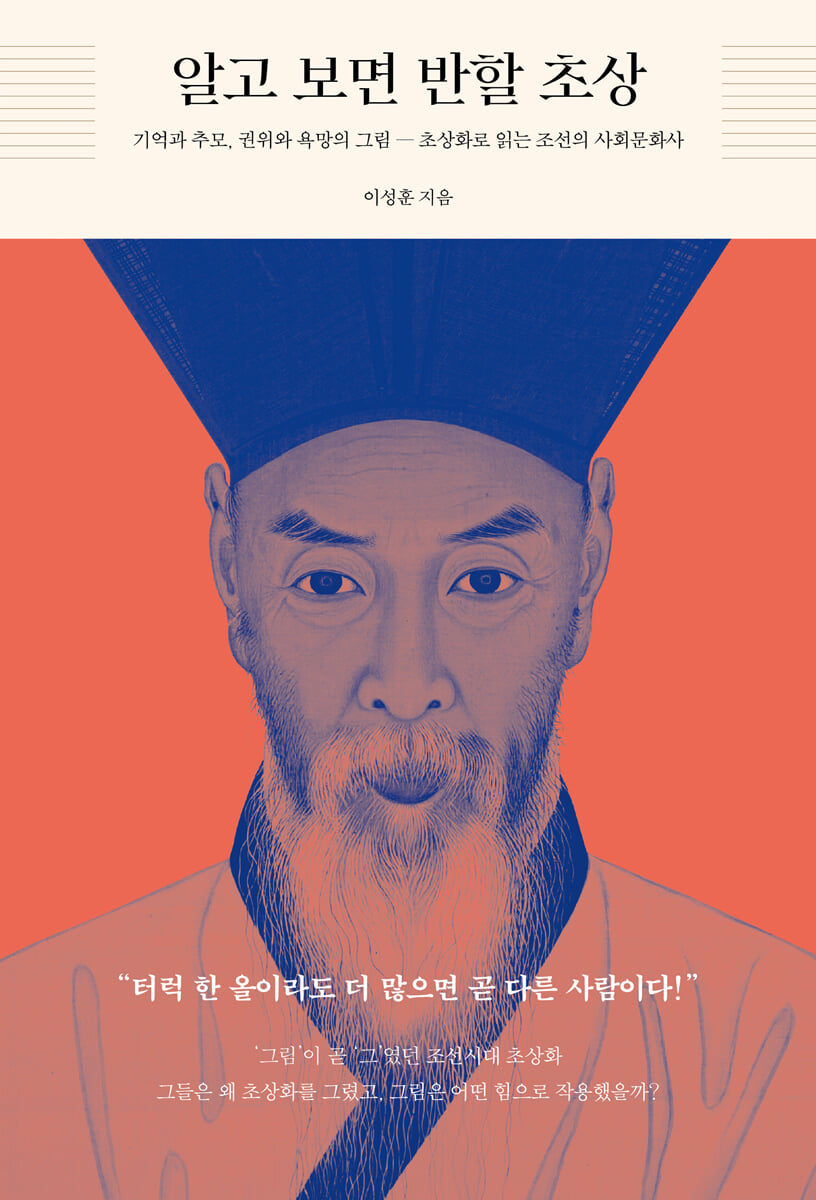
A portrait you'll fall in love with once you get to know it
 |
Description
Book Introduction
A Joseon Dynasty portrait that captures not only the appearance but also the spirit.
What stories are hidden behind these artistic paintings?
Joseon's political, social, and cultural landscape depicted in portraits
Why did Joseon Dynasty people paint portraits, and for what purpose did they use them? What impact did portraits have on people, and how did people utilize them? What efforts did painters put into portraying their subjects as they truly appeared, or was simply a good likeness enough? And did the subjects simply sit quietly, saying, "Please draw me a good picture!"?
This book traces and explains the politics, society, and culture of the Joseon Dynasty through various stories intertwined with portraits.
The author analyzes 120 portraits from the Joseon Dynasty one by one, from the ‘Eojin (御眞)’ that symbolizes the king’s authority, the ‘Portraits of Subjects’ bestowed by the king as a token of loyalty, the ‘Portraits of Teachers’ painted to show off the legitimacy of each political faction or school of thought, the ‘Portraits of Mokmin (government officials)’ that arose from the conflict of interest between local magistrates and the people, the ‘Portraits of the Nobles’ that depict the agony between going out to work (仕) and living in seclusion (隱逸), and the ‘Portraits of Friends and Family’ that depict love and mourning. He not only reveals the historical meaning and flow of art, but also traces the background in which the portraits were painted, what role the painted portraits played, what power they exerted, what were the perceptions of the people of the time who regarded portraits as something more than just pictures, and how the painted portraits were reflected in politics, society, and culture.
- You can preview some of the book's contents.
Preview
index
preface
prolog
When did humans start drawing portraits?
Early trends in Chinese portrait production
The beginning of portrait production in our country
Highly artistic portraits of the Joseon Dynasty
A representation of a specific person, but with a meaning beyond that
A painting that actively reflects the protagonist's intentions
1.
What is a portrait?
Figure 1: Pursuing 'Similarity': Similarity in appearance
Drawing to resemble, [Portrait of Lee Si-baek]
“If there’s even one more truck, it’s someone else.”
The difference between [Portrait of Jang Mal-son] and [Portrait of Lee Si-bang]
“A true king should have no shortcomings.”
A major change in portraiture techniques
Figure 2: Pursuing 'Similarity': Inner Similarity
Exaggerated descriptions, [Portrait of Song Si-yeol] and [Self-portrait of Yun Du-seo]
Capturing the Spirit: [Self-Portrait of Kang Se-hwang] and [Portrait of Seo Jik-su]
Revealing a kind personality, [Portrait of Kim Jeong-hui]
A painting imbued with 'spirit'
The Power of 'Shinmyeong': [Portrait of Lee Je-hyeon] and [Portrait of Ha-yeon]
[Portrait of Chae Je-gong] repainted after 7 years
A substitute for 'me'
2.
The power of portraits
The experience of 'welcome'
“The teacher is silent, and the student sheds tears.”
“It seems like you came from the nine springs.”
Enshrinement of portraits and construction of a shrine
[Portrait of An Hyang] at Sosu Seowon
[Portrait of Jeong Mong-ju] at Imgo Seowon and Sungyang Seowon
Portrait of Choi Chung at Nodong Seowon and Portrait of Confucius at Obong Seowon
The power of portraits of the sages
Portraits moved to shrines and spirit shrines
Kim Si-seup Yeongdang, Cheongilsa Temple, and Cheongjeolsa Temple
The story behind the construction of Poeun Seonsaeng Shrine
The politics of portrait enshrinement
From the memorial space to the sacrificial space
A space where you can feel the teacher's philosophy and thoughts
Production of a portrait of an aunt
Imobon, a characteristic of portrait production in the late Joseon Dynasty
[Portrait of An Hyang] The effort put into my aunt
[Portrait of An Hyang] The Full Story of the Re-Aunt Process
The value of enshrinement and preservation
3.
Paintings of memory and remembrance
Honoring the virtuous shepherd
Performing a ritual for a living shepherd
The portraits and portraits requested by Ming generals
The origin of the trend of creating Saengsadang, Lee Won-ik Saengsadang
The Saengsadang and their portraits built in Pyongyang
Portrait of a young shepherd painted by local painters
The harm caused by the proliferation of Saengsadang and the order to abolish it
Remembering the teacher
Portrait of Jang Hyeon-gwang, a scholar dedicated to his studies throughout his life.
The leader of the Noron faction, [Portrait of Song Si-yeol]
A secretly drawn portrait of the teacher, [Portrait of Yun Jeung]
Kwon Sang-ha's disciples, [Portrait of Han Won-jin] and [Portrait of Yun Bong-gu]
The most effective way to remember your teacher forever
Drawing beloved friends and family
The friend loved by Lee Seo and Yun Du-seo, [Portrait of Sim Deuk-gyeong]
A father painting his deceased son, [Portrait of Lee San-bae]
Drawing my 86-year-old mother, [Portrait of Mrs. Oh, Bokcheon]
A father-son collaboration, "The Seven-Minute War Chronicle"
4.
Records of the heyday
Grant a portrait to a meritorious subject
“Draw the portrait of the meritorious subject and make it widely known to future generations.”
Kim Man-gi and Kim Seok-ju, meritorious retainers of the Bosagongsin
King Yeongjo inspects portraits of meritorious subjects
“Repaint the portraits of the meritorious subjects.”
Portrait of Kwon Hee-hak and Chunghunbu and Portrait of Park Mun-su
Iconography and expressive forms of portraits of meritorious subjects
Treating an elderly subject with courtesy
The King's Admission to Giroso, the First in 300 Years: "Gihae Gisa Gyecheop"
King Yeongjo's admission to Giroso at the age of 51, "Gisa Gyeonghoecheop"
King Yeongjo made it a rule to produce portrait albums of elderly subjects.
Portraits of the remaining subjects of Giroso 1 - Lee San-du and Lee Ik-jeong
Portraits of the Remaining Officials of the Royal Secretariat, Part 2 - Kang Se-hwang and Gu Yun-myeong
Portraits of the remaining servants of Giroso, 3 - Kimchi-in and Chae Je-gong
Remembering the Wise and Loyal Subjects
[Portrait of Prince Yeoning] bestowed upon the prince by King Sukjong
Portraits of those who passed the military service examination
King Jeongjo frequently ordered the creation of portraits of his close officials.
Portrait of Chae Je-gong, King Jeongjo's favorite
The subjects' reactions to the king's portrait
《Haedong Jinshin Dosangcheop》 and 《Myeonghyeon Hwasangcheop》
Masterpieces of official portraits: [Portrait of Yoo Eon-ho] and [Portrait of Oh Jae-sun]
5.
A picture expressing 'me'
King Sukjong's portrait, the epitome of a sage king
Portraits and Expressions of Identity
King Sukjong ushered in a glorious era of royal portraits.
Until the production of [Portrait of King Sukjong] in 1713
The reason why King Sukjong devoted all his efforts to creating a perfect masterpiece
Portrait of King Jeongjo in military uniform, an expression of utmost filial piety
A clue to the portrait of King Jeongjo in military uniform: [Portrait of King Cheoljong] and [Portrait of Lee Chang-un]
The difference between [Portrait of Lee Chang-un] and [Portrait of Lee Sam]
Detailed elements of the portrait of King Jeongjo in military uniform - the cap, back panel, sword, and cap
To remain with my parents forever - Naengcheonjeong Pavilion and Hyeonryungwon Jaesil
The reason why King Jeongjo wore military uniform every time he visited Hyeonryungwon
Aspirations reflected in field clothes
The agony between 'going out' and 'seclusion'
Longing for a life of transcendence, [Portrait of Kim Jin]
“The body is empty, and the picture is not real.”
Yanggyeom and Jukseochodang
Longing for a life of seclusion, [Jo Jeong-man's Song Ha-an's Sikdo]
[Songgyedo], painted instead of a portrait, and [Geomseondo], filled with the sorrow of class discrimination
The meaning of deep clothing and wide head covering
“Neither the Way nor Zen, nor a hermit nor an outcast.”
“Who is this person wearing a royal robe and a robe of mourning?”
A painting that reveals 'me', a portrait with self-praise
Upper and lower garments and nansam (?衫)
Epilogue
Appendix - 14 other major portraits
Note
Find names of people and portraits
Detailed image

Publisher's Review
Drawing to resemble - “If there is even one more hair, it is a different person!”
The most important thing required of an artist commissioned to create a portrait during the Joseon Dynasty was to portray the subject so 'resembly' that anyone could immediately identify it.
That is why the words of Song Dynasty Confucian scholar Cheng Yi (程?) were often quoted: “If you have even one more hair, you will become a different person.”
Accordingly, painters made great progress in painting techniques by putting a lot of effort into drawing the protagonist's appearance more closely.
The author explains that there was a major change in the technique of expressing portraits around 1700, and that this change can be clearly seen in [Portrait of Kim Man-jung] (late 1600s) and [Portrait of Kim Jin-gyu] (1710s), which are believed to have been painted by Kim Jin-gyu.
Meanwhile, portrait techniques did not develop only toward drawing people closer to their actual appearance.
Kim Jin-yeo's [Portrait of Kwon Sang-ha] (1719) is considered a work of outstanding realistic reproduction skill as it well reflects Western chiaroscuro techniques, but Jin Jae-hae's [Portrait of Yu-su] (1726), painted later, does not reflect Western painting techniques and focuses on expressing warm skin tones.
As a result, [Portrait of Kwon Sang-ha] is realistic but portrayed as dark, while [Portrait of Yu Soo] is portrayed as having a very gentle personality.
Just as people today retouch their photos to hide wrinkles and blemishes on their faces, people at the time did not aim for realistic paintings.
Exposing the inner self through exaggerated descriptions - [Portrait of Song Si-yeol], [Portrait of Park Se-chae], [Self-portrait of Yun Du-seo]
As important as the appearance was the inner self, that is, the mental aspect of the protagonist, and at this time, there were many cases where the protagonist's unique aspects were intentionally exaggerated.
Representative examples include [Portrait of Song Si-yeol], which makes him look like a very strong-looking person with thick, winding wrinkles all over his face, thick red lips, a lush beard and eyebrows, and a large body, and [Portrait of Park Se-chae], which is depicted as having a very large build with broad shoulders and wide sleeves, so that his disciple said it had the “shape of a tall, large mountain.”
In particular, regarding [Yoon Du-seo's Self-Portrait], which is drawn with each hair of his beard growing from one ear to the other, neatly extending outward without being entangled, the author says, "Yoon Du-seo wanted to capture the academic and artistic achievements and the source of his confidence that he had built up throughout his life in his self-portrait, and he seemed to have believed that he could achieve this by expressing his beard in a way that seemed to radiate energy from his head (face)."
Portraits are soon to become 'substitutes for the protagonist' - [Portrait of An Hyang] Theft and Damage Case
People in the Joseon Dynasty perceived portraits drawn to resemble the subject as 'substitutes' for the subject.
In 1684, a thief broke into Sosu Seowon and stole the portrait of An Hyang that was enshrined there.
The thief damaged [the portrait of An Hyang] and abandoned it on the main road west of the town's castle.
At that time, as the region decided to re-establish Sunheungbu, many people were mobilized for forced labor as they independently built new government offices, and this led to widespread resentment among the people against the local yangban.
Prime Minister Nam Gu-man pointed out the people's resentment as the main cause of the theft and damage to An Hyang's portrait.
In other words, people at the time did not view An Hyang's portrait as a mere 'painting' that reproduced him, but rather as 'An Hyang' himself, and An Hyang was synonymous with the yangban nobility, so they expressed their dissatisfaction by damaging An Hyang's portrait.
The Politics of Portrait Enshrinement: The Power to Make Memorials More Passionate
After the mid-16th century, the Sarim faction, which suppressed the Hun-gu faction and seized power, began to actively pursue the work of honoring the sages, and as they built seowons (Confucian academies) across the country, they paid attention to the “power of portraits.”
It began to be recognized that portraits were an important medium that made the heart of admiring and honoring the sages more fervent.
In 1814, Kang Pil-hyo, a Confucian scholar of the Soron faction, said after seeing Yun Jeung's portrait at Yubong Yeongdang, "It was as if I were listening to the words of the previous teacher." Jang Hyeon-gwang, a Confucian scholar of the Namin faction who represented the 17th century, said after seeing Jeong Mong-ju's portrait, "Imagine going back to that time and it seems as if he has come out of the nine springs again." These are examples, and the author says that after the 16th century, portraits were not simply paintings that reproduced a specific person, but gained authority as objects of enshrinement comparable to ancestral tablets.
Portraits for the Saengsadang Shrine - A Product of Collusion Between the Mokmin Officials and the People
Many of the portraits of the Joseon Dynasty were not commissioned by the subject to be painted by an artist, but were 'painted' by people who wished to commemorate them.
Among these, there is a portrait called ‘Portrait for enshrinement in Saengsadang’, which was created by the people of a region to commemorate a governor who had carried out good governance in the region and left.
A sanctuary is a shrine built to hold memorial services for a person who is still alive.
The Saengsadang Shrine, built by local residents around 1595 for Pyeongan-gamsa Yi Won-ik, is considered to be the starting point. The author examines the origins and popularity of Saengsadang Shrine by examining portraits of Pyeongan-gamsa Heo Jeok, Yi Man-won, Hong Man-jo, and Pyeongyang Seoyun Seong Su-ung.
Meanwhile, the establishment of Saengsadang (shaman shrines) spread nationwide after the end of the 17th century, and during this period, the government repeatedly discussed the harmful effects of the indiscriminate establishment of Saengsadang.
In other words, local officials indiscriminately reduced taxes and gave out more favors than necessary in order to gain the reputation of being good officials, and the local residents built Saengsadang in return.
King Yeongjo ordered the demolition of all the monuments praising the virtues of the governors and the Saengsadang shrines built in Pyeongan Province after 1724.
In the end, the portraits for the Saengsadang shrine became special paintings that appeared in the 17th and 18th centuries.
A portrait of their teacher secretly painted by his disciples - [Portrait of Yun Jeung]
In the summer of 1711, Byeon Ryang, a painter at the Dohwaseo, painted two portraits of Yun Jeung.
The portrait production at this time was supervised by Yun Jeung's disciples.
When his disciples told Yun Jeung about their plan to create a portrait, he refused the offer, saying, “My father doesn’t even have a portrait, so how could I have one?”
So, while the disciples were holding a ceremony to celebrate the local feast, they had the painter Byeon Ryang enter the crowd and secretly draw a portrait of their teacher.
This is how Yun Dong-su was able to leave behind this record.
“With the help of heaven, I was able to draw a portrait of my teacher.
He has a face that clearly looks like yang energy nurturing all things, and he seems to be imbued with the energy of the spring breeze.
Even now, after his voice and form have vanished forever, I can still look up and admire him. His virtuous character is vague, but his spirit is reminiscent. I can hear his laughter and words, and it feels like I am receiving precious teachings.
“How could this not be a great blessing for the scholars and their followers?”
First, Yun Du-seo's masterpiece, a portrait of a deceased friend - [Portrait of Sim Deuk-gyeong]
Yun Du-seo completed [Portrait of Sim Deuk-gyeong] in November 1710, four months after his close friend Sim Deuk-gyeong passed away, imagining his appearance in his mind.
This portrait has two eulogies written by Lee Seo and Yun Du-seo.
Although Lee Seo was eleven years older than Shim Deok-gyeong and Yun Du-seo was five years older, they both considered Shim Deok-gyeong a friend.
About two months after Sim Deuk-gyeong's death, Lee Seo wrote in his memorial service, "Ah! I seem to have lost my mind after losing my ball.
I saw the ball from left and right, from front and back, from places we went back and forth together, in my dreams, and in vague conversations with adults.
Ah! When will I forget the appearance of the ball! When will I let go of the virtuous appearance of the ball!” he lamented, and later Yun Du-seo recreated the appearance of Sim Deuk-gyeong.
In the 『Yeonryeosil Technology』, it is written that “After Deokgyeong died, Duseo made a portrait of Deokgyeong and sent it to his house, and the whole family was shocked and cried.” This is an anecdote that allows us to guess at Yun Duseo’s skill in recreating the portrait so accurately.
A painting intended to forever preserve the image of her 86-year-old mother - [Portrait of Madam Oh, Bokcheon]
[Portrait of Lady Bokcheon Oh] (1761) is a portrait of Lady Dongbok Oh, the wife of Lee Jik, the Prince of Milchang, a representative royal figure during the reign of King Yeongjo, when she was 86 years old (Bokcheon is the old name of Dongbok, and refers to Dongbok-myeon, Hwasun-gun, Jeollanam-do).
This painting was commissioned by her son, Lee Ik-jeong, to be painted by Kang Se-hwang, a close friend of hers.
Kang Se-hwang, who believed that even the psychological aspects of a person could be captured in a painting through realistic representation, depicted Mrs. Oh as very small, thin, and sickly, just as she appeared at the time.
Her balding head, deep facial wrinkles, and slightly open left eye all clearly show her poor health.
Mrs. Oh died on March 13, 1762.
Assuming the painting was painted around September 1761, the year the portrait was created, it would mean that he died about six months after it was created.
The author assumes that Mrs. Oh's health was so poor at the time that she could not get out of bed, and that this picture was probably drawn because of "the feelings of her son, Lee Ik-jeong, who saw his mother, who was becoming thinner as time passed and had to stay in bed due to a chronic illness," and "the fear that he might not be able to see his mother again soon."
A collection of portraits filled with the sorrow of a father and son, "Chilbunjeonsincheop"
Painter Im Hee-su died on July 27, 1750, at the age of 18.
He left behind his only work, the "Seven-Part Transmission Album," and all 17 of the paintings in this album, except for [Kang Se-hwang's Self-Portrait] and one portrait of an unidentified person, were painted by Im Hee-su. The appendix was written by his father, Im Wi, in the process of decorating the album after Im Hee-su's death.
The most notable thing about this album are the five portraits of Im Wi, each with a slightly different facial expression.
The author views these paintings not as 'paintings in which Im Hee-su simply depicts her father's appearance', but as 'paintings completed after her father's repeated requests to perfectly reproduce his likeness'.
It is said that it is a product of the deep affection shared between rich people.
In particular, the unfinished portrait, in which only the outline of the face and the beard were roughly drawn with charcoal, was painted just 10 days before Im Hee-su's death. The record of his father, Im Wi, who said, "His hands were shaking, so he died before he could color it in using the Molgol method," is significant.
The author said, “After reading this appendix and looking at this portrait, the image of Im Hee-su trying to complete his father’s portrait despite his trembling hands due to poor health, and Im Wi watching him draw himself while anticipating his death, naturally overlaps.
He also says, “I can empathize with how heartbreaking it must have been for Imwi to look at the portrait of himself left behind by his beloved son after he passed away.”
King Sukjong, who devoted all his energy to creating his own masterpiece
King Sukjong is a very important figure in the study of portraits from the Joseon Dynasty.
Above all, by having his own portrait made on three occasions, he restored the practice of having a royal portrait made by a reigning king after nearly 200 years.
Almost all subsequent kings followed the royal portrait production practices and ceremonial procedures he established, producing numerous royal portraits during their reigns.
As a result, King Sukjong is evaluated as the king who brought an end to the so-called 'era of no kings' in the mid-Joseon period and opened the splendid 'era of kings' in the late Joseon period.
The author explains in detail the process by which King Sukjong created his portrait on three occasions, showing how deeply and how involved he was in the creation of the portrait.
Ultimately, the author says, King Sukjong would have earnestly hoped that his image would be accurately conveyed to future generations and subjects through a portrait that vividly portrayed his appearance, and that he would be remembered as a sage king like the kings who had great achievements in the early days of the nation, such as Taejo and Sejo.
Unfortunately, however, due to a fire in the royal relics warehouse in 1954, the portrait of him that was left intact has not been preserved to this day.
Portrait of a person wearing an unconventional hat and clothing
[Self-Portrait of Kang Se-hwang] is a representative work that is evaluated as strongly revealing the inner consciousness of the protagonist.
In this portrait, Kang Se-hwang is wearing a black gauze hat, a jade-colored robe, and a red belt around his waist.
However, the osa-mo is a hat worn by officials with their official uniform (danryeong), and the do-po is a type of wild clothing that is a general term for the clothes worn by the noblemen when they are away from their official posts.
The attire of the osamo and dopo is not appropriate for formal wear.
In the self-praise left on his self-portrait, Kang Se-hwang wrote, “I wore an official’s hat and field clothes.
“It seems that his heart is in the forest, but his name is on the list of the court.”
The author interprets the osamo as a symbol of ‘going out to work’ and the nightgown as a symbol of ‘seclusion,’ and explains that Kang Se-hwang “revealed his mental world, which was tormented between the conflicting values of going out to work and seclusion, by saying that his heart was in the forest but his name was on the royal list.”
In this way, we can see that portraits from the Joseon Dynasty were paintings that deeply reflected the subject's intentions, and were not simply drawn as they appeared.
The meaning of clothing expressed in portraits of Confucian scholars
In this book, the author devotes many pages to the meaning of clothing, especially as expressed in portraits of Confucian scholars from the Joseon Dynasty, and explains its meaning.
One of them is the 'deep robe and wide hat', which were widely recognized by the scholars of the Joseon Dynasty as the 'clothes' that symbolized Zhu Xi.
According to the author, the robe and hat in [Portrait of Song Si-yeol] are the attire that Song Si-yeol requested from the artist to symbolically show that he followed and inherited the learning of Zhu Xi throughout his life, and [Portrait of Yi Sam-hwan] and [Portrait of Yu Han-jun], which are painted in the same attire, can also be understood with the same meaning.
[Portrait of Lee Chae], painted in a nightgown (dopo) at Jeongjagwan, is also interpreted with the same meaning, and it is said that it can be assumed that Lee Chae was influenced by the portrait of his grandfather, Lee Jae, in leaving behind this portrait.
The author cautiously speculates that “he may have wanted to reveal the lineage of his family from his grandfather, Lee Jae, to himself, as well as his academic legitimacy, through the portrait of a man in a night gown.”
The subjects of Joseon Dynasty portraits believed that their images would remain forever through the painting.
That is why he tried to capture in his self-portrait what he desired and aspired for, as well as his own mental world, inner self, and thoughts.
In this way, for the Joseon Dynasty's aristocrats, portraits were a very useful and effective medium for visually expressing the self.
14 other major portraits
Although not covered in the main text, 14 portraits of art historical significance are introduced as an appendix at the end of the book.
[The portrait of Ambassador Samyeong] is one of the oldest surviving Korean portraits and is one of the most outstanding in its depiction style. [Portrait of Jo Yeong-bok] is a rare example of a Joseon Dynasty portrait in that it depicts both hands and each finger joint is depicted in detail, drawing attention.
[Portrait of Kim Ian] is very impressive for its depiction of the protagonist's unique appearance, including his tall stature, slender body, and sunken cheeks. [Portrait of King Gojong] is believed to be a portrait created by Chae Yong-shin, who had experience painting portraits of King Gojong during his lifetime, in response to the public's demand to commemorate King Gojong after the fall of the Korean Empire.
[Portrait of Choi Ik-hyeon], which depicts Choi Ik-hyeon preparing for battle against Japan by recruiting volunteers with a strong will in Jeolla Province in January and February 1906, approaches with a meaningful meaning along with the painful history, and [Portrait of Hwang Hyeon], which Chae Yong-shin produced after Hwang Hyeon's death based on a photograph taken at the Cheonnyeondang Photo Studio in Seoul in 1909, is unique in the unique production process.
GOODS SPECIFICS
- Date of issue: January 31, 2025
- Page count, weight, size: 456 pages | 686g | 155*225*28mm
- ISBN13: 9791168103320
- ISBN10: 1168103320
You may also like
카테고리
korean


korean


