

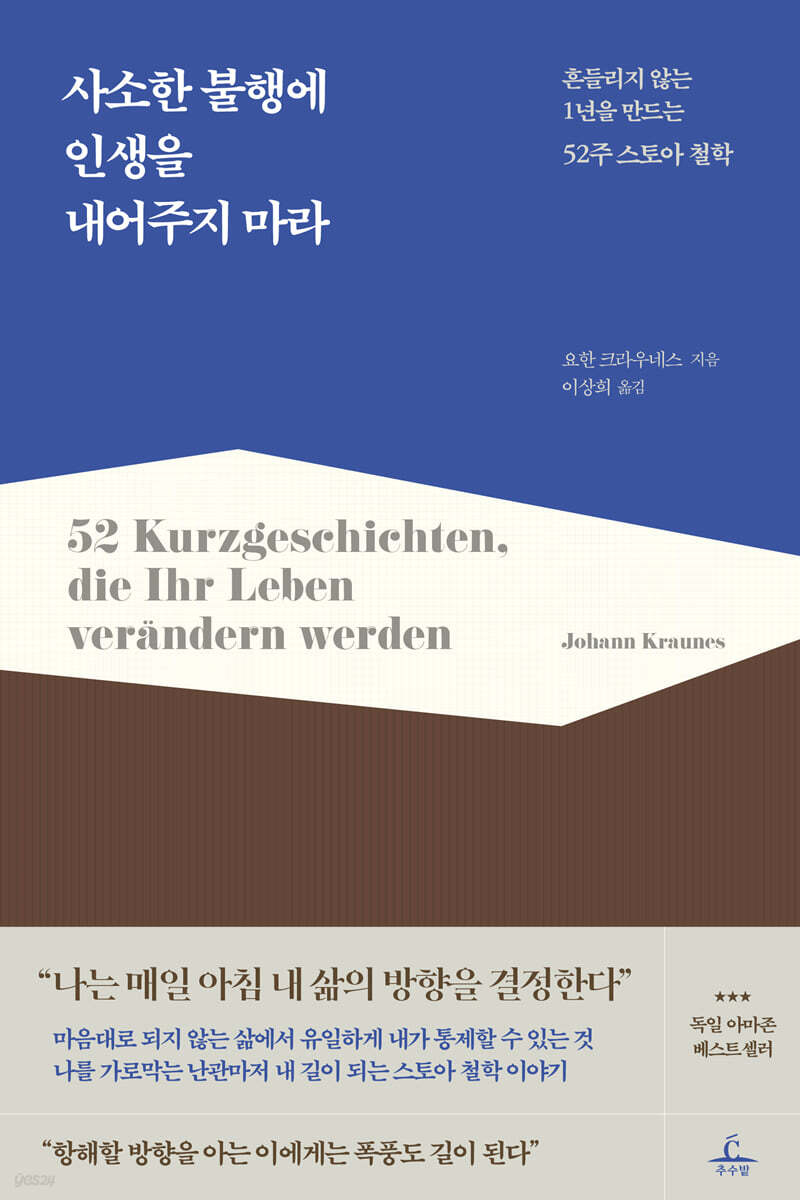
Don't give your life to petty misfortunes.
 |
Description
Book Introduction
- A word from MD
-
Moving forward without wavering, Stoic philosophyOf all the books introducing Stoic philosophy, this one is undoubtedly the best.
It explains the history and core concepts of Stoic philosophy in an easy-to-understand manner, and the text is filled with various fables, making it easy to read even for readers unfamiliar with philosophy.
Eudaimonia, the path to happiness, lies in Stoic philosophy.
December 20, 2024. Humanities PD Son Min-gyu
We present 52 Stoic philosophy stories that will help you cultivate inner strength that will not waver even in the midst of an unpredictable and uncertain life.
The wisdom of Stoic philosophers spanning thousands of years, including Aurelius, Seneca, and Epictetus, is conveyed through concise anecdotes and commentary that can be read once a week for a year.
This book offers readers time to instill in their lives the key aphorisms of each week, along with short stories filled with Stoic insights on equanimity, self-control, accepting the given situation, and staying present, along with commentary on how to apply them to our daily lives.
If you think about what each story means to you over the course of 52 weeks, you will be able to have a stronger year.
The wisdom of Stoic philosophers spanning thousands of years, including Aurelius, Seneca, and Epictetus, is conveyed through concise anecdotes and commentary that can be read once a week for a year.
This book offers readers time to instill in their lives the key aphorisms of each week, along with short stories filled with Stoic insights on equanimity, self-control, accepting the given situation, and staying present, along with commentary on how to apply them to our daily lives.
If you think about what each story means to you over the course of 52 weeks, you will be able to have a stronger year.
- You can preview some of the book's contents.
Preview
index
Enter the inner wisdom that is not easily shaken by the storms of life.
The World's Shortest Stoic Philosophy Lesson
The Core Teachings of Stoic Philosophy in 10 Sentences
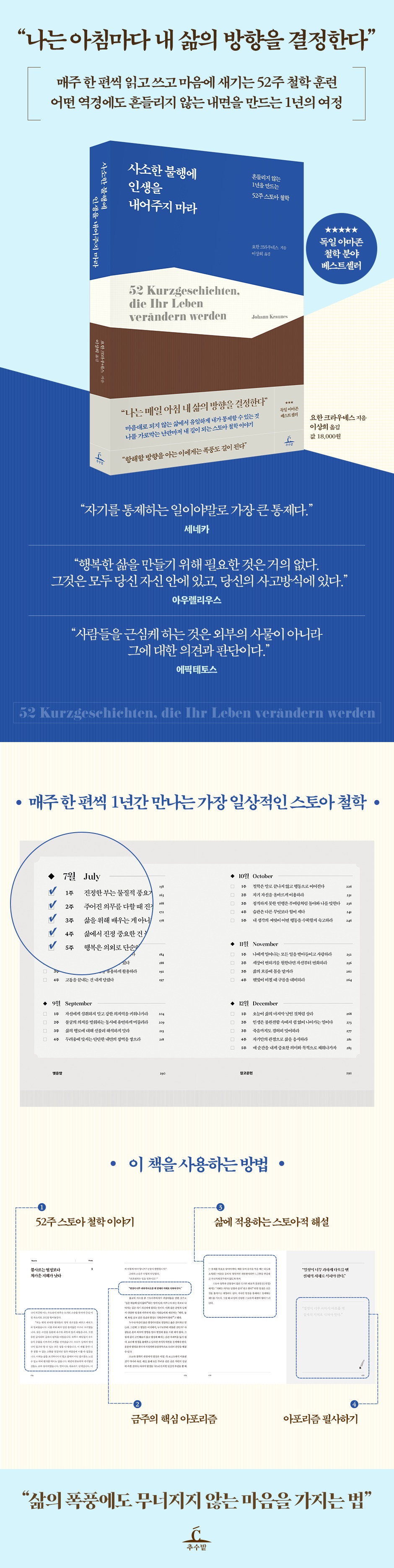
How to use this book
january
Week 1 - Start the year bravely
Week 2 - Think Before You Speak
Week 3 - Don't Ignore the Scales of Justice in Life
Week 4 - Knowing Yourself is the Root of All Wisdom
february
Week 1 - What to Fill in Your Life Jar First
2 weeks - The attitude of wanting to get it faster inevitably comes at a price.
Week 3 - The more we are fascinated by gold, the more we become slaves.
Week 4 - Let go of the illusion that you know yourself well.
March
Week 1 - Cold wisdom is better than burning passion.
Week 2 - Expect only the bare minimum, even at a lavish banquet.
3 weeks - Have everything without asking for anything
Week 4 - All the storms in life originate within me.
april
Week 1 - You don't always have to have an opinion.
2 weeks - The answer to all problems lies within me.
Week 3 - Passion for a life worth living is not a waste.
Week 4 - Unhappy thoughts lead to an unhappy life.
May
Week 1 - Focus on yourself to stay on the right path.
2 weeks - No one can judge my worth
Week 3 - Beauty comes from within, not from the outside.
Week 4 - If you think there's no tomorrow, you can live faithfully today.
Week 5 - Don't Lock Me in Repetitive Habits
June
Week 1 - Focus on finding the right solution rather than assigning blame for the problem.
Week 2 - Stop comparing your life to others.
Week 3 - Nothing in life is just given to you.
Week 4 - It's my mindset that determines the situation.
July
Week 1 - True wealth is not material abundance, but inner freedom.
2 weeks - True freedom comes when you fulfill your given duties.
Week 3 - Learn with life, not for life.
Week 4 - What is truly important in life is invisible to the eye.
Week 5 - Happiness is surprisingly simple.
August
Week 1 - When I feel confident in my life, constant joy comes.
2 weeks - No one is perfect, so we can grow.
Week 3 - Make the most of every moment and experience in your life.
Week 4 - It's up to me to end the suffering.
September
Week 1 - Don't be self-absorbed and develop strong willpower.
Week 2 - Stay flexible while demonstrating unwavering will.
Week 3 - Don't be hasty in interpreting your life's path.
Week 4 - Build a strong inner barrier against your fears.
october
Week 1 - Philosophy doesn't end with words, it leads to action.
Week 2 - Use Yourself Right
Week 3 - Dishonest words and actions come back to haunt me like a boomerang.
Week 4 - Great habits are more powerful than anything else.
Week 5 - Consider what actions the seeds of your thoughts will yield.
November
Week 1 - Accept and love everything that happens to me.
Week 2 - If you want to change the world, change yourself first.
Week 3 - Go with the flow of life
Week 4 - Be prepared for clouds when the sun shines
december
Week 1 - Live as if today were your last day.
2 weeks - Life is a constant process of moving forward amidst imperfection.
Week 3 - Embrace Death with Humility
Week 4 - Look at life from your own perspective.
Week 5 - Filling every moment with meaning and purpose that matters to me.
Conclusion
References
The World's Shortest Stoic Philosophy Lesson
The Core Teachings of Stoic Philosophy in 10 Sentences
How to use this book
january
Week 1 - Start the year bravely
Week 2 - Think Before You Speak
Week 3 - Don't Ignore the Scales of Justice in Life
Week 4 - Knowing Yourself is the Root of All Wisdom
february
Week 1 - What to Fill in Your Life Jar First
2 weeks - The attitude of wanting to get it faster inevitably comes at a price.
Week 3 - The more we are fascinated by gold, the more we become slaves.
Week 4 - Let go of the illusion that you know yourself well.
March
Week 1 - Cold wisdom is better than burning passion.
Week 2 - Expect only the bare minimum, even at a lavish banquet.
3 weeks - Have everything without asking for anything
Week 4 - All the storms in life originate within me.
april
Week 1 - You don't always have to have an opinion.
2 weeks - The answer to all problems lies within me.
Week 3 - Passion for a life worth living is not a waste.
Week 4 - Unhappy thoughts lead to an unhappy life.
May
Week 1 - Focus on yourself to stay on the right path.
2 weeks - No one can judge my worth
Week 3 - Beauty comes from within, not from the outside.
Week 4 - If you think there's no tomorrow, you can live faithfully today.
Week 5 - Don't Lock Me in Repetitive Habits
June
Week 1 - Focus on finding the right solution rather than assigning blame for the problem.
Week 2 - Stop comparing your life to others.
Week 3 - Nothing in life is just given to you.
Week 4 - It's my mindset that determines the situation.
July
Week 1 - True wealth is not material abundance, but inner freedom.
2 weeks - True freedom comes when you fulfill your given duties.
Week 3 - Learn with life, not for life.
Week 4 - What is truly important in life is invisible to the eye.
Week 5 - Happiness is surprisingly simple.
August
Week 1 - When I feel confident in my life, constant joy comes.
2 weeks - No one is perfect, so we can grow.
Week 3 - Make the most of every moment and experience in your life.
Week 4 - It's up to me to end the suffering.
September
Week 1 - Don't be self-absorbed and develop strong willpower.
Week 2 - Stay flexible while demonstrating unwavering will.
Week 3 - Don't be hasty in interpreting your life's path.
Week 4 - Build a strong inner barrier against your fears.
october
Week 1 - Philosophy doesn't end with words, it leads to action.
Week 2 - Use Yourself Right
Week 3 - Dishonest words and actions come back to haunt me like a boomerang.
Week 4 - Great habits are more powerful than anything else.
Week 5 - Consider what actions the seeds of your thoughts will yield.
November
Week 1 - Accept and love everything that happens to me.
Week 2 - If you want to change the world, change yourself first.
Week 3 - Go with the flow of life
Week 4 - Be prepared for clouds when the sun shines
december
Week 1 - Live as if today were your last day.
2 weeks - Life is a constant process of moving forward amidst imperfection.
Week 3 - Embrace Death with Humility
Week 4 - Look at life from your own perspective.
Week 5 - Filling every moment with meaning and purpose that matters to me.
Conclusion
References
Detailed image
Into the book
Wisdom comes from within us, not from without.
Just as simple acquisition of information is different from knowledge.
What is important here is the principle of organization, which involves properly discerning the information from the countless pieces of information spread out like a mosaic and accepting it in a form that fits my life in order to reach knowledge.
--- From "January, Week 4 - Knowing Yourself is the Root of All Wisdom"
But right action in the Stoic sense means always acting in a state of awareness in the present moment.
Therefore, the important thing is to think carefully about what tasks are given to me in life.
No, it might be more accurate to say that he gave himself a task.
Most people don't realize that many of the things they do every day are the result of decisions they make.
--- From "February, Week 1 - What to Fill in the Jar of Life First"
Every time you hope for something, you run the risk of being disappointed.
The more you want something, the greater the disappointment you feel when you don't get it.
There is probably no one who has not had this experience in their life.
People who live with excessive expectations and hopes waste precious time in life and only increase their inner emptiness.
Moreover, passions born of frustration can lead you down the wrong path without you even realizing it.
--- From "March, Week 3 - Having Everything Without Wanting Anything"
Practice observing what is happening without getting involved.
Let's distance ourselves mentally.
An important teaching of Stoic philosophy is that what makes people anxious is not external objects or situations, but rather their distorted judgments about them.
--- From "April, Week 1 - You Don't Always Have an Opinion"
If we interpret this in a Stoic way, it means that we must harvest the important moments of each day without missing them.
To do this, we need to do something just for ourselves or take a break from our daily routine and distance ourselves from our materialistic lives.
For a Stoic, keeping one's distance means sharpening one's perspective on things.
--- From "May, Week 4 - If You Think There Is No Tomorrow, You Can Be True to Today"
But if you go from A to B without knowing the intermediate path, you lose something important.
You are missing out on valuable experiences that could give you important insights between A and B.
Enlightenment can only be achieved through personal experience.
This also means that for those who practice Stoic philosophy, life must be acknowledged as a kind of struggle.
However, it is not a fight with others, but a fight with oneself, with one's uncontrolled impulses.
--- From "June, Week 3 - Nothing in Life Is Just Given"
Therefore, as a Stoic, in order to see reality with waking eyes, you must also learn to respect your intuition and instinctive feelings in everyday life.
Our sixth sense can be said to be a second brain that thinks along with our head.
Therefore, you can meaningfully complete the information and data you have already acquired through intuition.
--- From "July, Week 3 - Learning with Life, Not for Life"
People judge anything that is not perfect as useless and unnatural.
But that which is perfect, that which is smooth without any angularity, is no longer alive, nor does it possess creative vitality.
It is the imperfection that possesses a natural beauty, and rather than anything else, it captivates us and awakens our senses.
--- From "August, Week 2 - No One Can Grow Because They're Not Perfect"
We must follow our destiny, but we cannot look into the cards of destiny.
It's like driving down a dark country road at night.
Sitting in the driver's seat, we can only see the road ahead as much as the headlights illuminate.
However, if you keep running forward, the mileage will gradually accumulate.
Therefore, let us not try to interpret in advance the course of life, which we cannot know how it will unfold in the future.
--- From "September, Week 3 - Don't be hasty in interpreting the course of life"
In Stoic philosophy, honesty has several meanings.
This is because the word ‘honest’ also carries the meaning of ‘straightforward’ or ‘standing upright.’
For example, an honest person is considered to be upright, upright, and righteous.
--- From "October, Week 3 - Dishonest words and actions come back to haunt me like a boomerang"
The most important thing in life is to accept everything that surrounds me now.
Stoic philosophy calls this the 'art of conformity'.
Seneca said, “How foolish it is for us, who are not masters of tomorrow, to plan our lives.”
--- From "November, Week 1 - Accept and Love Everything That Happens to Me"
Only when we stand firm against the external distractions and temptations that distract us do we stop abandoning ourselves.
What matters is your experience and only that has value.
Even the experience and wisdom of the Stoic philosophers cannot take precedence over one's own.
Just as simple acquisition of information is different from knowledge.
What is important here is the principle of organization, which involves properly discerning the information from the countless pieces of information spread out like a mosaic and accepting it in a form that fits my life in order to reach knowledge.
--- From "January, Week 4 - Knowing Yourself is the Root of All Wisdom"
But right action in the Stoic sense means always acting in a state of awareness in the present moment.
Therefore, the important thing is to think carefully about what tasks are given to me in life.
No, it might be more accurate to say that he gave himself a task.
Most people don't realize that many of the things they do every day are the result of decisions they make.
--- From "February, Week 1 - What to Fill in the Jar of Life First"
Every time you hope for something, you run the risk of being disappointed.
The more you want something, the greater the disappointment you feel when you don't get it.
There is probably no one who has not had this experience in their life.
People who live with excessive expectations and hopes waste precious time in life and only increase their inner emptiness.
Moreover, passions born of frustration can lead you down the wrong path without you even realizing it.
--- From "March, Week 3 - Having Everything Without Wanting Anything"
Practice observing what is happening without getting involved.
Let's distance ourselves mentally.
An important teaching of Stoic philosophy is that what makes people anxious is not external objects or situations, but rather their distorted judgments about them.
--- From "April, Week 1 - You Don't Always Have an Opinion"
If we interpret this in a Stoic way, it means that we must harvest the important moments of each day without missing them.
To do this, we need to do something just for ourselves or take a break from our daily routine and distance ourselves from our materialistic lives.
For a Stoic, keeping one's distance means sharpening one's perspective on things.
--- From "May, Week 4 - If You Think There Is No Tomorrow, You Can Be True to Today"
But if you go from A to B without knowing the intermediate path, you lose something important.
You are missing out on valuable experiences that could give you important insights between A and B.
Enlightenment can only be achieved through personal experience.
This also means that for those who practice Stoic philosophy, life must be acknowledged as a kind of struggle.
However, it is not a fight with others, but a fight with oneself, with one's uncontrolled impulses.
--- From "June, Week 3 - Nothing in Life Is Just Given"
Therefore, as a Stoic, in order to see reality with waking eyes, you must also learn to respect your intuition and instinctive feelings in everyday life.
Our sixth sense can be said to be a second brain that thinks along with our head.
Therefore, you can meaningfully complete the information and data you have already acquired through intuition.
--- From "July, Week 3 - Learning with Life, Not for Life"
People judge anything that is not perfect as useless and unnatural.
But that which is perfect, that which is smooth without any angularity, is no longer alive, nor does it possess creative vitality.
It is the imperfection that possesses a natural beauty, and rather than anything else, it captivates us and awakens our senses.
--- From "August, Week 2 - No One Can Grow Because They're Not Perfect"
We must follow our destiny, but we cannot look into the cards of destiny.
It's like driving down a dark country road at night.
Sitting in the driver's seat, we can only see the road ahead as much as the headlights illuminate.
However, if you keep running forward, the mileage will gradually accumulate.
Therefore, let us not try to interpret in advance the course of life, which we cannot know how it will unfold in the future.
--- From "September, Week 3 - Don't be hasty in interpreting the course of life"
In Stoic philosophy, honesty has several meanings.
This is because the word ‘honest’ also carries the meaning of ‘straightforward’ or ‘standing upright.’
For example, an honest person is considered to be upright, upright, and righteous.
--- From "October, Week 3 - Dishonest words and actions come back to haunt me like a boomerang"
The most important thing in life is to accept everything that surrounds me now.
Stoic philosophy calls this the 'art of conformity'.
Seneca said, “How foolish it is for us, who are not masters of tomorrow, to plan our lives.”
--- From "November, Week 1 - Accept and Love Everything That Happens to Me"
Only when we stand firm against the external distractions and temptations that distract us do we stop abandoning ourselves.
What matters is your experience and only that has value.
Even the experience and wisdom of the Stoic philosophers cannot take precedence over one's own.
--- From "December, Week 4_Look at Life from Your Own Perspective"
Publisher's Review
★★★★★ German Amazon Philosophy Bestseller ★★★★★
“Even a storm becomes a path for those who know their course.”
Two thousand years of wisdom that creates an inner strength that is unshaken by any situation.
"A 52-week philosophy training program where you read, write, and memorize one piece each week."
The Teachings of Stoic Philosophy in 52 Stories and Commentaries
Life is full of things that don't go my way no matter how hard I try, and every day there are moments that shatter my inner peace.
In a world filled with people whose thoughts and standards of living differ so greatly from ours, what kind of mindset should we have as we navigate unpredictable lives? "Don't Surrender Your Life to Minor Misfortunes" presents 52 Stoic philosophy stories that will help us achieve a sense of unwavering composure in any situation.
Stoic philosophy recognizes the uncontrollable nature of life and the world, and guides us to maintain a calm attitude in any situation.
This book conveys the wisdom of Stoic philosophers such as Aurelius, Seneca, and Epictetus through concise anecdotes and commentary that can be read once a week for a year.
This book offers readers time to instill in their lives the key aphorisms of each week, along with short stories filled with Stoic insights on equanimity, self-control, accepting the given situation, and staying present, along with commentary on how to apply them to our daily lives.
If you reflect on what each story means to your life over the course of 52 weeks, you will be able to have a stronger year.
"The Attitude We Need in These Uncertain Times"
Finding meaning in everything you encounter in life
Even today, when science has advanced to the point where we can explore the vast universe using cutting-edge telescopes, our lives still remain an unsolved mystery.
Fundamental questions like 'Why do humans exist in this world and what do we live for?' are difficult to answer and can make us unhappy.
Moreover, in modern society, where the environment we live in and the values we pursue are rapidly changing due to rapid technological advancements, it is easy to lose the meaning of life.
We need a guide for life as we increasingly lose our way.
This book guides us to apply the principles of world and human life revealed in Stoic philosophy to each individual, so that we can live meaningful and happy lives.
According to Stoic philosophy, all things in the world are interconnected through meaningful meaning, and living in harmony with all of this is the ultimate goal and happiness.
So, what should we do to find meaning in the things we encounter in life and live a happy life?
“Accept your destiny and the twists and turns of life with grace.”
Cultivating a calm mind that won't be easily shaken by life's storms
This book teaches how to live a happy life, focusing on the core teachings of Stoic philosophy.
First, you must accept that everything that happens to you is a given fate and surrender to the flow of life.
In the process, we are encouraged to distinguish between what we can and cannot control, and to pay attention to what we can control: our inner voice.
Because while what happens is out of my control, I can choose how I perceive and react to it.
He emphasizes that we should not be overly elated or depressed by the good or bad fortune that comes with living together, and that we should not be overly proud or frustrated by success or failure, and that we should maintain composure in any situation.
The key is to realize that true happiness depends on yourself, not external factors.
In today's world, where it's easy to get lost amidst the endless stream of information and choices, practicing moving forward with your own inner principles rather than the standards of the outside world will help you develop a strong inner self that won't be easily shaken by any adversity.
“The answer to all problems lies within me.”
Look at life from your own perspective and be true to each moment.
The colorful stories in this book repeatedly emphasize the importance of the four cardinal virtues of Stoic philosophy: courage, temperance, justice, and wisdom.
The story of a man who is determined to become rich and ends up finding treasure demonstrates the courage to focus on his inner voice, while the story of a monk who struggles because he cannot reach enlightenment demonstrates the importance of moderating excessive passion and passion.
The anecdote of the farmer, who is not easily shaken by misfortune or good fortune, shows an attitude toward justice in life, and the story of the traveler who stole a precious jewel and then returned it shows that knowing oneself is the root of all wisdom.
He also generously shares Stoic wisdom, from the idea that the answers to all problems lie within oneself, to making possible changes rather than harboring vain hopes, to remaining faithful to the present rather than being bound by the past or future, to developing one's own perspective on life.
The book concludes the year with a message for the last week of December: "Let's fill every moment with meaning and purpose that matters to me."
If you build a strong inner self with this book for 52 weeks, every moment of your life will be filled with significant meaning as you welcome the new year.
“Even a storm becomes a path for those who know their course.”
Two thousand years of wisdom that creates an inner strength that is unshaken by any situation.
"A 52-week philosophy training program where you read, write, and memorize one piece each week."
The Teachings of Stoic Philosophy in 52 Stories and Commentaries
Life is full of things that don't go my way no matter how hard I try, and every day there are moments that shatter my inner peace.
In a world filled with people whose thoughts and standards of living differ so greatly from ours, what kind of mindset should we have as we navigate unpredictable lives? "Don't Surrender Your Life to Minor Misfortunes" presents 52 Stoic philosophy stories that will help us achieve a sense of unwavering composure in any situation.
Stoic philosophy recognizes the uncontrollable nature of life and the world, and guides us to maintain a calm attitude in any situation.
This book conveys the wisdom of Stoic philosophers such as Aurelius, Seneca, and Epictetus through concise anecdotes and commentary that can be read once a week for a year.
This book offers readers time to instill in their lives the key aphorisms of each week, along with short stories filled with Stoic insights on equanimity, self-control, accepting the given situation, and staying present, along with commentary on how to apply them to our daily lives.
If you reflect on what each story means to your life over the course of 52 weeks, you will be able to have a stronger year.
"The Attitude We Need in These Uncertain Times"
Finding meaning in everything you encounter in life
Even today, when science has advanced to the point where we can explore the vast universe using cutting-edge telescopes, our lives still remain an unsolved mystery.
Fundamental questions like 'Why do humans exist in this world and what do we live for?' are difficult to answer and can make us unhappy.
Moreover, in modern society, where the environment we live in and the values we pursue are rapidly changing due to rapid technological advancements, it is easy to lose the meaning of life.
We need a guide for life as we increasingly lose our way.
This book guides us to apply the principles of world and human life revealed in Stoic philosophy to each individual, so that we can live meaningful and happy lives.
According to Stoic philosophy, all things in the world are interconnected through meaningful meaning, and living in harmony with all of this is the ultimate goal and happiness.
So, what should we do to find meaning in the things we encounter in life and live a happy life?
“Accept your destiny and the twists and turns of life with grace.”
Cultivating a calm mind that won't be easily shaken by life's storms
This book teaches how to live a happy life, focusing on the core teachings of Stoic philosophy.
First, you must accept that everything that happens to you is a given fate and surrender to the flow of life.
In the process, we are encouraged to distinguish between what we can and cannot control, and to pay attention to what we can control: our inner voice.
Because while what happens is out of my control, I can choose how I perceive and react to it.
He emphasizes that we should not be overly elated or depressed by the good or bad fortune that comes with living together, and that we should not be overly proud or frustrated by success or failure, and that we should maintain composure in any situation.
The key is to realize that true happiness depends on yourself, not external factors.
In today's world, where it's easy to get lost amidst the endless stream of information and choices, practicing moving forward with your own inner principles rather than the standards of the outside world will help you develop a strong inner self that won't be easily shaken by any adversity.
“The answer to all problems lies within me.”
Look at life from your own perspective and be true to each moment.
The colorful stories in this book repeatedly emphasize the importance of the four cardinal virtues of Stoic philosophy: courage, temperance, justice, and wisdom.
The story of a man who is determined to become rich and ends up finding treasure demonstrates the courage to focus on his inner voice, while the story of a monk who struggles because he cannot reach enlightenment demonstrates the importance of moderating excessive passion and passion.
The anecdote of the farmer, who is not easily shaken by misfortune or good fortune, shows an attitude toward justice in life, and the story of the traveler who stole a precious jewel and then returned it shows that knowing oneself is the root of all wisdom.
He also generously shares Stoic wisdom, from the idea that the answers to all problems lie within oneself, to making possible changes rather than harboring vain hopes, to remaining faithful to the present rather than being bound by the past or future, to developing one's own perspective on life.
The book concludes the year with a message for the last week of December: "Let's fill every moment with meaning and purpose that matters to me."
If you build a strong inner self with this book for 52 weeks, every moment of your life will be filled with significant meaning as you welcome the new year.
GOODS SPECIFICS
- Date of issue: December 18, 2024
- Page count, weight, size: 304 pages | 480g | 140*210*20mm
- ISBN13: 9791155402436
- ISBN10: 115540243X
You may also like
카테고리
korean


korean

![ELLE 엘르 스페셜 에디션 A형 : 12월 [2025]](http://librairie.coreenne.fr/cdn/shop/files/b8e27a3de6c9538896439686c6b0e8fb.jpg?v=1766436872&width=3840)


