

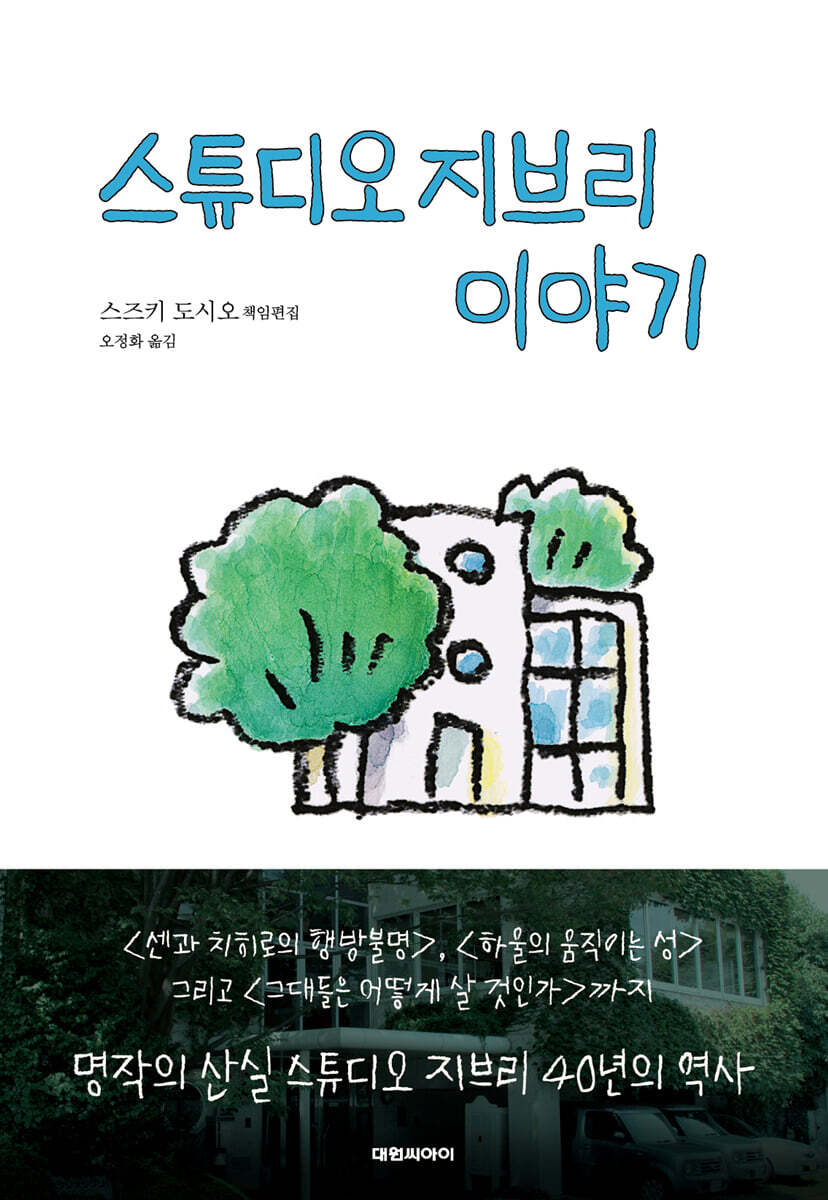
Studio Ghibli Story
 |
Description
Book Introduction
Producer Toshio Suzuki, Chief Editor
The story of 40 years of Ghibli is finally revealed.
Studio Ghibli was born from "Nausicaä of the Valley of the Wind."
A special creative group that has created numerous feature-length animations for nearly 40 years, their trajectory has been full of ups and downs.
A plan born from trial and error, a production site pressed for time, a promotional strategy that grasps the trends of the times, and a business environment that constantly bumps into the walls of reality.
It covers all the unique creative methods and management processes of each of the 27 works, including the behind-the-scenes story of the latest work, “How Will You Live?”, which was not included in the Japanese version.
This may be the last recorded statement from a Studio Ghibli character.
The story of 40 years of Ghibli is finally revealed.
Studio Ghibli was born from "Nausicaä of the Valley of the Wind."
A special creative group that has created numerous feature-length animations for nearly 40 years, their trajectory has been full of ups and downs.
A plan born from trial and error, a production site pressed for time, a promotional strategy that grasps the trends of the times, and a business environment that constantly bumps into the walls of reality.
It covers all the unique creative methods and management processes of each of the 27 works, including the behind-the-scenes story of the latest work, “How Will You Live?”, which was not included in the Japanese version.
This may be the last recorded statement from a Studio Ghibli character.
- You can preview some of the book's contents.
Preview
index
Chapter 1 From comic series to movie.
Nausicaä of the Valley of the Wind
Chapter 2: Establishing the Studio and "Castle in the Sky"
Chapter 3: Two films screened simultaneously, never before: "My Neighbor Totoro" and "Grave of the Fireflies."
Chapter 4: The Success of Kiki's Delivery Service and the Introduction of Studio Ghibli's Full-Time Employment System
Chapter 5: The Rebirth of Ghibli and "Same Old Days"
Chapter 6: "Porco Rosso," "I Hear the Sea," and the Establishment of a New Studio
Chapter 7: Operation Pom Poko and the Launch of the Filming Crew
Chapter 8: Yoshifumi Kondo's Directorial Debut, "Whisper of the Heart" and the Studio Ghibli Experimental Theater's "On Your Mark"
Chapter 9: The Unprecedented Masterpiece, Princess Mononoke
Chapter 10: The Challenge of Experimental Work "My Neighbor the Yamadas"
Chapter 11: The Incomparable Hit "Spirited Away"
Chapter 12: The Establishment of the Ghibli Museum in Mitaka and the Death of Yasuyoshi Tokuma
Chapter 13: Two Films by New Directors: The Cat Returns and Gibre's Episode 2
Chapter 14: Howl's Moving Castle and Ghibli's Independence Reflecting the Times
Chapter 15: Rookie Director Goro Miyazaki's "Legends of Earthsea"
Chapter 16: Ponyo on the Cliff by the Sea: A Surprise Full of Hand-Drawn Wonders
Chapter 17: Yonebayashi Hiromasa's "Arrietty"
Chapter 18: From Up on Poppy Hill: Created in the Whirlwind of Era of Change
Chapter 19: The Wind Blows: A Pour of All Its Energy, and Its Retirement and Restart
Chapter 20: The Tale of Princess Kaguya, Eight Years in the Making
Chapter 21: The New Production System Centered on Young Directors: "When Marnie Was There"
Chapter 22: The Red Turtle, Supported and Led by Isao Takahata
Chapter 23: Ghibli's First 3D CG Work, "Aya and the Witch"
Chapter 24: Hayao Miyazaki's New Challenge: "How Do You Live?"
Chapter 25: The Opening of Ghibli Park and the Grouping of Nippon TV
The End Doesn't Matter (Studio Ghibli, Toshio Suzuki)
References
Studio Ghibli Timeline
Nausicaä of the Valley of the Wind
Chapter 2: Establishing the Studio and "Castle in the Sky"
Chapter 3: Two films screened simultaneously, never before: "My Neighbor Totoro" and "Grave of the Fireflies."
Chapter 4: The Success of Kiki's Delivery Service and the Introduction of Studio Ghibli's Full-Time Employment System
Chapter 5: The Rebirth of Ghibli and "Same Old Days"
Chapter 6: "Porco Rosso," "I Hear the Sea," and the Establishment of a New Studio
Chapter 7: Operation Pom Poko and the Launch of the Filming Crew
Chapter 8: Yoshifumi Kondo's Directorial Debut, "Whisper of the Heart" and the Studio Ghibli Experimental Theater's "On Your Mark"
Chapter 9: The Unprecedented Masterpiece, Princess Mononoke
Chapter 10: The Challenge of Experimental Work "My Neighbor the Yamadas"
Chapter 11: The Incomparable Hit "Spirited Away"
Chapter 12: The Establishment of the Ghibli Museum in Mitaka and the Death of Yasuyoshi Tokuma
Chapter 13: Two Films by New Directors: The Cat Returns and Gibre's Episode 2
Chapter 14: Howl's Moving Castle and Ghibli's Independence Reflecting the Times
Chapter 15: Rookie Director Goro Miyazaki's "Legends of Earthsea"
Chapter 16: Ponyo on the Cliff by the Sea: A Surprise Full of Hand-Drawn Wonders
Chapter 17: Yonebayashi Hiromasa's "Arrietty"
Chapter 18: From Up on Poppy Hill: Created in the Whirlwind of Era of Change
Chapter 19: The Wind Blows: A Pour of All Its Energy, and Its Retirement and Restart
Chapter 20: The Tale of Princess Kaguya, Eight Years in the Making
Chapter 21: The New Production System Centered on Young Directors: "When Marnie Was There"
Chapter 22: The Red Turtle, Supported and Led by Isao Takahata
Chapter 23: Ghibli's First 3D CG Work, "Aya and the Witch"
Chapter 24: Hayao Miyazaki's New Challenge: "How Do You Live?"
Chapter 25: The Opening of Ghibli Park and the Grouping of Nippon TV
The End Doesn't Matter (Studio Ghibli, Toshio Suzuki)
References
Studio Ghibli Timeline
Detailed image

Into the book
The contact between the editorial staff of Animeju and Takahata and Miyazaki dates back to the first issue of Animeju (July 1978).
The opportunity came when Toshio Suzuki, who was the deputy editor-in-chief of Animeju at the time, approached them about covering “Horus the Great Adventure,” in which the two had participated, in a corner called “Encore Animation.”
At that time, Animeju, which had been refused an interview by Takahata and Miyazaki, actively covered Miyazaki's "Lupin III: The Castle of Cagliostro" and Takahata's "Little Lady Chie" in its print edition.
In this way, the Animeju editorial department gradually developed a deep bond with Takahata, Miyazaki, and Yasuo Otsuka, a senior whom the two met while working at Toei Douga (now Toei Animation) and the animation director of Lupin III: The Castle of Cagliostro and Little Lady Chie.
--- p.9
Miyazaki began to envision a grand-scale manga series, which became the current manga, Nausicaä.
The general direction of the series was decided, but I also had to decide what style of drawing to use.
Miyazaki called Suzuki to his personal office, Nibariki, in Asagaya, Tokyo, and showed him three different types of manga with different drawing styles.
The first is a meticulous and detailed drawing method, which Miyazaki said made it difficult to draw even one page a day using this method.
Secondly, he showed a simple, non-specific drawing style and said that he could draw about 30 pages a day like this.
And the last one was somewhere in between the first and second.
In response to Miyazaki's suggestion, Suzuki chose the first, meticulous drawing style.
Believing that the quality of the manga itself should be prioritized over productivity, Suzuki did not hesitate in his choice.
--- p.11
President Yasuyoshi Tokuma is a truly unique and interesting person.
If "Nausicaä of the Valley of the Wind" was such a huge hit, wouldn't they usually be making a sequel? But I'm not the type of person who says that.
And I didn't even tell you to make something else.
There was no order.
So, the movie “Nausicaä of the Valley of the Wind” was made so that director Miya could receive money.
That's what I did.
That was a whopping 60 million yen.
When Miya saw the money, she was shocked.
“Mr. Suzuki, what should we do now?” (laughter).
He said that if I built a new house with that money, my staff would think I was stupid and I wouldn't be able to buy a new car.
At that time, there was a plan to produce a youth film like "Blue Mountains" set in Yanagawa, a small provincial town, centered around Mr. Takahata.
Mr. Ogata brought up the idea of wanting to try “Blue Mountain Range.”
--- p.25
What is it about Princess Mononoke that draws audiences? Director Miyazaki has been asked this question many times, and he says, "Nothing has been finalized.
I feel like I've opened up a strange part of my head, and I can't seem to get my thoughts together.
He did not give a clear answer, saying, “It has been like that until now, but this time it was especially long.”
Before its release, there were many reviews saying, "This movie is too difficult for children."
Several letters arrived at Studio Ghibli, to which Director Miyazaki belongs, saying, "I didn't understand it, so I'm going to watch it again."
--- p.186
On the other hand, while producing Princess Mononoke, the environment surrounding Ghibli changed significantly.
It's a partnership with Disney.
On July 23, 1996, the Tokuma Group announced a partnership with Disney.
Accordingly, in October, Tokuma International, the overseas division, was established.
The origins of the partnership date back to 1994.
Koji Hoshino, who was the Japanese representative for Buena Vista Home Entertainment (BVHE), Walt Disney's video division, approached Studio Ghibli, saying, "I want to make a series of Ghibli works into a low-priced video series and release them. Would you mind selling the rights?"
--- p.190
Lasseter and Miyazaki have a long history of collaboration. Lasseter, originally an animator at Disney, became a passionate fan of Miyazaki after seeing Lupin the Third: The Castle of Cagliostro and becoming convinced that he could make an animated film that both adults and children could enjoy.
After meeting Miyazaki, who had come to the United States in 1982 for Tokyo Movie Shrine (today TMS Entertainment)'s Japanese-American joint project Little Nemo, Lasseter was assigned to work on a full CG short film at Pixar.
Later, when Lasseter visited Japan for the 1987 Hiroshima International Animation Festival, he also visited Studio Ghibli, which was producing My Neighbor Totoro.
As it passed through Lasseter's hands, the English version of Spirited Away became a work that required a lot of care, down to every single line.
Spirited Away, which received high praise at various film awards in Japan, also received good reviews in the United States.
It won the National Society of Film Critics Award, Los Angeles Film Critics Award, and New York Film Critics Circle Award for animation in succession, and in February 2003, it won four categories, including Best Director and Best Screenplay, at the Annie Awards (hosted by the International Animated Film Association), known as the "Academy Awards of the Animation World."
In March 2003, it won the Academy Award for Best Animated Feature Film, beating out Disney's Lilo Stitch and Treasure Island.
--- p.238
The person in charge of the theme song is Kenshi Yonezu.
This is the first time in a Ghibli work that a major popular artist has been commissioned to compose a new song.
Originally, Yonezu was a fan of Hayao Miyazaki.
As mentioned earlier, Studio Ghibli's monthly magazine, "Yokohama," planned a special feature on "Boro the Furry Bug" in the March 2018 issue, and planned to publish an interview with Yonezu.
The first contact from Studio Ghibli was to ask Yonezu for his thoughts after watching the preview.
Yonezu first met Miyazaki when he visited Ghibli for that interview.
Afterwards, Yonezu appeared on Toshio Suzuki's radio program "Suzuki Toshio's Ghibli Sweat" in July and August 2018, and by that time, Suzuki had already started thinking about asking Yonezu to write the theme song for "How Do You Live?"
The opportunity came when Toshio Suzuki, who was the deputy editor-in-chief of Animeju at the time, approached them about covering “Horus the Great Adventure,” in which the two had participated, in a corner called “Encore Animation.”
At that time, Animeju, which had been refused an interview by Takahata and Miyazaki, actively covered Miyazaki's "Lupin III: The Castle of Cagliostro" and Takahata's "Little Lady Chie" in its print edition.
In this way, the Animeju editorial department gradually developed a deep bond with Takahata, Miyazaki, and Yasuo Otsuka, a senior whom the two met while working at Toei Douga (now Toei Animation) and the animation director of Lupin III: The Castle of Cagliostro and Little Lady Chie.
--- p.9
Miyazaki began to envision a grand-scale manga series, which became the current manga, Nausicaä.
The general direction of the series was decided, but I also had to decide what style of drawing to use.
Miyazaki called Suzuki to his personal office, Nibariki, in Asagaya, Tokyo, and showed him three different types of manga with different drawing styles.
The first is a meticulous and detailed drawing method, which Miyazaki said made it difficult to draw even one page a day using this method.
Secondly, he showed a simple, non-specific drawing style and said that he could draw about 30 pages a day like this.
And the last one was somewhere in between the first and second.
In response to Miyazaki's suggestion, Suzuki chose the first, meticulous drawing style.
Believing that the quality of the manga itself should be prioritized over productivity, Suzuki did not hesitate in his choice.
--- p.11
President Yasuyoshi Tokuma is a truly unique and interesting person.
If "Nausicaä of the Valley of the Wind" was such a huge hit, wouldn't they usually be making a sequel? But I'm not the type of person who says that.
And I didn't even tell you to make something else.
There was no order.
So, the movie “Nausicaä of the Valley of the Wind” was made so that director Miya could receive money.
That's what I did.
That was a whopping 60 million yen.
When Miya saw the money, she was shocked.
“Mr. Suzuki, what should we do now?” (laughter).
He said that if I built a new house with that money, my staff would think I was stupid and I wouldn't be able to buy a new car.
At that time, there was a plan to produce a youth film like "Blue Mountains" set in Yanagawa, a small provincial town, centered around Mr. Takahata.
Mr. Ogata brought up the idea of wanting to try “Blue Mountain Range.”
--- p.25
What is it about Princess Mononoke that draws audiences? Director Miyazaki has been asked this question many times, and he says, "Nothing has been finalized.
I feel like I've opened up a strange part of my head, and I can't seem to get my thoughts together.
He did not give a clear answer, saying, “It has been like that until now, but this time it was especially long.”
Before its release, there were many reviews saying, "This movie is too difficult for children."
Several letters arrived at Studio Ghibli, to which Director Miyazaki belongs, saying, "I didn't understand it, so I'm going to watch it again."
--- p.186
On the other hand, while producing Princess Mononoke, the environment surrounding Ghibli changed significantly.
It's a partnership with Disney.
On July 23, 1996, the Tokuma Group announced a partnership with Disney.
Accordingly, in October, Tokuma International, the overseas division, was established.
The origins of the partnership date back to 1994.
Koji Hoshino, who was the Japanese representative for Buena Vista Home Entertainment (BVHE), Walt Disney's video division, approached Studio Ghibli, saying, "I want to make a series of Ghibli works into a low-priced video series and release them. Would you mind selling the rights?"
--- p.190
Lasseter and Miyazaki have a long history of collaboration. Lasseter, originally an animator at Disney, became a passionate fan of Miyazaki after seeing Lupin the Third: The Castle of Cagliostro and becoming convinced that he could make an animated film that both adults and children could enjoy.
After meeting Miyazaki, who had come to the United States in 1982 for Tokyo Movie Shrine (today TMS Entertainment)'s Japanese-American joint project Little Nemo, Lasseter was assigned to work on a full CG short film at Pixar.
Later, when Lasseter visited Japan for the 1987 Hiroshima International Animation Festival, he also visited Studio Ghibli, which was producing My Neighbor Totoro.
As it passed through Lasseter's hands, the English version of Spirited Away became a work that required a lot of care, down to every single line.
Spirited Away, which received high praise at various film awards in Japan, also received good reviews in the United States.
It won the National Society of Film Critics Award, Los Angeles Film Critics Award, and New York Film Critics Circle Award for animation in succession, and in February 2003, it won four categories, including Best Director and Best Screenplay, at the Annie Awards (hosted by the International Animated Film Association), known as the "Academy Awards of the Animation World."
In March 2003, it won the Academy Award for Best Animated Feature Film, beating out Disney's Lilo Stitch and Treasure Island.
--- p.238
The person in charge of the theme song is Kenshi Yonezu.
This is the first time in a Ghibli work that a major popular artist has been commissioned to compose a new song.
Originally, Yonezu was a fan of Hayao Miyazaki.
As mentioned earlier, Studio Ghibli's monthly magazine, "Yokohama," planned a special feature on "Boro the Furry Bug" in the March 2018 issue, and planned to publish an interview with Yonezu.
The first contact from Studio Ghibli was to ask Yonezu for his thoughts after watching the preview.
Yonezu first met Miyazaki when he visited Ghibli for that interview.
Afterwards, Yonezu appeared on Toshio Suzuki's radio program "Suzuki Toshio's Ghibli Sweat" in July and August 2018, and by that time, Suzuki had already started thinking about asking Yonezu to write the theme song for "How Do You Live?"
--- p.499
Publisher's Review
From Nausicaä of the Valley of the Wind to How Do You Live?
Studio Ghibli, the birthplace of masterpieces, has a 40-year history.
On March 11, 1984, the film Nausicaä of the Valley of the Wind was released in Toei Film theaters across Japan.
It was jointly produced by publisher Tokuma Shoten and advertising agency Hakuhodo, and the original work, screenplay, and direction were done by animation film director Hayao Miyazaki.
Additionally, animation director Isao Takahata, who has worked with Miyazaki, is listed as a producer, and Toshio Suzuki, who is currently a producer at Studio Ghibli, is also listed as a member of the production committee.
Studio Ghibli, an animation studio that began operations in 1985, has produced numerous feature-length animations, including "How Do You Live?", which was released in Japan in July 2023.
Nausicaä of the Valley of the Wind (1984)
1986 Castle in the Sky
1988 My Neighbor Totoro
Grave of the Fireflies (1988)
1989 Kiki's Delivery Service
1991 Memories Drop by Drop
1992 Red Pig
1993 I Can Hear the Sea
1994 Pom Poko Operation
1995 If you listen closely
1995 On Your Ma
1997 Princess Mononoke
1999 My Neighbor the Yamadas
2001 Spirited Away
2002 The Cat's Repayment
2004 Howl's Moving Castle
2006 Gadgeon Chronicles: Legends of Earthsea
Ponyo on the Cliff by the Sea (2008)
Arrietty Under the Floor 2010
From Up on Poppy Hill 2011
The Wind Blows 2013
The Tale of the Princess Kaguya (2013)
2014 Memories of Money
2016 Red Turtle
2021 Aya and the Witch
How will you live in 2023?
As you can see from the list of works, Studio Ghibli has been consistently releasing one or two new works every year or two since the mid-1980s.
It's an amazing speed, and the level of completion hasn't dropped either.
However, from the mid-2010s, the pace of publication began to noticeably slow down, and "How Will You Live" took an extremely long time to produce.
A record of Ghibli history that must be preserved right now
The story they tell themselves, which may be their last.
Among the three signboards that come to mind when thinking of 'Studio Ghibli', director Hayao Miyazaki was born in 1941, director Isao Takahata in 1935, and producer Toshio Suzuki in 1948.
It's not a young age at all.
Director Isao Takahata left for a place of no return in 2018.
Director Hayao Miyazaki is said to be the type of person who does not look back on the past.
Even at a mature age, he always looks to the future and values how to live in the present moment.
So it is producer Toshio Suzuki's role to document the history of Studio Ghibli.
“The important thing is that Mr. Suzuki remembers.” Producer Toshio Suzuki, who thought that he would not be able to keep Hayao Miyazaki’s words if he delayed any longer, began planning this book.
Although numerous books about Studio Ghibli have been published, none have presented a coherent chronological account of the company's history.
Animation critic Ryota Fujitsu and Studio Ghibli's Shinsuke Nonaka participated in the writing, while Takuya Kikuchi of Studio Ghibli Publishing was in charge of editing, and producer Toshio Suzuki played the role of 'responsible editor' by spending in-depth time with them, sleeping and waking up together.
Director Hayao Miyazaki is said to have reversed his retirement and begun planning a new work.
But we don't know when the new work will come to us.
It's fortunate that a book has been published that documents the creation and process of this masterpiece, directly from Studio Ghibli's perspective.
It will be a particularly inspiring time to look back on the story of Studio Ghibli, which has left behind one of the greatest achievements in animation history and influenced the world from the 20th to the 21st century.
Studio Ghibli, the birthplace of masterpieces, has a 40-year history.
On March 11, 1984, the film Nausicaä of the Valley of the Wind was released in Toei Film theaters across Japan.
It was jointly produced by publisher Tokuma Shoten and advertising agency Hakuhodo, and the original work, screenplay, and direction were done by animation film director Hayao Miyazaki.
Additionally, animation director Isao Takahata, who has worked with Miyazaki, is listed as a producer, and Toshio Suzuki, who is currently a producer at Studio Ghibli, is also listed as a member of the production committee.
Studio Ghibli, an animation studio that began operations in 1985, has produced numerous feature-length animations, including "How Do You Live?", which was released in Japan in July 2023.
Nausicaä of the Valley of the Wind (1984)
1986 Castle in the Sky
1988 My Neighbor Totoro
Grave of the Fireflies (1988)
1989 Kiki's Delivery Service
1991 Memories Drop by Drop
1992 Red Pig
1993 I Can Hear the Sea
1994 Pom Poko Operation
1995 If you listen closely
1995 On Your Ma
1997 Princess Mononoke
1999 My Neighbor the Yamadas
2001 Spirited Away
2002 The Cat's Repayment
2004 Howl's Moving Castle
2006 Gadgeon Chronicles: Legends of Earthsea
Ponyo on the Cliff by the Sea (2008)
Arrietty Under the Floor 2010
From Up on Poppy Hill 2011
The Wind Blows 2013
The Tale of the Princess Kaguya (2013)
2014 Memories of Money
2016 Red Turtle
2021 Aya and the Witch
How will you live in 2023?
As you can see from the list of works, Studio Ghibli has been consistently releasing one or two new works every year or two since the mid-1980s.
It's an amazing speed, and the level of completion hasn't dropped either.
However, from the mid-2010s, the pace of publication began to noticeably slow down, and "How Will You Live" took an extremely long time to produce.
A record of Ghibli history that must be preserved right now
The story they tell themselves, which may be their last.
Among the three signboards that come to mind when thinking of 'Studio Ghibli', director Hayao Miyazaki was born in 1941, director Isao Takahata in 1935, and producer Toshio Suzuki in 1948.
It's not a young age at all.
Director Isao Takahata left for a place of no return in 2018.
Director Hayao Miyazaki is said to be the type of person who does not look back on the past.
Even at a mature age, he always looks to the future and values how to live in the present moment.
So it is producer Toshio Suzuki's role to document the history of Studio Ghibli.
“The important thing is that Mr. Suzuki remembers.” Producer Toshio Suzuki, who thought that he would not be able to keep Hayao Miyazaki’s words if he delayed any longer, began planning this book.
Although numerous books about Studio Ghibli have been published, none have presented a coherent chronological account of the company's history.
Animation critic Ryota Fujitsu and Studio Ghibli's Shinsuke Nonaka participated in the writing, while Takuya Kikuchi of Studio Ghibli Publishing was in charge of editing, and producer Toshio Suzuki played the role of 'responsible editor' by spending in-depth time with them, sleeping and waking up together.
Director Hayao Miyazaki is said to have reversed his retirement and begun planning a new work.
But we don't know when the new work will come to us.
It's fortunate that a book has been published that documents the creation and process of this masterpiece, directly from Studio Ghibli's perspective.
It will be a particularly inspiring time to look back on the story of Studio Ghibli, which has left behind one of the greatest achievements in animation history and influenced the world from the 20th to the 21st century.
GOODS SPECIFICS
- Date of issue: January 31, 2025
- Page count, weight, size: 532 pages | 866g | 147*213*31mm
- ISBN13: 9791142303883
- ISBN10: 1142303888
You may also like
카테고리
korean


korean

![GQ KOREA Mark (Monthly): December [2025]](http://librairie.coreenne.fr/cdn/shop/files/8ef265dbbfbf186523ed75ba7319009d.jpg?v=1765340328&width=3840)


