

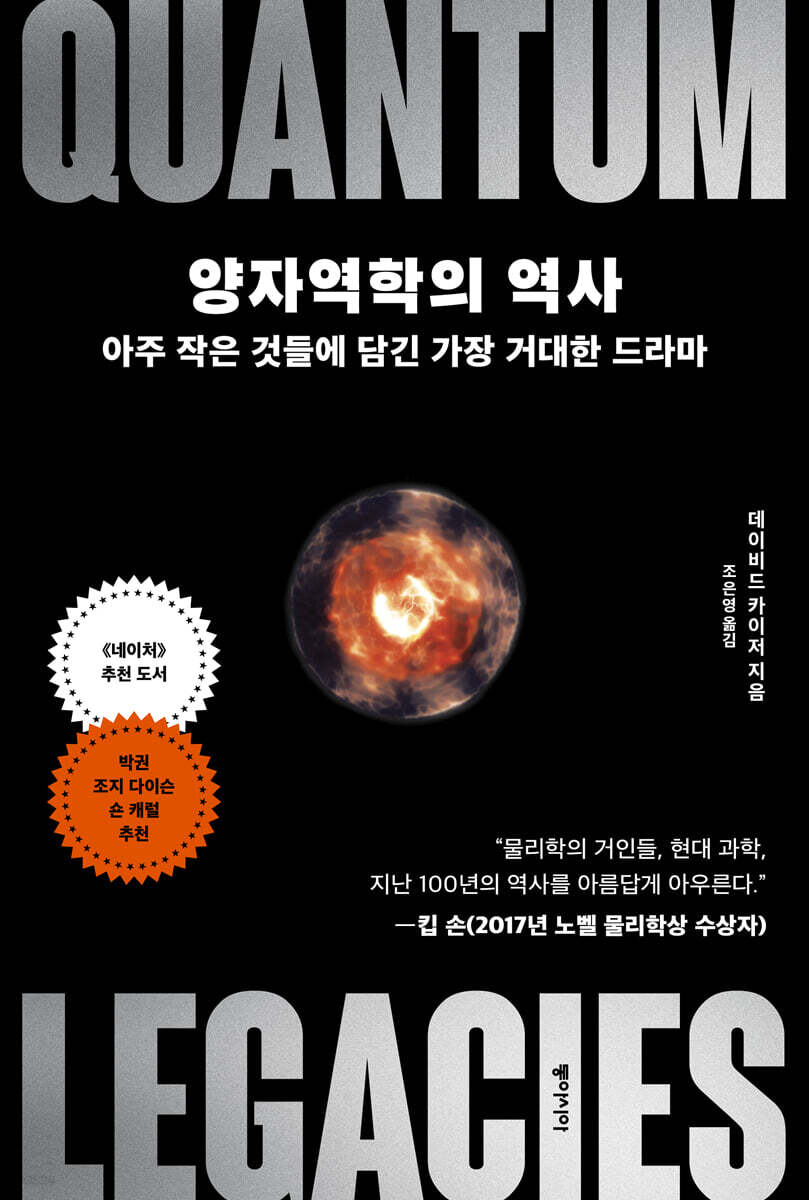
History of quantum mechanics
 |
Description
Book Introduction
- A word from MD
-
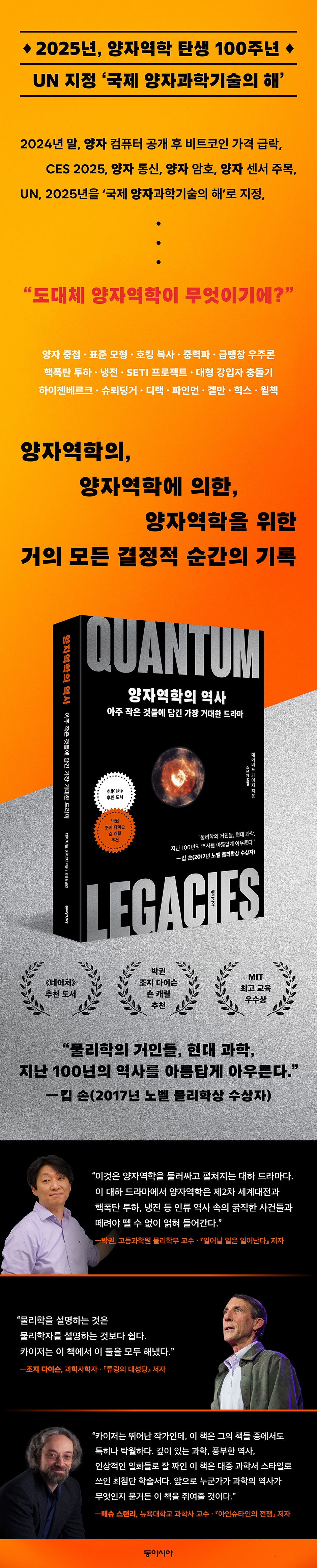
A must-read for the 100th anniversary of quantum mechanicsThe UN designated 2025 as the 'International Year of Quantum Science and Technology' to commemorate the 100th anniversary of the birth of quantum mechanics.
Thanks to quantum mechanics, the horizons of what modern physics can understand have been broadened, thanks to the work of Werner Heisenberg, Niels Bohr, Erwin Schrödinger, and others.
The minimum scientific knowledge required to live as an educated citizen.
February 11, 2025. Natural Science PD Son Min-gyu
2025, designated by the UN as the International Year of Quantum Science and Technology
Where did quantum mechanics come from, what is it, and where is it going?
★ Recommended books by Nature and Physics Today ★
★ Recommended by Park Kwon, Kip Thorne, George Dyson, and Sean Carroll ★
“A beautiful compilation of physics giants, modern science, and the past 100 years of history.” _Kip Thorne, 2017 Nobel Prize in Physics
In December 2024, when Google revealed 'this', the price of Bitcoin plummeted.
It was a quantum computer.
Google's new quantum computer, Willow, solved a problem that would take a supercomputer 10^24 years to solve in just 5 minutes, raising concerns that the security systems of blockchain and virtual currencies based on it are no longer safe.
Meanwhile, the Consumer Technology Association (CTA), which hosts CES 2025, the world's largest IT expo, selected quantum communication, quantum cryptography, and quantum sensors as next-generation core technologies along with quantum computers, and the UN designated 2025 as the 'International Year of Quantum Science and Technology', emphasizing the importance of quantum mechanics and its application technology (based on Heisenberg's paper on matrix mechanics, 2025 marks the 100th anniversary of the birth of quantum mechanics).
What on earth is quantum mechanics that causes the word 'quantum' to be thrown around so endlessly?
David Kaiser, a professor of physics and history of science at the Massachusetts Institute of Technology (MIT), commemorates the 100th anniversary of the birth of quantum mechanics by looking back on the past 100 years of quantum mechanics in this book, “A History of Quantum Mechanics,” introducing where quantum mechanics came from, what it is, and where it is headed.
In particular, as a physicist, he thoroughly explains not only the classical properties of quantum mechanics such as quantum superposition and the uncertainty principle, which became famous through the metaphor of 'Schrödinger's cat', but also the latest achievements in modern physics and cosmology based on quantum mechanics such as the standard model, Hawking radiation, and inflationary cosmology. Also, as a historian, he weaves together historical events closely intertwined with quantum mechanics, such as the Manhattan Project, the SETI Project, the Cold War, and the establishment and operation of the Large Hadron Collider, with anecdotes of key figures such as Einstein, Dirac, Feynman, Wheeler, Gell-Mann, and Higgs, to paint a three-dimensional picture of quantum mechanics and its history.
Where did quantum mechanics come from, what is it, and where is it going?
★ Recommended books by Nature and Physics Today ★
★ Recommended by Park Kwon, Kip Thorne, George Dyson, and Sean Carroll ★
“A beautiful compilation of physics giants, modern science, and the past 100 years of history.” _Kip Thorne, 2017 Nobel Prize in Physics
In December 2024, when Google revealed 'this', the price of Bitcoin plummeted.
It was a quantum computer.
Google's new quantum computer, Willow, solved a problem that would take a supercomputer 10^24 years to solve in just 5 minutes, raising concerns that the security systems of blockchain and virtual currencies based on it are no longer safe.
Meanwhile, the Consumer Technology Association (CTA), which hosts CES 2025, the world's largest IT expo, selected quantum communication, quantum cryptography, and quantum sensors as next-generation core technologies along with quantum computers, and the UN designated 2025 as the 'International Year of Quantum Science and Technology', emphasizing the importance of quantum mechanics and its application technology (based on Heisenberg's paper on matrix mechanics, 2025 marks the 100th anniversary of the birth of quantum mechanics).
What on earth is quantum mechanics that causes the word 'quantum' to be thrown around so endlessly?
David Kaiser, a professor of physics and history of science at the Massachusetts Institute of Technology (MIT), commemorates the 100th anniversary of the birth of quantum mechanics by looking back on the past 100 years of quantum mechanics in this book, “A History of Quantum Mechanics,” introducing where quantum mechanics came from, what it is, and where it is headed.
In particular, as a physicist, he thoroughly explains not only the classical properties of quantum mechanics such as quantum superposition and the uncertainty principle, which became famous through the metaphor of 'Schrödinger's cat', but also the latest achievements in modern physics and cosmology based on quantum mechanics such as the standard model, Hawking radiation, and inflationary cosmology. Also, as a historian, he weaves together historical events closely intertwined with quantum mechanics, such as the Manhattan Project, the SETI Project, the Cold War, and the establishment and operation of the Large Hadron Collider, with anecdotes of key figures such as Einstein, Dirac, Feynman, Wheeler, Gell-Mann, and Higgs, to paint a three-dimensional picture of quantum mechanics and its history.
- You can preview some of the book's contents.
Preview
index
introduction
Introduction
Part 1: Quantum
Chapter 1: Everything is Quantum, There is No Comfort
Chapter 2 Schrödinger's Cat: To Be or Not to Be, That Is the Question
Chapter 3: The Ghostly Particle, the Neutrino
Chapter 4: Cosmic Bell: Experimenting with Quantum Mechanics in Space
Part 2: Calculating
Chapter 5: The Physicist's War: From the Blackboard to the Bomb
Chapter 6: Prometheus's Fire and Calculating Machine
Chapter 7: Interpreting Quantum Mechanics: Shut Up and Do the Calculations!
Chapter 8: Modern Physics and Eastern Thought
Part 3: Matter
Chapter 9: A Tale of Two Giants: The Superconducting Supercollider and the Large Hadron Collider
Chapter 10: The Standard Model: Creating Something from Nothing
Chapter 11: The Higgs Hunt: Hide and Seek in the Midnight
Chapter 12 If what appears to be two is one
Part 4: Cosmos
Chapter 13: Hawking's Message from Aliens
Chapter 14: A Tribute to Gravity
Chapter 15: Another Evolutionary War: From the Big Bang to String Theory
Chapter 16: The Golden Age of Cosmology: They Are No Longer Alone
Chapter 17: What Gravitational Waves Teach Us
Chapter 18: A Farewell to Stephen Hawking
Appendix: Lies, Damn Lies, and Statistics
Acknowledgements
Abbreviation explanation
main
Image source
Search
Introduction
Part 1: Quantum
Chapter 1: Everything is Quantum, There is No Comfort
Chapter 2 Schrödinger's Cat: To Be or Not to Be, That Is the Question
Chapter 3: The Ghostly Particle, the Neutrino
Chapter 4: Cosmic Bell: Experimenting with Quantum Mechanics in Space
Part 2: Calculating
Chapter 5: The Physicist's War: From the Blackboard to the Bomb
Chapter 6: Prometheus's Fire and Calculating Machine
Chapter 7: Interpreting Quantum Mechanics: Shut Up and Do the Calculations!
Chapter 8: Modern Physics and Eastern Thought
Part 3: Matter
Chapter 9: A Tale of Two Giants: The Superconducting Supercollider and the Large Hadron Collider
Chapter 10: The Standard Model: Creating Something from Nothing
Chapter 11: The Higgs Hunt: Hide and Seek in the Midnight
Chapter 12 If what appears to be two is one
Part 4: Cosmos
Chapter 13: Hawking's Message from Aliens
Chapter 14: A Tribute to Gravity
Chapter 15: Another Evolutionary War: From the Big Bang to String Theory
Chapter 16: The Golden Age of Cosmology: They Are No Longer Alone
Chapter 17: What Gravitational Waves Teach Us
Chapter 18: A Farewell to Stephen Hawking
Appendix: Lies, Damn Lies, and Statistics
Acknowledgements
Abbreviation explanation
main
Image source
Search
Detailed image
Into the book
In the spring of 1931, under constant urging from Heisenberg and Pauli to explain the curious mathematical properties of their new equations, Dirac boldly predicted antimatter.
Antimatter is a cousin of the ordinary particles we encounter around us, with the same mass but opposite charge.
Over the next two years, physicists in California and Cambridge gathered remarkable experimental evidence supporting Dirac's prediction.
In this way, Dirac gave birth to the most accurate theory in physics.
Recent studies have shown that theoretical predictions calculated using quantum electrodynamics agree with experimental results to 11 decimal places.
Today, the error between theoretical calculations and experimental data is only one part in a trillion.
--- p.36~37
Schrödinger's attempt to overturn quantum mechanics has paradoxically become a familiar metaphor that everyone uses to teach the theory.
The core of quantum mechanics is that particles can exist in a state of 'superposition', possessing two opposing properties simultaneously.
We face moments in our daily lives where we have to choose between this or that, but at least as quantum mechanics describes it, nature can choose 'both'.
For decades, physicists have been coaxing tiny objects into a superposition of "both" and "both" states in the lab, and have been trying to create all sorts of Schrödinger's cat states by probing their properties.
As we'll discuss in the next chapter, my colleagues at MIT and I recently demonstrated that neutrinos, subatomic particles that interact very weakly with everyday matter, can travel hundreds of kilometers in such a cat-like state.
--- p.53
From now on, a story that would be worthy of a John le Carré spy novel unfolds.
In early September 1950, while on vacation with his family in Italy, Pontecorvo flew from Rome to Munich, Germany, then to Stockholm, Sweden, and finally to Helsinki, Finland, where he made contact with Soviet secret agents.
A secret caravan carrying Pontecorvo's wife and children in one car and Pontecorvo in the trunk of another car, passed through the forests into Soviet territory, reaching Leningrad in a few hours and Moscow in a few days.
The British and American governments only learned of the facts several weeks later.
Finally, the US Joint Congressional Committee on Atomic Energy published a voluminous report, Soviet Atomic Espionage, arguing that Pontecorvo's defection was no more damaging than Fuchs's, but far worse than the later espionage charges that led to the executions of Ethel and Julius Rosenberg.
--- p.62~63
While working on the weapons project for the exhibition, von Neumann got a taste of semi-automatic computation.
Among the tricky problems he and his colleagues faced was calculating how much of a product results from introducing neutrons into fissionable matter.
Will neutrons shatter, split, or be absorbed by a heavy nucleus? How will the shock wave from the nuclear charge propagate from the bomb's center? During wartime, these calculations were often performed by human computers armed with Marchant handheld calculators, a subject well documented in David Greer's 2005 book, "When Computers Were Human."
Young physicists like Richard Feynman would break down their calculations into steps, then have assistants (often the young wives of lab technicians) do the math, and then have several other assistants do the same calculations over and over again.
One person would calculate the square of a number given to them, while another person would add the two numbers and pass the result to another woman sitting next to them.
--- p.108~109
Some books become totems and icons of their time.
When you discover a book by chance in an attic or a used bookstore and happily open it, the cracking sound and musty smell bring back memories of not only the place where you read it in the past, but also yourself when you first read it.
For hundreds of thousands of readers around the world, Fritjof Capra's The Tao of Physics is a prime example.
First published in 1975, this novel book took the publishing world by storm, and its unexpected commercial success sparked a wave of imitations, reviving a dormant genre of popular science books exploring the mysteries of quantum mechanics.
The claim that modern physics is merely a revival of the ancient wisdom of Eastern mysticism, or even a summary of Eastern philosophy, is not entirely new.
Several founders of quantum mechanics made similar declarations in the 1920s and 1930s.
But unlike the analogies of Niels Bohr, Erwin Schrödinger, and their colleagues, which were long forgotten, Capra's book attracted enormous popular attention.
For generations of counterculture followers, Modern Physics and Eastern Thought promised a synthesis of Western science and the New Age.
--- p.137~138
In the paper, the Higgs boson was given a central role in the new Standard Model of particle physics.
Although theoretically the Higgs boson is the simplest of all particles described by the Standard Model—it has no charge, no intrinsic angular momentum, and no arcane quantum properties like "strangeness" or "color charge"—it has become absolutely crucial because of its ability to impart mass to massless particles.
The Higgs gives weight to other particles.
Nobel laureate Frank Wilczek playfully nicknamed the Higgs boson the "quantum of ubiquitous resistance." CERN theoretical physicist John Ellis likened the Higgs boson to a man pushing through a snow-covered field.
This theory, which was so compelling, remained just an idea for decades.
Over time, particle physicists realized that assuming a universal medium in which all matter moves heavily was quite different from finding empirical evidence that such a medium exists, that is, breaking it into tiny pieces (individual Higgs particles) and then measuring their properties.
--- p.180~181
My mother never asks me about my research over the phone.
However, an incident in which the sun actually rose in the west occurred in April 2010.
“Do you agree with what the author Stephen Hawking says?” This question is usually easy to answer.
From the behavior of black holes to the structure of the early universe, it's generally safe to say yes to questions about a wide range of topics.
But that wasn't what Mom wanted to know.
My mother was dying to know if I agreed with Hawking that trying to contact aliens was probably a bad idea.
Hawking warned that while some alien civilization might kindly come to Earth and show up at our doorstep after receiving our message, they would not be very friendly guests.
According to his guess, “any aliens who have achieved such an advanced civilization would want to colonize every planet they can reach.”
The words came out of Hawking's voice synthesizer and instantly spread to blogs around the world, even causing my mother to call me.
--- p.211~212
String theory suggests that instead of 10 to the 5th power of possibilities, there are 10 to the 500th power of distinct low-energy states, any of which could describe our observable universe, or none of which could.
Every observable quantity in our universe, from the mass of the fundamental particles to the strength of the fundamental forces, the expansion rate of our universe, and much more, depends on which of these string states our universe is in precisely.
However, string theory has not found a way to explain why our universe is in this shape among all these possibilities.
Let's pause for a moment and think about the number 10 to the 500th power.
This is a number so far removed from our everyday experience that even scientists cannot fathom the numbers and ratios they normally encounter.
It is difficult to produce this number using quantities we are familiar with.
Let's think about it from a secular perspective.
The ratio of billionaire Jeff Bezos's (as seen on the internet) wealth to mine is only 10 to the power of 5.
I don't know if I should be encouraged or depressed by this ratio, but it's nowhere near 10 to the 500th power. Not even the 20 universes can come close.
The age of the observable universe is about 10 to the 17th power seconds.
Even the ratio of the entire mass of our galaxy to the mass of one electron is only about 10 to the 71st power.
--- p.252~253
Roger Penrose's recent work is the latest example of a richly imaginative journey.
Now that cosmologists have determined the exact age of our observable universe, Penrose suggests that all this chaos that has blossomed and hummed since the Big Bang is but a snap of the fingers in the longer, perhaps infinite, history of our universe.
Instead of assuming that the Big Bang, which occurred 13.8 billion years ago, was the beginning of everything, Penrose proposed an ambitious model called "conformal cyclic cosmology" (CCC).
Penrose argued that our universe has existed countless times before the Big Bang and will continue to cycle forever, like Friedrich Nietzsche's "eternal return."
--- p.267~268
The singularity theorem applies to describing 'classical' spacetime, that is, space and time that ignore quantum mechanics, the other mainstay of modern physics.
As soon as he received his doctorate in 1966, Hawking began attacking the vexing boundary between relativity, which explains the largest objects in the universe, and quantum mechanics, which governs matter at the atomic level.
He made his most famous discovery by accident in the mid-1970s while thinking about a scenario in which pairs of quantum particles would be found near a black hole.
Hawking suggests that if one of the pair of particles falls into the black hole while the other escapes, the black hole will appear to a distant observer as if it were emitting radiation.
This is something that black holes do not allow, or, as Hawking himself put it in A Brief History of Time, in other words, “black holes are not that black.”
That is, black holes also shine.
Moreover, this radiation determines the fate of the black hole.
In astronomical time, the black hole evaporates.
The once enormous mass is leaking out as cosmic noise.
This enigmatic idea, both bizarre and fascinating, has spawned countless other ideas, some of which continue to challenge physics to this day.
Still, theoretical physicists struggle to answer whether information that falls into a black hole is truly lost forever.
Would we be left with nothing more than a jumble of meaningless radiation lines, with no possibility of reconstruction? This would violate the sacred law of quantum mechanics: information can neither be created nor destroyed.
Antimatter is a cousin of the ordinary particles we encounter around us, with the same mass but opposite charge.
Over the next two years, physicists in California and Cambridge gathered remarkable experimental evidence supporting Dirac's prediction.
In this way, Dirac gave birth to the most accurate theory in physics.
Recent studies have shown that theoretical predictions calculated using quantum electrodynamics agree with experimental results to 11 decimal places.
Today, the error between theoretical calculations and experimental data is only one part in a trillion.
--- p.36~37
Schrödinger's attempt to overturn quantum mechanics has paradoxically become a familiar metaphor that everyone uses to teach the theory.
The core of quantum mechanics is that particles can exist in a state of 'superposition', possessing two opposing properties simultaneously.
We face moments in our daily lives where we have to choose between this or that, but at least as quantum mechanics describes it, nature can choose 'both'.
For decades, physicists have been coaxing tiny objects into a superposition of "both" and "both" states in the lab, and have been trying to create all sorts of Schrödinger's cat states by probing their properties.
As we'll discuss in the next chapter, my colleagues at MIT and I recently demonstrated that neutrinos, subatomic particles that interact very weakly with everyday matter, can travel hundreds of kilometers in such a cat-like state.
--- p.53
From now on, a story that would be worthy of a John le Carré spy novel unfolds.
In early September 1950, while on vacation with his family in Italy, Pontecorvo flew from Rome to Munich, Germany, then to Stockholm, Sweden, and finally to Helsinki, Finland, where he made contact with Soviet secret agents.
A secret caravan carrying Pontecorvo's wife and children in one car and Pontecorvo in the trunk of another car, passed through the forests into Soviet territory, reaching Leningrad in a few hours and Moscow in a few days.
The British and American governments only learned of the facts several weeks later.
Finally, the US Joint Congressional Committee on Atomic Energy published a voluminous report, Soviet Atomic Espionage, arguing that Pontecorvo's defection was no more damaging than Fuchs's, but far worse than the later espionage charges that led to the executions of Ethel and Julius Rosenberg.
--- p.62~63
While working on the weapons project for the exhibition, von Neumann got a taste of semi-automatic computation.
Among the tricky problems he and his colleagues faced was calculating how much of a product results from introducing neutrons into fissionable matter.
Will neutrons shatter, split, or be absorbed by a heavy nucleus? How will the shock wave from the nuclear charge propagate from the bomb's center? During wartime, these calculations were often performed by human computers armed with Marchant handheld calculators, a subject well documented in David Greer's 2005 book, "When Computers Were Human."
Young physicists like Richard Feynman would break down their calculations into steps, then have assistants (often the young wives of lab technicians) do the math, and then have several other assistants do the same calculations over and over again.
One person would calculate the square of a number given to them, while another person would add the two numbers and pass the result to another woman sitting next to them.
--- p.108~109
Some books become totems and icons of their time.
When you discover a book by chance in an attic or a used bookstore and happily open it, the cracking sound and musty smell bring back memories of not only the place where you read it in the past, but also yourself when you first read it.
For hundreds of thousands of readers around the world, Fritjof Capra's The Tao of Physics is a prime example.
First published in 1975, this novel book took the publishing world by storm, and its unexpected commercial success sparked a wave of imitations, reviving a dormant genre of popular science books exploring the mysteries of quantum mechanics.
The claim that modern physics is merely a revival of the ancient wisdom of Eastern mysticism, or even a summary of Eastern philosophy, is not entirely new.
Several founders of quantum mechanics made similar declarations in the 1920s and 1930s.
But unlike the analogies of Niels Bohr, Erwin Schrödinger, and their colleagues, which were long forgotten, Capra's book attracted enormous popular attention.
For generations of counterculture followers, Modern Physics and Eastern Thought promised a synthesis of Western science and the New Age.
--- p.137~138
In the paper, the Higgs boson was given a central role in the new Standard Model of particle physics.
Although theoretically the Higgs boson is the simplest of all particles described by the Standard Model—it has no charge, no intrinsic angular momentum, and no arcane quantum properties like "strangeness" or "color charge"—it has become absolutely crucial because of its ability to impart mass to massless particles.
The Higgs gives weight to other particles.
Nobel laureate Frank Wilczek playfully nicknamed the Higgs boson the "quantum of ubiquitous resistance." CERN theoretical physicist John Ellis likened the Higgs boson to a man pushing through a snow-covered field.
This theory, which was so compelling, remained just an idea for decades.
Over time, particle physicists realized that assuming a universal medium in which all matter moves heavily was quite different from finding empirical evidence that such a medium exists, that is, breaking it into tiny pieces (individual Higgs particles) and then measuring their properties.
--- p.180~181
My mother never asks me about my research over the phone.
However, an incident in which the sun actually rose in the west occurred in April 2010.
“Do you agree with what the author Stephen Hawking says?” This question is usually easy to answer.
From the behavior of black holes to the structure of the early universe, it's generally safe to say yes to questions about a wide range of topics.
But that wasn't what Mom wanted to know.
My mother was dying to know if I agreed with Hawking that trying to contact aliens was probably a bad idea.
Hawking warned that while some alien civilization might kindly come to Earth and show up at our doorstep after receiving our message, they would not be very friendly guests.
According to his guess, “any aliens who have achieved such an advanced civilization would want to colonize every planet they can reach.”
The words came out of Hawking's voice synthesizer and instantly spread to blogs around the world, even causing my mother to call me.
--- p.211~212
String theory suggests that instead of 10 to the 5th power of possibilities, there are 10 to the 500th power of distinct low-energy states, any of which could describe our observable universe, or none of which could.
Every observable quantity in our universe, from the mass of the fundamental particles to the strength of the fundamental forces, the expansion rate of our universe, and much more, depends on which of these string states our universe is in precisely.
However, string theory has not found a way to explain why our universe is in this shape among all these possibilities.
Let's pause for a moment and think about the number 10 to the 500th power.
This is a number so far removed from our everyday experience that even scientists cannot fathom the numbers and ratios they normally encounter.
It is difficult to produce this number using quantities we are familiar with.
Let's think about it from a secular perspective.
The ratio of billionaire Jeff Bezos's (as seen on the internet) wealth to mine is only 10 to the power of 5.
I don't know if I should be encouraged or depressed by this ratio, but it's nowhere near 10 to the 500th power. Not even the 20 universes can come close.
The age of the observable universe is about 10 to the 17th power seconds.
Even the ratio of the entire mass of our galaxy to the mass of one electron is only about 10 to the 71st power.
--- p.252~253
Roger Penrose's recent work is the latest example of a richly imaginative journey.
Now that cosmologists have determined the exact age of our observable universe, Penrose suggests that all this chaos that has blossomed and hummed since the Big Bang is but a snap of the fingers in the longer, perhaps infinite, history of our universe.
Instead of assuming that the Big Bang, which occurred 13.8 billion years ago, was the beginning of everything, Penrose proposed an ambitious model called "conformal cyclic cosmology" (CCC).
Penrose argued that our universe has existed countless times before the Big Bang and will continue to cycle forever, like Friedrich Nietzsche's "eternal return."
--- p.267~268
The singularity theorem applies to describing 'classical' spacetime, that is, space and time that ignore quantum mechanics, the other mainstay of modern physics.
As soon as he received his doctorate in 1966, Hawking began attacking the vexing boundary between relativity, which explains the largest objects in the universe, and quantum mechanics, which governs matter at the atomic level.
He made his most famous discovery by accident in the mid-1970s while thinking about a scenario in which pairs of quantum particles would be found near a black hole.
Hawking suggests that if one of the pair of particles falls into the black hole while the other escapes, the black hole will appear to a distant observer as if it were emitting radiation.
This is something that black holes do not allow, or, as Hawking himself put it in A Brief History of Time, in other words, “black holes are not that black.”
That is, black holes also shine.
Moreover, this radiation determines the fate of the black hole.
In astronomical time, the black hole evaporates.
The once enormous mass is leaking out as cosmic noise.
This enigmatic idea, both bizarre and fascinating, has spawned countless other ideas, some of which continue to challenge physics to this day.
Still, theoretical physicists struggle to answer whether information that falls into a black hole is truly lost forever.
Would we be left with nothing more than a jumble of meaningless radiation lines, with no possibility of reconstruction? This would violate the sacred law of quantum mechanics: information can neither be created nor destroyed.
--- p.285~286
Publisher's Review
Quantum entanglement, the standard model, Hawking radiation, gravitational waves, and inflationary cosmology
Manhattan Project, Cold War, SETI Project, Large Hadron Collider
Heisenberg, Schrödinger, Dirac, Feynman, Gell-Mann, Higgs, Wilczek…
Of quantum mechanics, by quantum mechanics, for quantum mechanics
Records of almost every decisive moment!
Part 1, "Quantum," centers on the story of Paul Dirac, a man who is considerably less well-known than Schrödinger or Heisenberg, but just as important in physics, and covers the early 20th century, when physics was being "modernized" at a breakneck pace thanks to Einstein's special theory of relativity, Heisenberg's matrix mechanics, Schrödinger's wave equation (which became famous as "Schrödinger's cat"), and Dirac's own antimatter.
It also sheds light on the property of superposition in quantum objects, telling the story of the even more bizarre "ghost particle" neutrino through the bizarre life of Bruno Pontecorvo, who was later revealed to be a Soviet spy, and introduces the latest experiments on it, called the "Cosmic Bell."
Part 2, "Computation," covers the Manhattan Project, which involved 125,000 people, and the dropping of the atomic bomb on Hiroshima, the development and advancement of computers in nuclear weapons research (disguised as research on weather forecasting or biological evolution) after World War II, known as the "Physicists' War," and the overproduction of physicists in the post-war generation in the United States due to competition and anxiety about the Soviet Union in the early days of the Cold War, which led to changes in teaching methods and the subsequent shift from an emphasis on the "philosophical meaning" or "interpretation" of wave functions and the uncertainty principle to an emphasis on problem solving and computational methods.
“This is a great drama unfolding around quantum mechanics.
In this epic drama, quantum mechanics is inextricably intertwined with major events in human history, including World War II, the dropping of the atomic bomb, and the Cold War.
Park Kwon, Professor of Physics, Graduate School of Advanced Science and Technology, Author of "What's Worth Doing Will Happen"
Part 3, “Matter,” turns its attention to the Standard Model, which explains the three fundamental forces, as well as the familiar electrons and photons, as well as fundamental particles such as quarks, gluons, the Z boson, and the Higgs boson, which was dubbed the “God particle” in 2013 and caused a stir in the media.
It not only introduces concepts that dominate modern physics, such as symmetry and local transformations, in an easy-to-understand way through the properties of quarks and gluons, but also shows the political and social upheaval surrounding the Superconducting Super Collider (SSC) and the Large Hadron Collider (LHC), which were used to experiment with this 'high-energy physics', and the landscape of the late 20th century when particle physics and cosmology were integrated into a single field called particle cosmology.
The final part, Part 4, "The Universe," explains gravity, a fundamental force missing from the Standard Model, and introduces the general theory of relativity, which completely changed our understanding of time and space, and the surprising theories and phenomena discovered in the process of integrating it into quantum mechanics.
It goes beyond explaining the Penrose-Hawking singularity theorem, which predicts a black hole where the classical concept of space-time collapses, and the Hawking radiation phenomenon, in which energy is emitted according to the laws of quantum mechanics from the 'edge' of a black hole, to introducing inflationary cosmology, string theory, and the multiverse they imply.
From Stephen Hawking to Paul Davies and Fritjof Capra,
A revolution that is not over yet, brought about by very 'small' things
Just as the process of creating quantum mechanics was “a troupe closer to Heinrich Böll’s “Ladies and Groups” than to Herman Melville’s “Moby Dick,” this book is driven not by one or two heroes but by a number of fascinating characters.
Paul Divac, who was so taciturn that speaking one word per hour was called 'one Dirac'; Enrico Fermi, who escaped the Nazis in a way that rivaled 'The Sound of Music'; Bruno Pontecorvo, who was reminiscent of a spy in John le Carré's spy novel; Kurt Gödel, a logician who starved to death after being possessed by the delusion that someone was trying to poison him; Fritjof Capra, author of 'Modern Physics and Eastern Thought', which became a bestseller thanks to the New Age and counterculture movements; Philip Morrison, who turned his eyes to the sky after World War II to find more rational and benevolent alien civilizations; Kip Thorne, who became the most stubborn advocate of the gravitational wave detection method that he strongly opposed; and Stephen Hawking, who did not succumb to his illness and lived 50 years longer than doctors said to make amazing predictions about the universe. By following these examples, you can realize that quantum mechanics, which began with the study of the very small, is a huge revolution that has not yet ended and is being created by countless people. there is.
“Kaiser is a brilliant writer, and this book is particularly outstanding among his other books.
Well-crafted with deep science, rich history, and compelling anecdotes, this book is cutting-edge scholarship written in a popular science style.
“From now on, if someone asks me what the history of science is, I will give them this book.”
Matthew Stanley, Professor of the History of Science at New York University and author of Einstein's Wars
Manhattan Project, Cold War, SETI Project, Large Hadron Collider
Heisenberg, Schrödinger, Dirac, Feynman, Gell-Mann, Higgs, Wilczek…
Of quantum mechanics, by quantum mechanics, for quantum mechanics
Records of almost every decisive moment!
Part 1, "Quantum," centers on the story of Paul Dirac, a man who is considerably less well-known than Schrödinger or Heisenberg, but just as important in physics, and covers the early 20th century, when physics was being "modernized" at a breakneck pace thanks to Einstein's special theory of relativity, Heisenberg's matrix mechanics, Schrödinger's wave equation (which became famous as "Schrödinger's cat"), and Dirac's own antimatter.
It also sheds light on the property of superposition in quantum objects, telling the story of the even more bizarre "ghost particle" neutrino through the bizarre life of Bruno Pontecorvo, who was later revealed to be a Soviet spy, and introduces the latest experiments on it, called the "Cosmic Bell."
Part 2, "Computation," covers the Manhattan Project, which involved 125,000 people, and the dropping of the atomic bomb on Hiroshima, the development and advancement of computers in nuclear weapons research (disguised as research on weather forecasting or biological evolution) after World War II, known as the "Physicists' War," and the overproduction of physicists in the post-war generation in the United States due to competition and anxiety about the Soviet Union in the early days of the Cold War, which led to changes in teaching methods and the subsequent shift from an emphasis on the "philosophical meaning" or "interpretation" of wave functions and the uncertainty principle to an emphasis on problem solving and computational methods.
“This is a great drama unfolding around quantum mechanics.
In this epic drama, quantum mechanics is inextricably intertwined with major events in human history, including World War II, the dropping of the atomic bomb, and the Cold War.
Park Kwon, Professor of Physics, Graduate School of Advanced Science and Technology, Author of "What's Worth Doing Will Happen"
Part 3, “Matter,” turns its attention to the Standard Model, which explains the three fundamental forces, as well as the familiar electrons and photons, as well as fundamental particles such as quarks, gluons, the Z boson, and the Higgs boson, which was dubbed the “God particle” in 2013 and caused a stir in the media.
It not only introduces concepts that dominate modern physics, such as symmetry and local transformations, in an easy-to-understand way through the properties of quarks and gluons, but also shows the political and social upheaval surrounding the Superconducting Super Collider (SSC) and the Large Hadron Collider (LHC), which were used to experiment with this 'high-energy physics', and the landscape of the late 20th century when particle physics and cosmology were integrated into a single field called particle cosmology.
The final part, Part 4, "The Universe," explains gravity, a fundamental force missing from the Standard Model, and introduces the general theory of relativity, which completely changed our understanding of time and space, and the surprising theories and phenomena discovered in the process of integrating it into quantum mechanics.
It goes beyond explaining the Penrose-Hawking singularity theorem, which predicts a black hole where the classical concept of space-time collapses, and the Hawking radiation phenomenon, in which energy is emitted according to the laws of quantum mechanics from the 'edge' of a black hole, to introducing inflationary cosmology, string theory, and the multiverse they imply.
From Stephen Hawking to Paul Davies and Fritjof Capra,
A revolution that is not over yet, brought about by very 'small' things
Just as the process of creating quantum mechanics was “a troupe closer to Heinrich Böll’s “Ladies and Groups” than to Herman Melville’s “Moby Dick,” this book is driven not by one or two heroes but by a number of fascinating characters.
Paul Divac, who was so taciturn that speaking one word per hour was called 'one Dirac'; Enrico Fermi, who escaped the Nazis in a way that rivaled 'The Sound of Music'; Bruno Pontecorvo, who was reminiscent of a spy in John le Carré's spy novel; Kurt Gödel, a logician who starved to death after being possessed by the delusion that someone was trying to poison him; Fritjof Capra, author of 'Modern Physics and Eastern Thought', which became a bestseller thanks to the New Age and counterculture movements; Philip Morrison, who turned his eyes to the sky after World War II to find more rational and benevolent alien civilizations; Kip Thorne, who became the most stubborn advocate of the gravitational wave detection method that he strongly opposed; and Stephen Hawking, who did not succumb to his illness and lived 50 years longer than doctors said to make amazing predictions about the universe. By following these examples, you can realize that quantum mechanics, which began with the study of the very small, is a huge revolution that has not yet ended and is being created by countless people. there is.
“Kaiser is a brilliant writer, and this book is particularly outstanding among his other books.
Well-crafted with deep science, rich history, and compelling anecdotes, this book is cutting-edge scholarship written in a popular science style.
“From now on, if someone asks me what the history of science is, I will give them this book.”
Matthew Stanley, Professor of the History of Science at New York University and author of Einstein's Wars
GOODS SPECIFICS
- Date of issue: January 17, 2025
- Page count, weight, size: 376 pages | 510g | 145*215*25mm
- ISBN13: 9788962626391
You may also like
카테고리
korean


korean

![GQ KOREA Mark (Monthly): December [2025]](http://librairie.coreenne.fr/cdn/shop/files/8ef265dbbfbf186523ed75ba7319009d.jpg?v=1765340328&width=3840)


