

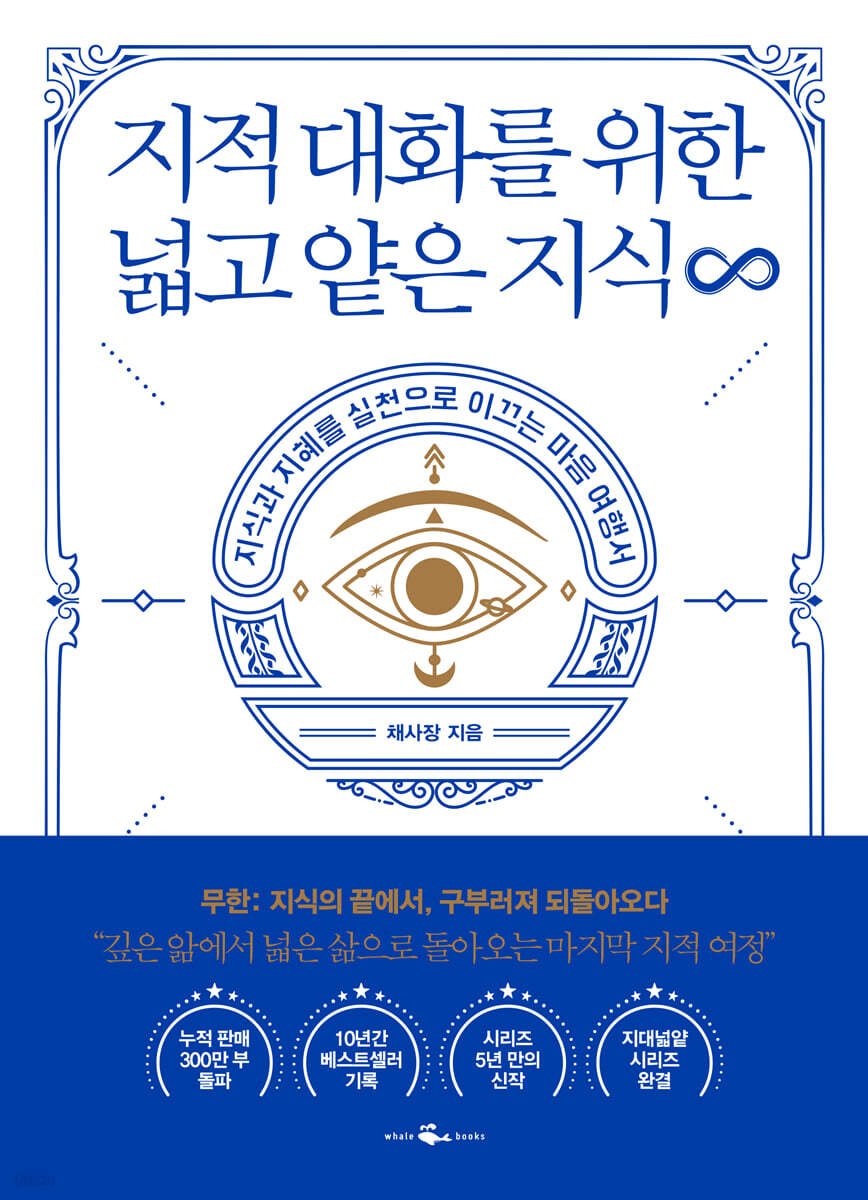
Infinite broad and shallow knowledge for intellectual conversation
 |
Description
Book Introduction
- A word from MD
-
Practice is more important than knowledge and wisdomThe birth of the 21st century version of the Ten Ox-Dolls.
This is the new book and final installment in the series, “Broad and Shallow Knowledge for Intellectual Conversation” by President Chae.
Why is life so uncomfortable and unstable, even when we know and possess a lot? This book suggests ways for humans to become free.
Why are you hesitating?
This is the entrance to the path to truth and freedom.
December 17, 2024. Humanities PD Son Min-gyu
A new installment in the "Wide and Shallow" series, a myth of the humanities, after five years.
And the conclusion after 10 years
∞ (infinity): At the end of knowledge, bending back
The ultimate form of culture that allows us to root our knowledge in life.
This book will lead you to true happiness and a true understanding of life!
Cha Sa-jang, who established himself as a representative humanities writer with the contemporary liberal arts textbook "Broad and Shallow Knowledge for Intellectual Conversation," which has never left the bestseller list for the past 10 years, has returned with a new series after 5 years.
Following the previous volumes 1 and 2, the author published the 0th volume, “Zero,” instead of the 3rd volume, demonstrating an unprecedented series structure, and at the same time connecting the vast intellectual history of humanity with the number 0, encompassing even profound knowledge.
And now, the new volume ∞, “Infinity,” released after five years, deals with the realm of “practice” that brings us back to life after diving into deep knowledge, and marks the culmination of a series that has created a great stir in the humanities for ten years.
We possess more knowledge than ever before, yet why does the more we learn, the more we feel fulfilled? After delving into this question for a long time, the author realized that the reason knowledge fails to take root in life is because we fail to put it into practice.
Here, practice means knowing the reality of myself and the world and changing my attitude toward life in a Copernican way.
The author, who has traveled extensively across all fields of knowledge and created a comprehensive map of the humanities with his own unique connections, is now solving the eternal task of life beyond knowledge and wisdom.
Through this book, readers will gain a powerful understanding of the knowledge we are missing, and learn how to become a good person, achieve true happiness, and live a life of peace and tranquility—something that seemed far away.
And the conclusion after 10 years
∞ (infinity): At the end of knowledge, bending back
The ultimate form of culture that allows us to root our knowledge in life.
This book will lead you to true happiness and a true understanding of life!
Cha Sa-jang, who established himself as a representative humanities writer with the contemporary liberal arts textbook "Broad and Shallow Knowledge for Intellectual Conversation," which has never left the bestseller list for the past 10 years, has returned with a new series after 5 years.
Following the previous volumes 1 and 2, the author published the 0th volume, “Zero,” instead of the 3rd volume, demonstrating an unprecedented series structure, and at the same time connecting the vast intellectual history of humanity with the number 0, encompassing even profound knowledge.
And now, the new volume ∞, “Infinity,” released after five years, deals with the realm of “practice” that brings us back to life after diving into deep knowledge, and marks the culmination of a series that has created a great stir in the humanities for ten years.
We possess more knowledge than ever before, yet why does the more we learn, the more we feel fulfilled? After delving into this question for a long time, the author realized that the reason knowledge fails to take root in life is because we fail to put it into practice.
Here, practice means knowing the reality of myself and the world and changing my attitude toward life in a Copernican way.
The author, who has traveled extensively across all fields of knowledge and created a comprehensive map of the humanities with his own unique connections, is now solving the eternal task of life beyond knowledge and wisdom.
Through this book, readers will gain a powerful understanding of the knowledge we are missing, and learn how to become a good person, achieve true happiness, and live a life of peace and tranquility—something that seemed far away.
- You can preview some of the book's contents.
Preview
index
prolog
1.
Origins - Questioning the World
2.
Maintenance - tidying up the surroundings
3.
Jeongjin - Entering the inner path
4.
Knowledge of one's nature - what is at the end of the road
5.
Advancement - Going Out into the World
6.
View - Seeing the beginning and the end, life and death
7.
Forward - keep walking
Epilogue
Author's Note - Concluding the Series
1.
Origins - Questioning the World
2.
Maintenance - tidying up the surroundings
3.
Jeongjin - Entering the inner path
4.
Knowledge of one's nature - what is at the end of the road
5.
Advancement - Going Out into the World
6.
View - Seeing the beginning and the end, life and death
7.
Forward - keep walking
Epilogue
Author's Note - Concluding the Series
Detailed image

Into the book
When a humpback whale flips its white belly over and waves its fins, it is sending a signal to divers.
You are too small.
It's dangerous down here.
You might wonder how on earth I knew that was what it meant.
However, there were often cases where divers who ignored the signal and went deeper ended up in danger.
Little is known about the ecology of this beautiful, giant creature, which seems to think of us as something cute.
Aside from its external appearance—it is as tall as a four-story building and weighs as much as a Boeing 737—we don't know what kind of life it leads or what kind of travel it takes.
As the humpback whale's hand signals indicate, the seas in which it operates are too deep for us.
Imagine.
The deep, dark blue abyss, barely visible through a few faint rays of light.
What emotions do humpback whales feel as they check their distance with their mysterious songs? What lies there, and what stories lie hidden within? In this life in human form, I will never be able to see it.
Because you won't be able to overcome the suffocating darkness and pressure of the deep sea.
The only way to see it is to be a humpback whale.
There is an old rumor.
There are rumors that there are people who have jumped into the sea within themselves.
There are incredible stories of people descending into the abyss from which no one returns, reaching the end from which no one has ever reached, and returning.
I've heard this story in countless classics.
What they brought back from there people called enlightenment.
But no one saw with their own eyes what they brought back.
Because it was in their hearts.
They said.
You can see it too.
You can overcome the suffocating darkness and the pressure of the abyss.
The way to do this is to become a humpback whale.
(syncopation)
Modern man is thrown into a wilderness of knowledge.
It is a vast space where only the distant horizon, whose distance cannot be measured, endlessly surrounds me.
The road is not visible.
The "Broad and Shallow Knowledge for Intellectual Conversation" series has played an important role over the past decade.
It was a task to provide a map so that modern people would not get lost in the wilderness of knowledge.
This massive map, which depicts the connections between various academic fields on a grand scale, helps modern people connect knowledge and avoid getting lost.
But that alone is not enough.
In some ways, maps were also another form of knowledge.
The road was dry as the wilderness was dry, and we grew tired on the endless road.
Now I think I have a vague idea what the problem was.
What we needed was not a torrent of knowledge.
A moment to stop your weary steps and sit down to digest it.
That's what we lacked.
This is why practice is necessary.
Practice is like the underground water that flows through the vast expanse of knowledge.
Knowledge without practice is bound to dry up, and only withered weeds will sprout from the ground.
When knowledge is digested and becomes wisdom through the process of practice, wisdom moistens the ground, and only then can the earth bloom.
The goal of this book is clear.
In an age of knowledge saturation, I propose practice as the remaining half of the domain to digest it.
This is why this book came into the world.
--- From the "Prologue"
Sometimes I wonder.
Where on earth are we going? I'm confused and want to give up, but how can people move so quickly, without feeling confused, as if they know exactly where they're going? It's because everyone is addicted to life.
Just as a person who is lost in fantasy cannot see reality, a person who is lost in reality does not have questions.
What materialism and science have achieved by completely excluding the spiritual element is consistency.
Just as all beliefs can only be consistent within a limited sphere, so materialism and science, by making limited use of the meaning of experience, can be perfectly consistent within the confines of matter.
This led the public to imagine that materialism and science were not ideologies, but objective truths that explained the entire world.
But in reality, it can be said that the world has been reduced to a small size.
The glory of consistency was a half-victory achieved by banishing all values related to the mind from the world.
And the victory thus achieved is functioning as a materialist biased paradigm in today's academia and the public.
For example, let's say you are locked in a metal box that is completely sealed off from the outside world.
Your only communication with the outside world is through your keyboard and monitor.
The words you write are displayed on a monitor attached to the outside of the metal box.
There is another keyboard outside the box, so you can chat with anyone passing by.
Can you prove that you're not a chat program, but a conscious being trapped inside a box? No matter how much time you're given, it's impossible.
In the material world, humans are no different from people trapped in an iron box.
I can never prove or show my consciousness to others with only my material body and language.
--- From "Beginning"
Even with the flood of information, something is missing.
We desire and enjoy more content, but the lack is not filled.
What causes this unquenchable thirst? It's because the content that can be contained varies depending on the media format.
Simply put, short-form media cannot naturally contain long-form content.
What this means is that consumers are exposed to an extremely large amount of content, but at the same time, they are only able to consume a very limited amount of it.
(...) The most fundamental way to solve the problem is to return the fragmented time to its original continuous time.
You have to create some free time.
You need to create enough time to not act.
When we decide to organize our smartphone photo albums, the way we go about doing it will vary from person to person.
But there is one thing they all have in common.
It starts with deleting similar photos that are repeated.
It's the same.
If we are determined to organize our minds, the first thing we must do is to stop repeating thoughts.
(...) Of course, if you are someone who knows that it is the emotions of attraction and aversion that amplify the repetition of thoughts, you can take a more radical approach.
It's about stopping the foolishness of adding fuel to the fire.
That is, do not add feelings of attraction and disgust to the thought.
This is a very central way to progress on the path to enlightenment, and we will discuss it in detail in the next chapter.
At this stage, it is enough for us to have the wisdom to just commit to cutting this off.
Feeling confused and vulnerable to stimulation doesn't actually mean you're vulnerable.
Because the world is fiercely competing for your attention.
So, people without wisdom are easily swayed by these stimuli and dragged here and there.
On the other hand, wise people see clearly that they are not the owner of the stimulus and try to keep an appropriate distance from it.
--- From "Maintenance"
Look at the sea.
Happiness, anger, jealousy, confusion, depression, pleasure, joy.
All these waves of emotion rise and fall on the surface of the ocean.
But the deep, emptiness of the mind that underlies all these waves does not surge, does not flow, and does not move.
The reason we remain deeply silent is to reach this still deep sea.
Now that we're here, we know what it's like.
It is quiet and peaceful.
People think that calmness and peace are also emotions.
But that's not the case.
Calmness and tranquility are not something that arises from human emotions, but are essential states of mind.
This is the foundation and background, and all human emotions arise and disappear here repeatedly.
--- From "Diligence"
The human species loves humans the most and hates humans the most.
The human mind is full of humans.
Take a step back and look at the smartphone you're looking at all day.
What are you looking at? You spend all day looking at this person's face and that person's face, this person's body and that person's body, liking and hating them.
You spend all day looking at human speech and writing, liking and hating it.
You spend all day looking at human things, liking and hating them.
Your conscious world is full of humans.
You were human, you are human, and you will return as human.
--- From "Kyenseong"
The truth that reality is an illusion just as dreams are an illusion does not necessarily lead us to apathy and futility.
Despite the same realization, some connect the truth that this moment is a welcome to a positive attitude toward life.
Just as he keeps flowers in a vase knowing they will wither, he vows to love a reality that will disappear like an illusion.
It is an ontological fact that reality is an illusion and finite, but whether we connect it with helplessness or accept it positively is a subjective interpretation.
A person who values life as meaningless will evaluate it as worthless and meaningless, even if life is finite or eternal.
A person who wants to embrace life positively will evaluate life as valuable and meaningful, whether it is finite or eternal.
Facing reality as an illusion simply means taking a step back from being too caught up in life.
It is a retreat from the judgment that the world is meaningful, and at the same time a retreat from the judgment that the world is meaningless.
The narrower the vision and the less wisdom a person has, the more accustomed he is to extreme evaluations.
They affirm what looks good and deny what looks bad.
If it's attractive, it attracts, and if it's repulsive, it repels.
If you see it, you think it exists, and if you don't see it, you think it doesn't exist.
I think existence is reality and absence is nothing.
The reason they judge so easily is because their thinking is rough.
But the reality of the world is always delicate.
It takes a lot of wisdom to deal with the world delicately.
Just as a person with a less refined sense of taste is more drawn to sweet and salty tastes, a person with less refined wisdom is easily drawn to extreme thoughts.
--- From "Success"
Words and judgments are always connected with foolishness.
Because the essence of language is to segment the world, and judgment is always a dichotomous division of good and bad.
The real world is not segmented or dichotomous.
So, those who see the reality of the world stop talking and stop judging.
The way we escape from foolishness and become wise is to distance ourselves from words and judgments.
--- From "View"
It's important to remember that substances are addictive, so the less you have of them, or the more you have of them, the more you love them.
So how much material do you need? You know that very well.
Just as you can adjust the temperature of the shower to your comfort level by finely adjusting the amount of cold and hot water without being instructed, you should prepare the amount of material that is most comfortable for your body and mind.
You are too small.
It's dangerous down here.
You might wonder how on earth I knew that was what it meant.
However, there were often cases where divers who ignored the signal and went deeper ended up in danger.
Little is known about the ecology of this beautiful, giant creature, which seems to think of us as something cute.
Aside from its external appearance—it is as tall as a four-story building and weighs as much as a Boeing 737—we don't know what kind of life it leads or what kind of travel it takes.
As the humpback whale's hand signals indicate, the seas in which it operates are too deep for us.
Imagine.
The deep, dark blue abyss, barely visible through a few faint rays of light.
What emotions do humpback whales feel as they check their distance with their mysterious songs? What lies there, and what stories lie hidden within? In this life in human form, I will never be able to see it.
Because you won't be able to overcome the suffocating darkness and pressure of the deep sea.
The only way to see it is to be a humpback whale.
There is an old rumor.
There are rumors that there are people who have jumped into the sea within themselves.
There are incredible stories of people descending into the abyss from which no one returns, reaching the end from which no one has ever reached, and returning.
I've heard this story in countless classics.
What they brought back from there people called enlightenment.
But no one saw with their own eyes what they brought back.
Because it was in their hearts.
They said.
You can see it too.
You can overcome the suffocating darkness and the pressure of the abyss.
The way to do this is to become a humpback whale.
(syncopation)
Modern man is thrown into a wilderness of knowledge.
It is a vast space where only the distant horizon, whose distance cannot be measured, endlessly surrounds me.
The road is not visible.
The "Broad and Shallow Knowledge for Intellectual Conversation" series has played an important role over the past decade.
It was a task to provide a map so that modern people would not get lost in the wilderness of knowledge.
This massive map, which depicts the connections between various academic fields on a grand scale, helps modern people connect knowledge and avoid getting lost.
But that alone is not enough.
In some ways, maps were also another form of knowledge.
The road was dry as the wilderness was dry, and we grew tired on the endless road.
Now I think I have a vague idea what the problem was.
What we needed was not a torrent of knowledge.
A moment to stop your weary steps and sit down to digest it.
That's what we lacked.
This is why practice is necessary.
Practice is like the underground water that flows through the vast expanse of knowledge.
Knowledge without practice is bound to dry up, and only withered weeds will sprout from the ground.
When knowledge is digested and becomes wisdom through the process of practice, wisdom moistens the ground, and only then can the earth bloom.
The goal of this book is clear.
In an age of knowledge saturation, I propose practice as the remaining half of the domain to digest it.
This is why this book came into the world.
--- From the "Prologue"
Sometimes I wonder.
Where on earth are we going? I'm confused and want to give up, but how can people move so quickly, without feeling confused, as if they know exactly where they're going? It's because everyone is addicted to life.
Just as a person who is lost in fantasy cannot see reality, a person who is lost in reality does not have questions.
What materialism and science have achieved by completely excluding the spiritual element is consistency.
Just as all beliefs can only be consistent within a limited sphere, so materialism and science, by making limited use of the meaning of experience, can be perfectly consistent within the confines of matter.
This led the public to imagine that materialism and science were not ideologies, but objective truths that explained the entire world.
But in reality, it can be said that the world has been reduced to a small size.
The glory of consistency was a half-victory achieved by banishing all values related to the mind from the world.
And the victory thus achieved is functioning as a materialist biased paradigm in today's academia and the public.
For example, let's say you are locked in a metal box that is completely sealed off from the outside world.
Your only communication with the outside world is through your keyboard and monitor.
The words you write are displayed on a monitor attached to the outside of the metal box.
There is another keyboard outside the box, so you can chat with anyone passing by.
Can you prove that you're not a chat program, but a conscious being trapped inside a box? No matter how much time you're given, it's impossible.
In the material world, humans are no different from people trapped in an iron box.
I can never prove or show my consciousness to others with only my material body and language.
--- From "Beginning"
Even with the flood of information, something is missing.
We desire and enjoy more content, but the lack is not filled.
What causes this unquenchable thirst? It's because the content that can be contained varies depending on the media format.
Simply put, short-form media cannot naturally contain long-form content.
What this means is that consumers are exposed to an extremely large amount of content, but at the same time, they are only able to consume a very limited amount of it.
(...) The most fundamental way to solve the problem is to return the fragmented time to its original continuous time.
You have to create some free time.
You need to create enough time to not act.
When we decide to organize our smartphone photo albums, the way we go about doing it will vary from person to person.
But there is one thing they all have in common.
It starts with deleting similar photos that are repeated.
It's the same.
If we are determined to organize our minds, the first thing we must do is to stop repeating thoughts.
(...) Of course, if you are someone who knows that it is the emotions of attraction and aversion that amplify the repetition of thoughts, you can take a more radical approach.
It's about stopping the foolishness of adding fuel to the fire.
That is, do not add feelings of attraction and disgust to the thought.
This is a very central way to progress on the path to enlightenment, and we will discuss it in detail in the next chapter.
At this stage, it is enough for us to have the wisdom to just commit to cutting this off.
Feeling confused and vulnerable to stimulation doesn't actually mean you're vulnerable.
Because the world is fiercely competing for your attention.
So, people without wisdom are easily swayed by these stimuli and dragged here and there.
On the other hand, wise people see clearly that they are not the owner of the stimulus and try to keep an appropriate distance from it.
--- From "Maintenance"
Look at the sea.
Happiness, anger, jealousy, confusion, depression, pleasure, joy.
All these waves of emotion rise and fall on the surface of the ocean.
But the deep, emptiness of the mind that underlies all these waves does not surge, does not flow, and does not move.
The reason we remain deeply silent is to reach this still deep sea.
Now that we're here, we know what it's like.
It is quiet and peaceful.
People think that calmness and peace are also emotions.
But that's not the case.
Calmness and tranquility are not something that arises from human emotions, but are essential states of mind.
This is the foundation and background, and all human emotions arise and disappear here repeatedly.
--- From "Diligence"
The human species loves humans the most and hates humans the most.
The human mind is full of humans.
Take a step back and look at the smartphone you're looking at all day.
What are you looking at? You spend all day looking at this person's face and that person's face, this person's body and that person's body, liking and hating them.
You spend all day looking at human speech and writing, liking and hating it.
You spend all day looking at human things, liking and hating them.
Your conscious world is full of humans.
You were human, you are human, and you will return as human.
--- From "Kyenseong"
The truth that reality is an illusion just as dreams are an illusion does not necessarily lead us to apathy and futility.
Despite the same realization, some connect the truth that this moment is a welcome to a positive attitude toward life.
Just as he keeps flowers in a vase knowing they will wither, he vows to love a reality that will disappear like an illusion.
It is an ontological fact that reality is an illusion and finite, but whether we connect it with helplessness or accept it positively is a subjective interpretation.
A person who values life as meaningless will evaluate it as worthless and meaningless, even if life is finite or eternal.
A person who wants to embrace life positively will evaluate life as valuable and meaningful, whether it is finite or eternal.
Facing reality as an illusion simply means taking a step back from being too caught up in life.
It is a retreat from the judgment that the world is meaningful, and at the same time a retreat from the judgment that the world is meaningless.
The narrower the vision and the less wisdom a person has, the more accustomed he is to extreme evaluations.
They affirm what looks good and deny what looks bad.
If it's attractive, it attracts, and if it's repulsive, it repels.
If you see it, you think it exists, and if you don't see it, you think it doesn't exist.
I think existence is reality and absence is nothing.
The reason they judge so easily is because their thinking is rough.
But the reality of the world is always delicate.
It takes a lot of wisdom to deal with the world delicately.
Just as a person with a less refined sense of taste is more drawn to sweet and salty tastes, a person with less refined wisdom is easily drawn to extreme thoughts.
--- From "Success"
Words and judgments are always connected with foolishness.
Because the essence of language is to segment the world, and judgment is always a dichotomous division of good and bad.
The real world is not segmented or dichotomous.
So, those who see the reality of the world stop talking and stop judging.
The way we escape from foolishness and become wise is to distance ourselves from words and judgments.
--- From "View"
It's important to remember that substances are addictive, so the less you have of them, or the more you have of them, the more you love them.
So how much material do you need? You know that very well.
Just as you can adjust the temperature of the shower to your comfort level by finely adjusting the amount of cold and hot water without being instructed, you should prepare the amount of material that is most comfortable for your body and mind.
--- From "Forward"
Publisher's Review
Cha Sa-jang, the author of "The Wide and Shallow Land," a bestseller that spanned 10 years, puts an end to his work.
The grand finale to the series, this time it's ∞ (infinity)!
Covering the Half of the Area We're Missing
What is the 'practice of knowledge' that humanity rarely deals with?
A bold challenge to knowledge that has never been addressed before, a historical narrative
For the past decade, "Broad and Shallow Knowledge for Intellectual Conversation" has been a true bestseller in the humanities and liberal arts.
The 'Wide and Shallow' series, which has become a byword, has drawn a large map in the difficult and vast field of humanities.
But over the past decade, the amount of knowledge has grown exponentially.
In an age of stagnant knowledge, where even maps are becoming a mere piece of information, what can books possibly do? Why don't people find happiness even when they're filled with knowledge? Author Cha Sa-jang realized it's because we can't digest it.
Because there is something we are missing.
So the writer posed a new question.
What kind of knowledge can help humanity?
In this book, “Infinity,” which is being completed after 10 years, the author presents the answer he has found after a long period of research.
It is about 'practice', the huge half of the area that humanity has difficulty dealing with.
Practice is not about the head but about the body, not about thinking but about doing.
It is about experiencing knowledge.
It is about putting down roots in life.
If Volumes 1, 2, and 0 of the 『Wide and Shallow』 series dealt with knowledge, Volume ∞ deals with the remaining half of the area, practice.
Practice is going inward to know the reality of myself and the world, and completely changing the attitude of looking at the world from the perspective of myself.
It is almost Copernican in that it makes everything look different.
At the end of knowledge, it bends and returns
How can we embrace knowledge and return to life?
Seven Steps to Understanding Yourself and the World: A True Self-Development Process
So what does it mean to know the true nature of myself and the world? To answer this question, author Cha Sa-jang proposes seven steps.
It is aspiration, maintenance, diligence, seeing one's true nature, advancement, outlook, and advancement.
This stage is structured as a step away from reality, entering a deep abyss, and then coming back to reality.
First, I open my mind to doubt the world, organize the world around me, and organize my inner self by understanding the psychological mechanisms of attraction and aversion.
Then, you will experience new knowledge by reaching the deepest part of your inner self, which is the core of this book.
The author unfolds a world we have never been able to reach.
If he were to suggest a new standard for dividing people, it would be those who have understood this stage of enlightenment and those who have not.
Because it is here that the true nature of me and the world is revealed.
Also, once you understand this reality, life will look different from then on.
Now the writer hits rock bottom and slowly climbs back into life.
It guides readers to come out into the world and live with an appropriate distance from the world, to view life with a broader perspective, and finally, to unfold the author's own profound interpretation of how to become a good person.
Through this process, readers can experience how books can truly help them develop themselves by changing themselves.
The reader progresses through seven stages to limitless knowledge.
And at the end, it bends and returns to life with a different perspective than before.
Knowledge has meaning only when it is rooted in life, and knowledge rooted in life becomes wisdom, which in turn becomes the foundation for new knowledge, an infinite continuation.
This is the meaning of infinity.
The "Wide and Shallow" series will establish two axes of all knowledge and practice that humanity can experience through a long process of starting from 0 and returning to ∞.
Writer Cha Sa-jang, who created a new myth with a map of the humanities,
A 10-year intellectual journey
The significance of the "Wide and Shallow" series, which travels with lions, elephants, and humpback whales.
The book 『Broad and Shallow Knowledge for Intellectual Conversation』, which appeared like a comet in December 2014, and its author, Cha Sa-jang, shook up the humanities field.
The unique development that connects the real world and the beyond-reality within the framework of dualism has aroused admiration from readers and created countless fans.
If the Serengeti lions could speak, would we understand them? At the beginning of Volumes 1 and 2, the author asks us what true communication is.
And what is needed for intellectual conversation is not language, but a common denominator, and that common denominator is the humanities.
The author then declares, “Humanities, simply put, means ‘broad and shallow knowledge.’”
This bold declaration, which cast off the burden that had been placed on the humanities, was the signal that announced the myth of the "Wide and Shallow" series.
Five years later, 『Broad and Shallow Knowledge for Intellectual Conversation』 was published as Volume 0 instead of Volume 3, presenting an unprecedented series structure.
Through this piece, “Zero,” which pierces the era of monism before the world of dualism with a single framework, the author expands the boundaries and advances to deeper knowledge.
Here the author asks another question.
Behold the Pajan ritual, which destroys the elephant's soul. Are you the beaten elephant, or the one wielding the club? Through this painful question, he offers the answer to why we must encounter the ancient classics: "To meet the great teacher."
The grand idea that these teachers convey is to take advantage of the knowledge that precedes knowledge.
The "Zero" series became the focal point for the "Wide and Shallow" series to encompass all knowledge.
In December 2024, the author embarks on another journey, choosing the title '∞' for the fourth volume of 'Broad and Shallow Knowledge for Intellectual Conversation'.
The "Infinite" section completes the two axes of knowledge and practice by talking about "practice," the half of the realm that our era cannot address, in addition to the realm of knowledge.
The last question is this:
How can we learn about the deep, dark depths of the ocean where humpback whales live? The author's answer will astonish you: "The only way is to become one."
But the author takes us into a deep, dark abyss and opens up a wonderful world we have never seen before.
There we become humpback whales, stones, and gods.
It becomes nothing and in the end it becomes me again.
How is this possible?
By helping us understand the inner world, a question the author has long grappled with, the "Infinity" chapter changes our perspective on life.
In fact, writer Cha Sa-jang came a long way to talk about the inner world that the “Infinity” section talks about.
What lies within us, so elusive no matter how hard we try? How does knowing it help us in life? What kind of people should we be, and how should we live? "Infinity" offers one grand answer to all these questions.
The author now puts an end to this ten-year intellectual journey, which began with the shallow knowledge of reality, progressed to the profound wisdom of my relationship with it, and finally to the infinite knowledge of the nation.
He says.
“I hope you enjoyed this trip with lions, elephants, and humpback whales.
Now it's your turn to embark on your own journey.
May your beautiful voyage towards new wisdom and deep practice begin.
I hope this comprehensive map will be helpful along the way.” I believe that the 『Wide and Shallow Earth』 series will be a reliable companion on the journey of life.
The grand finale to the series, this time it's ∞ (infinity)!
Covering the Half of the Area We're Missing
What is the 'practice of knowledge' that humanity rarely deals with?
A bold challenge to knowledge that has never been addressed before, a historical narrative
For the past decade, "Broad and Shallow Knowledge for Intellectual Conversation" has been a true bestseller in the humanities and liberal arts.
The 'Wide and Shallow' series, which has become a byword, has drawn a large map in the difficult and vast field of humanities.
But over the past decade, the amount of knowledge has grown exponentially.
In an age of stagnant knowledge, where even maps are becoming a mere piece of information, what can books possibly do? Why don't people find happiness even when they're filled with knowledge? Author Cha Sa-jang realized it's because we can't digest it.
Because there is something we are missing.
So the writer posed a new question.
What kind of knowledge can help humanity?
In this book, “Infinity,” which is being completed after 10 years, the author presents the answer he has found after a long period of research.
It is about 'practice', the huge half of the area that humanity has difficulty dealing with.
Practice is not about the head but about the body, not about thinking but about doing.
It is about experiencing knowledge.
It is about putting down roots in life.
If Volumes 1, 2, and 0 of the 『Wide and Shallow』 series dealt with knowledge, Volume ∞ deals with the remaining half of the area, practice.
Practice is going inward to know the reality of myself and the world, and completely changing the attitude of looking at the world from the perspective of myself.
It is almost Copernican in that it makes everything look different.
At the end of knowledge, it bends and returns
How can we embrace knowledge and return to life?
Seven Steps to Understanding Yourself and the World: A True Self-Development Process
So what does it mean to know the true nature of myself and the world? To answer this question, author Cha Sa-jang proposes seven steps.
It is aspiration, maintenance, diligence, seeing one's true nature, advancement, outlook, and advancement.
This stage is structured as a step away from reality, entering a deep abyss, and then coming back to reality.
First, I open my mind to doubt the world, organize the world around me, and organize my inner self by understanding the psychological mechanisms of attraction and aversion.
Then, you will experience new knowledge by reaching the deepest part of your inner self, which is the core of this book.
The author unfolds a world we have never been able to reach.
If he were to suggest a new standard for dividing people, it would be those who have understood this stage of enlightenment and those who have not.
Because it is here that the true nature of me and the world is revealed.
Also, once you understand this reality, life will look different from then on.
Now the writer hits rock bottom and slowly climbs back into life.
It guides readers to come out into the world and live with an appropriate distance from the world, to view life with a broader perspective, and finally, to unfold the author's own profound interpretation of how to become a good person.
Through this process, readers can experience how books can truly help them develop themselves by changing themselves.
The reader progresses through seven stages to limitless knowledge.
And at the end, it bends and returns to life with a different perspective than before.
Knowledge has meaning only when it is rooted in life, and knowledge rooted in life becomes wisdom, which in turn becomes the foundation for new knowledge, an infinite continuation.
This is the meaning of infinity.
The "Wide and Shallow" series will establish two axes of all knowledge and practice that humanity can experience through a long process of starting from 0 and returning to ∞.
Writer Cha Sa-jang, who created a new myth with a map of the humanities,
A 10-year intellectual journey
The significance of the "Wide and Shallow" series, which travels with lions, elephants, and humpback whales.
The book 『Broad and Shallow Knowledge for Intellectual Conversation』, which appeared like a comet in December 2014, and its author, Cha Sa-jang, shook up the humanities field.
The unique development that connects the real world and the beyond-reality within the framework of dualism has aroused admiration from readers and created countless fans.
If the Serengeti lions could speak, would we understand them? At the beginning of Volumes 1 and 2, the author asks us what true communication is.
And what is needed for intellectual conversation is not language, but a common denominator, and that common denominator is the humanities.
The author then declares, “Humanities, simply put, means ‘broad and shallow knowledge.’”
This bold declaration, which cast off the burden that had been placed on the humanities, was the signal that announced the myth of the "Wide and Shallow" series.
Five years later, 『Broad and Shallow Knowledge for Intellectual Conversation』 was published as Volume 0 instead of Volume 3, presenting an unprecedented series structure.
Through this piece, “Zero,” which pierces the era of monism before the world of dualism with a single framework, the author expands the boundaries and advances to deeper knowledge.
Here the author asks another question.
Behold the Pajan ritual, which destroys the elephant's soul. Are you the beaten elephant, or the one wielding the club? Through this painful question, he offers the answer to why we must encounter the ancient classics: "To meet the great teacher."
The grand idea that these teachers convey is to take advantage of the knowledge that precedes knowledge.
The "Zero" series became the focal point for the "Wide and Shallow" series to encompass all knowledge.
In December 2024, the author embarks on another journey, choosing the title '∞' for the fourth volume of 'Broad and Shallow Knowledge for Intellectual Conversation'.
The "Infinite" section completes the two axes of knowledge and practice by talking about "practice," the half of the realm that our era cannot address, in addition to the realm of knowledge.
The last question is this:
How can we learn about the deep, dark depths of the ocean where humpback whales live? The author's answer will astonish you: "The only way is to become one."
But the author takes us into a deep, dark abyss and opens up a wonderful world we have never seen before.
There we become humpback whales, stones, and gods.
It becomes nothing and in the end it becomes me again.
How is this possible?
By helping us understand the inner world, a question the author has long grappled with, the "Infinity" chapter changes our perspective on life.
In fact, writer Cha Sa-jang came a long way to talk about the inner world that the “Infinity” section talks about.
What lies within us, so elusive no matter how hard we try? How does knowing it help us in life? What kind of people should we be, and how should we live? "Infinity" offers one grand answer to all these questions.
The author now puts an end to this ten-year intellectual journey, which began with the shallow knowledge of reality, progressed to the profound wisdom of my relationship with it, and finally to the infinite knowledge of the nation.
He says.
“I hope you enjoyed this trip with lions, elephants, and humpback whales.
Now it's your turn to embark on your own journey.
May your beautiful voyage towards new wisdom and deep practice begin.
I hope this comprehensive map will be helpful along the way.” I believe that the 『Wide and Shallow Earth』 series will be a reliable companion on the journey of life.
GOODS SPECIFICS
- Date of issue: December 24, 2024
- Page count, weight, size: 352 pages | 498g | 152*210*23mm
- ISBN13: 9791192097978
- ISBN10: 1192097971
You may also like
카테고리
korean


korean

![GQ KOREA Mark (Monthly): December [2025]](http://librairie.coreenne.fr/cdn/shop/files/8ef265dbbfbf186523ed75ba7319009d.jpg?v=1765340328&width=3840)


