

A History of Life on Earth in Pictures
 |
Description
Book Introduction
- A word from MD
-
Reading Earth's 4 Billion Life in DetailAccording to modern science, life emerged as a single cell in the harsh environment of the primitive Earth and evolved into a multicellular organism.
The Earth's environment has changed frequently, and mutations have occurred in life.
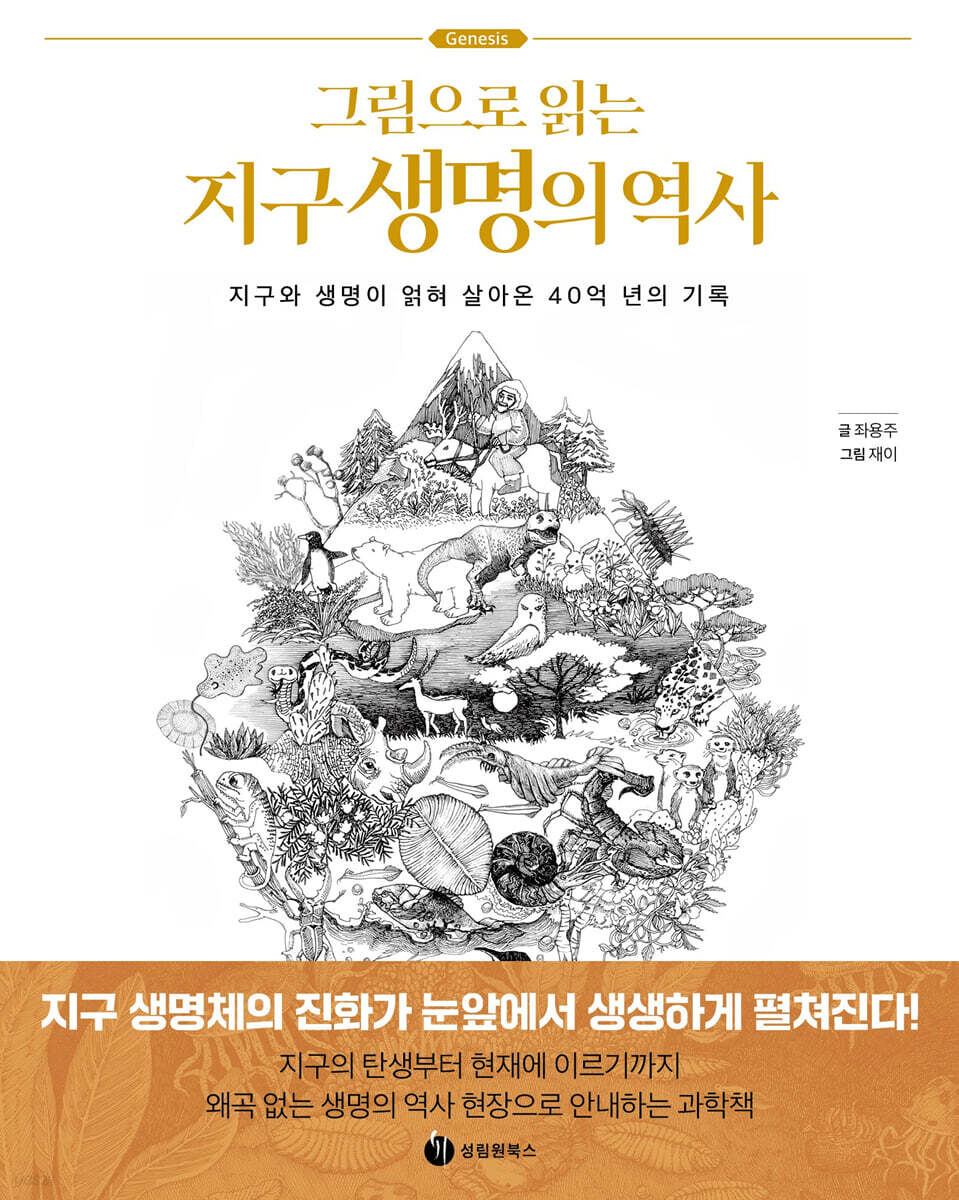
This book unfolds the grand history of life on Earth with realistic and beautiful illustrations.
A science textbook that is both a book and a work of art.
February 18, 2025. Natural Science PD Son Min-gyu
The living, breathing Earth, the grand history of life in which various creatures coexist.
Eliminate unnecessary information and concisely summarize only the key information.
Solve it with poetic metaphors and beautiful pictures!
The 4.6 billion-year history of life on Earth is not just a story of the passage of time, but also a significant story of life, evolution, and our interactions with the Earth's environment.
Life on Earth has evolved into increasingly complex multicellular life forms since the first single-celled organisms emerged in the harsh environment of the primitive Earth.
In this process, natural selection, mutations, and environmental changes influenced the form and function of living things, and through the repeated cycle of balance and restoration through the birth of various life forms, they formed the foundation of the Earth's ecosystem.
This book, "A History of Life on Earth: A Picture Book," contains scientific, philosophical, and cosmic implications of the history of life on Earth.
It also makes us think again about the origin of the Earth and the reason for the existence of life on Earth in the universe.
The author uses simple, poetic expressions to explain difficult and complex scientific concepts based solely on objective facts.
The beautiful details added to it vividly depict the history of life without distortion, perfectly guiding the journey from Earth 4 billion years ago to the present.
The book, written in concise sentences and without unnecessary details, follows the detailed illustrations that unfold like a panorama, retracing the memories of the first life on Earth one by one and suggesting the direction that humans, the most evolved life forms living on Earth today, must take.
Eliminate unnecessary information and concisely summarize only the key information.
Solve it with poetic metaphors and beautiful pictures!
The 4.6 billion-year history of life on Earth is not just a story of the passage of time, but also a significant story of life, evolution, and our interactions with the Earth's environment.
Life on Earth has evolved into increasingly complex multicellular life forms since the first single-celled organisms emerged in the harsh environment of the primitive Earth.
In this process, natural selection, mutations, and environmental changes influenced the form and function of living things, and through the repeated cycle of balance and restoration through the birth of various life forms, they formed the foundation of the Earth's ecosystem.
This book, "A History of Life on Earth: A Picture Book," contains scientific, philosophical, and cosmic implications of the history of life on Earth.
It also makes us think again about the origin of the Earth and the reason for the existence of life on Earth in the universe.
The author uses simple, poetic expressions to explain difficult and complex scientific concepts based solely on objective facts.
The beautiful details added to it vividly depict the history of life without distortion, perfectly guiding the journey from Earth 4 billion years ago to the present.
The book, written in concise sentences and without unnecessary details, follows the detailed illustrations that unfold like a panorama, retracing the memories of the first life on Earth one by one and suggesting the direction that humans, the most evolved life forms living on Earth today, must take.
- You can preview some of the book's contents.
Preview
index
- Author's Note
- Prologue
- Recommendation
NOW
The Blue Planet
BIRTH
Origin of the Earth and Seed of Life
Origin of Life
GROWTH
Cyanobacteria and Photosynthesis
Evolve gradually
Emergence of Eukaryotes
CATASTROPHE & SURVIVAL
Snowball Earth
Boring Billion
Evolution to Multicellular Life
Diversity and Extinction
Cambrian Explosion
Paleozoic Biota and Extinction
Mesozoic Biota and Extinction
New Beginning
New Biological Era and Humans
TOWARD FUTURE
Our Future
Science stories in textbooks
- Prologue
- Recommendation
NOW
The Blue Planet
BIRTH
Origin of the Earth and Seed of Life
Origin of Life
GROWTH
Cyanobacteria and Photosynthesis
Evolve gradually
Emergence of Eukaryotes
CATASTROPHE & SURVIVAL
Snowball Earth
Boring Billion
Evolution to Multicellular Life
Diversity and Extinction
Cambrian Explosion
Paleozoic Biota and Extinction
Mesozoic Biota and Extinction
New Beginning
New Biological Era and Humans
TOWARD FUTURE
Our Future
Science stories in textbooks
Detailed image

Publisher's Review
The history of life on Earth is the process by which life has adapted to its environment and evolved.
The history of life on Earth is a crucial fact that demonstrates the complexity and interaction of life, evolution, and the Earth's environment.
Since the first life forms, cyanobacteria, emerged in the harsh environment of the primitive Earth, life evolved from single-celled organisms to increasingly complex multicellular organisms.
The process of evolution has naturally been influenced by novelty, selection, mutation, and environmental changes that occur in natural occurrence, and the form and function of living things have been determined, and the balance has been maintained through the birth and extinction of various living things.
As you read along the author's calm chronological order, you will discover that Earth has experienced numerous mass extinction events, and each time, life on Earth has evolved into new forms and reshaped the Earth.
This demonstrates the resilience and tenacity of life, while also highlighting how crucial change is to the evolution of life.
The mere fact that photosynthesis by cyanobacteria increased the concentration of oxygen in the atmosphere, laying the foundation for life to obtain energy through respiration, shows that life did not simply adapt to changes in the Earth's environment, but also changed the environment itself.
This reminds us that the history of life is not simply a story about the past, but an important topic that provides deep insight into the present and future.
It is self-evident that young people studying earth science and biology at school and learning about the history of life on Earth not only provides value for understanding the past but also for planning the present and future.
Let us act as leaders of future generations with a sense of humanity's place and responsibility.
The nearly 4 billion-year history of life on Earth is not simply the accumulation of time, but the interaction and evolution of life and its environment, and the wisdom that humans can learn.
It is imperative to have respect for the wonders of nature and the diversity of life that has existed over a long period of time, and to understand how ecosystems and biodiversity maintain the balance of life on Earth.
If our youth understand the history of life on Earth through this book, "Reading the History of Life on Earth through Pictures," and thus develop an interest in "life" itself and pursue scientific inquiry and critical thinking, they will naturally be able to grow into leaders who protect the Earth's environment and life.
Furthermore, you will be able to cultivate interest in various fields such as geobiology, earth science, and astronomy, learn the importance of living in harmony with sustainable nature, and lay the foundation for making sound choices for the future.
Author's Note
Between prosperity and extinction, life continues to thrive on Earth today.
When I was little, my father came to me holding a rock the size of his fist.
A small plant was growing in the cracks of the stone surface.
Maybe he wanted to show me because he found it interesting.
It seemed fascinating that a creature could grow out of a rock.
The stone and plant that had settled in a corner of the house were a fleeting smile.
As time passed, I spent my days busy studying various stones.
Then suddenly I remembered that plant.
I realized that my childhood memories of connecting stones and life were not just a simple connection.
They have been intertwined and woven together for a very, very long time, and their essence is the same.
Words that describe life include wonderful, mysterious, beautiful, moving, etc.
But to me, life on Earth is desperately tenacious.
That's why even the smallest life is precious.
Looking back on the history of life, nearly 4 billion years old, is to realize our existence.
Sometimes hot, sometimes cold, sometimes green, sometimes desolate, life on Earth took its own steps little by little.
Even if the present becomes the past and recedes into the distance, and the distant future seems dim, the journey will not stop until we return to where we came from.
Author 2 Questions 2 Answers
1.
What kind of book is “A History of Life on Earth: A Picture Book”?
This book gently examines the process by which life was born and evolved amidst the birth and changes of the Earth.
Since the first life appeared on Earth around 4 billion years ago, shortly after the Earth was created, the Earth and life have been closely intertwined, continuously changing and evolving.
I have tried to express such scientific content as concisely as possible so that it can be easily read.
Moreover, it depicts the transformations of the earth and life, sometimes violently and sometimes tediously.
By reading the pictures of the evolution of Earth and its creatures in the past until we humans came into being today, you will be able to look back on the history of life on Earth.
2.
Why is it important to look back on the history of life on Earth?
Humans are just one of the many species that were born, grew up, and died on Earth.
Until we arrived on Earth today, the sky, the sea, and the land have all changed, and life has also continued to evolve tremendously.
For nearly 4 billion years.
Understanding life and its surroundings makes us think about how we should live in the future.
This blue planet is not only inhabited by humans, but also by many other living beings.
However, the reality that humans are destroying the environment with their own hands and creating the term "sixth extinction" is not desirable.
We must look back on the history of life on Earth and seriously consider what we must do for the future of humanity.
The history of life on Earth is a crucial fact that demonstrates the complexity and interaction of life, evolution, and the Earth's environment.
Since the first life forms, cyanobacteria, emerged in the harsh environment of the primitive Earth, life evolved from single-celled organisms to increasingly complex multicellular organisms.
The process of evolution has naturally been influenced by novelty, selection, mutation, and environmental changes that occur in natural occurrence, and the form and function of living things have been determined, and the balance has been maintained through the birth and extinction of various living things.
As you read along the author's calm chronological order, you will discover that Earth has experienced numerous mass extinction events, and each time, life on Earth has evolved into new forms and reshaped the Earth.
This demonstrates the resilience and tenacity of life, while also highlighting how crucial change is to the evolution of life.
The mere fact that photosynthesis by cyanobacteria increased the concentration of oxygen in the atmosphere, laying the foundation for life to obtain energy through respiration, shows that life did not simply adapt to changes in the Earth's environment, but also changed the environment itself.
This reminds us that the history of life is not simply a story about the past, but an important topic that provides deep insight into the present and future.
It is self-evident that young people studying earth science and biology at school and learning about the history of life on Earth not only provides value for understanding the past but also for planning the present and future.
Let us act as leaders of future generations with a sense of humanity's place and responsibility.
The nearly 4 billion-year history of life on Earth is not simply the accumulation of time, but the interaction and evolution of life and its environment, and the wisdom that humans can learn.
It is imperative to have respect for the wonders of nature and the diversity of life that has existed over a long period of time, and to understand how ecosystems and biodiversity maintain the balance of life on Earth.
If our youth understand the history of life on Earth through this book, "Reading the History of Life on Earth through Pictures," and thus develop an interest in "life" itself and pursue scientific inquiry and critical thinking, they will naturally be able to grow into leaders who protect the Earth's environment and life.
Furthermore, you will be able to cultivate interest in various fields such as geobiology, earth science, and astronomy, learn the importance of living in harmony with sustainable nature, and lay the foundation for making sound choices for the future.
Author's Note
Between prosperity and extinction, life continues to thrive on Earth today.
When I was little, my father came to me holding a rock the size of his fist.
A small plant was growing in the cracks of the stone surface.
Maybe he wanted to show me because he found it interesting.
It seemed fascinating that a creature could grow out of a rock.
The stone and plant that had settled in a corner of the house were a fleeting smile.
As time passed, I spent my days busy studying various stones.
Then suddenly I remembered that plant.
I realized that my childhood memories of connecting stones and life were not just a simple connection.
They have been intertwined and woven together for a very, very long time, and their essence is the same.
Words that describe life include wonderful, mysterious, beautiful, moving, etc.
But to me, life on Earth is desperately tenacious.
That's why even the smallest life is precious.
Looking back on the history of life, nearly 4 billion years old, is to realize our existence.
Sometimes hot, sometimes cold, sometimes green, sometimes desolate, life on Earth took its own steps little by little.
Even if the present becomes the past and recedes into the distance, and the distant future seems dim, the journey will not stop until we return to where we came from.
Author 2 Questions 2 Answers
1.
What kind of book is “A History of Life on Earth: A Picture Book”?
This book gently examines the process by which life was born and evolved amidst the birth and changes of the Earth.
Since the first life appeared on Earth around 4 billion years ago, shortly after the Earth was created, the Earth and life have been closely intertwined, continuously changing and evolving.
I have tried to express such scientific content as concisely as possible so that it can be easily read.
Moreover, it depicts the transformations of the earth and life, sometimes violently and sometimes tediously.
By reading the pictures of the evolution of Earth and its creatures in the past until we humans came into being today, you will be able to look back on the history of life on Earth.
2.
Why is it important to look back on the history of life on Earth?
Humans are just one of the many species that were born, grew up, and died on Earth.
Until we arrived on Earth today, the sky, the sea, and the land have all changed, and life has also continued to evolve tremendously.
For nearly 4 billion years.
Understanding life and its surroundings makes us think about how we should live in the future.
This blue planet is not only inhabited by humans, but also by many other living beings.
However, the reality that humans are destroying the environment with their own hands and creating the term "sixth extinction" is not desirable.
We must look back on the history of life on Earth and seriously consider what we must do for the future of humanity.
GOODS SPECIFICS
- Date of issue: February 17, 2025
- Page count, weight, size: 204 pages | 574g | 200*250*13mm
- ISBN13: 9791193357415
- ISBN10: 1193357411
You may also like
카테고리
korean


korean

![GQ KOREA Mark (Monthly): December [2025]](http://librairie.coreenne.fr/cdn/shop/files/8ef265dbbfbf186523ed75ba7319009d.jpg?v=1765340328&width=3840)


