

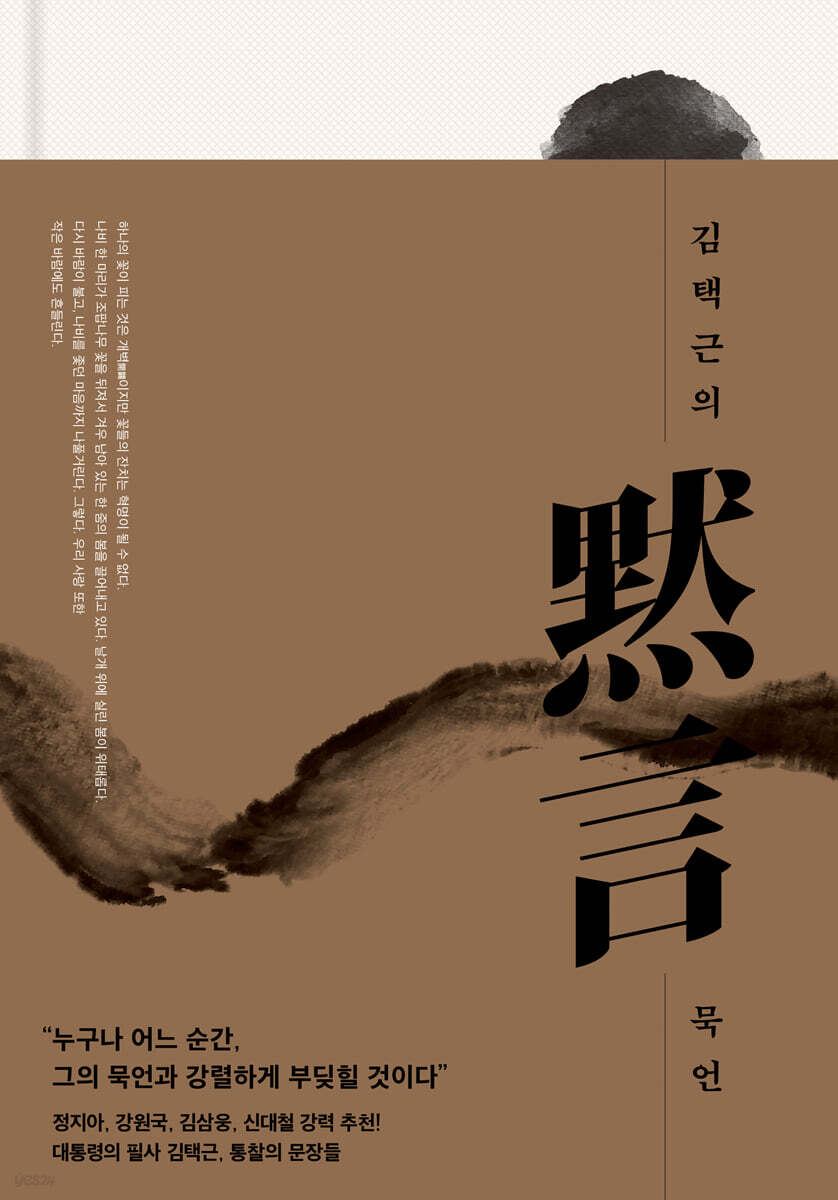
Kim Taek-geun's silence
 |
Description
Book Introduction
- A word from MD
-
Korean society as seen through the eyes of a master of sentencesThe Republic of Korea as seen by Kim Taek-geun, a poet, journalist, and biographer.
The Korean society, which is full of conflicts and contradictions, was cut down with a sharp sentence.
We look back at figures and events from modern and contemporary Korean history, including Kang Su-yeon, Kim Dae-jung, Kim Min-ki, Kim Young-sam, and Kim Ji-ha, and reflect on where we are and where we should go.
November 26, 2024. Humanities PD Son Min-gyu
“Everyone has at some point experienced his silence and
“It will hit hard.”
Kim Taek-geun, who wrote “Kim Dae-jung’s Autobiography” and “Dawn: A Biography of Kim Dae-jung,” is also called a “master of writing.”
The solid logic and poetic sentiments gained through his long career as a journalist have deeply resonated with countless readers.
The author's writing, which gets to the essence without being repetitive and always humble before humanity and nature, is clear and sharp, purifying the confused mind.
Kim Taek-geun's writings are also records of insights that transcend time.
The last article penetrates the current reality.
For decades, his columns have decried politics steeped in hate, called out the victims of national disaster, and sung of lost times and nature.
It is still relevant today and makes you want to read it over and over again.
Thus, novelist Jeong Ji-ah praised him, saying, “Kim Taek-geun’s writing is like a well-sharpened knife, engraving it in our hearts,” and poet Shin Dae-cheol asserted, “Everyone will at some point strongly collide with his silence.”
Regarding the meaning of “Silence,” the title of the column of the same name serialized in the Kyunghyang Shinmun, the author says, “It means to destroy the false and vain things built with words,” and “In an age where words are extremely polluted, silence is purification and reflection.”
For those who wish to escape from an era stained with hate speech and cultivate a reflective perspective, "Kim Taek-geun's Silence" is a book worth reading for a long time.
“It will hit hard.”
Kim Taek-geun, who wrote “Kim Dae-jung’s Autobiography” and “Dawn: A Biography of Kim Dae-jung,” is also called a “master of writing.”
The solid logic and poetic sentiments gained through his long career as a journalist have deeply resonated with countless readers.
The author's writing, which gets to the essence without being repetitive and always humble before humanity and nature, is clear and sharp, purifying the confused mind.
Kim Taek-geun's writings are also records of insights that transcend time.
The last article penetrates the current reality.
For decades, his columns have decried politics steeped in hate, called out the victims of national disaster, and sung of lost times and nature.
It is still relevant today and makes you want to read it over and over again.
Thus, novelist Jeong Ji-ah praised him, saying, “Kim Taek-geun’s writing is like a well-sharpened knife, engraving it in our hearts,” and poet Shin Dae-cheol asserted, “Everyone will at some point strongly collide with his silence.”
Regarding the meaning of “Silence,” the title of the column of the same name serialized in the Kyunghyang Shinmun, the author says, “It means to destroy the false and vain things built with words,” and “In an age where words are extremely polluted, silence is purification and reflection.”
For those who wish to escape from an era stained with hate speech and cultivate a reflective perspective, "Kim Taek-geun's Silence" is a book worth reading for a long time.
- You can preview some of the book's contents.
Preview
index
Recommendationㆍ005
Prologue - Crossing the Watery Ageㆍ010
Part 1 - Remember Your Death
Person Kim Min-kiㆍ026
We became what we are because of the adult Kim Jang-haㆍ030
Selling the Fieldㆍ034
Where the sound of the 'warang' ceased, weㆍ038
Exit Stationㆍ042
Big Child, Kwon Jeong-saengㆍ044
Minari and Atlanta Sisterㆍ047
Hometown and Zelkova Treeㆍ051
Don't ask what 'filial piety' isㆍ054
Where "Father's Liberation Diary" Pointsㆍ058
Plane tree in front of the History Museumㆍ062
A fixed star must flow and revolveㆍ066
Park Soo-geun's paintingㆍ069
Mother of the Unjustly Diedㆍ072
The dead still live in Gandoㆍ076
Testimony of the Blue Eyesㆍ080
Good politicians don't just emerge.ㆍ083
Remember Your Deathㆍ087
The Tyranny of Criticismㆍ091
Jeongㆍ094
Part 2 - Even the name is sick
Mukbang is sadㆍ100
Who's Crying Alone Now?ㆍ104
Are you looking for a good site?ㆍ107
Even the name is sickㆍ111
Shin Tae-in 100 Yearsㆍ115
For Kimchiㆍ119
Spring Day Disposalㆍ123
Will it disappear with the shaman?ㆍ125
Don't Sell the Buddhaㆍ129
Violence and Righteous Revengeㆍ133
Mercy of the Handㆍ137
Anonymous, you whom I cannot call in my native tongueㆍ140
Spring Rainㆍ144
Buddha's Smileㆍ147
Part 3 - Words Speak for Everything
Manager Kim from Jeolla Province, 152
The Battle of Knowledgeㆍ156
Will the South and North become "puppet states" again?ㆍ160
Swallows in the sky, violets on the groundㆍ164
Climate Villainsㆍ167
The Curse of the Saemangeum Tidal Flatsㆍ171
Light's Attackㆍ175
A Mayfly's Special Dayㆍ178
City Drinkersㆍ182
Walkingㆍ184
Stolen Povertyㆍ186
Stop committing evil deedsㆍ190
Is Your Knowledge Healthy?ㆍ194
Words Speak for Everythingㆍ198
The Roots of Grassroots Democracy Are Rottingㆍ202
Will it become a parasite in the history of democracy?ㆍ206
Professor Baek Gi-wan Asksㆍ210
Clash of Civilizationsㆍ214
Between Fall and Winterㆍ216
Part 4 - Therefore, I am you
Spring Day Passesㆍ220
One Moon in a Thousand Riversㆍ224
Have you ever seen the moon in Daldongne?ㆍ228
People Who Kicked Out of the Graveㆍ232
Centrism: Jeong Ha-ryong's Final Requestㆍ236
Do You Know the Sea?ㆍ240
At the end of the West Sea lies the Gyeokryeolbi Islandsㆍ244
It's Not the End of the Worldㆍ248
The End of the Petroleum Ageㆍ252
Pine Tree, Pine Treeㆍ256
Park Kyung-ni's 'Life'ㆍ259
Trees Have Soulsㆍ261
Open the Church Doorsㆍ265
If You Want Peace, Become Peace Firstㆍ269
Conductor Kim Sung-jin's "Breaking Down Boundaries"ㆍ273
The Master's Lament: "Breaking the Chains of Time"ㆍ277
Therefore, I am youㆍ281
Poorestㆍ285
The White-clad People in Blackㆍ287
Part 5 - Kim Dae-jung's Last Tears
Don't lump Kim Dae-jung into the "Three Kims"ㆍ292
Kim Dae-jung and Lim Dong-won, 295
There Was a Successful Presidentㆍ299
Re-establishment of the People's Governmentㆍ303
Kim Dae-jung's Last Tearsㆍ307
Kim Dae-jung's 100th Anniversary and March 11th
Epilogue - Meeting Kim Taek-geun
"You need to dig deep to cut out adjectives"ㆍ316
Prologue - Crossing the Watery Ageㆍ010
Part 1 - Remember Your Death
Person Kim Min-kiㆍ026
We became what we are because of the adult Kim Jang-haㆍ030
Selling the Fieldㆍ034
Where the sound of the 'warang' ceased, weㆍ038
Exit Stationㆍ042
Big Child, Kwon Jeong-saengㆍ044
Minari and Atlanta Sisterㆍ047
Hometown and Zelkova Treeㆍ051
Don't ask what 'filial piety' isㆍ054
Where "Father's Liberation Diary" Pointsㆍ058
Plane tree in front of the History Museumㆍ062
A fixed star must flow and revolveㆍ066
Park Soo-geun's paintingㆍ069
Mother of the Unjustly Diedㆍ072
The dead still live in Gandoㆍ076
Testimony of the Blue Eyesㆍ080
Good politicians don't just emerge.ㆍ083
Remember Your Deathㆍ087
The Tyranny of Criticismㆍ091
Jeongㆍ094
Part 2 - Even the name is sick
Mukbang is sadㆍ100
Who's Crying Alone Now?ㆍ104
Are you looking for a good site?ㆍ107
Even the name is sickㆍ111
Shin Tae-in 100 Yearsㆍ115
For Kimchiㆍ119
Spring Day Disposalㆍ123
Will it disappear with the shaman?ㆍ125
Don't Sell the Buddhaㆍ129
Violence and Righteous Revengeㆍ133
Mercy of the Handㆍ137
Anonymous, you whom I cannot call in my native tongueㆍ140
Spring Rainㆍ144
Buddha's Smileㆍ147
Part 3 - Words Speak for Everything
Manager Kim from Jeolla Province, 152
The Battle of Knowledgeㆍ156
Will the South and North become "puppet states" again?ㆍ160
Swallows in the sky, violets on the groundㆍ164
Climate Villainsㆍ167
The Curse of the Saemangeum Tidal Flatsㆍ171
Light's Attackㆍ175
A Mayfly's Special Dayㆍ178
City Drinkersㆍ182
Walkingㆍ184
Stolen Povertyㆍ186
Stop committing evil deedsㆍ190
Is Your Knowledge Healthy?ㆍ194
Words Speak for Everythingㆍ198
The Roots of Grassroots Democracy Are Rottingㆍ202
Will it become a parasite in the history of democracy?ㆍ206
Professor Baek Gi-wan Asksㆍ210
Clash of Civilizationsㆍ214
Between Fall and Winterㆍ216
Part 4 - Therefore, I am you
Spring Day Passesㆍ220
One Moon in a Thousand Riversㆍ224
Have you ever seen the moon in Daldongne?ㆍ228
People Who Kicked Out of the Graveㆍ232
Centrism: Jeong Ha-ryong's Final Requestㆍ236
Do You Know the Sea?ㆍ240
At the end of the West Sea lies the Gyeokryeolbi Islandsㆍ244
It's Not the End of the Worldㆍ248
The End of the Petroleum Ageㆍ252
Pine Tree, Pine Treeㆍ256
Park Kyung-ni's 'Life'ㆍ259
Trees Have Soulsㆍ261
Open the Church Doorsㆍ265
If You Want Peace, Become Peace Firstㆍ269
Conductor Kim Sung-jin's "Breaking Down Boundaries"ㆍ273
The Master's Lament: "Breaking the Chains of Time"ㆍ277
Therefore, I am youㆍ281
Poorestㆍ285
The White-clad People in Blackㆍ287
Part 5 - Kim Dae-jung's Last Tears
Don't lump Kim Dae-jung into the "Three Kims"ㆍ292
Kim Dae-jung and Lim Dong-won, 295
There Was a Successful Presidentㆍ299
Re-establishment of the People's Governmentㆍ303
Kim Dae-jung's Last Tearsㆍ307
Kim Dae-jung's 100th Anniversary and March 11th
Epilogue - Meeting Kim Taek-geun
"You need to dig deep to cut out adjectives"ㆍ316
Detailed image

Into the book
We had to keep clamoring for slogans like ‘modernization of the fatherland’ and ‘construction of a just society.’
They were other names for state violence.
It was a painful time.
There is no such thing as pure violence in the world.
If the shadow of desire does not become violent, repentance is necessary.
But our society did not repent.
We didn't perform a grand ceremony to wash away the past, with everyone resonating together.
There was no public reflection.
So even now, countries, workplaces, and even religions harbor violence.
The violence of the Japanese colonial period, the Korean War, the US military government, and the dictatorship remains.
There is violence lurking not only in money and power, but also in school ties and regional ties.
I wanted to expose the true nature of the violence and expose the perpetrators of the violence.
--- From "Prologue, Crossing the Watery Age"
He will not shine only in the sky.
When the lights are turned on in the poor village, the songs of the stars will come down.
In a town where all the good things have disappeared, there will be another Kim Min-ki living there.
I'll get off there and wander around.
When you find an inn, you will smile without any vulgarity.
Our lives are also drifting away.
I can see the darkness behind the sunset.
We too must get off somewhere soon, holding up a song.
What should I uphold and what should I discard to enter Kim Min-ki's village?
--- From "Part 1, Person Kim Min-ki"
Looking back, during those harsh times, politicians Kim Young-sam and Kim Dae-jung were a source of hope just by their names.
To the people who yearned for democracy, the two Kims were a 'new tomorrow.'
It is a blessing to have a good politician who can go through an era with us.
Even if corrupt and incompetent politicians do bad politics, it is only through politics that they can be corrected.
So, you shouldn't hate politics unconditionally.
If you turn a blind eye to politics because you think politics is dirty and politicians are corrupt, even worse politicians will run rampant.
If you want to be a good leader, you must be a gentle supporter and a fierce watchdog.
--- From "Part 1: Good Politicians Can't Suddenly Appear"
Almost all religions offer prayers over food.
First of all, I join my hands in gratitude for the blessings of heaven, the mercy of the earth, and the sincerity of the farmer.
I bow my head to the sun, moon, stars, wind, and rain that permeate the form.
In the end, he worshipped the living beings who had become food.
Choi Si-hyeong, the second leader of Donghak, preached the principle of ‘eating heaven with food.’
Since the living beings that become food are also part of heaven, the act of eating food is like eating heaven with heaven.
I, the sky, eat other sky and gain life.
--- From "Part 2, Mukbang is Sad"
Now the public revenge has begun.
There is no such thing as a good punch, but there is righteous revenge.
We must not allow the one who tramples on a person's soul and ruins his life to remain the winner.
A violent addict may have a seizure at any moment.
Violence is everyone's problem.
If you leave the wounds of violence as personal, you will eventually be caught up in a whirlpool of violence.
Violence can only be eradicated when everyone feels pain at the sight of the victim's suffering.
--- From "Part 2, Violence and Righteous Revenge"
What went wrong.
Nothing has changed.
The same disaster occurred in Itaewon, very close to Yongsan Station.
Almost half a century later, young people are still being crushed to death.
It is said that what happens at a certain point does not disperse into the universe but continues to linger and reverberate.
Karma cannot break through gravity.
So, if we want to see what our future will be like, we should look at our actions today.
How frightening it would be if karma did not disappear as time passed and one day it would strike as a disaster.
But there is only one act that will dissolve karma: repentance.
All religions tell us to repent before praying for blessings and good fortune.
--- From "Part 3, Stop Committing Evil Deeds"
Words have a recipient.
So the word comes back.
Good words come back with a smiling face, bad words come back with an angry face.
Words once spoken will follow you for the rest of your life.
Sometimes, it can even tie up fate.
Words have waves.
Spicy and harsh words spread rapidly.
The statement that one will kill the other person implies the determination to die oneself as well.
The tongue is a sword, and the mouth is a gate through which misfortune comes and goes.
--- From "Part 3, Words Speak for Everything"
We don't age slowly.
Suddenly I get old.
One day, I suddenly looked in the mirror and saw a middle-aged man staring at me.
We hate to admit it, but our youth no longer exists in this world.
How many springs will we experience in our lifetime?
Where is my youth, which has taken another step away, wandering around?
The tear-soaked past must flow away to a place without tears.
But what can we do?
I'm sad that spring is coming back and I'm shedding tears.
--- From "Part 4, Spring Day Passes By"
In the 1960s, the government began to support industry.
People admired the city lights and the machines of the factories.
Rural areas were gradually abandoned.
The discouraged people marched to Seoul, hoping to get a quick drink before they died.
How scary it is to leave home.
Each person had to carry a knife in their chest.
As I was applying force, the bloodshot eyes did not go away.
I built a house on the mountainside and called it my home.
But the authorities turned a blind eye.
The government was unable to afford to take care of the urban poor.
I couldn't touch that bloody sorrow and anger.
Industrialization also required cheap labor that could be called upon at any time.
The unlicensed mountain village was left to rot.
--- From "Part 4, Have You Ever Seen the Moon in Daldongne?"
It is often said that all presidents since liberation have failed and been unfortunate.
I can't agree.
We had a successful president.
The five years of the People's Government shine brightly in history.
In this presidential election, the politician most sought after by each camp was Kim Dae-jung.
However, the group that failed to manage the country will find it burdensome to compare themselves with the successful Kim Dae-jung government.
So, isn't it possible that we are evaluating Kim Dae-jung's legacy abstractly rather than calculating it concretely?
It is time to properly organize our political history.
The president's merits and demerits must be politically meticulously investigated.
How could democracy develop without ‘politics’?
Although it is a country divided into two, if we look into its modern history, we find immortal moments and touching anecdotes that will remain in history for a long time.
They were other names for state violence.
It was a painful time.
There is no such thing as pure violence in the world.
If the shadow of desire does not become violent, repentance is necessary.
But our society did not repent.
We didn't perform a grand ceremony to wash away the past, with everyone resonating together.
There was no public reflection.
So even now, countries, workplaces, and even religions harbor violence.
The violence of the Japanese colonial period, the Korean War, the US military government, and the dictatorship remains.
There is violence lurking not only in money and power, but also in school ties and regional ties.
I wanted to expose the true nature of the violence and expose the perpetrators of the violence.
--- From "Prologue, Crossing the Watery Age"
He will not shine only in the sky.
When the lights are turned on in the poor village, the songs of the stars will come down.
In a town where all the good things have disappeared, there will be another Kim Min-ki living there.
I'll get off there and wander around.
When you find an inn, you will smile without any vulgarity.
Our lives are also drifting away.
I can see the darkness behind the sunset.
We too must get off somewhere soon, holding up a song.
What should I uphold and what should I discard to enter Kim Min-ki's village?
--- From "Part 1, Person Kim Min-ki"
Looking back, during those harsh times, politicians Kim Young-sam and Kim Dae-jung were a source of hope just by their names.
To the people who yearned for democracy, the two Kims were a 'new tomorrow.'
It is a blessing to have a good politician who can go through an era with us.
Even if corrupt and incompetent politicians do bad politics, it is only through politics that they can be corrected.
So, you shouldn't hate politics unconditionally.
If you turn a blind eye to politics because you think politics is dirty and politicians are corrupt, even worse politicians will run rampant.
If you want to be a good leader, you must be a gentle supporter and a fierce watchdog.
--- From "Part 1: Good Politicians Can't Suddenly Appear"
Almost all religions offer prayers over food.
First of all, I join my hands in gratitude for the blessings of heaven, the mercy of the earth, and the sincerity of the farmer.
I bow my head to the sun, moon, stars, wind, and rain that permeate the form.
In the end, he worshipped the living beings who had become food.
Choi Si-hyeong, the second leader of Donghak, preached the principle of ‘eating heaven with food.’
Since the living beings that become food are also part of heaven, the act of eating food is like eating heaven with heaven.
I, the sky, eat other sky and gain life.
--- From "Part 2, Mukbang is Sad"
Now the public revenge has begun.
There is no such thing as a good punch, but there is righteous revenge.
We must not allow the one who tramples on a person's soul and ruins his life to remain the winner.
A violent addict may have a seizure at any moment.
Violence is everyone's problem.
If you leave the wounds of violence as personal, you will eventually be caught up in a whirlpool of violence.
Violence can only be eradicated when everyone feels pain at the sight of the victim's suffering.
--- From "Part 2, Violence and Righteous Revenge"
What went wrong.
Nothing has changed.
The same disaster occurred in Itaewon, very close to Yongsan Station.
Almost half a century later, young people are still being crushed to death.
It is said that what happens at a certain point does not disperse into the universe but continues to linger and reverberate.
Karma cannot break through gravity.
So, if we want to see what our future will be like, we should look at our actions today.
How frightening it would be if karma did not disappear as time passed and one day it would strike as a disaster.
But there is only one act that will dissolve karma: repentance.
All religions tell us to repent before praying for blessings and good fortune.
--- From "Part 3, Stop Committing Evil Deeds"
Words have a recipient.
So the word comes back.
Good words come back with a smiling face, bad words come back with an angry face.
Words once spoken will follow you for the rest of your life.
Sometimes, it can even tie up fate.
Words have waves.
Spicy and harsh words spread rapidly.
The statement that one will kill the other person implies the determination to die oneself as well.
The tongue is a sword, and the mouth is a gate through which misfortune comes and goes.
--- From "Part 3, Words Speak for Everything"
We don't age slowly.
Suddenly I get old.
One day, I suddenly looked in the mirror and saw a middle-aged man staring at me.
We hate to admit it, but our youth no longer exists in this world.
How many springs will we experience in our lifetime?
Where is my youth, which has taken another step away, wandering around?
The tear-soaked past must flow away to a place without tears.
But what can we do?
I'm sad that spring is coming back and I'm shedding tears.
--- From "Part 4, Spring Day Passes By"
In the 1960s, the government began to support industry.
People admired the city lights and the machines of the factories.
Rural areas were gradually abandoned.
The discouraged people marched to Seoul, hoping to get a quick drink before they died.
How scary it is to leave home.
Each person had to carry a knife in their chest.
As I was applying force, the bloodshot eyes did not go away.
I built a house on the mountainside and called it my home.
But the authorities turned a blind eye.
The government was unable to afford to take care of the urban poor.
I couldn't touch that bloody sorrow and anger.
Industrialization also required cheap labor that could be called upon at any time.
The unlicensed mountain village was left to rot.
--- From "Part 4, Have You Ever Seen the Moon in Daldongne?"
It is often said that all presidents since liberation have failed and been unfortunate.
I can't agree.
We had a successful president.
The five years of the People's Government shine brightly in history.
In this presidential election, the politician most sought after by each camp was Kim Dae-jung.
However, the group that failed to manage the country will find it burdensome to compare themselves with the successful Kim Dae-jung government.
So, isn't it possible that we are evaluating Kim Dae-jung's legacy abstractly rather than calculating it concretely?
It is time to properly organize our political history.
The president's merits and demerits must be politically meticulously investigated.
How could democracy develop without ‘politics’?
Although it is a country divided into two, if we look into its modern history, we find immortal moments and touching anecdotes that will remain in history for a long time.
--- From "Part 5, There Was a Successful President"
Publisher's Review
“Let it be engraved in our hearts like a well-sharpened sword.”
President Kim Taek-geun's Handwritten Notes: Sentences of Insight
When I turn on the news, I feel dizzy from the dizzying state of affairs every day.
Incitement, fabrication, and violence by those in power armed with factional logic are rampant.
The new media surrounding us now seems to bring freedom of communication, but instead, it is contributing to value bias.
What we need most now, as we live in a more tumultuous time than ever before, is no longer words, but reflection and introspection.
Kim Taek-geun, the author of “Kim Taek-geun’s Silence,” is a poet.
He debuted in 1984 through the magazine “Modern Literature” and worked as an editor at the Kyunghyang Shinmun for over 30 years.
He also wrote Kim Dae-jung's autobiography over a period of six years from 2004 to 2010.
The nicknames Kim Taek-geun earned while working as a journalist are 'Master of Sentences' and 'Poet Who Never Ages'.
This is because he writes dense sentences with objectivity and logic, while not losing sight of the poet's warm gaze toward the world.
Kim Taek-geun's writing, grounded in both contemporary and poetic reflection, is thus both solid and lyrical.
This book is a compilation of the author's columns published in the Kyunghyang Shinmun, Weekly Kyunghyang, and Monthly Bulkwang.
For decades, his columns have decried politics steeped in hate, called out the victims of national disasters, and sung of lost times and nature.
With the eyes of a journalist, I saw the battlefield of logic, but with the heart of a poet, I dealt with the pain of the times.
The author's writing, which gets to the essence without being repetitive and always humble before humanity and nature, is clear and sharp, purifying the confused mind.
This is why everyone who has encountered Kim Taek-geun's writing regards it as a textbook on prose.
Novelist Jeong Ji-ah said of “Silence,” “Kim Taek-geun’s writing is like a well-sharpened knife, engraving it in our hearts.
In a world that has become unbearably light, his deep and intense love is always directed towards the lowly, towards those barely surviving,” he said, and former Blue House speech secretary Kang Won-guk said, “I have been enviously looking at Kim Taek-geun’s writing for a long time.
I read and read again.
He confessed, “I copied and imitated it.”
The true 'power of words' that destroys the false and vain
Silence in the face of rampant violence
The dictionary definition of 'silence', taken from the title of a column of the same name serialized in the Kyunghyang Shinmun, is 'not speaking'.
Writing is about saying something, so it is strange to use the word “silence” as the title, which means not saying anything.
In an interview at the end of the book, the author explains the meaning of silence, saying, “It means destroying the false and vain things built with words,” and “In an age where words are extremely polluted, silence is purification and reflection.”
The most representative keyword for ‘bad things’ in the book is ‘violence.’
The author identifies the widespread violence that has long been embedded in our history and its contemporary phenomena.
Violence is found in seemingly trivial everyday situations, such as “a teacher who hits a student in the face with his palm” during school days (Part 2, “Violence and Righteous Revenge”), and in countless subcontractors where workers die “from being hit, falling, getting caught, or being run over” (Part 1, “Mothers of Unjust Death”).
There is also state violence, such as the Je-am-ri massacre, in which “churches were set on fire and villages were burned” (Part 1, “Testimony of the Blue Eyes”).
Furthermore, the author's gaze reaches out to the flora, fauna, and environment that share the Earth.
The destruction of the ecosystem, which destroys mountains, fields, and the sanctuary of countless living creatures, is clearly caused by human violence.
The author does not take the easy way out of blaming a few political opponents for the violence that surrounds us, but seeks to recognize it as a problem “for all of us.”
All individuals, groups, societies, and people living in a history and culture of violence have a responsibility to overcome it together.
So, we must also share the wounds of violence.
“Violence can only be banished when everyone feels pain at the sight of the victim’s suffering.” Accurately identifying the cause and target of violence while not abandoning the responsibility to embrace it is the goal of 『Muteon』, which rejects “polluted words” and “wrong things,” and the origin that resonates in our hearts.
Have you ever seen the moon in Daldongne?
Comfort in an age of loss
『Silence』 is composed of a total of 5 parts.
Part 1, “Remember Your Death,” and Part 2, “Even Names Get Sick,” mainly deal with our precious past values that are gradually disappearing and the current state of affairs. Part 3, “Words Speak All,” and Part 4, “Therefore I Am You,” talk about the evils embedded in our politics and focus on peace and ecology.
Part 5, “Kim Dae-jung’s Last Tears,” is a collection of writings related to Kim Dae-jung, a politician with whom the author had a relationship.
The author, Kim Taek-geun, is from Shintaein, Jeongeup, and is a member of a generation that experienced rural migration and urbanization firsthand.
So, throughout the book, there is a deep longing for lost landscapes and virtues that are gradually being forgotten and disappearing.
The anecdote of a mother who raised her granddaughter until she was seven years old in place of her sister and brother-in-law who left to settle in the United States (Part 1, “Minari and Atlanta Sister”), and the story of the moment when her father, who was “a husband and a child” and “the last source of pride” at the time, sold his rice paddy (Part 1, “Selling the Rice Paddy”) make the reader feel helplessly nostalgic.
The story of Baeksa Village, the village where the author spent his youth, cannot be easily overlooked.
The story of the Dal-dongne community (Part 4, “Have You Ever Seen the Moon in Dal-dongne”), where “poverty was covered with planks, but soon everything was revealed” and “boasting about the past made reality look even more shabby,” expands to the story of all those who left their hometowns and “marched to Seoul to try to suck on a faucet,” and is heartbreaking.
It's not just about bringing up personal stories.
It also contains stories about the true adults of the times.
We remember and commemorate those who “lived for others” rather than “dividing the world,” including singers Kim Min-ki, Kim Jang-ha, Baek Gi-wan, Kwon Jeong-saeng, and Monk Seongcheol.
『Silence』, which remembers and revives lost values and people, thus becomes a lament for the times gone by.
And that song comforts us as we live in an age of loss.
The letter addressed to the anonymous person, to all of us who live in a world of chaos, contains sincere and good feelings.
The author offers love and comfort to all ordinary people living in this world, saying, “We cannot be comforted by ourselves or console ourselves,” and “We have tomorrow because we are together.”
If you are someone who often recalls lost times and is doing everything in your power to survive today, you will have no choice but to grasp the quietly reaching hand of 『Silence』.
Call him again
Kim Dae-jung's last tears
Kim Taek-geun has a special relationship with former President Kim Dae-jung.
From 2004 to 2012, I wrote 『Kim Dae-jung's Autobiography』 over a period of six years, and 『Dawn: A Biography of Kim Dae-jung』 over a period of two years.
As the author says, he was “trapped in the ‘Kim Dae-jung writing prison’ for eight years.”
The six articles in Part 5, “Kim Dae-jung’s Last Tears,” are not simply reminiscent of Kim Dae-jung, but are written out of a sense of urgency.
He was called upon to stand before a democracy in peril (“Kim Dae-jung’s Last Tears”), to reflect on the significance of the June 15th Joint Declaration on the occasion of its 20th anniversary (“Kim Dae-jung and Lim Dong-won”), and to examine the requirements for former President Moon Jae-in’s re-establishment of power (“Re-establishment of the People’s Government”).
It is worth reflecting on Kim Taek-geun's writings to see if our politics and society need his name again.
President Kim Taek-geun's Handwritten Notes: Sentences of Insight
When I turn on the news, I feel dizzy from the dizzying state of affairs every day.
Incitement, fabrication, and violence by those in power armed with factional logic are rampant.
The new media surrounding us now seems to bring freedom of communication, but instead, it is contributing to value bias.
What we need most now, as we live in a more tumultuous time than ever before, is no longer words, but reflection and introspection.
Kim Taek-geun, the author of “Kim Taek-geun’s Silence,” is a poet.
He debuted in 1984 through the magazine “Modern Literature” and worked as an editor at the Kyunghyang Shinmun for over 30 years.
He also wrote Kim Dae-jung's autobiography over a period of six years from 2004 to 2010.
The nicknames Kim Taek-geun earned while working as a journalist are 'Master of Sentences' and 'Poet Who Never Ages'.
This is because he writes dense sentences with objectivity and logic, while not losing sight of the poet's warm gaze toward the world.
Kim Taek-geun's writing, grounded in both contemporary and poetic reflection, is thus both solid and lyrical.
This book is a compilation of the author's columns published in the Kyunghyang Shinmun, Weekly Kyunghyang, and Monthly Bulkwang.
For decades, his columns have decried politics steeped in hate, called out the victims of national disasters, and sung of lost times and nature.
With the eyes of a journalist, I saw the battlefield of logic, but with the heart of a poet, I dealt with the pain of the times.
The author's writing, which gets to the essence without being repetitive and always humble before humanity and nature, is clear and sharp, purifying the confused mind.
This is why everyone who has encountered Kim Taek-geun's writing regards it as a textbook on prose.
Novelist Jeong Ji-ah said of “Silence,” “Kim Taek-geun’s writing is like a well-sharpened knife, engraving it in our hearts.
In a world that has become unbearably light, his deep and intense love is always directed towards the lowly, towards those barely surviving,” he said, and former Blue House speech secretary Kang Won-guk said, “I have been enviously looking at Kim Taek-geun’s writing for a long time.
I read and read again.
He confessed, “I copied and imitated it.”
The true 'power of words' that destroys the false and vain
Silence in the face of rampant violence
The dictionary definition of 'silence', taken from the title of a column of the same name serialized in the Kyunghyang Shinmun, is 'not speaking'.
Writing is about saying something, so it is strange to use the word “silence” as the title, which means not saying anything.
In an interview at the end of the book, the author explains the meaning of silence, saying, “It means destroying the false and vain things built with words,” and “In an age where words are extremely polluted, silence is purification and reflection.”
The most representative keyword for ‘bad things’ in the book is ‘violence.’
The author identifies the widespread violence that has long been embedded in our history and its contemporary phenomena.
Violence is found in seemingly trivial everyday situations, such as “a teacher who hits a student in the face with his palm” during school days (Part 2, “Violence and Righteous Revenge”), and in countless subcontractors where workers die “from being hit, falling, getting caught, or being run over” (Part 1, “Mothers of Unjust Death”).
There is also state violence, such as the Je-am-ri massacre, in which “churches were set on fire and villages were burned” (Part 1, “Testimony of the Blue Eyes”).
Furthermore, the author's gaze reaches out to the flora, fauna, and environment that share the Earth.
The destruction of the ecosystem, which destroys mountains, fields, and the sanctuary of countless living creatures, is clearly caused by human violence.
The author does not take the easy way out of blaming a few political opponents for the violence that surrounds us, but seeks to recognize it as a problem “for all of us.”
All individuals, groups, societies, and people living in a history and culture of violence have a responsibility to overcome it together.
So, we must also share the wounds of violence.
“Violence can only be banished when everyone feels pain at the sight of the victim’s suffering.” Accurately identifying the cause and target of violence while not abandoning the responsibility to embrace it is the goal of 『Muteon』, which rejects “polluted words” and “wrong things,” and the origin that resonates in our hearts.
Have you ever seen the moon in Daldongne?
Comfort in an age of loss
『Silence』 is composed of a total of 5 parts.
Part 1, “Remember Your Death,” and Part 2, “Even Names Get Sick,” mainly deal with our precious past values that are gradually disappearing and the current state of affairs. Part 3, “Words Speak All,” and Part 4, “Therefore I Am You,” talk about the evils embedded in our politics and focus on peace and ecology.
Part 5, “Kim Dae-jung’s Last Tears,” is a collection of writings related to Kim Dae-jung, a politician with whom the author had a relationship.
The author, Kim Taek-geun, is from Shintaein, Jeongeup, and is a member of a generation that experienced rural migration and urbanization firsthand.
So, throughout the book, there is a deep longing for lost landscapes and virtues that are gradually being forgotten and disappearing.
The anecdote of a mother who raised her granddaughter until she was seven years old in place of her sister and brother-in-law who left to settle in the United States (Part 1, “Minari and Atlanta Sister”), and the story of the moment when her father, who was “a husband and a child” and “the last source of pride” at the time, sold his rice paddy (Part 1, “Selling the Rice Paddy”) make the reader feel helplessly nostalgic.
The story of Baeksa Village, the village where the author spent his youth, cannot be easily overlooked.
The story of the Dal-dongne community (Part 4, “Have You Ever Seen the Moon in Dal-dongne”), where “poverty was covered with planks, but soon everything was revealed” and “boasting about the past made reality look even more shabby,” expands to the story of all those who left their hometowns and “marched to Seoul to try to suck on a faucet,” and is heartbreaking.
It's not just about bringing up personal stories.
It also contains stories about the true adults of the times.
We remember and commemorate those who “lived for others” rather than “dividing the world,” including singers Kim Min-ki, Kim Jang-ha, Baek Gi-wan, Kwon Jeong-saeng, and Monk Seongcheol.
『Silence』, which remembers and revives lost values and people, thus becomes a lament for the times gone by.
And that song comforts us as we live in an age of loss.
The letter addressed to the anonymous person, to all of us who live in a world of chaos, contains sincere and good feelings.
The author offers love and comfort to all ordinary people living in this world, saying, “We cannot be comforted by ourselves or console ourselves,” and “We have tomorrow because we are together.”
If you are someone who often recalls lost times and is doing everything in your power to survive today, you will have no choice but to grasp the quietly reaching hand of 『Silence』.
Call him again
Kim Dae-jung's last tears
Kim Taek-geun has a special relationship with former President Kim Dae-jung.
From 2004 to 2012, I wrote 『Kim Dae-jung's Autobiography』 over a period of six years, and 『Dawn: A Biography of Kim Dae-jung』 over a period of two years.
As the author says, he was “trapped in the ‘Kim Dae-jung writing prison’ for eight years.”
The six articles in Part 5, “Kim Dae-jung’s Last Tears,” are not simply reminiscent of Kim Dae-jung, but are written out of a sense of urgency.
He was called upon to stand before a democracy in peril (“Kim Dae-jung’s Last Tears”), to reflect on the significance of the June 15th Joint Declaration on the occasion of its 20th anniversary (“Kim Dae-jung and Lim Dong-won”), and to examine the requirements for former President Moon Jae-in’s re-establishment of power (“Re-establishment of the People’s Government”).
It is worth reflecting on Kim Taek-geun's writings to see if our politics and society need his name again.
GOODS SPECIFICS
- Date of issue: November 21, 2024
- Format: Hardcover book binding method guide
- Page count, weight, size: 328 pages | 634g | 145*210*23mm
- ISBN13: 9788962626360
You may also like
카테고리
korean


korean

![ELLE 엘르 스페셜 에디션 A형 : 12월 [2025]](http://librairie.coreenne.fr/cdn/shop/files/b8e27a3de6c9538896439686c6b0e8fb.jpg?v=1766436872&width=3840)


