

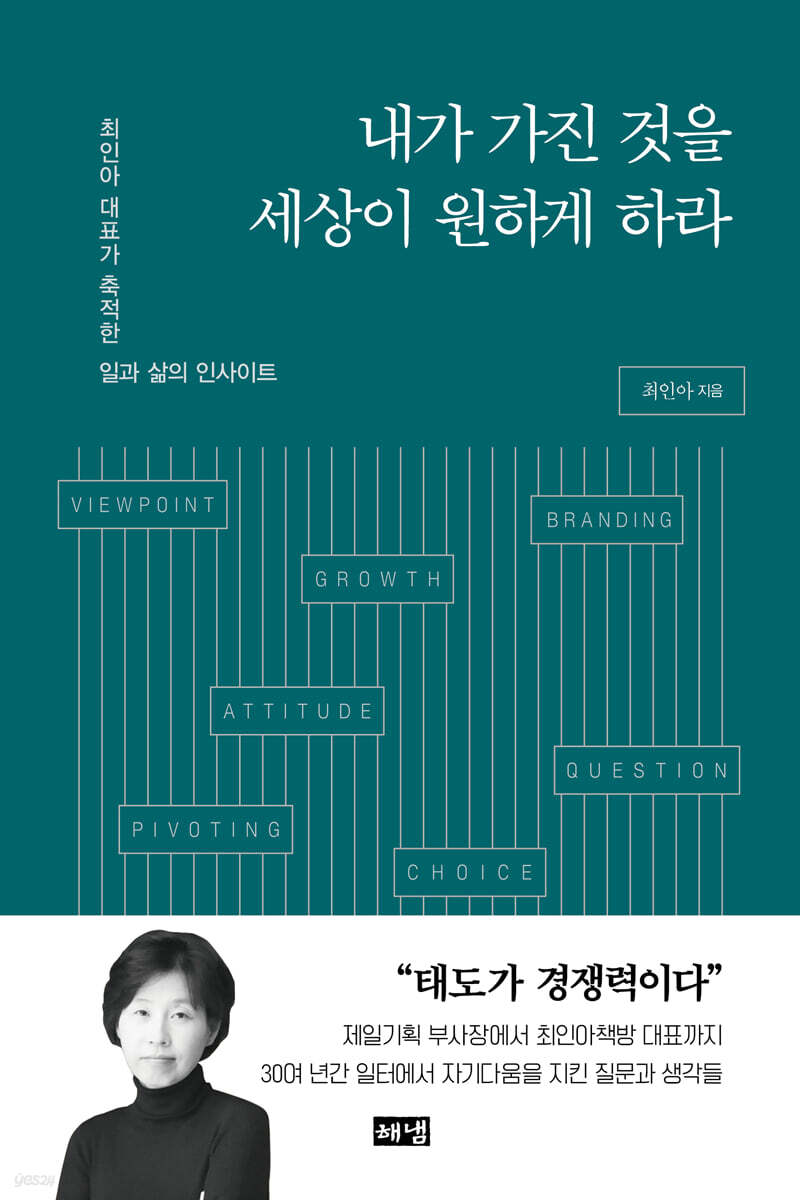
Make the world want what I have
 |
Description
Book Introduction
“Do you have a world of your own that even the world cannot do anything about?” Holding on to the worries and wanderings of the working 'me' The perspective and attitude that a person working under his or her own name should have Should I change jobs, change careers, or start my own business? In today's world, with increasing market uncertainty, rapid industrial change, and conflicting organizational values, working people's concerns are deepening. Can't we live well doing what we love, in the way we love, without being swept away by this environment? Former Vice President of Cheil Worldwide, Ina Choi, has been recognized for her unique style and achieved success in the advertising industry, the forefront of creativity, for over 30 years. Since stepping down from her first job and running her own eponymous bookstore, ‘Choi In-a Bookstore,’ for eight years, the attention of the public has always been drawn to this question. He has been active for a long time and has developed his own perspective and attitude that has allowed him to grow into a power brand. He wants to include this in his new book, “Make the World Want What You Have.” He has been given countless "firsts" and has paved his way from a new employee to a vice president and even an entrepreneur, but his concerns about work and life are not unique or special, but rather no different from those of us who strive to improve even a little while struggling. |
- You can preview some of the book's contents.
Preview
index
prolog
Part 1: Working for Me
Contribute as a result
Chapter 1: Why We Work
· If I make billions, will I not have to work?
· Things that work gives you besides money
· Happiness of working people
· Finding meaning in my work
· Do you have a perspective that penetrates the essence of karma?
Chapter 2: Work is an Opportunity for Growth
· The problem isn't the company!
· Doing my own work, not doing company work
· Working time is time to build assets
· Where, with whom and how to work
· How do you want it to be used?
Chapter 3 My Name is Seok Ja-ga Brand
· Seeing yourself as a brand
· What values am I putting forward?
· If you do it well, it will last a long time, and if you do it for a long time, it will become good.
· The average is not safe
· “Play with your main character, not your sub-character.”
· Point the antenna inward as well.
· Do you have a world of your own that even time cannot change?
Chapter 4: Attitude is Competitiveness
· The driving force that brings out the talent within us
· Density of time
· Increase productivity and focus
· Secure time alone
· Attitude toward work-life balance
· Sensitivity, an essential skill for working together
· The power of “I just did it”
· Don't forget your seniors
· We have the power to respond to the environment.
Part 2 Life_ The time spent trying and trying
It remains in me
Chapter 5: Time to Ask Me Questions
· To respect myself first
· Time and effort are your ticket to a world of fun.
· You have to experience at least four seasons to know.
When 'no alternative' becomes an alternative
· The power to keep going
· When I don't even know my own mind, I try writing it down first.
· Don't be intoxicated by yourself
· There are traps in shortcuts.
· Am I an expert?
· Uncertainty, a test of the universe that filters out solid primes
Chapter 6: How to Navigate Life's Crucial Moments
· Time is running out!
· Walk, walk, and walk again
· Things you can only know by going all the way · No one can avoid the path that leads down
Chapter 7: Will we continue to live like this?
· Reach a conclusion you can accept on your own
· Tie a knot to live differently
· We are all individuals
Epilogue
References
Part 1: Working for Me
Contribute as a result
Chapter 1: Why We Work
· If I make billions, will I not have to work?
· Things that work gives you besides money
· Happiness of working people
· Finding meaning in my work
· Do you have a perspective that penetrates the essence of karma?
Chapter 2: Work is an Opportunity for Growth
· The problem isn't the company!
· Doing my own work, not doing company work
· Working time is time to build assets
· Where, with whom and how to work
· How do you want it to be used?
Chapter 3 My Name is Seok Ja-ga Brand
· Seeing yourself as a brand
· What values am I putting forward?
· If you do it well, it will last a long time, and if you do it for a long time, it will become good.
· The average is not safe
· “Play with your main character, not your sub-character.”
· Point the antenna inward as well.
· Do you have a world of your own that even time cannot change?
Chapter 4: Attitude is Competitiveness
· The driving force that brings out the talent within us
· Density of time
· Increase productivity and focus
· Secure time alone
· Attitude toward work-life balance
· Sensitivity, an essential skill for working together
· The power of “I just did it”
· Don't forget your seniors
· We have the power to respond to the environment.
Part 2 Life_ The time spent trying and trying
It remains in me
Chapter 5: Time to Ask Me Questions
· To respect myself first
· Time and effort are your ticket to a world of fun.
· You have to experience at least four seasons to know.
When 'no alternative' becomes an alternative
· The power to keep going
· When I don't even know my own mind, I try writing it down first.
· Don't be intoxicated by yourself
· There are traps in shortcuts.
· Am I an expert?
· Uncertainty, a test of the universe that filters out solid primes
Chapter 6: How to Navigate Life's Crucial Moments
· Time is running out!
· Walk, walk, and walk again
· Things you can only know by going all the way · No one can avoid the path that leads down
Chapter 7: Will we continue to live like this?
· Reach a conclusion you can accept on your own
· Tie a knot to live differently
· We are all individuals
Epilogue
References
Detailed image
.jpg)
Into the book
To those who are looking for a way to live their own life
The title of this book is 'Make the world want what you have.'
If the title was a bit longer, these words would have been added before the current title.
‘Don’t just conform to the world.’
Yes, that's what I wanted to say in the book.
'Don't just try to fit in with the world, but make the world want what you have.' We are all unique beings, with different faces, personalities, likes, and strengths.
These days, everyone wants to live their own way.
Doing what you love, in the way you excel, is no different from living your true self.
I wrote about the perspective and attitude that opened that path in the book, and I, too, have come to where I am today by relying on that perspective and attitude.
If this book can be of even a little help to those who are looking for their way, it will be worthwhile to write it.
---From the "Prologue"
The time I spent working hard remains within me.
I kept searching for meaning in my work.
When work piled up, I was so engrossed in it that I didn't have time to think about these things.
But when I had free time after a busy period or when I was in a slump due to poor performance, I would constantly be tormented by the thoughts of what was lacking and what was not fulfilling in my work.
Still, what I want to commend myself for is that I never stopped worrying.
Although I put it on the back burner when I was busy, I came back to that place and dug deeper, asking and asking again about the meaning of my work.
When you dwell on your worries for too long, do you begin to see something faint? That happened to me, too.
Just as when you enter a dark place and at first you can't see anything, but gradually the scene before your eyes becomes clear, I also realized one important thing.
I found that this job required quite a bit of qualifications and suited me quite well!
---From "1-4 Finding the Meaning of My Work"
The problem isn't the company.
The right question is, 'Can I do what I want, how I want, here?'
I need to organize my thoughts on this first.
It's about creating a new 'frame' for looking at the problem from your own perspective.
In fact, finding the core of a problem, thinking about it, and finding an answer is an incredibly difficult task, and it also requires courage.
Because you have to face yourself head on.
Often times, we blame our own problems on our environment.
It's easier and more convenient to do it that way.
But this is just turning a blind eye to the real problem.
It's like avoiding your worries.
The problem is not solved.
Throughout our lives, we face many times of struggle and choice.
In such cases, to make the right choice and decision, you should first look into your own heart rather than thinking that the problem lies in the surrounding circumstances or environment, such as the company.
You need to reframe and figure out what's important to you and what you absolutely cannot compromise.
---From "2-1 The problem is not the company!"
If you want to do your job well, achieve good results, and have a long-term career, ask yourself this question.
Would your team leader, general manager, coworkers, seniors, juniors, and customers want to entrust you with important tasks? Do they expect me to deliver positive results? Then, think about why you'd be a good choice and write down the reasons why.
That's the value you provide to your customers as a brand.
If your values are clear and you are competitive enough, just keep moving forward on that path.
But if that's not the case, if you don't think it has any clear value to you, then you need to start creating it now.
---From "3-2 What Value Am I Proposing"
A commodity is a brand that customers can exchange for another brand without any specific reason.
Commodity is a problem that occurs not only in the world of brands, but also in the world of work.
If something doesn't have its own distinct value, it becomes a commodity, whether it's a product or a person.
When a worker becomes a commodity, it means that he or she is no longer distinguishable from others in terms of performance, and is therefore a target for replacement by someone with a lower salary.
It also means that you are not someone who 'must take on this job' or 'is absolutely necessary for our company'.
That's a scary story.
In my experience, it seems that seniority and performance are proportional for about 3 to 5 years after joining the company.
A deputy manager performs better than a new employee, and a manager performs better than a deputy manager.
But it didn't stay that way after that.
Managers who are better than department heads and assistant managers who do better work than managers begin to emerge.
Performance is not proportional to seniority.
---From "3-4 Average is Not Safe"
When it comes to work-life balance, some people tend to think that work is not life, going beyond the separation of work and life.
That's a rather extreme position.
But work is an important axis of our lives that holds many meanings.
Therefore, work-life balance means finding a balance so that life isn't just about work, and at one end of that balance should be relationships, especially relationships with loved ones.
With those with whom you need to spend sufficient time, such as family, friends, and yourself.
Since my father passed away, I always tell my juniors to spend more time with their parents whenever I have time.
I said that to our bookstore manager the day before yesterday.
If you go on three trips with friends, go with your mom on one of them.
---From "4-5 Attitudes toward Work-Life Balance"
What I did every day on my pilgrimage to Santiago was to think.
As I walked for 6-7 hours every day, looking back on where I had been and the time that had passed, I realized that my anxiety stemmed from the feeling that I had already started down the path.
I was afraid that the upward curve would end and collapse.
I left the workplace where I worked, was frustrated, cheered, and worried with that kind of feeling, and I looked back.
To look back was to think and think again, to erase one thought and embrace a new one, to negate the previous one and open myself to the new one.
After continuing this for a month, I finally came to one thought that I could no longer deny.
A clear realization came to me that I had entered the downward path, and that the time that followed would probably not be like the time before.
Yes, "awareness"! Whenever I face a challenge or problem, I know that the starting point for resolution is "awareness."
Or perhaps we could say 'acceptance'.
---From "6-4 No one can avoid the path that goes down"
There is something you need to do to make a decision that you can be confident in, beyond the pros and cons.
First of all, time, and that time alone.
It's about setting aside some time alone to focus on a problem.
I thought about it, erased it, thought about it again, erased it again… … .
In the end, you finally come across a solid idea that you can convince yourself of.
I live the future relying on that thought.
Of course, doing this doesn't mean there won't be any difficulties.
Just as waves will always crash as long as there is an ocean, we will inevitably experience hardships and challenges as long as we live our lives.
But one thing is certain: if you have an idea that you've spent a long time working toward, not just because it's advantageous, but because you've convinced yourself that it's important to you, you'll be much less likely to get swept away.
The title of this book is 'Make the world want what you have.'
If the title was a bit longer, these words would have been added before the current title.
‘Don’t just conform to the world.’
Yes, that's what I wanted to say in the book.
'Don't just try to fit in with the world, but make the world want what you have.' We are all unique beings, with different faces, personalities, likes, and strengths.
These days, everyone wants to live their own way.
Doing what you love, in the way you excel, is no different from living your true self.
I wrote about the perspective and attitude that opened that path in the book, and I, too, have come to where I am today by relying on that perspective and attitude.
If this book can be of even a little help to those who are looking for their way, it will be worthwhile to write it.
---From the "Prologue"
The time I spent working hard remains within me.
I kept searching for meaning in my work.
When work piled up, I was so engrossed in it that I didn't have time to think about these things.
But when I had free time after a busy period or when I was in a slump due to poor performance, I would constantly be tormented by the thoughts of what was lacking and what was not fulfilling in my work.
Still, what I want to commend myself for is that I never stopped worrying.
Although I put it on the back burner when I was busy, I came back to that place and dug deeper, asking and asking again about the meaning of my work.
When you dwell on your worries for too long, do you begin to see something faint? That happened to me, too.
Just as when you enter a dark place and at first you can't see anything, but gradually the scene before your eyes becomes clear, I also realized one important thing.
I found that this job required quite a bit of qualifications and suited me quite well!
---From "1-4 Finding the Meaning of My Work"
The problem isn't the company.
The right question is, 'Can I do what I want, how I want, here?'
I need to organize my thoughts on this first.
It's about creating a new 'frame' for looking at the problem from your own perspective.
In fact, finding the core of a problem, thinking about it, and finding an answer is an incredibly difficult task, and it also requires courage.
Because you have to face yourself head on.
Often times, we blame our own problems on our environment.
It's easier and more convenient to do it that way.
But this is just turning a blind eye to the real problem.
It's like avoiding your worries.
The problem is not solved.
Throughout our lives, we face many times of struggle and choice.
In such cases, to make the right choice and decision, you should first look into your own heart rather than thinking that the problem lies in the surrounding circumstances or environment, such as the company.
You need to reframe and figure out what's important to you and what you absolutely cannot compromise.
---From "2-1 The problem is not the company!"
If you want to do your job well, achieve good results, and have a long-term career, ask yourself this question.
Would your team leader, general manager, coworkers, seniors, juniors, and customers want to entrust you with important tasks? Do they expect me to deliver positive results? Then, think about why you'd be a good choice and write down the reasons why.
That's the value you provide to your customers as a brand.
If your values are clear and you are competitive enough, just keep moving forward on that path.
But if that's not the case, if you don't think it has any clear value to you, then you need to start creating it now.
---From "3-2 What Value Am I Proposing"
A commodity is a brand that customers can exchange for another brand without any specific reason.
Commodity is a problem that occurs not only in the world of brands, but also in the world of work.
If something doesn't have its own distinct value, it becomes a commodity, whether it's a product or a person.
When a worker becomes a commodity, it means that he or she is no longer distinguishable from others in terms of performance, and is therefore a target for replacement by someone with a lower salary.
It also means that you are not someone who 'must take on this job' or 'is absolutely necessary for our company'.
That's a scary story.
In my experience, it seems that seniority and performance are proportional for about 3 to 5 years after joining the company.
A deputy manager performs better than a new employee, and a manager performs better than a deputy manager.
But it didn't stay that way after that.
Managers who are better than department heads and assistant managers who do better work than managers begin to emerge.
Performance is not proportional to seniority.
---From "3-4 Average is Not Safe"
When it comes to work-life balance, some people tend to think that work is not life, going beyond the separation of work and life.
That's a rather extreme position.
But work is an important axis of our lives that holds many meanings.
Therefore, work-life balance means finding a balance so that life isn't just about work, and at one end of that balance should be relationships, especially relationships with loved ones.
With those with whom you need to spend sufficient time, such as family, friends, and yourself.
Since my father passed away, I always tell my juniors to spend more time with their parents whenever I have time.
I said that to our bookstore manager the day before yesterday.
If you go on three trips with friends, go with your mom on one of them.
---From "4-5 Attitudes toward Work-Life Balance"
What I did every day on my pilgrimage to Santiago was to think.
As I walked for 6-7 hours every day, looking back on where I had been and the time that had passed, I realized that my anxiety stemmed from the feeling that I had already started down the path.
I was afraid that the upward curve would end and collapse.
I left the workplace where I worked, was frustrated, cheered, and worried with that kind of feeling, and I looked back.
To look back was to think and think again, to erase one thought and embrace a new one, to negate the previous one and open myself to the new one.
After continuing this for a month, I finally came to one thought that I could no longer deny.
A clear realization came to me that I had entered the downward path, and that the time that followed would probably not be like the time before.
Yes, "awareness"! Whenever I face a challenge or problem, I know that the starting point for resolution is "awareness."
Or perhaps we could say 'acceptance'.
---From "6-4 No one can avoid the path that goes down"
There is something you need to do to make a decision that you can be confident in, beyond the pros and cons.
First of all, time, and that time alone.
It's about setting aside some time alone to focus on a problem.
I thought about it, erased it, thought about it again, erased it again… … .
In the end, you finally come across a solid idea that you can convince yourself of.
I live the future relying on that thought.
Of course, doing this doesn't mean there won't be any difficulties.
Just as waves will always crash as long as there is an ocean, we will inevitably experience hardships and challenges as long as we live our lives.
But one thing is certain: if you have an idea that you've spent a long time working toward, not just because it's advantageous, but because you've convinced yourself that it's important to you, you'll be much less likely to get swept away.
---From "7-1 Reaching a Conclusion You Can Accept"
Publisher's Review
Attitude is competitiveness
As the author has long been working across a diverse spectrum of fields, his insights are both rich and broad.
But in the end, it all boils down to the questions of 'why do we work' and 'how do we work', that is, the meaning and attitude toward work, and the core of it is that we must create our own answers, not the world's answers.
When numerous conflicts and concerns arise, the author emphasizes, “The problem is not the company!”
I think the fundamental question of 'when, where, with whom and how do I want to work' should come first.
Even if reality is unsatisfactory, I encourage you to do your best and fully experience the joys and sorrows that work brings, because that time in your life will never come again.
Work is not just a means of making a living; it is an important path to growth, and the time spent working so hard will definitely remain in my heart.
He also says that rather than simply remaining a member of an organization, one must become a 'power brand' that can live by one's own name.
We often think of work as something we do for the organization, but that time is also a process of shaping us.
That is, working for me and contributing as a result.
A power brand is possible when its substance is stronger than its reputation, and this requires the right attitude to accumulate value over time.
When I see myself as a brand, my priorities become clear, and those choices accumulate to form the foundation for working and living my life as myself.
Ultimately, the question that started at work also touches on the question of life: “How should we live?”
From understanding the essence of business to the core of self-branding.
This book presents readers with questions that anyone working on branding, from the meaning of work to the meaning of branding, should ask, divided into seven keywords: 'vision, growth, branding, attitude, question, transition, and choice.'
Chapter 1 reflects on the meaning of work and the nature of karma, and Chapter 2 asks how, with whom, and where I will work as the master of my work.
Chapter 3 examines whether you can view yourself as a brand and create value that cannot be easily replaced.
Chapter 4 explains the attitudes necessary to improve the quality of performance, such as time density, productivity, and sensitivity.
Chapter 5 shows that the power to find what you love and keep going comes from asking questions.
Chapters 6 and 7 provide the courage and wisdom to make choices you can accept at crucial moments in your work and life, such as changing jobs, quitting your job, or starting a business.
The author's confessions of anguish and wandering contained in this book provide us with comfort and empathy.
As a rookie who longed to become a journalist, in his early 30s he suffered from burnout and left for India, and in his 40s he had to accept the aging process in the cutthroat advertising industry… After a period of intense internal fortitude, asking and answering questions, the author stood up again and forged his own path through that strength.
A book that shakes me up with fundamental questions
While there are a variety of books on work, this one doesn't offer immediate solutions or know-how.
It shakes readers up and makes them think for themselves through cool questions and insights that dig straight to the heart of the matter.
As an excellent copywriter, he writes simple yet impactful sentences such as, “Do you have a world of your own that even time cannot change?”, “You have to do well to last, and you have to do it for a long time to do well”, “Time and effort are the ticket to the world of fun”, and his unique “quiet” style gives you an intimate time as if you were having a one-on-one mentoring session with the author.
Since the pandemic, the work environment has changed dramatically, from quiet retirements among employees to mass layoffs by companies.
It is a time when everyone is confused and easily shaken.
When you're unsure if what you're doing is what you love, when you want to excel at your job but things aren't going as planned, when your work and life priorities clash... Following the questions in this book will help you see your problems objectively.
It will guide those who want to confidently build their work and life around their own three-letter names, from juniors and leaders working within the organization to those working outside the organization.
As the author has long been working across a diverse spectrum of fields, his insights are both rich and broad.
But in the end, it all boils down to the questions of 'why do we work' and 'how do we work', that is, the meaning and attitude toward work, and the core of it is that we must create our own answers, not the world's answers.
When numerous conflicts and concerns arise, the author emphasizes, “The problem is not the company!”
I think the fundamental question of 'when, where, with whom and how do I want to work' should come first.
Even if reality is unsatisfactory, I encourage you to do your best and fully experience the joys and sorrows that work brings, because that time in your life will never come again.
Work is not just a means of making a living; it is an important path to growth, and the time spent working so hard will definitely remain in my heart.
He also says that rather than simply remaining a member of an organization, one must become a 'power brand' that can live by one's own name.
We often think of work as something we do for the organization, but that time is also a process of shaping us.
That is, working for me and contributing as a result.
A power brand is possible when its substance is stronger than its reputation, and this requires the right attitude to accumulate value over time.
When I see myself as a brand, my priorities become clear, and those choices accumulate to form the foundation for working and living my life as myself.
Ultimately, the question that started at work also touches on the question of life: “How should we live?”
From understanding the essence of business to the core of self-branding.
This book presents readers with questions that anyone working on branding, from the meaning of work to the meaning of branding, should ask, divided into seven keywords: 'vision, growth, branding, attitude, question, transition, and choice.'
Chapter 1 reflects on the meaning of work and the nature of karma, and Chapter 2 asks how, with whom, and where I will work as the master of my work.
Chapter 3 examines whether you can view yourself as a brand and create value that cannot be easily replaced.
Chapter 4 explains the attitudes necessary to improve the quality of performance, such as time density, productivity, and sensitivity.
Chapter 5 shows that the power to find what you love and keep going comes from asking questions.
Chapters 6 and 7 provide the courage and wisdom to make choices you can accept at crucial moments in your work and life, such as changing jobs, quitting your job, or starting a business.
The author's confessions of anguish and wandering contained in this book provide us with comfort and empathy.
As a rookie who longed to become a journalist, in his early 30s he suffered from burnout and left for India, and in his 40s he had to accept the aging process in the cutthroat advertising industry… After a period of intense internal fortitude, asking and answering questions, the author stood up again and forged his own path through that strength.
A book that shakes me up with fundamental questions
While there are a variety of books on work, this one doesn't offer immediate solutions or know-how.
It shakes readers up and makes them think for themselves through cool questions and insights that dig straight to the heart of the matter.
As an excellent copywriter, he writes simple yet impactful sentences such as, “Do you have a world of your own that even time cannot change?”, “You have to do well to last, and you have to do it for a long time to do well”, “Time and effort are the ticket to the world of fun”, and his unique “quiet” style gives you an intimate time as if you were having a one-on-one mentoring session with the author.
Since the pandemic, the work environment has changed dramatically, from quiet retirements among employees to mass layoffs by companies.
It is a time when everyone is confused and easily shaken.
When you're unsure if what you're doing is what you love, when you want to excel at your job but things aren't going as planned, when your work and life priorities clash... Following the questions in this book will help you see your problems objectively.
It will guide those who want to confidently build their work and life around their own three-letter names, from juniors and leaders working within the organization to those working outside the organization.
GOODS SPECIFICS
- Date of issue: April 19, 2023
- Page count, weight, size: 344 pages | 534g | 140*210*21mm
- ISBN13: 9791167140609
- ISBN10: 1167140605
You may also like
카테고리
korean


korean

![GQ KOREA Mark (Monthly): December [2025]](http://librairie.coreenne.fr/cdn/shop/files/8ef265dbbfbf186523ed75ba7319009d.jpg?v=1765340328&width=3840)


