

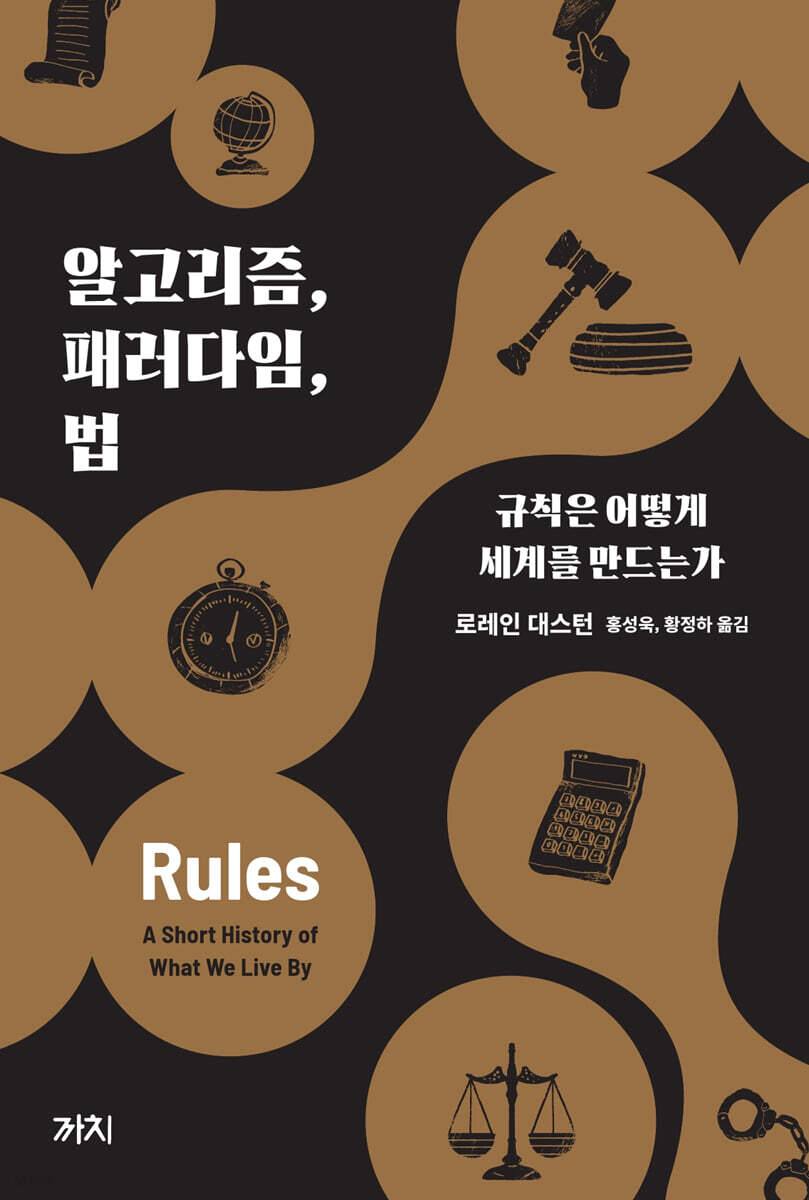
Algorithm, Paradigm, Law
 |
Description
Book Introduction
- A word from MD
- A new book by Lorraine Daston, an authority on the history of science.
Modern humans have created and eliminated many rules up to now.
This book analyzes how rules are created and how they control and change reality.
We examine the thoughts and historical examples of thinkers from Aristotle to Thomas Kuhn.
- Min-gyu Son, PD of Natural Sciences
Humans make rules and rules make the world!
A detailed analysis by world-renowned science historian Lorraine Daston,
The power of rules that define and control our lives
★Winner of the Association of American Publishers Prose Award in the History of Science, Medicine, and Technology Category★
★Chronicle of Higher Education's Book of the Year★
★Notable Books of the Year Selected by Seminary Cooperative Bookstore★
We cannot live without rules.
Even in chaotic emergencies like disasters, wars, and terrorism, when circumstances change suddenly and the rules of the day crumble, we struggle to find principles and restore order.
Living with rules isn't always comfortable, and some people complain about the needlessly tight rules, but a society without rules doesn't exist.
We understand the world by discovering and organizing rules, and rules shape the order of the world by determining how we should behave.
In this book, Lorraine Daston, one of the most important historians of science of our time, meticulously analyzes how humans create, change, and abolish rules, how the rules that emerge in this way define, shape, and control reality, and thus, what rules are, in the end.
This book is a masterpiece that illuminates the power of rules, crossing over time and fields, from ancient Aristotle to modern Thomas Kuhn, scientists such as Newton and Wittgenstein, philosophers such as Locke and Kant, and political and social thinkers such as Pufendorf and Hobbes.
This book analyzes rules by dividing them into three categories: rules as tools for measurement and calculation (algorithms), rules as models to follow (paradigms), and laws that link rules to social control (laws).
It also meticulously traces how the dominant meaning of rules has changed up to the present day, presenting a new view of human history centered on rules.
A detailed analysis by world-renowned science historian Lorraine Daston,
The power of rules that define and control our lives
★Winner of the Association of American Publishers Prose Award in the History of Science, Medicine, and Technology Category★
★Chronicle of Higher Education's Book of the Year★
★Notable Books of the Year Selected by Seminary Cooperative Bookstore★
We cannot live without rules.
Even in chaotic emergencies like disasters, wars, and terrorism, when circumstances change suddenly and the rules of the day crumble, we struggle to find principles and restore order.
Living with rules isn't always comfortable, and some people complain about the needlessly tight rules, but a society without rules doesn't exist.
We understand the world by discovering and organizing rules, and rules shape the order of the world by determining how we should behave.
In this book, Lorraine Daston, one of the most important historians of science of our time, meticulously analyzes how humans create, change, and abolish rules, how the rules that emerge in this way define, shape, and control reality, and thus, what rules are, in the end.
This book is a masterpiece that illuminates the power of rules, crossing over time and fields, from ancient Aristotle to modern Thomas Kuhn, scientists such as Newton and Wittgenstein, philosophers such as Locke and Kant, and political and social thinkers such as Pufendorf and Hobbes.
This book analyzes rules by dividing them into three categories: rules as tools for measurement and calculation (algorithms), rules as models to follow (paradigms), and laws that link rules to social control (laws).
It also meticulously traces how the dominant meaning of rules has changed up to the present day, presenting a new view of human history centered on rules.
- You can preview some of the book's contents.
Preview
index
1 Introduction: The Hidden History of the Rules
2 Ancient Rules: Straightedges, Models, and Laws
Rule 3: Head and Hands Unite
4 Algorithms Behind Mechanical Calculations
5 Algorithmic Intelligence in the Computing Machine Age
6 Rules and Regulations
7 Natural Law and Natural Laws
8. Transformation and Destruction of the Rules
Epilogue | Rules It's More Honorable to Break Than to Follow
Acknowledgements
main
References
Translator's Note
Biographical Index
2 Ancient Rules: Straightedges, Models, and Laws
Rule 3: Head and Hands Unite
4 Algorithms Behind Mechanical Calculations
5 Algorithmic Intelligence in the Computing Machine Age
6 Rules and Regulations
7 Natural Law and Natural Laws
8. Transformation and Destruction of the Rules
Epilogue | Rules It's More Honorable to Break Than to Follow
Acknowledgements
main
References
Translator's Note
Biographical Index
Detailed image

Into the book
Algorithms have been central to understanding the nature of mathematical proof, driving the computer revolution in the mid-20th century and making dreams of everything from artificial intelligence to artificial life a reality.
We are now all subjects of the algorithmic empire.
--- p.21
Rules as algorithms have destroyed the bridge that connected the universal and the particular in rules as models by prohibiting the exercise of discretion.
--- p.38
Rules created grand hopes and promises that they would elevate commerce into a skill, lowly laborers into respected and honored craftsmen, crude goods into fine goods, government debt into surplus, voiceless intuitions into clear precepts, and endless details into solid generalizations.
--- p.84
If law, as the phrase “rule of law” suggests, represents the most dignified and noble aspect of rules, then regulations are closer to rules that roll up your sleeves and get things done on the ground.
--- p.202
Every rule aspires to be prophetic.
If the rules are followed, the originally desired outcome or order is realized.
--- p.276
In any domain where outcome volatility is high or where significant changes occur over time, rules are subject to change and sometimes even breakdown.
--- p.314
By any definition, the power to declare exceptions is a central problem in modern political theory.
Who can break the law, let alone change it?
--- p.335
Exceptions prove the existence of rules by testing and verifying them.
Rules not only include exceptions, they define exceptions and are defined by them.
--- p.350
Every time we try to follow or break a rule, we sharpen our abilities of judgment, discretion, and reasoning—capacities that explicit rules banish.
We are now all subjects of the algorithmic empire.
--- p.21
Rules as algorithms have destroyed the bridge that connected the universal and the particular in rules as models by prohibiting the exercise of discretion.
--- p.38
Rules created grand hopes and promises that they would elevate commerce into a skill, lowly laborers into respected and honored craftsmen, crude goods into fine goods, government debt into surplus, voiceless intuitions into clear precepts, and endless details into solid generalizations.
--- p.84
If law, as the phrase “rule of law” suggests, represents the most dignified and noble aspect of rules, then regulations are closer to rules that roll up your sleeves and get things done on the ground.
--- p.202
Every rule aspires to be prophetic.
If the rules are followed, the originally desired outcome or order is realized.
--- p.276
In any domain where outcome volatility is high or where significant changes occur over time, rules are subject to change and sometimes even breakdown.
--- p.314
By any definition, the power to declare exceptions is a central problem in modern political theory.
Who can break the law, let alone change it?
--- p.335
Exceptions prove the existence of rules by testing and verifying them.
Rules not only include exceptions, they define exceptions and are defined by them.
--- p.350
Every time we try to follow or break a rule, we sharpen our abilities of judgment, discretion, and reasoning—capacities that explicit rules banish.
--- p.358
Publisher's Review
Unraveling the nature of diverse and complex rules through three categories and three criteria.
We are always entangled in a web of rules.
When we hear the word "rule," the things that come to mind—traffic signs, sports regulations, cooking recipes, instruction manuals, spelling, constitutions—are simply explicit rules that govern and determine our daily lives.
Add to this the unspoken rules of greetings that vary depending on the person you're talking to, table manners, social manners, and etiquette, and it becomes clear that none of our actions can escape the web of rules.
Rules are so universal, essential, and authoritative that they feel like they are given for granted.
However, the content and form of the rules that exist in various societies and cultures are dizzyingly diverse.
This book divides the numerous rules of human society into algorithms, paradigms, and laws.
The history of rules is the history of the spread and connection of these three categories of rules.
Daston also presents three pairs of opposites that constitute the long history of rules.
That is, rules allow for discretion or subjectivity, can be thick or thin, can be applied flexibly or strictly, and can be general or specific in scope.
For example, we do not aim to become exactly like our role models (paradigms, i.e., the rules that serve as models).
Role models are examples of thick rules that people follow flexibly depending on their circumstances.
On the other hand, a computer algorithm (i.e., a rule as a computational tool) that, given a specific value, produces a result that is strictly proportional to that value is an example of a thin rule that assumes a stable world in which all possibilities can be anticipated.
Daston dissects the rules and their history using these criteria.
And it addresses fascinating questions such as whether absolute rules that can fit an infinite variety of realities can ever emerge, what drives rules to become more flexible or more rigid, and what happens when the very concept of rules is shaken.
When faced with an unexpected emergency, we first look for rules and crave something that will allow us to maintain our routine.
Daston concludes his book by pointing out that every rule inevitably involves exceptions that test and confirm existing rules.
In today's world, where circumstances change so rapidly that existing rules are constantly being revised, this book provides an opportunity to reflect on the meaning and significance of rules.
A masterpiece by Lorraine Daston, a leading figure in the history of science who has integrated science, history, and philosophy.
World-renowned scholar Lorraine Daston has been leading the field of history of science since Thomas Kuhn, who gave new meaning to the word paradigm and left a significant mark on both the history and philosophy of science.
Daston, honorary director of the Max Planck Institute for the History of Science in Berlin, Germany, and a life member of the Berlin Institute for Advanced Study, has become arguably the most important historian of science of our time, having received the George Sarton Medal for outstanding achievements in the history of science.
This book, which is Daston's masterpiece and has received numerous accolades from leading media outlets since its publication and has been selected as the book of the year by various organizations, is written to provide an easy-to-understand taste of Daston's research, which has consistently explored the ideal and reality of rationality, and the development and standards of science.
Unlike previous works that were somewhat specialized and academic, stories closely related to everyday life and interesting historical events add to the pleasure of reading.
With its incisive scientific and philosophical discussions and rich case studies, it will be accessible to both academics and the general public.
A history of order in a chaotic world, created by humanity and rules.
This book, which reconstructs human history from a new perspective called the "history of rules," allows us to look at the rules that are ubiquitous in our daily lives in a new and unfamiliar way.
Chapter 1, written as an introduction, provides an overview of the key concepts (three meanings of rules, oppositions, etc.) necessary for viewing rules differently, as well as the topics covered in this book.
Chapters 2 and 3 examine the rules as a paradigm (model) that have been active from ancient times to the 18th century, focusing on their characteristics of imitation and discretion.
It discusses the role of the Rule of St. Benedict, which emphasizes the role of the abbot as a role model, and the role of practical books that served as guides for practicing specific skills such as sculpture, warfare, and cooking.
As a paradigm, these rules were examples of flexible and thick rules that presented an ideal to be achieved, while emphasizing practice and allowing discretion to fit reality.
Chapters 4 and 5 illuminate how rules as algorithms, which have existed since ancient times and have become increasingly influential since the rise of algorithms and mechanical calculation in the 19th and 20th centuries, actually work.
Algorithm is a thin set of rules, the meaning of which has changed between pre- and post-modern times.
Before the modern era, rules were used to deal with specific problems in reality, such as calculating the area of land or how to share bread among many people, but they gradually acquired abstract generality like formulas or functions in mathematics and science.
Also, today computers execute algorithms, but before the modern era, algorithms were “mechanical” and “simple” rules that people followed.
Chapters 6 and 7 explore rules as law, contrasting the most detailed regulations with the most general laws.
Regulations, such as the sumptuary laws of Europe, the traffic and sanitary regulations of Paris, and the spelling reform, serve to regulate daily life and maintain society, and have proliferated from the Middle Ages to the present day.
Since regulations are directly applied to specific realities, they cannot regulate all diverse situations.
In order to manage as many people as possible who slip through the net of regulations, regulations must become more detailed and numerous.
On the other hand, the laws of nature and the laws represented by natural law are the most ultimate, permanent, and unchanging rules.
Chapters 6 and 7 explore the spectrum of rules as law, examining how the meaning of rules for governing and governing society has shifted.
Chapter 8 deals with how rules are transformed or even broken in the face of exceptional circumstances.
We analyze the relationship between rules and exceptions by examining how discretionary powers that can be flexibly applied to situations and subjective judgments in law enforcement interact with rules.
In the final epilogue, we recapitulate the three meanings of rules and return to the rules themselves, addressing what it means for rules to emerge as algorithms today.
Rules have coexisted with humanity and evolved together since the birth of society.
In a world full of uncertainty, humanity has constantly sought order.
It was because of the desire for a predictable world, and therefore a stable world.
As science and technology advance, it may be natural that the importance of rigorously designed algorithms to prepare for all situations has increased dramatically.
However, this book emphasizes the importance of ambiguity, such as discretion, subjectivity, and analogy, and argues that such ambiguity is inseparable from rules.
This book, which meticulously dissects the rules that have directly and indirectly guided humanity and civilization, offers a remarkable experience of viewing human history from a macroscopic perspective.
We are always entangled in a web of rules.
When we hear the word "rule," the things that come to mind—traffic signs, sports regulations, cooking recipes, instruction manuals, spelling, constitutions—are simply explicit rules that govern and determine our daily lives.
Add to this the unspoken rules of greetings that vary depending on the person you're talking to, table manners, social manners, and etiquette, and it becomes clear that none of our actions can escape the web of rules.
Rules are so universal, essential, and authoritative that they feel like they are given for granted.
However, the content and form of the rules that exist in various societies and cultures are dizzyingly diverse.
This book divides the numerous rules of human society into algorithms, paradigms, and laws.
The history of rules is the history of the spread and connection of these three categories of rules.
Daston also presents three pairs of opposites that constitute the long history of rules.
That is, rules allow for discretion or subjectivity, can be thick or thin, can be applied flexibly or strictly, and can be general or specific in scope.
For example, we do not aim to become exactly like our role models (paradigms, i.e., the rules that serve as models).
Role models are examples of thick rules that people follow flexibly depending on their circumstances.
On the other hand, a computer algorithm (i.e., a rule as a computational tool) that, given a specific value, produces a result that is strictly proportional to that value is an example of a thin rule that assumes a stable world in which all possibilities can be anticipated.
Daston dissects the rules and their history using these criteria.
And it addresses fascinating questions such as whether absolute rules that can fit an infinite variety of realities can ever emerge, what drives rules to become more flexible or more rigid, and what happens when the very concept of rules is shaken.
When faced with an unexpected emergency, we first look for rules and crave something that will allow us to maintain our routine.
Daston concludes his book by pointing out that every rule inevitably involves exceptions that test and confirm existing rules.
In today's world, where circumstances change so rapidly that existing rules are constantly being revised, this book provides an opportunity to reflect on the meaning and significance of rules.
A masterpiece by Lorraine Daston, a leading figure in the history of science who has integrated science, history, and philosophy.
World-renowned scholar Lorraine Daston has been leading the field of history of science since Thomas Kuhn, who gave new meaning to the word paradigm and left a significant mark on both the history and philosophy of science.
Daston, honorary director of the Max Planck Institute for the History of Science in Berlin, Germany, and a life member of the Berlin Institute for Advanced Study, has become arguably the most important historian of science of our time, having received the George Sarton Medal for outstanding achievements in the history of science.
This book, which is Daston's masterpiece and has received numerous accolades from leading media outlets since its publication and has been selected as the book of the year by various organizations, is written to provide an easy-to-understand taste of Daston's research, which has consistently explored the ideal and reality of rationality, and the development and standards of science.
Unlike previous works that were somewhat specialized and academic, stories closely related to everyday life and interesting historical events add to the pleasure of reading.
With its incisive scientific and philosophical discussions and rich case studies, it will be accessible to both academics and the general public.
A history of order in a chaotic world, created by humanity and rules.
This book, which reconstructs human history from a new perspective called the "history of rules," allows us to look at the rules that are ubiquitous in our daily lives in a new and unfamiliar way.
Chapter 1, written as an introduction, provides an overview of the key concepts (three meanings of rules, oppositions, etc.) necessary for viewing rules differently, as well as the topics covered in this book.
Chapters 2 and 3 examine the rules as a paradigm (model) that have been active from ancient times to the 18th century, focusing on their characteristics of imitation and discretion.
It discusses the role of the Rule of St. Benedict, which emphasizes the role of the abbot as a role model, and the role of practical books that served as guides for practicing specific skills such as sculpture, warfare, and cooking.
As a paradigm, these rules were examples of flexible and thick rules that presented an ideal to be achieved, while emphasizing practice and allowing discretion to fit reality.
Chapters 4 and 5 illuminate how rules as algorithms, which have existed since ancient times and have become increasingly influential since the rise of algorithms and mechanical calculation in the 19th and 20th centuries, actually work.
Algorithm is a thin set of rules, the meaning of which has changed between pre- and post-modern times.
Before the modern era, rules were used to deal with specific problems in reality, such as calculating the area of land or how to share bread among many people, but they gradually acquired abstract generality like formulas or functions in mathematics and science.
Also, today computers execute algorithms, but before the modern era, algorithms were “mechanical” and “simple” rules that people followed.
Chapters 6 and 7 explore rules as law, contrasting the most detailed regulations with the most general laws.
Regulations, such as the sumptuary laws of Europe, the traffic and sanitary regulations of Paris, and the spelling reform, serve to regulate daily life and maintain society, and have proliferated from the Middle Ages to the present day.
Since regulations are directly applied to specific realities, they cannot regulate all diverse situations.
In order to manage as many people as possible who slip through the net of regulations, regulations must become more detailed and numerous.
On the other hand, the laws of nature and the laws represented by natural law are the most ultimate, permanent, and unchanging rules.
Chapters 6 and 7 explore the spectrum of rules as law, examining how the meaning of rules for governing and governing society has shifted.
Chapter 8 deals with how rules are transformed or even broken in the face of exceptional circumstances.
We analyze the relationship between rules and exceptions by examining how discretionary powers that can be flexibly applied to situations and subjective judgments in law enforcement interact with rules.
In the final epilogue, we recapitulate the three meanings of rules and return to the rules themselves, addressing what it means for rules to emerge as algorithms today.
Rules have coexisted with humanity and evolved together since the birth of society.
In a world full of uncertainty, humanity has constantly sought order.
It was because of the desire for a predictable world, and therefore a stable world.
As science and technology advance, it may be natural that the importance of rigorously designed algorithms to prepare for all situations has increased dramatically.
However, this book emphasizes the importance of ambiguity, such as discretion, subjectivity, and analogy, and argues that such ambiguity is inseparable from rules.
This book, which meticulously dissects the rules that have directly and indirectly guided humanity and civilization, offers a remarkable experience of viewing human history from a macroscopic perspective.
GOODS SPECIFICS
- Date of issue: January 10, 2025
- Page count, weight, size: 464 pages | 606g | 145*215*25mm
- ISBN13: 9788972918622
- ISBN10: 8972918628
You may also like
카테고리
korean


korean

![GQ KOREA Mark (Monthly): December [2025]](http://librairie.coreenne.fr/cdn/shop/files/8ef265dbbfbf186523ed75ba7319009d.jpg?v=1765340328&width=3840)


