

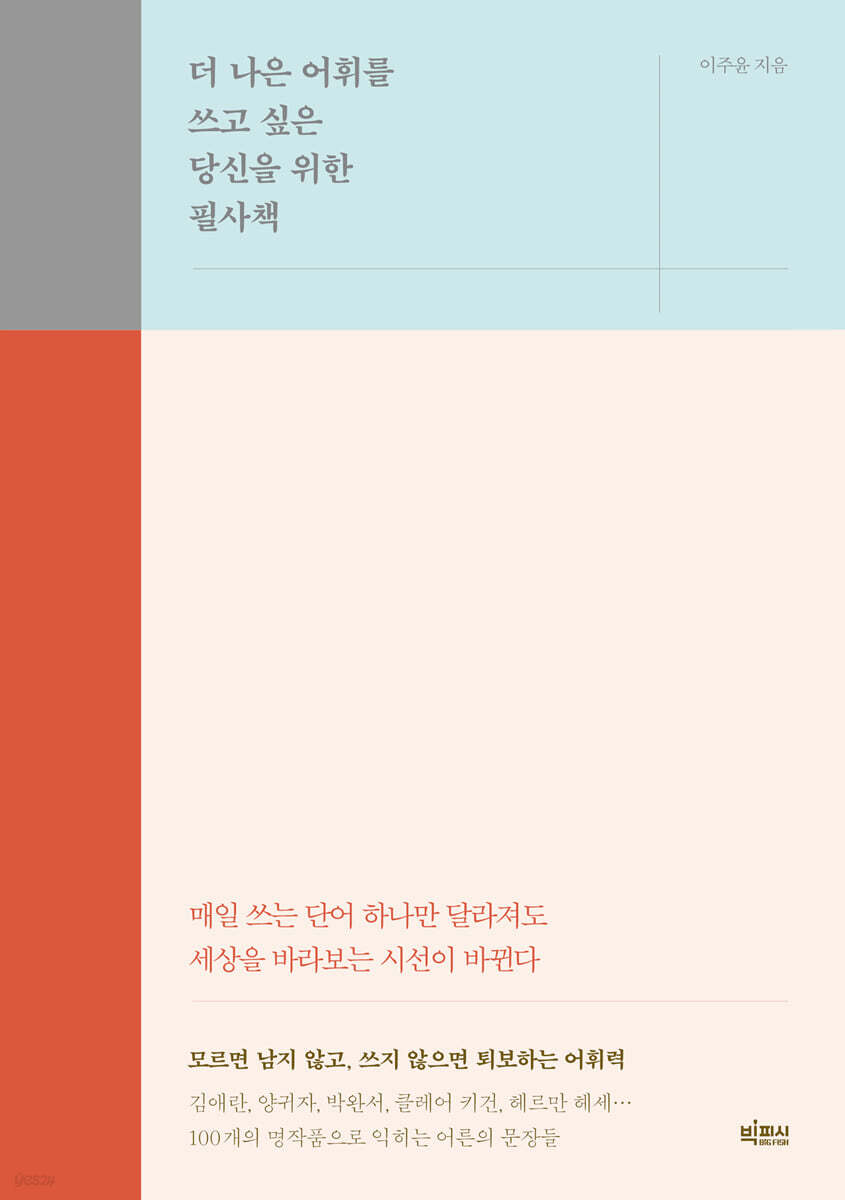
A writing book for those who want to use a better vocabulary
 |
Description
Book Introduction
- A word from MD
-
The handwriting craze continues2024 was a desperate year.
Following the previous work, “A Handwritten Book for Those Who Want to Write Better Sentences,” we have included the precious writings of a master writer.
This episode focuses particularly on expressiveness and vocabulary.
As an appendix, 330 vocabulary words that will add elegance to sentences are included, and the convenience of copying has been increased with the four-page binding.
November 22, 2024. Humanities PD Son Min-gyu
"Just changing one word you use every day can change your perspective on the world."
Kim Ae-ran, Yang Gui-ja, Park Wan-seo, Claire Keegan, and Hermann Hesse
Mastering Adult Vocabulary with 100 Masterpieces
The sequel to 『A Handwritten Book for You Who Want to Write Better Sentences』, which immediately became a general bestseller and number one in the humanities category and received explosive love from readers, has been published as 『A Handwritten Book for You Who Want to Write Better Vocabulary』.
Recently, news reports about serious problems with vocabulary and literacy have been coming out every day.
What's the best way to improve your vocabulary and literacy? It's to copy proven sentences yourself, ingraining them in your mind and heart.
This book is a selection of 100 works by master writers, from Kim Ae-ran, Yang Gui-ja, and Claire Keegan, who are most loved by readers today, to Park Wan-seo, Park Kyung-ni, Alain de Botton, and Hermann Hesse, who are loved across the ages, and is organized so that you can copy one page a day.
Just by following along, you will not only improve your vocabulary and literacy, but you will also have the experience of the world, which you had previously felt dimly, coming into clearer focus through the practice of expressing vague emotions in a concrete way.
Kim Ae-ran, Yang Gui-ja, Park Wan-seo, Claire Keegan, and Hermann Hesse
Mastering Adult Vocabulary with 100 Masterpieces
The sequel to 『A Handwritten Book for You Who Want to Write Better Sentences』, which immediately became a general bestseller and number one in the humanities category and received explosive love from readers, has been published as 『A Handwritten Book for You Who Want to Write Better Vocabulary』.
Recently, news reports about serious problems with vocabulary and literacy have been coming out every day.
What's the best way to improve your vocabulary and literacy? It's to copy proven sentences yourself, ingraining them in your mind and heart.
This book is a selection of 100 works by master writers, from Kim Ae-ran, Yang Gui-ja, and Claire Keegan, who are most loved by readers today, to Park Wan-seo, Park Kyung-ni, Alain de Botton, and Hermann Hesse, who are loved across the ages, and is organized so that you can copy one page a day.
Just by following along, you will not only improve your vocabulary and literacy, but you will also have the experience of the world, which you had previously felt dimly, coming into clearer focus through the practice of expressing vague emotions in a concrete way.
- You can preview some of the book's contents.
Preview
index
[Prologue] Vocabulary: A Weapon for Seeing the Dim World Clearly
[PART 1] How to Express Ordinary Life in a Strange Way
1.
Why we need to look at familiar words in an unfamiliar way
_To avoid further narrowing the scope of emotions, experiences and intellectual world
[001] Yang Gui-ja's novel, "Contradiction"
[002] Baek Seok's poem, "Nun"
[003] Virginia Woolf's essay, A Room of One's Own
[004] The novel of the pervert, 『The Story of Heo Sam-gwan Selling Blood』
[005] Yun Dong-ju's poem, "Like the Moon"
[006] Claire Keegan's novel, 'Small Things Like This'
[007] Kim Yu-jeong's novel, "Manmubang"
[008] Lulu Miller's essay, "Fish Doesn't Exist"
2.
Developing the ability to think in short sentences and single words
If you don't know, you won't have anything left, and if you don't use it, you'll regress.
[009] Bohumil Hrabal's novel, "The Noisy Solitude"
[010] Hermann Hesse's novel, 'Demian'
[011] Kim Ae-ran's novel, "Thirty"
[012] Henry David Thoreau's essay, "Walking"
[013] Jared Diamond, Guns, Germs, and Steel
[014] Hemingway's novel, The Old Man and the Sea
[015] Shin Kyeong-rim's poem, "Reeds"
[016] Nikos Kazantzakis' novel, Zorba the Greek
[017] Hwang Jeong-eun's novel, "The Shadow of a White Dress"
3.
The secret to expressing delicately and depicting vividly
_No matter how many words you know, if you don't have any special feelings about them
[018] Jeong Ji-yong's poem, "Perfume"
[019] Kim Hon-bi's essay, "The Moment Alcohol Changed My Life"
[020] Park Kyung-ni's novel, "Land"
[021] Max Jacob, Horizon
[022] Lee Cheong-jun's novel, "Snow Road"
[023] Victor Hugo's poem, "Boas the Sleeper"
[024] Charles Dickens' novel, A Tale of Two Cities
[025] Yun Dong-ju's poem, "Boy"
[026] Ezra Pound, "In a Station"
[027] Jang Ji-wan's poem, "Laughing at My Own Gray Hair"
4.
Just changing one word you use every day can change the world.
_Replacing familiar everyday vocabulary with slightly unfamiliar words
[028] Han Yong-un's poem, "The Reason for Love"
[029] Emile Ajar's novel, The Life Before Us
[030] Essay by Isul-ah, "Anyway, Song"
[031] Lee Jeong-rok's poem, "Preface"
[032] John Williams' novel, Stoner
[033] Choi Eun-young's novel, "Bright Night"
[034] Antoine de Saint-Exupéry's novel, The Little Prince
[035] Choi Seung-ja's poem, "Early I"
[036] Samuel Beckett's novel, 'Murphy'
[PART 2] How to Express Your Everyday Feelings Concretely
1.
If I can't find a single word to describe my feelings
_Words that delicately express the inner world
[037] Kim Chun-su's poem, "Flower"
[038] Gu Byeong-mo's novel, "Wizard Bakery"
[039] Park Wan-seo's essay, "Even a grain of truth"
[040] Jin Eun-young's poem, "Things That Remain"
[041] Jane Austen's novel, Pride and Prejudice
[042] Jean-Paul Sartre's novel, Nausea
[043] Mugwort Essay, "How to Endure the Blurry Me"
[044] Natsume Soseki's novel, "I Am a Cat"
[045] Jeong I-hyeon's novel, "My Sweet City"
2.
How to avoid vaguely expressing specific emotions
_Understanding the subtle nuances of emotional vocabulary
[046] Alain de Botton's essay, "How Proust Changes Our Lives"
[047] Jinyoung Choi's novel, "Proof of the Sphere"
[048] Johann Wolfgang von Goethe's poem, "The Beloved Close by"
[049] Anton Chekhov's novel, "Fear"
[050] Choi Young-mi's poem, "At Seonunsa Temple"
[051] André Gide's novel, The Food of the Earth
[052] Paul Auster's novel, The Palace of the Moon
[053] JM
Vasconcelos' novel, My Sweet Orange Tree
[054] Poetry by Guillaume Apollinaire, “The Mirabeau Bridge”
3.
The power of sincerity in carefully chosen words
Words that enhance empathy and communication skills
[055] Emily Dickinson's Letters, "To Mr. Bowles"
[056] Jerome David Salinger's novel, The Catcher in the Rye
[057] Lee Seok-won's essay, "You"
[059] William Shakespeare's novel, Romeo and Juliet
[059] Na Hee-deok's poem, "Blue Night"
[060] Stendhal's novel, The Red and the Black
[061] Bertolt Brecht's poem, "The Sorrow of the Survivor"
[PART 3] How to Expand Your World with Classy Vocabulary
1.
The comfort you can receive just from the sound of a pencil scribbling
The power of words that make us look forward to tomorrow
[062] Charles Pierre Baudelaire's prose poem, "Be Drunk"
[063] Delia Owens' novel, Where the Crawdads Sing
[064] Sim Bo-seon's poem, "Youth"
[065] F.
Scott Fitzgerald's novel, The Great Gatsby
[066] Osamu Dazai's novel, "No Longer Human"
[067] Mitch Albom's essay, "Tuesdays with Morrie"
[069] Ham Min-bok's poem, "Positive Rice"
[069] Kim Geum-hee's novel, "Love in Broad Daylight"
[070] Rainer Maria Rilke's Letters, Letters to a Young Poet
[071] Marcus Aurelius, Meditations
[072] Jean-Jacques Rousseau, Emile
2.
Using dignified language
_How to consistently follow the sentences of adults
[073] Kim Ji-hye, “The Benevolent Discriminationist”
[074] William Shakespeare Sonnet, "My Thee in a Summer's Day"
[075] Marcel Proust's novel, In Search of Lost Time
[076] Lee Seong-bok's poem, "Music"
[077] Hermann Hesse's poem, "Alone"
[078] Michel Tournier's essay, "Diary of an Outward Appearance"
[079] Henrik Ibsen's play, A Doll's House
[080] Baek Si, Jang Jin-ju
3.
If you hesitate in front of difficult words or philosophical sentences,
The more painful the word, the deeper the thought becomes.
[081] Albert Camus' novel, The Myth of Sisyphus
[082] Shin Young-bok's essay, "Thoughts from Prison"
[083] Christian Bobin's essay, "The Little Party Dress"
[084] James Matthew Barrie's novel, Peter Pan
[085] Emile Cioran's essay, "The Discomfort of Being Born"
[086] Johann Wolfgang von Goethe's novel, Faust
[087] Robert Frost's poem, "The Road Not Taken"
[088] Amelie Nothomb's novel, "The Airship"
[089] Charlotte Brontë's novel, Jane Eyre
[090] Lee Yang-yeon's poem, "Night Novel"
[091] Arthur Schopenhauer, 『Schopenhauer's Words』
4.
Some words change the world
_Until one point becomes a line
[092] Steve Jobs' speech, "2005 Stanford University Commencement Address"
[093] Yann Martel's novel, Life of Pi
[094] Hermann Hesse's novel, Siddhartha
[095] Yuval Harari, Sapiens
[096] Leo Tolstoy's novel, War and Peace
[097] Siddhartha Gautama, 『Dhammapada』
[098] Alfred Adler, Lectures on Individual Psychology
[099] Françoise Sagan's novel, "Do You Like Brahms?"
[100] Viktor Frankl's essay, "Man's Search for Meaning"
[Appendix] 330 Emotional Vocabulary Words for Expressing Subtle Nuances
- When you're happy
- When you're upset
- When you feel anxious
- When you refuse
- When apologizing
- When you're tired
- When you feel sad
- When you're lonely
- When you feel embarrassed
- When you are impressed
[PART 1] How to Express Ordinary Life in a Strange Way
1.
Why we need to look at familiar words in an unfamiliar way
_To avoid further narrowing the scope of emotions, experiences and intellectual world
[001] Yang Gui-ja's novel, "Contradiction"
[002] Baek Seok's poem, "Nun"
[003] Virginia Woolf's essay, A Room of One's Own
[004] The novel of the pervert, 『The Story of Heo Sam-gwan Selling Blood』
[005] Yun Dong-ju's poem, "Like the Moon"
[006] Claire Keegan's novel, 'Small Things Like This'
[007] Kim Yu-jeong's novel, "Manmubang"
[008] Lulu Miller's essay, "Fish Doesn't Exist"
2.
Developing the ability to think in short sentences and single words
If you don't know, you won't have anything left, and if you don't use it, you'll regress.
[009] Bohumil Hrabal's novel, "The Noisy Solitude"
[010] Hermann Hesse's novel, 'Demian'
[011] Kim Ae-ran's novel, "Thirty"
[012] Henry David Thoreau's essay, "Walking"
[013] Jared Diamond, Guns, Germs, and Steel
[014] Hemingway's novel, The Old Man and the Sea
[015] Shin Kyeong-rim's poem, "Reeds"
[016] Nikos Kazantzakis' novel, Zorba the Greek
[017] Hwang Jeong-eun's novel, "The Shadow of a White Dress"
3.
The secret to expressing delicately and depicting vividly
_No matter how many words you know, if you don't have any special feelings about them
[018] Jeong Ji-yong's poem, "Perfume"
[019] Kim Hon-bi's essay, "The Moment Alcohol Changed My Life"
[020] Park Kyung-ni's novel, "Land"
[021] Max Jacob, Horizon
[022] Lee Cheong-jun's novel, "Snow Road"
[023] Victor Hugo's poem, "Boas the Sleeper"
[024] Charles Dickens' novel, A Tale of Two Cities
[025] Yun Dong-ju's poem, "Boy"
[026] Ezra Pound, "In a Station"
[027] Jang Ji-wan's poem, "Laughing at My Own Gray Hair"
4.
Just changing one word you use every day can change the world.
_Replacing familiar everyday vocabulary with slightly unfamiliar words
[028] Han Yong-un's poem, "The Reason for Love"
[029] Emile Ajar's novel, The Life Before Us
[030] Essay by Isul-ah, "Anyway, Song"
[031] Lee Jeong-rok's poem, "Preface"
[032] John Williams' novel, Stoner
[033] Choi Eun-young's novel, "Bright Night"
[034] Antoine de Saint-Exupéry's novel, The Little Prince
[035] Choi Seung-ja's poem, "Early I"
[036] Samuel Beckett's novel, 'Murphy'
[PART 2] How to Express Your Everyday Feelings Concretely
1.
If I can't find a single word to describe my feelings
_Words that delicately express the inner world
[037] Kim Chun-su's poem, "Flower"
[038] Gu Byeong-mo's novel, "Wizard Bakery"
[039] Park Wan-seo's essay, "Even a grain of truth"
[040] Jin Eun-young's poem, "Things That Remain"
[041] Jane Austen's novel, Pride and Prejudice
[042] Jean-Paul Sartre's novel, Nausea
[043] Mugwort Essay, "How to Endure the Blurry Me"
[044] Natsume Soseki's novel, "I Am a Cat"
[045] Jeong I-hyeon's novel, "My Sweet City"
2.
How to avoid vaguely expressing specific emotions
_Understanding the subtle nuances of emotional vocabulary
[046] Alain de Botton's essay, "How Proust Changes Our Lives"
[047] Jinyoung Choi's novel, "Proof of the Sphere"
[048] Johann Wolfgang von Goethe's poem, "The Beloved Close by"
[049] Anton Chekhov's novel, "Fear"
[050] Choi Young-mi's poem, "At Seonunsa Temple"
[051] André Gide's novel, The Food of the Earth
[052] Paul Auster's novel, The Palace of the Moon
[053] JM
Vasconcelos' novel, My Sweet Orange Tree
[054] Poetry by Guillaume Apollinaire, “The Mirabeau Bridge”
3.
The power of sincerity in carefully chosen words
Words that enhance empathy and communication skills
[055] Emily Dickinson's Letters, "To Mr. Bowles"
[056] Jerome David Salinger's novel, The Catcher in the Rye
[057] Lee Seok-won's essay, "You"
[059] William Shakespeare's novel, Romeo and Juliet
[059] Na Hee-deok's poem, "Blue Night"
[060] Stendhal's novel, The Red and the Black
[061] Bertolt Brecht's poem, "The Sorrow of the Survivor"
[PART 3] How to Expand Your World with Classy Vocabulary
1.
The comfort you can receive just from the sound of a pencil scribbling
The power of words that make us look forward to tomorrow
[062] Charles Pierre Baudelaire's prose poem, "Be Drunk"
[063] Delia Owens' novel, Where the Crawdads Sing
[064] Sim Bo-seon's poem, "Youth"
[065] F.
Scott Fitzgerald's novel, The Great Gatsby
[066] Osamu Dazai's novel, "No Longer Human"
[067] Mitch Albom's essay, "Tuesdays with Morrie"
[069] Ham Min-bok's poem, "Positive Rice"
[069] Kim Geum-hee's novel, "Love in Broad Daylight"
[070] Rainer Maria Rilke's Letters, Letters to a Young Poet
[071] Marcus Aurelius, Meditations
[072] Jean-Jacques Rousseau, Emile
2.
Using dignified language
_How to consistently follow the sentences of adults
[073] Kim Ji-hye, “The Benevolent Discriminationist”
[074] William Shakespeare Sonnet, "My Thee in a Summer's Day"
[075] Marcel Proust's novel, In Search of Lost Time
[076] Lee Seong-bok's poem, "Music"
[077] Hermann Hesse's poem, "Alone"
[078] Michel Tournier's essay, "Diary of an Outward Appearance"
[079] Henrik Ibsen's play, A Doll's House
[080] Baek Si, Jang Jin-ju
3.
If you hesitate in front of difficult words or philosophical sentences,
The more painful the word, the deeper the thought becomes.
[081] Albert Camus' novel, The Myth of Sisyphus
[082] Shin Young-bok's essay, "Thoughts from Prison"
[083] Christian Bobin's essay, "The Little Party Dress"
[084] James Matthew Barrie's novel, Peter Pan
[085] Emile Cioran's essay, "The Discomfort of Being Born"
[086] Johann Wolfgang von Goethe's novel, Faust
[087] Robert Frost's poem, "The Road Not Taken"
[088] Amelie Nothomb's novel, "The Airship"
[089] Charlotte Brontë's novel, Jane Eyre
[090] Lee Yang-yeon's poem, "Night Novel"
[091] Arthur Schopenhauer, 『Schopenhauer's Words』
4.
Some words change the world
_Until one point becomes a line
[092] Steve Jobs' speech, "2005 Stanford University Commencement Address"
[093] Yann Martel's novel, Life of Pi
[094] Hermann Hesse's novel, Siddhartha
[095] Yuval Harari, Sapiens
[096] Leo Tolstoy's novel, War and Peace
[097] Siddhartha Gautama, 『Dhammapada』
[098] Alfred Adler, Lectures on Individual Psychology
[099] Françoise Sagan's novel, "Do You Like Brahms?"
[100] Viktor Frankl's essay, "Man's Search for Meaning"
[Appendix] 330 Emotional Vocabulary Words for Expressing Subtle Nuances
- When you're happy
- When you're upset
- When you feel anxious
- When you refuse
- When apologizing
- When you're tired
- When you feel sad
- When you're lonely
- When you feel embarrassed
- When you are impressed
Detailed image
.jpg)
Publisher's Review
“The depth of language determines the limits of the world.”
★★★ An immediate bestseller in general, #1 in the humanities category ★★★
A sequel to "A Handwritten Guide for Those Who Want to Write Better Sentences"
There are approximately 510,000 words listed in the Standard Korean Dictionary.
However, research shows that most people use around 1,000 words.
This means that hundreds of thousands of words we don't use remain like an unknown world.
Some might ask, what's the point of knowing so many words? As long as they don't interfere with communication, that's all that matters.
But when we consider how frequently misunderstandings occur due to words, we can never overlook the importance of vocabulary.
To accurately convey our thoughts and feelings, thereby reducing unnecessary misunderstandings and facilitating smoother communication, we must strive to learn and utilize a wider vocabulary.
Lee Ju-yoon, author of "A Handwritten Book for Those Who Want to Write Better Sentences," which became an instant bestseller, has carefully selected 100 works perfect for handwriting to improve your vocabulary.
As you embark on a 100-day journey guided by the author, you will discover diverse examples of word usage, the origins and meanings of Chinese characters used in everyday life, and emotional vocabulary for expressing joy, anger, sorrow, and pleasure. As your vocabulary grows, you will feel your world expanding.
If you don't know it, it won't remain, and if you don't use it, your vocabulary will deteriorate.
The easiest and most reliable way to improve is transcription.
For readers who wish to broaden their horizons of emotions, experiences, and worlds while concretely expressing familiar daily life, this book presents a step-by-step method of transcription.
[PART 1] explains 'how to express ordinary daily life in an unfamiliar way'.
To broaden the scope of one's intellectual world, it explains how to look at familiar words in an unfamiliar way and use precise words, how to cultivate the power of thinking by looking deeply into short sentences and single words, and the secrets of expressing delicately and vividly through special appreciation.
[PART 2] covers 'how to express your daily emotions in detail'.
No matter how many words I know, they are useless if I can't explain how I feel right now.
It explains why we must choose our words carefully, by exploring the subtle nuances of emotional vocabulary and the subtle expressions of our inner world.
The final [PART 3] guides you on how to 'expand your world with classy vocabulary'.
By examining the true meaning of words and philosophical sentences that once seemed difficult, you will develop the power to think more deeply than simply using better vocabulary.
And through this deep thinking, we also examine how words used have changed the world.
I carefully copied each sentence.
The joy of recalling lost vocabulary
What if everyday words just don't come to mind when you try to explain something, or you want to express your feelings with more refined words, but your vocabulary seems to be declining every day? It's not too late.
Because writing is the easiest and most reliable way to improve your vocabulary.
Now, put down your smartphone and open this book.
You can also let go of the burden of having to transcribe an entire volume.
Just reading a short passage slowly, copying it, and savoring the meaning of the words contained within is enough to develop your thinking skills.
Just by giving ourselves a little peace and a sense of accomplishment every day, we will become better than we were yesterday.
★★★ An immediate bestseller in general, #1 in the humanities category ★★★
A sequel to "A Handwritten Guide for Those Who Want to Write Better Sentences"
There are approximately 510,000 words listed in the Standard Korean Dictionary.
However, research shows that most people use around 1,000 words.
This means that hundreds of thousands of words we don't use remain like an unknown world.
Some might ask, what's the point of knowing so many words? As long as they don't interfere with communication, that's all that matters.
But when we consider how frequently misunderstandings occur due to words, we can never overlook the importance of vocabulary.
To accurately convey our thoughts and feelings, thereby reducing unnecessary misunderstandings and facilitating smoother communication, we must strive to learn and utilize a wider vocabulary.
Lee Ju-yoon, author of "A Handwritten Book for Those Who Want to Write Better Sentences," which became an instant bestseller, has carefully selected 100 works perfect for handwriting to improve your vocabulary.
As you embark on a 100-day journey guided by the author, you will discover diverse examples of word usage, the origins and meanings of Chinese characters used in everyday life, and emotional vocabulary for expressing joy, anger, sorrow, and pleasure. As your vocabulary grows, you will feel your world expanding.
If you don't know it, it won't remain, and if you don't use it, your vocabulary will deteriorate.
The easiest and most reliable way to improve is transcription.
For readers who wish to broaden their horizons of emotions, experiences, and worlds while concretely expressing familiar daily life, this book presents a step-by-step method of transcription.
[PART 1] explains 'how to express ordinary daily life in an unfamiliar way'.
To broaden the scope of one's intellectual world, it explains how to look at familiar words in an unfamiliar way and use precise words, how to cultivate the power of thinking by looking deeply into short sentences and single words, and the secrets of expressing delicately and vividly through special appreciation.
[PART 2] covers 'how to express your daily emotions in detail'.
No matter how many words I know, they are useless if I can't explain how I feel right now.
It explains why we must choose our words carefully, by exploring the subtle nuances of emotional vocabulary and the subtle expressions of our inner world.
The final [PART 3] guides you on how to 'expand your world with classy vocabulary'.
By examining the true meaning of words and philosophical sentences that once seemed difficult, you will develop the power to think more deeply than simply using better vocabulary.
And through this deep thinking, we also examine how words used have changed the world.
I carefully copied each sentence.
The joy of recalling lost vocabulary
What if everyday words just don't come to mind when you try to explain something, or you want to express your feelings with more refined words, but your vocabulary seems to be declining every day? It's not too late.
Because writing is the easiest and most reliable way to improve your vocabulary.
Now, put down your smartphone and open this book.
You can also let go of the burden of having to transcribe an entire volume.
Just reading a short passage slowly, copying it, and savoring the meaning of the words contained within is enough to develop your thinking skills.
Just by giving ourselves a little peace and a sense of accomplishment every day, we will become better than we were yesterday.
GOODS SPECIFICS
- Date of issue: November 20, 2024
- Format: Guide to book binding methods for four-sided binding
- Page count, weight, size: 304 pages | 148*210*19mm
- ISBN13: 9791194033455
- ISBN10: 1194033458
You may also like
카테고리
korean


korean

![ELLE 엘르 스페셜 에디션 A형 : 12월 [2025]](http://librairie.coreenne.fr/cdn/shop/files/b8e27a3de6c9538896439686c6b0e8fb.jpg?v=1766436872&width=3840)


