

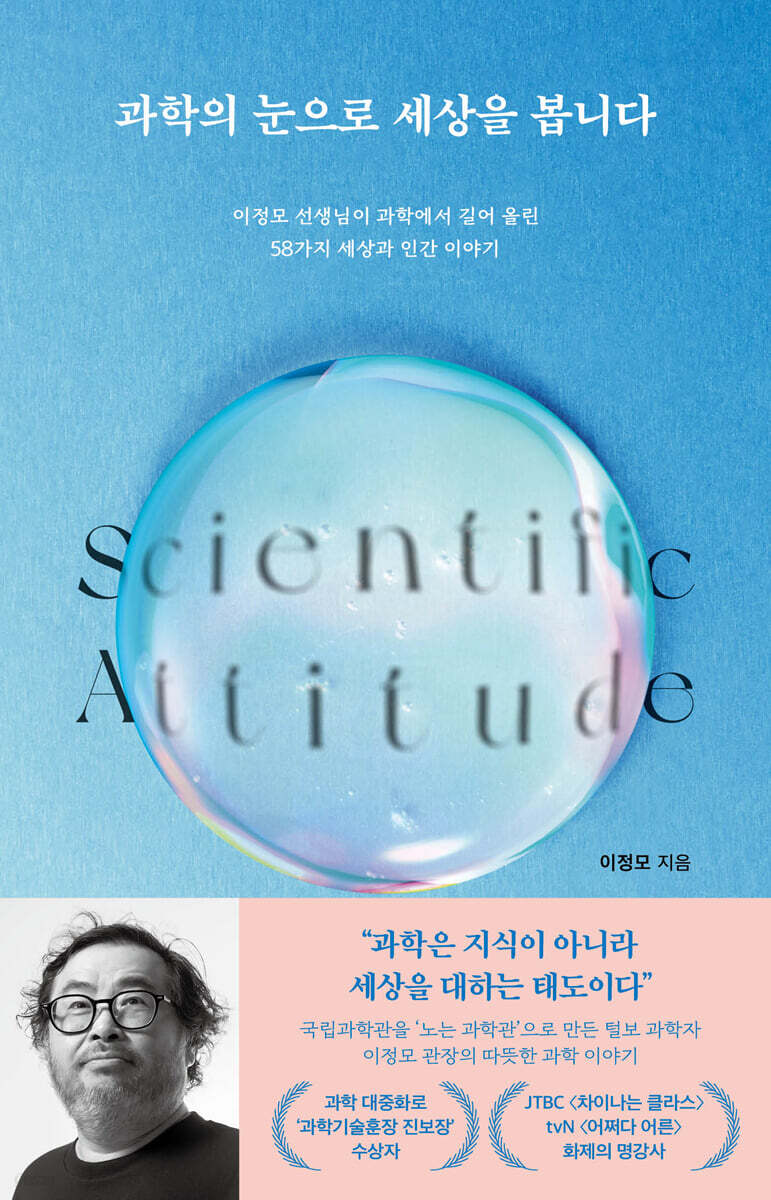
Seeing the world through scientific eyes
 |
Description
Book Introduction
“Science is not knowledge,
“It is an attitude toward the world.”
Professor Lee Jeong-mo brought up science
58 Stories of the World and Humanity
Director Lee Jeong-mo, Korea's most entertaining scientist, returns with a delightful follow-up to his best-selling book, "Splendid Extinction."
Director Lee Jeong-mo has served as the head of the National Science Museum for 12 years, and has been at the forefront of popularizing science, directly engaging with citizens' science.
He lives as the most popular scientist and talks about the world with an enlightened scientific attitude.
『Seeing the World Through the Eyes of Science』 contains a variety of stories closely related to daily life.
Stories on diverse topics captivate readers, such as people collapsing from the daily burden of delivery boxes, the scientific basis for the introduction of a four-day workweek, the scientific approach to responding to Japanese seafood imports, and climate politics in the age of artificial intelligence.
What we need to survive in the 21st century, the age of science, is not scientific knowledge.
It is ‘science literacy’ that views the world scientifically.
Scientific literacy comes from evidence-based verification, unbiased acceptance of better ideas, and the courage to say you don't know what you don't know.
Director Lee Jeong-mo adds one thing to this whole process: warmth.
Scientific literacy only becomes effective when people are involved in science.
“It is an attitude toward the world.”
Professor Lee Jeong-mo brought up science
58 Stories of the World and Humanity
Director Lee Jeong-mo, Korea's most entertaining scientist, returns with a delightful follow-up to his best-selling book, "Splendid Extinction."
Director Lee Jeong-mo has served as the head of the National Science Museum for 12 years, and has been at the forefront of popularizing science, directly engaging with citizens' science.
He lives as the most popular scientist and talks about the world with an enlightened scientific attitude.
『Seeing the World Through the Eyes of Science』 contains a variety of stories closely related to daily life.
Stories on diverse topics captivate readers, such as people collapsing from the daily burden of delivery boxes, the scientific basis for the introduction of a four-day workweek, the scientific approach to responding to Japanese seafood imports, and climate politics in the age of artificial intelligence.
What we need to survive in the 21st century, the age of science, is not scientific knowledge.
It is ‘science literacy’ that views the world scientifically.
Scientific literacy comes from evidence-based verification, unbiased acceptance of better ideas, and the courage to say you don't know what you don't know.
Director Lee Jeong-mo adds one thing to this whole process: warmth.
Scientific literacy only becomes effective when people are involved in science.
- You can preview some of the book's contents.
Preview
index
Preface: Brightening the World Through the Eyes of Science
Chapter 1: Avoiding Extinction
Why Mammoth Fossil Prices Are Plummeting
Why are there 52 bones in the foot?
Oasis under the sea
Suspense and surprise
How to Use the Brain in the Age of Artificial Intelligence
Toad's Warning
The boy comes
This summer is the coolest
hibernation
Pale Blue Dot and Climate Politics
Trailer for the Great Disaster
Don't die, just disappear
A cat that acts like the owner
Chapter 2: Living Together
Life like hydrogen bonds
If you put a chimpanzee in FaceApp
All bald people of the world, let's stand in solidarity!
A Scientific Look at Kindness
What the maple leaves teach us
Peace is needed for Baekdu Mountain too.
persistent cockroach
Japan Dolphin Day
Cider remarks
Box hole handle
Why they can stop running
In the season of tearful rainbows
Chapter 3 Becoming Wise
The Goldberg Device and Justice Ginsburg
Reflections on Addiction
We still have these concerns
I'm a bear
A meaningful small funeral
Escaping Black-and-White Logic
Attitude toward young leaves
Who is my North Star?
Why the neonatal mortality rate is low
How to Play for the Earth
World Asteroid Day
Flying on Mars
Don't get diarrhea in the pool
Attitude towards snails
Scientists' Conversational Method
To the bride and groom of November
Scientists, run for office!
Things we learn from trees
Contradiction, Pseudoscience, and Vaccines
Bar humbug!
Chapter 4: Discovering Common Sense
Caffeine and the American Revolution
Comrades do not change
Remove ten days from the calendar
The power that unified time around the world
Steal that French ass
Man with Flowers and Space Bulgogi
A quiet triumph, Cheonlian 2B
Remember January 27th
A nostalgic cliché
No matter how cold it is, spring is spring
Today too, the dinosaur cried out loud
Beware of the lust that comes from the white cow.
The Better Angels of Our Nature or Factfulness
Chapter 1: Avoiding Extinction
Why Mammoth Fossil Prices Are Plummeting
Why are there 52 bones in the foot?
Oasis under the sea
Suspense and surprise
How to Use the Brain in the Age of Artificial Intelligence
Toad's Warning
The boy comes
This summer is the coolest
hibernation
Pale Blue Dot and Climate Politics
Trailer for the Great Disaster
Don't die, just disappear
A cat that acts like the owner
Chapter 2: Living Together
Life like hydrogen bonds
If you put a chimpanzee in FaceApp
All bald people of the world, let's stand in solidarity!
A Scientific Look at Kindness
What the maple leaves teach us
Peace is needed for Baekdu Mountain too.
persistent cockroach
Japan Dolphin Day
Cider remarks
Box hole handle
Why they can stop running
In the season of tearful rainbows
Chapter 3 Becoming Wise
The Goldberg Device and Justice Ginsburg
Reflections on Addiction
We still have these concerns
I'm a bear
A meaningful small funeral
Escaping Black-and-White Logic
Attitude toward young leaves
Who is my North Star?
Why the neonatal mortality rate is low
How to Play for the Earth
World Asteroid Day
Flying on Mars
Don't get diarrhea in the pool
Attitude towards snails
Scientists' Conversational Method
To the bride and groom of November
Scientists, run for office!
Things we learn from trees
Contradiction, Pseudoscience, and Vaccines
Bar humbug!
Chapter 4: Discovering Common Sense
Caffeine and the American Revolution
Comrades do not change
Remove ten days from the calendar
The power that unified time around the world
Steal that French ass
Man with Flowers and Space Bulgogi
A quiet triumph, Cheonlian 2B
Remember January 27th
A nostalgic cliché
No matter how cold it is, spring is spring
Today too, the dinosaur cried out loud
Beware of the lust that comes from the white cow.
The Better Angels of Our Nature or Factfulness
Detailed image
.jpg)
Into the book
Past navigators believed that coral-building animals instinctively built giant rings to protect the gods within the atoll.
It's just imagination.
There is no single example in nature of so many different species of corals working together for the same purpose.
--- From "Oasis in the Sea"
But aren't we living in such a world? Beneath the table, a climate crisis timer ticks, while above, a staccato voice adds sound effects, claiming people don't need to know about things like RE100.
The scenes show the prices rising every day and the reasonable price of 875 won intersecting each other.
On the table, we talk about billions of dollars invested in science and technology, but under the table, young scientists are leaving the labs.
--- From "Suspense and Surprise"
This incident is not just a heartbreaking and sad incident.
It's a sorry incident.
And it is an uneasy omen.
Because the cause of these wildfires is the heating of the Earth.
(Scientists no longer use the comfortable term 'global warming'.) In other words, it is a result of the climate crisis.
(Scientists no longer use the vague term 'climate change'.
--- From "The Trailer of the Great Disaster"
Why did humanity abandon the formidable weapon of murder known as the fang? The most reasonable explanation is that it was because they didn't threaten or kill each other.
It is true that although there were fights, they became gentle beings.
Some argue that it is due to changes in food.
The fangs on the upper jaw are lethal to the enemy when fighting.
In reality, the canines of humans became smaller first in the upper jaw.
This is because the explanation that fighting has decreased rather than eating habits is more persuasive.
While chimpanzees are known to resolve conflicts through war, their closest relatives, bonobos, are known to resolve conflicts through love.
In that sense, bonobos are a symbol of peace.
However, although humans are larger than bonobos, their canines are smaller.
This means that humans are more peaceful than bonobos.
--- From "If We Put a Chimpanzee in FaceApp"
And let's remember.
Every year, September 1st is 'Japan Dolphin Day'.
On this day, we must freely condemn Japan.
Swearing is originally bad, but when you have to, you should do it as hard as possible.
You have to curse the Japanese government and fishermen to the point where you feel ashamed and sorry for no reason.
Only then will Japanese citizens step forward.
--- From "Japan Dolphin Day"
Although it has been over 150 years since Nature was founded, the reality is regrettable.
Nature, which should be a forum for scientific discussion, has become a black hole that sucks up all kinds of authority.
Instead of presenting a compelling argument based on evidence, modern-day social media is full of Wilberforce-style ridicule.
If you love someone, you agree with all his words and actions, and if you hate someone, you deny all his words and actions.
The trust that founded Nature has disappeared from our hearts, leaving only authoritarianism.
--- From "Escape from Black and White Logic"
Many people believe that the Earth would be peaceful if only Homo sapiens were not there.
That might actually be the case.
But what meaning would the Earth, nature, and the universe have without me? Because of Homo sapiens, the universe knows it's 13.8 billion years old, and even flowers and animals have names.
The birth of Homo sapiens is the greatest blessing the universe has ever received.
--- From "Reasons for Low Neonatal Mortality Rates"
Science is having a hard time these days.
I have a different opinion, but since the Prime Minister is calling it a nuclear waste disposal facility, let's call it that for now.
But has it really been dealt with? This is the Japanese government's claim.
It is not scientific for us to write like that.
Why? Science speaks with data.
No foreign scientists have their own measured data on nuclear waste.
We only have the numbers unilaterally provided by the Japanese government.
--- From "Don't get diarrhea in the pool"
But our emotions cannot be solved with arithmetic.
(Omitted) I would like to say something to people who do some math.
You may think you are rational.
However, we should not package theories and inferences made at a desk without actual measurement data as rationality.
This is not a scientific attitude at all.
Given Japan's uncooperative attitude in collecting samples, it is rather reasonable to doubt their claims.
--- From "Attitudes Toward Snails"
A country's scientific level is determined by its junior scientists.
Now, rather than dreaming of the absurd Nobel Prize, we are in a situation where we need to restore the system.
It takes at least five years for a research system to recover once it has collapsed.
It's a new start.
Let's take the first step by sending scientists to Congress.
What if it fails? Scientists aren't afraid of failure.
Failure is a scientist's daily life.
--- From "Scientists, Run for Office!"
We tend to remember only the first successful hero, and that too only the first one who appears before our eyes.
The fact that Apollo 11 landed on the moon means that there were Apollo 1 through 10.
Even if you don't remember all ten previous lunar landings, shouldn't you at least know about the Apollo 1 astronauts? But I've never seen them in class or in newspaper articles.
--- From "Remembering January 27th"
Many people feel that spring and fall are disappearing due to climate change.
But spring is actually getting longer.
Comparing the Japanese colonial period to the past 30 years, the summer has increased by 20 days, with an increase of about 6 days.
The warm and hot season has been extended by almost a month.
Instead, cold days are even more bitterly cold.
--- From "No matter how cold it is, spring is spring"
We, fortunate enough to have never experienced war, want lasting peace.
So which of the four angels is the most important? People consider morality to be the most important.
I think, “If I act well and pursue justice, the world will be peaceful.”
But the problem is that everyone has different standards of justice and morality.
Therefore, if you pursue justice through morality, you may end up in a bad way.
Here Pinker says:
“If you want peace, don’t seek justice; seek peace.”
It's just imagination.
There is no single example in nature of so many different species of corals working together for the same purpose.
--- From "Oasis in the Sea"
But aren't we living in such a world? Beneath the table, a climate crisis timer ticks, while above, a staccato voice adds sound effects, claiming people don't need to know about things like RE100.
The scenes show the prices rising every day and the reasonable price of 875 won intersecting each other.
On the table, we talk about billions of dollars invested in science and technology, but under the table, young scientists are leaving the labs.
--- From "Suspense and Surprise"
This incident is not just a heartbreaking and sad incident.
It's a sorry incident.
And it is an uneasy omen.
Because the cause of these wildfires is the heating of the Earth.
(Scientists no longer use the comfortable term 'global warming'.) In other words, it is a result of the climate crisis.
(Scientists no longer use the vague term 'climate change'.
--- From "The Trailer of the Great Disaster"
Why did humanity abandon the formidable weapon of murder known as the fang? The most reasonable explanation is that it was because they didn't threaten or kill each other.
It is true that although there were fights, they became gentle beings.
Some argue that it is due to changes in food.
The fangs on the upper jaw are lethal to the enemy when fighting.
In reality, the canines of humans became smaller first in the upper jaw.
This is because the explanation that fighting has decreased rather than eating habits is more persuasive.
While chimpanzees are known to resolve conflicts through war, their closest relatives, bonobos, are known to resolve conflicts through love.
In that sense, bonobos are a symbol of peace.
However, although humans are larger than bonobos, their canines are smaller.
This means that humans are more peaceful than bonobos.
--- From "If We Put a Chimpanzee in FaceApp"
And let's remember.
Every year, September 1st is 'Japan Dolphin Day'.
On this day, we must freely condemn Japan.
Swearing is originally bad, but when you have to, you should do it as hard as possible.
You have to curse the Japanese government and fishermen to the point where you feel ashamed and sorry for no reason.
Only then will Japanese citizens step forward.
--- From "Japan Dolphin Day"
Although it has been over 150 years since Nature was founded, the reality is regrettable.
Nature, which should be a forum for scientific discussion, has become a black hole that sucks up all kinds of authority.
Instead of presenting a compelling argument based on evidence, modern-day social media is full of Wilberforce-style ridicule.
If you love someone, you agree with all his words and actions, and if you hate someone, you deny all his words and actions.
The trust that founded Nature has disappeared from our hearts, leaving only authoritarianism.
--- From "Escape from Black and White Logic"
Many people believe that the Earth would be peaceful if only Homo sapiens were not there.
That might actually be the case.
But what meaning would the Earth, nature, and the universe have without me? Because of Homo sapiens, the universe knows it's 13.8 billion years old, and even flowers and animals have names.
The birth of Homo sapiens is the greatest blessing the universe has ever received.
--- From "Reasons for Low Neonatal Mortality Rates"
Science is having a hard time these days.
I have a different opinion, but since the Prime Minister is calling it a nuclear waste disposal facility, let's call it that for now.
But has it really been dealt with? This is the Japanese government's claim.
It is not scientific for us to write like that.
Why? Science speaks with data.
No foreign scientists have their own measured data on nuclear waste.
We only have the numbers unilaterally provided by the Japanese government.
--- From "Don't get diarrhea in the pool"
But our emotions cannot be solved with arithmetic.
(Omitted) I would like to say something to people who do some math.
You may think you are rational.
However, we should not package theories and inferences made at a desk without actual measurement data as rationality.
This is not a scientific attitude at all.
Given Japan's uncooperative attitude in collecting samples, it is rather reasonable to doubt their claims.
--- From "Attitudes Toward Snails"
A country's scientific level is determined by its junior scientists.
Now, rather than dreaming of the absurd Nobel Prize, we are in a situation where we need to restore the system.
It takes at least five years for a research system to recover once it has collapsed.
It's a new start.
Let's take the first step by sending scientists to Congress.
What if it fails? Scientists aren't afraid of failure.
Failure is a scientist's daily life.
--- From "Scientists, Run for Office!"
We tend to remember only the first successful hero, and that too only the first one who appears before our eyes.
The fact that Apollo 11 landed on the moon means that there were Apollo 1 through 10.
Even if you don't remember all ten previous lunar landings, shouldn't you at least know about the Apollo 1 astronauts? But I've never seen them in class or in newspaper articles.
--- From "Remembering January 27th"
Many people feel that spring and fall are disappearing due to climate change.
But spring is actually getting longer.
Comparing the Japanese colonial period to the past 30 years, the summer has increased by 20 days, with an increase of about 6 days.
The warm and hot season has been extended by almost a month.
Instead, cold days are even more bitterly cold.
--- From "No matter how cold it is, spring is spring"
We, fortunate enough to have never experienced war, want lasting peace.
So which of the four angels is the most important? People consider morality to be the most important.
I think, “If I act well and pursue justice, the world will be peaceful.”
But the problem is that everyone has different standards of justice and morality.
Therefore, if you pursue justice through morality, you may end up in a bad way.
Here Pinker says:
“If you want peace, don’t seek justice; seek peace.”
--- From "The Better Angels of Our Nature, or Factfulness"
Publisher's Review
“Scientists are not afraid of failure.
“Failure is the daily life of a scientist.”
The scientific attitude toward being more wisely wrong
Everyone has heard the story of Apollo 11 and Neil Armstrong, the first man on the moon, but few know about the ten previous Apollo missions and the astronaut who piloted the spacecraft in Armstrong's stead, Michael Collins.
We tend to remember only the first success, and only the success that was immediately apparent.
But the tower of science was built by countless failures and nameless people.
In the book, “Seeing the World Through the Eyes of Science,” you can feel the struggles of science.
Director Lee Jeong-mo constantly asks questions about the flood of news and easily accepted common sense.
From "The Daily Calendar" to "Scientists' Political Candidacy," nothing escapes the author's keen scientific eye.
The questions posed in a playful way using materials closely related to daily life make us reflect on the value of science.
Science does not avoid failure.
Science knows that failure is experience and the only great way to move forward.
That is why science is not knowledge but an attitude.
Director Lee Jeong-mo knows better than anyone that it is a way of looking at the world and a way of dealing with the world.
“Let’s look at the world through the eyes of warm science.
We have the right to live a little more cheerfully.”
Scientific attitude toward living together
Science is based on facts and numbers, but Director Lee Jeong-mo's scientific stories are warm.
The author's efforts to see the world correctly are also the efforts of adults to treat others correctly.
From dolphins unable to return home to Mt. Baekdu for future generations, we explore everyday life through science that cannot be discovered without warmth.
Director Lee Jeong-mo's warm science comes from his experience as a night school teacher.
Since my college days, I have been teaching science to tired night school students who work more than ten hours a day, working as a night school teacher for over nine years.
I practiced science communication by designing jokes and examples in advance to communicate with them.
His scientific communication, which has been warm from the beginning, is now reaching out to the world again.
For those who are growing increasingly weary in a world that seems to be going backwards, I hope this book will become a journey of science that will help them understand the world and themselves and become stronger.
“Failure is the daily life of a scientist.”
The scientific attitude toward being more wisely wrong
Everyone has heard the story of Apollo 11 and Neil Armstrong, the first man on the moon, but few know about the ten previous Apollo missions and the astronaut who piloted the spacecraft in Armstrong's stead, Michael Collins.
We tend to remember only the first success, and only the success that was immediately apparent.
But the tower of science was built by countless failures and nameless people.
In the book, “Seeing the World Through the Eyes of Science,” you can feel the struggles of science.
Director Lee Jeong-mo constantly asks questions about the flood of news and easily accepted common sense.
From "The Daily Calendar" to "Scientists' Political Candidacy," nothing escapes the author's keen scientific eye.
The questions posed in a playful way using materials closely related to daily life make us reflect on the value of science.
Science does not avoid failure.
Science knows that failure is experience and the only great way to move forward.
That is why science is not knowledge but an attitude.
Director Lee Jeong-mo knows better than anyone that it is a way of looking at the world and a way of dealing with the world.
“Let’s look at the world through the eyes of warm science.
We have the right to live a little more cheerfully.”
Scientific attitude toward living together
Science is based on facts and numbers, but Director Lee Jeong-mo's scientific stories are warm.
The author's efforts to see the world correctly are also the efforts of adults to treat others correctly.
From dolphins unable to return home to Mt. Baekdu for future generations, we explore everyday life through science that cannot be discovered without warmth.
Director Lee Jeong-mo's warm science comes from his experience as a night school teacher.
Since my college days, I have been teaching science to tired night school students who work more than ten hours a day, working as a night school teacher for over nine years.
I practiced science communication by designing jokes and examples in advance to communicate with them.
His scientific communication, which has been warm from the beginning, is now reaching out to the world again.
For those who are growing increasingly weary in a world that seems to be going backwards, I hope this book will become a journey of science that will help them understand the world and themselves and become stronger.
GOODS SPECIFICS
- Date of issue: November 29, 2024
- Page count, weight, size: 308 pages | 442g | 135*210*20mm
- ISBN13: 9791191552300
- ISBN10: 1191552306
You may also like
카테고리
korean


korean

![GQ KOREA Mark (Monthly): December [2025]](http://librairie.coreenne.fr/cdn/shop/files/8ef265dbbfbf186523ed75ba7319009d.jpg?v=1765340328&width=3840)


